
United States Aircraft Lavatory System Market Size & Forecast:
- United States Aircraft Lavatory System Market Size 2025: USD 62.4 Million
- United States Aircraft Lavatory System Market Size 2033: USD 113.2 Million
- United States Aircraft Lavatory System Market CAGR: 7.83%
- United States Aircraft Lavatory System Market Segments: By Component (Lavatory Modules, Vacuum Systems, Toilets, Wash Basins, Water Heaters, Waste Tanks, Others); By Aircraft Type (Commercial Aircraft, Business Jets, Military Aircraft, Regional Aircraft, Cargo Aircraft, Helicopters, Others); By Material (Composite Materials, Stainless Steel, Aluminum, Plastic Components, Lightweight Materials, Others); By End User (OEMs, MRO Providers, Airlines, Defense Sector, Charter Operators, Others).

To learn more about this report,  Download Free Sample Report
United States Aircraft Lavatory System Market Summary
The United States Aircraft Lavatory System Market was valued at USD 62.4 Million in 2025. It is forecast to reach USD 113.2 Million by 2033. That is a CAGR of 7.83% over the period.
Aircraft lavatory systems are kind of a critical piece of the cabin setup, handling onboard waste collection, water movement, sanitation, and odor control, so airlines can keep passenger comfort up and also meet tough aviation hygiene and day to day operational rules. In real life, these systems don’t just sit there, they swing turnaround speed, influence maintenance timing, and even change how dependable the cabin service feels overall. So yes, they matter a lot for both commercial and military aviation, across the United States.
Over the last three to five years the market kinda changed its shape. More operators are moving toward lightweight vacuum based lavatory systems that come with smart monitoring sensors built in. Airlines and OEMs like these approaches, because cutting the component mass reduces fuel burn, and predictive diagnostics lower the chance of surprise maintenance. That shift picked up again after the post-pandemic travel rebound, when pressure points showed up in fleet use and in how fast cabins could be serviced. Also, supply chain disruptions, tied to aerospace component shortages, made it harder for operators to fully swap everything out. So instead, they modernized in a more selective way rather than replacing an entire arrangement. Which then leaves room for stronger demand for retrofit compatible technologies. This lets suppliers make money not only from new aircraft deliveries, but from upgrade paths, aftermarket service work and digital maintenance solutions too, even when fleets are being updated in stages.
Key Market Insights
- For the South United States, it basically dominates the United States Aircraft Lavatory System Market, grabbing nearly 38% market share in 2025 and it’s backed by major aerospace manufacturing centers that keep pushing.
- Meanwhile the West region holds a pretty strong position at 29% , largely pushed by aircraft component innovation and a solid OEM presence too.
- The Midwest looks like the fastest moving place, forecast to keep expanding through 2026–2032 , mainly because aerospace supply chain investments keep increasing and that kind of thing tends to compound.
- When it comes to type, vacuum lavatory systems lead the United States Aircraft Lavatory System Market with almost 56% of the industry size share in 2025, mostly due to fuel-saving benefits that really matter on operations.
- And the smart sensor-integrated lavatory systems are the fastest-growing segment , expected to grow strongly through 2032 as predictive maintenance adoption ramps up across airlines and aircraft operators.
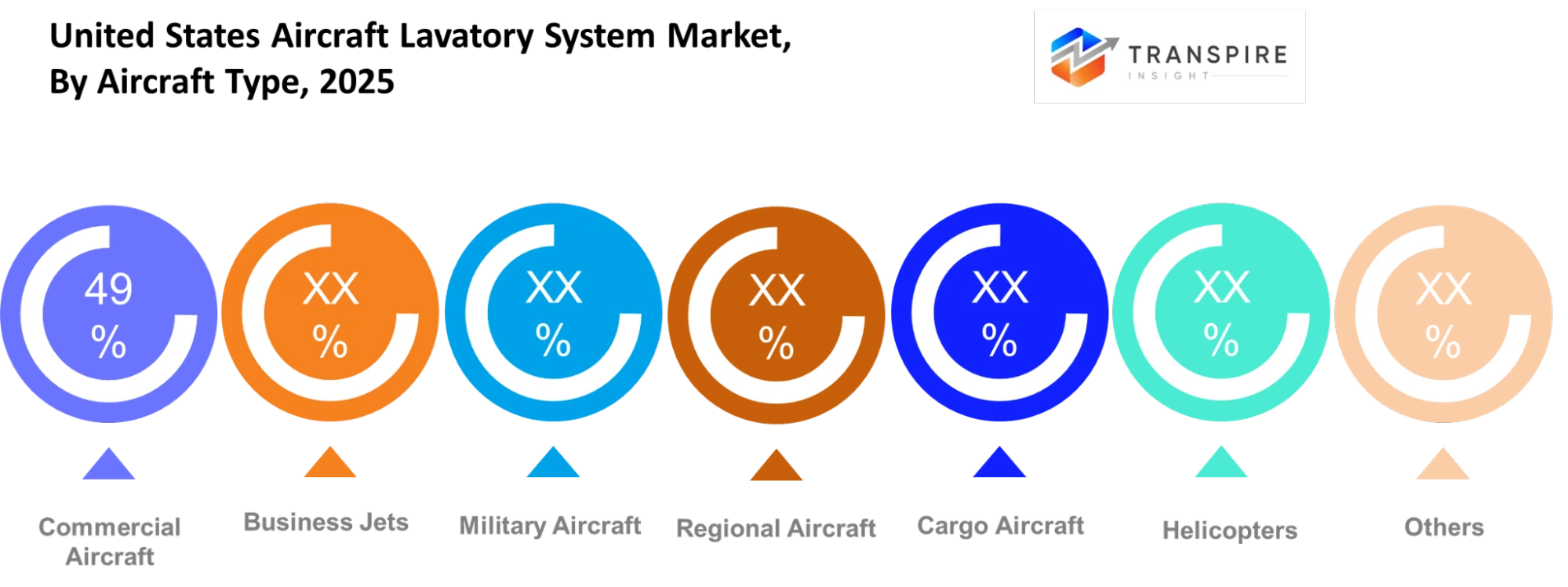
- In general the commercial narrow-body aircraft uses, kind of dominate things, and they’re expected to land at about 48% of the total market share in 2025, mainly because domestic fleet utilization stays high.
- On the other hand, wide-body retrofit applications are starting to pull more demand lately, it seems, and that’s mostly linked to long haul cabin modernization programs.
- Military and defense aviation uses are also getting more momentum , supported by federal aircraft refurbishment investments that keep moving along.
- In the United States Aircraft Lavatory System Market, commercial airlines end up leading the pack, taking roughly 61% of the revenue share in 2025. This happens because cabin upgrade cycles keep running, again and again, rather steadily.
- Meanwhile, Aircraft MRO providers show up as the second biggest end user category, and they benefit from the continued rise in aftermarket servicing contracts.
What are the Key Drivers, Restraints, and Opportunities in the United States Aircraft Lavatory System Market?
In the United States, the aircraft lavatory system market is kind of being pulled along by a faster replacement cycle for commercial aircraft interiors. This is mostly happening because airlines are trying to sync cabin updates with post-pandemic fleet modernization plans, and you know, the timing is everything. In 2024 and 2025, when big carriers started putting back money into those deferred retrofits, cabin elements that were often treated as secondary ,including lavatories, started to show up in wider, money focused cabin redesign strategies. The whole movie is tightly connected to passenger experience scores and also operational efficiency goals. A lot of airlines are leaning toward lightweight vacuum-based lavatory systems that aim to cut water usage and at the same time reduce aircraft mass. Even small decreases in onboard system weight can turn into real fuel savings, especially on high frequency routes, so lavatory upgrades feel more financially reasonable . That, in turn, grows purchasing activity for OEM suppliers and retrofit contractors.
Still, the biggest restraint is the long certification and integration timeline that comes with changing aircraft cabin systems. Lavatory systems have to meet tough Federal Aviation Administration airworthiness expectations, plus fire safety rules, and then also aircraft-specific integration procedures. Since each modification touches plumbing architecture, waste management networks, and cabin layout boundaries, redesign approvals can drag on for several quarters or longer. So this kind of structural bottleneck pushes back installation plans, slows retrofit rollouts, and ends up limiting near term supplier revenue even though demand is still there.
A big opportunity seems to be showing up with smart lavatory technologies, kinda tied in with predictive maintenance platforms. Basically, sensor-enabled monitoring is becoming a thing where systems keep an eye on waste tank levels, component wear, and sanitation needs in real time, and yes that’s getting traction. And since airlines are putting serious money into connected cabin ecosystems, the early rollouts on next-generation narrow-body fleets could open up a fresh premium product niche, and then those higher-margin service contracts might follow too.
What Has the Impact of Artificial Intelligence Been on the United States Aircraft Lavatory System Market?
Artificial intelligence and other advanced digital techs are starting to kinda shift aircraft lavatory systems around, by turning cabin sanitation infrastructure into something more “intelligent” and efficient, and yes easier to manage when you’re dealing with big fleet operations. Airlines, plus OEM suppliers are, in practice, dropping in IoT sensors that feed AI monitoring platforms. Then they automate things like waste tank level detection, vacuum pressure regulation and system health diagnostics. With this setup maintenance teams can look at lavatory performance remotely and catch weird behavior early, before it turns into anything that bothers flight operations. There are also digital compliance dashboards that make it simpler to log sanitation cycles and servicing history, and that tends to strengthen adherence to aviation maintenance standards while cutting down the amount of manual checking they have to do.
More and more machine learning models are now supporting predictive maintenance, basically by studying old records of how components behaved, including valve pressure fluctuations and vacuum pump cycle patterns. In many cases these models spot wear signatures and estimate likely failure windows. So operators can swap out parts during planned maintenance, rather than waiting until something goes wrong mid service. This has helped lavatory system uptime, and it’s reduced those unscheduled maintenance events. At the same time, lightweight digitally optimized control systems contribute a bit, marginal but real, to fuel savings, mostly because of better water use efficiency and lower system mass.
A main limit still is the pretty high integration cost,when you’re retrofitting older aircraft to use a connected monitoring architecture, kind of all at once. A lot of legacy fleets dont really have the onboard data infrastructure required, for continuous analytics or all the usual stuff , and you end up with inconsistent operating data across different aircraft types. That inconsistency then caps the model accuracy, especially during early deployment phases, because the inputs aren’t uniform enough.
Key Market Trends
- Since 2023, major U.S. carriers like Delta Air Lines and United Airlines have kind of grown their cabin retrofit budgets , and this has pushed lavatory system replacements into these bigger interior modernization efforts.
- Vacuum lavatory adoption has been rising , since airlines are chasing around 3 to 5 percent cabin weight reductions. Since 2022 manufacturers have been redesigning the assemblies with advanced composites, sort of to make the weight and complexity work better together.
- From 2021 to 2025, OEMs such as Safran and Collins Aerospace moved their spending toward sensor-integrated lavatory modules. The idea is better predictive maintenance compatibility, not only faster checks.
- After the pandemic, FAA sanitation compliance expectations got stronger , and airlines responded by taking on automated service logging systems. That means manual inspection documentation is getting replaced across a lot of large narrow-body fleets.
- The supply chain disruptions that delayed valve and pump deliveries by as much as six months in 2022 have eased up. Retrofit timelines are improving again, and projects are not stuck as long.
- After 2024, airlines leaned more into modular lavatory designs, and that reduced maintenance turnaround time by nearly 20 percent during scheduled overnight servicing, which honestly helps a lot operationally.
- Touchless faucet, flush, and occupancy monitoring systems have moved from premium wide-body cabins into single-aisle aircraft. This happened because passenger hygiene expectations changed and stayed changed , so operators adjusted.
- Competitive focus has shifted away from pure unit pricing toward lifecycle efficiency guarantees. Suppliers have been pitching multi-year digital diagnostics service agreements since 2023, kind of bundling outcomes.
- Even with all that, legacy aircraft operators keep delaying full smart lavatory integration , mainly because retrofit costs still run about 25 to 35 percent higher than conventional replacement systems.
United States Aircraft Lavatory System Market Segmentation
By Component :
Lavatory modules kind of work like integrated units, they bring several lavatory functions together in one structure, so the whole thing is easier to set up and easier to service on aircraft. Vacuum systems help move waste more efficiently, with less water use, which improves operational efficiency and keeps weight more controlled. Toilets, wash basins, and water heaters all contribute to passenger comfort across different aircraft categories, not just one.
Waste tanks hold the collected waste in a secure way until it gets handled during ground disposal, this supports hygiene and safety while flying. There are also other supporting pieces like sensors, control systems, and fittings, they help keep the system running well. Basically each part works in sync, for reliability, space optimization, and compliance with aviation safety standards.
By Aircraft Type :
Commercial aircraft are pushed toward advanced lavatory systems because passenger volume is high and usage is frequent, so the focus is durability and quick servicing. Business jets tend to prefer compact premium designs, with upgraded comfort features that feel nicer. Military aircraft need robust systems that can endure demanding operational conditions without a lot of compromises.
Regional aircraft typically use lighter arrangements that are optimized for short routes. Cargo aircraft may carry only a limited lavatory setup, often for crew use only. Helicopters and other aircraft types need smaller, lighter configurations due to space and weight limits, so they still deliver basic functionality without hurting performance or flight efficiency.
To learn more about this report, Download Free Sample Report
By Material :
Composite materials are pretty much everywhere in lavatory systems, mostly because they bring that strength-to-weight edge, and they also resist corrosion really well, which is sort of the big deal for wet areas. Stainless steel is often chosen for supports because it’s durable, sanitary, and it holds up in high contact spots like basins and toilet fittings. Aluminum, meanwhile, gets attention for being light weight and also structurally dependable, especially in aircraft related work.
Plastic components tend to show up in the non structural areas, meaning parts that don’t take the main loads, to help cut down overall system weight while still keeping things cost efficient. Lightweight materials also keep growing in importance as airlines push harder for fuel efficiency and lower emissions. And then there are other specialized materials too, these help with insulation, sealing, and long-term staying power when cabin conditions change over time.
By End User :
OEMs usually integrate lavatory systems during the aircraft build phase, so the whole setup meets design and safety expectations from the start. On the other side, MRO providers deal with repair, replacement, and upgrading of lavatory components, so operational efficiency doesn’t slip, and hygiene standards stay consistent across aircraft fleets.
Airlines then aim to protect passenger comfort and keep the system reliable through routine servicing and periodic upgrades. For defense, the requirement is durable and low maintenance systems that can handle mission based aircraft use. Charter operators often want flexible and cost effective options, balancing comfort, mass reduction, and day to day operational efficiency across different ways aircraft are actually used.
What are the Key Use Cases Driving the United States Aircraft Lavatory System Market?
The main use case that really drives demand comes from commercial narrow body airplanes that run on high frequency domestic routes across the United States. These aircraft need sturdy, lightweight lavatory systems that can handle repeated day after day use, while also cutting down on water consumption and reducing maintenance downtime, so they end up being the biggest source of replacement, and retrofit work.
There is also a secondary pull that keeps growing. This shows up in premium cabin retrofits on wide body international aircraft where airlines are installing touchless fixtures and more advanced accessibility features, to make the passenger experience feel better. Business aviation is starting to look like a pretty strong adoption lane as well, especially for corporate jet operators who want compact customized lavatory modules with nicer materials, plus smart monitoring functions.
Looking forward, connected lavatory systems with predictive servicing in mind seem like the next emerging thing. Airlines that are trialing digital cabin ecosystems are starting to weave lavatory diagnostics into wider aircraft health monitoring platforms. Another developing direction involves next generation electric and hybrid aircraft, where ultra lightweight sanitation systems will be needed to satisfy tough energy efficiency goals and payload optimization requirements.
|
Report Metrics |
Details |
|
Market size value in 2025 |
USD 62.4 Million |
|
Market size value in 2026 |
USD 66.8 Million |
|
Revenue forecast in 2033 |
USD 113.2 Million |
|
Growth rate |
CAGR of 7.83% from 2026 to 2033 |
|
Base year |
2025 |
|
Historical data |
2021 - 2024 |
|
Forecast period |
2026 - 2033 |
|
Report coverage |
Revenue forecast, competitive landscape, growth factors, and trends |
|
Geographic scope |
United States of America |
|
Key company profiled |
Collins Aerospace, Safran, Diehl Aviation, JAMCO Corporation, Boeing, Airbus, Zodiac Aerospace, AVIC Cabin Systems, Yokohama Aerospace, Geven, Bucher Group, Nordam Group, Honeywell, Panasonic Avionics, ST Engineering. |
|
Customization scope |
Free report customization (country, regional & segment scope). Avail customized purchase options to meet your exact research needs. |
|
Report Segmentation |
By Component (Lavatory Modules, Vacuum Systems, Toilets, Wash Basins, Water Heaters, Waste Tanks, Others); By Aircraft Type (Commercial Aircraft, Business Jets, Military Aircraft, Regional Aircraft, Cargo Aircraft, Helicopters, Others); By Material (Composite Materials, Stainless Steel, Aluminum, Plastic Components, Lightweight Materials, Others); By End User (OEMs, MRO Providers, Airlines, Defense Sector, Charter Operators, Others). |
Which Regions are Driving the United States Aircraft Lavatory System Market Growth?
North America sort of leads the aircraft lavatory system market, with the United States taking the biggest slice because it has this huge commercial aviation fleet and a pretty aggressive push toward new cabin modernization cycles. Also, the strong oversight from the Federal Aviation Administration has kind of forced airlines to keep high operational cleanliness and sanitation standards, and that ends up speeding up the need to replace older lavatory systems with newer ones. On top of that, the region benefits from a dense aerospace manufacturing setup, with major OEMs, systems integrators, and MRO service providers in the mix. Because of that, deployment happens faster and the after market servicing stays readily available. So the overall infrastructure feels mature enough that airlines can run retrofit programs efficiently, while still keeping procurement steady from both older platforms and newer next-generation aircraft.
Europe then comes in as a stable contributor, but the growth story there is not exactly the same. Instead of being driven by fleet size alone, the region leans more on continuous investment in premium cabin presentation and environmental performance improvements. A number of major European carriers keep upgrading their wide body fleets using lightweight lavatory technologies and water efficient solutions, and they tie this work into broader sustainability targets. There are also long standing supplier relationships, plus coordinated regulatory rollout across several important aviation markets. That combination makes demand patterns more predictable and helps established manufacturers keep generating reliable revenue streams over time, even as the mix of aircraft platforms evolves.
Asia Pacific seems to be coming in as the fastest growing region, as airline fleet expansion , and airport infrastructure investment keeps accelerating across China, India, and Southeast Asia. Lately, rapid growth in domestic air travel has nudged carriers to place orders for new narrow body aircraft that come with more advanced cabin systems. At the same time, government-backed aviation modernization programs, plus higher levels of aircraft assembly activity, have basically boosted regional procurement capacity a lot. So there’s this momentum building, and it brings pretty solid opportunities for suppliers and investors from 2026 to 2033 especially for players that can offer cost efficient lightweight lavatory solutions, kind of custom fitted for high utilization fleets.
Who are the Key Players in the United States Aircraft Lavatory System Market and How Do They Compete?
The United States aircraft lavatory system market stays moderately consolidated , and a lot of the rivalry is basically among older cabin systems manufacturers. These players have serious certification know-how , plus long standing OEM ties. Newcomers have trouble moving in because lavatory components usually need complicated FAA validation , integration testing, and they also must work with several different airframe setups. So in practice, the contest is less about price, and more about engineering efficiency, system reliability, weight reduction, and how quickly service teams can respond after purchase. Incumbents keep pressure on share by rolling out digital diagnostics, lighter weight material experimentation, and more integrated cabin solutions that match broader airline modernization roadmaps.
Safran plays it more as a technology led cabin integration story. It offers modular lavatory platforms meant to reduce installation headaches and also shrink lifecycle maintenance burdens. Its main edge is the combination of lightweight composite construction with touchless and sensor enabled features, which airlines often like when they are raising passenger experience expectations. They keep expanding too, by working with major airframers, and by putting connected diagnostics inside cabin management systems so everything reports back.Collins Aerospace, on the other hand, differentiates through strong retrofit engineering muscle across narrow-body and wide-body fleets. That lets operators adjust lavatory layouts without doing heavy structural rework or redesign.
Diehl Aviation, i mean, focuses on space efficient lavatory modules that are sort of tailored for high density cabin setups, and that gives them the edge, because airlines are basically pushing seat economics as hard as possible. Their growth plan leans on partnerships with next generation aircraft programs, plus sustainability driven lightweight solutions too, which is kinda the whole thing. Jamco Corporation on the other hand, competes by going into a more narrow lane with premium cabin lavatory interiors , using high end materials and bespoke arrangements for long haul and business aviation customers. So yeah, this product differentiation helps Jamco snag the projects where design flexibility matters more than pure unit cost.
Company List
- Collins Aerospace
- Safran
- Diehl Aviation
- JAMCO Corporation
- Boeing
- Airbus
- Zodiac Aerospace
- AVIC Cabin Systems
- Yokohama Aerospace
- Geven
- Bucher Group
- Nordam Group
- Honeywell
- Panasonic Avionics
- ST Engineering
Recent Development News
In 2026, Nexdigm reported continued expansion in the U.S. commercial aircraft lavatory system market driven by OEM fitment and retrofit demand across major aircraft interior suppliers including Honeywell International and Collins Aerospace.
Source: https://www.nexdigm.com/
In August 2025, Knight Aerospace entered into a 20-year strategic supply agreement with Embraer. The company will provide modular aircraft interior systems including lavatories, galleys, and medical suites for Embraer’s KC-390 Millennium cargo aircraft, strengthening long-term demand for integrated cabin sanitation and modular lavatory solutions in military aviation programs with U.S.-linked supply chains.
Source: https://www.expressnews.com/
What Strategic Insights Define the Future of the United States Aircraft Lavatory System Market?
Over the next five to seven years, the United States aircraft lavatory system market is sort of structurally drifting toward fully connected, ultra-lightweight cabin sanitation platforms that are also folded into bigger aircraft health management ecosystems. And yeah, this change is being driven less by obvious passenger-facing upgrades and more by airline pressure to cut turnaround time, lower the maintenance bill, and squeeze higher aircraft operating efficiency using real-time diagnostics plus predictive servicing.
There is also a quieter risk, basically material concentration across advanced composite supply chains. As more manufacturers lean on specialized lightweight polymers and electronic sensor components, any disruption in aerospace-grade material availability could push back retrofit schedules, and it may even compress supplier margins. On the other side, a newer opening is the growing hybrid-electric and regional advanced air mobility segment, where designers will need compact lavatory systems that are engineered for tight weight and power constraints, not just “good enough.”
For market players, the most practical move is to invest now in digital retrofit compatibility. Suppliers that build modular systems, capable of integrating with legacy fleet data architecture will likely get a real edge, because airlines are increasingly favoring upgrade pathways that show measurable operational savings without forcing a full cabin redesign.
United States Aircraft Lavatory System Market Report Segmentation
By Component
- Lavatory Modules
- Vacuum Systems
- Toilets
- Wash Basins
- Water Heaters
- Waste Tanks
By Aircraft Type
- Commercial Aircraft
- Business Jets
- Military Aircraft
- Regional Aircraft
- Cargo Aircraft
- Helicopters
By Material
- Composite Materials
- Stainless Steel
- Aluminum
- Plastic Components
- Lightweight Materials
By End User
- OEMs
- MRO Providers
- Airlines
- Defense Sector
- Charter Operators
Frequently Asked Questions
Find quick answers to common questions.
The United States Aircraft Lavatory System Market size is USD 113.2 Million in 2033.
Key segments for the United States Aircraft Lavatory System Market are By Component (Lavatory Modules, Vacuum Systems, Toilets, Wash Basins, Water Heaters, Waste Tanks, Others); By Aircraft Type (Commercial Aircraft, Business Jets, Military Aircraft, Regional Aircraft, Cargo Aircraft, Helicopters, Others); By Material (Composite Materials, Stainless Steel, Aluminum, Plastic Components, Lightweight Materials, Others); By End User (OEMs, MRO Providers, Airlines, Defense Sector, Charter Operators, Others).
Major United States Aircraft Lavatory System Market players are Collins Aerospace, Safran, Diehl Aviation, JAMCO Corporation, Boeing, Airbus, Zodiac Aerospace, AVIC Cabin Systems, Yokohama Aerospace, Geven, Bucher Group, Nordam Group, Honeywell, Panasonic Avionics, ST Engineering.
The United States Aircraft Lavatory System Market size is USD 62.4 Million in 2025.
The United States Aircraft Lavatory System Market CAGR is 7.83% from 2026 to 2033.
- Collins Aerospace
- Safran
- Diehl Aviation
- JAMCO Corporation
- Boeing
- Airbus
- Zodiac Aerospace
- AVIC Cabin Systems
- Yokohama Aerospace
- Geven
- Bucher Group
- Nordam Group
- Honeywell
- Panasonic Avionics
- ST Engineering
Recently Published Reports
-
Apr 2026
Aerospace Fluoropolymers Market
Aerospace Fluoropolymers Market Size, Share & Analysis Report By Type (PTFE, FEP, PFA, ETFE, and Others), By Application (Electrical Insulation, Seals & Gaskets, Coatings, and Others), By End User (Commercial Aviation, Military Aviation, General Aviation, and Others), and Geography (North America, Europe, Asia-Pacific, Middle East and Africa, South and Central America), 2021 - 2031
-
Apr 2026
Airborne SATCOM System Market
Airborne SATCOM System Market Size, Share & Analysis Report By Type (SATCOM Terminals, Transceivers, Airborne Radio, Modems and Routers, SATCOM Radomes, and Other), By Application (Government and Defense and Commercial), and Geography (North America, Europe, Asia-Pacific, Middle East and Africa, South and Central America), 2021 – 2031
-
Apr 2026
Ship Leasing Market
Ship Leasing Market Size, Share & Analysis Report By Vessel Type (Container Ships, Bulk Carriers, Tankers, and Specialized Vessels), By Lease Duration (Short-Term Lease (Less than 1 year), Medium-Term Lease (1-5 years), and Long-Term Lease (More than 5 years)), By Lease Type (Bareboat Charter, Time Charter, Financial Lease, and Others), By End-User Industry (Oil and Gas, Manufacturing and Industrial, Automotive, Agriculture and Food, Retail and Consumer Goods, and Others), and Geography (North America, Europe, Asia-Pacific, Middle East and Africa, South and Central America), 2021 – 2031
-
Apr 2026
Thread Rolling Dies Market
Thread Rolling Dies Market Size, Share & Analysis Report By Type (Flat Thread Rolling Dies, Circular (Cylindrical) Dies, Tangential Thread Rolling Dies, Planetary Thread Rolling Dies, and Other Types), By Material Type (High-Speed Steel (HSS), Carbide, Tool Steel, Alloy Steel, and Other Specialized Alloys), By Distribution Channel (Direct Sales, Distributors and Dealers, and Online Platforms), By Application (Automotive Industry, Aerospace and Defense, Construction and Infrastructure, Industrial Machinery, Electronics and Electrical Components, Medical Devices, and Fastener Production), and Geography (North America, Europe, Asia-Pacific, Middle East and Africa, South and Central America), 2021 – 2031
Our Clients