
South Korea Data Center Market Size & Forecast:
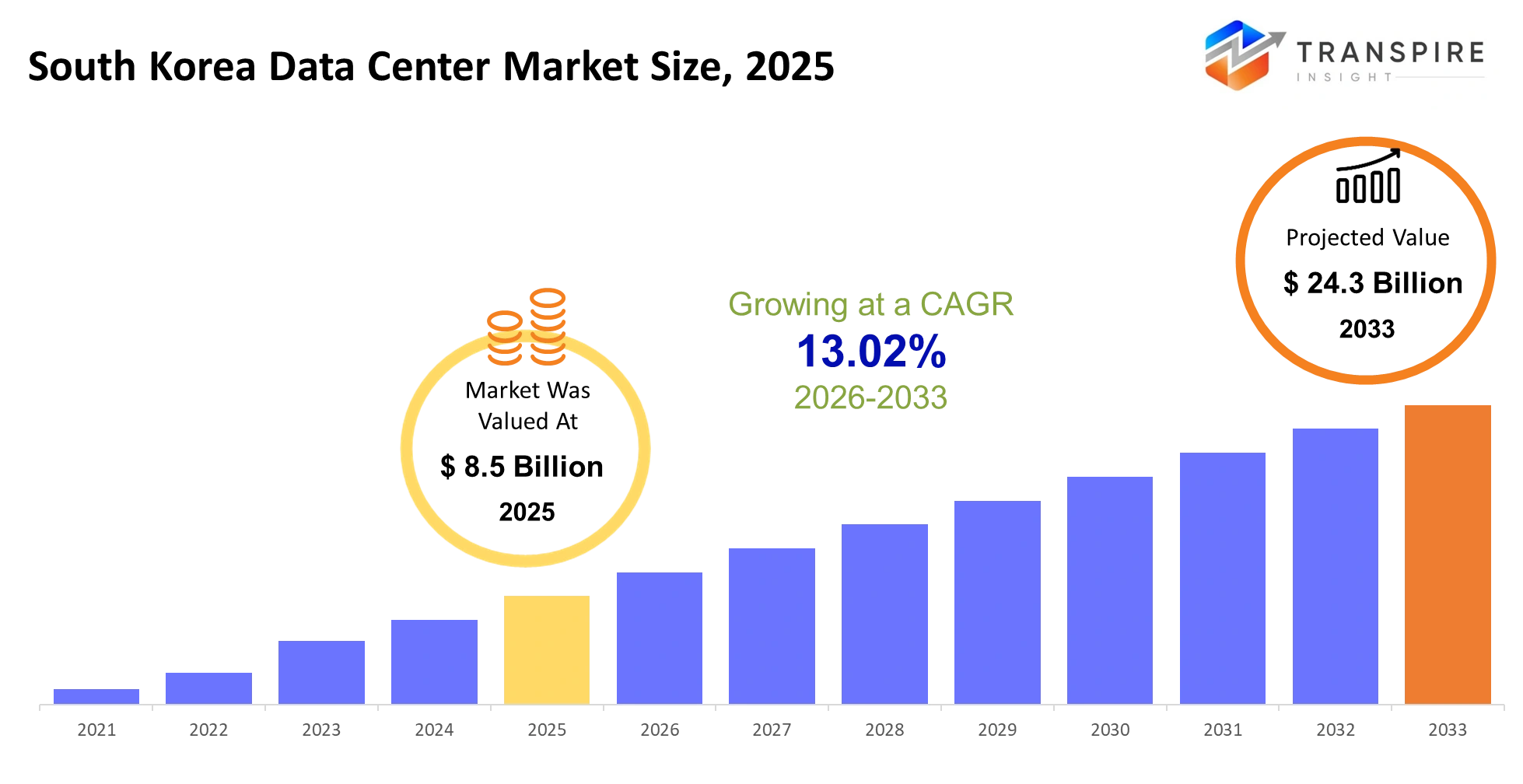
- South Korea Data Center Market Size 2025: USD 8.5 Billion
- South Korea Data Center Market Size 2033: USD 24.3 Billion
- South Korea Data Center Market CAGR: 13.02%
- South Korea Data Center Market Segments: By Component (Servers, Storage Systems, Networking Equipment, Cooling Systems, Others); By Type (Enterprise Data Centers, Colocation Data Centers, Hyperscale Data Centers, Edge Data Centers, Others); By Application (Cloud Computing, Big Data Analytics, Disaster Recovery, AI Workloads, Others); By Tier Standard (Tier I, Tier II, Tier III, Tier IV, Others); By End User (IT & Telecom, BFSI, Government, Healthcare, Retail, Others).
To learn more about this report,  Download Free Sample Report
South Korea Data Center Market Summary
The South Korea Data Center Market was valued at USD 8.5 Billion in 2025. It is forecast to reach USD 24.3 Billion by 2033. That is a CAGR of 13.02% over the period.
South Korea’s data center market is now sort of a core piece of the country’s digital foundation, backing everything from cloud banking transactions and semiconductor factory systems to AI model learning and streaming platforms. These places allow enterprises to handle and keep huge piles of data with low delay, something that has really mattered as Korean companies shift more work onto cloud services and also automate production environments. Over the last five years, the whole market has moved away from the more traditional colocation setups, and leaned toward hyperscale and AI-focused campuses, built specifically for high-density computing loads.
This change picked up speed after the pandemic, when many enterprises had to rethink remote operations and also roll out digital services at a bigger scale. Meanwhile, tougher energy efficiency rules and ongoing concerns around power availability near Seoul, reworked how operators choose locations, so investments started flowing more into regional infrastructure clusters. And as AI workloads keep growing and local cloud providers fight harder against global operators, many teams are putting money into liquid cooling, renewable energy sourcing, and larger server capacity. That’s pushing infrastructure spending higher, while also lifting longer-term service revenues.
Key Market Insights
- The South Korea Data Center market is seeing pretty strong capacity expansion right now, especially as AI workloads and cloud-native applications keep pushing rack density needs across lots of enterprise facilities.
- In 2025 the Seoul metropolitan region really dominated the market, with nearly 65% market share , mainly because enterprise and telecom infrastructure are so concentrated there.
- Then you’ve got Busan and Gyeonggi Province showing up as the fastest-growing regional hubs during the 2025–2030 forecast window, mostly due to lower land costs and, yeah, more favorable power costs overall.
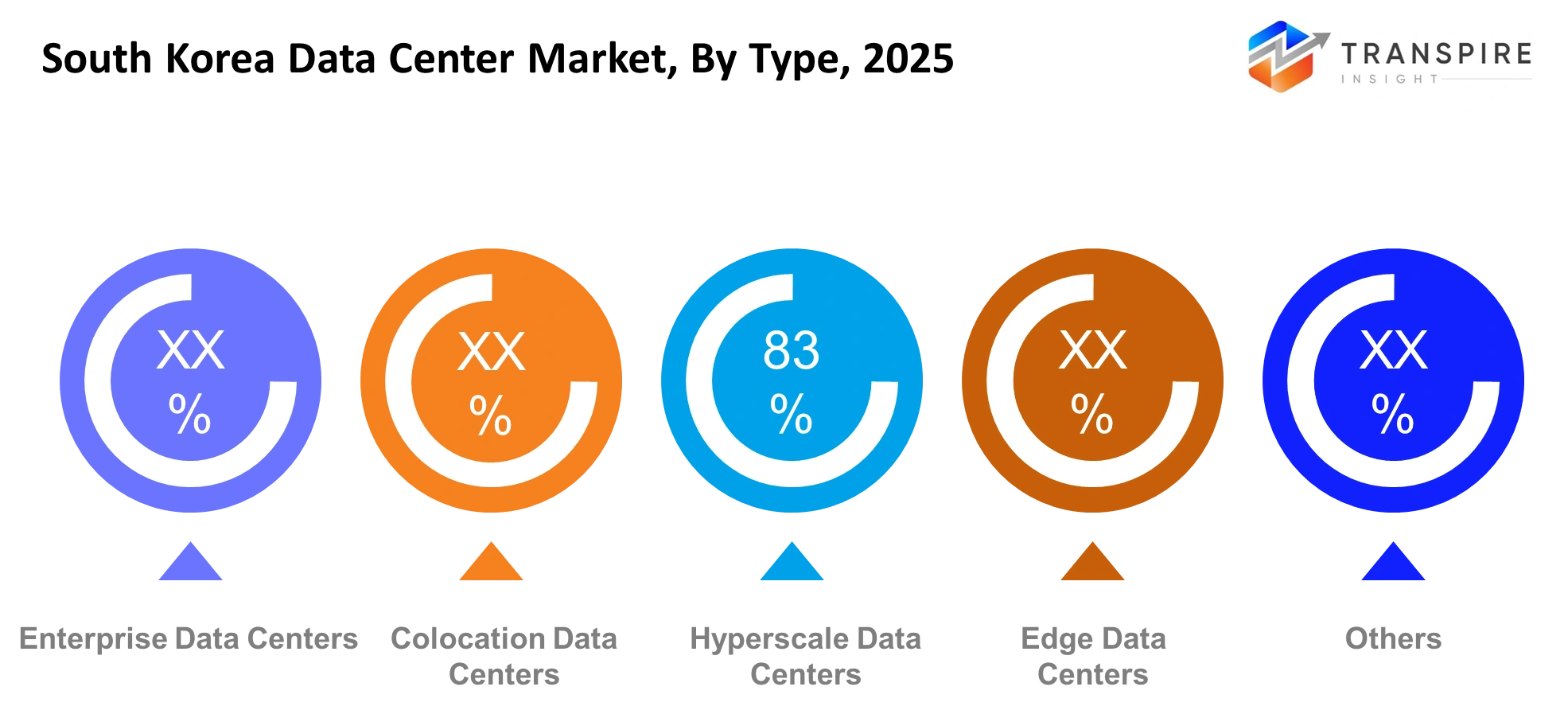
- Meanwhile hyperscale data centers were about 48% of the industry share in 2025, largely because global cloud providers and digital platform operators keep pouring in capital.
- And for the segment that is moving quickest—edge data centers , they’re expected to grow the most through 2030 as 5G rollout spreads and low-latency applications start needing nationwide infrastructure faster than before.
- Cloud computing applications, kind of dominated with more than 42% market share in 2025 because enterprises kept moving away from old legacy IT setups, and into hybrid cloud environments.
- IT and telecom companies had the leading end-user slice at around 38% in 2025, since digital traffic kept growing and mobile data consumption just kept going up, without much pause.
- Healthcare and biotechnology businesses are projected to show the quickest growth through 2030, mainly as medical data analytics, plus AI diagnostics, keep expanding across South Korea.
- Meanwhile, the South Korea Data Center Market is shifting toward energy-efficient cooling setups, including liquid cooling, and also improved airflow management systems for high-density facilities, more or less.
- On top of that, renewable energy procurement and carbon reduction programs are becoming bigger themes, as operators try to comply with tighter environmental rules, and stricter energy efficiency expectations.
What are the Key Drivers, Restraints, and Opportunities in the South Korea Data Center Market?
The main thing that is really shaping the South Korea Data Center Market is the fast expansion of AI computing together with hyperscale cloud infrastructure. Big language models, semiconductor simulation workloads and enterprise AI use cases all push for high-density computing spaces, and the usual server rooms just don’t handle it well. This move sped up after the big cloud providers, plus local tech firms started ramping up capital spending on GPU clusters and AI-ready setups from 2022 into 2025. Once companies shift more of their core workloads into cloud ecosystems, the operators end up making more recurring money, often via premium colocation services, managed cloud integration, and high-power rack deployments.
One major restraint is South Korea’s structural limits around power supply and land, especially near the Seoul metro area, where most digital traffic and enterprise demand still gathers. Data centers need steady electricity delivery, sizable land parcels, and approvals for long-term grid connections, but the city style infrastructure and tougher environmental reviews slow down new buildings. Because of that, project durations stretch out and operating costs climb. So operators can’t switch on added capacity quick enough to keep up with hyperscale demand. In the end, customer onboarding gets delayed, and infrastructure revenue growth gets held back.
A big chance is kinda unfolding in regional edge and secondary-city growth , especially around Busan and Gyeonggi Province. Folks are putting money into submarine cable connections, renewable power harmonization, and 5G- powered edge computing, and that’s making it easier for distributed infrastructure to spread out. If operators build low-latency sites beyond Seoul, they can usually get away with cheaper day to day costs, while also supporting AI, gaming, and self-driving mobility scenarios in a more nimble way.
What Has the Impact of Artificial Intelligence Been on the South Korea Data Center Market?
Artificial intelligence is kind of reshaping South Korea’s data center industry, mainly by automating the whole infrastructure management thing, and then, in the same breath, by boosting energy efficiency in these high-density computing settings. A lot of operators are now deploying AI-based data center infrastructure management platforms that watch over cooling systems, server loads, and power distribution in real time. From there, the systems tend to automatically tune airflow, dial up or down liquid cooling intensity, and even rearrange workload allocation, so they can prevent overheating and cut back on energy waste that is kinda unnecessary. Bigger campuses—especially the ones supporting AI model training—are also bringing in intelligent control software to balance GPU utilization, and keep stable uptime during those peak processing windows where everything gets stressed.
On top of that, machine learning models are being used more and more for predictive maintenance across power supply units, backup batteries, and cooling equipment. By looking at temperature shifts, vibration signatures, and energy usage logs, operators can spot failures in components before outages show up. That method, generally speaking, reduces unplanned downtime and trims maintenance expenses, because it means fewer emergency repairs and less chaos. Several hyperscale operators in South Korea have, reportedly, seen measurable improvements in power usage effectiveness when AI-driven cooling optimization is applied, and the automated monitoring approach has also helped operational reliability in high-capacity facilities.
Still, there are limitations. AI adoption faces high integration costs, plus the legacy infrastructure situation is often fragmented. Many existing sites were not built with AI-based automation in mind, so retrofitting becomes costly and technically tangled, especially for older enterprise colocation spaces where the hardware and control layers are already set in stone, kind of.
Key Market Trends
- Since 2021, hyperscale operators kind of expanded rapidly, moving the South Korea Data Center Market away from mostly colocation driven demand toward AI-ready infrastructure, investment-led growth happened more and more.
- Seoul’s dominance has slowly eased though , because land scarcity and grid constraints keep pushing fresh capacity toward Gyeonggi and Busan clusters, especially starting in 2022.
- Liquid cooling adoption then picked up after 2023, since GPU heavy AI workloads replaced the more traditional server mix, and that meant operators had to redesign their thermal management setup, not just tweak it.
- For 2024–2026, AI training workloads reshaped procurement strategies, with operators favoring high-density racks and NVIDIA GPU optimized infrastructure builds , basically.
- Meanwhile, strict grid allocation policies plus delayed power approvals since 2022 have slowed expansions tied to Seoul , and project lead times have grown a lot, noticeably.
- Also, edge data centers in Busan and other secondary cities expanded quickly, as 5G adoption increased and latency-sensitive gaming workloads intensified demand.
- Global operators like Equinix, Digital Realty, AWS ,and Microsoft basically intensified the competition, using localized partnerships and continuing capacity expansion across Korea.
South Korea Data Center Market Segmentation
By Component :
Servers are sort of the main hardware need right now, mainly because AI workloads keep growing and cloud migration keeps happening , which makes rack density go up across facilities in South Korea. As high performance computing becomes more common, organizations tend to upgrade servers more often, and GPU-enabled systems end up being the most frequent target. At the same time storage systems keep expanding, driven by the unstructured data pile from analytics and enterprise apps, so the goal is faster retrieval and more scalable digital operations across different industries.
Networking equipment demand goes up too, because cloud connectivity expands and traffic between hyperscale facilities gets heavier. Cooling systems become even more important as the heat output rises from those tightly packed server setups, so you see more liquid cooling use alongside improved airflow engineering. All these ongoing infrastructure updates help keep uptime steady and also cut energy losses in large plants, even when power profiles get complicated.
By Type :
Enterprise data centers still serve internal corporate IT tasks, but their expansion pace looks slower now as companies lean into cloud based models. Colocation facilities keep growing at a steady rate, since many businesses outsource infrastructure administration to lower capital expenses and gain more elasticity. The demand stays firm with financial firms and digital service providers that need guarded environments for compliance and security.
Hyperscale data centers keep expanding quickly, largely due to cloud provider investment plus the way AI workloads cluster and require massive computing capacity. Meanwhile edge data centers are getting more attention in secondary cities, mainly to support low latency use cases and 5G related services. With more distributed infrastructure, there’s less reliance on centralized, Seoul centered facilities, and regional service delivery performance tends to improve.
To learn more about this report, Download Free Sample Report
By Application :
Cloud computing is still the main thing here, like enterprises moving away from older legacy systems, and then they end up in hybrid setups, and maybe multi-cloud too. At the same time, big data analytics keeps spreading, especially through retail, finance, and manufacturing, so teams can get real time decisions and better operational tweaks, using these large-scale data processing platforms that just keep running.
AI workloads are also ramping up fast, mainly because generative AI is getting adopted, and well, the GPU heavy model training needs a lot of horsepower. Disaster recovery stuff becomes stronger as digital dependency grows across key industries , so there is continuity even when something goes wrong, during those system failures. Then there are other use cases like content delivery and enterprise automation tools, all supporting digital transformation efforts across South Korea.
By Tier Standard :
As for the facilities, Tier III tends to lead, because it’s kind of a sweet spot between cost efficiency and high availability rules, so it fits enterprise work and cloud workloads reasonably well. And the demand for uninterrupted operations is going up, so companies start leaning toward redundant infrastructure systems , basically to push higher uptime and steadier service reliability across financial and other digital platforms.
Tier IV is getting adopted more in hyperscale and mission-critical environments, where near-zero downtime tolerance is not optional. Meanwhile Tier I and Tier II drop off gradually as the older systems retire, or they get upgraded into something more current. Overall, investments move toward advanced redundancy , better fault tolerance, and tighter operational performance standards across modern data center deployments.
By End User :
The IT and telecom space still leads because demand keeps climbing, mainly from rising mobile data usage, cloud services expanding, and the continual upgrades in network infrastructure… which sounds simple but it’s really a big driver. The BFSI industry stays pretty strong too, pushed by secure transaction handling, regulatory compliance needs, and that broader digital banking shift happening across many financial institutions.
Government bodies also ramp up, they broaden data center utilization for digital public services, plus for secure data management systems that are meant to be “safe by design” or something like that. In healthcare, uptake grows alongside AI diagnostics and medical data analytics, where hospitals and partners start leaning more on evidence-based insights. Retail meanwhile increases its use for e-commerce platforms and customer analytics, so they can run real time inventory support, and offer more tailored, personalized service delivery models.
What are the Key Use Cases Driving the South Korea Data Center Market?
Cloud computing is still the most dominant thing pushing South Korea Data Center Market demand , as many enterprises move core workloads away from on-premise systems toward this hybrid mix plus multi-cloud setups. In practice, financial services firms, telecom operators and big digital platforms keep asking for high availability infrastructure so they can handle real-time transactions , and stay alive without interruption in their services. Because the migration keeps going, there’s more need for high density server capacity and low latency connectivity across the big urban corridors.
At the same time, big data analytics and disaster recovery are becoming more noticeable as secondary use cases, and that’s especially visible in BFSI and retail. Banks and insurers run analytics platforms for huge piles of customer information and risk signals, while retailers build or expand data center capacity to support inventory optimization along with demand forecasting. Disaster recovery is also picking up, government organizations and healthcare providers included, since they are tightening business continuity frameworks for those critical digital services.
Then there’s AI workloads and edge computing, these are newer use cases but they look like they have real traction going forward. AI model training and inference need GPU heavy infrastructure, and that’s showing up strongly in healthcare diagnostics, and also in autonomous systems development. Meanwhile, edge deployments keep gaining relevance in smart city initiatives and in 5G enabled industrial automation, where low latency and localized data processing are not just “nice to have” but more like operational requirements.
|
Report Metrics |
Details |
|
Market size value in 2025 |
USD 8.5 Billion |
|
Market size value in 2026 |
USD 9.7 Billion |
|
Revenue forecast in 2033 |
USD 24.3 Billion |
|
Growth rate |
CAGR of 13.02% from 2026 to 2033 |
|
Base year |
2025 |
|
Historical data |
2021 - 2024 |
|
Forecast period |
2026 - 2033 |
|
Report coverage |
Revenue forecast, competitive landscape, growth factors, and trends |
|
Country scope |
South Korea |
|
Key company profiled |
Samsung SDS, LG CNS, SK Broadband, KT Corporation, Naver Cloud, Amazon Web Services, Google Cloud, Microsoft Azure, Equinix, Digital Realty, Oracle, IBM, Dell Technologies, Cisco Systems, Hewlett Packard Enterprise. |
|
Customization scope |
Free report customization (country, regional & segment scope). Avail customized purchase options to meet your exact research needs. |
|
Report Segmentation |
By Component (Servers, Storage Systems, Networking Equipment, Cooling Systems, Others); By Type (Enterprise Data Centers, Colocation Data Centers, Hyperscale Data Centers, Edge Data Centers, Others); By Application (Cloud Computing, Big Data Analytics, Disaster Recovery, AI Workloads, Others); By Tier Standard (Tier I, Tier II, Tier III, Tier IV, Others); By End User (IT & Telecom, BFSI, Government, Healthcare, Retail, Others). |
Which Regions are Driving the South Korea Data Center Market Growth?
Seoul metropolitan region still shows up as the dominant hub in the South Korea Data Center Market, mostly because the density of financial institutions, telecom operators, and hyperscale cloud nodes is pretty high. There’s also strong fiber connectivity and it’s close enough to big enterprise clients, so data exchange tends to stay low latency which matters a lot for real time digital services. The regulatory setup for digital infrastructure feels more settled here too, so approvals for high capacity facilities can come a bit faster. Plus the whole ecosystem, network providers, software firms, and IT service companies, kind of keeps feeding the leadership position in a consistent way.
Gyeonggi Province works like a stable secondary location, and it’s supported by industrial clusters as well as more flexible land availability than central Seoul. Instead of the capital’s intense demand density , its growth leans more toward cost efficiency. Manufacturing firms, along with mid-sized enterprises, keep putting money into localized data processing and private cloud infrastructure so they can maintain better operational control. Power supply conditions stay steady and infrastructure upgrades move along gradually, so overall it feels dependable for long term capacity expansion.
Busan meanwhile is starting to grow the quickest, and a lot of that comes from new investments around submarine cable landing stations and port linked digital infrastructure. With government backed efforts aimed at spreading digital capacity outward, hyperscale and edge facilities are popping up faster in this area. Land costs are lower, international connectivity is getting better, and that combination pulls in global cloud providers that want regional redundancy somewhere outside Seoul. This kind of movement also hints at solid entry opportunities for investors looking at distributed infrastructure growth between 2026 and 2033, especially if they’re aiming for that between region balance.
Who are the Key Players in the South Korea Data Center Market and How Do They Compete?
Competition in the South Korea Data Center Market is sort of moderately consolidated, but you still see a pretty strong mix of global hyperscale operators with domestic IT service providers. Lately, things feel like they’re speeding up, because the demand is sliding toward AI-ready infrastructure and high-density computing set ups, not so much traditional colocation space. What really matters for winning business has shifted, like the whole center of gravity moved to technology capability, especially cooling efficiency, network delay behavior, and whether they can actually back GPU-heavy workloads. Also, the location advantage near Seoul, plus the growing secondary hubs, still helps a lot for landing enterprise contracts and keeping long-term cloud relationships.
Amazon Web Services and Microsoft keep expanding capacity via localized availability zones and AI-optimized infrastructure, and they’re basically aiming at low-latency enterprise cloud services. Equinix tends to stand out with carrier-neutral colocation plus high interconnection density, and that’s tied closely to stronger partnerships with telecom operators, plus financial firms too. Digital Realty puts a lot of weight on expanding big facilities and doing hyperscale leasing deals, to lock in long-term enterprise commitments. At the same time, Samsung SDS mixes cloud management with enterprise digital transformation services, while LG CNS leans into AI-driven infrastructure refinement and smart facility operations. Overall, these companies push forward through joint ventures, regional buildouts, and technology collaborations that help them hold a stronger position in Korea’s fast-changing digital infrastructure environment, which is kinda constantly evolving anyway.
Company List
- Samsung SDS
- LG CNS
- SK Broadband
- KT Corporation
- Naver Cloud
- Amazon Web Services
- Google Cloud
- Microsoft Azure
- Equinix
- Digital Realty
- Oracle
- IBM
- Dell Technologies
- Cisco Systems
- Hewlett Packard Enterprise
Recent Development News
In March 2026, SK Telecom announced a strategic AI data center partnership with Supermicro and Schneider Electric. The companies signed an MOU to develop modular, pre-fabricated AI data center infrastructure aimed at reducing construction time and easing GPU and power-supply bottlenecks in South Korea’s hyperscale AI buildout.
Source: https://www.sdxcentral.com/
In March 2026, SK Hynix announced major infrastructure and capacity expansion plans tied to AI data centers. The company confirmed large-scale investments in advanced chip packaging facilities in South Korea to support rapidly growing demand for high-bandwidth memory used in AI data center workloads.
Source: https://www.reuters.com/
What Strategic Insights Define the Future of the South Korea Data Center Market?
The South Korea Data Center Market is kinda moving, more structurally, toward distributed and AI optimized infrastructure where hyperscale facilities and edge sites run in parallel, not like they’re directly competing. I mean the shift is pushed by steady growth in AI workloads, bigger GPU density needs, and also how enterprises are migrating into hybrid cloud setups that basically require lower latency, but also more processing flexibility , all at once.
There’s also a risk that doesn’t get as much attention. It’s this power dependency that’s concentrated in the Seoul metropolitan grid, where the demand for AI training clusters could start moving faster than the long term transmission upgrades. So you end up with exposure to slower project approvals and kind of uneven capacity allocations, which can quietly suppress revenue realization even if demand signals look really strong on paper.
At the same time, there’s an opportunity brewing, especially around Busan, as it builds into an international connectivity and edge hub. That’s backed by submarine cable expansions, plus investment in port linked digital infrastructure. The region could become a place for redundancy driven deployments for hyperscale operators who want risk diversification away from Seoul. Market participants should probably focus on early land acquisition and long term power agreements in secondary cities, because those assets end up shaping competitive positioning in the next infrastructure cycle.
South Korea Data Center Market Report Segmentation
By Component
- Servers
- Storage Systems
- Networking Equipment
- Cooling Systems
By Type
- Enterprise Data Centers
- Colocation Data Centers
- Hyperscale Data Centers
- Edge Data Centers
By Application
- Cloud Computing
- Big Data Analytics
- Disaster Recovery
- AI Workloads
By Tier Standard
- Tier I
- Tier II
- Tier III
- Tier IV
By End User
- IT & Telecom
- BFSI
- Government
- Healthcare
- Retail
Frequently Asked Questions
Find quick answers to common questions.
The South Korea Data Center Market size is USD 24.3 Billion in 2033.
Key segments for the South Korea Data Center Market are By Component (Servers, Storage Systems, Networking Equipment, Cooling Systems, Others); By Type (Enterprise Data Centers, Colocation Data Centers, Hyperscale Data Centers, Edge Data Centers, Others); By Application (Cloud Computing, Big Data Analytics, Disaster Recovery, AI Workloads, Others); By Tier Standard (Tier I, Tier II, Tier III, Tier IV, Others); By End User (IT & Telecom, BFSI, Government, Healthcare, Retail, Others).
Major South Korea Data Center Market players are Samsung SDS, LG CNS, SK Broadband, KT Corporation, Naver Cloud, Amazon Web Services, Google Cloud, Microsoft Azure, Equinix, Digital Realty, Oracle, IBM, Dell Technologies, Cisco Systems, Hewlett Packard Enterprise.
The South Korea Data Center Market size is USD 8.5 Billion in 2025.
The South Korea Data Center Market CAGR is 13.02% from 2026 to 2033.
- Samsung SDS
- LG CNS
- SK Broadband
- KT Corporation
- Naver Cloud
- Amazon Web Services
- Google Cloud
- Microsoft Azure
- Equinix
- Digital Realty
- Oracle
- IBM
- Dell Technologies
- Cisco Systems
- Hewlett Packard Enterprise
Recently Published Reports
-
Apr 2026
3D Optical Profiler Market
3D Optical Profiler Market Size, Share & Analysis Report By Type (Desktop 3D Optical Profiler, and Portable 3D Optical Profiler), By Technology (Confocal Technology, and White Light Interference), By End-Use Industry (Manufacturing, Research Institutions, Automotive, Aerospace and Defense, Medical Devices, and Other), and Geography (North America, Europe, Asia-Pacific, Middle East and Africa, South and Central America), 2021 - 2031
-
Apr 2026
Depth Sensor Market
Depth Sensor Market Size, Share & Analysis Report By Type (Infrared Depth Sensors, Time-of-Flight (ToF) Sensors, Stereo Vision Sensors, Structured Light Sensors, Ultrasonic Depth Sensors), By Application (Automotive, Robotics, Gaming, Consumer Electronics, Industrial Automation, Healthcare, Security & Surveillance, Others), By End Users (Automotive Manufacturers, Consumer Electronics Companies, Healthcare Providers, Industrial Companies, Security Agencies, Gaming Companies, Robotics Companies, Others), and Geography (North America, Europe, Asia-Pacific, Middle East and Africa, South and Central America), 2021 – 2031
-
Apr 2026
Digital Manufacturing Market
Digital Manufacturing Market Size, Share & Analysis Report By Component (Hardware, Software, and Services), By Technology (Robotics, 3D Printing, Internet of Things (IoT), and Others), By Application (Automotive and Transportation, Aerospace and Defense, Consumer Electronics, Industrial Machinery, and Others), By Process Type (Computer-Based Designing, Computer-Based Simulation, Computer 3D Visualization, Analytics, and Others), and Geography (North America, Europe, Asia-Pacific, Middle East and Africa, South and Central America), 2021 – 2031
-
Apr 2026
Digital Visa Services Market
Digital Visa Services Market Size, Share & Analysis Report By Type (Individual Travelers, Group Travelers), By Application (Tourism, Business Travel, Others), and Geography (North America, Europe, Asia-Pacific, Middle East and Africa, South and Central America), 2021 – 2031