
Europe Data Analytics Market Size & Forecast:
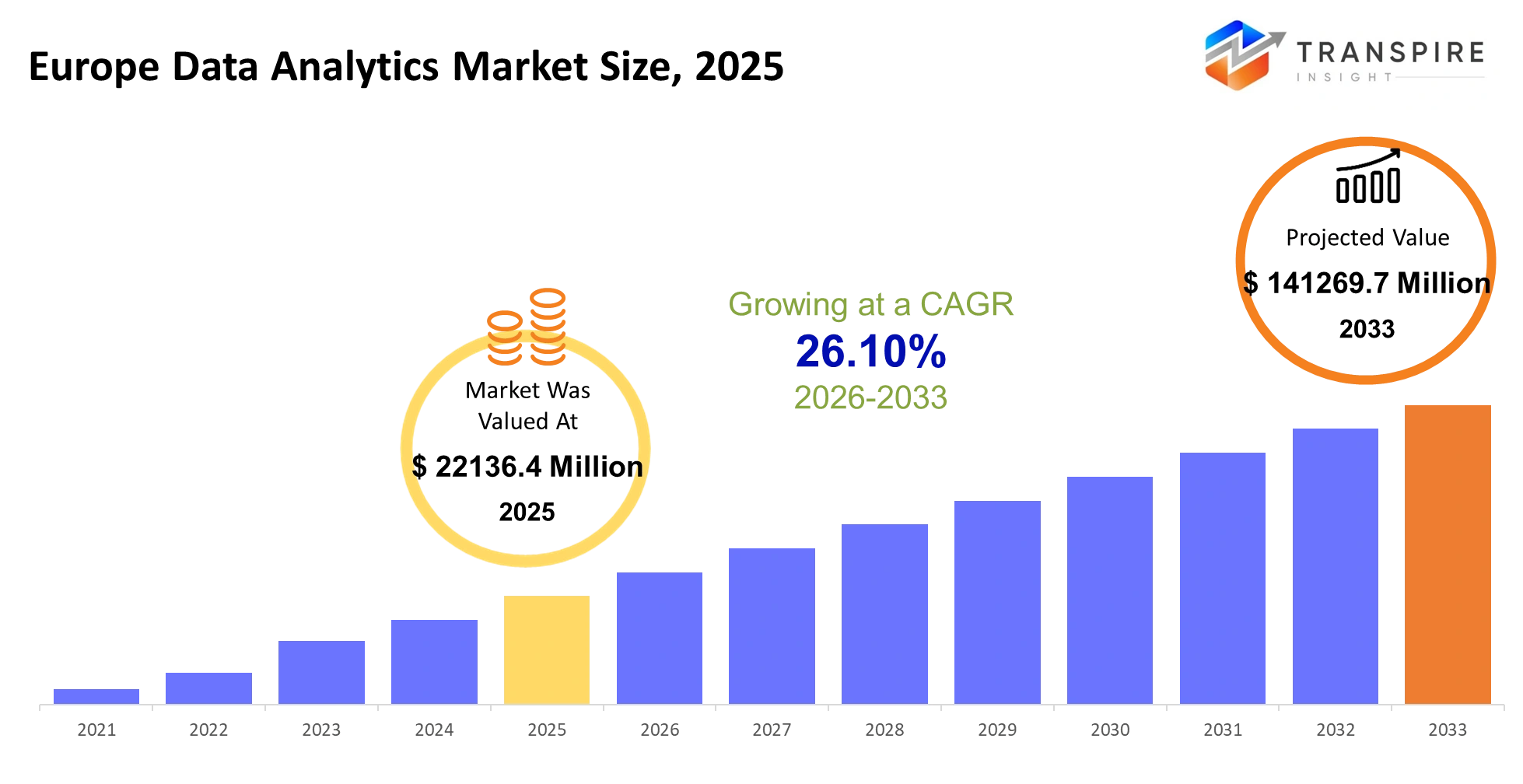
- Europe Data Analytics Market Size 2025: USD 22136.4 Million
- Europe Data Analytics Market Size 2033: USD 141269.7 Million
- Europe Data Analytics Market CAGR: 26.10%
- Europe Data Analytics Market Segments: By Type (Descriptive Analytics, Predictive Analytics, Prescriptive Analytics, Diagnostic Analytics, Others); By Application (BFSI, Healthcare, Retail, Manufacturing, Telecom, Others); By End-User (Enterprises, SMEs, Government, Research Institutes, Others); By Deployment (Cloud, On-premise, Hybrid, Others).
To learn more about this report,  Download Free Sample Report
Europe Data Analytics Market Summary
The Europe Data Analytics Market was valued at USD 22136.4 Million in 2025. It is forecast to reach USD 141269.7 Million by 2033. That is a CAGR of 26.10% over the period.
Data analytics markets in Europe function as essential operational components which manufacturers and logistics operators and utility providers and financial institutions use to transform their scattered operational data into quicker business and operational solutions. Companies use analytics platforms to predict equipment failures optimize energy consumption detect fraud improve supply chain visibility and automate compliance reporting across complex regional operations.
The market has transformed during the past five years from using separate on-premise business intelligence systems to adopting cloud-based AI-powered analytics platforms which enable companies to share their data across different departments and locations. Enterprises needed to update their data systems and establish traceable analytics processes because the stricter European data governance regulations which include GDPR compliance standards required them to do so. The Russia-Ukraine conflict has revealed supply chain vulnerabilities which resulted in organizations adopting real-time analytics to monitor risks and forecast demand. Organizations which focus on improving their operational resilience through automation now allocate their analytics budget toward essential infrastructure projects which will help them achieve their long-term business goals through company-wide software use and consistent revenue generation from software products.
Key Market Insights
- The Europe Data Analytics Market in 2025 saw Western Europe achieve 42% market share through its three main countries Germany the UK and France.
- The Northern Europe market will achieve maximum growth through 2030 because of its advanced cloud infrastructure and enterprise-wide AI adoption.
- The analytics industry in Europe maintains its significant size because Germany invests in Industry 4.0 and implements smart manufacturing technologies.
- The Europe Data Analytics Market saw cloud-based analytics platforms achieve 48% revenue share in 2025 because their enterprise deployment models enable businesses to expand their operations.
- The second largest market segment for predictive analytics existed because manufacturing maintenance optimization and retail demand forecasting applications required that technology.
- The fastest-growing market segment between 2025 and 2030 involves AI-powered analytics solutions because organizations use machine learning technology in their daily business operations.
- The supply chain and operations management sector held a 31% market share in 2025 because businesses required real-time inventory and logistics optimization solutions.
- The application category for fraud detection and cybersecurity analytics became the fastest-growing segment after European data protection regulations tightened their requirements.
- Utilities adopted energy management analytics on a large scale because they used smart grid monitoring and consumption forecasting systems for their operations.
- Retail and e-commerce businesses adopted customer behavior analytics to enhance their personalization efforts while driving revenue growth.
What are the Key Drivers, Restraints, and Opportunities in the Europe Data Analytics Market?
The Europe Data Analytics Market experiences its greatest growth through businesses that adopt AI technologies for their complete operational processes. During the past five years European manufacturers and banks together with logistics operators began using modern data processing systems after declining cloud computing expenses made AI tools accessible for widespread use. The European Union General Data Protection Regulation and industry-specific reporting standards led organizations to upgrade their existing disconnected data systems because of their stringent compliance needs. The combination of these elements increased costs for real-time analytics systems which enable predictive maintenance and automated compliance reporting and supply chain optimization. Analytics systems generate subscription income for vendors through their integration into operational processes which replace traditional IT systems.
Data sovereignty and infrastructure fragmentation remain the market’s most significant structural barriers. Multiple European enterprises continue to use outdated systems which operate across various countries that have distinct cybersecurity and storage and compliance needs. Organizations must allocate large financial resources together with qualified team members to process sensitive operational and financial data into cohesive analytics systems while they also face extended wait times for regulatory approvals. The existing limitations prevent companies from using enterprise-level systems especially mid-sized businesses while they also restrict analytics growth in highly regulated fields such as healthcare and public administration.
Sovereign cloud analytics represents a major long-term growth opportunity for the Europe Data Analytics market.Governments and enterprises increasingly require data storage facilities that operate within their local regions and meet European privacy standards while enabling artificial intelligence operations. Germany and France have developed into key investment centers for sovereign AI infrastructure which benefits analytics companies that provide localized cloud services and specialized AI solutions and secure cross-border data sharing technologies.
What Has the Impact of Artificial Intelligence Been on the Europe Data Analytics Market?
European companies now use artificial intelligence together with sophisticated digital technologies to manage their data-heavy industrial and maritime operations. The marine emission control systems now use AI-driven analytics platforms to monitor scrubbers by tracking sulfur oxide emissions and washwater quality and pump operations and fuel usage throughout the day. Shipping operators increasingly connect these systems to their centralized fleet compliance dashboards which create environmental reports that meet both IMO and European Union regulations thus decreasing manual reporting tasks while minimizing compliance risks.
Machine learning models enable better predictive maintenance solutions for exhaust gas cleaning systems and industrial analytics systems. Operators apply sensor-based algorithms to identify abnormal vibration patterns and corrosion danger signals and pressure changes which precede equipment breakdowns. Fleet operators who implement predictive analytics systems that improve engine load and emissions performance throughout different operating conditions experience measurable reductions in unplanned maintenance downtime and fuel consumption. AI tools for route planning and performance enhancement help decrease fuel usage while increasing vessel availability because they modify operational settings according to weather conditions and cargo weight and emission limits.
The existing integration costs present a major obstacle because these costs continue to be excessive. The majority of existing vessels and industrial facilities still operate without standard sensor systems which creates difficulties for AI implementation because it becomes expensive and less precise when used in unpredictable real-world conditions.
Key Market Trends
- The period from 2021 to 2025 saw European manufacturers transition their operational processes from traditional on-premise analytics systems to hybrid cloud platforms which enabled them to monitor operations across international borders.
- GDPR enforcement forced companies to eliminate their divided outdated database systems and establish unified analytics systems which enhanced their capacity to conduct audits and prepare compliance reports.
- Since the Russia-Ukraine conflict began logistics companies have started using predictive analytics technology to track supply chain interruptions and energy cost fluctuations.
- European banks experienced a more than 30 percent increase in digital transaction activities since 2020 which led financial institutions to expand their implementation of AI-based fraud detection systems.
- Microsoft Corporation and SAP SE increased their investments in sovereign cloud services throughout Germany and France to meet the European data residency requirements.
- Retailers redirected their budget allocation toward customer behavior analytics platforms after e-commerce personalization methods resulted in documented improvements to their conversion and customer retention metrics.
- Utilities adopted smart grid analytics between 2022 and 2025 to improve electricity balancing operations which they faced during their efforts to incorporate renewable energy sources.
- After hospitals encountered staff capacity issues and patient prediction challenges during their pandemic recovery stages healthcare providers began using AI-powered analytic solutions.
- Mid-sized enterprises adopted subscription-based analytics software because the costs of implementation decreased and low-code platforms made software deployment easy.
- Companies now compete in their markets by combining business intelligence software with AI systems that provide cybersecurity functions and automation capabilities and real-time operational data analysis.
Europe Data Analytics Market Segmentation
By Type :
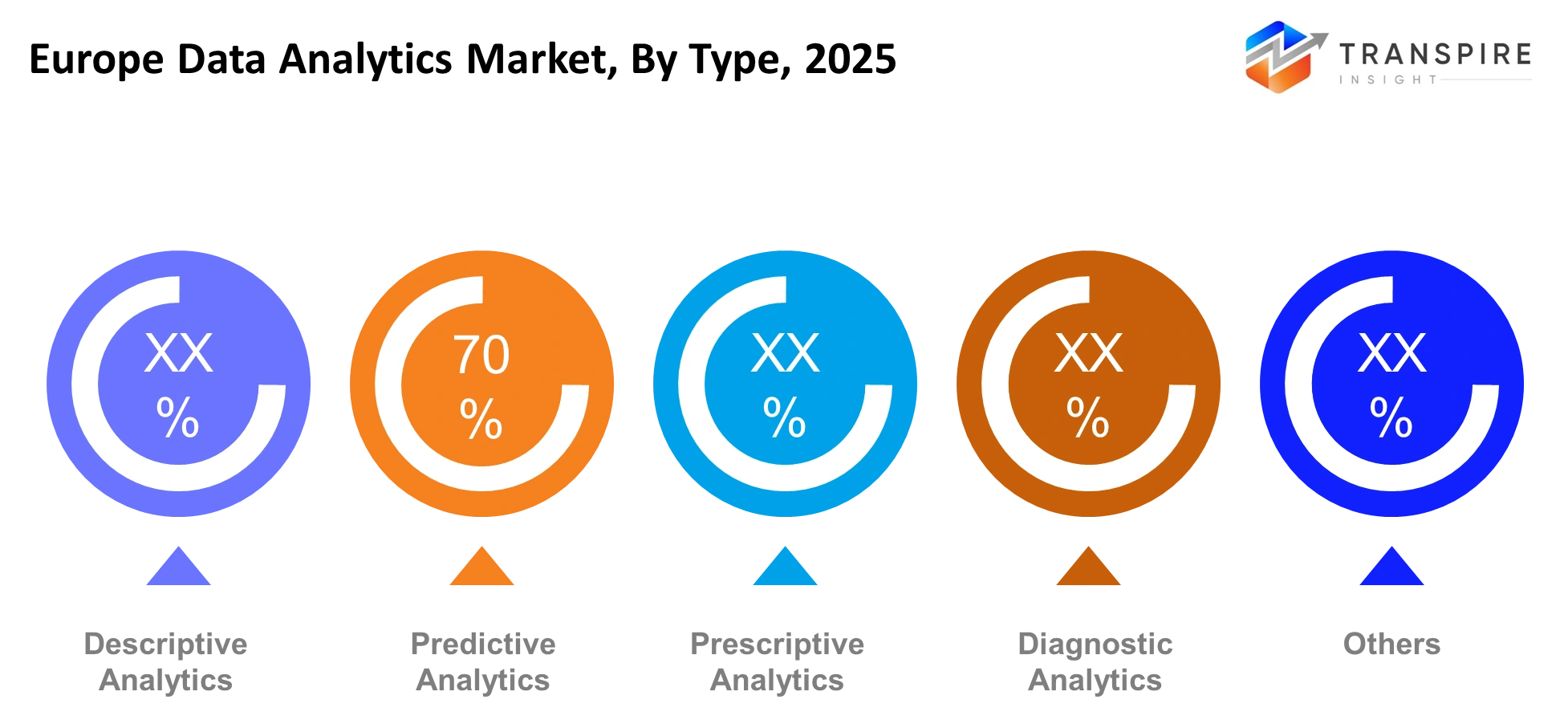
The regional analytics market maintains its largest portion as businesses continue to use historical data for their operational needs and financial monitoring and regulatory requirements. Dashboards function as reporting tools for large banks and manufacturers and retailers to gather data from their separate operational systems. Business intelligence companies and enterprise software vendors achieve consistent revenue streams through their strong customer adoption of traditional industries which drive their business.
Organizations are now focusing their budgets on predictive analytics which uses forecasting tools to improve maintenance scheduling and fraud detection and supply chain planning. Machine learning technology and reduced cloud computing expenses drove logistics and manufacturing organizations to adopt new systems after the year 2021. Enterprises use prescriptive analytics and diagnostic analytics for their strategic needs because businesses now prefer automated decision support systems instead of using basic reporting tools. The period of the forecast will show more investment in AI-enabled prescriptive systems which companies will use to build their operational automation and real-time decision intelligence capabilities.
To learn more about this report, Download Free Sample Report
By Application:
The BFSI segment maintains its dominant market share because it depends on risk analytics and fraud detection and regulatory compliance systems and customer behavior analysis platforms. Financial institutions in Germany and France and the United Kingdom are increasing their analytics budgets because they need to address cybersecurity threats and regulatory requirements that have emerged from digital transaction growth. The industry maintains ongoing software and cloud analytics expenditures because companies generate high data volumes which create mandatory compliance reporting requirements.
The healthcare industry and manufacturing sector are expanding their operations because organizations need to improve efficiency while utilizing predictive modeling technologies for clinical scheduling and industrial equipment upkeep. Retailers are increasingly using customer analytics tools to enhance their pricing methods and product distribution and sales operations through multiple channels. Telecom companies are developing their analytics systems to forecast network utilization and ensure uninterrupted service through their predictive monitoring technology. The forecast period will see significant investment into healthcare analytics because hospitals and public health organizations need to implement AI-based solutions for diagnostic purposes and resource management and evaluation of patient health results.
By End-User:
Enterprise software adoption rates reach their peak through multinational corporations because these organizations need to manage extensive data systems which require them to use unified operational intelligence solutions. The banking sector together with automotive manufacturers and logistics companies are spending money on cloud-based analytics systems to enhance their ability to make decisions in real time while meeting compliance requirements across different regions. Organizations use AI-based analytics systems for wider deployment because they have more access to capital and their digital systems have reached advanced development stages.
The decreasing costs of implementation together with the increased availability of subscription-based analytics platforms have made small and medium-sized enterprises become the fastest growing group of end users. The combination of low-code development tools together with managed cloud services created an environment which enables smaller organizations to use analytics tools without facing technical obstacles. Government agencies and research institutes are also increasing investment in data intelligence systems which support public infrastructure planning and cybersecurity monitoring and healthcare analytics initiatives. The upcoming years will see software vendors establish new revenue streams through analytics solutions which focus on small and medium-sized enterprises that need affordable deployment options.
By Deployment:
Cloud deployment leads the market because organizations show increasing demand for scalable analytics platforms which need minimal initial costs and require quick setup. Enterprises adopted hybrid work models and cross-company data access needs after they moved away from their previous practice of using separate on-premise systems. Cloud-native analytics platforms enable better AI integration and real-time processing and automated software updates compared to traditional deployment models.
Regulated industries that need to protect sensitive operational and financial data are increasingly adopting hybrid deployment models. Financial institutions and healthcare providers and government organizations need to balance cloud storage advantages with their European data sovereignty requirements. Organizations in sectors that require strict cybersecurity measures or low latency performance choose on-premise systems because they need to meet these specific requirements. Large enterprises that need compliance-focused analytics environments will experience procurement strategy changes because of sovereign cloud expansion and AI-enabled hybrid architecture development during the forecast period.
What are the Key Use Cases Driving the Europe Data Analytics Market?
Financial institutions throughout Europe maintain their highest analytics expenditures because their operations need continuous monitoring of fraudulent activities and financial transactions and compliance with regulatory requirements. Predictive analytics platforms help banks and insurance providers decrease their financial risks while they strengthen their cybersecurity measures and automate their compliance processes which European regulations require.
The manufacturing and retail industries are increasing their use of analytics by implementing predictive maintenance and inventory forecasting and customer behavior analysis functions. Automotive manufacturers use machine learning systems to track their factory equipment performance while e-commerce companies apply analytics tools to develop pricing strategies and enhance their supply chain operations during changes in customer demand.
AI-assisted healthcare diagnostics and energy grid optimization platforms which include renewable power integration projects represent two newly developed applications. Utilities and public infrastructure operators use advanced analytics systems to predict electricity demand and track carbon emissions while they enhance their operational resilience in decentralized energy networks.
|
Report Metrics |
Details |
|
Market size value in 2025 |
USD 22136.4 Million |
|
Market size value in 2026 |
USD 27869.3 Million |
|
Revenue forecast in 2033 |
USD 141269.7 Million |
|
Growth rate |
CAGR of 26.10% from 2026 to 2033 |
|
Base year |
2025 |
|
Historical data |
2021 - 2024 |
|
Forecast period |
2026 - 2033 |
|
Report coverage |
Revenue forecast, competitive landscape, growth factors, and trends |
|
Regional scope |
Europe (Germany, United Kingdom, France, Italy, Spain, Rest of Europe) |
|
Key company profiled |
IBM, Microsoft, Google, SAP, Oracle, SAS Institute, Tableau, Qlik, TIBCO, Teradata, Snowflake, Databricks, Alteryx, Zoho, MicroStrategy. |
|
Customization scope |
Free report customization (country, regional & segment scope). Avail customized purchase options to meet your exact research needs. |
|
Report Segmentation |
By Type (Descriptive Analytics, Predictive Analytics, Prescriptive Analytics, Diagnostic Analytics, Others); By Application (BFSI, Healthcare, Retail, Manufacturing, Telecom, Others); By End-User (Enterprises, SMEs, Government, Research Institutes, Others); By Deployment (Cloud, On-premise, Hybrid, Others). |
Which Regions are Driving the Europe Data Analytics Market Growth?
Western Europe maintains its position as the leading region for analytics because Germany and the United Kingdom and France operate their digital systems at advanced levels while businesses in these countries invest heavily in technology. The financial sector and manufacturing industry and logistics companies needed to upgrade their outdated data systems because the European Union enforced GDPR together with specific industry regulations. The banking and automotive and industrial industries benefit from ongoing advanced analytical platform development because of substantial hyperscale cloud funding and established AI research frameworks. The enterprise software industry and telecommunications sector and government-supported digital transformation programs work together to establish regional leadership that lasts for an extended period.
The Northern European region generates stable market revenue because its digital capabilities are advanced and its economic systems are strong and its cloud infrastructure upgrade projects receive ongoing funding. The region shows different economic growth patterns from Western Europe because it relies more on public-sector digital development and smart city projects and renewable energy systems than on large industrial manufacturing networks. Sweden and Denmark and Finland have not stopped their research into analytics for healthcare planning and cybersecurity and sustainable energy development. The region experiences stable analytics expenditure because organizations trust cloud systems and regulatory rules remain consistent.
The regional market in Eastern Europe has become the fastest-growing market after government bodies and business organizations activated their digital modernization efforts because of supply chain interruptions and cybersecurity threats which emerged after 2022. The three countries of Poland and Romania and the Czech Republic expanded their investments into regional data centers and artificial intelligence research facilities and business cloud transition programs to build operational strength and draw international technology investments. The upward trend in e-commerce and the shift of manufacturing operations generated increased requirements for businesses to use predictive analytics and logistics intelligence technologies. The period from 2026 to 2033 will provide analytics vendors and cloud providers and AI-centric investors with valuable development possibilities due to ongoing infrastructure expansion and decreased market saturation throughout this timeframe.
Who are the Key Players in the Europe Data Analytics Market and How Do They Compete?
The European Data Analytics Market displays moderate consolidation because global enterprise software vendors control main market platforms while specialized AI companies and cloud-native businesses create new market entry points through their predictive maintenance solutions and real-time compliance analytics products. Existing market players maintain their market position through ecosystem lock-in and integrated cloud solutions and long-term contracts which they provide to enterprise customers, while startups enter the market through their expertise in artificial intelligence and their ability to deliver cheaper implementation solutions. The two main competitive factors in the market operate as technology depth and regulatory compliance capacity, which determine vendor selection criteria under the strict European data sovereignty regulations.
SAP SE strengthens its position through deep integration of analytics with enterprise resource planning systems used by European manufacturers and logistics operators. The company stands out from competitors through its complete industrial data visibility solution which allows real-time operational analytics to occur within current ERP systems. The company expands its business through cloud migration partnerships with major industrial companies based in Germany and France, which help them maintain their existing customer base.
Microsoft Corporation uses its Azure analytics and AI platform to compete in the market because it provides customers with cloud solutions that can scale and uses generative AI technology to work with their enterprise data systems. The company provides a unique product through its hybrid cloud solutions, which enable regulated industries to process data in specific local areas. The company expands through strategic partnerships with European governments and telecom providers to strengthen sovereign cloud infrastructure.
IBM Corporation develops trustworthy analytical solutions which meet the requirements of regulated industries especially banking and government operations. The company establishes its unique position through its AI governance tools and advanced data security systems which it integrates into its analytics products. The company expands its operations through consulting business partnerships and its acquisition of AI automation companies which enhance its enterprise transformation solutions throughout Europe.
Company List
- IBM
- Microsoft
- SAP
- Oracle
- SAS Institute
- Tableau
- Qlik
- TIBCO
- Teradata
- Snowflake
- Databricks
- Alteryx
- Zoho
- MicroStrategy
Recent Development News
In November 2025, Nordic Capital announced the acquisition of BMLL. The deal, valuing the UK-based financial data analytics firm at approximately US$250 million, highlighted increasing private equity investment in Europe’s AI-driven market data and analytics ecosystem.
Source: https://www.fnlondon.com
What Strategic Insights Define the Future of the Europe Data Analytics Market?
The Europe Data Analytics Market is moving toward an architecture where analytics becomes embedded inside operational systems rather than functioning as a separate reporting layer. The manufacturing and finance and regulated infrastructure sectors drive this change because enterprises now implement AI throughout their business processes. The demand for real-time automated decision systems will increase during the next five to seven years which link cloud platforms with edge environments to create faster response times in industrial and logistics operations while enhancing regulatory compliance.
The software providers create dependency risk for European enterprises because a small number of hyperscale cloud and enterprise software vendors have become their primary vendors. European enterprises face dependency risks because their data residency rules become stricter which creates higher switching costs and limits their long-term flexibility to choose between vendors.
The EU-controlled cloud infrastructure provides an emerging opportunity for sovereign AI analytics platforms to operate their analytics platforms. Germany and France are accelerating investment in localized data ecosystems that support secure cross-border analytics for defense, energy, and healthcare sectors. Market participants should prioritize modular, interoperable analytics solutions that integrate with sovereign cloud frameworks while maintaining portability across multi-cloud environments to avoid long-term structural lock-in.
Europe Data Analytics Market Report Segmentation
By Type
- Descriptive Analytics
- Predictive Analytics
- Prescriptive Analytics
- Diagnostic Analytics
- Others
By Application
- BFSI
- Healthcare
- Retail
- Manufacturing
- Telecom
- Others
By End-User
- Enterprises
- SMEs
- Government
- Research Institutes
- Others
By Deployment
- Cloud
- On-premise
- Hybrid
- Others
Frequently Asked Questions
Find quick answers to common questions.
The Europe Data Analytics Market size is USD 141269.7 Million in 2033.
Key segments for the Europe Data Analytics Market are By Type (Descriptive Analytics, Predictive Analytics, Prescriptive Analytics, Diagnostic Analytics, Others); By Application (BFSI, Healthcare, Retail, Manufacturing, Telecom, Others); By End-User (Enterprises, SMEs, Government, Research Institutes, Others); By Deployment (Cloud, On-premise, Hybrid, Others).
Major Europe Data Analytics Market players are IBM, Microsoft, Google, SAP, Oracle, SAS Institute, Tableau, Qlik, TIBCO, Teradata, Snowflake, Databricks, Alteryx, Zoho, MicroStrategy.
The Europe Data Analytics Market size is USD 22136.4 Million in 2025.
The Europe Data Analytics Market CAGR is 26.10% from 2026 to 2033.
- IBM
- Microsoft
- SAP
- Oracle
- SAS Institute
- Tableau
- Qlik
- TIBCO
- Teradata
- Snowflake
- Databricks
- Alteryx
- Zoho
- MicroStrategy
Recently Published Reports
-
Apr 2026
3D Optical Profiler Market
3D Optical Profiler Market Size, Share & Analysis Report By Type (Desktop 3D Optical Profiler, and Portable 3D Optical Profiler), By Technology (Confocal Technology, and White Light Interference), By End-Use Industry (Manufacturing, Research Institutions, Automotive, Aerospace and Defense, Medical Devices, and Other), and Geography (North America, Europe, Asia-Pacific, Middle East and Africa, South and Central America), 2021 - 2031
-
Apr 2026
Depth Sensor Market
Depth Sensor Market Size, Share & Analysis Report By Type (Infrared Depth Sensors, Time-of-Flight (ToF) Sensors, Stereo Vision Sensors, Structured Light Sensors, Ultrasonic Depth Sensors), By Application (Automotive, Robotics, Gaming, Consumer Electronics, Industrial Automation, Healthcare, Security & Surveillance, Others), By End Users (Automotive Manufacturers, Consumer Electronics Companies, Healthcare Providers, Industrial Companies, Security Agencies, Gaming Companies, Robotics Companies, Others), and Geography (North America, Europe, Asia-Pacific, Middle East and Africa, South and Central America), 2021 – 2031
-
Apr 2026
Digital Manufacturing Market
Digital Manufacturing Market Size, Share & Analysis Report By Component (Hardware, Software, and Services), By Technology (Robotics, 3D Printing, Internet of Things (IoT), and Others), By Application (Automotive and Transportation, Aerospace and Defense, Consumer Electronics, Industrial Machinery, and Others), By Process Type (Computer-Based Designing, Computer-Based Simulation, Computer 3D Visualization, Analytics, and Others), and Geography (North America, Europe, Asia-Pacific, Middle East and Africa, South and Central America), 2021 – 2031
-
Apr 2026
Digital Visa Services Market
Digital Visa Services Market Size, Share & Analysis Report By Type (Individual Travelers, Group Travelers), By Application (Tourism, Business Travel, Others), and Geography (North America, Europe, Asia-Pacific, Middle East and Africa, South and Central America), 2021 – 2031