
South Korea Bulletproof Glass Market Size & Forecast:
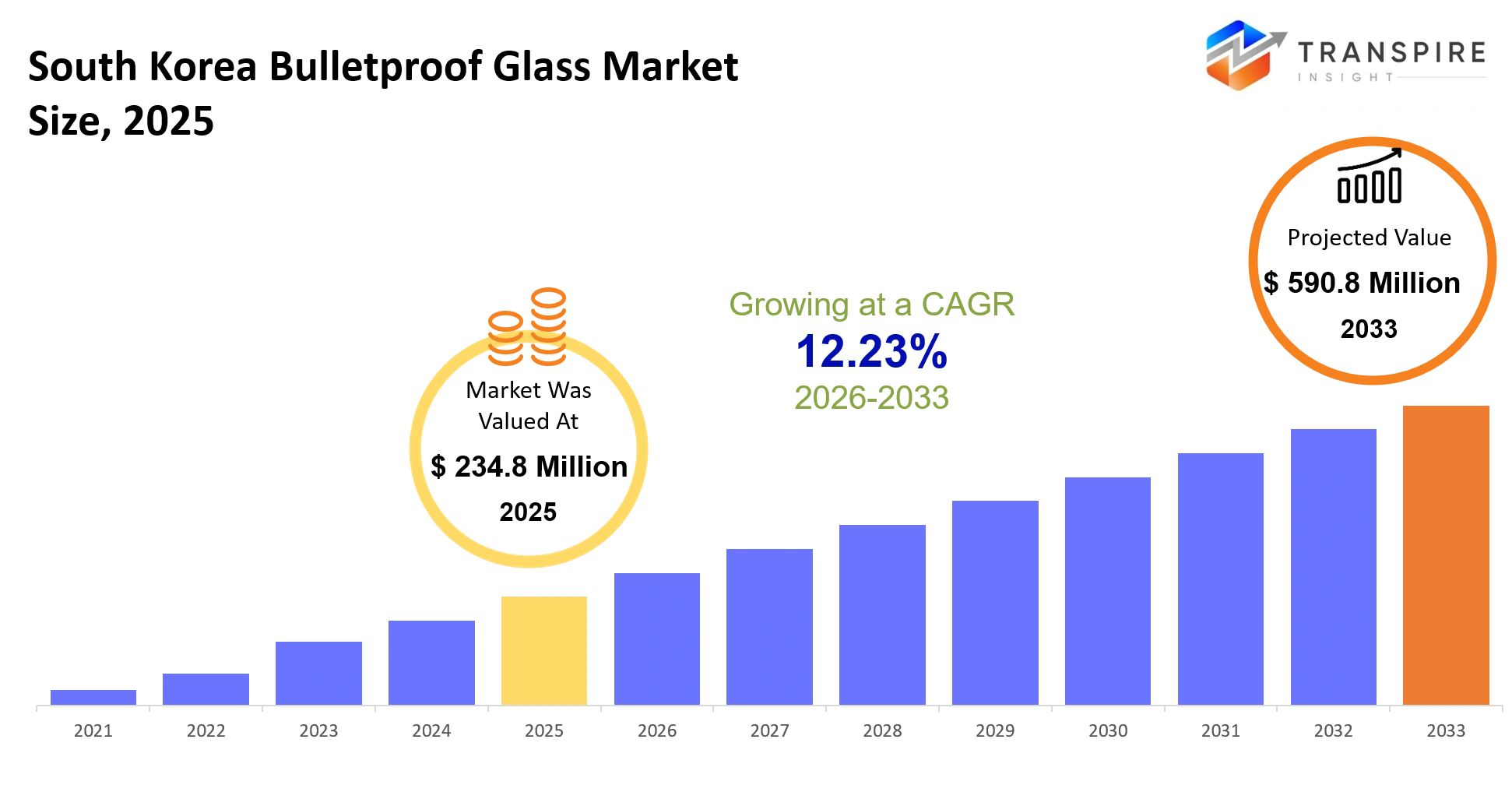
- South Korea Bulletproof Glass Market Size 2025: USD 234.8 Million
- South Korea Bulletproof Glass Market Size 2033: USD 590.8 Million
- South Korea Bulletproof Glass Market CAGR: 12.23%
- South Korea Bulletproof Glass Market Segments: By Product Type (Laminated Bulletproof Glass, Acrylic Bulletproof Glass, Polycarbonate Bulletproof Glass, Glass-clad Polycarbonate, Others); By Security Level (Low Security Glass, Medium Security Glass, High Security Glass, Military-grade Glass, Others); By Application (Defense Vehicles, Banking & Financial Security, VIP Vehicles, Commercial Buildings, Others); By End User (Defense Sector, Banking Sector, Automotive Industry, Government Organizations, Others); By Thickness (Below 20 mm, 20–40 mm, Above 40 mm, Others)
To learn more about this report,  Download Free Sample Report
South Korea Bulletproof Glass Market Summary
The South Korea Bulletproof Glass Market was valued at USD 234.8 million in 2025. It is forecast to reach USD 590.8 million by 2033. That is a CAGR of 12.23% over the period.
The South Korea Bulletproof Glass Market kind of plays a critical role in protecting people, assets, and also sensitive infrastructure from ballistic threats, especially in defense vehicles, government sites, financial institutions, and high-security commercial buildings. In actual use these materials help organizations keep running with fewer interruptions while they also tighten up physical security as threat scenarios keep changing.
Over the last three to five years, the market has started to shift in a more structural way toward lighter, multi layered glass systems. These systems mix ballistic protection with better optical clarity and, yes, lower vehicle weight. That change has been supported by improvements in polycarbonate composites and glass-clad materials. One big trigger that really sped up activity was the increased attention to national security and critical infrastructure protection, after regional geopolitical tensions in East Asia. When governments and private operators rechecked their security weaknesses, procurement plans more and more leaned toward upgraded protective glazing solutions. This in turn has broadened adoption across defense, transportation, and public-sector projects, which creates fresh revenue chances for manufacturers that can supply certified, high performance products with stronger durability and more customization options.
Key Market Insights
- The Seoul area is the part of the South Korea Bulletproof Glass market with over 40% share in 2025. This is because the government and companies are investing a lot in security there.
- The southeastern industrial area, including Busan and Ulsan is growing fast. This is because of defense manufacturing and infrastructure development.
- The demand for bulletproof glass is increasing in transportation hubs, public buildings and important industrial areas.
- Laminated Bulletproof Glass is the popular type with over 45% share in 2025. This is because it works well against bullets and is widely used in defense and banking.
- Glass-clad Polycarbonate is the most popular type. This is because it is durable, clear and can withstand impact.
- Polycarbonate Bulletproof Glass is expected to grow the fastest from 2025 to 2030. This is because organizations want protection systems that're light but still strong.
- Companies are working on products that are lighter but still offer high protection.
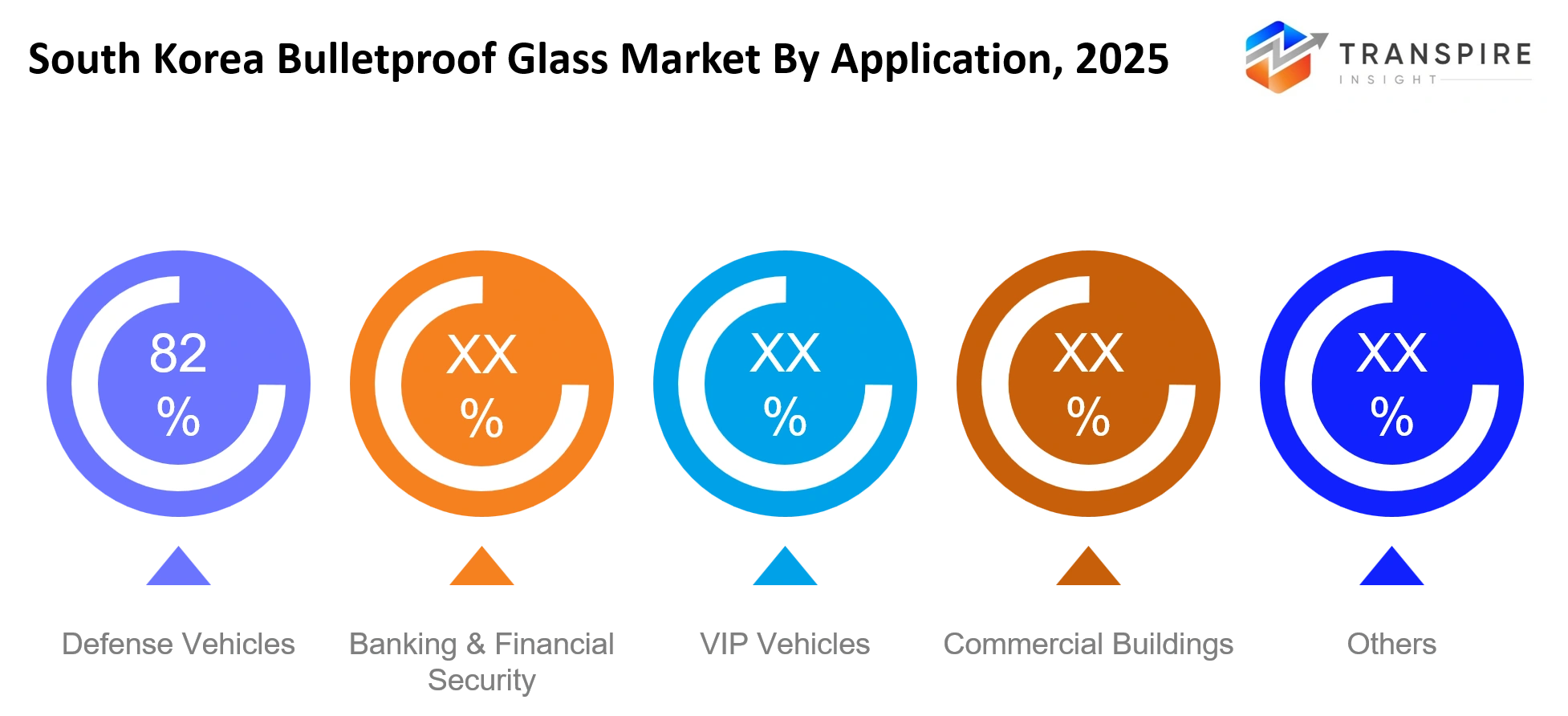
- Defense Vehicles use the most bulletproof glass with over 35% share, in 2025.
- The military is still updating its vehicles, which means they are buying advanced transparent armor.
- Commercial Buildings are starting to use bulletproof glass. This is because they need to be secure, especially important buildings and high-end facilities.
What are the Key Drivers, Restraints, and Opportunities in the South Korea Bulletproof Glass Market?
The main thing pushing the South Korea Bulletproof Glass Market forward is the ongoing modernization of defense and security infrastructure, kinda like a slow but steady shift. With heightened geopolitical tensions in East Asia, the government has felt the need to boost military readiness, and also tighten up protection standards for defense vehicles, command centers and key strategic facilities. That change has effectively expanded procurement budgets for newer ballistic protection systems, including those transparent armor solutions that sound almost futuristic. As defense agencies swap out older glazing materials for lighter yet stronger options, manufacturers end up with higher-value contracts and longer project pipelines. Also, when advanced polycarbonate composites get integrated, performance goes up too, which then helps drive more widespread adoption across security-sensitive contexts.
The biggest obstacle though is the high production cost tied to certified ballistic glass systems. Making bulletproof glass isn’t just about strong material, it needs specialized raw components, careful lamination methods, and strict testing so it actually meets international protection standards. In a way this is a structural challenge, because the certification requirements and material costs can’t be trimmed quickly without risking safety performance. So smaller commercial projects, or budget-constrained organisations, often postpone upgrades or choose more affordable security alternatives instead. That ends up limiting penetration into broader commercial markets, and it also suppresses the possibility of stronger revenue growth overall.
A big opening is in the making of light weight see-through armor for the next wave military and shielded transport vehicles. New progress in glass clad polycarbonate tech is making it possible to cut mass quite a lot while still holding up ballistic resistance, and not in some casual way. Since South Korea keeps pouring more funding into modern defense platforms and movement systems, the vendors who can provide top tier lightweight solutions are set to grab fresh, long lasting growth chances.
What Has the Impact of Artificial Intelligence Been on the South Korea Bulletproof Glass Market?
Artificial intelligence along with advanced digital technologies are starting to quietly shift the South Korea Bulletproof Glass Market, mainly by nudging manufacturing precision, quality control ,and production efficiency into a more steady rhythm. A lot of manufacturers are now using AI powered vision inspection systems—sort of like smart sight— to find microscopic defects, delamination risks, and optical distortions during lamination. These automated checks lower how much they depend on manual reviews, and they support ongoing compliance with ballistic protection standards, even when output volumes get busy.
Machine learning models are also showing up for predictive maintenance across glass processing and coating lines. The basic idea is pretty straightforward: by studying equipment vibration, temperature signals, and production logs, teams can spot failures before they turn into real disruptions. That tends to cut unplanned downtime, raises equipment utilization, and makes production schedules feel less chaotic. On top of that, digital twin technologies are helping engineers model material behavior under different ballistic and environmental situations, which can reduce the overall development time for new transparent armor solutions.
The operational impact is becoming more and more visible in practice. AI assisted quality control can bring down defect rates, boost yield efficiency, and help shorten the testing cycles, while predictive maintenance programs contribute to better production uptime and lower maintenance costs. Together these gains make it easier for manufacturers to meet tight delivery obligations in defense, automotive, and security programs.
Still, the AI adoption story isn’t all smooth. There are limitations, of course. Blending advanced analytics with older manufacturing equipment calls for a fairly substantial investment, and the availability of high quality ballistic test data is still rather limited. As a result, model accuracy can drop , and the wider rollout of AI-driven optimisation across the industry may move more slowly.
Key Market Trends
- Defense procurement programs have been looking for transparent armor solutions since 2021. These defense procurement programs want to reduce the weight of vehicles while keeping the level of ballistic protection.
- Manufacturers are now using glass-clad polycarbonate technologies of the old laminated systems. This change is helping to make the vehicles more resistant to impact and easier to use in security situations.
- Between 2022 and 2025 tools that use intelligence to inspect things visually became more popular. These tools are helping producers find defects earlier and make mistakes when they are making things.
- Because of security concerns in regions people are replacing old protective glazing systems in government buildings, military vehicles and important infrastructure faster.
- Since 2023 buyers have been looking for defense procurement programs that can protect against kinds of threats. These defense procurement programs should be able to stop attacks and blasts.
- Companies like Saint-Gobain, AGC Inc. And Schott AG are now focusing on making materials. These materials should be strong a long time and be clear to look through.
- When making decisions about what to buy people are now thinking about how something will work over its whole life. They are also thinking about how much it will cost to maintain, not how much it costs to buy at first.
- Manufacturers in the country have been making their supply chains stronger since 2022. They are doing this by not relying much on special parts and materials from other countries.
- The standards for testing and saying something is okay are now very important when choosing a supplier. This is making manufacturers invest in ways to test and make sure they are following the rules.
- Since 2024 commercial security projects have been using performance protective glazing more and more. This is because the people, in charge of infrastructure are looking again at how secure their buildings are.
South Korea Bulletproof Glass Market Segmentation
By Product Type:
Laminated Bulletproof Glass has a pretty strong standing due to dependable ballistic shielding and also good long haul durability, especially in those strict security spaces. Bank facilities , government buildings, and defense installations keep choosing it because the results look solid when there are high-impact situations. There is also steady optical clarity along with overall structural firmness, and that kind of support helps it roll into more critical use cases without too much friction.
Acrylic Bulletproof Glass still works well where you need that middle ground between protection and a lighter setup. Polycarbonate Bulletproof Glass keeps getting more attention, largely because it stays light in weight and tends to handle impacts better. Meanwhile Glass-clad Polycarbonate solutions bring visibility and stronger defense into one package, so they are often picked for advanced security projects. The Others category basically covers specialized materials created for unusual protection needs , plus customized placements depending on the scenario.
By Security Level:
Low Security Glass works in settings where defense against limited threats is still, uhm, enough. Medium Security Glass supports commercial buildings and institutions that need stronger pushback against security risks . Growth in city infrastructure initiatives continues to help the spread across several public and private sites.
High Security Glass is for cases where more serious ballistic resistance and better occupant safeguarding stay important. Military-grade Glass supports defense vehicles, defense facilities and strategic infrastructure, where the protection bar has to be the top level. The Others category covers specialized security solutions that are created for singular operational needs and customized threat protection requirements.
By Application:
Defense Vehicles are, kind of a big deal for deployments because military modernization programs still keep their eyes on crew safety and vehicle survivability. Advanced protective glazing really helps keep operational readiness up, while you can still see well in rough conditions. Procurement programs also keep pushing the adoption of protection systems that are both stronger and lighter, which seems to matter a lot.
Banking & Financial Security applications depend on protective glass, not just to “look nice” but to secure personnel, customers, and other valuable assets. VIP Vehicles call for protection solutions that do more than stop threats— they also need to preserve comfort, visibility, and security while people are being transported. Commercial Buildings keep improving physical security by installing high-performance protective glazing systems. And the Others category covers additional use cases where ballistic protection stays a critical requirement, plain and simple.
To learn more about this report, Download Free Sample Report
By End User:
The Defense Sector is still kind of a leading end-user because security requirements and modernization initiatives keep pushing procurement work. Adding money toward military infrastructure and protected mobility platforms helps sustain demand for advanced ballistic materials. Over the long run, defense programs will keep shaping purchasing patterns across the wider industry, pretty directly.
The Banking Sector tends to lean on protective glazing, since it helps reinforce branch security and keeps employees along with customers more protected. The Automotive Industry, meanwhile, continues to adopt advanced materials for protected transportation solutions and for specialized vehicles that need extra guarding. Government Organizations roll out security upgrades across public facilities and strategic locations. The Others category is basically for additional industries where protection against ballistic threats still matters, even if it is not always as obvious.
By Thickness:
Under 20 mm products are for use in cases where less weight and moderate defense needs still matter most. These setups support installations where better mobility is useful, handling is simpler, and deployment stays quick. People usually want it for projects that kind of mix security outcomes with practical design thinking, so the demand never really separates from those tradeoffs.
The 20–40 mm range keeps getting selected because it can deliver solid protection for many kinds of situations. When you go past 40 mm, the solutions tend to target harsher surroundings, meaning the goal is maximum ballistic resistance, plus extra protection against severe threats. And the Others group is basically for customized thickness requirements, created to fit specialized operational and security needs, depending on what the program actually demands in the field.
What are the Key Use Cases Driving the South Korea Bulletproof Glass Market?
The biggest portion of demand comes from defense and security operations, where bulletproof glass is put in military vehicles, command centers, guard posts, and other strategic facilities. At the same time, national defense modernization programs keep putting emphasis on personnel protection, plus operational readiness, so advanced transparent armor stays a key part of the security infrastructure.
Adoption is also rising in banking and financial institutions, because protective glazing helps lock down branches, cash handling spaces, and customer service zones. In parallel, government buildings and critical public infrastructure projects are more and more bringing in high-security glass systems to boost physical protection, against possible threats.
New opportunities are showing up in protected transportation and advanced mobility platforms. Manufacturers are now checking out lighter transparent armor solutions for next generation security vehicles and specialized law enforcement fleets. Also, smart building initiatives and high value commercial facilities are reviewing advanced ballistic glazing technologies that mix protection, durability and better architectural design, which opens fresh paths for future market expansion.
|
Report Metrics |
Details |
|
Market size value in 2025 |
USD 234.8 million |
|
Market size value in 2026 |
USD 263.5 Mn million |
|
Revenue forecast in 2033 |
USD 590.8 million |
|
Growth rate |
CAGR of 12.23% from 2026 to 2033 |
|
Base year |
2025 |
|
Historical data |
2021 - 2024 |
|
Forecast period |
2026 - 2033 |
|
Report coverage |
Revenue forecast, competitive landscape, growth factors, and trends |
|
Regional scope |
South Korea |
|
Key company profiled |
Saint-Gobain, AGC Inc., Nippon Sheet Glass, Schott AG, Asahi India Glass, Armortex, Total Security Solutions, Apogee Enterprises, Guardian Glass, China Specialty Glass, Corning, Taiwan Glass, Vetrotech Saint-Gobain, Smartglass International, PPG Industries |
|
Customization scope |
Free report customization (country, regional & segment scope). Avail customized purchase options to meet your exact research needs. |
|
Report Segmentation |
By Product Type (Laminated Bulletproof Glass, Acrylic Bulletproof Glass, Polycarbonate Bulletproof Glass, Glass-clad Polycarbonate, Others); By Security Level (Low Security Glass, Medium Security Glass, High Security Glass, Military-grade Glass, Others); By Application (Defense Vehicles, Banking & Financial Security, VIP Vehicles, Commercial Buildings, Others); By End User (Defense Sector, Banking Sector, Automotive Industry, Government Organizations, Others); By Thickness (Below 20 mm, 20–40 mm, Above 40 mm, Others) |
Which Regions are Driving the South Korea Bulletproof Glass Market Growth?
The Seoul Capital Area kind of stays as the leading place for bulletproof glass adoption, because it gathers national government institutions, defense administration hubs, financial head offices, and large corporate installations. Security spending around Seoul and the nearby cities keeps pushing the need for more capable protective glazing systems. There is also a lot of procurement momentum from public sector agencies and some high-security commercial builds, which makes the customer base feel steady. On top of that, a pretty well formed ecosystem exists there—technology providers, engineering consultancies, testing facilities, and construction contractors all together, so the region can keep that top spot longer.
The southeastern industrial region, like Busan and Ulsan, sits as the second most important market contributor, kind of overall. And unlike the Seoul Capital Area, the pace of growth here is tied more tightly to industrial infrastructure, production assets, and transportation networks than it is to government administration or policy work. Big industrial complexes keep spending on facility protection, not just for compliance, but to cut operational risks and keep business continuity more reliable. With steady economic activity and long-term capital investment programs, the region ends up being a dependable stream of market revenue.
Meanwhile the central region, which covers Daejeon and nearby provinces, looks like it is becoming the fastest-growing area across the forecast period. Because investment has been rising in research facilities, upgrades to public infrastructure, and specialized government projects, the opportunity space for advanced security materials has widened. The recent modernization push also encourages wider use of higher-performance protective solutions in both newer facilities and older ones that are being updated. This overall momentum opens up appealing opportunities for manufacturers and investors aiming for expansion between 2026 and 2033, especially when the projects need tailored ballistic protection technologies.
Who are the Key Players in the South Korea Bulletproof Glass Market and How Do They Compete?
Competition in the South Korea Bulletproof Glass Market is fairly moderately consolidated, with a blend of global specialty glass makers and security material providers who are all chasing defense , government , and commercial contracts. In practice, technology performance is what really drives the competition, especially when it comes to weight reduction, optical clarity, ballistic resistance, and multi-threat protection, as well as how reliably those features show up during testing.
Older suppliers keep pushing their market share by leaning on certified product lineups and long-term customer ties , while newer entrants kind of hunt for openings in more specialized uses and customized safety solutions. Procurement buyers are increasingly picky , and they tend to select the vendors who can pass very strict testing standards and also deliver a tailored product that fits the specific operational needs at hand.
Saint-Gobain stands out thanks to advanced transparent armor technologies, and it brings a lot of hands-on expertise in high performance glazing materials. Ongoing investment in lightweight protective solutions helps the firm respond to shifting defense needs and infrastructure expectations. AGC Inc. puts its focus on material innovation and precision manufacturing know-how, so durability and visibility improve while ballistic protection requirements stay intact. Its expansion approach also seems to be leaning harder toward collaboration with defense and security system integrators , in order to improve participation across projects.
Schott AG kind of competes by doing specialized glass engineering and advanced material technologies, really built for demanding security environments. The strong technical capabilities help them to craft customized solutions for protection needs that are complex and not so straightforward. Meanwhile Nippon Sheet Glass leans on manufacturing efficiency and product reliability to support a variety of security use cases, sort of broad range, you know. Guardian Glass keeps pushing ahead too, using advanced glazing technologies that try to balance protection, durability, and optical performance at the same time. Together these approaches help the companies win contracts in situations where certification, performance consistency, and long-term reliability still stay as the key purchasing factors, even if buyers are picky.
Company List
- Saint-Gobain
- AGC Inc.
- Nippon Sheet Glass
- Schott AG
- Asahi India Glass
- Armortex
- Total Security Solutions
- Apogee Enterprises
- Guardian Glass
- China Specialty Glass
- Corning
- Taiwan Glass
- Vetrotech Saint-Gobain
- Smartglass International
- PPG Industries
Recent Development News
"In 2025, Saint-Gobain and Vetrotech confirmed joint participation at SAFETY EXPO 2025 to showcase high-performance safety and protective glazing technologies. The collaboration strengthened visibility of advanced security glass solutions and supported broader adoption across commercial and institutional security projects.https://www.vetrotech.com
What Strategic Insights Define the Future of the South Korea Bulletproof Glass Market?
Over the next five to seven years, the South Korea Bulletproof Glass Market should shift , a bit toward lighter multi-functional protection systems that manage ballistic resistance, decent optical performance, and less overall weight. That change is mostly tied to the growing way advanced materials are being baked into defense platforms, protected mobility solutions, and also those high-security infrastructure projects that never really wait. In terms of value , it feels like growth will come , not so much from moving more units, but from technology upgrades that can charge higher margins and bring along tougher certification rules.
There’s also a less obvious risk in how the industry leans on specialized raw materials and advanced manufacturing know-how that ends up being concentrated with only a few suppliers. If material availability stutters, or if certification becomes a bottleneck , projects can slip, timelines get delayed , and costs can climb, even when what the end-users want is still strong. Meanwhile a newer opportunity is starting to appear in smart protective glazing, where the glass basically bundles sensors, monitoring functions, and improved situational awareness for security-sensitive environments.
Market participants should put priority on investment in lightweight composite technologies and on strategic partnerships with defense contractors plus system integrators. Getting in early on next-generation transparent armor solutions should create a more noticeable competitive edge, especially as purchasing requirements become increasingly performance driven.
South Korea Bulletproof Glass Market Report Segmentation
By Product Type
- Laminated Bulletproof Glass
- Acrylic Bulletproof Glass
- Polycarbonate Bulletproof Glass
- Glass-clad Polycarbonate
- Others
By Security Level
- Low Security Glass
- Medium Security Glass
- High Security Glass
- Military-grade Glass
- Others
By Application
- Defense Vehicles
- Banking & Financial Security
- VIP Vehicles
- Commercial Buildings
- Others
By End User
- Defense Sector
- Banking Sector
- Automotive Industry
- Government Organizations
- Others
By Thickness
- Below 20 mm
- 20–40 mm
- Above 40 mm
- Others
Frequently Asked Questions
Find quick answers to common questions.
The expected South Korea Bulletproof Glass Market size for the market will be USD 590.8 million in 2033.
Key segments for the South Korea Bulletproof Glass Market are By Product Type (Laminated Bulletproof Glass, Acrylic Bulletproof Glass, Polycarbonate Bulletproof Glass, Glass-clad Polycarbonate, Others); By Security Level (Low Security Glass, Medium Security Glass, High Security Glass, Military-grade Glass, Others); By Application (Defense Vehicles, Banking & Financial Security, VIP Vehicles, Commercial Buildings, Others); By End User (Defense Sector, Banking Sector, Automotive Industry, Government Organizations, Others); By Thickness (Below 20 mm, 20–40 mm, Above 40 mm, Others).
Major South Korea Bulletproof Glass Market players are Saint-Gobain, AGC Inc., Nippon Sheet Glass, Schott AG, Asahi India Glass, Armortex, Total Security Solutions, Apogee Enterprises, Guardian Glass, China Specialty Glass, Corning, Taiwan Glass, Vetrotech Saint-Gobain, Smartglass International, PPG Industries.
The South Korea Bulletproof Glass Market size is USD 234.8 Million in 2025.
The South Korea Bulletproof Glass Market CAGR is 12.23% from 2026 to 2033.
- Saint-Gobain
- AGC Inc.
- Nippon Sheet Glass
- Schott AG
- Asahi India Glass
- Armortex
- Total Security Solutions
- Apogee Enterprises
- Guardian Glass
- China Specialty Glass
- Corning
- Taiwan Glass
- Vetrotech Saint-Gobain
- Smartglass International
- PPG Industries
About the Authors

Pankaj Ghogare Patil
I am Pankaj Ghogare Patil, a Senior Research Analyst at Transpire Insight, specializing in the Pharmaceutical, Chemicals & Materials, Healthcare IT, and Biotechnology industry. My expertise lies in conducting comprehensive market research, analyzing industry trends, evaluating competitive landscapes, and translating complex data into actionable insights. At Transpire Insight, I closely follow emerging technologies, regulatory developments, and market innovations to create accurate, well-researched, and informative content that helps businesses and professionals make informed decisions. I am committed to producing credible, evidence-based articles that reflect industry best practices while making technical topics accessible and valuable for a broad audience.

Chakradhar Khansole
Chakradhar serves as the Research Director at Transpire Insight, bringing over 8 years of experience in technology, innovation, and strategic market intelligence. He specializes in transforming complex market data into actionable business insights that enable organizations to make informed, growth-oriented decisions. Recognized for his strategic vision and analytical expertise, Chakradhar leads high-impact research initiatives, delivering comprehensive market assessments, competitive intelligence, and forward-looking industry analysis.
Recently Published Reports
-
May 2026
Healthcare Polymer Packaging Market
Healthcare Polymer Packaging Market Size, Share & Analysis Report By Packaging Type (Syringes, IV Bottles and Pouches, Clamshells, Blisters, Bottles & Jars, Containers, Tubes, IV Parental Packaging, Others), By Type (Regulated, Non-regulated), By Polymer Type (LDPE (Low-Density Polyethylene), HDPE (High-Density Polyethylene), Homo-polymer (Homo), Random Copolymer (Random), Block Copolymer (Block), PET, Polystyrene, Polyvinyl Chloride, Polyamide/EVOH, Others), and Geography (North America, Europe, Asia-Pacific, Middle East and Africa, South and Central America), 2021 - 2031
-
Apr 2026
Hydrophilic Tape (Waterstop) Market
Hydrophilic Tape (Waterstop) Market Size, Share & Analysis Report By Type (Bentonite-Based Hydrophilic Tape, Rubber-Based Hydrophilic Tape), By Application (Residential Buildings, Commercial Buildings, Infrastructure Projects), and Geography (North America, Europe, Asia-Pacific, Middle East and Africa, South and Central America), 2021 - 2031
-
Apr 2026
Metalens Market
Metalens Market Size, Share & Analysis Report By Type (Visible Light Metalens, and Infrared Metalens), By Application (Consumer Electronics, Automotive Electronics, Industrial, Medical, and Others), and Geography (North America, Europe, Asia-Pacific, Middle East and Africa, South and Central America), 2021 - 2031
-
Apr 2026
PBT Resin Market
PBT Resin Market Size, Share & Analysis Report By Type (Reinforced PBT Resin, Unreinforced PBT Resin), By Processing Method (Injection Molding, Extrusion, Blow Molding, Others), By End-User (Automotive, Electrical & Electronics, Consumer Appliances, Industrial Machinery, Medical Devices, Packaging, Others), and Geography (North America, Europe, Asia-Pacific, Middle East and Africa, South and Central America), 2021 - 2031