

Asia Pacific Glass Fiber Yarn Market Size & Forecast:
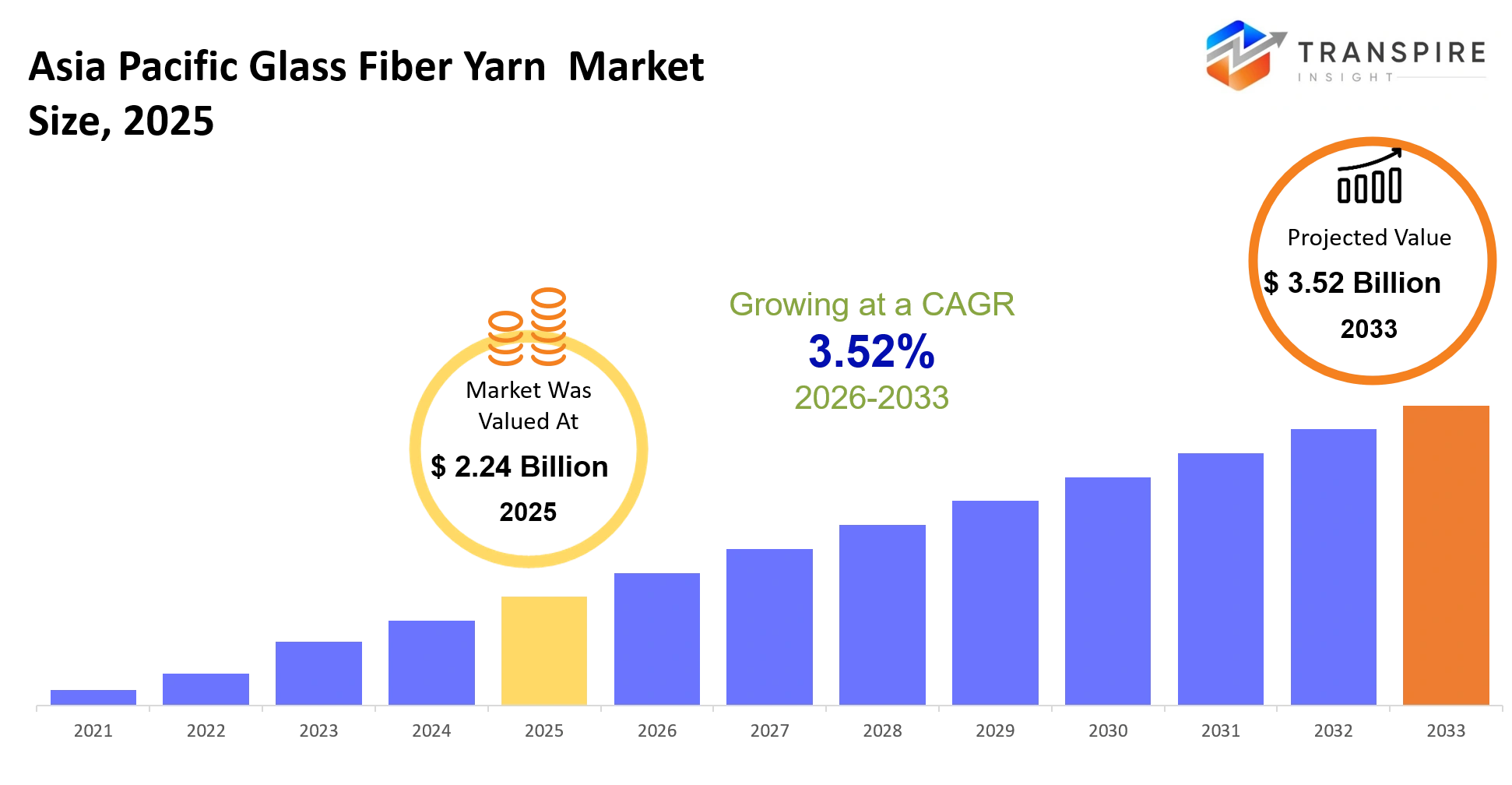
- Asia Pacific Glass Fiber Yarn Market Size 2025: USD 2.24 Billion
- Asia Pacific Glass Fiber Yarn Market Size 2033: USD 3.52 Billion
- Asia Pacific Glass Fiber Yarn Market CAGR: 3.52%
- Asia Pacific Glass Fiber Yarn Market Segments: By Product Type (E-Glass Yarn, S-Glass Yarn, C-Glass Yarn, Others); By Application (Construction Materials, Electrical Insulation, Automotive Components, Wind Energy, Others); By End User (Construction Industry, Automotive Industry, Electronics Industry, Others)
To learn more about this report,  Download Free Sample Report
Asia Pacific Glass Fiber Yarn Market Summary
The Asia Pacific Glass Fiber Yarn Market was valued at USD 2.24 Billion in 2025. It is forecast to reach USD 3.52 Billion by 2033. That is a CAGR of 3.52% over the period.
Glass fiber yarn does a pretty critical job when it comes to reinforcing composite materials, and it shows up in construction, electronics, wind energy, automotive, and industrial manufacturing too. In a very real sense it allows manufacturers to make things that are, somehow, lighter, stronger, and also more resistant to corrosion. At the same time it lowers the total material load and it tends to cut down on maintenance costs. For practical use, glass fiber yarn helps resilient infrastructure hold up better, supports high performance circuit boards,helps wind turbine blades, and also those lighter vehicle components that make day to day operations more efficient and can extend a product’s service life a bit longer.
Over the past five years the market seems to have shifted in a more structural way, especially toward advanced composite use cases in renewable energy equipment and electronic-grade materials. You can basically point to the fast growth of wind energy installations and electric vehicle output across China, India, Japan, and South Korea, and that changed consumption behavior. It also pushed investments into high-performance yarn grades, which in turn made adoption more active. During the pandemic, supply chain disruption made it pretty clear that dependence on a few concentrated manufacturing hubs was not ideal, so regional capacity expansions followed and localization strategies were used. And now, as manufacturers look for materials that are “stronger yet lighter” glass fiber yarn keeps moving into new industrial use cases, supporting higher production volumes and opening up more steady revenue possibilities across the Asia Pacific manufacturing ecosystem.
Key Market Insights
- Asia Pacific really takes the lead in global glass fiber yarn consumption, more or less based on big manufacturing pockets in China, Japan, South Korea, and India.
- China stays in the top spot, and it seems to benefit from heavy wind power rollouts, plus all those electronics manufacturing ecosystems around it.
- India, on the other hand, is forecast to become the fastest-growing national market through 2033, mainly because of industrial expansion and those infrastructure investment programs.
- Electronic-grade glass fiber yarn also picked up pace after 2023, since PCB and semiconductor supply chains kept spreading across Asia, bit by bit.
- For construction use, fiberglass accounts for a hefty portion of overall demand, and in multiple regional markets it passes the 30% line.
- Wind energy is still the quickest-growing end use segment too, largely due to bigger turbine blade requirements and the ongoing renewable energy targets governments are pushing.
- Jushi Group controls about 18% of the world's glass fiber production capacity, which ends up helping it gain more leverage across Asia Pacific supply chains.
- Also, in 2025, more than 37 manufacturing expansion projects got announced globally,and the whole goal is to keep fiberglass supply stable and sort of predictable.
- Meanwhile, the main manufacturers are putting money into carbon-neutral and smart production facilities, to improve efficiency and cut those daily operating costs.
- Companies like Owens Corning, Jushi Group, Saint-Gobain, Nippon Electric Glass, Taishan Fiberglass, and Johns Manville compete by leaning on product innovation, digital manufacturing approaches, and regional expansion roadmaps.
What are the Key Drivers, Restraints, and Opportunities in the Asia Pacific Glass Fiber Yarn Market?
The main driver of market growth is the quick move toward lightweight yet high-strength materials across transportation, renewable energy, and infrastructure. In fact wind turbine makers increasingly lean on glass fiber reinforced composites to get longer blades while not paying too much in extra mass. At the same time, automakers are applying fiberglass based materials to trim vehicle weight and help energy efficiency. Because of that, many producers have felt the push to broaden output capability and also roll out specialized yarn grades, for tasks that are more demanding than before.
The biggest restraint is kind of more stubborn though, it’s the energy intensive side of glass fiber manufacturing. Making the fibers needs high temperature furnaces plus steady energy use, so manufacturers end up exposed to swinging electricity prices and raw material costs. This is not just temporary either, it is structural, since starting a new production unit takes major capital outlays, long build periods, and specialized technical know-how. Therefore, new capacity cannot respond too fast when market conditions shift, and that can squeeze supply, then hit profitability.
A strong opportunity shows up in electronic grade glass fiber yarn for printed circuit boards and more advanced electronics. In several regions, local governments back semiconductor and electronics manufacturing investments, especially in China,India, South Korea, and parts of Southeast Asia. For example Jushi has put money into a large scale electronic glass fiber production line, showing how suppliers are trying to aim at higher value use cases. As electronics get more complex and local supply chains become a priority, premium glass fiber yarn products may end up taking a rather substantial portion of future industry revenues.
What Has the Impact of Artificial Intelligence Been on the Asia Pacific Glass Fiber Yarn Market?
Artificial intelligence is kinda gradually transforming glass fiber yarn manufacturing by boosting production efficiency, upgrading quality checks, and even better asset management. Lately, most modern plants are using AI enabled sensors, plus a machine vision setup, to keep an eye on fiber diameter how consistent it stays,spot defects faster, and tweak furnace performance on the fly. In practice this sort of system can lower waste, make the output more uniform, and keep stricter quality guidelines steady for tough use cases like electronics, as well as wind energy.
Also, machine learning models are getting plugged into predictive upkeep routines. If they watch equipment vibration,temperature, and day to day operational signals, manufacturers can catch likely failures early before anything breaks the production rhythm. That usually means higher uptime, smaller maintenance bills, and a longer lifespan for the more critical equipment inside the factory. On top of that, AI driven production scheduling helps fine tune energy consumption and inventory handling, so producers can squeeze better operational margins.
There’s more; advanced analytics are used for demand forecasting too. They look at construction activity, shifts in automotive output, and renewable energy investments across the region. With those signals, manufacturers can match capacity utilization with market conditions in a more accurate way.
Even so, adoption is still somewhat limited, mostly because implementation costs can be high and integrating AI platforms with older manufacturing equipment isn’t straightforward. Many smaller producers still don’t have enough operational data and the digital infrastructure needed, so they can’t fully capture the benefits from advanced analytics, or automation in general.
Key Market Trends
- Since 2023, the demand for electronic-grade glass fiber yarn has been speeding up, kinda with the semiconductor and PCB manufacturing spend, and it shows up in a steady way.
- In 2025, China ramped up advanced production capacity through a 100,000-ton electronic glass fiber project,yes that scale.
- Wind turbine makers are more and more asking for high-strength yarns, especially as blade lengths keep getting longer across the utility-scale installs.
- At the same time, manufacturers have drifted away from purely volume-centric output toward specialized grades, with better strength and improved thermal behavior,kinda the whole package.
- For the regional buyers, localized sourcing is gaining favor, mostly after the pandemic-era supply chain disruptions made concentration risks feel too obvious.
- Digital manufacturing investments also jumped sharply from 2024 to 2026, which helped with process governance and production efficiency.
- Carbon-neutral manufacturing programs have started to take hold, since producers try to cut operating costs and also chase those sustainability benefits.
- Meanwhile, strategic capacity expansions across Asia are being planned to reduce reliance on imports and to strengthen supply security for industrial customers.
- The bigger players are increasing investments in renewable-energy linked manufacturing setups, plus smart factory technologies.
- And partnerships and acquisitions have become more common, because firms are trying to get wider geographic reach and clearer technology differentiation.
Asia Pacific Glass Fiber Yarn Market Segmentation
By Product Type
E-Glass Yarn kinda takes a big share,mostly because it shows up in construction, electrical, transport, and industrial uses. The mechanical behavior is strong, the costs stay sensible, and the performance is steady enough that manufacturers keep picking it for composite making. It also gives good insulating traits and it resists environmental effects pretty well, so the demand keeps looking solid across a bunch of industries.
S-Glass Yarn is getting attention when the job needs higher tensile strength, better stiffness, and more durability when conditions get harsh. C-Glass Yarn holds its ground too, since it has strong resistance to chemical contact,which makes it a good fit where corrosion protection still matters a lot. Other options include specialty glass fiber yarn types that are made for specific factory or industrial needs, also newer composite uses, and custom production routines where the performance has to match unique requirements.
By Application
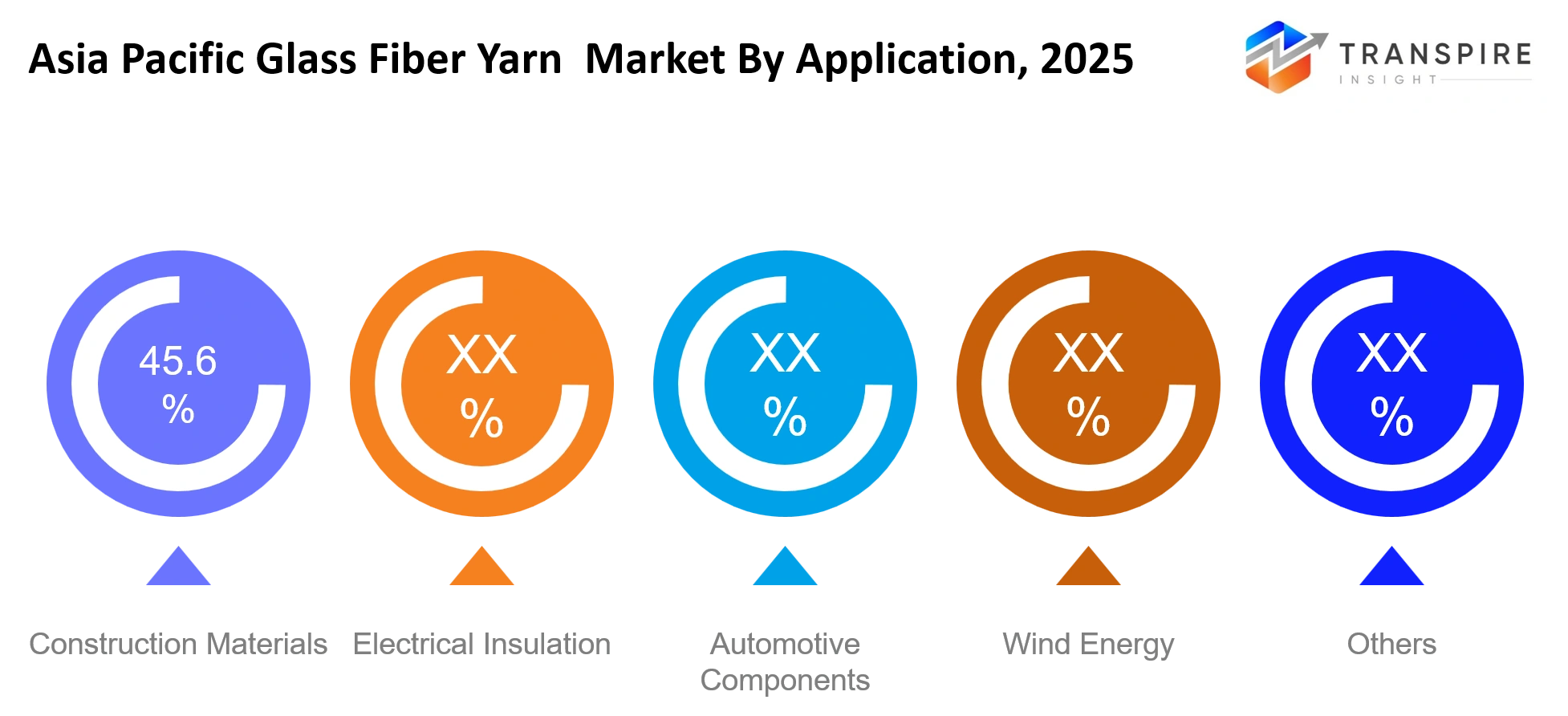
Construction Materials come up as a leading application because reinforced composites help with structural strength, durability,and also corrosion resistance in buildings and bigger infrastructure jobs. A lot of this shows up in panels, roof systems, piping, plus reinforcement products so the material consumption stays pretty consistent. The long service life and the lower upkeep kind of requirements keep pushing adoption, even in residential, commercial, and industrial construction work.
Electrical Insulation takes a big chunk of use, mainly thanks to strong dielectric properties that enable safe, dependable electrical systems. Automotive Components keep demand steady too, since makers keep leaning on lightweight materials that improve vehicle efficiency and overall performance. Wind Energy keeps growing, mostly as composite materials get used more in turbine blades, and then “Others” covers industrial equipment, consumer goods, marine structures, and specialized uses where strength, durability, and low weight characteristics matter.
To learn more about this report, Download Free Sample Report
By End User
Construction Industry takes up a meaningful chunk of the market, mainly because infrastructure buildouts, city expansion, and renovation jobs demand long lasting reinforcement materials. These products tend to stay in service longer, so people keep buying them. Also, strong spending on commercial properties, transport corridors and industrial plants keeps pushing material needs forward. At the same time structural dependability plus lower upkeep charges help keep demand steady, even when budgets get a bit tight.
Automotive Industry still counts as a key end user, since car makers integrate lightweight composite options to get better fuel efficiency, stronger vehicle behavior, and more flexible design layouts. The Electronics Industry also keeps opening chances for growth, thanks to glass fiber based materials used in circuit boards, insulation systems, and electronic components that have to perform reliably day after day. Other segments range from wind energy developers, to industrial producers, consumer goods manufacturers, and transportation equipment companies, they all lean on advanced composites for different kinds of operating needs and production requirements.
What are the Key Use Cases Driving the Asia Pacific Glass Fiber Yarn Market?
The biggest use case for glass fiber yarn, still is composite reinforcement in construction and infrastructure projects. Manufacturers use fiberglass materials in reinforced concrete structures, bridge components, pipelines, roofing panels, and other tasks where strength, resistance against corrosion, and long lasting performance are a big deal. This area creates real demand because infrastructure endeavors need huge material volumes, and they must last for many years.
Past construction, glass fiber yarn shows up in wind turbine blades, automotive parts, and printed circuit boards. Wind energy developers lean on fiberglass composites to craft lighter blades that can manage higher mechanical stress. In electronics, producers choose specialized yarn grades to help with high performance PCB fabrication.
Newer uses are starting to appear like electric vehicle battery enclosures, advanced communications devices, and next generation electronic substrates. These uses are still not massive today, but they should offer promising growth chances as advanced manufacturing keeps spreading across Asia Pacific.
|
Report Metrics |
Details |
|
Market size value in 2025 |
USD 2.24 Billion |
|
Market size value in 2026 |
USD 2.37 Billion |
|
Revenue forecast in 2033 |
USD 3.52 Billion |
|
Growth rate |
CAGR of3.52% from 2026 to 2033 |
|
Base year |
2025 |
|
Historical data |
2021 - 2024 |
|
Forecast period |
2026 - 2033 |
|
Report coverage |
Revenue forecast, competitive landscape, growth factors, and trends |
|
Regional scope |
Asia Pacific (India, China, Japan, Australia, South Korea, Rest of Asia Pacific) |
|
Key company profiled |
Owens Corning, Jushi Group, Saint-Gobain, Nippon Electric Glass, Taishan Fiberglass, Johns Manville, Chongqing Polycomp, AGY Holding, Binani Industries, 3B Fibreglass, PFG Fiber Glass, BASF, Lanxess, Toray Industries, Hexcel |
|
Customization scope |
Free report customization (country, regional & segment scope). Avail customized purchase options to meet your exact research needs. |
|
Report Segmentation |
By Product Type (E-Glass Yarn, S-Glass Yarn, C-Glass Yarn, Others); By Application (Construction Materials, Electrical Insulation, Automotive Components, Wind Energy, Others); By End User (Construction Industry, Automotive Industry, Electronics Industry, Others) |
Which Regions are Driving the Asia Pacific Glass Fiber Yarn Market Growth?
China kinda represents the leading market in Asia Pacific because it has this huge manufacturing ecosystem, really tied-up supply chains, and lots of money flowing into renewable energy and electronics production. The place also has several of the biggest fiberglass manufacturers around, and it keeps pushing to expand production capacity. On top of that, strong local demand from construction, transport, and industrial activities keeps reinforcing that leadership. And yeah, there are government backed industrial development programs, which in practice help keep long-term investment in advanced materials moving forward, even when conditions shift.
Japan together with South Korea make up another large regional cluster. But honestly, they’re not so much about raw production volume, it is more like their edge is in high value manufacturing use cases. Their electronics sectors are solid, automotive manufacturing quality is advanced, and research and development investment stays steady, so demand tends to remain stable for premium glass fiber solutions. Both countries continue to be key markets for specialized electronic grade and high performance yarn types, which is why they matter for suppliers that focus on more technical performance.
Then India shows up as the fastest moving market across the forecast period. The reason feels pretty straightforward: industrial expansion, infrastructure spending, growth in automotive output, plus manufacturing policies that give more support. That combination creates conditions where fiberglass use can climb. New investments in advanced materials and in domestic manufacturing are also helping India strengthen its role inside regional supply chains. For investors and companies entering the market, this growth path is like a two way chance, meaning opportunities both in building capacity and in downstream composite manufacturing applications.
Who are the Key Players in the Asia Pacific Glass Fiber Yarn Market and How Do They Compete?
In the Asia Pacific glass fiber yarn market the competition is kind of moderately concentrated, with a cluster of big multinational and regional producers that hold a lot of the production capacity. Most players compete by riding on production scale, product quality, the technological know-how, and also how strong they are in local manufacturing presence. Still, the ability to keep delivering steady, reliable quality while also staying cost efficient remains one of those key deal makers, even if the phrasing differs.
Jushi Group leans on large-scale production and ongoing capacity buildouts to keep its position firm. The group invested in advanced electronic glass fiber setups and also carbon-neutral manufacturing initiatives, and that helps both efficiency and sustainability objectives… at the same time, sort of.Owens Corning seems to put most attention on product innovation and the development of sustainable materials. They keep enlarging their advanced composites portfolio to meet shifting customer demands, especially in construction and industrial use cases.
Saint-Gobain differentiates with wide-ranging material expertise, plus a more strategic expansion throughout the Asia Pacific area. More recently, acquisitions and partnerships have reinforced its regional footprint, and they open up chances for cross segment technology integration.Nippon Electric Glass centers on high-performance glass materials, mainly for electronics and industrial applications. Meanwhile Taishan Fiberglass emphasizes big production capabilities and growing involvement in renewable energy supply chains.
Company List
- Owens Corning
- Jushi Group
- Saint-Gobain
- Nippon Electric Glass
- Taishan Fiberglass
- Johns Manville
- Chongqing Polycomp
- AGY Holding
- Binani Industries
- 3B Fibreglass
- PFG Fiber Glass
- BASF
- Lanxess
- Toray Industries
- Hexcel
Recent Development News
In February 2025, Jushi Group launched construction of the second phase of its Huai'an carbon-neutral intelligent manufacturing base. The project includes a 100,000-ton electronic glass fiber production line and strengthens the company's position in advanced fiberglass manufacturing.https://www.jushi.com
In February 2025, Saint-Gobain completed the acquisition of FOSROC. The transaction expanded Saint-Gobain's presence across India and Asia Pacific, enhancing its industrial materials footprint and regional growth platform.https://www.saint-gobain.com
In September 2025, Saint-Gobain Indonesia and Muliaglass entered a joint venture agreement for a new coated glass business in Indonesia. The partnership strengthens manufacturing capabilities and expands market reach across Southeast Asia.https://id.investing.com
What Strategic Insights Define the Future of the Asia Pacific Glass Fiber Yarn Market?
The market seems to be drifting toward higher-value and more technology-heavy use cases, not really just chasing volume. Electronic-grade materials, components for renewable energy, and advanced transportation composites are projected to bring in a bigger slice of industry revenues over the next seven years. If you ask what’s pushing it, the driver is basically the growing demand for lightweight, long lasting and high performance materials across key manufacturing areas, you know across “strategic” sectors.
But there’s also a less obvious risk… production capacity is getting concentrated, in other words, only a handful of major suppliers and manufacturing locations hold the big share. So if something happens around energy expenses, trade rules, or raw material availability, supply stability and pricing can get impacted pretty quickly. Meanwhile, electronic-grade glass fiber yarn is showing up as an opportunity, it’s still not deeply adopted though, compared with older construction uses.
For players in the market, the smarter approach looks like focusing on specialized product development and on digital manufacturing capabilities, not just trying to win on production volume alone. Businesses that sync their capacity growth with electronics, renewable energy, and advanced industrial applications are the ones most likely to secure stronger margins, and better long-term growth.
Asia Pacific Glass Fiber Yarn Market Report Segmentation
By Product Type
- E-Glass Yarn
- S-Glass Yarn
- C-Glass Yarn
- Others
By Application
- Construction Materials
- Electrical Insulation
- Automotive Components
- Wind Energy
- Others
By End User
- Construction Industry
- Automotive Industry
- Electronics Industry
- Others
Frequently Asked Questions
Find quick answers to common questions.
The expected Asia Pacific Glass Fiber Yarn Market size for the market will be USD 3.52 Billion in 2033.
Key segments for the Asia Pacific Glass Fiber Yarn Market are By Product Type (E-Glass Yarn, S-Glass Yarn, C-Glass Yarn, Others); By Application (Construction Materials, Electrical Insulation, Automotive Components, Wind Energy, Others); By End User (Construction Industry, Automotive Industry, Electronics Industry, Others)
Major Asia Pacific Glass Fiber Yarn Market players are Owens Corning, Jushi Group, Saint-Gobain, Nippon Electric Glass, Taishan Fiberglass, Johns Manville, Chongqing Polycomp, AGY Holding, Binani Industries, 3B Fibreglass, PFG Fiber Glass, BASF, Lanxess, Toray Industries, Hexcel
The Asia Pacific Glass Fiber Yarn Market size is USD 2.24 Billion in 2025.
The Asia Pacific Glass Fiber Yarn Market CAGR is 3.52% from 2026 to 2033.
- Owens Corning
- Jushi Group
- Saint-Gobain
- Nippon Electric Glass
- Taishan Fiberglass
- Johns Manville
- Chongqing Polycomp
- AGY Holding
- Binani Industries
- 3B Fibreglass
- PFG Fiber Glass
- BASF
- Lanxess
- Toray Industries
- Hexcel
About the Authors

Pankaj Ghogare Patil
I am Pankaj Ghogare Patil, a Senior Research Analyst at Transpire Insight, specializing in the Pharmaceutical, Chemicals & Materials, Healthcare IT, and Biotechnology industry. My expertise lies in conducting comprehensive market research, analyzing industry trends, evaluating competitive landscapes, and translating complex data into actionable insights. At Transpire Insight, I closely follow emerging technologies, regulatory developments, and market innovations to create accurate, well-researched, and informative content that helps businesses and professionals make informed decisions. I am committed to producing credible, evidence-based articles that reflect industry best practices while making technical topics accessible and valuable for a broad audience.

Chakradhar Khansole
Chakradhar serves as the Research Director at Transpire Insight, bringing over 8 years of experience in technology, innovation, and strategic market intelligence. He specializes in transforming complex market data into actionable business insights that enable organizations to make informed, growth-oriented decisions. Recognized for his strategic vision and analytical expertise, Chakradhar leads high-impact research initiatives, delivering comprehensive market assessments, competitive intelligence, and forward-looking industry analysis.
Recently Published Reports
-
May 2026
Healthcare Polymer Packaging Market
Healthcare Polymer Packaging Market Size, Share & Analysis Report By Packaging Type (Syringes, IV Bottles and Pouches, Clamshells, Blisters, Bottles & Jars, Containers, Tubes, IV Parental Packaging, Others), By Type (Regulated, Non-regulated), By Polymer Type (LDPE (Low-Density Polyethylene), HDPE (High-Density Polyethylene), Homo-polymer (Homo), Random Copolymer (Random), Block Copolymer (Block), PET, Polystyrene, Polyvinyl Chloride, Polyamide/EVOH, Others), and Geography (North America, Europe, Asia-Pacific, Middle East and Africa, South and Central America), 2021 - 2031
-
Apr 2026
Hydrophilic Tape (Waterstop) Market
Hydrophilic Tape (Waterstop) Market Size, Share & Analysis Report By Type (Bentonite-Based Hydrophilic Tape, Rubber-Based Hydrophilic Tape), By Application (Residential Buildings, Commercial Buildings, Infrastructure Projects), and Geography (North America, Europe, Asia-Pacific, Middle East and Africa, South and Central America), 2021 - 2031
-
Apr 2026
Metalens Market
Metalens Market Size, Share & Analysis Report By Type (Visible Light Metalens, and Infrared Metalens), By Application (Consumer Electronics, Automotive Electronics, Industrial, Medical, and Others), and Geography (North America, Europe, Asia-Pacific, Middle East and Africa, South and Central America), 2021 - 2031
-
Apr 2026
PBT Resin Market
PBT Resin Market Size, Share & Analysis Report By Type (Reinforced PBT Resin, Unreinforced PBT Resin), By Processing Method (Injection Molding, Extrusion, Blow Molding, Others), By End-User (Automotive, Electrical & Electronics, Consumer Appliances, Industrial Machinery, Medical Devices, Packaging, Others), and Geography (North America, Europe, Asia-Pacific, Middle East and Africa, South and Central America), 2021 - 2031