

Global Stained Glass Market Size & Forecast:
- Global Stained Glass Market Size 2025: USD 5.45 Billion
- Global Stained Glass Market Size 2033: USD 7.755 Billion
- Global Stained Glass Market CAGR: 4.51%
- Global Stained Glass Market Segments: By Type (Cathedral Glass, Opalescent Glass, Antique Glass, Colored Glass), By Application (Residential, Commercial, Religious Buildings, Decorative), By End-User (Consumers, Architects, Designers, Churches)

To learn more about this report,  Download Free Sample Report
Global Stained Glass Market Summary:
The Stained Glass Market size is estimated at USD 5.45 Billion in 2025 and is anticipated to reach USD 7.755 Billion by 2033, growing at a CAGR of 4.51% from 2026 to 2033.
This industry manufactures and cuts colored, rolled, and opalescent glass sheets used to assemble decorative windows, structural panels, and architectural accents. Over the past three years, purchasing strategies have shifted from purely traditional heritage restorations to modern commercial interior engineering. What actually triggered this was a sudden design movement toward biophilic office layouts and premium hospitality spaces seeking unique acoustic and light-filtering materials. To protect their luxury branding, major architects drove a structural shift away from generic laminated glass toward custom-rolled art glass. They now require high-purity cathedral and opalescent sheets to manage internal glare while creating custom branding aesthetics. This reliance on high-end glass structures forces commercial developers to secure volume contracts directly with specialty kilns, multiplying production pipelines.
Key Global Stained Glass Market Insights:
- The global stained glass market is shifting from classic leaded heritage designs toward high-purity, structurally engineered interior installations. This transition is accelerated by commercial architects demanding custom-rolled sheets to execute dynamic light-filtering and biophilic corporate layouts.
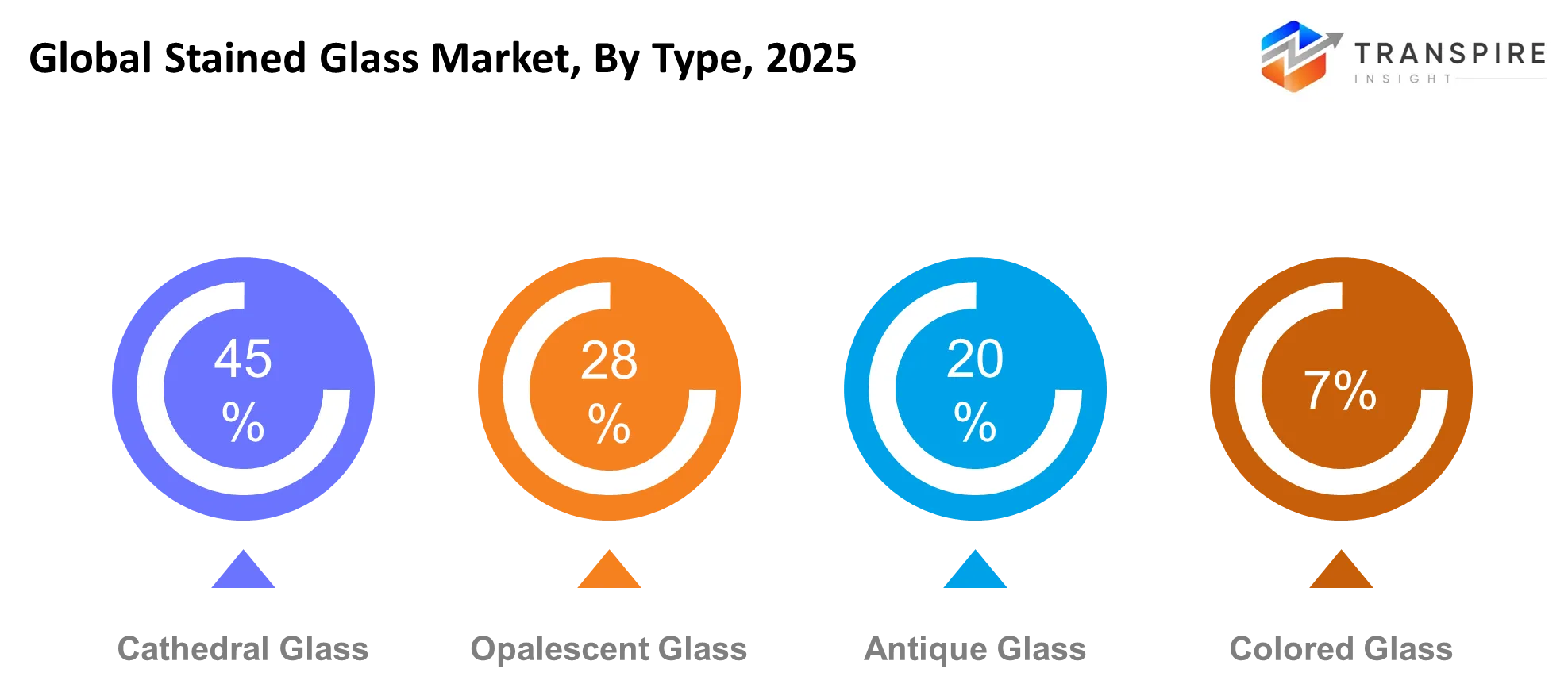
- Cathedral glass holds a 45% share as Saint-Gobain advances automated rolling kilns, driving a technological movement toward uniform thickness in large-scale projects.
- Opalescent glass expands at a 9.7% CAGR as Corning engineers high-density crystalline opacifiers, sparking a behavioral movement toward dramatic, non-transparent light diffusion.
- The decorative segment commands a 57% market share as Asahi Glass rolls out ultra-thin decorative laminates, fueling a behavioral movement for premium corporate branding.
- Antique glass captures a stable 20% share as Nippon Sheet Glass modernizes mouth-blown glass techniques, supporting a behavioral movement to replicate historic textures.
- Colored glass maintains a 7% share as Guardian Glass develops stable metal-oxide doping formulas, powering a technological movement toward permanently vibrant panels.
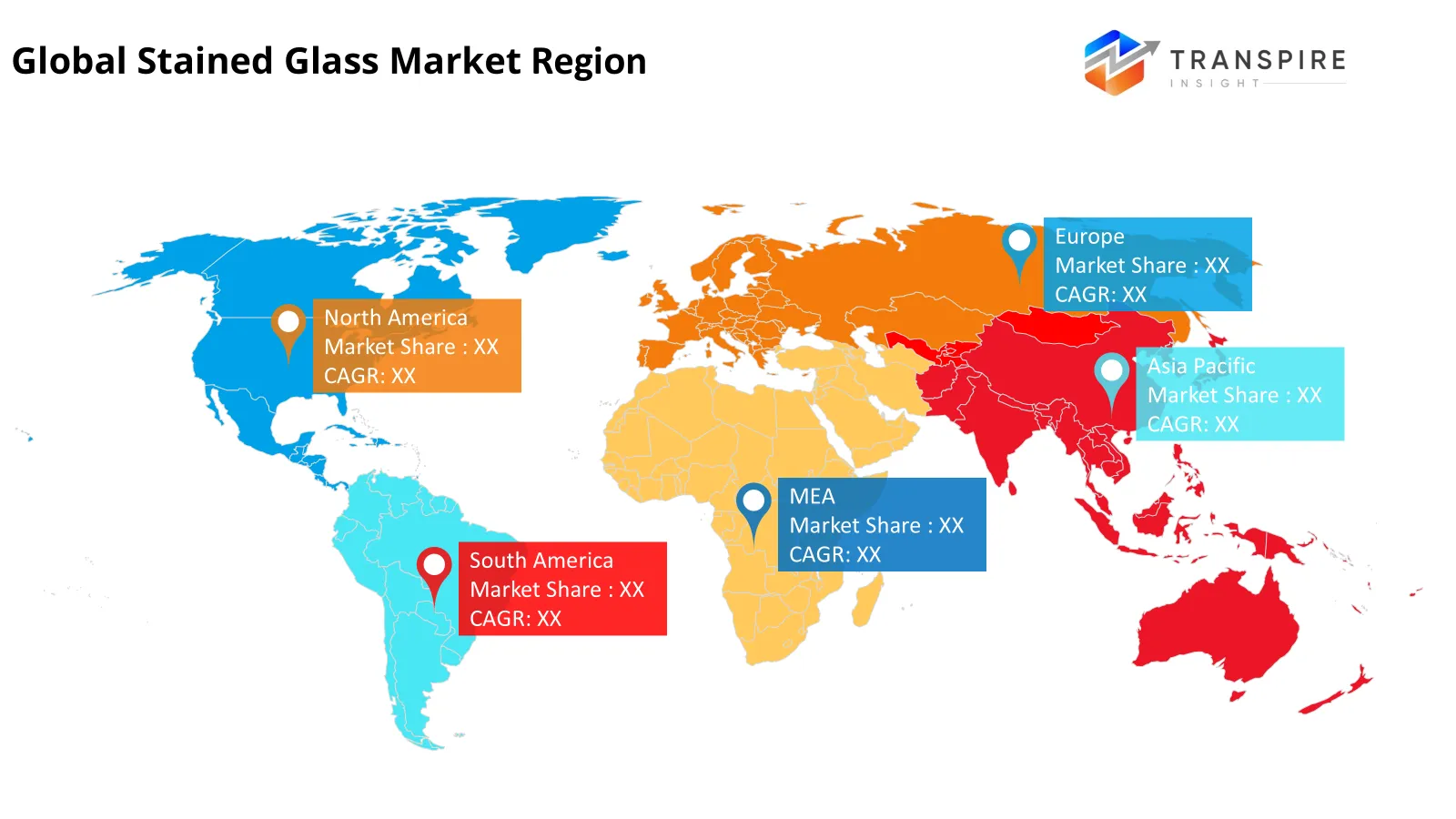
- Asia Pacific leads with a 40% share as AGC Inc expands regional high-purity silica processing mills, triggering a technological movement to secure localized supply chains.
- Europe secures a 26% regional share as Schott deploys specialized zero-emission electric furnaces, forcing a behavioral movement to comply with strict eco-mandates.
- North America hits an 11.6% CAGR (20% share) as Pilkington rolls out self-cleaning coatings, engineering a technological movement for low-maintenance urban storefronts.
What are the Key Drivers, Restraints, and Opportunities in the Global Stained Glass Market?
Driver:
High-end hotels and corporate offices are obsessing over luxury branding, and that is pushing this market forward. The real catalyst here was a massive architectural shift toward biophilic design, which forced interior designers to hunt for custom ways to filter light and dampen sound. A practical instance of this is luxury resort chains completely dumping generic laminated glass partitions in favor of custom-rolled cathedral glass walls. Because global design firms are writing these exact premium materials straight into their blueprint specs, glass manufacturers are locking down massive, recurring high-volume contracts that heavily multiply overall industry revenue.
Restraint:
The severe shortage of traditionally trained, highly skilled master glass artisans acts as the primary structural ceiling on market profitability. This bottleneck persists because the manual techniques required to consistently blow antique sheets or assemble leaded windows cannot be effectively duplicated by standard high-volume assembly lines. When older craftspeople retire, kilns face long operational delays, directly capping production volumes, stretching project lead times, and preventing broader commercial adoption.
Opportunity:
The biggest future opportunity lies in the commercialization of vacuum-insulated glass (VIG) framing systems for stained installations. Historically, custom art glass panels were choked out of major urban developments due to strict, modern building insulation codes. By engineering advanced, multi-layered energy envelopes around art glass sheets, manufacturers can fully comply with aggressive green construction mandates, unlocking a massive modernization pipeline across major North American corporate corridors.
What Has the Impact of Artificial Intelligence Been on the Global Stained Glass Market?
Artificial intelligence is fundamentally reshaping the stained glass industry by transitioning traditional, manual glass-scoring into an optimized, data-driven system. Kilns and design studios are rapidly adopting AI-driven nesting algorithms to achieve maximum material optimization during the layout phase. Instead of master cutters manually planning how to piece intricate cathedral and opalescent shapes together, machine learning software instantly configures multi-axial layouts on raw sheets. This technology introduces massive operational improvements, primarily by driving down scrap and material waste to absolute minimum thresholds while drastically increasing cutting speeds.
Furthermore, advanced predictive capabilities are streamlining modern factory floor workflows. Upgraded automated vision systems track micro-fissures and thermal cooling stresses in structural sheets, predicting exactly when a raw panel is structurally unstable long before a mechanical diamond blade ever touches the surface. A practical instance of this operational overhaul is glass manufacturing giants deploying automated post-processor software like CrystalCAM to auto-generate custom G-code toolpaths and pre-scoring routines for intricate architectural patterns.
The primary limitation to this digital evolution is the steep initial capital integration cost. Upgrading legacy glass rollers and CNC machinery to interface seamlessly with advanced AI vision engines requires massive infrastructure spending, meaning smaller boutique stained glass studios are currently priced out of these premium modernization systems.
Key Market Insights:
- The global stained glass industry is shifting from traditional lead-framed ecclesiastical projects toward ultra-durable, frameless architectural glass panels. This evolution is defined by a massive technological movement toward safety lamination and a behavioral push to blend art glass into modern corporate spaces.
- Design studios replaced manual glass-cutting over time via a technological movement toward multi-axis waterjet cutting, driving an industry shift allowing complex geometric window designs.
- Manufacturers evolved past traditional lead came over time through a behavioral movement demanding safer workspaces, sparking an industry shift toward lead-free copper foil.
- Architects moved away from thin structural sheets over time via a technological movement engineering resin-laminated cores, forcing an industry shift toward code-compliant safety glass.
- Commercial builders shifted from imported glass over time through a behavioral movement to source from local kilns, solidifying an industry shift toward decentralized procurement.
- Engineers evolved past standard soda-lime formulas over time via a technological movement embedding high-purity borosilicate, causing an industry shift toward superior thermal stability.
- Glass studios abandoned basic uninsulated installations over time through a technological movement using vacuum-sealed dual-glazing, driving an industry shift toward energy-efficient art glass.
- Restorers replaced manual archival matching over time via a technological movement utilizing spectroradiometric color scanning, causing an industry shift toward perfect historical tint replicas.
- Hospitality brands moved past plain frosted panels over time through a behavioral movement demanding custom-fused textures, triggering an industry shift toward premium lounge interiors.
Global Stained Glass Market Segmentation
By Type
Looking at the core material classifications, cathedral glass firmly holds the dominant market position, locking down a massive 45% global volume share. The unique growth logic powering this segment is an industry-wide transition toward large-scale architectural projects that demand absolute clarity and uniform light transmission across expansive surfaces. Moving forward, the future implication is that cathedral glass will remain the absolute operational backbone of commercial glass production lines as high-volume rolling kilns scale their output. Meanwhile, opalescent glass ranks as the fastest-growing type, accelerating at a breakneck 9.7% CAGR while capturing a stable 28% share. Its growth logic is purely born out of a shifting design movement toward dramatic, non-transparent light diffusion inside high-end luxury interiors. Ultimately, this implies opalescent glass will experience massive retail and commercial adoption as premium hospitality brands increasingly specify it for custom spatial partitioning. Finally, antique glass and colored glass capture the remaining 20% and 7% shares, respectively. Their growth relies entirely on boutique heritage restorations and highly specialized UV-resistant exterior curtain installations, implying these classic configurations will steadily mature into highly stable, recession-resistant market niches.
To learn more about this report, Download Free Sample Report
By Application
Evaluating the market by functional installation, the decorative segment commands the absolute most aggressive market position and user adoption rate, securing a dominant 57% market share. The unique growth logic driving this overwhelming presence is a widespread behavioral push from modern interior designers who deploy custom art glass sheets to execute experiential branding and premium sensory themes. The future implication here is that decorative applications will essentially render plain, untreated glass accents completely obsolete across high-end urban storefronts within the next development cycle. Conversely, commercial, residential, and religious building applications maintain highly secure, foundational market footprints. Their growth logic relies on the absolute structural necessity to integrate aesthetic art panels with rigid, code-compliant safety features like resin-laminated cores or thermal borosilicate raw materials. Moving forward, this implies that non-decorative building segments will transition almost exclusively into ultra-durable, dual-glazed energy envelopes designed to withstand extreme structural and environmental pressures.
By End-User
Evaluating the market participants, architects and professional designers completely dictate the primary demand side of the ecosystem. Their market position is absolute, and their unique growth logic is fueled by the modern commercial reality where architects continuously write premium, light-filtering art glass straight into their upscale blueprint specifications. The future implication of this massive design-led purchasing shift is that glass manufacturers will be forced to secure long-term volume supply contracts directly with major architecture firms or risk permanently losing market share to alternative composite materials. On the supply side, consumers and churches hold the classic capital positions. They continue to purchase stained glass installations based on a very simple growth logic: they are actively driving historic preservation and premium residential estate renovations. Ultimately, the future implication here is a structural shift where institutional buying and large-scale corporate specifications aggressively crowd out traditional ecclesiastical orders, fundamentally re-engineering the factory lines to favor high-volume, modern commercial tranches.
What are the Key Use Cases Driving the Global Stained Glass Market?
The primary use case fueling the market is structural architectural installations, directly anchoring the cathedral glass segment. High-end retail showrooms and luxury corporate offices deploy these large-scale sheets to execute dynamic, glare-free daylighting while establishing premium branding layouts.
Acoustic spatial partitioning serves as the primary expanding application. Interior designers and corporate planners utilize custom-rolled opalescent panels to construct private boardroom barriers and hospitality lounges, bridging the gap between artistic visual isolation and noise reduction.
Integrated solar-harvesting facades act as the ultimate emerging usecase. Building engineers are increasingly embedding photovoltaic thin-films directly into colored exterior safety laminates, transforming decorative skyscraper windows into active energy-generating infrastructure.
|
Report Metrics |
Details |
|
Market size value in 2025 |
USD 5.45 Billion |
|
Market size value in 2026 |
USD 5.696 Billion |
|
Revenue forecast in 2033 |
USD 7.755 Billion |
|
Growth rate |
CAGR of 4.51% from 2026 to 2033 |
|
Base year |
2025 |
|
Historical data |
2021 - 2024 |
|
Forecast period |
2026 - 2033 |
|
Report coverage |
Revenue forecast, competitive landscape, growth factors, and trends |
|
Regional scope |
United States; Canada; Mexico; United Kingdom; Germany; France; Italy; Spain; Denmark; Sweden; Norway; China; Japan; India; Australia; South Korea; Thailand; Brazil; Argentina; South Africa; Saudi Arabia; United Arab Emirates |
|
Key company profiled |
Saint-Gobain, Corning, Asahi Glass, Nippon Sheet Glass, Guardian Glass, Schott, Pilkington, Vitro, Sisecam, Cardinal Glass, Oldcastle Glass, Kawneer, Viracon, PPG Industries, AGC Inc. |
|
Customization scope |
Free report customization (country, regional & segment scope). Avail customized purchase options to meet your exact research needs. |
|
Report Segmentation |
By Type (Cathedral Glass, Opalescent Glass, Antique Glass, Colored Glass), By Application (Residential, Commercial, Religious Buildings, Decorative), By End-User (Consumers, Architects, Designers, Churches) |
Which Regions are Driving the Global Stained Glass Market Growth?
Asia Pacific currently holds the dominant position in the global stained glass space, securing a commanding 40% of the total revenue share. This territory leads the market primarily because local commercial construction firms are funneling massive capital pools into expansive urban development projects. This aggressive expansion is heavily supported by a localized industrial ecosystem, where regional manufacturers utilize high-capacity silica processing mills to lower underlying material costs. By establishing specialized, high-volume production facilities to handle large-scale architectural projects, Asia Pacific guarantees a highly secure, cost-effective supply chain to sustain its massive regional demand. In February 2025, AGC Inc expanded its regional high-purity silica processing operations by rolling out automated material sorting protocols, cutting localized raw sheet supply costs to insulate the regional commercial glass manufacturing pipeline from cross-border inflation.
Europe holds a steady 26% of the market because they focus heavily on fixing what they already have, unlike the massive new building wave in Asia Pacific. The big anchor here is their endless collection of legally protected, historic church sites that constantly need expert heritage restoration work. Local governments actively back this up by passing strict preservation laws that legally force contractors to buy traditional, historically accurate glass textures. Because European nations obsess over keeping things authentic and fund high-end color-matching tech, specialty glass kilns are locked into a recession-proof, long-term supply pipeline. In March 2026, Pilkington upgraded its European restoration network by opening a dedicated spectroradiometric scanning lab, giving preservation teams a way to instantly match and replicate exact medieval glass tints for heritage cathedral windows.
North America is currently the fastest-expanding territory on the map, capturing a 20% market share while accelerating at a breakneck 11.6% CAGR. This rapid growth surge was triggered by corporate real estate developers executing an absolute behavioral movement to integrate art glass into upscale office designs and premium retail storefronts. Local architects are heavily investing in next-generation building envelopes, rapidly favoring structural panels over basic leaded windows to align with modern energy codes. This sharp technical pivot creates a massive future opportunity for glass fabricators to lock down lucrative commercial contracts by delivering high-performance, structurally laminated safety glass. In March 2026, Guardian Glass accelerated its North American market footprint at the annual Commercial Project Awards by demonstrating high-performance safety coatings on custom structural panels, enabling commercial glaziers to deploy code-compliant art glass across high-end urban storefront installations.
To learn more about this report, Download Free Sample Report
Who are the Key Players in the Global Stained Glass Market and how do they Compete?
The global stained glass landscape is split cleanly between massive industrial factories and high-end specialty art kilns. Competition is no longer about matching small hand-cut sheets. Instead, it is a heavy corporate race to deliver building-code-compliant safety laminates, flawless clarity, and perfect tint matching for huge, modern architectural installations.
Saint-Gobain leans heavily into a high-volume, low-cost manufacturing model to lock down big commercial real estate projects. They stand out by running highly automated, continuous-rolling kilns that pump out massive sheets of uniform cathedral glass, actively slashing per-unit costs for skyscraper glaziers. To grow, they use a highly localized factory footprint, setting up processing hubs right next to major construction zones to avoid expensive shipping fees over long distances.
Corning counts on a premium innovation strategy to capture lucrative, high-end interior design specs. They separate themselves from the competition by using advanced optical physics to blend custom chemical formulas, adding dense opacifiers and anti-reflective surfaces that give architects complete control over internal glare. Their primary expansion route relies on tight B2B partnerships, writing their specialty glass patents straight into global architectural supply chains.
Company List
- Saint-Gobain
- Corning
- Asahi Glass
- Nippon Sheet Glass
- Guardian Glass
- Schott
- Pilkington
- Vitro
- Sisecam
- Cardinal Glass
- Oldcastle Glass
- Kawneer
- Viracon
- PPG Industries
- AGC Inc
Recent Development News
- In March 2026, Corning launched its advanced Corning Gorilla Glass Ceramic 3 cover material focused on superior drop resilience. The release gives device designers a practical way to put tough, clear glass-ceramic composites right onto high-end retail displays or fragile structural setups. Source:https://www.corning.com
- In September 2025, AGC Inc teamed up with regional glass processors to demonstrate a horizontal recycling setup for flat window and solar panel glass at the Expo 2025 Osaka–Kansai. This work creates a closed loop to melt old building sheets back into fresh float glass, dropping raw material costs and slashing emissions for architectural glass builders. Source:https://www.agc-asiapacific.com
- In May 2026, SCHOTT Pharma, an operating subsidiary of the Schott Group, hit over EUR 45.4 million in positive free cash flow while holding its capital expenditures at EUR 50.1 million. This cash influx boosts factory capacity expansions across its automated facilities, speeding up the volume pipelines for specialized, highly stable structural containment and glass panels. Source:https://www.schott-pharma.com
What Strategic Insights Define the Future of the Global Stained Glass Market?
The stained glass industry is steering straight into modern green building infrastructure. It is moving past simple decoration to become a fully code-compliant structural asset. A massive emerging opportunity sits in marrying photovoltaic thin-films with custom art glass and vacuum-insulated frames, which opens wide pipelines across new corporate office builds. But a quiet, hidden risk is threatening the market: the disappearing artisan labor pool. Automated kilns just cannot copy the manual touch needed for old heritage restorations, leading to major project backlogs as older masters retire.
To hold their market positions, manufacturers need to abandon basic sheet production and push hard into custom, high-margin design options. Locking in multi-year, exclusive material contracts with major architecture firms guarantees steady volume, while putting capital into vision-guided automated cutting machinery protects production lines from these artisan labor shortages.
Global Stained Glass Market Report Segmentation
By Type
- Cathedral Glass
- Opalescent Glass
- Antique Glass
- Colored Glass
By Application
- Residential
- Commercial
- Religious Buildings
- Decorative
By End-User
- Consumers
- Architects
- Designers
- Churches
Regional Outlook
North America
- United States
- Canada
- Mexico
Europe
- Germany
- United Kingdom
- France
- Spain
- Italy
- Rest of Europe
Asia Pacific
- Japan
- China
- Australia & New Zealand
- South Korea
- India
- Rest of Asia Pacific
South America
- Brazil
- Argentina
- Rest of South America
Middle East & Africa
- Saudi Arabia
- United Arab Emirates
- South Africa
- Rest of the Middle East & Africa
Frequently Asked Questions
Find quick answers to common questions.
The approximate global stained glass market size will reach USD 7.755 Billion by 2033.
Key segments for the global stained glass market are Type (Cathedral Glass, Opalescent Glass, Antique Glass, Colored Glass), Application (Residential, Commercial, Religious Buildings, Decorative), and End-User (Consumers, Architects, Designers, Churches).
Major global stained glass market players are Saint-Gobain, Corning, Asahi Glass, Nippon Sheet Glass, Guardian Glass, Schott, Pilkington, Vitro, Sisecam, Cardinal Glass, Oldcastle Glass, Kawneer, Viracon, PPG Industries, and AGC Inc.
The global stained glass market size is USD 5.45 Billion in 2025.
The global stained glass market CAGR is 4.51% from 2026 to 2033.
- Saint-Gobain
- Corning
- Asahi Glass
- Nippon Sheet Glass
- Guardian Glass
- Schott
- Pilkington
- Vitro
- Sisecam
- Cardinal Glass
- Oldcastle Glass
- Kawneer
- Viracon
- PPG Industries
- AGC Inc
About the Authors

Pankaj Ghogare Patil
I am Pankaj Ghogare Patil, a Senior Research Analyst at Transpire Insight, specializing in the Pharmaceutical, Chemicals & Materials, Healthcare IT, and Biotechnology industry. My expertise lies in conducting comprehensive market research, analyzing industry trends, evaluating competitive landscapes, and translating complex data into actionable insights. At Transpire Insight, I closely follow emerging technologies, regulatory developments, and market innovations to create accurate, well-researched, and informative content that helps businesses and professionals make informed decisions. I am committed to producing credible, evidence-based articles that reflect industry best practices while making technical topics accessible and valuable for a broad audience.

Chakradhar Khansole
Chakradhar serves as the Research Director at Transpire Insight, bringing over 8 years of experience in technology, innovation, and strategic market intelligence. He specializes in transforming complex market data into actionable business insights that enable organizations to make informed, growth-oriented decisions. Recognized for his strategic vision and analytical expertise, Chakradhar leads high-impact research initiatives, delivering comprehensive market assessments, competitive intelligence, and forward-looking industry analysis.
Recently Published Reports
-
May 2026
Healthcare Polymer Packaging Market
Healthcare Polymer Packaging Market Size, Share & Analysis Report By Packaging Type (Syringes, IV Bottles and Pouches, Clamshells, Blisters, Bottles & Jars, Containers, Tubes, IV Parental Packaging, Others), By Type (Regulated, Non-regulated), By Polymer Type (LDPE (Low-Density Polyethylene), HDPE (High-Density Polyethylene), Homo-polymer (Homo), Random Copolymer (Random), Block Copolymer (Block), PET, Polystyrene, Polyvinyl Chloride, Polyamide/EVOH, Others), and Geography (North America, Europe, Asia-Pacific, Middle East and Africa, South and Central America), 2021 - 2031
-
Apr 2026
Hydrophilic Tape (Waterstop) Market
Hydrophilic Tape (Waterstop) Market Size, Share & Analysis Report By Type (Bentonite-Based Hydrophilic Tape, Rubber-Based Hydrophilic Tape), By Application (Residential Buildings, Commercial Buildings, Infrastructure Projects), and Geography (North America, Europe, Asia-Pacific, Middle East and Africa, South and Central America), 2021 - 2031
-
Apr 2026
Metalens Market
Metalens Market Size, Share & Analysis Report By Type (Visible Light Metalens, and Infrared Metalens), By Application (Consumer Electronics, Automotive Electronics, Industrial, Medical, and Others), and Geography (North America, Europe, Asia-Pacific, Middle East and Africa, South and Central America), 2021 - 2031
-
Apr 2026
PBT Resin Market
PBT Resin Market Size, Share & Analysis Report By Type (Reinforced PBT Resin, Unreinforced PBT Resin), By Processing Method (Injection Molding, Extrusion, Blow Molding, Others), By End-User (Automotive, Electrical & Electronics, Consumer Appliances, Industrial Machinery, Medical Devices, Packaging, Others), and Geography (North America, Europe, Asia-Pacific, Middle East and Africa, South and Central America), 2021 - 2031