

Europe Stained Glass Market Size & Forecast:
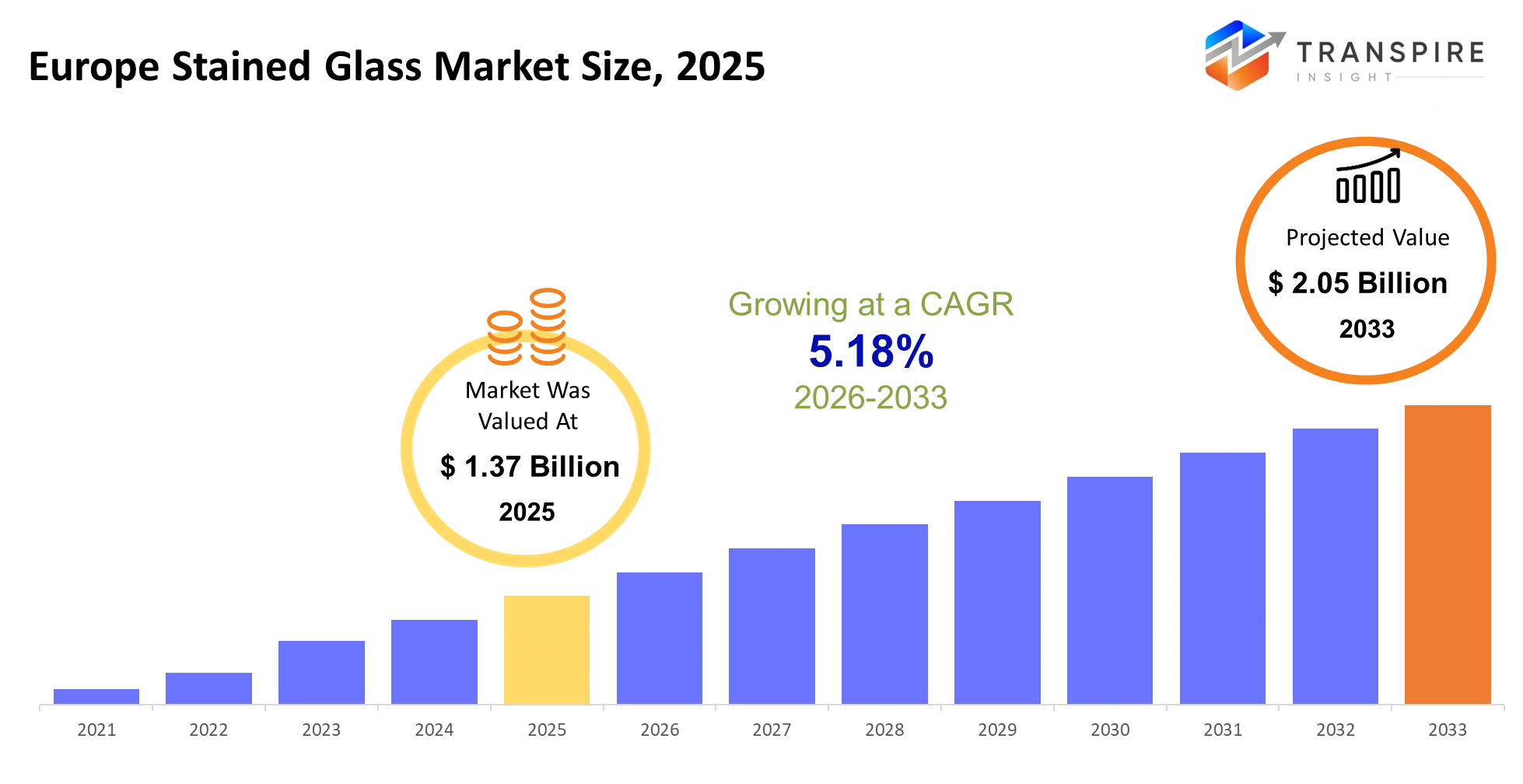
- Europe Stained Glass Market Size 2025: USD 1.37 Billion
- Europe Stained Glass Market Size 2033: USD 2.05 Billion
- Europe Stained Glass Market CAGR: 5.18%
- Europe Stained Glass Market Segments: By Type (Flat Glass, Beveled Glass, Colored Glass, Others); By Application (Windows, Doors, Decorative Panels, Others); By End-User (Residential, Commercial, Religious Buildings, Others); By Distribution (Direct, Retail, Online, Others).
To learn more about this report,  Download Free Sample Report
Europe Stained Glass Market Summary
The Europe Stained Glass Market was valued at USD 1.37 Billion in 2025. It is forecast to reach USD 2.05 Billion by 2033. That is a CAGR of 5.18% over the period.
The stained glass market in Europe provides decorative and functional glass installations for cathedrals and historic civic buildings and high-end architectural projects which use restoration techniques together with contemporary design solutions. The solution to this problem enables heritage window restoration through modern energy standards and safety requirements while maintaining the windows' historical value. The market has transitioned during the last three to five years from creating new custom installations to executing extensive restoration and retrofit work. Digital design technology and precision cutting technology have enabled wider use which produces better results for heritage restoration work because they enable better heritage material replication. European energy crisis and cultural tourism recovery after the pandemic have driven increased funding for conservation projects while supply chain disruptions have affected the acquisition of specialty metals and glass materials.
The higher project costs together with increased need for expert restoration work have resulted in continuous revenue increases for both specialized contractors and artisan studios.
Key Market Insights
-
Western Europe controls the biggest portion of the European Stained Glass Market in 2025 because France, Germany, and the UK maintain strong heritage conservation programs.
- The Central and Eastern European region will experience its fastest growth between 2024 and 2030 because of rising cultural restoration spending and developments in tourism infrastructure.
- Architectural glass ranks as the second largest segment which architects use in both high-end commercial spaces and contemporary religious buildings.
- Custom restoration seLeaded stained glass panels dominate the Europe Stained Glass Market, supported by cathedral restoration and historical building refurbishment demand.
- The decorative services market will grow at the highest rate until 2030 because of the rising need for accurate heritage restoration work.
- The Europe Stained Glass Market primarily serves religious and heritage buildings which receive ongoing funding for cathedral restoration work.
- The European market for bespoke interior design trends leads to rapid growth of luxury residential and commercial architectural applications.
- European authorities and heritage conservation organizations control most end-user market share because they finance major restoration projects at protected monuments.
- Private architectural firms represent the fastest-growing end-user category, integrating stained glass into modern, high-value construction projects.
- Technology upgrades in glass durability and energy efficiency are improving adoption in modern architectural applications.
What are the Key Drivers, Restraints, and Opportunities in the Europe Stained Glass Market?
Structural forces operate throughout the European Stained Glass Market, which determines both its restoration activities and its current architectural practices. The main force behind this trend is heritage conservation funding, which has gained momentum throughout Europe, because public grants and UNESCO preservation requirements support its growth. The French, German, and UK governments have increased their restoration budgets for cathedrals and historic civic buildings, because they want to use cultural heritage sites to stimulate tourism after COVID. The growing project backlog from restoration work has resulted in higher contract values, which helps specialized stained glass studios maintain their financial stability through consistent revenue growth.
The main limitation of the enterprise exists because it relies on skilled artisan workers who have specialized training but their numbers are limited and their availability throughout Europe is not uniform. Stained glass restoration requires manual craftsmanship combined with historical replication expertise, and this skills gap cannot be quickly resolved through automation or short-term training programs. The European Stained Glass Market suffers from installation delays because project backlogs continue to exist, which prevents the market from growing, although funding resources are abundant.
Digital fabrication and 3D modeling technology have established a new pathway to improve restoration workflows. Central European cathedral refurbishment studios increasingly adopt CAD-based replication tools to recreate damaged panels because these tools enable them to achieve better accuracy while producing less waste. The accessibility of this technology will create faster project completion times while it enables the Europe Stained Glass Market to enter mid-sized commercial architectural projects which extend beyond traditional heritage restoration work.
What Has the Impact of Artificial Intelligence Been on the Europe Stained Glass Market?
The Europe Stained Glass Market uses artificial intelligence and advanced digital tools to improve restoration accuracy and production efficiency which leads to new workflow methods for the industry. Modern studios use AI-powered image recognition technology to examine damaged cathedral windows which lets the system create automatic maps of cracks and missing pieces and historical design elements. The system enables CNC cutting machines to create replacement glass pieces with better accuracy because it decreases the need for manual tracing work. AI-powered control systems improve kiln firing and color matching procedures by using material response data to change temperature cycles.
The second transformation layer introduces predictive capabilities as its second layer. Machine learning models analyze environmental exposure, humidity, and structural stress on lead came frameworks to forecast glass degradation and prioritize maintenance schedules for heritage sites. The conservation planning process gets enhanced through this method which decreases the need for urgent restoration work.
The technologies achieve operational improvements by increasing workshop efficiency, which enables restoration projects to finish 20–25 percent faster while cutting material waste through better cutting pattern design. The process of adopting new technology faces challenges because organizations must spend large amounts to implement systems while they have difficulty finding historical glass data to train their models which leads to incorrect results when working with different building designs and light conditions. Digitalization continues to transform efficiency benchmarks throughout the Europe Stained Glass Market and its associated conservation fields despite existing obstacles.
Key Market Trends
- The international status of Western Europe has experienced a minor reduction since 2020 because Central and Eastern European countries have increased their investments in heritage restoration and cultural tourism development projects.
- The development of AI-assisted design and CAD-based restoration tools has progressed since 2022 to eliminate manual tracing methods and achieve better accuracy in restoring damaged historical glass panels.
- The period from 2021 to 2025 saw a major increase in funding allocation which resulted in extended project development capacities for both cathedral and civic building restoration companies.
- The demand for stained glass work shifted after 2021 from new stained glass installations to restoration projects which became the primary focus for post-pandemic cultural infrastructure recovery programs.
- The production of specialty pigments and lead materials has faced supply chain disruptions since 2020 which resulted in manufacturers adopting local sourcing and building multiple supplier partnerships.
- The project execution process has experienced delays because of the increasing demand for hybrid digital-craft restoration methods which arose from a shortage of skilled artisans after 2022.
- The European Union renovation codes now require building energy efficiency standards to incorporate insulated stained glass units during contemporary architectural restoration projects.
- The competitive business approaches employed by Saint-Gobain and European design studios now prioritize their partnerships with technology firms together with their abilities to create accurate restoration work.
Europe Stained Glass Market Segmentation
By Type:
The Europe Stained Glass Market receives its largest market share from flat glass which architects use to restore historic windows and architects use to execute their large-scale building designs. The market leader sustains its position because it can be used with both conventional leaded window designs and contemporary insulating glass systems which retrofit applications require. Beveled glass and colored glass maintain moderate positions, supported mainly by decorative and premium architectural demand, while specialty variants remain niche because their production requires complex processes.
The segment experiences growth because restoration projects demand precise restoration methods which use flat glass as the fundamental material for creating digital heritage design replicas. The demand for colored glass has increased because Western Europe now has extended funding cycles for cathedral refurbishment projects. The combination of technological advancements in glass cutting and color matching technology leads to decreased material waste, which improves standardization of production processes.
Future development will favor hybrid materials which combine flat glass with energy-efficient coatings. The manufacturing sector will focus on developing precision fabrication technologies which allow businesses to produce customized items at higher speeds. Investors may find stable returns in flat glass supply chains, while premium glass categories will expand through high-value architectural commissions.
By Application:
The Stained Glass Market in Europe most commonly uses windows because these windows are utilized throughout churches and heritage buildings and civic monuments that exist in France and Germany and the United Kingdom. Decorative panels hold a strong secondary position because luxury interiors and hospitality spaces increasingly adopt this design element. The market for doors and other specialty products operates at a minor size because structural limitations prevent them from being used as design elements.
Windows see their growth because historical facade preservation needs and government conservation initiatives require their ongoing restoration work. Architects currently choose to use stained glass for decorative purposes in contemporary commercial spaces because these elements will help their designs stand out. The demand for religious spaces has decreased because architectural spaces now require different design solutions than before.
The future will focus on developing applications that combine insulation capabilities with artistic design elements. The commercial real estate sector will increasingly use decorative installations for their redevelopment projects. Stained glass systems that achieve energy efficiency will become the primary choice for developers who want to use these systems in building envelopes while creating new operational possibilities for their original restoration purpose.

To learn more about this report, Download Free Sample Report
By End-User:
The Europe Stained Glass Market finds its biggest segment in religious buildings because European countries fund cathedral restoration and cultural heritage protection projects. The commercial building sector is expanding because hotels and corporate offices and cultural institutions increasingly use stained glass. The use of stained glass in residential spaces remains uncommon but it is increasing in upscale residential developments.
The establishment of religious buildings receives financial support from institutions which work together with UNESCO to protect cultural heritage sites. Developers increasingly use stained glass for branding purposes and creating premium interior spaces which drive commercial demand. High-income households show increasing interest in personalized architectural design, which affects their decision to build new homes.
Future trends indicate that religious institutions will decrease their activities and start developing business operations. Urban development will create more equal demand patterns throughout various industries, which investors will encounter. Manufacturers are expected to develop design solutions that enable them to handle both institutional restoration projects and contemporary architectural design work.
By Distribution:
The Europe Stained Glass Market depends on direct sales because restoration work needs customized agreements between studios and architects and heritage institutions. The retail market exists at a minor scale, which mainly serves customers who buy decorative items and local artists. Online distribution has started to develop, but its progress remains slow because stained glass products require specialized knowledge.
The expansion of direct distribution through direct distribution channels occurs because project-driven procurement systems which emphasize custom solutions and technical expertise and historical data accuracy. Retail demand exhibits consistent patterns but it is restricted because of limited product availability and specialized purchasing behavior. The design consultation services now available through online platforms enable smaller architectural projects to access these services.
Future expansion will likely strengthen hybrid distribution models which combine direct contracts with digital consultation platforms. The development of better visualization technologies will enable online channels to increase client participation in design selection activities. The integrated sales systems will help manufacturers because they shorten project lead times and create better communication between designers and restoration teams.
What are the Key Use Cases Driving the Europe Stained Glass Market?
Heritage restoration of religious and historic buildings through cathedral window reconstruction functions as the primary application of the Europe Stained Glass Market, which particularly serves the window restoration needs of cathedrals throughout France and Germany and the United Kingdom. The need for historical monument restoration work exists because public funding for cultural preservation efforts continues to support existing funding requirements, which governmental bodies have enforced to protect historical sites.
Stained glass works are used in luxury commercial interiors and hospitality projects, which include hotels and corporate lobbies and cultural venues to create distinctive architectural styles. Commercial developers and private architectural firms drive these projects, which aim to develop unique design solutions need to compete in urban real estate markets.
The implementation of energy-efficient architectural glazing systems emerges as a new application that uses stained glass for all building designs through its combination with insulated glass units. The adoption of adaptive reuse projects shows limited success because industrial buildings take on mixed-use functions through retaining their historic design elements while meeting modern building requirements.
|
Report Metrics |
Details |
|
Market size value in 2025 |
USD 1.37 Billion |
|
Market size value in 2026 |
USD 1.44 Billion |
|
Revenue forecast in 2033 |
USD 2.05 Billion |
|
Growth rate |
CAGR of 5.18% from 2026 to 2033 |
|
Base year |
2025 |
|
Historical data |
2021 - 2024 |
|
Forecast period |
2026 - 2033 |
|
Report coverage |
Revenue forecast, competitive landscape, growth factors, and trends |
|
Regional scope |
Europe (Germany, United Kingdom, France, Italy, Spain, Rest of Europe) |
|
Key company profiled |
Saint-Gobain, Asahi Glass, Nippon Sheet Glass, Guardian Glass, Pilkington, Schott, Corning, Sisecam, Vitro, Central Glass, Viracon, Hartung Glass, PPG Industries, NSG Group, Euroglas. |
|
Customization scope |
Free report customization (country, regional & segment scope). Avail customized purchase options to meet your exact research needs. |
|
Report Segmentation |
By Type (Flat Glass, Beveled Glass, Colored Glass, Others); By Application (Windows, Doors, Decorative Panels, Others); By End-User (Residential, Commercial, Religious Buildings, Others); By Distribution (Direct, Retail, Online, Others). |
Which Regions are Driving the Europe Stained Glass Market Growth?
Western Europe holds the leading position in the Europe Stained Glass Market, driven by its dense concentration of heritage landmarks and strict cultural preservation frameworks. The three countries of France, Germany, and the United Kingdom implement their established restoration regulations which require ongoing maintenance of cathedrals and historical municipal structures. The region maintains operational requirements which depend on essential factors from its network of artisan studios and conservation architects and government-funded heritage organizations. The integrated network maintains regular demand patterns which enable restoration projects of high value to continue throughout the entire region.
Northern Europe represents a stable but structurally different contributor, with modern architectural integration creating demand which exceeds historical restoration requirements. The countries of Sweden and the Netherlands and Denmark build energy-efficient structures which use stained glass as part of modern architectural design. The combination of municipal renovation programs and ongoing public infrastructure investment leads to gradual adoption of new technologies in commercial and institutional buildings. The region develops a demand base which stays constant because it does not depend on heritage density.
The fastest-growing region in Central and Eastern Europe receives support from increased EU cultural funding and the quick restoration of post-socialist heritage sites. The three countries of Poland and Hungary and the Czech Republic invest in urban renewal projects which focus on tourism and the restoration of cathedrals. The recent enhancements in public financing together with cross-border cultural projects have created new opportunities for restoration contractors to obtain work.Entry opportunities are strong because of the momentum and should be targeted so that the investor and supplier, seeking long-term growth for the route in between 2025 and 2033, capitalizes on the software.
Who are the Key Players in the Europe Stained Glass Market and How Do They Compete?
The European stained glass market operates with multiple competing companies following a specialized business model while a few major glass producers control raw material supply. Heritage restoration companies maintain market presence through their permanent contracts with cathedrals and their abilities to obtain professional certifications. Digital fabrication technology enables new businesses to enter the market, yet they encounter difficulties because they need to acquire artisan skills. Technical precision and historical authenticity and project-specific service quality create the main competitive framework while customers pursue lower prices. The current competitive environment turns to digital design tools and CNC-assisted restoration processes for its transformative capacity.
Saint-Gobain develops new materials and high-performance architectural glass solutions, which provide energy-efficient substrates for European restoration projects. Lamberts Glass produces handmade colored mouth-blown glass in Germany, which enables conservation studios to access historically accurate materials for their work. Derix Glasstudios builds competitive advantage through cathedral-scale restoration expertise and collaboration with heritage institutions across Western Europe.
The York Glaziers Trust provides historic cathedral restoration services through conservation-led methods, which utilize both government preservation funds and their internal archival capabilities. Glasmalerei Peters provides precise glass painting and restoration services for ecclesiastical buildings, which strengthens their market position through partnerships with European heritage institutions. The organizations broaden their reach by entering into international restoration agreements and participating in UNESCO-related conservation initiatives, which helps them maintain their stronghold over premium contracts.
Company List
- Saint-Gobain
- Asahi Glass
- Nippon Sheet Glass
- Guardian Glass
- Pilkington
- Schott
- Corning
- Sisecam
- Vitro
- Central Glass
- Viracon
- Hartung Glass
- PPG Industries
- NSG Group
- Euroglas
Recent Development News
In March 2026, Pilkington (NSG Group) advanced its energy-efficient glazing solutions through upgraded coated glass technologies for architectural applications. The update enhances thermal insulation performance in renovation projects, aligning with stricter EU building efficiency regulations and strengthening its position in retrofit-driven demand across European markets.
Source: https://tracxn.com
What Strategic Insights Define the Future of the Europe Stained Glass Market?
The Europe Stained Glass Market is undergoing structural changes which are leading to two new market segments: technology-based restoration and hybrid architectural usage. The market demand will shift during the next 5 to 7 years towards digitally supported restoration processes which use glazing systems that provide both aesthetic value and thermal efficiency. The production process will become less dependent on traditional artisan methods while equipment upgrades to advanced manufacturing systems will raise production costs.
The risk becomes less clear because there are fewer certified restoration experts who can perform restoration work. Retirement of senior craftsmen will result in knowledge transfer gaps which will restrict execution capacity because funding and demand will remain high. The trend of energy retrofit regulations in Northern and Western European countries will create new opportunities for heritage-compatible restoration projects which include smart glass coatings.
Digital restoration infrastructure needs to become the main focus for market participants while they develop specific training programs which will teach hybrid artisan-technologist skills. Organizations that combine precise manufacturing techniques with heritage compliance standards will gain the strongest position for winning institutional contracts and sustaining their market advantage.
Europe Stained Glass Market Report Segmentation
By Type
- Flat Glass
- Beveled Glass
- Colored Glass
- Others
By Application
- Windows
- Doors
- Decorative Panels
- Others
By End-User
- Residential
- Commercial
- Religious Buildings
- Others
By Distribution
- Direct
- Retail
- Online
- Others
Frequently Asked Questions
Find quick answers to common questions.
The Europe Stained Glass Market size is USD 2.05 Billion in 2033.
Key segments for the Europe Stained Glass Market are By Type (Flat Glass, Beveled Glass, Colored Glass, Others); By Application (Windows, Doors, Decorative Panels, Others); By End-User (Residential, Commercial, Religious Buildings, Others); By Distribution (Direct, Retail, Online, Others).
Major Europe Stained Glass Market players are Saint-Gobain, Asahi Glass, Nippon Sheet Glass, Guardian Glass, Pilkington, Schott, Corning, Sisecam, Vitro, Central Glass, Viracon, Hartung Glass, PPG Industries, NSG Group, Euroglas.
The Europe Stained Glass Market size is USD 1.37 Billion in 2025.
The Europe Stained Glass Market CAGR is 5.18% from 2026 to 2033.
- Saint-Gobain
- Asahi Glass
- Nippon Sheet Glass
- Guardian Glass
- Pilkington
- Schott
- Corning
- Sisecam
- Vitro
- Central Glass
- Viracon
- Hartung Glass
- PPG Industries
- NSG Group
- Euroglas
Recently Published Reports
-
Apr 2026
Healthcare Polymer Packaging Market
Healthcare Polymer Packaging Market Size, Share & Analysis Report By Packaging Type (Syringes, IV Bottles and Pouches, Clamshells, Blisters, Bottles & Jars, Containers, Tubes, IV Parental Packaging, Others), By Type (Regulated, Non-regulated), By Polymer Type (LDPE (Low-Density Polyethylene), HDPE (High-Density Polyethylene), Homo-polymer (Homo), Random Copolymer (Random), Block Copolymer (Block), PET, Polystyrene, Polyvinyl Chloride, Polyamide/EVOH, Others), and Geography (North America, Europe, Asia-Pacific, Middle East and Africa, South and Central America), 2021 - 2031
-
Apr 2026
Hydrophilic Tape (Waterstop) Market
Hydrophilic Tape (Waterstop) Market Size, Share & Analysis Report By Type (Bentonite-Based Hydrophilic Tape, Rubber-Based Hydrophilic Tape), By Application (Residential Buildings, Commercial Buildings, Infrastructure Projects), and Geography (North America, Europe, Asia-Pacific, Middle East and Africa, South and Central America), 2021 - 2031
-
Apr 2026
Metalens Market
Metalens Market Size, Share & Analysis Report By Type (Visible Light Metalens, and Infrared Metalens), By Application (Consumer Electronics, Automotive Electronics, Industrial, Medical, and Others), and Geography (North America, Europe, Asia-Pacific, Middle East and Africa, South and Central America), 2021 - 2031
-
Apr 2026
PBT Resin Market
PBT Resin Market Size, Share & Analysis Report By Type (Reinforced PBT Resin, Unreinforced PBT Resin), By Processing Method (Injection Molding, Extrusion, Blow Molding, Others), By End-User (Automotive, Electrical & Electronics, Consumer Appliances, Industrial Machinery, Medical Devices, Packaging, Others), and Geography (North America, Europe, Asia-Pacific, Middle East and Africa, South and Central America), 2021 - 2031