
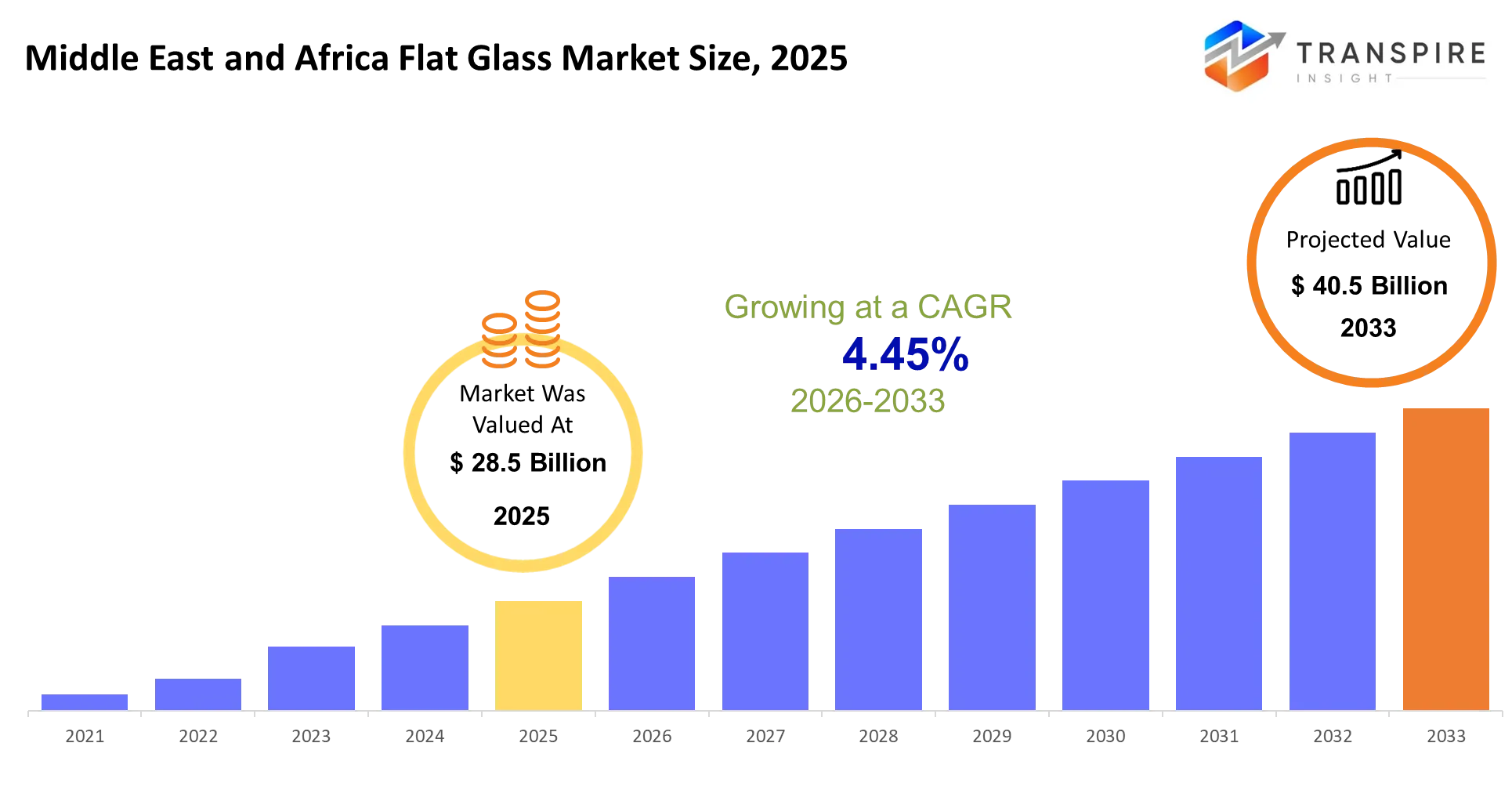
Middle East and Africa Flat Glass Market Size & Forecast:
- Middle East and Africa Flat Glass Market Size 2025: USD 28.5 Billion
- Middle East and Africa Flat Glass Market Size 2033: USD 40.5 Billion
- Middle East and Africa Flat Glass Market CAGR: 4.45%
- Middle East and Africa Flat Glass Market Segments: By Type (Float Glass, Sheet Glass, Rolled Glass, Others); By Application (Construction, Automotive, Solar Panels, Electronics, Others); By End-User (Construction Industry, Automotive Industry, Solar Industry, Electronics Industry, Others); By Product (Tempered Glass, Laminated Glass, Coated Glass, Others)
To learn more about this report,  Download Free Sample Report
Middle East and Africa Flat Glass Market Summary
The Middle East and Africa Flat Glass Market was valued at USD 28.5 Billion in 2025. It is forecast to reach USD 40.5 Billion by 2033. That is a CAGR of 4.45% over the period.
The Middle East and Africa flat glass market plays a major role in today’s construction, automotive production, and solar systems, mostly because it delivers those transparent , heat-resistant surfaces people rely on in façades, windows, interior partitions, vehicle glazing and photovoltaic panels. In real life, flat glass lets buildings cut heat gain, make energy use calmer and more efficient, and stay in line with tougher city planning requirements especially in high-temperature areas across the Gulf, also in parts of Africa.
Over the past five years, things have been leaning more toward coated, energy-efficient glass. That shift has been driven by governments tightening green building rules and developers chasing lower operating expenses in commercial real estate. Then during the COVID-19 period, global supply chains got disrupted, and freight costs were volatile, so buyers in the region started diversifying suppliers , and they also began expanding local processing capabilities. As a result there’s been more investment in domestic manufacturing and value-added glass processing, mainly for solar and broader infrastructure projects. This momentum is creating better margins for regional suppliers and it’s pushing wider adoption of advanced glazing products across both public and private sector developments.
Key Market Insights
- The Gulf Cooperation Council area sort of dominated the Middle East and Africa Flat Glass Market with almost 48% market share in 2025 , though it’s hard to call it “just” one place.
- Saudi Arabia and the UAE seems to be leading demand , mainly because of mega infrastructure programs, tourism expansion, and ongoing commercial property growth.
- Africa shows the quickest regional momentum through 2030, pushed by urbanization, industrial builds and also renewable power spending.
- In terms of product, tempered flat glass sat at the top of the industry size picture with above 35% revenue share in 2025 , mostly tied to safety and durability expectations.
- After that, laminated flat glass took the second position because it’s seeing more use in commercial façades and automobile windshields.
- Coated flat glass is expected to move the fastest across the forecast window, supported by energy efficiency rules and green construction targets.
- Solar control plus low emissivity glass products are getting noticeable traction across the higher temperature climates in the Middle East.
- For applications, construction use accounted for more than 60% of market revenue in 2025 .
- In particular , commercial buildings keep pulling demand because developers care about heat insulation, better daylight balance, and sustainable architectural concepts.
- Finally , solar power installations came in as the fastest-growing application segment , as utility scale photovoltaic projects keep rolling across the GCC region.
What are the Key Drivers, Restraints, and Opportunities in the Middle East and Africa Flat Glass Market?
The most powerful force, accelerating the Middle East and Africa flat glass market is kinda the rapid growth of energy saving building works across Gulf economies. Governments in Saudi Arabia, the UAE, and Qatar rolled out more stringent building efficiency rules, because cooling bills kept rising in overheated city areas. Once that happened, developers started leaning more toward low emissivity and solar control glass, which cuts down indoor heat transfer and also lowers the long haul electricity use. Big projects tied to Vision 2030 initiatives, plus tourism related construction, have basically pushed adoption forward, since companies now want premium façades that blend thermal ability with design look. So in the end, glass makers are pulling in more revenue from value added coated glass, not just standard clear glass items.
Even so, the market still has structural friction, coming from manufacturing that eats energy and a dependence on imported raw materials like soda ash and specialized coating mixes. In many African countries, there is still not enough large scale float glass production infrastructure, so buyers end up depending on imports. Then freight charges swing around, and lead times can get longer. These limitations dampen regional profit potential, and they also slow project schedules, especially in residential segments where pricing is more sensitive.
Solar infrastructure might be the clearest long-term opening for the market. Nations such as Saudi Arabia and Egypt are ramping up utility scale photovoltaic investments, which keeps demand steady for high transparency solar glass.Regional processors are expanding their coating plus tempering know-how to feed solar developers nearby, so local supply can work out, and they cut back on import reliance. It also opens up that more lucrative growth lane for domestic manufacturers, kinda like a better margin option, even if the rollout is a bit slower.
What Has the Impact of Artificial Intelligence Been on the Middle East and Africa Flat Glass Market?
Artificial intelligence alongside advanced digital technologies is quietly, but really, changing the way flat glass gets made across the Middle East and Africa. The impact shows up in more precise production, better furnace efficiency, and even maintenance planning that feels more “scheduled” than reactive. In fact, bigger float glass plants are getting more and more comfortable with AI-enabled control systems, which watch furnace temperatures, coating uniformity, and energy usage in real time. Then those systems basically nudge the process settings automatically, aiming to cut down material loss and keep the glass thickness more or less steady. The result is better yields and lower daily costs for operations.
At the same time, manufacturers in the Gulf are folding machine learning models into predictive maintenance platforms too, so they can catch early signals of furnace wear, conveyor issues, or coating defects, before they slip into an unplanned shutdown situation. Digital twins paired with industrial IoT sensors are adding another layer, they help forecast equipment stress and they also tune the production rhythm based on demand variations. A number of processors say they saw real improvements in furnace uptime and energy efficiency once automated monitoring was in place, especially on coated glass lines where energy use tends to be high. And for quality, AI-driven inspection systems powered by computer vision are cutting rejection rates, by spotting microcracks and surface distortion more quickly than manual checks, or at least more consistently in practice.
That said, the rollout is not uniform. Adoption is still uneven because advanced automation usually takes a lot of upfront spending , and it also expects highly specialized engineering know how. Quite a few regional manufacturers still run legacy lines, and those setups often do not have the sensor network and historical operating data required for accurate AI-based optimization. So even if the intent is there, the infrastructure gaps slow everything down.
Key Market Trends
- Since 2021, Gulf developers kinda started swapping the usual clear glass for low-emissivity glazing, mainly to cut commercial building cooling demand by as much 30% or so.
- Saudi Arabia’s Vision 2030 work also pushed up requests for architectural façade glass , so after 2022 regional processors were forced to enlarge their coating plus tempering capacity.
- In Africa, many buyers moved toward locally processed flat glass, because the freight situation earlier , during 2020 to 2023, made imported glass take longer and raised procurement costs.
- Saint-Gobain and Guardian Glass then leaned into more regional partnerships, trying to secure supply reliability better and shorten delivery cycles across construction markets in the GCC.
- Starting 2022, solar project teams in Egypt and the UAE increased their buying of high-transparency solar glass for large-scale photovoltaic plants, you know the utility type.
- Manufacturers also started using AI-enabled furnace monitoring systems that reduced production downtime , and made the coating results more consistent across their energy-efficient glass offerings.
- And demand for laminated safety glass kept rising after updated building regulations in Saudi Arabia and the UAE tightened up façade, and impact-resistance expectations.
- Regional processors increasingly put money into automated inspection systems, after labor shortages revealed quality-control weak spots during the post-pandemic construction rebound.
- Between 2021 and 2025, coated flat glass took a larger share of the market, since commercial developers kept choosing thermal insulation over cheaper conventional glazing options.
- Lastly, Turkish supplier Şişecam increased distribution investments across the Middle East, as regional construction firms diversified sourcing and looked less toward Asian imports.
Middle East and Africa Flat Glass Market Segmentation
By Type
Float glass held, kind of the dominant position in 2025 with over 60% share , mainly because it is used a lot in commercial facades, home windows and automotive glazing. Big infrastructure push in Saudi Arabia, the UAE, and Egypt, basically made buyers look more for high clarity float glass for premium architectural work. Also the uninterrupted production capacity and cost efficiency kept making it easier for regional processors and construction contractors to stay with it. Sheet glass had a smaller slice, because its optical quality stays a bit lower, so it doesn’t fit as well into modern high performance building systems.
Rolled glass got more traction in niche industrial uses and patterned options, where privacy still matters and textured finishes remain important. Solar projects helped too , since rolled glass shows up in photovoltaic modules. Looking ahead, growth should lean toward advanced float and coated varieties , as energy efficiency rules get stricter across Gulf construction markets. Manufacturers that put money into automated float lines and add value through processing technologies are expected to lock in better long term margins and stronger supply agreements.
By Application
Construction applications generated the biggest revenue contribution, taking more than 60% of total demand in 2025. Urban expansion, tourism related infrastructure, plus mixed use commercial projects increased demand for insulated, laminated, and solar control glazing products. And in most Gulf economies, outdoor heat is high, so there is a faster move toward thermally efficient façade systems that help lower cooling spend. Automotive demand stayed steady as regional vehicle assembly ramps up , and safety glazing requirements keep expanding.
Solar panel applications kind of emerged as the fastest-growing segment , mainly because utility-scale photovoltaic investments in Saudi Arabia, Egypt, and the UAE kept stacking up. The government-backed renewable energy targets also unlocked long-term procurement chances for high-transparency and anti-reflective glass products. Electronics applications stayed comparatively limited too, since regional electronics manufacturing capacity is still kind of lagging behind Asian production hubs. Looking ahead , future market momentum will increasingly revolve around solar and smart building use cases, and this should push suppliers to develop lightweight coated solutions, with better abrasion resistance and durability— more or less that kind of glass package.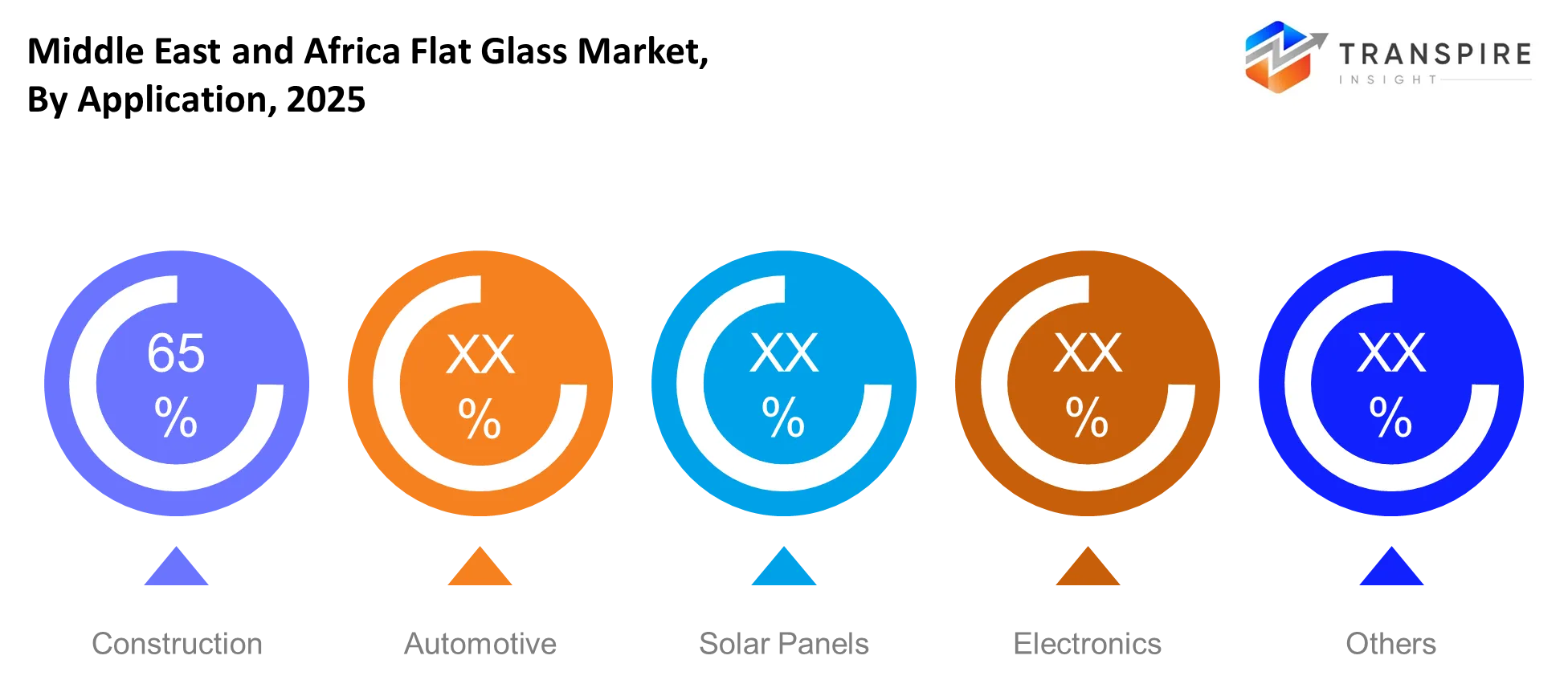
To learn more about this report, Download Free Sample Report
By End-User
In terms of end-users the construction sector held the leading spot because commercial real estate, and public infrastructure projects continued to expand across the Gulf economies. Airports, hotels, healthcare facilities, and luxury residential towers generated ongoing demand for premium architectural glazing. Building code updates in Saudi Arabia and the UAE additionally encouraged developers to specify energy-efficient glass systems instead of plain conventional clear glazing. The automotive industry demand meanwhile remained more concentrated in safety glass and windshield manufacturing applications, so not everything spread evenly.
The solar industry recorded the fastest expansion rate as renewable energy developers accelerated utility-scale solar installations after 2021. Domestic processing facilities increasingly put money into tempering and coating technologies designed for photovoltaic modules. Electronics industry demand remained relatively niche, mainly because semiconductor and display manufacturing infrastructure is still limited in the region. Long-term investment activity is expected to drift toward solar-linked processing capacity, and that should open new revenue channels for regional manufacturers and special coating suppliers, at least in the near to mid term.
By Product
Tempered glass took the largest product share in 2025, not exactly by luck, but because regional construction standards started emphasizing impact resistance, thermal durability, and occupant safety more consistently. Commercial developers broadly leaned on tempered product lines for curtain walls, partitions and exterior glazing systems especially in taller high-rise projects. Laminated glass ended up in the second spot, driven by increased adoption for automotive windshields and also for premium commercial façades where stronger acoustic insulation and security performance really matter. Meanwhile conventional untreated glass products kept sliding and losing traction in many major urban developments.
Coated glass showed up as the quickest growing product category, since developers wanted less energy use and a more stable indoor climate overall. Low-emissivity, plus solar-control coatings, gained notable momentum in Gulf countries where cooling expenses weigh heavily on building operating costs. Going forward, investment momentum will likely tilt toward multifunctional glazing that blends thermal insulation, UV protection and even smart light transmission features. Product developers who focus on advanced coating technologies, and add automated inspection systems, are expected to improve their competitive position across the forecast period.
What are the Key Use Cases Driving the Middle East and Africa Flat Glass Market?
Commercial construction is still basically the main use, for flat glass across the Middle East and Africa, especially in places like high-rise offices, hotels, airports, and mixed-use projects. Developers are starting to push coated and tempered glazing more often, because thermal insulation seems to hit cooling costs quite directly , in the really hot cities like Riyadh, Dubai, and Doha.
On another track, automotive glazing and solar infrastructure are getting more attention too, kind of as nearby uses. In the region, vehicle assembly teams keep moving toward laminated safety glass for windshields and side windows, while utility-scale photovoltaic programs in Saudi Arabia and Egypt are pulling harder on demand for high-transparency solar glass , typically with anti-reflective coatings.
Then there are the newer things, smart glazing systems that get built into energy-efficient commercial structures, plus specialized glass for data centers and advanced industrial sites. Also, more capital is landing in green hydrogen initiatives and smart city efforts, so there should be future openings for multifunctional architectural glass that can handle shifting light and heat in a more dynamic way.
|
Report Metrics |
Details |
|
Market size value in 2025 |
USD 28.5 Billion |
|
Market size value in 2026 |
USD 29.8 Billion |
|
Revenue forecast in 2033 |
USD 40.5 Billion |
|
Growth rate |
CAGR of 4.45% from 2026 to 2033 |
|
Base year |
2025 |
|
Historical data |
2021 - 2024 |
|
Forecast period |
2026 - 2033 |
|
Report coverage |
Revenue forecast, competitive landscape, growth factors, and trends |
|
Regional scope |
Middle East and Africa (Saudi Arabia, United Arab Emirates, South Africa, Rest of Middle East and Africa) |
|
Key company profiled |
AGC Inc, Saint-Gobain, NSG Group, Guardian Glass, Sisecam, Xinyi Glass, Taiwan Glass, Fuyao Glass, Central Glass, Asahi India Glass, Vitro, Cardinal Glass, Schott, Corning, Pilkington |
|
Customization scope |
Free report customization (country, regional & segment scope). Avail customized purchase options to meet your exact research needs. |
|
Report Segmentation |
By Type (Float Glass, Sheet Glass, Rolled Glass, Others); By Application (Construction, Automotive, Solar Panels, Electronics, Others); By End-User (Construction Industry, Automotive Industry, Solar Industry, Electronics Industry, Others); By Product (Tempered Glass, Laminated Glass, Coated Glass, Others) |
Which Regions are Driving the Middle East and Africa Flat Glass Market Growth?
The Gulf Cooperation Council region is kind of leading the Middle East and Africa flat glass market , mainly because of aggressive build-outs in infrastructure, solid manufacturing capability, and fairly strict energy efficiency rules applied in commercial construction. Saudi Arabia and the UAE still keep putting money into smart cities, tourism plans, airports, and a bunch of high rise office projects, these setups end up needing premium coated and laminated glazing products. Also, government supported initiatives like Vision 2030 has pushed faster use of solar-control along with low emissivity glass over big urban projects . There’s a more mature network of processors, logistics providers, façade teams, and local distributors which helps speed up delivery and keeps the regional advantage strong over time.
North Africa shows up as the second largest regional contributor, backed by industrial diversification and construction activity that stays relatively stable in Egypt, Morocco, and Algeria. But compared with the Gulf, expansion there depends less on luxury mega projects and more on steady residential build, automotive production, and public infrastructure improvements. Egypt’s growing float glass output improved supply reliability in the region and made it easier to rely less on imported architectural glass . Meanwhile steady public spending on transport corridors and industrial zones keeps procurement predictable for both domestic producers and commercial developers.
Sub-Saharan Africa is coming up as the fastest-growing regional market, mostly because urbanization keeps speeding up and there are big, large-scale renewable energy investments rolling in. In places like South Africa , Kenya and Nigeria, spending on solar infrastructure, commercial real estate, and industrial facilities went higher after 2022 and that sort of thing is directly, creating fresh demand for tempered and solar glass products. On top of that, electrification programs are expanding, plus foreign-backed infrastructure financing is helping too, which makes the whole regional construction pace look better, even if it still feels a bit uneven in some areas. Overall, growth across the region should lead to solid chances for new entrants, local processing partnerships and even value-added coating technologies during 2026 to 2033.
Who are the Key Players in the Middle East and Africa Flat Glass Market and How Do They Compete?
In the Middle East and Africa flat glass market there is this kinda moderately consolidated set-up up top, while in the regions the processors stay fairly fragmented across downstream fabrication, so it feels a bit uneven. Big global makers tend to defend their share by leaning on advanced coating technologies, energy-efficient product lines, and those long-term supply arrangements with construction conglomerates. Lately the competitive push feels more about performance differentiation, not just price, mainly on high-rise commercial projects , and also on solar-linked installations. Meanwhile regional players are testing the incumbents by tightening logistics proximity and giving façade contractors faster customization, kind of like quicker turnarounds for specific envelopes.
Saint-Gobain seems to solidify its role by technology leadership in low-emissivity and solar-control glass, and it zeroes in on high-performance building envelopes for large infrastructure programs. The company also expands through joint ventures with regional façade contractors, which boosts specification wins in Gulf megaprojects, at least that’s the direction it’s taking. Guardian Glass highlights production efficiency and integrated supply networks, helping it deliver shorter lead times to construction clients across the UAE and Saudi Arabia. AGC Inc. goes for differentiation via advanced automotive as well as architectural glazing solutions, and it leans on R&D spending in multifunctional coated glass to secure more premium project contracts.
Şişecam builds its edge through vertically integrated float glass production plus solid export channels into North Africa and the Middle East. Emirates Glass, on the other hand, leans into regional specialization, supplying customized façade solutions that are adapted to Gulf climate realities.Both companies expand through capacity upgrades and strategic partnerships with local developers, improving penetration in energy-efficient construction projects and solar-ready infrastructure developments.
Company List
- AGC Inc
- Saint-Gobain
- NSG Group
- Guardian Glass
- Sisecam
- Xinyi Glass
- Taiwan Glass
- Fuyao Glass
- Central Glass
- Asahi India Glass
- Vitro
- Cardinal Glass
- Schott
- Corning
- Pilkington
Recent Development News
In September 2025, Guardian Glass announced a new high-performance sputter coater investment in Egypt, scheduled to begin operations in 2026. The facility expansion strengthens local production of advanced coated glass designed for energy-efficient buildings across Africa and the broader Middle East. This development improves regional supply reliability and reduces dependence on imported coated glass, directly supporting faster project execution timelines.https://www.guardianglass.com/
What Strategic Insights Define the Future of the Middle East and Africa Flat Glass Market?
The Middle East and Africa flat glass market seems like it is moving toward a more structurally higher-value setup, pushed by energy efficiency rules, plus these big urban infrastructure buildouts that keep expanding. In the next five to seven years, demand looks like it will hunker down around coated, solar-compatible, and sort-of multifunctional glazing systems, as governments tighten building performance requirements, and developers start to weigh lifecycle energy savings more heavily than upfront material spend. Because of that shift, conventional clear glass demand should get squeezed over time , and the more technology-heavy product lines should become the main revenue engine.
There’s also a risk that is less obvious, coming from production concentration among a relatively small set of global suppliers. That kind of clustering can increase exposure to pricing rigidity, and it can cause supply bottlenecks when energy issues or logistics disruptions show up. At the same time, there is substitution pressure from advanced polymer based transparent materials in a few niche architectural and transport uses , and if performance parity improves faster than people expect , it could slowly chew away at demand in some selected high-margin segments.
The biggest emerging opportunity, though, is integrated solar façade systems aimed at net-zero commercial districts, especially across Saudi Arabia and the UAE. In those places, regulatory frameworks now link building approvals to sustainability measures, so the “why” is getting stronger, and sooner. Market players should move early on localized coating capacity , and build long-term relationships with developers to lock in specifications before the project pipelines fully mature.
Middle East and Africa Flat Glass Market Report Segmentation
By Type
- Float Glass
- Sheet Glass
- Rolled Glass
- Others
By Application
- Construction
- Automotive
- Solar Panels
- Electronics
- Others
By End-User
- Construction Industry
- Automotive Industry
- Solar Industry
- Electronics Industry
- Others
By Product
- Tempered Glass
- Laminated Glass
- Coated Glass
- Others
Frequently Asked Questions
Find quick answers to common questions.
The Estimated Middle East and Africa Flat Glass Market size is USD 40.5 Billion in 2033.
Key Segments for the Middle East and Africa Flat Glass Market are By Type (Float Glass, Sheet Glass, Rolled Glass, Others); By Application (Construction, Automotive, Solar Panels, Electronics, Others); By End-User (Construction Industry, Automotive Industry, Solar Industry, Electronics Industry, Others); By Product (Tempered Glass, Laminated Glass, Coated Glass, Others).
Major Middle East and Africa Flat Glass Market Players are AGC Inc, Saint-Gobain, NSG Group, Guardian Glass, Sisecam, Xinyi Glass, Taiwan Glass, Fuyao Glass, Central Glass, Asahi India Glass, Vitro, Cardinal Glass, Schott, Corning, Pilkington.
The Current Middle East and Africa Flat Glass Market size is USD 28.5 Billion in 2025.
The Middle East and Africa Flat Glass Market CAGR is 4.45% from 2026 to 2033.
- AGC Inc
- Saint-Gobain
- NSG Group
- Guardian Glass
- Sisecam
- Xinyi Glass
- Taiwan Glass
- Fuyao Glass
- Central Glass
- Asahi India Glass
- Vitro
- Cardinal Glass
- Schott
- Corning
- Pilkington
Recently Published Reports
-
May 2026
Healthcare Polymer Packaging Market
Healthcare Polymer Packaging Market Size, Share & Analysis Report By Packaging Type (Syringes, IV Bottles and Pouches, Clamshells, Blisters, Bottles & Jars, Containers, Tubes, IV Parental Packaging, Others), By Type (Regulated, Non-regulated), By Polymer Type (LDPE (Low-Density Polyethylene), HDPE (High-Density Polyethylene), Homo-polymer (Homo), Random Copolymer (Random), Block Copolymer (Block), PET, Polystyrene, Polyvinyl Chloride, Polyamide/EVOH, Others), and Geography (North America, Europe, Asia-Pacific, Middle East and Africa, South and Central America), 2021 - 2031
-
Apr 2026
Hydrophilic Tape (Waterstop) Market
Hydrophilic Tape (Waterstop) Market Size, Share & Analysis Report By Type (Bentonite-Based Hydrophilic Tape, Rubber-Based Hydrophilic Tape), By Application (Residential Buildings, Commercial Buildings, Infrastructure Projects), and Geography (North America, Europe, Asia-Pacific, Middle East and Africa, South and Central America), 2021 - 2031
-
Apr 2026
Metalens Market
Metalens Market Size, Share & Analysis Report By Type (Visible Light Metalens, and Infrared Metalens), By Application (Consumer Electronics, Automotive Electronics, Industrial, Medical, and Others), and Geography (North America, Europe, Asia-Pacific, Middle East and Africa, South and Central America), 2021 - 2031
-
Apr 2026
PBT Resin Market
PBT Resin Market Size, Share & Analysis Report By Type (Reinforced PBT Resin, Unreinforced PBT Resin), By Processing Method (Injection Molding, Extrusion, Blow Molding, Others), By End-User (Automotive, Electrical & Electronics, Consumer Appliances, Industrial Machinery, Medical Devices, Packaging, Others), and Geography (North America, Europe, Asia-Pacific, Middle East and Africa, South and Central America), 2021 - 2031