

Europe Glass Manufacturing Market Size & Forecast:
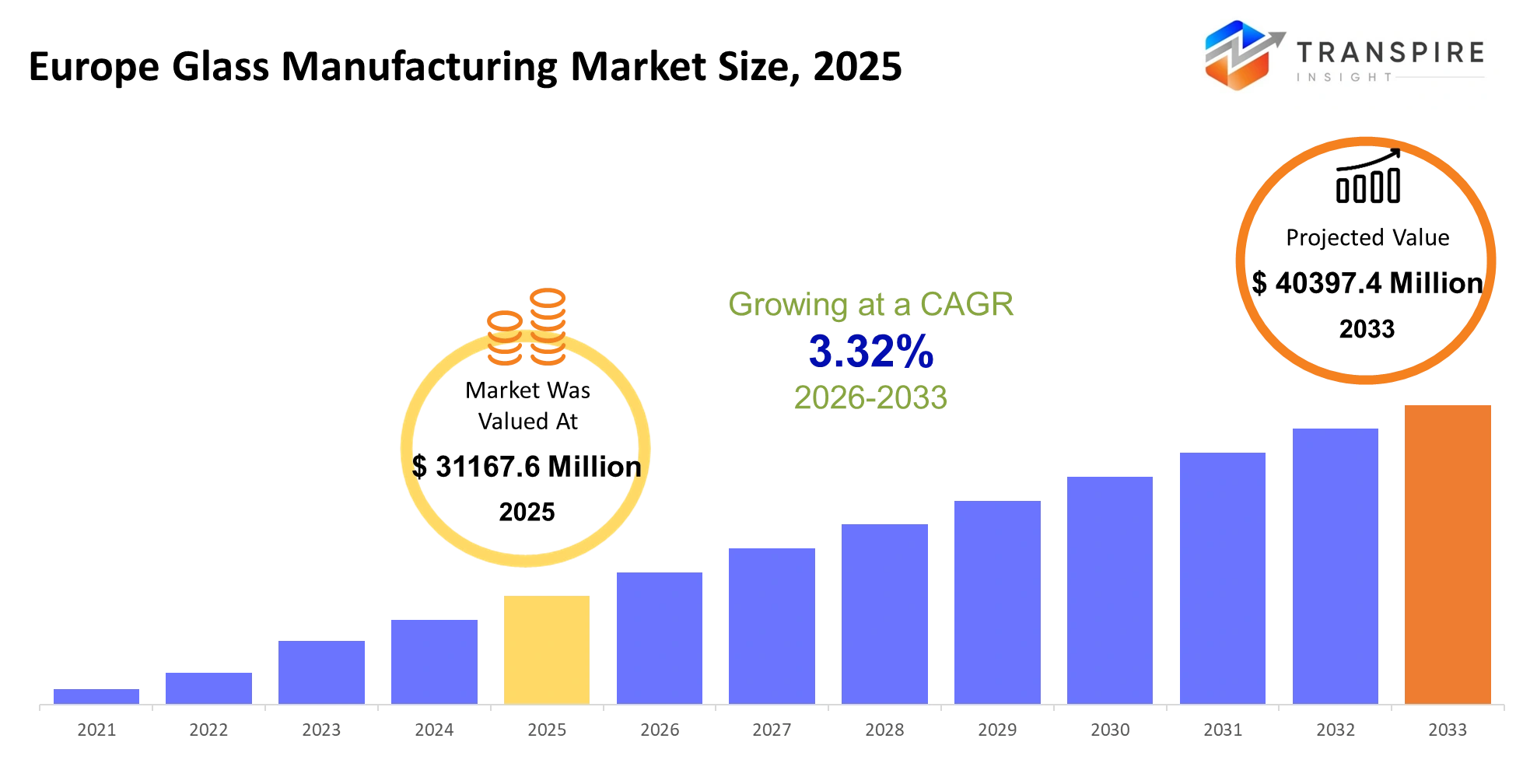
- Europe Glass Manufacturing Market Size 2025: USD 31167.6 Million
- Europe Glass Manufacturing Market Size 2033: USD 40397.4 Million
- Europe Glass Manufacturing Market CAGR: 3.32%
- Europe Glass Manufacturing Market Segments: By Type (Flat Glass, Container Glass, Fiberglass, Specialty Glass, Solar Glass, Others); By Application (Construction, Automotive, Packaging, Electronics, Solar Energy, Others); By End-User (Construction Industry, Automotive Industry, Packaging Industry, Electronics Industry, Others); By Manufacturing Process (Float Process, Rolled Process, Blown Glass, Others).
To learn more about this report,  Download Free Sample Report
Europe Glass Manufacturing Market Summary:
The Europe Glass Manufacturing Market size is estimated at USD 31167.6 Million in 2025 and is anticipated to reach USD 40397.4 Million by 2033, growing at a CAGR of 3.32% from 2026 to 2033. The European glass manufacturing market supports industries which need products that maintain their strength and protect against weather and provide visibility and withstand chemical damage throughout their regular work activities.
Glass manufacturers provide architectural glass panels which support energy-saving building designs and they supply reinforced glass for car manufacturing and they make special containers used in the pharmaceutical and food export industries and high-performance glass which functions in industrial equipment and renewable energy technologies. The market system enables European construction and transportation and medical and packaging sectors to fulfill their requirements for enhanced safety measures and environmentally friendly practices and advanced operational capabilities.
The industry has shifted from producing products according to sales volume to developing sustainable products through advanced production methods in the last three to five years. Manufacturers used EU decarbonization policies and energy efficiency requirements as reasons to develop electric furnace systems and recycle cullet and implement smart manufacturing technologies. The Russia-Ukraine energy crisis forced the industry to move away from its reliance on natural gas because it showed how unstable energy costs could affect operations. Advanced glass products have become the preferred choice for buyers because they help decrease energy expenses throughout their entire lifespan which enables manufacturers to sell their products at higher prices while securing their future sales income.
Key Market Insights
- The European Glass Manufacturing Market in 2025 based its 48% market share on Western European construction activities and automotive manufacturing operations.
- Germany maintains the largest industrial presence in the area through its extensive flat glass production facilities and technological advancements in automated manufacturing systems.
- Eastern European markets will experience the most rapid growth until 2032 which industrial companies will support through their facility relocations and their plans to improve their infrastructure while cutting expenses for production.
- The premium packaging glass market for cosmetics and pharmaceuticals and luxury beverages drove France and Italy to achieve substantial market share expansion.
- The Europe Glass Manufacturing Market received its major share from flat glass which accounted for more than 42% of the market in 2025 through its use in architectural projects and automotive manufacturing.
- Container glass maintained its position as the second largest market segment because environmentally friendly beverage packaging options and European Union recycling requirements gained more popularity.
- The specialty glass market will experience the highest growth rate until 2032 because of its use in semiconductor production and solar panel development and smart electronics manufacturing.
- The European fiberglass industry experienced a surge in glass fiber demand because wind energy projects and lightweight insulation material usage reached higher levels across the continent.
- Energy-efficient building renovation projects in Europe supported the construction industry which reached 46% market share in 2025.
- The category for solar energy applications developed into the fastest-growing sector because governments worked to increase their renewable energy production capacity while they invested in net-zero energy infrastructure development projects.
- The demand for automotive glass increased steadily because more electric vehicles were produced and advanced driver-assistance systems were integrated into those vehicles.
What are the Key Drivers, Restraints, and Opportunities in the Europe Glass Manufacturing Market?
The European Glass Manufacturing Market experiences its highest growth rate because European energy-efficiency regulations for buildings and vehicles have become more strict. The European Green Deal and the updated Energy Performance of Buildings Directive required developers and manufacturers to implement high-performance glazing and insulated glass units and solar-control glass systems. The 2022 energy crisis established the financial consequences that arise from using inefficient buildings because businesses see their heating costs become unpredictable. Commercial property owners who upgraded their old systems created opportunities for glass manufacturers to gain high-profit contracts through their advanced architectural glass products.
The market faces its biggest growth obstacle because energy intensity acts as a fundamental restriction. Glass melting furnaces operate at high temperatures which need continuous power from natural gas and electricity sources. The hydrogen-ready and electric furnace systems demand multi-billion-euro capital funding and extended operational halts and grid network upgrades which build do not proceed at an immediate pace. Manufacturing companies still deal with high production costs because energy prices fluctuate which creates difficulties for their profit margins. Smaller regional facilities experience both capacity expansion delays and modernization project setbacks.
The most promising long-term business opportunity exists through specialty glass used in renewable energy infrastructure. European solar manufacturing investments are growing at an accelerated pace which leads to increased demand for anti-reflective solar glass and high-durability photovoltaic panel components. The domestic solar supply chains of Germany and Spain expansion will help those countries decrease their dependence on Asian imports while it creates better opportunities for local glass manufacturers to secure premium industrial contracts.
What Has the Impact of Artificial Intelligence Been on the Europe Glass Manufacturing Market?
Artificial intelligence together with advanced digital technologies has brought changes to the Europe Glass Manufacturing Market by delivering better furnace operation and more accurate production results and improved operational dependability. Manufacturers increasingly use AI-driven control systems to monitor furnace temperatures and combustion stability and raw material composition in real time. The systems automatically control fuel-air ratio and melting process parameters which enables operators to decrease energy usage while producing glass of consistent quality. European facilities have implemented computer vision systems which examine flat glass and container glass for tiny defects at production-line speeds that exceed what manual inspection can achieve.
Machine learning models have become standard tools for predictive maintenance throughout all furnace systems and roller systems and cutting equipment. Equipment degradation prediction uses vibration analysis together with thermal pattern recognition and equipment failure history data. The solution results in improved production efficiency because unplanned interruptions decrease while equipment maintenance expenses drop. Digital twin technology serves as a valuable tool for emissions prediction purposes which enables companies to test their furnace systems while decreasing carbon emissions through uninterrupted operations.
The widespread implementation of AI technology faces a critical obstacle because many European glass manufacturing plants still depend on outdated industrial systems. The process of linking current analytics systems with old furnace control equipment from past decades demands extensive financial resources and particular technical skills and substantial amounts of high-grade operational data which mid-sized companies typically do not possess.
Key Market Trends
- European manufacturers increased their cullet usage beyond 50% at multiple facilities since 2021 to achieve lower furnace energy costs and decrease carbon compliance expenses.
- The 2022 energy crisis prompted Saint-Gobain and other companies to speed up their electric furnace pilot projects which aimed to establish more reliable energy sources because of their natural gas dependency issues.
- Automotive OEMs started using lightweight laminated glazing during the 2020 to 2025 period because it improved electric vehicle battery efficiency and cabin insulation performance.
- After 2023, Germany and France increased their investments in solar glass production because their governments wanted to develop domestic renewable energy supply chains which could replace their need for Asian imports.
- AI-powered visual inspection systems took over some manual quality control tasks which enabled multiple flat glass production facilities to decrease their defect-related waste and operational downtime.
- Eastern Europe became a manufacturing expansion center after 2021 because its lower labor and operating expenses made it possible to produce goods there at lower costs than other regions.
- Pharmaceutical packaging producers increased borosilicate glass procurement after pandemic-era supply disruptions exposed vulnerabilities in medical container availability.
- EU building renovation policies pushed developers toward triple-glazed architectural glass which caused buyers to switch from standard glazing products to energy-efficient premium products.
- Specialty glass portfolios for semiconductor and advanced electronics applications received expansion from SCHOTT AG and AGC Inc. after 2023.
- The industry began to notice hydrogen-ready furnace technology between 2024 and 2026 as manufacturers searched for methods to achieve EU decarbonization targets through scalable solutions.
Europe Glass Manufacturing Market Segmentation
By Type
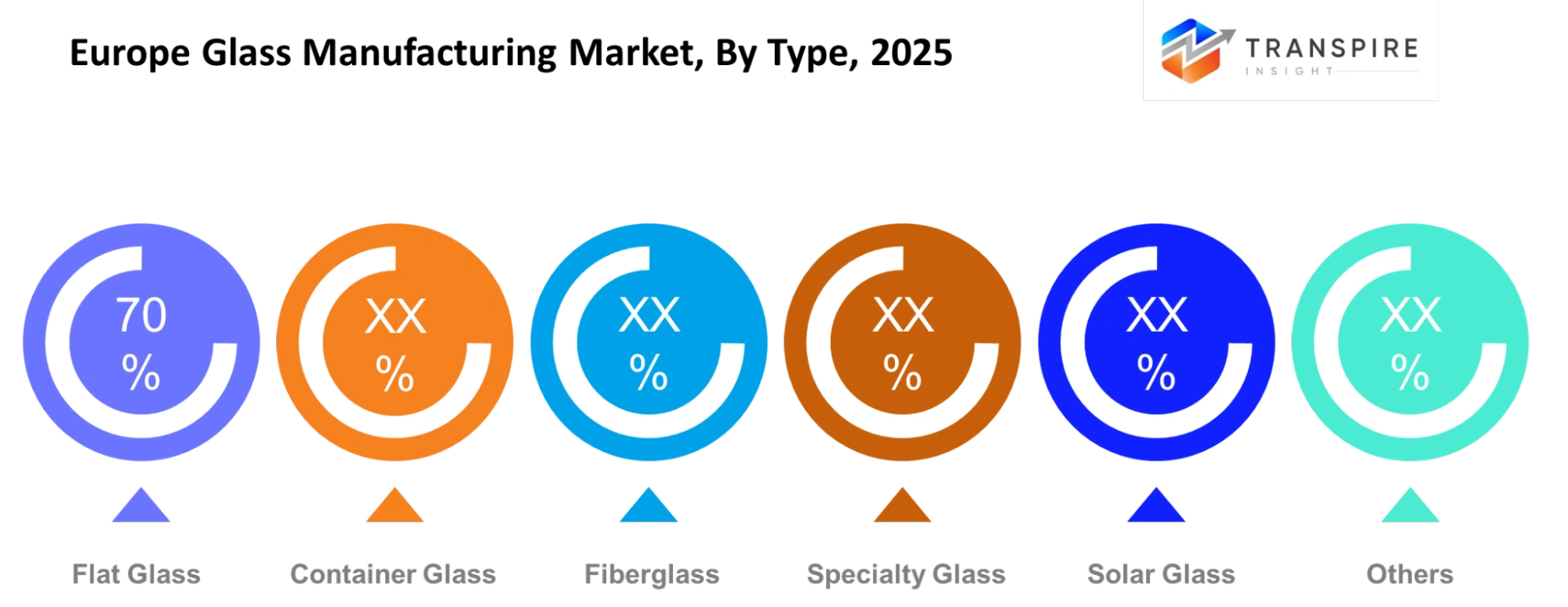
The category of glass products remains dominated by flat glass because construction and automotive manufacturers need to purchase large quantities of insulated and laminated and tempered glazing materials. The requirement for high-performance flat glass persists because Western Europe experiences active renovation projects and implements more demanding building energy efficiency standards. The packaging needs of food and beverage and pharmaceutical products in Germany and France and Italy sustain container glass as a strong secondary market.
The demand for fiberglass materials has grown because investments in wind turbine blades and thermal insulation materials have increased due to renewable energy initiatives and industrial efficiency programs. The fastest-growing product segments include specialty glass and solar glass because semiconductor production and photovoltaic manufacturing and smart electronics all demand optical and heat-resistant materials. The market will develop towards premium products which use advanced technology because manufacturers will focus on implementing low-carbon production processes and automated quality control systems and specialized coating technologies to enhance profit margins and secure long-term supply agreements.
To learn more about this report, Download Free Sample Report
By Application
The construction industry uses energy-efficient glazing systems and durable architectural glass products because these materials suit commercial buildings and residential renovation projects and public infrastructure upgrades. European energy regulations have become more stringent which has caused customers to choose triple-glazed windows and solar-control products that help lower their heating and cooling expenses during extended usage periods. Electric vehicle manufacturers are expanding their use of lightweight laminated glass and panoramic glazing systems to automotive applications because these materials help increase energy efficiency and improve passenger experience.
The pharmaceutical industry and premium beverage industry both sustain steady growth through their use of recyclable glass containers which possess strong chemical resistance. The semiconductor fabrication industry and large-scale photovoltaic deployment across Germany and Spain and Eastern Europe are creating the fastest growth potential for electronics and solar energy applications. The market for glass products shows a trend toward higher investments in specialized glass items which deliver superior performance compared to standard glass commodities.
By End-User
The construction industry represents the largest end-user market because real estate developers, infrastructure contractors, and public housing programs continue to purchase advanced glazing products which provide insulation and durability and meet regulatory standards. European vehicle producers make automotive manufacturers the second-largest market because they use lightweight and safety-enhanced glass in their electric and autonomous vehicle platforms. Packaging companies remain important buyers because premium beverage brands and pharmaceutical firms increasingly choose recyclable glass packaging over other materials which face environmental scrutiny.
The electronics manufacturing sector has become a crucial customer group because there is rising demand for display glass and optical glass and semiconductor-grade materials which are essential in high-value industrial applications. Future industry dynamics predict that glass producers will work more closely with end-user industries to create custom products which provide better thermal performance and lower emissions and greater durability. The transition is expected to increase long-term supply contracts while boosting investment in specialized manufacturing facilities and advanced research capabilities.
By Manufacturing Process
The float process dominates manufacturing operations because large-scale flat glass production requires factories to produce glass with uniform thickness and perfect optical properties while maintaining high production rates. Architectural and automotive manufacturers depend on float-produced glass to fulfill their needs for certified glass products which meet their performance standards in both commercial and transportation markets. The rolled process maintains its function to produce patterned and textured glass which decorative construction materials and particular industrial uses require to achieve aesthetic value and light scattering effects.
Blown glass production stays important because it serves premium packaging needs and laboratory equipment demands and luxury goods that need special shapes in low production quantities. Producers now use up-to-date automation systems together with digital furnace control technology throughout their main manufacturing operations because these systems help lower energy usage and enhance defect identification and create stable product quality. Manufacturing investment will focus on electric furnace technologies and recycled cullet systems and hydrogen-compatible systems as European producers work to meet carbon reduction goals while managing high energy expenses.
What are the Key Use Cases Driving the Europe Glass Manufacturing Market?
The primary application driving market expansion throughout Europe functions as energy-efficient architectural glazing. The building standards of the European Union require commercial developers and public infrastructure projects and residential renovation programs to use insulated and solar-control glass.
The manufacturing sectors across different regions experience steady growth in the automotive industry and pharmaceutical packaging market. Electric vehicle manufacturers adopt lightweight laminated glazing for enhancing battery performance and cabin temperature control while pharmaceutical companies require high-purity glass containers to store biologics and vaccines and injectable medications.
The development of new use cases involves solar glass applications for photovoltaic systems and specialty glass applications for semiconductor manufacturing facilities. The governments of Germany and Spain are both enhancing their domestic renewable energy capacity while boosting their electronics sector investments which creates a new market for anti-reflective glass products that also possess heat resistance and high durability features.
|
Report Metrics |
Details |
|
Market size value in 2025 |
USD 31167.6 Million |
|
Market size value in 2026 |
USD 32134.3 Million |
|
Revenue forecast in 2033 |
USD 40397.4 Million |
|
Growth rate |
CAGR of 3.32% from 2026 to 2033 |
|
Base year |
2025 |
|
Historical data |
2021 - 2024 |
|
Forecast period |
2026 - 2033 |
|
Report coverage |
Revenue forecast, competitive landscape, growth factors, and trends |
|
Regional scope |
Europe (Germany, United Kingdom, France, Italy, Spain and Rest of Europe) |
|
Key company profiled |
Saint-Gobain, AGC Inc, Guardian Glass, NSG Group, Schott AG, Corning, Vitro, Sisecam, Central Glass, Xinyi Glass, Fuyao Glass, Asahi Glass, Euroglas, Pilkington, Borosil. |
|
Customization scope |
Free report customization (country, regional & segment scope). Avail customized purchase options to meet your exact research needs. |
|
Report Segmentation |
By Type (Flat Glass, Container Glass, Fiberglass, Specialty Glass, Solar Glass, Others); By Application (Construction, Automotive, Packaging, Electronics, Solar Energy, Others); By End-User (Construction Industry, Automotive Industry, Packaging Industry, Electronics Industry, Others); By Manufacturing Process (Float Process, Rolled Process, Blown Glass, Others). |
Which Regions are Driving the Europe Glass Manufacturing Market Growth?
The glass manufacturing industry in Western Europe reaches its highest development level because Germany, France, and Italy possess advanced industrial infrastructure together with superior furnace technology and strict building efficiency guidelines. European Union decarbonization policies accelerated investment in insulated glazing, recycled cullet processing, and low-emission production systems across the region. Major manufacturers gain advantages from transportation networks which connect their operations to existing raw material supply chains while being close to their automotive and construction customers. This ecosystem enables large-scale production operations which help premium glass manufacturers keep their strong international market position for high-value industrial products.
Northern European demand patterns develop through their greater dependence on sustainable development initiatives than their production capacity. The Scandinavian countries of Sweden, Denmark, and Finland show ongoing demand for advanced architectural and solar glass products because they continue to build energy-efficient infrastructure and smart buildings and renewable energy solutions. The existing regulatory framework enables manufacturers and developers to forecast capital expenditures because it provides them with better operational risk assessment than most new industrial areas. The adoption of specialty glass solutions which provide higher thermal efficiency and durability performance gets promoted by strong environmental compliance standards.
Eastern Europe emerges as the fastest expanding market because industrial relocation and manufacturing growth have increased since 2022.
Who are the Key Players in the Europe Glass Manufacturing Market and How Do They Compete?
The European glass manufacturing industry demonstrates moderate market consolidation because multinational companies control most float glass and specialty glass production facilities while local businesses operate in packaging and specialized industrial markets. Current business competition focuses on energy-efficient solutions combined with advanced coating methods and low-carbon production procedures instead of measuring success through production capacity. Existing manufacturers maintain their market presence by updating their furnaces and using recycled cullet and establishing permanent supply contracts with their automotive and construction clients. New companies encounter significant obstacles because they need to invest heavily in both furnace systems and emissions regulations and energy-consuming business activities which demand expensive equipment and specialized knowledge.
Saint-Gobain built its distinct market position through its use of building solutions that combine advanced glazing systems with insulation materials and environmentally sustainable building materials. The company continues investing in low-carbon flat glass production and electric furnace technology to align with European decarbonization targets. AGC Inc. concentrates its research efforts on automotive and smart glass development especially for lightweight glazing and electric vehicle display systems. AGC established strong partnerships with European automotive manufacturers which enabled the company to obtain stable long-term contracts and jointly develop technical projects with its partners. SCHOTT AG retains its market position through its high-precision specialty glass products which serve pharmaceutical and semiconductor and laboratory markets that require customers to maintain quality control and chemical resistance standards.
Company List
- Saint-Gobain
- AGC Inc
- Guardian Glass
- NSG Group
- Schott AG
- Corning
- Vitro
- Sisecam
- Central Glass
- Xinyi Glass
- Fuyao Glass
- Asahi Glass
- Euroglas
- Pilkington
- Borosil
Recent Development News
In February 2026, Saint-Gobain Q1 2026 Results Show Stable Europe Performance: Europe’s glass and construction materials leader Saint-Gobain reported near-stable European sales in Q1 2026, despite weak construction demand and weather disruptions. The company highlighted resilience in Europe, supported by pricing discipline and acquisitions in construction chemicals.
Source: https://www.webdisclosure.com
In April 2026, Verallia considers restructuring amid European demand pressure: Verallia, one of Europe’s leading glass bottle manufacturers, is reviewing operations that could include up to 360 job cuts and partial plant closures in Germany, France, and the UK.The move reflects weakening demand for glass bottles driven by declining beverage consumption and export slowdown, forcing production realignment across Europe.
Source: https://www.reuters.com
What Strategic Insights Define the Future of the Europe Glass Manufacturing Market?
The European glass manufacturing industry will undergo structural changes between 2023 and 2030 to produce lower-volume products that have higher value through its energy-efficient architectural glass production and specialty industrial applications and low-carbon manufacturing systems. European industrial policy together with building efficiency regulations and corporate decarbonization targets creates a strict framework that drives this process of change. Manufacturers who fail to upgrade their furnace systems and their renewable energy sources will face competitive disadvantage because energy-intensive commodity production will become less profitable.
The industry fails to recognize that raw material and recycled cullet availability represents a significant danger. The increasing competition among industries for premium recycled glass feedstock will result in supply shortages which drive up costs and slow down carbon reduction efforts especially for smaller regional producers who lack strong purchasing power.
There exists a developing opportunity for companies to establish semiconductor and photovoltaic supply chains within Europe. The German government and Eastern European countries are increasing their domestic electronics and solar manufacturing incentives which will establish future demand for specialty and solar glass products. The market needs to establish strategic alliances with renewable energy companies and semiconductor manufacturers while developing their electric furnace and recycling systems to achieve stable profit margins in the future.
Europe Glass Manufacturing Market Report Segmentation
By Type
- Flat Glass
- Container Glass
- Fiberglass
- Specialty Glass
- Solar Glass
- Others
By Application
- Construction
- Automotive
- Packaging
- Electronics
- Solar Energy
- Others
By End-User
- Construction Industry
- Automotive Industry
- Packaging Industry
- Electronics Industry
- Others
By Manufacturing Process
- Float Process
- Rolled Process
- Blown Glass
- Others
Frequently Asked Questions
Find quick answers to common questions.
The approximate Europe Glass Manufacturing Market size for the market will be USD 40397.4 Million in 2033.
The key segments of the Europe Glass Manufacturing Market are By Type (Flat Glass, Container Glass, Fiberglass, Specialty Glass, Solar Glass, Others); By Application (Construction, Automotive, Packaging, Electronics, Solar Energy, Others); By End-User (Construction Industry, Automotive Industry, Packaging Industry, Electronics Industry, Others); By Manufacturing Process (Float Process, Rolled Process, Blown Glass, Others).
Major players in the Europe Glass Manufacturing Market are Saint-Gobain, AGC Inc, Guardian Glass, NSG Group, Schott AG, Corning, Vitro, Sisecam, Central Glass, Xinyi Glass, Fuyao Glass, Asahi Glass, Euroglas, Pilkington, Borosil.
The current market size of the Europe Glass Manufacturing Market is USD 31167.6 Million in 2025.
The Europe Glass Manufacturing Market CAGR is 3.32%.
- Saint-Gobain
- AGC Inc
- Guardian Glass
- NSG Group
- Schott AG
- Corning
- Vitro
- Sisecam
- Central Glass
- Xinyi Glass
- Fuyao Glass
- Asahi Glass
- Euroglas
- Pilkington
- Borosil
Recently Published Reports
-
Apr 2026
Healthcare Polymer Packaging Market
Healthcare Polymer Packaging Market Size, Share & Analysis Report By Packaging Type (Syringes, IV Bottles and Pouches, Clamshells, Blisters, Bottles & Jars, Containers, Tubes, IV Parental Packaging, Others), By Type (Regulated, Non-regulated), By Polymer Type (LDPE (Low-Density Polyethylene), HDPE (High-Density Polyethylene), Homo-polymer (Homo), Random Copolymer (Random), Block Copolymer (Block), PET, Polystyrene, Polyvinyl Chloride, Polyamide/EVOH, Others), and Geography (North America, Europe, Asia-Pacific, Middle East and Africa, South and Central America), 2021 - 2031
-
Apr 2026
Hydrophilic Tape (Waterstop) Market
Hydrophilic Tape (Waterstop) Market Size, Share & Analysis Report By Type (Bentonite-Based Hydrophilic Tape, Rubber-Based Hydrophilic Tape), By Application (Residential Buildings, Commercial Buildings, Infrastructure Projects), and Geography (North America, Europe, Asia-Pacific, Middle East and Africa, South and Central America), 2021 - 2031
-
Apr 2026
Metalens Market
Metalens Market Size, Share & Analysis Report By Type (Visible Light Metalens, and Infrared Metalens), By Application (Consumer Electronics, Automotive Electronics, Industrial, Medical, and Others), and Geography (North America, Europe, Asia-Pacific, Middle East and Africa, South and Central America), 2021 - 2031
-
Apr 2026
PBT Resin Market
PBT Resin Market Size, Share & Analysis Report By Type (Reinforced PBT Resin, Unreinforced PBT Resin), By Processing Method (Injection Molding, Extrusion, Blow Molding, Others), By End-User (Automotive, Electrical & Electronics, Consumer Appliances, Industrial Machinery, Medical Devices, Packaging, Others), and Geography (North America, Europe, Asia-Pacific, Middle East and Africa, South and Central America), 2021 - 2031