

Europe Printed Electronics Market Size & Forecast:
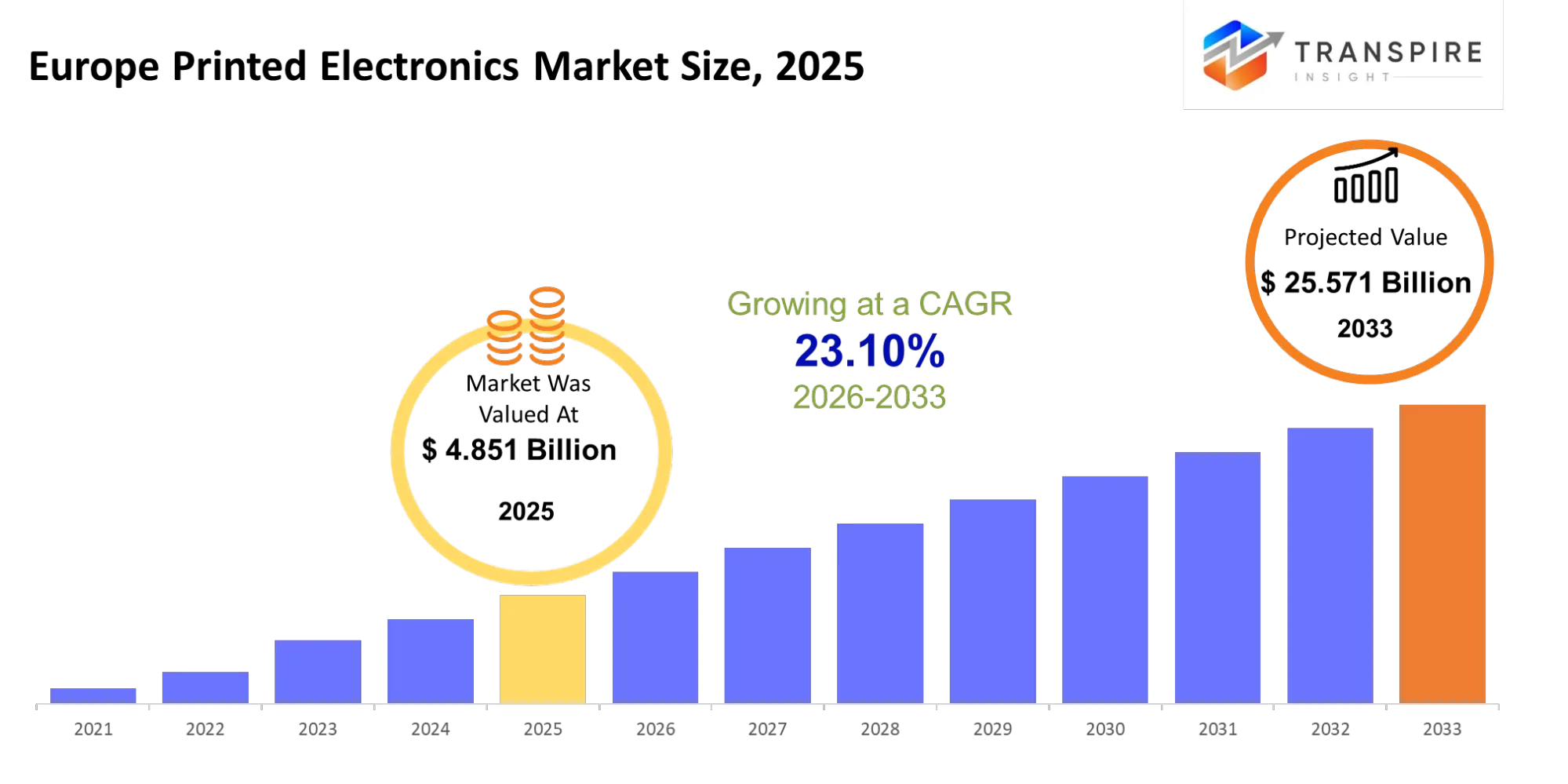
- Europe Printed Electronics Market Size 2025: USD 4.851 Billion
- Europe Printed Electronics Market Size 2033: USD 25.571 Billion
- Europe Printed Electronics Market CAGR: 23.10%
- Europe Printed Electronics Market Segments: By Type (Inkjet Printing, Screen Printing, Flexography, Others); By Application (Displays, Sensors, RFID, Photovoltaics, Others); By End-User (Electronics, Automotive, Healthcare, Others); By Material (Conductive Ink, Substrates, Others)
To learn more about this report,  Download Free Sample Report
Europe Printed Electronics Market Summary
The Europe Printed Electronics Market was valued at USD 4.851 Billion in 2025. It is forecast to reach USD 25.571 Billion by 2033. That is a CAGR of 23.10% over the period.
Europe employs printed electronics to integrate lightweight flexible circuits and sensors into various industrial systems which include automotive interiors and EV battery monitoring and smart packaging and corrosion tracking systems used on maritime equipment. Manufacturers use flexible substrates to print conductive inks instead of using inflexible silicon-based assemblies because this method provides low-cost and scalable solutions for tracking and monitoring operations at remote locations. The market has transitioned during the past three to five years from laboratory-scale prototyping to industrial roll-to-roll production which now operates within automotive and IoT supply chains to establish hybrid electronics manufacturing as a mainstream process. OEMs accelerated their shift toward printed electronic solutions for non-critical functions because semiconductor shortages and pandemic-related supply chain issues made traditional chip manufacturing methods less reliable. The investment in European production facilities has resulted in faster delivery times while creating new business opportunities through smart industrial monitoring systems and connected product design services
Key Market Insights
-
Germany leads the European Printed Electronics Market with a 28% market share which it will achieve in 2025 because of its strong automotive OEM system connections.
-
The industrial IoT systems development and the smart packaging innovation ecosystems in France and the UK enable their continuous progress toward technology adoption.
-
The electronics manufacturing relocation combined with affordable production expansion will make Eastern Europe the most rapidly expanding region between 2025 and 2030.
-
The Europe Printed Electronics Market gets its 2025 market share lead from the conductive ink and functional materials segment which holds about 35% of the market.
-
The second biggest market segment consists of flexible displays and sensors which develop because of rising needs for wearable devices and smart packaging solutions.
-
Printed sensors will experience their fastest growth between 2025 and 2030 because of industrial monitoring requirements and predictive maintenance needs.
-
The Europe Printed Electronics Market primarily consists of consumer electronics which hold almost 30% market share because of their wearable devices and smart labeling products.
-
The automotive industry experiences its fastest growth rate because of electric vehicle integration and the requirement for lightweight materials and embedded sensing technology.
-
The automotive manufacturing industry accounts for the majority of user adoption because automotive original equipment manufacturers integrated electric vehicle systems and smart vehicle interior technology.
-
The industrial manufacturing sector experiences its fastest expansion because organizations which implement Industry 4.0 automation and demand real-time asset monitoring increase their operations.
What are the Key Drivers, Restraints, and Opportunities in the Europe Printed Electronics Market?
The Europe Printed Electronics Market exists because automotive and industrial sectors increasingly adopt lightweight and low-power electronic systems. The electric vehicle platforms started to expand rapidly which made it necessary to decrease wire usage and material expenses for new vehicle designs. The OEMs started to use printed sensors for battery monitoring and touch interfaces in their vehicles which increased their revenue from design-in projects and resulted in permanent supply contracts for conductive inks and flexible substrates.
The printed electronics industry in Europe faces a critical challenge because it relies heavily on specific materials together with exact manufacturing equipment. Printed electronics need strict control over their deposition methods and stable conductive powder creation which current European markets find too expensive and difficult to implement. The production costs because of this restriction together with the slow adoption of new technologies in high-reliability sectors create a system that prevents revenue growth
The industrial IoT market will create new business opportunities through its combination with smart packaging which uses printed sensors to track logistics and monitor conditions. The European Union supports Industry 4.0 projects which enables Germany and the Netherlands to test digital supply chain solutions. The roll-to-roll printing technologies will enable scalable production capabilities which will create new high-volume applications and drive European Printed Electronics Market growth beyond automotive sector requirements.
What Has the Impact of Artificial Intelligence Been on the Europe Printed Electronics Market?
Through its development of flexible sensors and printed circuit solutions, The European printed electronics market demonstrates its growing adoption of artificial intelligence technology. The AI-enabled platforms of exhaust gas cleaning systems and scrubber performance monitoring systems gather real-time information from the printed sensors which track temperature and flow and corrosion detection. The system enables automatic system operation to change its functioning aspects without human control which helps organizations to meet their emission standards while their operations become less unpredictable.
The industrial equipment and EV platforms use machine learning models to develop predictive maintenance systems for their printed sensor networks. The systems use vibration and thermal and conductivity signal analysis to determine when components will degrade so they can schedule maintenance prior to equipment failure. System calibration improvements and unplanned downtime reductions have resulted in operators reporting better uptime performance and fuel efficiency improvements ranging from single-digit to low double-digit percentages during multiple deployments.
The Europe Printed Electronics Market faces challenges in expanding its operations because of insufficient access to high-quality training data which organizations need to study equipment performance under demanding sea and industrial operational conditions. The model accuracy suffers because of three factors which include signal noise issues and connectivity problems and differences in calibration between different sensor batches. The ongoing advancements in edge computing technology together with sensor standardization efforts continue to enhance artificial intelligence capabilities within future printed electronics ecosystems.
Key Market Trends
- Automotive original equipment manufacturers in Germany began using printed sensors because they wanted to use them in their electric vehicle platforms after 2022.
- European manufacturers of conductive ink started to build their production facilities closer to their customers after 2023 because semiconductor shortages had disrupted their regular electronic component supply routes.
- The period from 2021 to 2025 saw flexible hybrid electronics progress from early testing to widespread industrial deployment because of advancements in roll-to-roll printing technology.
- The European Union introduced stricter vehicle emission regulations after 2022, which created a growing need for embedded monitoring systems in both scrubber systems and exhaust gas systems.
- The healthcare industry started using disposable printed biosensors for diagnostic purposes after 2023, which allowed medical staff to better protect themselves from contamination risks during clinical procedures.
- The implementation of industrial IoT systems experienced rapid growth after 2021 because manufacturing facilities began using printed sensor networks to monitor equipment health through predictive maintenance.
- Material suppliers and electronics companies established partnerships after 2022 to create stable supply networks for conductive materials, which included BASF SE.
- The requirements for logistics tracking and the need to comply with sustainability regulations created a rapid increase in smart packaging usage throughout France and the Netherlands after 2023.
- European research and development investment shifted between 2020 and 2025 from academic prototyping activities to commercial-scale manufacturing facilities, which enabled better production scalability.
- The market became more competitive because Henkel AG and DuPont started to develop hybrid electronics solutions to win industrial contracts.
Europe Printed Electronics Market Segmentation
By Type:
The Europe Printed Electronics Market uses inkjet printing as its dominant technology because it offers accurate printing results while using materials efficiently and supporting fast development of personalized electronic products. Screen printing maintains a significant installed base because it provides an economical solution for producing large quantities of conductive layers used in sensors and RFID tags. The emerging methods of flexography and other techniques currently possess a smaller market share which is expanding because they offer solutions to support large-scale industrial operations.
The demand for miniaturized electronics that can be flexibly designed and used in medical diagnostics and wearables drives the need for inkjet printing because it produces high-resolution results with minimal waste. The automotive and industrial supply chains that support screen printing operations use established supply chains which focus on producing durable products instead of achieving fine detail. Flexography experiences gradual growth because its roll-to-roll processing capabilities continue to advance.
The growing demand for digital manufacturing will increase the impact of inkjet printing across various fields which require personalized printing solutions for their high-value products. Screen printing will maintain its importance for producing large quantities of products while losing market presence in sophisticated fields. The main area of investment will shift toward hybrid printing systems which combine operational efficiency with precise printing capabilities.
By Application:
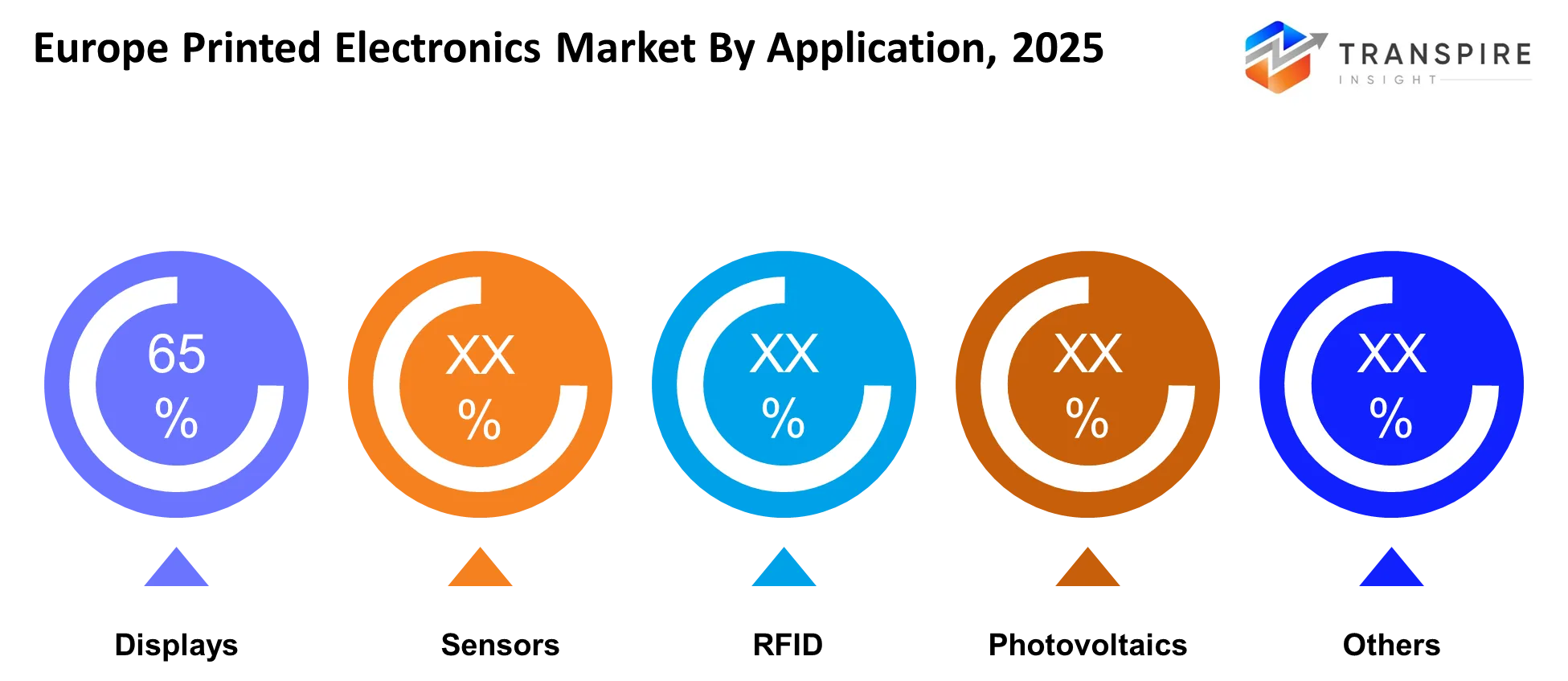
The application areas of the system include Displays and Sensors and RFID and Photovoltaics and Other applications. The European Printed Electronics Market shows high demand for sensors which automotive systems and industrial monitoring systems and smart infrastructure systems use as standard components. The retail and logistics sectors use RFID systems for their tracking needs while display technology and photovoltaic systems operate in specialized advanced technical fields. The first category of applications includes new biomedical technologies and flexible circuit applications.
The IoT industry uses sensors to support its Industry 4.0 initiatives and electric vehicle development because real-time data acquisition enables better system performance and maintenance prediction. The supply chain operations of European logistics networks use digitization technology to drive RFID system growth. Low-power IoT devices increasingly adopt photovoltaic technology because energy harvesting creates less need for battery power.
The sensor market will retain its leading position because automation technology continues to enter more industrial sectors. The RFID market will experience consistent growth through its connection to digital trade systems. Distributed energy systems will experience minor increases in photovoltaic system capacity. Product developers increasingly focus on creating printed systems which enable multiple functions by combining sensing and identification and energy harvesting capabilities.
To learn more about this report, Download Free Sample Report
By End-User:
The automotive sector constitutes a major portion of the European printed electronics market because of their current push towards electric vehicle development which includes the use of lightweight sensor technology. Electronics manufacturers follow closely, using printed components for wearables and flexible devices. The healthcare market develops into a smaller segment which experiences rapid growth because of new diagnostic methods.
The automotive industry depends on three technology components which include electric vehicle battery monitoring systems, interior touch control interfaces, and emission control systems. The demand for electronics products results from consumers who choose portable electronic devices with flexible functionality. The healthcare industry expands its usage of medical biosensors because their disposable nature combined with non-invasive monitoring technology helps decrease the expenses of hospital tests.
The automotive industry will continue to generate most of its revenue from electric vehicle sales as European countries increase their electric vehicle adoption rates. The healthcare industry will grow faster because digital health solutions will receive more support from regulations. Investors are concentrating their efforts on developing health sensor systems that meet automotive standards for reliability while also creating platforms that can be scaled up.
By Material:
The European Printed Electronics Market is dominated by conductive ink because it has essential functions which create operational circuits needed for all printed electronic technologies. The secondary market position of substrates is strong because flexible polymers are utilized in both industrial systems and wearable technology. The category of other materials includes dielectric inks and encapsulation layers.
The demand for conductive ink increases because printed sensors and RFID systems are growing, which requires conductivity performance that affects device reliability. The substrate market expands because manufacturers need flexible, durable materials that can be produced through roll-to-roll manufacturing methods. The current focus of material innovation efforts centers on developing materials which will enhance conductivity while providing better protection against environmental elements.
The market for conductive ink will continue to grow because its different applications will be used in both the automotive and healthcare industries. The substrate market will experience steady growth because flexible electronics become more widely used. Material suppliers are investing in nano-ink formulations and sustainable substrate alternatives to meet long-term industrial scalability requirements.
What are the Key Use Cases Driving the Europe Printed Electronics Market?
The Europe Printed Electronics Market displays its main application through automotive sensing systems which receive support from the growing adoption of electric vehicles and the development of lightweight monitoring technologies that consume minimal power. The implementation of printed sensors inside batteries and vehicle interiors and thermal systems enables electric vehicles to achieve better performance tracking while minimizing their wiring needs. The strong EU emission compliance requirements create a need for OEM platforms to adopt their solutions.
Printed RFID and sensor networks enable asset tracking and predictive maintenance which creates new operational possibilities in industrial IoT and smart logistics. The healthcare diagnostics market generates additional demand because patients require disposable biosensors for monitoring and testing at medical facilities which leads to increased need for medical equipment.
The energy-harvesting surfaces and smart packaging with integrated sensing for cold-chain monitoring in pharmaceuticals emerge as new use cases. The maritime industry has begun to use printed electronics for corrosion detection systems which help ships conduct their maintenance operations while meeting European Union shipping regulations.
|
Report Metrics |
Details |
|
Market size value in 2025 |
USD 4.851 Billion |
|
Market size value in 2026 |
USD 5.970 Billion |
|
Revenue forecast in 2033 |
USD 25.571 Billion |
|
Growth rate |
CAGR of 23.10% from 2026 to 2033 |
|
Base year |
2025 |
|
Historical data |
2021 - 2024 |
|
Forecast period |
2026 - 2033 |
|
Report coverage |
Revenue forecast, competitive landscape, growth factors, and trends |
|
Regional scope |
Europe (Germany, United Kingdom, France, Italy, Spain, Rest of Europe) |
|
Key company profiled |
Samsung Electronics, LG Electronics, Xerox, Thinfilm, Molex, E Ink, BASF, Dupont, NovaCentrix, Enfucell, PragmatIC, FlexEnable, Toppan Printing, Nissha, VTT |
|
Customization scope |
Free report customization (country, regional & segment scope). Avail customized purchase options to meet your exact research needs. |
|
Report Segmentation |
By Type (Inkjet Printing, Screen Printing, Flexography, Others); By Application (Displays, Sensors, RFID, Photovoltaics, Others); By End-User (Electronics, Automotive, Healthcare, Others); By Material (Conductive Ink, Substrates, Others) |
Which Regions are Driving the Europe Printed Electronics Market Growth?
Germany dominates the Europe Printed Electronics Market because of its advanced automotive manufacturing capabilities and its established industrial automation system. The implementation of EU emission standards together with Germany's decision to implement electric vehicle technology has resulted in printed sensors being used for battery systems interior design and exhaust system monitoring. The region maintains a strong network of Original Equipment Manufacturers and material suppliers and research and development institutes which enables continuous product development and fast market entry. The system allows businesses to move from initial product testing to full-scale implementation which strengthens Germany's position as the top revenue generator.
France functions as a steady and dependable market participant which serves industrial needs through its various industrial sectors instead of depending on automotive operations. The country experiences constant growth in aerospace defense electronics and healthcare diagnostics because these fields require dependable systems that meet regulatory standards instead of needing fast expansion. Government-funded programs for industrial modernization support the gradual adoption of printed electronics technology into smart packaging and logistics systems. France maintains its balanced growth across various sectors because of its automotive industry focus while creating stable demand patterns that will continue for many years.
Eastern Europe has become the fastest-growing region because manufacturing companies are moving their operations to new locations and infrastructure projects are being developed. Poland and the Czech Republic have attracted new printed electronics assembly facilities because they offer lower production costs and digital manufacturing investments supported by the European Union. Industrial adoption of new technologies has increased because ports now operate with modernized systems and supply chains have been expanded to include diverse options. The period from 2026 to 2033 will bring significant market entry opportunities because companies can establish scalable manufacturing partnerships and use contract-based production systems.
Who are the Key Players in the Europe Printed Electronics Market and How Do They Compete?
The Europe Printed Electronics Market shows a moderately consolidated structure where a small group of global material science and specialty chemical firms compete alongside niche electronics innovators. Material performance and print precision and long-term reliability in industrial environments have become the primary factors that drive competition between companies instead of purely pricing. Incumbents safeguard their market position through complete supply chain connections with automotive and industrial original equipment manufacturers while new market players create changes through adaptive manufacturing systems and high-resolution application conductive materials that they have developed.
Henkel AG & Co. KGaA strengthens its position through adhesive-based conductive inks optimized for roll-to-roll manufacturing which enable automotive interior and sensor integration to achieve reliable mass production. DuPont focuses on high-performance functional materials which include advanced inks and pastes that boost durability in harsh industrial environments to achieve better performance in long-life applications. BASF SE uses its extensive chemical manufacturing capabilities to achieve cost advantages and supply chain stability which enables it to produce conductive and dielectric materials that are essential for printed sensor technology.
Avery Dennison differentiates through smart labeling and RFID solutions which provide logistics and retail traceability systems to European customers through strong integration with supply chain software platforms. Thin Film Electronics ASA develops NFC-enabled printed electronics for authentication and tracking applications which it expands through collaborations with packaging and pharmaceutical organizations. These strategies collectively reflect a shift toward specialization where companies compete by aligning material innovation with specific industrial use cases instead of broad product portfolios.
Company List
- Samsung Electronics
- LG Electronics
- Xerox
- Thinfilm
- Molex
- E Ink
- BASF
- Dupont
- NovaCentrix
- Enfucell
- PragmatIC
- FlexEnable
- Toppan Printing
- Nissha
- VTT
Recent Development News
“In May 2026, BASF SE expanded its advanced conductive ink production capacity in Europe. The initiative supports rising demand for printed sensor materials used in automotive and industrial monitoring systems and strengthens supply chain resilience.”https://www.basf.com
“In January 2026, DuPont announced a strategic collaboration with European automotive suppliers to scale printed sensor integration in electric vehicle battery systems. The partnership enhances thermal and conductivity performance in high-reliability automotive environments.”https://www.dupont.com
What Strategic Insights Define the Future of the Europe Printed Electronics Market?
The Europe Printed Electronics Market is moving toward deep integration within industrial and mobility ecosystems rather than remaining a standalone component industry. Over the next 5–7 years, growth will be driven by the convergence of electrification, distributed sensing, and localized manufacturing, where printed electronics become embedded directly into vehicle platforms, smart infrastructure, and logistics systems. This shift is being accelerated by the need for lighter architectures and real-time operational intelligence across regulated industries.
A less visible risk lies in material dependency concentration, particularly on specialized conductive inks and substrate supply chains controlled by a limited group of chemical producers. Any disruption in these inputs could slow scaling and expose manufacturers to cost volatility, even as demand rises. This structural dependency may also limit innovation flexibility for smaller entrants.
An emerging opportunity is the integration of printed electronics into circular economy systems, particularly in recyclable smart packaging and energy-harvesting industrial surfaces under EU sustainability mandates. This is expected to gain traction as regulatory pressure increases on waste reduction and traceability. Market participants should prioritize partnerships with material innovators and invest in modular, multi-function printing platforms to capture long-term value in scalable, regulation-driven applications.
Europe Printed Electronics Market Report Segmentation
By Type
- Inkjet Printing
- Screen Printing
- Flexography
- Others
By Application
- Displays
- Sensors
- RFID
- Photovoltaics
- Others
By End-User
- Electronics
- Automotive
- Healthcare
- Others
By Material
- Conductive Ink
- Substrates
- Others
Frequently Asked Questions
Find quick answers to common questions.
The Europe Printed Electronics Market size is USD 25.571 Billion in 2033.
Key segments for the Europe Printed Electronics Market are By Type (Inkjet Printing, Screen Printing, Flexography, Others); By Application (Displays, Sensors, RFID, Photovoltaics, Others); By End-User (Electronics, Automotive, Healthcare, Others); By Material (Conductive Ink, Substrates, Others).
Major Europe Printed Electronics Market players are Samsung Electronics, LG Electronics, Xerox, Thinfilm, Molex, E Ink, BASF, Dupont, NovaCentrix, Enfucell, PragmatIC, FlexEnable, Toppan Printing, Nissha, VTT.
The Europe Printed Electronics Market size is USD 4.851 Billion in 2025.
The Europe Printed Electronics Market CAGR is 23.10% from 2026 to 2033.
- Samsung Electronics
- LG Electronics
- Xerox
- Thinfilm
- Molex
- E Ink
- BASF
- Dupont
- NovaCentrix
- Enfucell
- PragmatIC
- FlexEnable
- Toppan Printing
- Nissha
- VTT
Recently Published Reports
-
Apr 2026
Fiber Optic Faceplates Market
Fiber Optic Faceplates Market Size, Share & Analysis Report By Type (< 300 mm2, 300-350 mm2, and > 350 mm2, By Application (Night Vision, Holographic Imaging, Medical, and Others), and Geography (North America, Europe, Asia-Pacific, Middle East and Africa, South and Central America), 2021 - 2031
-
Apr 2026
High Temperature Superconductors Market
High Temperature Superconductors Market Size, Share & Analysis Report By Type (1G HTS, and 2G HTS), By Application (Power Cable, Fault Current Limiter, and Transformer), and Geography (North America, Europe, Asia-Pacific, Middle East and Africa, South and Central America), 2021 - 2031
-
Apr 2026
Industrial Plugs and Socket Market
Industrial Plugs and Socket Market Size, Share & Analysis Report By Type (Industrial Plugs, Industrial Sockets), By Current (Up to 32 A, 32 to 125 A, Above 125 A), By Protection (Dustproof and Splash Proof, Waterproof, Explosion Proof), By End User (Heavy Industries, Oil and Gas, Chemicals and Pharmaceuticals, Power Generation, Others), and Geography (North America, Europe, Asia-Pacific, Middle East and Africa, South and Central America), 2021 - 2031
-
Apr 2026
InGaAs Avalanche Photodiodes Market
InGaAs Avalanche Photodiodes Market Size, Share & Analysis Report By Type (1100 - 1700 nm, and 1000 - 1600 nm), By Application (Missile Warning System, Muzzle Flash Detection, Wafer Defect Inspection, Laser Rangefinders, and Others), and Geography (North America, Europe, Asia-Pacific, Middle East and Africa, South and Central America), 2021 - 2031