
Japan Laminated Busbar Market Size & Forecast:
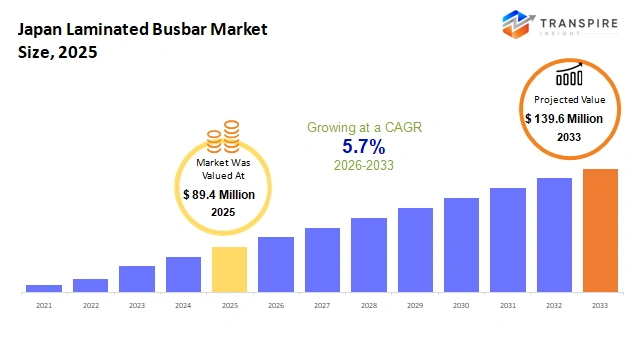
- Japan Laminated Busbar Market Size 2025: USD 89.4 Million
- Japan Laminated Busbar Market Size 2033: USD 139.6 Million
- Japan Laminated Busbar Market CAGR: 5.7%
- Japan Laminated Busbar Market Segments:By Insulation Type (Epoxy Powder Coating, Polyimide Film, Polyester Film, PVF Film, Heat-Resistant Fiber), By Conductor Material (Copper, Aluminum), By End-User Industry (Automotive, Telecom, Aerospace & Defense, Industrial, Renewable Energy).
To learn more about this report,  Download Free Sample Report
Japan Laminated Busbar Market Summary:
The Japan Laminated Busbar Market size is estimated at USD 89.4 Million in 2025 and is anticipated to reach USD 139.6 Million by 2033, growing at a CAGR of 5.7% from 2026 to 2033. The laminated busbar market in Japan experiences continuous expansion because of the country's dedication to developing advanced electronic systems and electric vehicle technology and renewable energy infrastructure. The modern electrical systems benefit from these small power distribution units which provide better efficiency and lower energy waste and improved system dependability. The Japanese manufacturing sector now utilizes laminated busbars for their industrial automation systems and power electronics equipment and battery technologies. The market will experience consistent growth because of ongoing technological progress and increasing demand for energy-saving products.
Key Market Trends & Insights:
- Increasing Adoption of Electric Vehicles (EVs) The demand for laminated busbar components is growing because Japan is currently experiencing a rapid growth phase in its electric vehicle industry. The components enable efficient management of high electrical currents while creating space savings and enhanced thermal capabilities in electric vehicle battery and power systems.
- Japanese industries are prioritizing energy-efficient electrical systems to reduce power loss and improve performance. Laminated busbars support this goal by minimizing inductance and resistance which makes them a preferred solution in modern power electronics.
- The growth of solar and wind energy projects in Japan provides new business opportunities to laminated busbars. The technology serves as an essential component of inverters and power conversion systems which enable renewable energy sources to connect with the electrical grid.
- The ongoing research efforts in power electronics and semiconductor technology development create a demand for smaller yet more dependable power distribution system components. Advanced electronic systems now use laminated busbars as their primary power distribution system because of the technology's ability to provide long-lasting and efficient performance.
- Japanese manufacturers and automation companies now implement laminated busbars to enhance power control systems used in their robotics and automated machinery. The compact design of these products makes them suitable for operation in high-performance industrial environments while maintaining their reliable performance.
Japan Laminated Busbar Market Segmentation
By Insulation Type
- Epoxy Powder Coating: The laminated busbars choose epoxy powder coating because the coating provides excellent insulation and durable protection. The material safeguards conductors against damage from moisture and heat and mechanical impact. Japanese industries select this insulation method when they need dependable performance that lasts throughout extended operational periods.
- Polyimide Film: Polyimide film provides excellent thermal stability and electrical insulation which makes it highly valuable material. The product maintains its functionality under extreme heat conditions which makes it suitable for use in aerospace systems and advanced electronic devices and electric vehicle technology. Japanese manufacturers choose polyimide film because power distribution systems require both space-efficient designs and dependable performance.
- Polyester Film: Polyester film provides an economical solution which delivers dependable insulation protection to users. The material is utilized in systems which need to operate at intermediate temperatures while delivering efficient electrical performance. Japanese industries use polyester film laminated busbars in both industrial equipment and consumer electronic devices.
- PVF Film: PVF film delivers exceptional protection against chemical exposure and water damage and environmental pressures. The material proves suitable for extreme operating environments because its durability functions as a vital requirement. Japanese power electronics systems and outdoor electrical equipment sectors utilise PVF-insulated laminated busbars to achieve extended operational safety.
- Heat-Resistant Fibre: The insulation system for heat-resistant fibre provides protection to electrical systems which experience high temperatures and heavy electrical demands. The system enables insulation systems to maintain their protective functions while delivering power distribution efficiency. Japanese industries and energy facilities select this type of equipment for their operations in high-temperature working conditions.
By Conductor Material
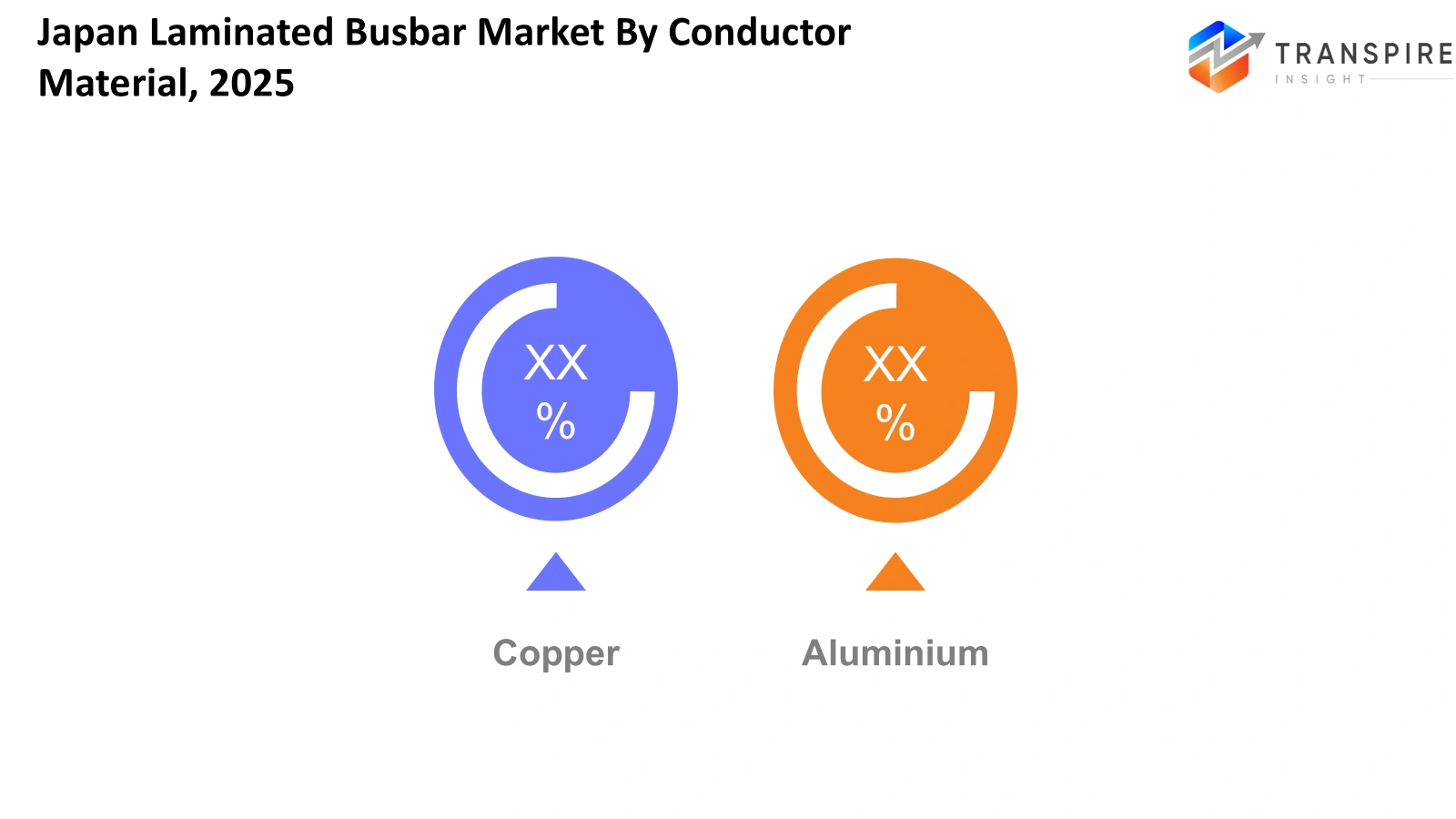
- Copper: The most common conductor material used in laminated busbars exists because copper provides superior electrical conductivity together with excellent thermal performance. The system enables power transmission through its efficient operation which results in minimal energy waste. Japanese industries prefer copper busbars in high-performance applications such as electric vehicles, power electronics, and industrial machinery.
- Aluminium: Aluminium-laminated busbars become popular because their lightweight construction and affordable cost elements work together to create effective performance. Aluminum delivers reliable performance in weight-sensitive applications, although its conductivity falls short of copper. The material has seen rising usage in Japan for both renewable energy systems and specific automotive electrical applications.
To learn more about this report, Download Free Sample Report
By End-User Industry
- Automotive: The automotive sector in Japan requires laminated busbars because electric and hybrid vehicle production continues to expand. The components enable power distribution management between battery systems and inverters and charging infrastructure while maintaining compact vehicle designs.
- Telecom: Telecom infrastructure needs steady power systems which supply reliable power to its data centres and base stations and communication equipment. The use of laminated busbars decreases power loss while increasing the dependability of electrical systems. The advanced Japanese telecom system uses these devices to establish high-speed communication links throughout the country.
- Aerospace & Defence: The laminated busbars used in aerospace and defence applications deliver dependable power distribution which complies with strict safety and performance requirements. The Japanese aerospace industry needs these compact and durable systems for its aircraft electrical systems and defence electronics applications.
- Industrial: The manufacturing strength of Japan creates high demand for laminated busbars used in industrial machinery and robotics and automation systems. The components provide continuous power supply while reducing equipment space requirements inside complex systems. The equipment shows high reliability and operational efficiency, which makes it perfect for controlling industrial power systems in contemporary environments.
- Renewable Energy: The renewable energy sector in Japan presents new business prospects for companies that produce laminated busbars. The products find extensive application in solar inverters and wind power systems and energy storage systems. The technology enables efficient handling of high currents, which helps Japan move towards renewable energy generation methods.
Country Insights
The Japan laminated busbar market benefits from the country's advanced technological capabilities and its developed manufacturing base. The modern electrical systems need laminated busbars because industries now require better methods to control their electrical power use. The Japanese electric vehicle market demands reliable power distribution systems which work efficiently in compact designs.
The market develops because top electronics and automotive companies establish their operations in the region. The industries need electrical components which provide high performance to increase efficiency while reducing heat and minimising space requirements in their complicated systems. Designers need to use laminated busbars because they deliver better electrical performance together with multiple design options.
The Japanese government promotes power electronics development through its energy efficiency programmes and commitment to sustainable technologies. The laminated busbar market in Japan will experience continuous expansion because industries are upgrading their systems with modern smart technologies and their need for automated systems and increased electrical power usage.
Recent Development News
Global Laminated Busbar Market Expected to Reach $2.2 Billion by 2032 as EV Demand Accelerates
Global Battery Busbars Market Forecast to Grow Strongly with Rising Electric Mobility and Energy Storage Demand
|
Report Metrics |
Details |
|
Market size value in 2025 |
USD 89.4 Million |
|
Market size value in 2026 |
USD 94.7 Million |
|
Revenue forecast in 2033 |
USD 139.6 Million |
|
Growth rate |
CAGR of 5.7% from 2026 to 2033 |
|
Base year |
2025 |
|
Historical data |
2021 – 2024 |
|
Forecast period |
2026 – 2033 |
|
Report coverage |
Revenue forecast, competitive landscape, growth factors, and trends |
|
Country scope |
Japan |
|
Key company profiled |
Amphenol Corporation, Rogers Corporation, Mersen SA, ABB Ltd., Bevone, Jans Copper Pvt. Ltd., Sun.King Power Electronics Group Ltd., Methode Electronics Inc., OEM Automatic Ltd., Raychem RPG Pvt. Ltd., Schneider Electric SE, Storm Power Components, Zhuzhou CRRC Times Electric Co. Ltd., Molex LLC, Ryoden Kasei Co. Ltd. |
|
Customization scope |
Free report customization (country, regional & segment scope). Avail customized purchase options to meet your exact research needs. |
|
Report Segmentation |
By Insulation Type (Epoxy Powder Coating, Polyimide Film, Polyester Film, PVF Film, Heat-Resistant Fiber), By Conductor Material (Copper, Aluminum), By End-User Industry (Automotive, Telecom, Aerospace & Defense, Industrial, Renewable Energy). |
Key Japan Laminated Busbar Company Insights
The laminated busbar market in Japan shows a combination of international electrical solution companies and dedicated component producers. Ryoden Kasei Co. Ltd. Mersen and Amphenol Corporation work to create new busbar technologies for use in automotive industrial and renewable energy sectors. The companies work to develop efficient power systems which will help them fulfill present-day electrical requirements through their thermal control solutions and compact system designs.
Japan now strengthens its position as a technology-oriented market for laminated busbar solutions because multiple companies invest in research and development to create electric vehicles and advanced power electronics technologies.
Company List
- Amphenol Corporation
- Rogers Corporation
- Mersen SA
- ABB Ltd.
- Bevone
- Jans Copper Pvt. Ltd.
- Sun.King Power Electronics Group Ltd.
- Methode Electronics Inc.
- OEM Automatic Ltd.
- Raychem RPG Pvt. Ltd.
- Schneider Electric SE
- Storm Power Components
- Zhuzhou CRRC Times Electric Co. Ltd.
- Molex LLC
- Ryoden Kasei Co. Ltd.
Japan Laminated Busbar Market Report Segmentation
By Insulation Type
- Epoxy Powder Coating
- Polyimide Film
- Polyester Film
- PVF Film
- Heat-Resistant Fiber
By Conductor Material
- Copper
- Aluminum
By End-User Industry
- Automotive
- Telecom
- Aerospace & Defense
- Industrial
- Renewable Energy
Frequently Asked Questions
Find quick answers to common questions.
The approximate Japan Laminated Busbar Market size for the market will be USD 139.6 Million in 2033.
The key segments of the Japan Laminated Busbar Market are By Insulation Type (Epoxy Powder Coating, Polyimide Film, Polyester Film, PVF Film, Heat-Resistant Fiber), By Conductor Material (Copper, Aluminum), By End-User Industry (Automotive, Telecom, Aerospace & Defense, Industrial, Renewable Energy).
Major players in the Japan Laminated Busbar Market are Amphenol Corporation, Rogers Corporation, Mersen SA, ABB Ltd., Bevone, Jans Copper Pvt. Ltd., Sun.King Power Electronics Group Ltd., Methode Electronics Inc., OEM Automatic Ltd., Raychem RPG Pvt. Ltd., Schneider Electric SE, Storm Power Components, Zhuzhou CRRC Times Electric Co. Ltd., Molex LLC, Ryoden Kasei Co. Ltd.
The current market size of Japan Laminated Busbar Market is USD 89.4 Million in 2025.
The Japan Laminated Busbar Market CAGR is 5.7%.
- Amphenol Corporation
- Rogers Corporation
- Mersen SA
- ABB Ltd.
- Bevone
- Jans Copper Pvt. Ltd.
- Sun.King Power Electronics Group Ltd.
- Methode Electronics Inc.
- OEM Automatic Ltd.
- Raychem RPG Pvt. Ltd.
- Schneider Electric SE
- Storm Power Components
- Zhuzhou CRRC Times Electric Co. Ltd.
- Molex LLC
- Ryoden Kasei Co. Ltd.
Recently Published Reports
-
Apr 2026
Healthcare Polymer Packaging Market
Healthcare Polymer Packaging Market Size, Share & Analysis Report By Packaging Type (Syringes, IV Bottles and Pouches, Clamshells, Blisters, Bottles & Jars, Containers, Tubes, IV Parental Packaging, Others), By Type (Regulated, Non-regulated), By Polymer Type (LDPE (Low-Density Polyethylene), HDPE (High-Density Polyethylene), Homo-polymer (Homo), Random Copolymer (Random), Block Copolymer (Block), PET, Polystyrene, Polyvinyl Chloride, Polyamide/EVOH, Others), and Geography (North America, Europe, Asia-Pacific, Middle East and Africa, South and Central America), 2021 - 2031
-
Apr 2026
Hydrophilic Tape (Waterstop) Market
Hydrophilic Tape (Waterstop) Market Size, Share & Analysis Report By Type (Bentonite-Based Hydrophilic Tape, Rubber-Based Hydrophilic Tape), By Application (Residential Buildings, Commercial Buildings, Infrastructure Projects), and Geography (North America, Europe, Asia-Pacific, Middle East and Africa, South and Central America), 2021 - 2031
-
Apr 2026
Metalens Market
Metalens Market Size, Share & Analysis Report By Type (Visible Light Metalens, and Infrared Metalens), By Application (Consumer Electronics, Automotive Electronics, Industrial, Medical, and Others), and Geography (North America, Europe, Asia-Pacific, Middle East and Africa, South and Central America), 2021 - 2031
-
Apr 2026
PBT Resin Market
PBT Resin Market Size, Share & Analysis Report By Type (Reinforced PBT Resin, Unreinforced PBT Resin), By Processing Method (Injection Molding, Extrusion, Blow Molding, Others), By End-User (Automotive, Electrical & Electronics, Consumer Appliances, Industrial Machinery, Medical Devices, Packaging, Others), and Geography (North America, Europe, Asia-Pacific, Middle East and Africa, South and Central America), 2021 - 2031