

South Korea Automotive Propeller Shaft Market Size & Forecast:
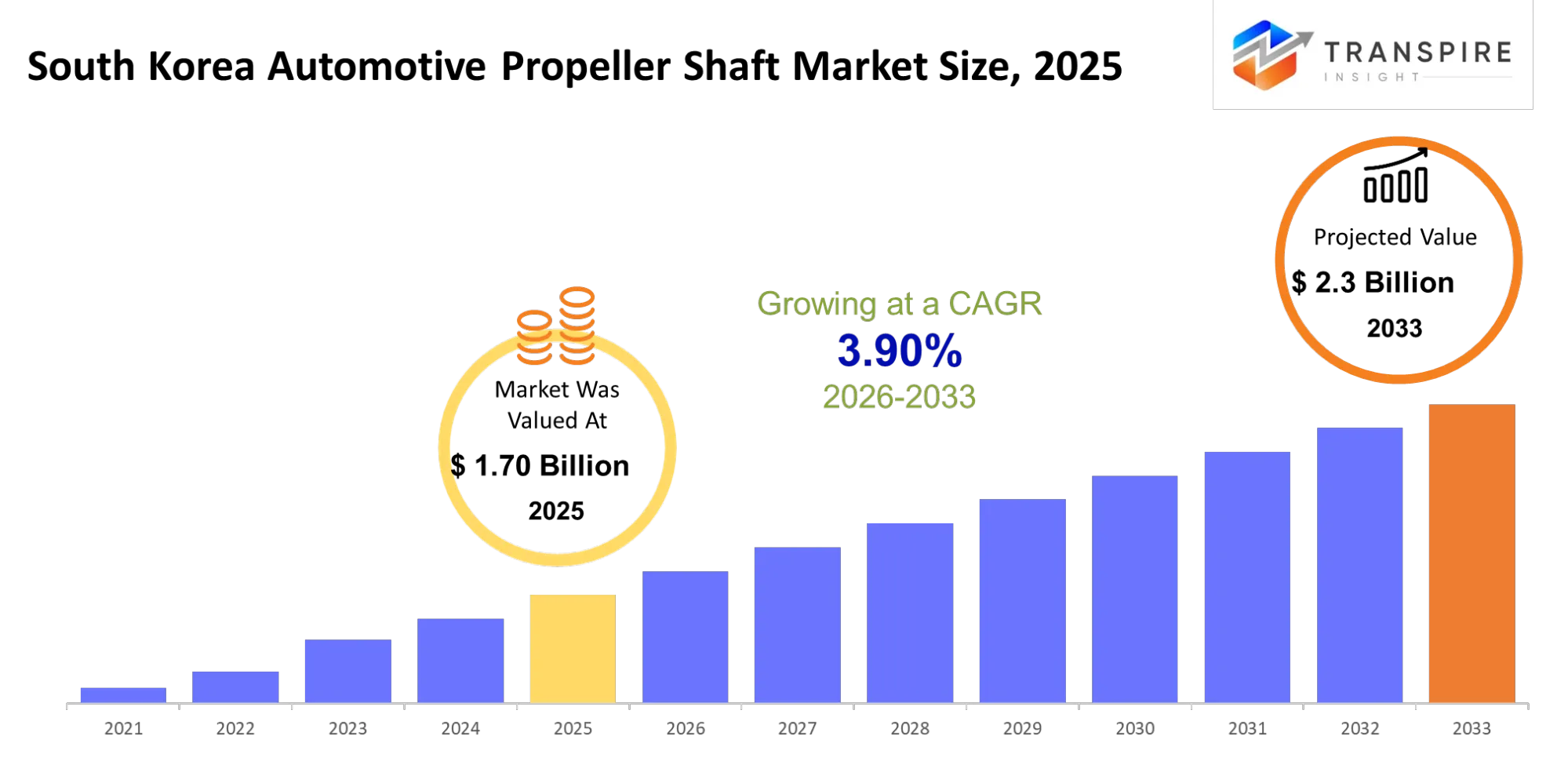
- South Korea Automotive Propeller Shaft Market Size 2025: USD 1.70 Billion
- South Korea Automotive Propeller Shaft Market Size 2033: USD 2.3 Billion
- South Korea Automotive Propeller Shaft Market CAGR: 3.90%
- South Korea Automotive Propeller Shaft Market Segments: By Material (Steel Propeller Shafts, Aluminum Propeller Shafts, Carbon Fiber Propeller Shafts, Others); By Vehicle Type (Passenger Vehicles, Commercial Vehicles, Electric Vehicles, Others); By Application (Front-wheel Drive, Rear-wheel Drive, All-wheel Drive, Others); By End User (OEMs, Aftermarket Suppliers, Fleet Operators, Others).
To learn more about this report,  Download Free Sample Report
South Korea Automotive Propeller Shaft Market Summary
The South Korea Automotive Propeller Shaft Market was valued at USD 1.70 billion in 2025. It is forecast to reach USD 2.3 billion by 2033. That is a CAGR of 3.90% over the period.
The South Korea automotive propeller shaft market, like a kind of quiet backbone, is crucial for moving engine and motor power over to the wheels, so torque lands where it should for passenger vehicles , commercial trucks, and even those specialized mobility platforms. Since South Korea keeps being a major automotive manufacturing hub, propeller shafts remain essential bits that support vehicle performance, long term durability, and drivetrain efficiency for both local production and export oriented output.
Over the last five years, the whole market has sort of leaned toward lighter but tougher materials, like aluminum and advanced composites. Automakers are pushing for weight reduction and better energy efficiency, so the shaft design narrative changes alongside it. One major push behind this shift was the tightening of global emissions regulations and fuel economy requirements, which basically made manufacturers rethink how drivetrain systems behave, and tune component performance more precisely. At the same time, growth in electric and hybrid vehicle production is also reshaping expectations, with buyers and engineers asking for quieter operation, smaller packaging, and more accurate, fine engineered shaft assemblies. All of it is lifting the value per vehicle, so suppliers tend to invest in upgrades across the supply chain, and revenue growth is increasingly driven by improved, higher-performance component use rather than only moving more units.
Key Market Insights
- In 2024, the Seoul Capital Area sort of dominated the South Korea Automotive Propeller Shaft Market , taking up around 42% of the total industry revenue. Meanwhile, the southeastern industrial corridor, with places like Ulsan and Busan , kept a notable market share because automotive manufacturing is concentrated there , in a more or less clear cluster.
- Looking ahead, Gyeonggi Province is projected to be the fastest-growing regional market during the 2025–2030 forecast , backed by investments in advanced automotive components and related work. On the material side, steel propeller shafts were the main thing in 2024, reaching nearly 58% share , largely because they stay durable and make sense on cost, especially for commercial vehicles.
- Aluminum propeller shafts took the second-largest slice, mainly as vehicle makers push weight reduction goals and fuel efficiency targets, not just for marketing but for real compliance too. Composite propeller shafts are expected to be the fastest-growing segment through 2030, since automakers are moving toward lighter materials and better overall performance, kind of like a package deal.
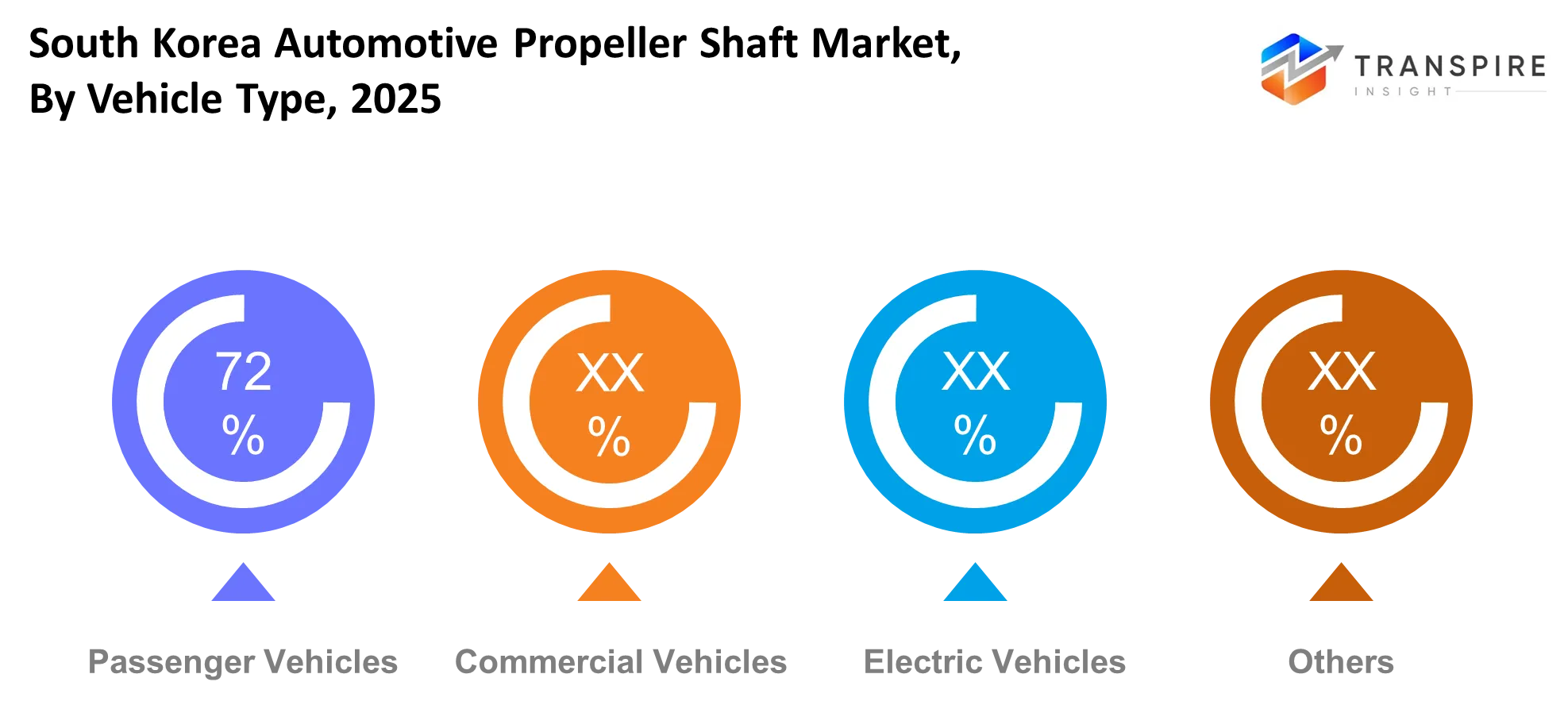
- By vehicle type, passenger vehicles accounted for more than 60% of the South Korea Automotive Propeller Shaft Market share in 2024 , supported by strong domestic production. For application trends, electric and hybrid vehicles are the quickest-growing application segment , as manufacturers redesign drivetrains for higher efficiency and less vibration.
- Commercial vehicle use is still showing steady demand , driven by logistics fleet modernization and ongoing transportation infrastructure development. In terms of customer channel, Original Equipment Manufacturers (OEMs) led the market with about 72% share in 2024, thanks to large-scale vehicle production contracts and long running purchasing routines.
- The aftermarket segment also remains important, mainly due to replacement needs and routine maintenance requirements. And EV-focused automotive manufacturers are emerging as the fastest-growing end-user category during the forecast period, even if the pace varies by region.
What are the Key Drivers, Restraints, and Opportunities in the South Korea Automotive Propeller Shaft Market?
Driver
The strongest growth driver in the South Korea Automotive Propeller Shaft Market is this fast move toward lighter vehicle structures, you know, lighter platforms overall. The momentum really picked up once global requirements on fuel economy and exhaust went tighter, so automakers had to cut vehicle mass without losing the driving feel or the overall performance. Because of that, manufacturers are more and more choosing aluminum and composite propeller shafts, since these designs bring down weight while also boosting drivetrain efficiency. With this kind of shift, the value of the propeller shaft assembly per vehicle tends to rise, and that opens up fresh revenue streams for suppliers that focus on better materials and careful precision engineering. On top of that, redesigns to vehicle platforms are speeding up replacement cycles , since OEMs keep adjusting architecture to match new performance targets.
Restraint
The biggest restraint is the high price tag and also the tech complexity tied to advanced lightweight shaft production. Composite materials do not just “show up”, they need specialized manufacturing methods , plus testing know-how and supply chains that can’t be built overnight. This practical barrier makes it harder for smaller suppliers to join in, and it also slows down the industry’s ability to scale output. So adoption stays mostly with larger automotive manufacturers, which means broader market penetration takes longer and potential revenue growth across the whole supply network gets limited.
Opportunity
A major opportunity lies in South Korea's expanding electric vehicle production base. EV platforms require highly efficient drivetrain components with reduced vibration and noise characteristics. Investments in dedicated EV manufacturing facilities and next-generation mobility programs are creating favorable conditions for advanced propeller shaft technologies. Suppliers that develop lightweight, high-strength shafts tailored for electric vehicles are well positioned to secure long-term contracts and capture the next phase of market expansion.
What Has the Impact of Artificial Intelligence Been on the South Korea Automotive Propeller Shaft Market?
Artificial intelligence and advanced digital manufacturing technologies are increasingly reshaping the South Korea Automotive Propeller Shaft Market by improving production efficiency, quality control, and component reliability. Leading automotive suppliers are deploying AI-powered machine vision systems on production lines to inspect shaft alignment, surface defects, weld quality, and dimensional accuracy in real time. These automated inspection systems reduce manual intervention, shorten production cycles, and help manufacturers maintain tighter quality standards for OEM customers.
Machine learning models are also being used for predictive maintenance across machining centers, forging equipment, and balancing systems involved in propeller shaft production. By analyzing vibration patterns, temperature readings, and equipment utilization data, manufacturers can identify potential failures before they occur. This approach reduces unplanned downtime, improves asset utilization, and supports higher factory throughput. In some facilities, predictive maintenance programs have contributed to double-digit reductions in maintenance-related stoppages and lower operating costs.
Digital twin technology is emerging as another important tool, enabling engineers to simulate torque loads, fatigue behavior, and drivetrain performance before physical testing. This accelerates product development and improves component durability. However, AI adoption still faces limitations. High integration costs, legacy manufacturing infrastructure, and the need for large volumes of high-quality operational data can slow implementation, particularly among smaller component suppliers with limited digital transformation budgets.
Key Market Trends
- Since 2020, South Korean automakers have accelerated aluminum propeller shaft adoption to reduce vehicle weight and meet stricter fuel-efficiency targets.
- EV platform development has shifted supplier priorities from traditional torque transmission toward vibration reduction, noise control, and compact drivetrain integration.
- Manufacturers increasingly replaced manual inspection processes with AI-powered vision systems between 2021 and 2025, improving quality consistency and reducing defect rates.
- Suppliers such as Hyundai WIA expanded investment in precision machining and automated balancing technologies to meet tighter OEM performance specifications.
- Composite material usage gained momentum after 2022 as automakers sought stronger components that support extended electric vehicle driving ranges.
- Global supply chain disruptions during 2021–2023 encouraged manufacturers to strengthen local sourcing networks and reduce dependence on imported components.
- OEM procurement strategies shifted toward long-term supplier partnerships, prioritizing engineering capabilities and co-development expertise over purely cost-based purchasing decisions.
- Digital twin technology emerged across drivetrain development programs, allowing manufacturers to shorten testing cycles and improve component durability before production.
- Export-focused vehicle production increasingly influenced product design, as suppliers adapted shaft systems to meet North American and European regulatory requirements.
- Competition has moved beyond manufacturing scale since 2023, with companies differentiating through lightweight designs, predictive maintenance capabilities, and advanced materials expertise.
South Korea Automotive Propeller Shaft Market Segmentation
By Material
Steel propeller shafts continue to hold a strong position due to durability, strength, and cost advantages. Extensive use in passenger and commercial vehicles supports steady demand across the automotive sector. High load-bearing capacity makes steel a preferred choice for applications that require reliability and long service life.
Aluminum propeller shafts are gaining attention because vehicle manufacturers are focusing on weight reduction and fuel efficiency. Lower weight helps improve vehicle performance and supports energy-saving goals. Carbon fiber propeller shafts are expanding gradually as premium vehicle manufacturers seek advanced materials with high strength and reduced weight. Other materials serve specialized requirements where unique performance characteristics are necessary.
By Vehicle
Passenger vehicles account for a significant share due to large production volumes and consistent consumer demand. Strong domestic automotive manufacturing activity supports the installation of propeller shafts in a wide range of vehicle models. Continuous product upgrades also encourage the use of advanced drivetrain components.
Commercial vehicles create stable demand because logistics, construction, and transportation activities require dependable vehicle performance. Electric vehicles are becoming an important growth area as manufacturers develop new drivetrain systems and lightweight vehicle platforms. Other vehicle categories contribute additional opportunities through specialized transportation and mobility applications that require tailored component solutions.
To learn more about this report, Download Free Sample Report
By Application
Front-wheel drive applications remain important in compact and mid-sized vehicles because of efficient space utilization and practical vehicle design. Manufacturers continue refining drivetrain configurations to improve efficiency and driving comfort. Consistent production of front-wheel drive models supports ongoing component demand.
Rear-wheel drive applications maintain relevance in performance-oriented and commercial vehicle segments where balanced power delivery is important. All-wheel drive systems are gaining greater attention as consumer preference shifts toward improved traction and driving stability. Other applications support niche vehicle categories that require customized drivetrain arrangements for specific operational needs.
By End User
OEMs represent the leading end-user category due to direct integration of propeller shafts during vehicle manufacturing. Long-term supply agreements and strict quality requirements encourage continuous product development among component manufacturers. Close collaboration between automotive companies and suppliers supports innovation and production efficiency.
Aftermarket suppliers generate demand through replacement parts and maintenance requirements throughout vehicle lifecycles. Fleet operators increasingly focus on component durability and operational reliability to reduce downtime and maintenance costs. Other end users contribute to market activity through specialized automotive applications and customized vehicle requirements.
What are the Key Use Cases Driving the South Korea Automotive Propeller Shaft Market?
Passenger vehicle manufacturing represents the primary use case driving demand for automotive propeller shafts in South Korea. High production volumes from domestic automakers require reliable drivetrain components that efficiently transfer torque while maintaining vehicle performance, durability, and fuel efficiency. Continuous model upgrades further support component replacement and integration across new vehicle platforms.
Commercial transportation and logistics applications are expanding steadily as fleet operators seek dependable power transmission systems for delivery trucks and heavy-duty vehicles. Demand is also increasing from electric vehicle manufacturers that require specialized shaft designs capable of supporting new drivetrain architectures and lightweight vehicle structures.
Emerging use cases are developing in next-generation electric mobility platforms and high-performance vehicle programs. Advanced lightweight shafts made from aluminum and composite materials are gaining attention as manufacturers focus on extending driving range, reducing vehicle weight, and improving drivetrain efficiency. These applications remain at an early stage but offer strong growth potential throughout the forecast period.
|
Report Metrics |
Details |
|
Market size value in 2025 |
USD 1.70 Billion |
|
Market size value in 2026 |
USD 1.76 Billion |
|
Revenue forecast in 2033 |
USD 2.3 Billion |
|
Growth rate |
CAGR of 3.90% from 2026 to 2033 |
|
Base year |
2025 |
|
Historical data |
2021 - 2024 |
|
Forecast period |
2026 - 2033 |
|
Report coverage |
Revenue forecast, competitive landscape, growth factors, and trends |
|
Regional scope |
South Korea |
|
Key company profiled |
Hyundai WIA, Dana Incorporated, GKN Automotive, NTN Corporation, Nexteer Automotive, JTEKT Corporation, AAM, Hyundai Mobis, Meritor, IFA Rotorion, Neapco Holdings, Yuasa Manufacturing, SDS Co., Ltd., Seohan Group, Dura Automotive Systems |
|
Customization scope |
Free report customization (country, regional & segment scope). Avail customized purchase options to meet your exact research needs. |
|
Report Segmentation |
By Material (Steel Propeller Shafts, Aluminum Propeller Shafts, Carbon Fiber Propeller Shafts, Others); By Vehicle Type (Passenger Vehicles, Commercial Vehicles, Electric Vehicles, Others); By Application (Front-wheel Drive, Rear-wheel Drive, All-wheel Drive, Others); By End User (OEMs, Aftermarket Suppliers, Fleet Operators, Others). |
Which Regions are Driving the South Korea Automotive Propeller Shaft Market Growth?
The Seoul Capital Area leads the market due to its concentration of automotive manufacturing facilities, research centers, and component suppliers. Major vehicle manufacturers maintain extensive production operations across the region, creating sustained demand for advanced drivetrain components. Strong transportation infrastructure and proximity to engineering talent support efficient product development and supply chain coordination. A well-established ecosystem of OEMs, technology providers, and precision manufacturing companies continues to reinforce regional leadership.
The southeastern region, particularly Ulsan and Busan, serves as the second-largest contributor and differs from the leading region through its industrial manufacturing focus. Large-scale vehicle assembly plants and export-oriented production facilities create a stable foundation for component demand. Long-standing investments in automotive production capacity provide resilience during changing market conditions. Consistent procurement activity from major manufacturers supports predictable revenue opportunities for propeller shaft suppliers operating in the region.
Gyeonggi Province is emerging as the fastest-growing regional market as investments in electric vehicle production and advanced mobility technologies accelerate. Recent expansion of EV manufacturing facilities and increased funding for automotive innovation have strengthened regional growth prospects. Growing adoption of lightweight materials and digitally enabled production systems is creating new opportunities for component manufacturers. Over the 2026–2033 period, this momentum is expected to attract technology-focused suppliers and investors seeking exposure to next-generation automotive platforms.
Who are the Key Players in the South Korea Automotive Propeller Shaft Market and How Do They Compete?
Competition in the South Korea Automotive Propeller Shaft Market remains moderately consolidated, with a mix of domestic automotive component manufacturers and global drivetrain specialists competing for OEM contracts. Market participants primarily compete through engineering capabilities, material innovation, manufacturing precision, and the ability to support next-generation vehicle platforms. Established suppliers continue to defend market share through long-term relationships with automakers, while specialized technology providers seek opportunities in electric vehicle and lightweight component applications. Product performance, durability, and integration with evolving drivetrain architectures have become more important than price alone in securing new business.
Hyundai WIA focuses on technology innovation and close integration with South Korea's automotive manufacturing ecosystem. The company differentiates itself through advanced machining capabilities, precision balancing technologies, and direct collaboration with vehicle manufacturers during product development. Continued investment in automated production systems and EV-related component technologies strengthens competitiveness as drivetrain requirements become more complex. GKN Automotive emphasizes advanced driveline engineering and lightweight solutions that support vehicle efficiency targets. Strong research and development capabilities allow the company to develop specialized products for electric and hybrid vehicle platforms.
Dana Incorporated competes through expertise in drivetrain optimization and high-performance torque management systems. The company differentiates itself by offering integrated solutions that improve durability and efficiency across multiple vehicle categories. JTEKT Corporation focuses on precision engineering and high-quality component manufacturing, helping meet strict OEM performance standards. Expansion of research partnerships, advanced material development programs, and support for emerging electric mobility platforms continues to create growth opportunities for both companies across domestic and export-focused automotive markets.
Company List
- Hyundai WIA
- Dana Incorporated
- GKN Automotive
- NTN Corporation
- Nexteer Automotive
- JTEKT Corporation
- American Axle & Manufacturing Holdings, Inc.
- Hyundai Mobis
- Meritor
- IFA Rotorion
- Neapco Holdings
- Yuasa Manufacturing
- SDS Co., Ltd.
- Seohan Group
- Dura Automotive Systems
Recent Development News
"In February 2026, American Axle & Manufacturing (AAM) completed its combination with Dowlais Group, the parent company of GKN Automotive. The transaction created a larger driveline and propulsion systems supplier with expanded global capabilities across propeller shaft, driveline, and electrified vehicle technologies, strengthening competitive dynamics in automotive component markets.https://www.aam.com
"In April 2026, American Axle & Manufacturing and GKN Automotive, operating under the Dauch Corporation structure, published their 2025 Sustainability Reports following the completed corporate integration. The reports highlighted operational progress and strategic alignment across global driveline operations, supporting long-term investment in advanced mobility and drivetrain technologies.https://www.gknautomotive.com
"In February 2026, Dana Incorporated reaffirmed its 2026 targets and reported continued investment in powertrain and electrification technologies following its 2025 financial results. The company emphasized new business growth and technology development in drivetrain systems, supporting future opportunities in automotive driveshaft and propulsion applications.https://www.dana.com
What Strategic Insights Define the Future of the South Korea Automotive Propeller Shaft Market?
The South Korea Automotive Propeller Shaft Market is moving toward higher-value, technology-intensive products rather than growth driven solely by production volumes. Over the next five to seven years, drivetrain electrification, lightweight vehicle platforms, and stricter performance requirements will push manufacturers to develop advanced shaft systems with improved strength, reduced weight, and greater durability. Competitive advantage will increasingly depend on engineering capabilities and material expertise rather than manufacturing scale alone.
A less visible risk comes from technology substitution within electric vehicle architectures. Some next-generation EV platforms are adopting drivetrain configurations that reduce dependence on traditional propeller shaft designs, potentially limiting demand growth in specific vehicle categories. In addition, dependence on a relatively small number of major automotive manufacturers creates concentration risk for suppliers.
An emerging opportunity lies in the development of advanced composite and smart propeller shafts equipped with condition-monitoring capabilities. As predictive maintenance gains importance across connected vehicles, these technologies could create new revenue streams. Market participants should invest early in lightweight materials, digital engineering tools, and EV-focused product development partnerships to secure long-term positioning in future vehicle platforms.
South Korea Automotive Propeller Shaft Market Report Segmentation
By Material
- Steel Propeller Shafts
- Aluminum Propeller Shafts
- Carbon Fiber Propeller Shafts
- Others
By Vehicle Type
- Passenger Vehicles
- Commercial Vehicles
- Electric Vehicles
- Others
By Application
- Front-wheel Drive
- Rear-wheel Drive
- All-wheel Drive
- Others
By End User
- OEMs
- Aftermarket Suppliers
- Fleet Operators
- Others
Frequently Asked Questions
Find quick answers to common questions.
The expected South Korea Automotive Propeller Shaft Market size for the market will be USD 2.3 Billion in 2033.
Key segments for the South Korea Automotive Propeller Shaft Market are By Material (Steel Propeller Shafts, Aluminum Propeller Shafts, Carbon Fiber Propeller Shafts, Others); By Vehicle Type (Passenger Vehicles, Commercial Vehicles, Electric Vehicles, Others); By Application (Front-wheel Drive, Rear-wheel Drive, All-wheel Drive, Others); By End User (OEMs, Aftermarket Suppliers, Fleet Operators, Others).
Major South Korea Automotive Propeller Shaft Market players are Hyundai WIA, Dana Incorporated, GKN Automotive, NTN Corporation, Nexteer Automotive, JTEKT Corporation, AAM, Hyundai Mobis, Meritor, IFA Rotorion, Neapco Holdings, Yuasa Manufacturing, SDS Co., Ltd., Seohan Group, Dura Automotive Systems.
The South Korea Automotive Propeller Shaft Market size is USD 1.70 Million in 2025.
The South Korea Automotive Propeller Shaft Market CAGR is confirmed 3.90% from 2026 to 2033.
- Hyundai WIA
- Dana Incorporated
- GKN Automotive
- NTN Corporation
- Nexteer Automotive
- JTEKT Corporation
- American Axle & Manufacturing Holdings, Inc.
- Hyundai Mobis
- Meritor
- IFA Rotorion
- Neapco Holdings
- Yuasa Manufacturing
- SDS Co., Ltd.
- Seohan Group
- Dura Automotive Systems
About the Authors

Mayur Shinde
I am Mayur Shinde, a Senior Research Analyst at Transpire Insight, specializing in the Automotive & Transportation and Information & Communication Technology (ICT) Industry. My work focuses on analyzing emerging market trends, technological advancements, competitive landscapes, and industry developments to deliver accurate, data-driven insights. I am passionate about transforming complex market information into clear, actionable content that helps businesses, professionals, and decision-makers stay informed and make confident strategic decisions.

Chakradhar Khansole
Chakradhar serves as the Research Director at Transpire Insight, bringing over 8 years of experience in technology, innovation, and strategic market intelligence. He specializes in transforming complex market data into actionable business insights that enable organizations to make informed, growth-oriented decisions. Recognized for his strategic vision and analytical expertise, Chakradhar leads high-impact research initiatives, delivering comprehensive market assessments, competitive intelligence, and forward-looking industry analysis.
Recently Published Reports
-
Apr 2026
ATV & UTV Market
ATV & UTV Market Size, Share & Analysis Report By Type (ATV, and UTV), By Variants (Less Than 400 CC, 400 CC To 800 CC, and More Than 800 CC), and Geography (North America, Europe, Asia-Pacific, Middle East and Africa, South and Central America), 2021 - 2031
-
Apr 2026
Automotive Central Gateway Module Market
Automotive Central Gateway Module Market Size, Share & Analysis Report By Type (Ethernet Central Gateway Module, CAN Central Gateway Module, LIN Central Gateway Module, and FlexRay), By Application (Powertrain Control, Body Control, Infotainment System, Advanced Driver Assistance Systems (ADAS), and Others), By End User (Passenger Vehicles, and Commercial Vehicles), and Geography (North America, Europe, Asia-Pacific, Middle East and Africa, South and Central America), 2021 - 2031
-
Apr 2026
Automotive Engine Oil Filter Market
Automotive Engine Oil Filter Market Size, Share & Analysis Report By Filter Type (Fuel Filter, Engine Oil Filter, Hydraulic Oil Filter, and Others), By Filter Media (Cellulose, Synthetic, and Micro), By Sales Channel (OEMs, and Aftermarket), By Vehicle Type (Passenger Cars, Light Commercial Vehicles, Heavy Duty Trucks, Buses and Coaches, and Off-road Vehicles), and Geography (North America, Europe, Asia-Pacific, Middle East and Africa, South and Central America), 2021 - 2031
-
Apr 2026
Automotive Parts Aluminium Die Casting Market
Automotive Parts Aluminium Die Casting Market Size, Share & Analysis Report By Production Process (Pressure Die Casting, Vacuum Die Casting, Squeeze Die Casting, Gravity Die Casting), By Application (Body Parts, Engine Parts, Transmission Parts, Battery And Related Components, Other Application Types), and Geography (North America, Europe, Asia-Pacific, Middle East and Africa, South and Central America), 2021 - 2031
Our Clients



