
South Korea Automotive Fender Market Size & Forecast:
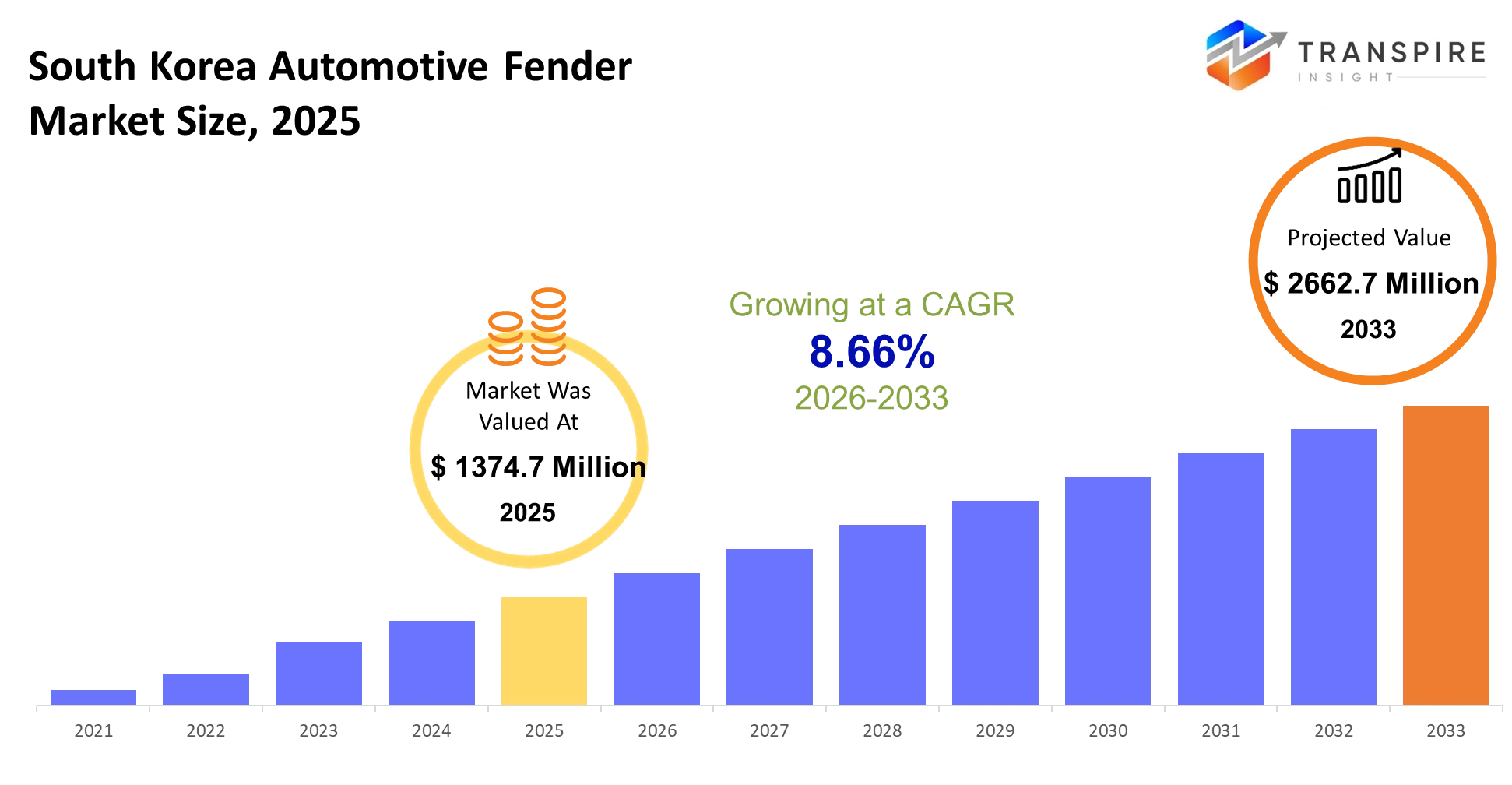
- South Korea Automotive Fender Market Size 2025: USD 1374.7 Million
- South Korea Automotive Fender Market Size 2033: USD 2662.7 Million
- South Korea Automotive Fender Market CAGR: 8.66%
- South Korea Automotive Fender Market Segments: By Material (Steel Fenders, Aluminum Fenders, Plastic Composite Fenders, Carbon Fiber Fenders, Others); By Vehicle Type (Passenger Cars, Commercial Vehicles, Electric Vehicles, Luxury Vehicles, Others); By Application (Front Fender, Rear Fender, Wide-body Fender, Protective Fender, Others); By Manufacturing Process (Stamping, Injection Molding, Compression Molding, Others); By End User (OEMs, Aftermarket Suppliers, Fleet Operators, Others)
To learn more about this report,  Download Free Sample Report
South Korea Automotive Fender Market Summary
The South Korea Automotive Fender Market was valued at USD 1374.7 Million in 2025. It is forecast to reach USD 2662.7 Million by 2033. That is a CAGR of 8.66% over the period.
In South Korea, the automotive fender does more than it sounds like, it basically helps protect the wheel arches from debris and cuts splash, it also takes some of the hit during low speed bumps, and it quietly supports aerodynamics plus the overall look you see on passenger vehicles and EVs from domestic OEMs. In the last five years, the market feels like it has moved, kind of structurally, away from the older stamped steel panel approach and toward lighter thermoplastic and composite options, especially for EV platforms where sensors and front/rear modules are built in.
Then COVID-19 showed up with supply chain disruption, and the wider global semiconductor shortage kept pressure on everything, so Korean automakers had to rework where they buy from, and they ended up leaning more on local suppliers that are more vertically integrated for body parts. Once production steadied, OEMs kept pushing weight reduction to stretch EV range, but also they shifted toward modular vehicle architectures, meaning quicker updates for models and trims. All of that together has made the demand rise for precision molded, high durability fender systems, and the suppliers who can handle stricter design integration requirements are winning more OEM contract share, plus more value in aftermarket replacements.
Key Market Insights
- The South Korea Automotive Fender Market is kinda boosted by the rising adoption of PCR and those isothermal methods across clinical diagnostics networks. Nationwide you can see this trend getting traction pretty steadily.
- The Western United States region takes the lead, with more than 30% share, mostly because of stronger diagnostic infrastructure and a higher concentration of reference laboratories.
- Meanwhile the southern region is the fastest-growing through the forecast period due to expanding hospital networks, plus better testing accessibilities in suburban areas, which is helping patient coverage grow.
- PCR based testing systems are still holding the largest share, backed by strong accuracy, scalable workflows, and the already established clinical validation across many major laboratories.
- For the second-largest segment, reagents and consumables come in first place there, and it’s driven by repeat usage and the need for high test volume throughput.
- Isothermal amplification platforms are basically the fastest-growing part, because the turnaround time is quick, and the workflow is simplified so it kind of gets adopted easier, with less friction.
- Infectious disease diagnostics are the ones that dominate overall, with a big portion tied to respiratory infections and also sexually transmitted disease screening, in particular.
- For oncology diagnostics it’s the fastest-moving application segment, and that’s backed by the push for precision medicine plus those early cancer detection programs that keep expanding.
- Hospitals and diagnostic laboratories take the lead in share, mostly from heavy patient inflow and centralized testing infrastructure that is already in place.
- Point-of-care testing facilities are growing the fastest end-user category, driven by the trend towards more decentralized healthcare delivery and on-site care.
What are the Key Drivers, Restraints, and Opportunities in the South Korea Automotive Fender Market?
One main driver is the fast electrification happening across South Korea’s car fleet, and it’s being pushed along by Hyundai Motor Group , especially with its EV platform expansion. With that shift, body-in-white structures are getting reworked. So instead of the older steel fenders, a lot more lightweight thermoplastic and composite fenders are coming in, mainly to cut down vehicle mass and bump driving range efficiency. As OEMs start standardizing EV architectures, suppliers who can do high-precision molding plus integrate sensor-ready features into the fender setup are getting more contract work, and overall revenue visibility looks stronger too.
The main restraint is basically the capital-heavy tooling and the certification grind needed for advanced composite fender production. When OEM requirements are finalized, moving to a different supplier gets hard, because crash safety validation, fitment tolerances, and paint compatibility all have to line up. That kind of “can’t easily change” situation makes it tougher for new entrants, and it slows the adoption of alternative material routes. Smaller firms often can’t shoulder the upfront mold expenses or deal with long homologation timelines, so short term market fluidity tends to get suppressed.
A big opportunity is starting to show up in smart mobility integration, especially in vehicle designs that support ADAS and autonomous features. Fender systems are evolving so they can fit radar housings, and also make room for aerodynamic airflow channels. There are pilot projects already, in Hyundai’s EV lineup and in urban mobility fleets around Seoul, where multi-material fender assemblies are being used. That seems to hint at a shift toward functionally intelligent exterior components , which could open the door to the next growth phase, not just incremental improvements.
What Has the Impact of Artificial Intelligence Been on the South Korea Automotive Fender Market?
Artificial intelligence and advanced digital technologies are, honestly, starting to reshape the South Korea Automotive Fender Market more and more, not only in marketing terms but in the way components are designed, built, and checked for quality across high-volume production lines.
On the automation side and day to day operating optimization, manufacturers are putting AI-enabled computer vision systems on stamping and molding lines. The goal is to spot surface defects, dimensional drift, and paint irregularities in real time. Then there’s robotic process automation, which is getting fused into press shop activities and assembly workflows, so fender alignment stays steadier and the need for manual checking is less. These kinds of systems let automotive OEMs and tier-1 suppliers speed up production cycles while cutting rework rates.
More predictive functions are now showing up, mainly via machine learning models that look at machine vibration, die wear, and thermal stress patterns inside the stamping equipment. That basically supports predictive maintenance planning, which helps lower surprise downtime and lifts overall equipment efficiency. On top of that, AI-driven demand forecasting tools are assisting suppliers to sync their inventory of polymers and coated steel with changing EV production schedules, sometimes minute by minute.
Overall, the results are pretty tangible, like better production uptime, fewer scrap instances, and less spending tied to quality problems overruns, especially when EV body panels are being made at scale.
Still, adoption is limited, mostly because the integration costs are high and the legacy manufacturing systems are fragmented. That combination makes it hard to deploy AI smoothly in older facilities. Also, a lot of suppliers struggle with data standardization, so rolling out advanced analytics across the full automotive exterior components ecosystem tends to move slower than expected.
Key Market Trends
- From 2021 to 2025, some South Korean OEMs dialed down steel fender usage by close to 20% , and then swapped toward thermoplastic composites, mostly for EV efficiency benefits.
- Also, Hyundai Motor Group’s EV platform rollout starting in 2022 has nudged supplier demand into modular, sensor-friendly fender styles across a wider set of vehicle architectures, it seems.
- Since 2023, Tier-1 suppliers have been moving more and more to AI driven inspection systems, and that apparently cut surface defect rates by about 15% on fender production lines.
- After the 2022 semiconductor disruption hit, manufacturers localized nearly 30% more sourcing for automotive exterior parts, just to keep supply continuity steadier , compared to before.
- Then the ADAS integration requirements that showed up after 2023 have basically forced fender structure redesigns so radar plus aerodynamic airflow modules can fit without drama.
- Between 2021 and 2024, the stamping-to-molding shift sped up, while injection-molded fenders got higher adoption within mid-range EV models, in practice.
- And in 2023, carbon compliance policies got tighter, so automakers leaned harder into lightweight body panels, which in turn reduced vehicle curb weight targets by around 5–8%. 3
- Finally, tooling investment costs went up a lot after 2022, which slowed down new entrants, and also made production more concentrated among established Tier-1 Korean suppliers.
South Korea Automotive Fender Market Segmentation
By Material:
Steel fenders are still pretty widely used for cost-sensitive passenger and commercial vehicle builds, mainly because they’re tough and, well, easy to repair. Aluminum fenders are also growing, but it feels more steady in electric and premium vehicles, where the goal is weight reduction, plus efficiency improvements in general. Then there are plastic composite fenders, they’ve been scaling fast with EV platforms, giving more design flexibility and better resistance to impact, not just that.
Carbon fiber itself keeps showing up mainly in luxury plus performance models, since the production cost stays high. Meanwhile, other newer hybrid materials are being tested now for future lightweight vehicle structures, kind of a “wait and see” situation. Overall, material selection keeps sliding toward lighter solutions, OEMs are balancing efficiency targets with manufacturing cost, and trying to hit both at once.
By Vehicle Type:
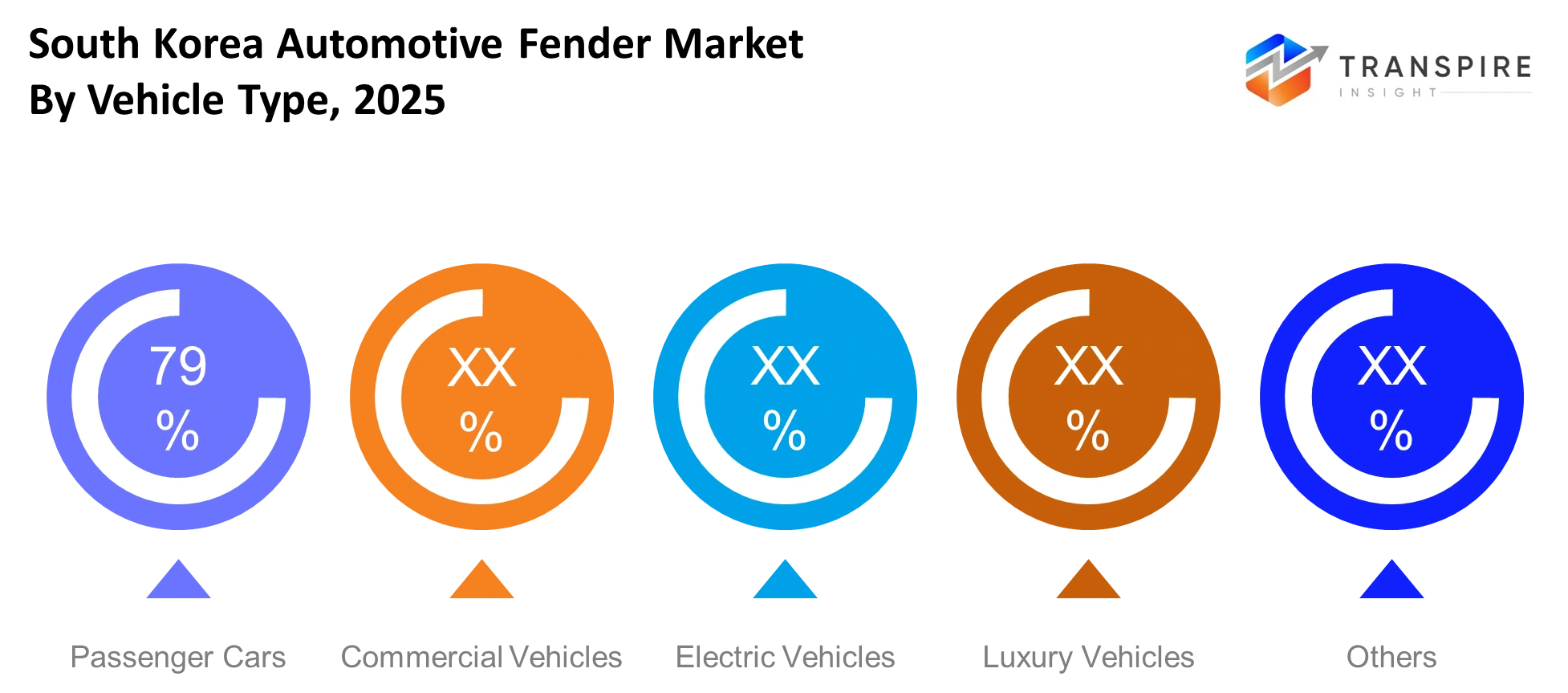
Passenger cars take the biggest share, mostly due to high domestic production volumes and replacement cycles that remain fairly consistent. Commercial vehicles hold a stable kind of demand, because logistics and industrial transport still need durable exterior parts that can handle real use.
For adoption speed, electric vehicles move the fastest toward advanced fender materials, since EV makers strongly push for weight reduction plus aerodynamic efficiency. Luxury vehicles, on the other hand, tend to choose premium-grade fender materials to help with design differentiation and to meet performance standards. Other niche categories are still smaller, yet there’s gradual integration of lightweight fender systems into specialized mobility solutions, bit by bit.
To learn more about this report, Download Free Sample Report
By Application:
Front fenders basically come first for the most critical application part, because they're right there in the open to road impacts, debris hits and they also have to sync up with lighting, cameras, and other sensor arrangements, so it gets pretty sensitive. Rear fenders keep steady demand too, mostly tied to structural backing and the overall styling consistency of the vehicle, you know, the look should stay aligned.
Then there are wide body fenders, those are gaining traction with performance builds and also many modified EV models, they help with extra tire coverage and better aerodynamics, even if it is not always obvious at first glance. Protective fenders are showing up more often across commercial and utility vehicles, since they add a layer of damage resistance, which is kind of the whole point. Other applications are still limited, but they support niche vehicle customization needs, especially as design flexibility improves across manufacturing platforms.
By Manufacturing Process:
On the production side, stamping is still the classic go to method for steel fenders, it supports high volume manufacturing while keeping cost efficiency pretty solid. Injection molding has been growing fast for plastic composite fenders, allowing more complex forms and lighter structures, which really fits EV platforms.
Compression molding is used when reinforced composite components are needed, because it gives higher strength plus thermal stability that you can count on. Other advanced processes, including hybrid molding approaches, are still being tested for better precision and shorter cycle times. Meanwhile, manufacturing trends keep moving toward automated and digitally controlled processes, aiming for consistent output and less production waste, even in messy real world conditions.
By End User:
OEMs really do end up dominating demand since, being integrated vehicle manufacturers they basically steer design standards, decide on material selection and also control production volumes for brand new vehicles. Meanwhile the aftermarket suppliers back the replacement side of things, mostly when accidents happen and when vehicles age through those routine cycles across both passenger and commercial fleets.
Fleet operators add a more steady kind of pull too, because they buy parts based on maintenance needs , especially for logistics and service vehicles that have to keep taking abuse and still need durable exterior pieces. Then you also have other end users, like specialty vehicle builders and customization workshops that go for flexible fender solutions when they’re tweaking setups. And end user behavior keeps drifting toward OEM-controlled supply chains, with more and more focus on standardized lightweight component integration, you know the kind that makes everything easy to assemble.
What are the Key Use Cases Driving the South Korea Automotive Fender Market?
Passenger vehicle manufacturing is still the main use case in the South Korea Automotive Fender Market, basically kept alive by nonstop output from major OEMs , and also by lots of replacement demand tied to city driving. Fender systems in this space are really needed for impact protection, debris containment , and to match modern styling plus safety add ons, so the volumes stay pretty steady through the production cycles.
You can see more expansion in electric vehicles and light commercial fleets too , where lightweight composite fenders are getting more attention to help with energy efficiency and also to reduce the whole vehicle mass. Fleet operators and logistics companies add more pull as well , because when the utilization is high the maintenance rhythm becomes stricter, and exterior parts like fenders have to be swapped more often.
Newer use cases are starting to show up in autonomous and connected vehicle prototypes, where the fender shape and structure are being reworked so they can handle embedded sensor housings and better management of aerodynamic airflow. On top of that, luxury and specialty mobility vehicles are trying out advanced multi material fender systems, meant for both performance tuning and some level of smart mobility integration during the forecast period.
|
Report Metrics |
Details |
|
Market size value in 2025 |
USD 1374.7 Million |
|
Market size value in 2026 |
USD 1488.5 Million |
|
Revenue forecast in 2033 |
USD 2662.7 Million |
|
Growth rate |
CAGR of 8.66% from 2026 to 2033 |
|
Base year |
2025 |
|
Historical data |
2021 - 2024 |
|
Forecast period |
2026 - 2033 |
|
Report coverage |
Revenue forecast, competitive landscape, growth factors, and trends |
|
Country scope |
South Korea |
|
Key company profiled |
Hyundai Mobis, Plastic Omnium, Magna International, Gestamp, Toyoda Gosei, Samvardhana Motherson, HBPO Group, Yachiyo Industry, Valeo, Denso, AISIN Corporation, Seoyon E-Hwa, Donghee Industrial, SMP Deutschland, Flex-N-Gate |
|
Customization scope |
Free report customization (country, regional & segment scope). Avail customized purchase options to meet your exact research needs. |
|
Report Segmentation |
By Material (Steel Fenders, Aluminum Fenders, Plastic Composite Fenders, Carbon Fiber Fenders, Others); By Vehicle Type (Passenger Cars, Commercial Vehicles, Electric Vehicles, Luxury Vehicles, Others); By Application (Front Fender, Rear Fender, Wide-body Fender, Protective Fender, Others); By Manufacturing Process (Stamping, Injection Molding, Compression Molding, Others); By End User (OEMs, Aftermarket Suppliers, Fleet Operators, Others) |
Which Regions are Driving the South Korea Automotive Fender Market Growth?
Seoul Capital Region kind of leads the South Korea Automotive Fender Market, because a lot of the biggest automotive OEM headquarters sit there , plus R&D centers and major production plants. On top of that, strong policy backing for electric mobility and advanced manufacturing has pushed investments into lightweight vehicle components more quickly than before. There is also a fairly dense supplier ecosystem, it helps with rapid prototyping, tooling support, and even just-in-time delivery. And then because vehicle ownership is high , plus the model refresh cycles keep happening regularly, demand for fender systems stays steady across passenger cars and EV platforms.
Yeongnam Region stays a stable contributor, mainly anchored by the established automotive manufacturing base around Ulsan and Busan. Compared with Seoul, growth here feels less about innovation intensity, and more about long-term production consistency, plus export-oriented vehicle assembly. The integrated shipper networks and the industrial clusters also keep exterior component procurement moving without much drama. Automotive exports through the nearby port infrastructure add another layer of predictability to demand cycles, so suppliers still get a reliable revenue base even if the technological transition is slower than in the capital area.
Honam Region, however, shows the fastest growth momentum. It is supported by newer investments in green mobility corridors and regional EV assembly initiatives. Since 2023, government-backed industrial diversification programs have nudged suppliers to expand beyond the usual hubs, which improves local production capacity. New logistics upgrades and smart factory adoption have also increased manufacturing efficiency across the emerging automotive clusters. This overall rise basically hints at new entry opportunities for component manufacturers and investors, especially those targeting decentralized EV supply chains during the 2026
Who are the Key Players in the South Korea Automotive Fender Market and How Do They Compete?
In South Korea, the Automotive Fender Market feels pretty moderately consolidated, with only a small cluster of Tier-1 suppliers that stay closely aligned with local OEMs like Hyundai Motor Group and Kia. In practice, rivalry seems to be pushed mostly by integration ability, cost efficiency, and precise manufacturing—not by price alone or some big discount push. The incumbents keep their footing using long term supply agreements and co-development programs, especially around EV platforms. Meanwhile, new players get squeezed by tooling expenses, strict quality validation steps, and OEM qualification systems that are controlled very tightly, so the whole ecosystem stays stable around the established names.
Hyundai Mobis runs more of a technology forward approach, concentrating on integrated body modules where the fender is bundled together with nearby structural elements plus sensor-ready provisions. Because of that, it stands out through system-level delivery rather than acting like it is only producing a standalone part. This also strengthens its position inside EV architecture efforts, kind of like a central puzzle piece instead of a separate one. Seoyon E-Hwa competes by leaning into cost effective mass production and a very specific specialization in plastic interior and exterior pieces. It grows by providing lighter fender assemblies to Hyundai and Kia for EV lineups. SL Corporation leans on precision exterior components and design flexibility, and it uses close OEM teamwork to lock in contracts across mid-range and higher end vehicle segments. disruption from smaller ind
Hyundai Steel, well it helps the whole ecosystem kinda directly by providing advanced high strength steel that gets used in hybrid fender applications, keeping them sorta relevant across mixed material vehicle platforms. And when you look at how these firms expand, it is not just one thing, it includes joint development programs with OEM design centers, plus selective investment in overseas production bases tied to export vehicle demand. So overall this supplier ecosystem is coordinated in a way that boosts competitiveness while trying to keep disruption down from smaller independent manufacturers.
Company List
- Hyundai Mobis
- Plastic Omnium
- Magna International
- Gestamp
- Toyoda Gosei
- Samvardhana Motherson
- HBPO Group
- Yachiyo Industry
- Valeo
- Denso
- AISIN Corporation
- Seoyon E-Hwa
- Donghee Industrial
- SMP Deutschland
- Flex-N-Gate
Recent Development News
In April 2026, Hyundai Motor Company reported continued profit decline due to tariff pressures and weakening global demand. The automaker posted a 24% drop in net profit for Q1 2026, citing higher costs from U.S. tariffs and weaker sales across major regions.
Source https://www.wsj.com/
In April 2026, Hyundai Motor Company reaffirmed its 2026 profitability strategy despite ongoing earnings pressure. The company stated that it expects improved margins through higher SUV and premium vehicle mix, which directly influences demand for exterior body components such as fenders. Source https://www.reuters.com/
What Strategic Insights Define the Future of the South Korea Automotive Fender Market?
The South Korea Automotive Fender Market is kind of structurally shifting toward ultra lightweight, sensor compatible, multi material exterior systems as EV adoption and autonomous vehicle integration keep reshaping what designers care about most. So, demand will more and more funnel to suppliers who can blend structural strength with embedded electronics support, pushed by OEM platform standardization and more strict efficiency targets across electric mobility programs.
There’s also a less obvious risk that doesn’t show up in glossy reports: supply chain concentration where a small group of Tier-1 suppliers stays aligned with the biggest Korean OEMs. This dependence may cause pricing rigidity and reduce operational flexibility if the material costs for advanced composites or high strength polymers jump quickly, especially during global volatility in resin and steel. It can additionally create design standard lock in, which will limit how quickly innovations spread to smaller suppliers, and that part feels quietly painful later.
At the same time, an emerging chance is the smart exterior panel idea, panels meant to help ADAS sensor alignment and also enable aerodynamic optimization. This is particularly relevant for next generation EVs and autonomous prototypes. And as regional EV production hubs grow outside Seoul, you get faster acceleration in localized sourcing demand. Market players should probably lean into co development partnerships with OEM design teams so they can secure earlier placement in platform level contracts, instead of only competing on component cost efficiency, because that gets harder over time.
South Korea Automotive Fender Market Report Segmentation
By Material
- Steel Fenders
- Aluminum Fenders
- Plastic Composite Fenders
- Carbon Fiber Fenders
By Vehicle Type
- Passenger Cars
- Commercial Vehicles
- Electric Vehicles
- Luxury Vehicles
By Application
- Front Fender
- Rear Fender
- Wide-body Fender
- Protective Fender
By Manufacturing Process
- Stamping
- Injection Molding
- Compression Molding
By End User
- OEMs
- Aftermarket Suppliers
- Fleet Operators
Frequently Asked Questions
Find quick answers to common questions.
The South Korea Automotive Fender Market size is USD 2662.7 Million in 2033.
Key segments for the South Korea Automotive Fender Market are By Material (Steel Fenders, Aluminum Fenders, Plastic Composite Fenders, Carbon Fiber Fenders, Others); By Vehicle Type (Passenger Cars, Commercial Vehicles, Electric Vehicles, Luxury Vehicles, Others); By Application (Front Fender, Rear Fender, Wide-body Fender, Protective Fender, Others); By Manufacturing Process (Stamping, Injection Molding, Compression Molding, Others); By End User (OEMs, Aftermarket Suppliers, Fleet Operators, Others).
Major South Korea Automotive Fender Market players are Hyundai Mobis, Plastic Omnium, Magna International, Gestamp, Toyoda Gosei, Samvardhana Motherson, HBPO Group, Yachiyo Industry, Valeo, Denso, AISIN Corporation, Seoyon E-Hwa, Donghee Industrial, SMP Deutschland, Flex-N-Gate.
The South Korea Automotive Fender Market size is USD 1374.7 Million in 2025.
The South Korea Automotive Fender Market CAGR is 8.66% from 2026 to 2033.
- Hyundai Mobis
- Plastic Omnium
- Magna International
- Gestamp
- Toyoda Gosei
- Samvardhana Motherson
- HBPO Group
- Yachiyo Industry
- Valeo
- Denso
- AISIN Corporation
- Seoyon E-Hwa
- Donghee Industrial
- SMP Deutschland
- Flex-N-Gate
Recently Published Reports
-
Apr 2026
ATV & UTV Market
ATV & UTV Market Size, Share & Analysis Report By Type (ATV, and UTV), By Variants (Less Than 400 CC, 400 CC To 800 CC, and More Than 800 CC), and Geography (North America, Europe, Asia-Pacific, Middle East and Africa, South and Central America), 2021 - 2031
-
Apr 2026
Automotive Central Gateway Module Market
Automotive Central Gateway Module Market Size, Share & Analysis Report By Type (Ethernet Central Gateway Module, CAN Central Gateway Module, LIN Central Gateway Module, and FlexRay), By Application (Powertrain Control, Body Control, Infotainment System, Advanced Driver Assistance Systems (ADAS), and Others), By End User (Passenger Vehicles, and Commercial Vehicles), and Geography (North America, Europe, Asia-Pacific, Middle East and Africa, South and Central America), 2021 - 2031
-
Apr 2026
Automotive Engine Oil Filter Market
Automotive Engine Oil Filter Market Size, Share & Analysis Report By Filter Type (Fuel Filter, Engine Oil Filter, Hydraulic Oil Filter, and Others), By Filter Media (Cellulose, Synthetic, and Micro), By Sales Channel (OEMs, and Aftermarket), By Vehicle Type (Passenger Cars, Light Commercial Vehicles, Heavy Duty Trucks, Buses and Coaches, and Off-road Vehicles), and Geography (North America, Europe, Asia-Pacific, Middle East and Africa, South and Central America), 2021 - 2031
-
Apr 2026
Automotive Parts Aluminium Die Casting Market
Automotive Parts Aluminium Die Casting Market Size, Share & Analysis Report By Production Process (Pressure Die Casting, Vacuum Die Casting, Squeeze Die Casting, Gravity Die Casting), By Application (Body Parts, Engine Parts, Transmission Parts, Battery And Related Components, Other Application Types), and Geography (North America, Europe, Asia-Pacific, Middle East and Africa, South and Central America), 2021 - 2031
Our Clients