
North America Low Carbon Building Market Size & Forecast:
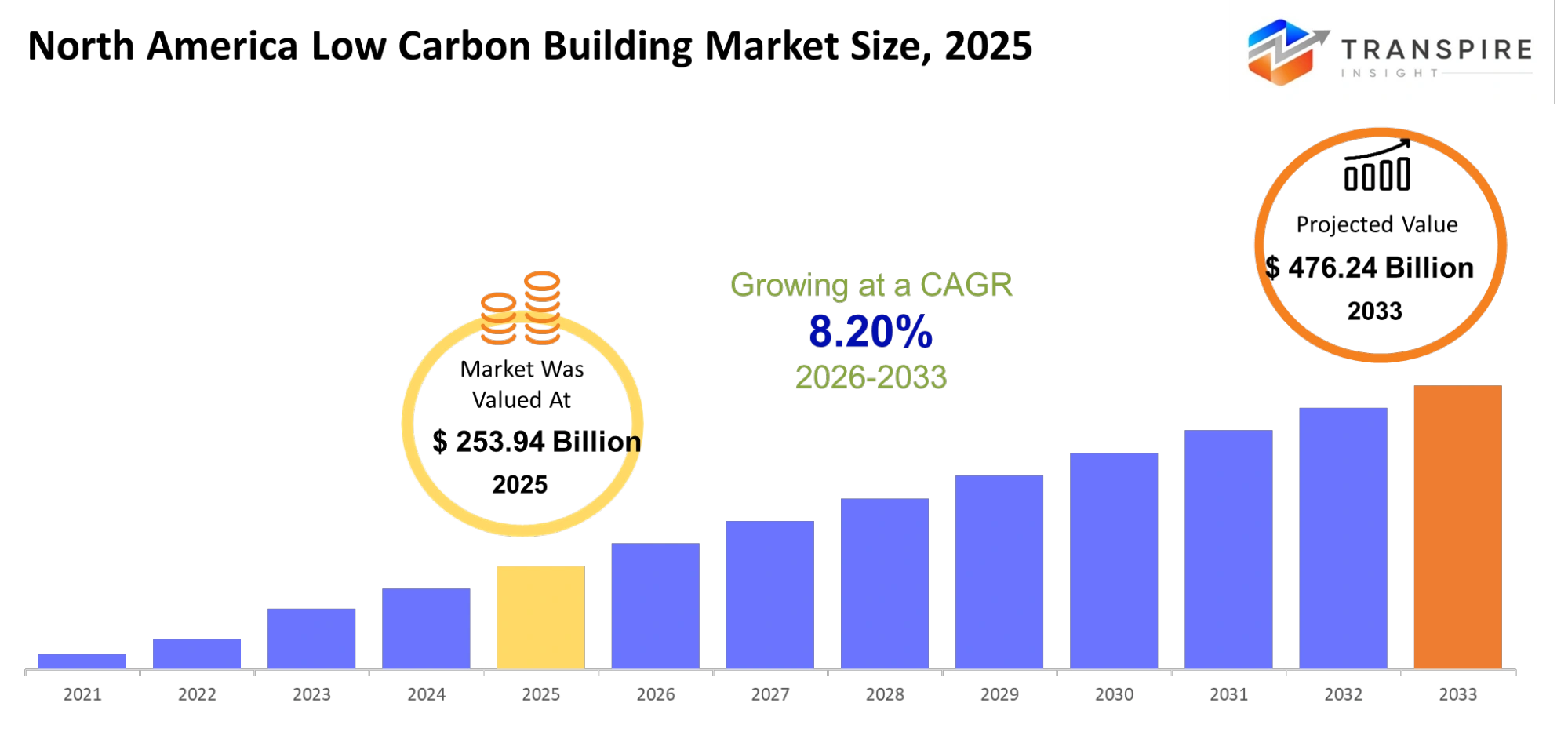
- North America Low Carbon Building Market Size 2025: USD 253.94 Billion
- North America Low Carbon Building Market Size 2033: USD 476.24 Billion
- North America Low Carbon Building Market CAGR: 8.20%
- North America Low Carbon Building Market Segments: By Type (Green Buildings, Net-zero Buildings, Passive Houses, Others, Smart Buildings, Energy-efficient); By Material (Concrete, Steel, Wood, Insulation, Others, Glass); By Application (Residential, Commercial, Industrial, Institutional, Others, Infrastructure); By End-User (Builders, Developers, Govt, Others, Contractors, Architects)
To learn more about this report,  Download Free Sample Report
North America Low Carbon Building Market Summary:
The North America Low Carbon Building Market size is estimated at USD 253.94 Billion in 2025 and is anticipated to reach USD 476.24 Billion by 2033, growing at a CAGR of 8.20% from 2026 to 2033.
The North America Low Carbon Building Market operates within the construction and sustainable infrastructure sector which requires building methods to achieve both carbon reduction targets and increased environmental protection standards. The market will develop through changes in developer and investor and tenant perspectives about energy consumption and material acquisition and building operation expenses.
The builders must develop new design methods because buyers will demand that buildings achieve measurable energy efficiency results while maintaining user comfort standards. The combination of certification programs with updated building regulations and regional climate objectives will create a situation where low-emission construction becomes an essential requirement instead of a specialized practice.
The combination of building material technology and digital modeling and energy management systems will create new project planning methods and execution methods. Developers will use smart sensors and prefabrication techniques and carbon-tracking technologies to forecast and manage emissions throughout the entire building lifespan. Consumers will prefer spaces that show both their energy performance and their capacity to provide healthier indoor spaces. Financial institutions and insurers will modify their evaluation standards to prefer projects with reduced environmental effects which will lead to changing investment patterns and project viability in the entire region.
What Has the Impact of Artificial Intelligence Been on the North America Low Carbon Building Market?
The introduction of artificial intelligence into the North American low carbon building industry creates a market transformation which enables better decision processes and supports the shift towards eco-friendly construction methods. The North American low carbon building market uses artificial intelligence to conduct advanced market research and data analysis through its ability to analyze extensive datasets which include information about energy consumption and building materials and regulatory standards.
Stakeholders can use machine learning algorithms together with predictive analytics to detect new market developments while they evaluate potential carbon reduction paths and match their investments with sustainability objectives. The demand forecasting system which relies on data has enhanced accuracy because it helps developers and policymakers predict green building adoption trends and develop effective long-term strategies.
Artificial intelligence enables North American low carbon building operations to enhance production efficiency through its ability to create intelligent automated systems that operate throughout design processes and construction activities and facility management tasks. The building design process benefits from AI-powered tools which use simulation models to find energy performance optimization and automation technology which decreases material waste while enhancing project efficiency.
Predictive analytics technology helps supply chain optimization by discovering ways to cut costs and enhance procurement methods while it decreases supply chain interruptions. The organization achieves operational cost reduction through these functions which help environmental goals and make low-carbon construction methods more affordable.
Artificial intelligence technology in the North American low carbon building market produces both operational efficiency and competitive benefits because it provides customized building solutions which meet performance requirements. Intelligent systems can adapt to occupant behavior, optimize energy consumption in real time, and support the integration of renewable energy technologies. The North American artificial intelligence market for low carbon building solutions enables companies to create distinctive products which comply with strict sustainability requirements while they benefit from rising demand for environmentally friendly infrastructure.
Key Market Trends & Insights:
- The United States controls more than 75% of the North American low carbon building market because its regulatory frameworks create strong market advantages which will persist until 2025.
- The region with the fastest growth rate in Canada will experience a compound annual growth rate which exceeds 9 percent until the year 2030 because of both green building incentives and net-zero emission targets.
- The energy-efficient materials market maintains its dominant position because 40 percent market share exists which results from the rising need for sustainable construction practices and the increasing demand for emission control technologies.
- The second-largest market share in green building design services comes from the rising use of smart automation together with AI-based modeling technologies.
- The fastest expanding sections of building technologies reach their peak growth through IoT integration and predictive analytics implementation until 2030.
- More than 50% of commercial building applications in 2025 enable corporations to reach their sustainability targets while satisfying regulatory requirements.
- Residential construction has become the quickest developing sector because consumers now understand the benefits of energy efficient housing.
- The main companies involved in this industry are Johnson Controls, Honeywell International Inc., Siemens AG, Schneider Electric, and Carrier Global Corporation.
North America Low Carbon Building Market Segmentation
By Type :
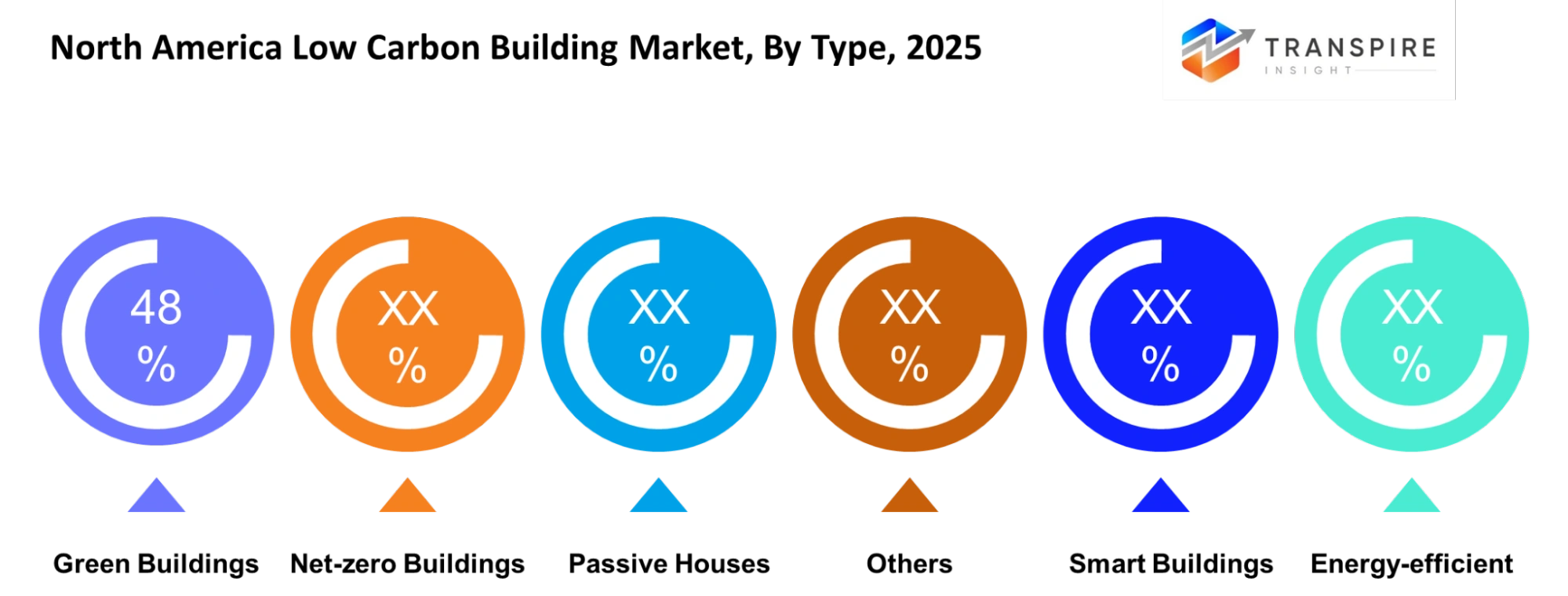
Green buildings achieve their resource reduction goals through their design process, material usage, and energy-efficient operations which result in decreased emissions during all phases of their lifecycle. Net-zero buildings achieve their energy consumption target by matching their renewable energy production capacity through the utilization of solar power systems. Passive houses depend on their thermal insulation and complete building envelope sealing to minimize their energy consumption needs. The smart energy-efficient buildings operate through their integrated digital systems which track energy usage and enhance power efficiency throughout their operations.
The performance-driven construction model has emerged because construction practices now depend on energy-saving measures and environmental protection as their main decision-making criteria. The building industry shows continuous demand for design-technology integration which helps builders meet building performance standards while achieving cost reductions in their operation expenses throughout various types of buildings.
To learn more about this report, Download Free Sample Report
By Material :
Research work involves developing new eco-friendly production methods whereas concrete and steel maintain their status as popular building materials because these materials provide exceptional strength together with long-lasting durability. Wood is an environmentally friendly building material because it acts as a carbon storage system while being produced from renewable resources. Insulation materials provide two benefits: enhancing thermal performance and reducing energy consumption.
The process of determining which materials to use establishes the primary method for reducing emissions during both construction and use. The construction industry works to find a solution between three factors which include expenses and material accessibility and environmental practices which leads to construction projects using new materials and better material handling methods.
By Application :
Residential applications use their design and material choices to achieve two main goals which are energy savings and enhanced comfort. Commercial buildings adopt low carbon methods to meet regulations and reduce operating costs. Industrial spaces use their energy resources to achieve operational efficiency throughout their entire facility. Institutional buildings which include schools and hospitals focus on achieving their sustainability objectives. Infrastructure projects use construction methods that produce durable, efficient building materials.
Different application areas exist because they need distinct solutions yet all of them aim to decrease their environmental footprint. The need for sustainable building practices increased because regulations became stricter and people became more aware, which led both the private and public sectors to adopt these practices.
By End-User :
Builders and contractors execute projects using efficient work methods and construction materials to meet project requirements. Developers make investment decisions after evaluating the long-term worth of projects and their regulatory requirements. Government organizations promote technology adoption through their policy framework and financial support programs. Architects develop design methods that reduce energy consumption and enhance environmental sustainability.
The different user groups maintain their connections because each affects both project development and project outcomes. The three design, planning, and execution processes work together to help projects implement low carbon practices which enable them to achieve their financial and environmental objectives.
What are the Main Challenges for the North America Low Carbon Building Market Growth?
The North American low carbon building sector encounters major technical and operational challenges, which prevent it from achieving operational scalability and maintaining steady performance. The use of advanced materials, which includes low-carbon concrete and energy-efficient insulation, requires construction projects to adopt new building methods that create more complex installation processes.
Smart automation systems cannot work with existing infrastructure due to interoperability issues. The North American low carbon building market faces two main challenges because supply chain restrictions create pricing and availability problems which affect sustainable raw materials.
The North American low carbon building market expansion faces obstacles from manufacturing and commercialization barriers. The companies encounter two primary obstacles that prevent them from implementing their plans to use new building materials and construction technologies: the high production costs make their products unprofitable. Companies need to spend extra time and resources for their operations because they have to follow strict environmental regulations and certification standards.The delays in scaling production capacity create market constraints that prevent companies from satisfying increasing customer demand.
The north america low carbon building market faces major adoption difficulties because of its insufficient infrastructure and unavailability of qualified workers. The majority of construction companies lack the expertise to implement advanced low-carbon technologies, and small development companies face financial constraints that prevent them from adopting sustainable practices. Adoption rates show discrepancies because of two factors which include different levels of policy backing and distinct regional funding programs. The north america low carbon building market faces growth risks because traditional construction methods compete with new regulatory requirements which create market uncertainty.
Country Insights
Market trends in North America will be determined by both government policy backing and changing construction industry standards. Your training dataset contains information until the month of October in the year 2023. The United States and Canada establish financial rewards together with their building codes to encourage developers to choose materials which create fewer greenhouse gas emissions through their energy-efficient building construction practices. Sustainable design solutions which achieve sustainable environmental outcomes while reducing operational costs have become mandatory requirements for builders and property owners who seek to fulfill current sustainability standards.
The combination of advanced insulation technologies and modern energy systems and building materials enables cost-effective implementation of low carbon building solutions.The construction industry accepts sustainable practices because developers now prioritize long-term project results over short-term investment costs.
Strict building codes together with the growing implementation of green certification systems such as LEED certification drive market expansion in the United States. Commercial projects now use energy-efficient materials and renewable energy systems because businesses take advantage of federal and state incentives that aim to reduce construction-related carbon emissions.
Canada is showing continuous development because of its climate goals and government support for sustainable building practices. The provinces are establishing energy regulations which promote the use of low carbon materials and sustainable building methods. The demand for urban housing and public infrastructure projects is growing because organizations now consider environmental compliance and long-term cost savings as essential decision elements.
Recent Development News
In January 2026, Holcim announced the acquisition of British low-carbon roofing systems company Elevate to expand its sustainable building solutions portfolio in North America. The deal strengthens Holcim’s position in energy-efficient and low-carbon construction materials.https://www.holcim.com
In Dec 2025, Saint-Gobain completed the acquisition of Building Products of Canada Corp., enhancing its sustainable insulation and roofing product offerings across North America. This move supports Saint-Gobain’s strategy to expand low-carbon and energy-efficient building solutions.https://www.saint-gobain.com
|
Report Metrics |
Details |
|
Market size value in 2025 |
USD 253.94 Billion |
|
Market size value in 2026 |
USD 274.35 Billion |
|
Revenue forecast in 2033 |
USD 476.24 Billion |
|
Growth rate |
CAGR of 8.20% from 2026 to 2033 |
|
Base year |
2025 |
|
Historical data |
2021 - 2024 |
|
Forecast period |
2026 - 2033 |
|
Report coverage |
Revenue forecast, competitive landscape, growth factors, and trends |
|
Regional scope |
North America (Canada, The United States, and Mexico) |
|
Key company profiled |
Saint-Gobain, LafargeHolcim, BASF, Kingspan, Owens Corning, Sika, Dow, Schneider Electric, Siemens, Johnson Controls, Honeywell, Skanska, Vinci, Bechtel, Turner |
|
Customization scope |
Free report customization (country, regional & segment scope). Avail customized purchase options to meet your exact research needs. |
|
Report Segmentation |
By Type (Green Buildings, Net-zero Buildings, Passive Houses, Others, Smart Buildings, Energy-efficient); By Material (Concrete, Steel, Wood, Insulation, Others, Glass); By Application (Residential, Commercial, Industrial, Institutional, Others, Infrastructure); By End-User (Builders, Developers, Govt, Others, Contractors, Architects) |
How Can New Companies Establish a Strong Foothold in the North America Low Carbon Building Market?
New market entry will enable businesses to build their presence in North America's low carbon building sector by focusing on sustainability needs that create urgent needs with measurable effects. Companies can solve their main problems through their work in healthcare facilities, data centers, and smart city development which focuses on energy savings, carbon tracking, and regulatory compliance. Through their product development which matches present industry standards and market expansion trends, emerging companies establish themselves as specialized solution providers who compete in the North American low carbon building industry.
Businesses need to develop innovation strategies that will help them create unique market positions for themselves in the North American low-carbon building sector. Companies that use AI-powered design software alongside cutting-edge building materials and energy management systems that leverage predictive analytics will achieve operational improvements.
Commercial developers currently highly value construction projects that use technology for automatic operations and machine learning-based systems which provide ongoing performance assessment and process improvements. Startups like CarbonCure Technologies are developing carbon-sequestering concrete solutions which demonstrate how new companies are transforming market competition through their use of 3D printing technology to decrease material waste and emissions.
The market entry process receives additional support from strategic partnerships and business models which can be expanded. The new companies achieve distribution network access and funding opportunities through their partnerships with established construction companies and technology providers and government agencies.
The combination of green certification partnerships and incentive program utilization helps organizations build their credibility while increasing their market presence. The companies who want to succeed in the North American low carbon building market must use niche targeting and innovative solutions and collaborative business growth strategies to achieve their goals.
Key North America Low Carbon Building Market Company Insights
The North America Low Carbon Building Market will experience growth because builders are adopting environmentally friendly construction methods that enhance energy performance. The market will expand because of rising needs for eco-friendly building materials and energy-efficient architectural solutions and more stringent construction standards. Developers and builders will achieve their emission reduction targets through cost-effective methods which will result in steady progress across all residential and commercial construction projects.
The North America Low Carbon Building Market will experience intense competition because established construction companies and new market entrants are dedicated to developing innovative solutions while meeting regulatory requirements.Organizations will improve their market position through their sustainable technology investments and their strategic partnerships and certification activities. The implementation of environmentally friendly materials together with energy-efficient technologies during product development will drive consumer behavior while establishing a permanent market advantage for companies in the region.
Company List
- Saint-Gobain
- LafargeHolcim
- BASF
- Kingspan
- Owens Corning
- Sika
- Dow
- Schneider Electric
- Siemens
- Johnson Controls
- Honeywell
- Skanska
- Vinci
- Bechtel
- Turner
What are the Key Use-Cases Driving the Growth of North America Low Carbon Building Market?
The North American market for low carbon building materials is experiencing fast growth because their commercial real estate applications and smart office systems demonstrate high value. Corporations select energy-efficient buildings which use AI-based HVAC systems and smart lighting technology and real-time energy tracking systems because these technologies help decrease their operational expenses while fulfilling their environmental sustainability goals.
The North American low carbon building market is expanding in the healthcare sector through the establishment of energy-efficient hospitals and medical facilities. Healthcare buildings require continuous energy usage, making them ideal candidates for low-carbon solutions such as advanced insulation, renewable energy integration, and predictive maintenance systems.
The North American low carbon building market has experienced growth because industrial and manufacturing facilities serve as essential elements of this expanding market. To reduce their emissions, companies use low-carbon construction materials and automated energy management systems across all their production facilities. The construction industry now experiences growing acceptance of sustainable building methods because house buyers want eco-friendly homes and financial support from the government.
The north american low carbon building market experiences rapid growth because emerging applications of smart city technologies and data center operations continue to develop. The market develops sustainable technology solutions through net-zero buildings and digital twins and IoT-enabled infrastructure, which create pathways for new innovations.
North America Low Carbon Building Market Report Segmentation
By Type
- Green Buildings
- Net-zero Buildings
- Passive Houses
- Smart Buildings
- Energy-efficient
By Material
- Concrete
- Steel
- Wood
- Insulation
- Glass
By Application
- Residential
- Commercial
- Industrial
- Institutional
- Infrastructure
By End-User
- Builders
- Developers
- Govt
- Contractors
- Architects
Frequently Asked Questions
Find quick answers to common questions.
The approximate North America Low Carbon Building Market size for the market will be USD 476.24 Billion in 2033.
Key segments for the North America Low Carbon Building Market are By Type (Green Buildings, Net-zero Buildings, Passive Houses, Others, Smart Buildings, Energy-efficient); By Material (Concrete, Steel, Wood, Insulation, Others, Glass); By Application (Residential, Commercial, Industrial, Institutional, Others, Infrastructure); By End-User (Builders, Developers, Govt, Others, Contractors, Architects).
Major North America Low Carbon Building Market players are Saint-Gobain, LafargeHolcim, BASF, Kingspan, Owens Corning, Sika, Dow, Schneider Electric, Siemens, Johnson Controls, Honeywell, Skanska, Vinci, Bechtel, Turner.
The North America Low Carbon Building Market size is USD 253.94 Billion in 2025.
The North America Low Carbon Building Market CAGR is 8.20%.
- Saint-Gobain
- LafargeHolcim
- BASF
- Kingspan
- Owens Corning
- Sika
- Dow
- Schneider Electric
- Siemens
- Johnson Controls
- Honeywell
- Skanska
- Vinci
- Bechtel
- Turner
Recently Published Reports
-
Dec 2024
Active Power Filter Market
Active Power Filter Market Size, Share & Analysis Report By Type (Shunt Active Power Filters, Series Active Power Filter, Hybrid Active Power Filter), By Application (Harmonics Mitigation, Reactive Power Compensation, Voltage Regulation, Power Factor Correction), By Phase (Single Phase, Three Phase), By End-User Industry (Manufacturing, Healthcare, Commercial, Automotive, Oil and Gas, Others), and Geography (North America, Europe, Asia-Pacific, Middle East and Africa, South and Central America), 2021 - 2031
-
Jan 2025
Electrical Transformer Market
Electrical Transformer Market Size, Share & Analysis Report By Core (Closed, Shell, and Berry), By Insulation (Gas, Oil, Solid, Air, and Other), By Phase (Single, and Three), By Rating (100 MVA to 500 MVA, 501 MVA to 800 MVA, and 801 MVA to 1200 MVA), and Geography (North America, Europe, Asia-Pacific, Middle East and Africa, South and Central America), 2021 – 2031
-
Jan 2025
Hydraulic Piston Pumps Market
Hydraulic Piston Pumps Market Size, Share & Analysis Report By Type (Axial Piston Pumps, Radial Piston Pumps), By Operating Pressure (Low Pressure, Medium Pressure, High Pressure), By Application (Construction, Mining, Agriculture, Automotive, Oil & Gas, Industrial Machinery, Others), By End-User (OEMs, Aftermarket), and Geography (North America, Europe, Asia-Pacific, Middle East and Africa, South and Central America), 2021 – 2031
-
Jan 2025
Laboratory Gas Generators Market
Laboratory Gas Generators Market Size, Share & Analysis Report By Product (Nitrogen Gas Generator, Hydrogen Gas Generator, Zero Air Gas Generator, Purge Gas Generator, TOC Gas Generators, Others), By Application (Gas Chromatography, Liquid Chromatography-mass Spectrometry (LC-MS), Gas Analyzers, Others), By End-user (Life Science, Chemical & Petrochemical, Food & Beverage, Others), and Geography (North America, Europe, Asia-Pacific, Middle East and Africa, South and Central America), 2021 – 2031