
South Korea Automation Testing Market Size & Forecast:
- South Korea Automation Testing Market Size 2025: USD 418.7 Million
- South Korea Automation Testing Market Size 2033: USD 1284.9 Million
- South Korea Automation Testing Market CAGR: 15.05%
- South Korea Automation Testing Market Segments: By Component (Testing Tools, Testing Services, Frameworks, Test Management Platforms, Analytics Tools, AI Testing Solutions, Monitoring Tools, Others); By Deployment (Cloud, On-Premise, Hybrid, SaaS Platforms, DevOps Integration, CI/CD Platforms, Container-based Testing, Others); By Application (Web Testing, Mobile App Testing, API Testing, Performance Testing, Security Testing, Regression Testing, Functional Testing, Others); By End User (IT & Telecom, BFSI, Healthcare, Retail, Manufacturing, Government, Media & Entertainment, Others)
South Korea Automation Testing Market Summary
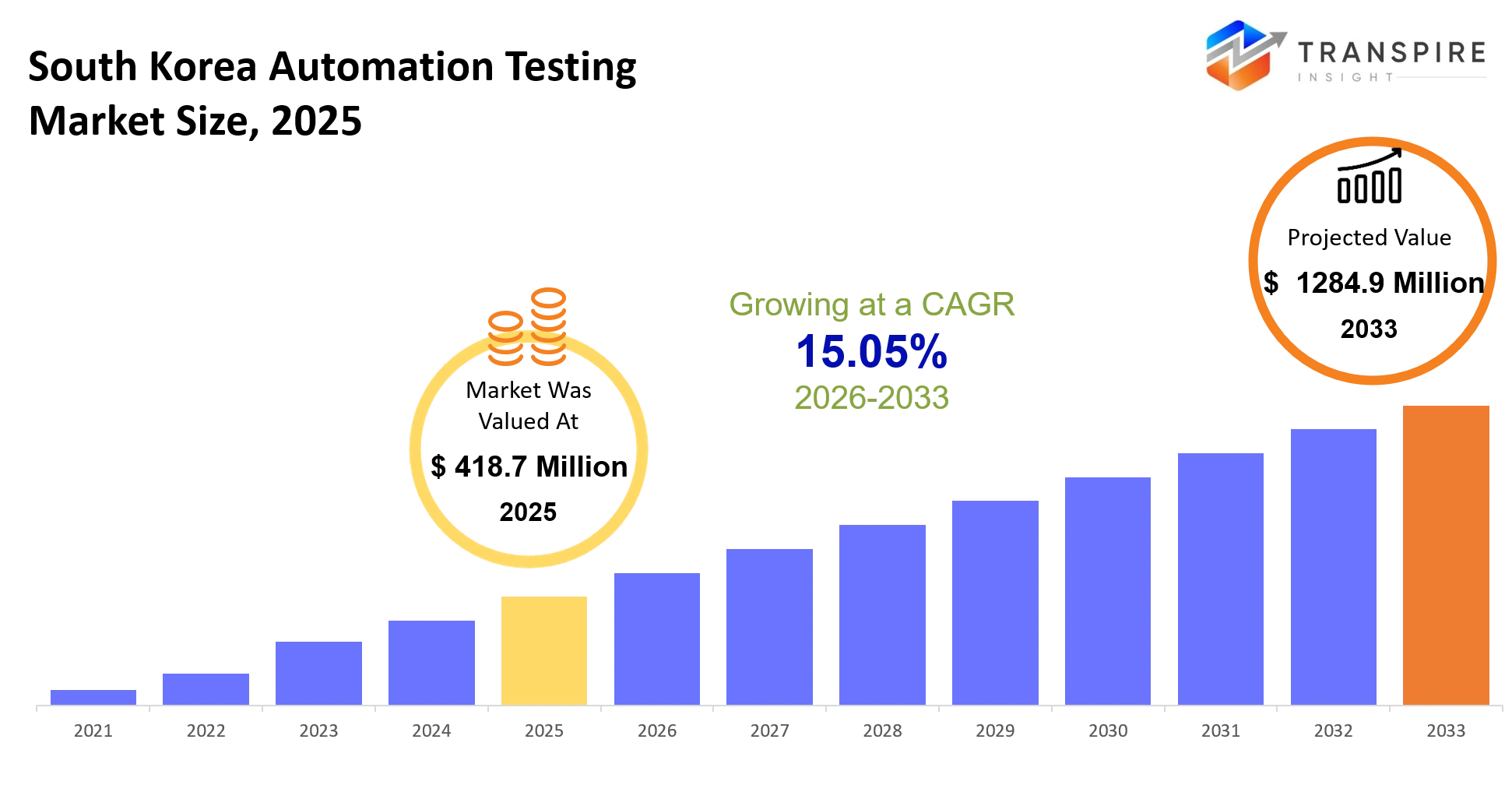
The South Korea Automation Testing Market was valued at USD 418.7 Million in 2025. It is forecast to reach USD 1284.9 Million by 2033. That is a CAGR of 15.05% over the period.
In the real-world context, the South Korea Automation Testing Market helps assure that software used for running a factory, shipyard, telecommunications company, or a digital banking application runs without glitches when being released into a live environment. Automating testing removes potential points of failure, preventing downtime from impacting highly networked systems in manufacturing, transportation, telecommunications, and logistics. From manufacturing of semiconductors, ships, etc., where even minor software errors can cause issues on an assembly line.
Automated software testing frameworks based on DevOps models are displacing manual QA for a cloud-native, AI-powered system for the past 3-5 years, especially since the adoption of micro-service architectures are rising among companies (including shipyard and consumer electronics companies) that need to stay nimble. However, The pandemic disrupted organizations’ workflows and led many enterprises that previously hesitated on accelerating to remote workforces, continuous integration and continuous delivery(CI/CD) to accelerate their journey while also shortening timelines and dealing with disparate supply chains. Therefore, organizations are increasing spending on automated software testing in order to shorten development cycles and cope with the system complexities. This, in turn, accelerates the adoption of software platforms and, by extension, the increase in recurrent revenue from software products at the enterprise level.
Key Market Insights
- South Korea Automation Testing Market is shifting, kind of toward AI enabled continuous testing, and by 2025 more than 60% of enterprise DevOps pipelines are pulling in automation.
- Cloud based testing platforms are mostly taking the lead in the South Korea Automation Testing Market, grabbing close to 48% share in 2025, mainly because CI/CD adoption is getting really scalable across many industries.
- In terms of offerings, test automation services seem to dominate, taking a meaningful chunk of mindshare, meanwhile the software tools slice is seeing the quickest momentum from 2024–2030.
- Banking and financial services sit at roughly 32% application share, largely driven by high frequency digital transactions, and also because cybersecurity checks have to be validated again and again.
- Manufacturing and semiconductor testing is showing up as the fastest-growing use case, boosted by Industry 4.0 plus smart factory rollouts.
- Big enterprises still dominate adoption, but SMEs are growing faster, since low code testing tools lower the entry barriers, and that part matters a lot.
- Key names like IBM, Micro Focus, Tricentis, Accenture, Capgemini, and Cognizant are extending their AI driven testing portfolios, and they keep doing it.
- Also, strategic partnerships between Korean IT firms and global vendors are speeding up modernization for test automation, especially across banking and telecom ecosystems.
- With continuous testing frameworks now tied into DevOps pipelines, many leading companies report release cycle time reductions around 30–40% .
- And finally, demand is moving away from scripted testing toward self healing automation tools, which then reshapes how providers compete across the South Korea Automation Testing Market.
What are the Key Drivers, Restraints, and Opportunities in the South Korea Automation Testing Market?
The main driver is rapid DevOps and cloud migration happening across South Korea’s banking, semiconductor, and telecom sectors. Since many enterprises shifted to continuous integration after 2020, especially around supply chain disruptions, manual testing started to feel kinda slow for those high frequency deployment cycles. So, automation testing adoption went up too, because companies want to cut down production errors, shorten release cycles, and keep service uptime stable in mission critical environments.
One key structural limitation is the really high integration complexity when automation testing platforms need to connect with legacy enterprise systems, which are still widely used in manufacturing and financial institutions. Those systems were not made for API-first testing settings, and that creates compatibility gaps that are hard to bridge quickly. Because of this, organizations often see longer implementation timelines, plus higher initial costs. That tends to delay full scale rollout and it can suppress near term revenue realization, even when market demand is there.
A big opportunity, however, is AI driven self healing test automation paired with digital twin environments in semiconductor and smart factory ecosystems. Companies like Samsung Electronics are increasingly simulating production settings digitally, which lets testing systems check software behavior in real time before deployment. That can unlock faster scalability, and also reduce the risks tied to production downtime, which is kinda the whole point.
What Has the Impact of Artificial Intelligence Been on the South Korea Automation Testing Market?
Artificial intelligence is kinda reshaping how testing gets executed in the South Korea Automation Testing Market, by moving workflows away from fixed script runs into adaptive, data-driven validation systems. AI tools, at this point, can automatically draft test cases , they also spot anomalies in how software behaves and they even help compress regression testing cycles across enterprise DevOps pipelines. In places like manufacturing and semiconductor ecosystems, AI improves scrubber performance systems and supports industrial control software validation by flagging configuration errors before release, which cuts down on system failure risks.
More and more, predictive machine learning models are being used for performance forecasting, system load prediction, and defect detection trends, so enterprises can prevent downtime instead of only reacting after the fact. In telecom and banking platforms, these approaches have helped raise operational uptime by an estimated 20–30% while also lowering testing cycle expenses, mainly via automated defect clustering and prioritization.
Still, adoption has a real bottleneck. The integration costs can be high, and there ’s also limited access to good labeled test data, which restricts how accurate AI models can be in complex real world industrial environments. On top of that, connectivity constraints in distributed infrastructure setups slow the real-time feedback loops, so full-scale deployment of these advanced AI testing frameworks across every enterprise layer ends up getting held back.
Key Market Trends
- The shift away from manual QA to AI-powered automation really accelerated after 2021 and that’s when the whole enterprise-wide cloud migration surged.
- Between 2022 and 2025, continuous testing adoption went up by something like 45% across South Korean fintech and telecom circles, and it felt pretty fast overall.
- These days, test automation tools are embedded straight into CI/CD pipelines, which helped cut down defect leakage in production environments, quite noticeably since 2023.
- And because more companies moved to microservices, they started replacing older monolithic testing approaches with modular automated frameworks.
- After 2022, the move toward low-code automation platforms also broadened SME participation in the South Korea Automation Testing Market , kind of like more players could jump in without huge overhead.
- Big global vendors such as Tricentis and IBM expanded their AI based testing portfolios through partnerships with Korean enterprises, and that momentum kept stacking.
- Also, the demand for self-healing test scripts grew, because organizations want to trim maintenance expenses and keep test stability higher.
- On the industry side, semiconductor and smart factory digitalization increased the need for real-time automated validation of industrial software systems, instead of slower checks.
- Finally, regulatory pressure related to data security and uptime reliability pushed enterprises toward fully automated regression testing frameworks, even when the teams were busy.
South Korea Automation Testing Market Segmentation
By Component:
Testing tools kind of make up a major chunk of the South Korea Automation Testing Market, mainly because organizations are relying more and more on automated solutions, to lift software quality and also cut down testing time. In practice these tools help spot defects early, they also support continuous testing work, and in general they push development efficiency higher. And since software complexity keeps growing, there’s a clearer need for dependable testing environments across different industries, not just one or two.
Then you have testing services, which basically help teams that need specialized know-how for test planning, test execution, and ongoing maintenance. Frameworks give a more structured way of doing things, which makes automation processes easier to manage and keeps results more consistent. On top of that, test management platforms help coordinate all testing efforts, they track what’s going on and manage resources rather well. Analytics tools assist with evaluating test outcomes and spotting performance directions across software applications, even when it gets a bit messy.
AI testing solutions are getting a lot more attention now due to the rising wish for smarter automation, predictive analysis, and self-healing test capabilities. Monitoring tools back up continuous observation of application performance and overall system behavior during testing cycles. Finally the others segment covers emerging technologies and supporting solutions, that handle specialized testing needs across a bunch of different development environments, depending on the stack.
By Deployment:
Cloud deployment is still growing, businesses keep looking for flexibility, scalability and a more cost-efficient way to run testing environments. With cloud based solutions, testing teams can grab resources remotely and ramp up testing pretty fast depending on project needs. Also, the more digital transformation initiatives move forward, the more steady the demand becomes for cloud testing platforms across many different areas.
Meanwhile, On-Premise deployment stays a big deal for organizations that want tighter control over data security, infrastructure management, and regulatory compliance. Hybrid deployment, basically mixes cloud with on-premise setups and it aims to keep that middle ground between adaptability and governance. And then there are SaaS Platforms, they make things simpler by giving ready to use testing solutions, so teams don’t need to worry as much about infrastructure setup, or ongoing upkeep.
Another big part is DevOps Integration, it helps development and operations collaborate across the whole software lifecycle, not just at one stage. CI/CD Platforms support continuous integration and continuous delivery practices, which lets companies ship software updates more often. Container based Testing also fits modern application development, because it keeps environments consistent for testing and release activities. The Others category covers alternative deployment approaches, these are made for specialized operational needs, when normal patterns just don’t quite work.
By Application:
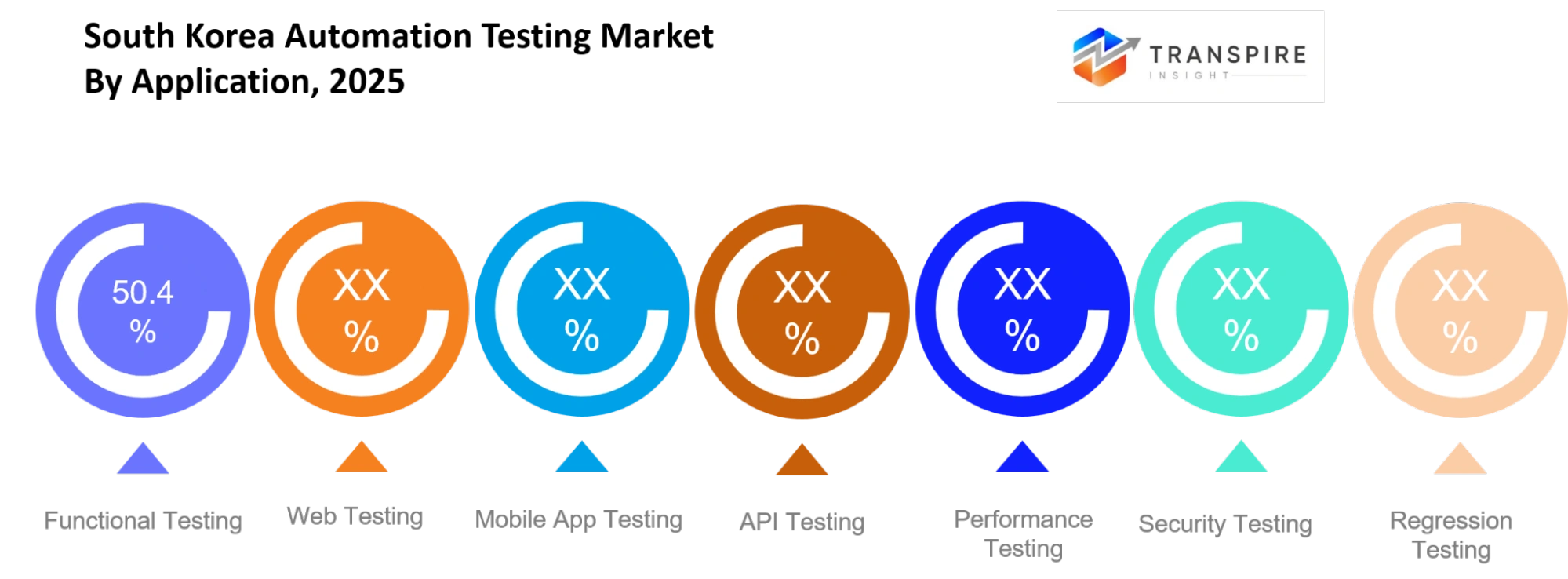
Web Testing is pretty significant as an application area, mainly because companies now lean on web based platforms for business operations and for how they engage customers. In practice, organizations try to keep websites working, compatible ,and giving a solid user experience, across many browsers and different devices. As digital services are adopted more and more, it keeps raising the need for web testing solutions that actually work well.
Mobile App Testing has become more and more necessary, just because smartphones and mobile applications are everywhere. API Testing supports how software systems communicate, and it also helps confirm whether data exchange is accurate or not. Performance Testing checks how responsive, stable, and scalable a system is, even when workloads change, so the application behaves effectively in real world scenarios.
Security Testing centers on spotting vulnerabilities and defending applications from cyber threats. Regression Testing makes sure that new updates don't mess up existing functions, while Functional Testing confirms the software performs based on the defined requirements. The Others segment is basically the set of specialized testing applications that are built to handle unusual software development and operational challenges.
By End User:
IT & Telecom still stays as a leading end-user segment, mainly because there are constant software development activities , plus network modernization and a broader digital service expansion . In this space organizations really lean on automated testing, to keep software quality stable and also help product releases move faster. It seems like the growing adoption of more advanced technologies also continues to back the demand for automation testing solutions.
For BFSI, automation testing is used so digital banking , payments, and all financial services can stay secure and dependable. In healthcare, institutions apply testing solutions to support electronic health systems , patient management platforms , and all kinds of connected medical technologies. Retail firms, meanwhile, use automation testing to boost e-commerce performance , improve customer experience and keep transaction reliability strong across different digital channels.
Manufacturing companies are also increasingly rolling out automation testing, to back smart factory initiatives, and connected production systems too. Government agencies count on testing solutions to strengthen public service platforms , and to improve digital infrastructure reliability. Media & Entertainment organizations use automated testing to keep content delivery systems running smoothly, and to protect user engagement platforms. The “Others” segment includes additional industries that are adopting automation testing, for better operational efficiency and improved software quality, generally.
What are the Key Use Cases Driving the South Korea Automation Testing Market?
Web application testing still feels like the main reason companies in South Korea are adopting automation testing. Big enterprises, and a lot of tech firms rely on automated testing to make sure websites stay fast, the user experience is right and every transaction is correct before a software release. Since digital platforms get updated pretty often, and customers seem to expect more all the time, the pressure for testing that is faster and more dependable doesn’t really stop.
Mobile banking applications and healthcare platforms are also starting to matter as secondary use cases. For finance organizations, automation helps keep payment systems secure and also supports compliance with tough regulatory rules. In healthcare, the focus is usually around patient portals and digital health services, making sure everything runs reliably while protecting sensitive data and patient information.
AI-driven testing for connected factories and autonomous systems is showing up as a newer chance. We can already see early adoption in advanced manufacturing sites where predictive testing and self-healing automation can strengthen software stability, and reduce unexpected operational problems, in the next few years.
|
Report Metrics |
Details |
|
Market size value in 2025 |
USD 418.7 Million |
|
Market size value in 2026 |
USD 481.7 Million |
|
Revenue forecast in 2033 |
USD 1284.9 Million |
|
Growth rate |
CAGR of 15.05% from 2026 to 2033 |
|
Base year |
2025 |
|
Historical data |
2021 - 2024 |
|
Forecast period |
2026 - 2033 |
|
Report coverage |
Revenue forecast, competitive landscape, growth factors, and trends |
|
Country scope |
South Korea |
|
Key company profiled |
Tricentis, SmartBear, Micro Focus, IBM, Microsoft, BrowserStack, Sauce Labs, Selenium, Parasoft, ACCELQ, Capgemini, Cognizant, Infosys, TCS, Wipro |
|
Customization scope |
Free report customization (country, regional & segment scope). Avail customized purchase options to meet your exact research needs. |
|
Report Segmentation |
By Component (Testing Tools, Testing Services, Frameworks, Test Management Platforms, Analytics Tools, AI Testing Solutions, Monitoring Tools, Others); By Deployment (Cloud, On-Premise, Hybrid, SaaS Platforms, DevOps Integration, CI/CD Platforms, Container-based Testing, Others); By Application (Web Testing, Mobile App Testing, API Testing, Performance Testing, Security Testing, Regression Testing, Functional Testing, Others); By End User (IT & Telecom, BFSI, Healthcare, Retail, Manufacturing, Government, Media & Entertainment, Others) |
Which Regions are Driving the South Korea Automation Testing Market Growth?
Leading with by far the largest contribution to overall market revenue in the South Korea Automation Testing Market, the Seoul Capital Area maintains the position of dominance on account of being home to the largest cluster of tech firms, the financial industry, and the primary software development sector in the nation. Heavy reliance on digital transformation projects, artificial intelligence (AI) research & deployment supported by governmental agencies fosters greater investment and the adoption of high-tech automation testing suites. Furthermore, significant presence of leading cloud service providers, prominent research institutes, the availability of a large pool of technology experts, a developed ecosystem and high collaboration between the software product vendors and their end-user enterprises fuels steady progress across the market.
The southeastern part of South Korea which consists of the cities like Busan and Ulsan registers significant growth by way of its initiatives towards digital industrialization & industrial automation. Unlike its capital-intensive counterparts in the Seoul Capital Area, automation testing adoption is gaining an uptick in the southeastern sector by way of the integration of smart factories, advanced manufacturing for automotive industries, as well as for specialized industrial software applications. Sustainable spending on productive efficiency & technology enhancement in the industry enables a predictable, robust demand base across all business size segments. Long-established export sectors and consistent modernization programmes ensure enduring and high market activity for various large organizations and for some of the smaller & medium enterprises as well.
As is observed in most emerging technology markets, development of nascent sectors like advanced research, increased investment in research facilities & startup development ecosystem (Daejeon) along with several innovative & research oriented projects spearheaded by the government is fueling aggressive and high demand for automated software testing solutions & best practices. Investment growth for artificial intelligence (AI) technologies, adoption of latest Cloud technology & development of cybersecurity applications in the central region has unlocked considerable growth avenues for various automation testing service & solution providers in this country. A rapid acceleration in product/service creation by R&D firms and nascent businesses can result in a potentially lucrative growth environment for the players during the forecast period 2026 to 2033.
Who are the Key Players in the South Korea Automation Testing Market and How Do They Compete?
The South Korea automation testing market can be regarded as moderately fragmented with a few global tech enterprises fiercely contending for market share with local software firms and consulting consultancies. Technology advancement is the most significant competitive factor, with businesses clamoring for accelerated test cycles, AI-based automation, and the capacity to easily integrate with the development frameworks of other applications. The leading organizations, while continuing to boost their service offerings, are beginning to shift toward cloud-native solutions and niche testing competencies to acquire new clients. IBM differentiates itself with a wide assortment of AI-based test suites and advanced consultative know-how that empowers large corporations to automate the entirety of the test processes they often encounter.
These corporations persist to develop their hybrid cloud technological know-how in collaboration with strategic partners that make sure of its visibility across manufactured goods enterprises, the financial institutions that service those businesses, in addition to other general governing body initiatives. Through risk-based automation, Tricentis aims to provide hastened software versions using model-based tests that simplify the upkeep requirements required for software package programs. It has additionally worked diligently to extend itself with the purchase of more enterprises in recent times that assist combining additional software-based technological innovation with big and well-known DevOps schemes, encouraging the keep rate of its customers and a rising market penetration.
The utilization of Selenium gives itself to a degree in open resources versatility combined with the support of a huge group of software program engineers, enabling the customized and highly customizable test suites that numerous organizations yearn for. Micro Focus also works hard to give its enterprise-rated test items; those which take pleasure in efficient protection and performance tests capabilities appeal to those providers with large and complex software packages landscapes. Furthermore, Accenture expands to offer managed testing services and projects associated with digital changes as the organization increasingly draws in customers from varied industry sectors while simultaneously adopting new automation and software-based technologies.
Company List
- Tricentis
- SmartBear
- Micro Focus
- IBM
- Microsoft
- BrowserStack
- Sauce Labs
- Selenium
- Parasoft
- ACCELQ
- Capgemini
- Cognizant
- Infosys
- TCS
- Wipro
Recent Development News
In April 2026, Google entered a partnership with the South Korean government to establish an AI campus in Seoul. The initiative will strengthen collaboration between Google engineers, local startups, and research organizations, creating new opportunities for AI-driven software development and automation testing technologies.Sourcehttps://www.reuters.com/
In March 2026, Tricentis announced the Regional Partner Awards 2026, recognizing partners that expanded AI-powered quality engineering and test automation capabilities across Asia including South Korea. The program reinforced the company's partner ecosystem strategy and supported wider adoption of intelligent testing solutions in enterprise environments.
Source https://www.tricentis.com/
What Strategic Insights Define the Future of the South Korea Automation Testing Market?
The South Korea automation testing market is transforming, aiming towards an intelligent, automated test system, where AI will eventually handle test creation, execution, and maintenance with negligible human intervention. Several factors will be influencing this trend, such as increasing sophistication of software architecture, acceleration in software delivery cadence and increased cloud-native application deployment.
There are additional underlying concerns in this growing trend; market dominance due to few international players could potentially lessen negotiation powers on cost with increased dependency. Moreover, this consolidation around few vendors might cause issues during custom-fit solution implementation for companies with bespoke system architectures. The upcoming trend of AI governance, audit, and compliance testing could prove beneficial as regulatory agencies push towards increased adoption of responsible, Ethical-AI, as a result.
Early establishment of explainable AI tests, cybersecurity tests and unique compliance solution frameworks, across vertical sectors will prove advantageous. We would recommend market stakeholders establishing partnerships with leading cloud providers and the best of AI-companies and developing open, adaptable testing ecosystems which can dynamically respond to the evolving business requirements.
South Korea Automation Testing Market Report Segmentation
By Component
- Testing Tools
- Testing Services
- Frameworks
- Test Management Platforms
- Analytics Tools
- AI Testing Solutions
- Monitoring Tools
By Deployment
- Cloud
- On-Premise
- Hybrid
- SaaS Platforms
- DevOps Integration
- CI/CD Platforms
- Container-based Testing
By Application
- Web Testing
- Mobile App Testing
- API Testing
- Performance Testing
- Security Testing
- Regression Testing
- Functional Testing
By End User
- IT & Telecom
- BFSI
- Healthcare
- Retail
- Manufacturing
- Government
- Media & Entertainment
Frequently Asked Questions
Find quick answers to common questions.
The South Korea Automation Testing Market size is USD 1284.9 Million in 2033.
Key segments for the South Korea Automation Testing Market are By Component (Testing Tools, Testing Services, Frameworks, Test Management Platforms, Analytics Tools, AI Testing Solutions, Monitoring Tools, Others); By Deployment (Cloud, On-Premise, Hybrid, SaaS Platforms, DevOps Integration, CI/CD Platforms, Container-based Testing, Others); By Application (Web Testing, Mobile App Testing, API Testing, Performance Testing, Security Testing, Regression Testing, Functional Testing, Others); By End User (IT & Telecom, BFSI, Healthcare, Retail, Manufacturing, Government, Media & Entertainment, Others).
Major South Korea Automation Testing Market players are Tricentis, SmartBear, Micro Focus, IBM, Microsoft, BrowserStack, Sauce Labs, Selenium, Parasoft, ACCELQ, Capgemini, Cognizant, Infosys, TCS, Wipro.
The South Korea Automation Testing Market size is USD 418.7 Million in 2025.
The South Korea Automation Testing Market CAGR is 15.05% from 2026 to 2033.
- Tricentis
- SmartBear
- Micro Focus
- IBM
- Microsoft
- BrowserStack
- Sauce Labs
- Selenium
- Parasoft
- ACCELQ
- Capgemini
- Cognizant
- Infosys
- TCS
- Wipro
About the Authors

Kartik bhong
I am Kartik Bhong, a Senior Research Analyst at Transpire Insight, specializing in the Packaging, Manufacturing, and Construction industry. My work focuses on analyzing market trends, emerging technologies, industry regulations, and competitive landscapes to deliver accurate, data-driven insights. I am passionate about transforming complex industry information into clear, practical content that helps businesses, professionals, and decision-makers stay informed and make confident strategic decisions. Through continuous research and a strong commitment to accuracy, I strive to create reliable, well-researched content that reflects the latest developments across these dynamic industries and supports the vision of Transpire Insight in delivering valuable market intelligence.

Chakradhar Khansole
Chakradhar serves as the Research Director at Transpire Insight, bringing over 8 years of experience in technology, innovation, and strategic market intelligence. He specializes in transforming complex market data into actionable business insights that enable organizations to make informed, growth-oriented decisions. Recognized for his strategic vision and analytical expertise, Chakradhar leads high-impact research initiatives, delivering comprehensive market assessments, competitive intelligence, and forward-looking industry analysis.
Recently Published Reports
-
Apr 2026
Handling and Lifting Equipment Market
Handling and Lifting Equipment Market Size, Share & Analysis Report By Product (Cranes and Hoists, Forklifts, Conveyor Systems, Aerial Work Platforms, Others), By Application (E-Commerce, Automotive and Railway, Food and Beverages, Aviation, Others), and Geography (North America, Europe, Asia-Pacific, Middle East and Africa, South and Central America), 2021 - 2031
-
Apr 2026
HVAC Equipment Market
HVAC Equipment Market Size, Share & Analysis Report By Heating Equipment Type (Boilers and Furnaces, Heat Pumps, and Unitary Heaters), By Ventilation Equipment (Air Handling Units, Humidifiers and Dehumidifiers, Air Filters, and Fan Coiling Units), By Air Conditioning Equipment (Unitary Air Conditioners, Room Air Conditioners, Packaged Terminal Air Conditioners, and Chillers), By End User (Commercial, Residential, Industrial, and others), and Geography (North America, Europe, Asia-Pacific, Middle East and Africa, South and Central America), 2021 – 2031
-
Apr 2026
Refrigeration Valves Market
Refrigeration Valves Market Size, Share & Analysis Report By Type (Solenoid Valves, Expansion Valves, Check Valves, Service Valves, Others), By Application (Commercial Refrigeration, Industrial Refrigeration, Transport Refrigeration, Residential Refrigeration, Air Conditioning Systems), By End User (Food and Beverage Industry, Pharmaceutical Industry, HVAC Industry, Chemical Industry, Others), and Geography (North America, Europe, Asia-Pacific, Middle East and Africa, South and Central America), 2021 – 2031
-
Apr 2026
E-Commerce Packaging Materials Market
E-Commerce Packaging Materials Market By Material Type (Corrugated Boxes, Paper & Paperboard, Foam & Cushioning Materials, Plastic Packaging, Flexible Packaging, Protective Packaging, Others), By Product(Primary Packaging, Secondary Packaging, Tertiary Packaging), By Packaging Function (Protective Packaging, Branding & Presentation Packaging, Transit & Logistic Packaging, Sustainable Packaging, Tamper Evidence Packaging), By End-User (Retail & Consumer Goods, Electronic Appliances, Food & Beverages, Healthcare & Pharmaceutical, Fashion & Apparel, Home & Furnishing, Others); By Industry Analysis, Size, Share, Growth, Trends, and Forecasts 2021-2033