

Middle East and Africa Hospitality Point Of Sale Software Market Size & Forecast:
- Middle East and Africa Hospitality Point Of Sale Software Market Size 2025: USD 134.96 Million
- Middle East and Africa Hospitality Point Of Sale Software Market Size 2033: USD 278.97 Million
- Middle East and Africa Hospitality Point Of Sale Software Market CAGR: 9.50%
- Middle East and Africa Hospitality Point Of Sale Software Market Segments: By Component (Software, Services, Hardware, Others); By Deployment (Cloud-based, On-premise, Hybrid, Others); By End User (Restaurants, Hotels, Cafes, Bars, Others); By Application (Order Management, Billing, Inventory Management, Analytics, Others)
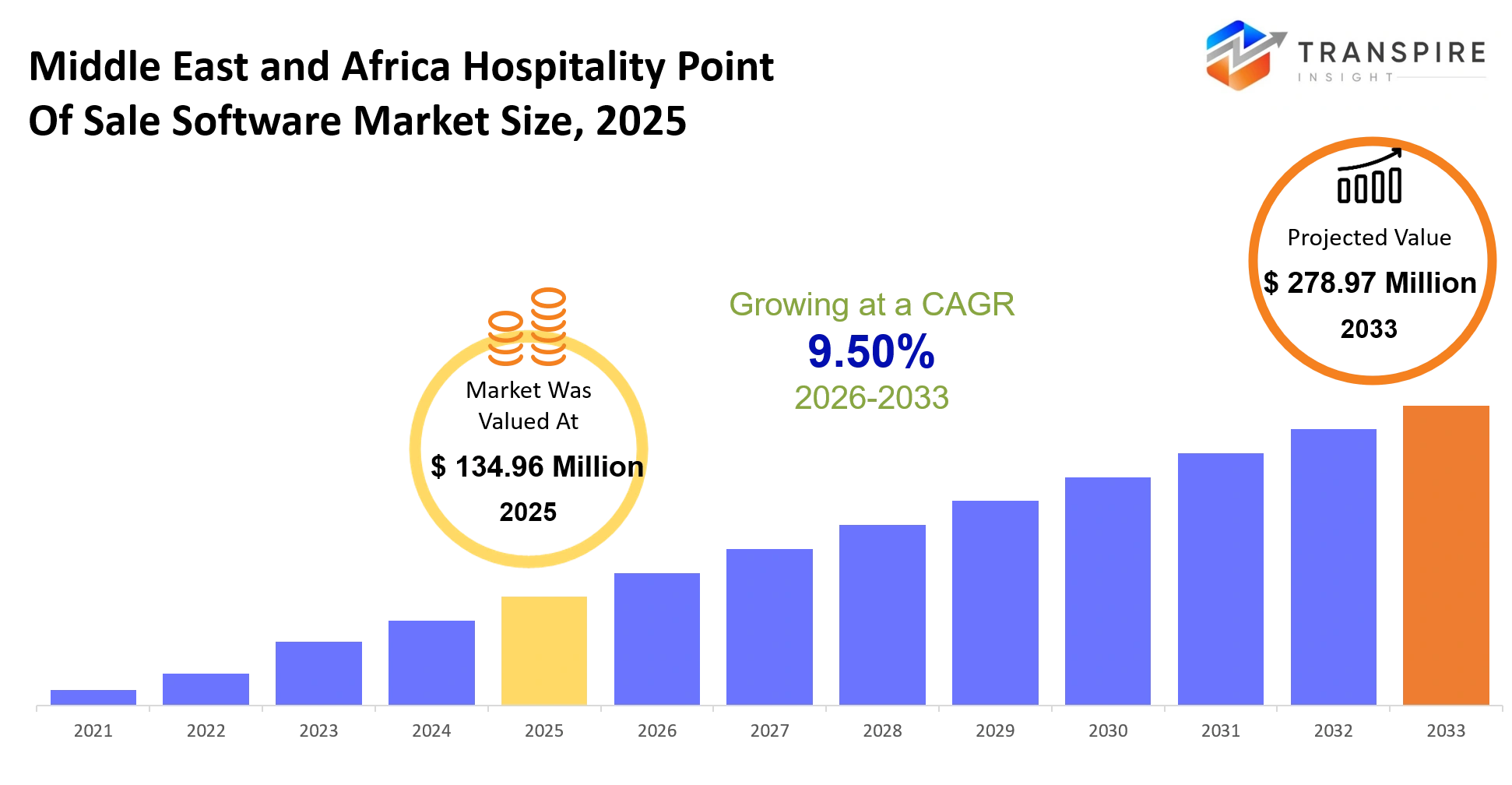
Middle East and Africa Hospitality Point Of Sale Software Market Summary
The Middle East and Africa Hospitality Point Of Sale Software Market was valued at USD 134.96 Million in 2025. It is forecast to reach USD 278.97 Million by 2033. That is a CAGR of 9.50% over the period.
In hospitality operations across the Middle East and Africa, point of sale software kinda works like a digital control layer that links ordering billing, kitchen routines, and payment settlement all at once. Restaurants, hotels, and cafes depend on these systems to cut service delays , reduce invoicing errors and keep customer transactions synced between in person and digital touchpoints.
In the last 3–5 years, the market has been moving away from standalone cash registers toward cloud connected mobile friendly platforms that also tie in with inventory and analytics. One big structural change is the shift toward subscription based SaaS offerings, replacing on premise deployments, mostly because internet reach is broader now and the entry cost is lighter. The COVID-19 pandemic really served as a catalyst, pushing venues into contactless ordering, QR style menus, and remote payments , more broadly than before.
Because of this, operators increasingly treat POS software as more than just a checkout instrument. They see it as a revenue enhancement system, helping lift table turnover, improve labor efficiency, and shape a smoother customer journey.
Key Market Insights
- The Middle East and Africa Hospitality Point Of Sale Software market is seeing a strong shift toward cloud deployment, and it’s pulling in nearly 48% share in 2025 , mostly because operators need scalability and faster rollouts.
- UAE comes in as the leading region for adoption with around 32% market share in 2025, driven by strong tourism infrastructure and digital payment ecosystems.
- By end user type, the Hotels segment is the one that really dominates demand , taking close to 41% share as major chains modernize guest billing and loyalty workflows.
- For revenue, Order management applications still sit at the center, contributing more than 35% share , helped by real-time kitchen integration and automation.
- Cloud-based SaaS adoption jumped quite a bit after 2020, which has helped cut upfront IT expenses by roughly 30% for hospitality operators.
- The fastest-growing portion is analytics-enabled POS systems, expanding quickly through AI driven demand forecasting and menu optimization tools, that kind of thing.
- Also, café chains are starting to show more emerging demand , and it’s accelerating with QR ordering systems plus mobile-first customer engagement models.
- Key companies like Oracle Hospitality, NCR Voyix, Toast, Lightspeed and Square are expanding as they push cloud integration and rely on regional partnerships.
- Competition is also getting more intense around API-based integrations, especially with payment gateways and delivery platforms.
- Meanwhile, mobile POS adoption across Africa is speeding up , thanks to smartphone penetration and the digitization of the more informal hospitality sector.
What are the Key Drivers, Restraints, and Opportunities in the Middle East and Africa Hospitality Point Of Sale Software Market?
The strongest growth driver is, kinda, the fast digitization of hospitality billing and order management systems that was triggered by the move toward contactless service models after the pandemic. Hotels and restaurants sort of adopted QR-based ordering and cloud POS platforms, to reduce human contact, and also smooth service bottlenecks. Because of this shift transaction speed and table turnover improved right away, which boosted revenue per outlet and nudged a broader rollout of subscription-based POS software across mid sized hospitality chains.
A key structural barrier is the inconsistent digital infrastructure across parts of Africa and lower tier cities in the Middle East. A lot of small hospitality operators still rely on cash heavy workflows, and unstable internet connectivity too, so real time cloud synchronization stays limited. That ends up slowing adoption cycles down and it also prevents vendors from scaling advanced analytics, or AI driven functions. So the market becomes a bit fragmented where high end urban setups sit next to low digitization rural operations, and overall it suppresses full revenue potential.
The biggest opportunity sits in integrated hospitality ecosystems that connect POS with delivery platforms, loyalty systems, and AI driven demand forecasting. The UAE and Saudi Arabia are leading this change through smart tourism initiatives, plus big hospitality investments. Vendors that link POS software with a single customer experience platform can unlock fresh subscription income, and also longer term contracts across hotel groups and restaurant brands.
What Has the Impact of Artificial Intelligence Been on the Middle East and Africa Hospitality Point Of Sale Software Market?
Artificial intelligence is a kind of reshaping of hospitality point of sale systems across the Middle East and Africa, by turning plain transactional software into something more like predictive operational platforms. Nowadays modern POS systems don’t just record sales , they actually use machine learning to fine tune menu pricing, anticipate demand using seasonal tourism patterns, and even change staffing levels on the fly. In bigger hotel groups, AI enabled setups look through past order records to bring down food waste and streamline kitchen prep cycles, so overall operational efficiency gets noticeably better.
Also, predictive analytics is starting to show up in maintenance planning, for POS terminals and for integrated payment hardware. The goal is simple: fewer breakdowns and less downtime, so transaction continuity stays solid especially during busy tourist seasons. On top of that, some more advanced installations connect AI with inventory systems so that restocking happens automatically when the internal thresholds are reached, which helps supply chain responsiveness.
But adoption still hits a big wall, and it’s mostly about inconsistent data quality across fragmented hospitality operators. A lot of smaller businesses don’t have properly structured historical datasets, so the model accuracy drops and AI scalability becomes harder. Plus, the costs to integrate AI modules are still high for mid tier restaurants, which slows down widespread rollout. Still, despite those limits, AI keeps pushing revenue optimization forward, and early adopters often report measurable improvements like better operational efficiency and faster service cycles.
Key Market Trends
- Cloud POS adoption kinda shot up after 2022, and legacy terminals started getting swapped for subscription based platforms across big hotel chains.
- At the same time, mobile ordering systems moved deeper into urban cafés, which helped cut the order processing duration by almost 25% during 2025 deployments, even though it wasn’t always cleanly measured day one.
- AI driven menu optimization tools also got more traction, basically boosting revenue per order via changing or dynamic pricing models.
- Contactless payment integration meanwhile became standard in more premium hospitality spots across the UAE and Saudi Arabia after 2023, and it felt like it happened pretty fast.
- Delivery app plus POS cross-platform integration got stronger too, so restaurant chains improved operational flow without as much back and forth.
- In Africa, hospitality SMEs increasingly chose low cost mobile POS solutions, mostly because smartphone penetration rates kept rising.
- Loyalty program integration inside POS platforms improved customer retention for hotel groups, and the analytics part shifted as well, from “nice to have” add-ons into core system components in enterprise rollouts.
- Competition also intensified as global vendors localized their offerings, to match regional tax compliance and multilingual interfaces.
- Finally, subscription pricing replaced those one time licensing deals, and it reshaped vendor revenue structures in a fairly direct way.
Middle East and Africa Hospitality Point Of Sale Software Market Segmentation
By Component
Middle East and Africa Hospitality Point Of Sale Software market is expected to cover Software, Services, Hardware, and Others kinda setup. Software, i mean the software part, will dominate because there is a strong need for cloud based billing and integrated analytics tools across hospitality outlets. Services will also grow, sort of naturally , through implementation support, training, and system integration, especially for large hotel chains.
Hardware will still matter a lot for things like terminals, kiosks, and payment devices that get used in restaurants and cafés. And then there are Others, like add-on modules plus third party integrations, which basically improve the overall system capability in different hospitality environments.
By Deployment
Middle East and Africa Hospitality Point Of Sale Software market is expected to cover Software, Services, Hardware, and Others kinda setup. Software, i mean the software part, will dominate because there is a strong need for cloud based billing and integrated analytics tools across hospitality outlets. Services will also grow, sort of naturally , through implementation support, training, and system integration, especially for large hotel chains.
Hardware will still matter a lot for things like terminals, kiosks, and payment devices that get used in restaurants and cafés. And then there are Others, like add-on modules plus third party integrations, which basically improve the overall system capability in different hospitality environments.
By End User
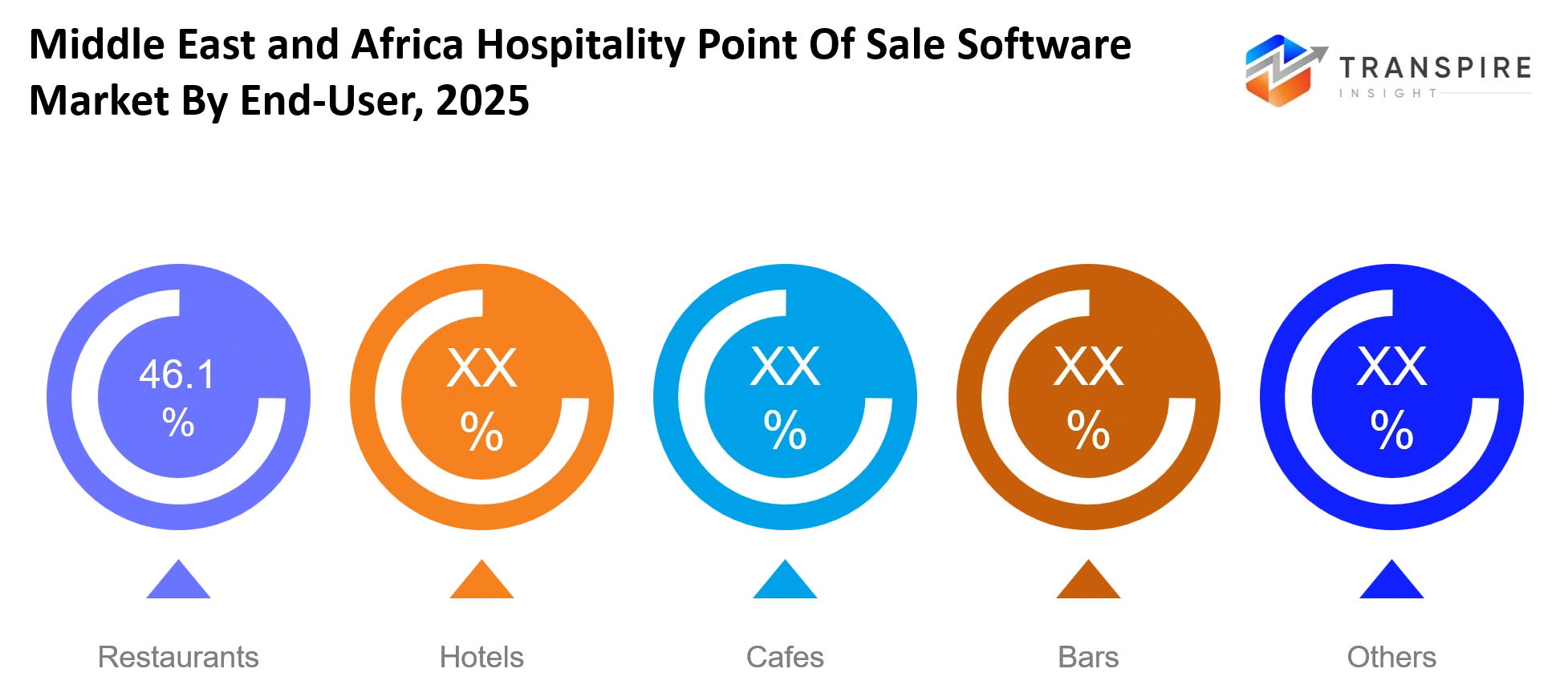
Middle East and Africa Hospitality Point Of Sale Software Market likely include Restaurants, Hotels, Cafes , Bars, and Others. Restaurants will dominate because of very high transaction volume, plus demand for speedy billing tools. Hotels will keep strong adoption via integrated guest management systems, more or less.
Cafes should grow faster with QR ordering, and mobile-first customer engagement patterns. Bars will lean on quick billing along with inventory monitoring systems. Others , meaning catering services and institutional food operations, will start adopting digital POS tools too, in a steadier way.
By Application
Middle East and Africa Hospitality Point of Sale Software Market will cover a mix of Order Management, Billing, Inventory Management, Analytics, and Others. Order Management is expected to lead because the real-time kitchen coordination thing, plus customer service efficiency needs, is pretty important. Billing systems will stay essential since accurate transaction processing still has to happen.
Inventory Management should keep expanding as operators look for cost control measures and waste reduction strategies. Analytics is likely to grow the fastest, powered by AI-driven insights for pricing and demand forecasting. In the “Others” group, you can find CRM integration and loyalty program management tools, which also matters for smooth engagement.
What are the Key Use Cases Driving the Middle East and Africa Hospitality Point Of Sale Software Market?
The core use case is really about real time order management inside restaurants and hotels , where the POS setup helps with kitchen coordination and also keeps the billing more precise. Basically this app gets the most attention because there are so many transactions , and everyone wants service delivered faster, like, all the time.
On the secondary side, you also see integrated payment handling along with inventory tracking across hotel groups and café networks. In practice this is used to tighten cost control and reduce those tedious manual reconciliation mistakes, especially for big multi outlet hospitality organizations that operate in busy urban areas.
Then there are the emerging scenarios, such as AI based demand forecasting and systems for a more tailored guest experience. Hospitality teams are starting to lean on POS data to anticipate peak hours, reshape staffing schedules, and even steer customized promotions, most noticeably in luxury hotels around Gulf tourism hubs.
|
Report Metrics |
Details |
|
Market size value in 2025 |
USD 134.96 Million |
|
Market size value in 2026 |
USD 147.78 Million |
|
Revenue forecast in 2033 |
USD 278.97 Million |
|
Growth rate |
CAGR of 9.50%from 2026 to 2033 |
|
Base year |
2025 |
|
Historical data |
2021 - 2024 |
|
Forecast period |
2026 - 2033 |
|
Report coverage |
Revenue forecast, competitive landscape, growth factors, and trends |
|
Regional scope |
Middle East and Africa (Saudi Arabia, United Arab Emirates, South Africa, Rest of Middle East and Africa) |
|
Key company profiled |
Toast, Oracle MICROS, NCR Voyix, Square, Lightspeed, Clover, Revel Systems, Shopify POS, TouchBistro, SAP, Infor, PAR Technology, eZee, POSist, Maitre'D |
|
Customization scope |
Free report customization (country, regional & segment scope). Avail customized purchase options to meet your exact research needs. |
|
Report Segmentation |
By Component (Software, Services, Hardware, Others); By Deployment (Cloud-based, On-premise, Hybrid, Others); By End User (Restaurants, Hotels, Cafes, Bars, Others); By Application (Order Management, Billing, Inventory Management, Analytics, Others) |
Which Regions are Driving the Middle East and Africa Hospitality Point Of Sale Software Market Growth?
The Middle East basically leads the market, mostly from strong tourism infrastructure in UAE and Saudi Arabia as well. There’s a lot of large scale hospitality investment and also some government guided smart tourism programs, that somehow speed up POS software adoption across hotels, and fine dining places. Plus, high smartphone penetration and pretty solid digital payment ecosystems make it easier to adopt, so integration across hospitality networks stays smooth.
Africa is a steady contributor, with digital transformation picking up in urban hospitality hubs like South Africa and Kenya. It’s a bit different from the Middle East though, because growth comes less from luxury tourism and more from SME digitization and this informal sector modernization trend. With stable economic growth, and mobile money ecosystems working in the background, POS adoption just happens gradually across restaurants and cafés.
The fastest moving region is the Gulf Cooperation Council expansion corridor, where hospitality mega projects and tourism diversification tactics are pushing deployment faster. New hotel builds, entertainment zones, and international events keep creating demand for more advanced POS ecosystems. Overall this momentum is a signal, meaning strong long term opportunities for vendors aiming at integrated cloud hospitality platforms between 2026 and 2033.
Who are the Key Players in the Middle East and Africa Hospitality Point Of Sale Software Market and How Do They Compete?
Competition in the Middle East and Africa hospitality POS software market is kinda moderately fragmented, like, you’ve got global technology providers going head to head with regional service integrators. Usually, the main battle comes from cloud capability, integration flexibility, and cost efficiency, not so much from hardware differentiation alone. More and more vendors seem to be moving toward SaaS based models, to grab that steady recurring revenue, as hospitality operators drift away from older legacy systems and that whole setup.
Oracle Hospitality plays with enterprise level hotel management integration, and they push end to end property plus POS connectivity, especially for big hospitality chains. NCR Voyix, on the other hand, leans into scalable POS hardware-software bundles, and that helps them in high volume restaurant environments where volume really matters. Toast differentiates with restaurant focused cloud workflows, plus real time kitchen coordination tools that keep things moving.
Lightspeed expands by using multi industry POS solutions, so retail and hospitality operations can run together on one platform, kinda under one umbrella. Square benefits from its payment ecosystem integration too, which lets smaller and medium hospitality businesses adopt low cost digital POS systems without too much friction.
Overall, competitive advantage is starting to hinge more on API ecosystems, regional compliance customization, and how well systems connect with delivery and payment platforms.
Company List
- Toast
- Oracle MICROS
- NCR Voyix
- Square
- Lightspeed
- Clover
- Revel Systems
- Shopify POS
- TouchBistro
- SAP
- Infor
- PAR Technology
- eZee
- POSist
- Maitre'D
Recent Development News
In January 2025, Oracle Hospitality expanded its cloud-based hospitality platform adoption across Middle East hotel chains through enhanced integration with OPERA Cloud and digital payment ecosystems. The development strengthened unified property and POS operations, improving transaction speed and guest service efficiency across large hospitality groups in the region.https://www.oracle.com/hospitality/ (Oracle Hospitality)
In March 2025, NCR Voyix advanced its cloud POS deployment strategy by expanding enterprise hospitality partnerships in Africa and the Gulf region, focusing on integrated restaurant and hotel transaction systems. The move enabled hospitality operators to streamline billing, inventory, and order management within a single POS ecosystem, improving operational consistency.https://www.ncrvoyix.com/ (NCR Voyix)
In February 2026, Lightspeed strengthened its hospitality POS footprint by enhancing API-based integrations for restaurant and café operators in emerging Middle East markets. The upgrade improved connectivity with delivery platforms and payment gateways, enabling faster order processing and improved customer experience across digital-first hospitality outlets.https://www.lightspeedhq.com/ (Lightspeed)
What Strategic Insights Define the Future of the Middle East and Africa Hospitality Point Of Sale Software Market?
The Middle East and Africa hospitality POS software market is kinda shifting more and more toward fully integrated cloud ecosystems, where payments, operations and customer engagement get pulled together into one single digital layer. I mean, this change is clearly pushing forward because tourism is expanding, digital payment adoption keeps rising, and there are big hospitality investments happening across Gulf economies. But there is also a quieter risk that doesn’t show up as easily , it sits in vendor concentration. If operators get stuck depending on just a few big global SaaS providers, then pricing flexibility can get limited and switching becomes a hassle, like real switching barriers.
At the same time, there is a real emerging chance in AI-native hospitality platforms. These systems mix POS, loyalty systems, and predictive analytics into one unified view, or dashboards, especially for multi-property hotel groups. That momentum is growing in places like Saudi Arabia and the UAE hospitality expansion zones, where new projects and upgrades happen fast. Market players should really focus on API-first architectures and also build regional partnerships with tourism operators, so they can secure long-term contracts and eventually create ecosystem lock-in. Overall, digital transformation is accelerating through 2033, so the timing matters.
Middle East and Africa Hospitality Point Of Sale Software Market Report Segmentation
By Component
- Software
- Services
- Hardware
- Others
By Deployment
- Cloud-based
- On-premise
- Hybrid
- Others
By End User
- Restaurants
- Hotels
- Cafes
- Bars
- Others
By Application
- Order Management
- Billing
- Inventory Management
- Analytics
- Others
Frequently Asked Questions
Find quick answers to common questions.
The expected Middle East and Africa Hospitality Point Of Sale Software Market size for the market will be USD 278.97 Million in 2033.
Key segments for the Middle East and Africa Hospitality Point Of Sale Software Market are By Component (Software, Services, Hardware, Others); By Deployment (Cloud-based, On-premise, Hybrid, Others); By End User (Restaurants, Hotels, Cafes, Bars, Others); By Application (Order Management, Billing, Inventory Management, Analytics, Others)
Major Middle East and Africa Hospitality Point Of Sale Software Market players are Toast, Oracle MICROS, NCR Voyix, Square, Lightspeed, Clover, Revel Systems, Shopify POS, TouchBistro, SAP, Infor, PAR Technology, eZee, POSist, Maitre'D
The Middle East and Africa Hospitality Point Of Sale Software Market size is USD 134.96 Million in 2025.
The Middle East and Africa Hospitality Point Of Sale Software Market CAGR is 9.50% from 2026 to 2033.
- Toast
- Oracle MICROS
- NCR Voyix
- Square
- Lightspeed
- Clover
- Revel Systems
- Shopify POS
- TouchBistro
- SAP
- Infor
- PAR Technology
- eZee
- POSist
- Maitre'D
About the Authors

Mayur Shinde
I am Mayur Shinde, a Senior Research Analyst at Transpire Insight, specializing in the Automotive & Transportation and Information & Communication Technology (ICT) Industry. My work focuses on analyzing emerging market trends, technological advancements, competitive landscapes, and industry developments to deliver accurate, data-driven insights. I am passionate about transforming complex market information into clear, actionable content that helps businesses, professionals, and decision-makers stay informed and make confident strategic decisions.

Chakradhar Khansole
Chakradhar serves as the Research Director at Transpire Insight, bringing over 8 years of experience in technology, innovation, and strategic market intelligence. He specializes in transforming complex market data into actionable business insights that enable organizations to make informed, growth-oriented decisions. Recognized for his strategic vision and analytical expertise, Chakradhar leads high-impact research initiatives, delivering comprehensive market assessments, competitive intelligence, and forward-looking industry analysis.
Recently Published Reports
-
Apr 2026
3D Optical Profiler Market
3D Optical Profiler Market Size, Share & Analysis Report By Type (Desktop 3D Optical Profiler, and Portable 3D Optical Profiler), By Technology (Confocal Technology, and White Light Interference), By End-Use Industry (Manufacturing, Research Institutions, Automotive, Aerospace and Defense, Medical Devices, and Other), and Geography (North America, Europe, Asia-Pacific, Middle East and Africa, South and Central America), 2021 - 2031
-
Apr 2026
Depth Sensor Market
Depth Sensor Market Size, Share & Analysis Report By Type (Infrared Depth Sensors, Time-of-Flight (ToF) Sensors, Stereo Vision Sensors, Structured Light Sensors, Ultrasonic Depth Sensors), By Application (Automotive, Robotics, Gaming, Consumer Electronics, Industrial Automation, Healthcare, Security & Surveillance, Others), By End Users (Automotive Manufacturers, Consumer Electronics Companies, Healthcare Providers, Industrial Companies, Security Agencies, Gaming Companies, Robotics Companies, Others), and Geography (North America, Europe, Asia-Pacific, Middle East and Africa, South and Central America), 2021 – 2031
-
Apr 2026
Digital Manufacturing Market
Digital Manufacturing Market Size, Share & Analysis Report By Component (Hardware, Software, and Services), By Technology (Robotics, 3D Printing, Internet of Things (IoT), and Others), By Application (Automotive and Transportation, Aerospace and Defense, Consumer Electronics, Industrial Machinery, and Others), By Process Type (Computer-Based Designing, Computer-Based Simulation, Computer 3D Visualization, Analytics, and Others), and Geography (North America, Europe, Asia-Pacific, Middle East and Africa, South and Central America), 2021 – 2031
-
Apr 2026
Digital Visa Services Market
Digital Visa Services Market Size, Share & Analysis Report By Type (Individual Travelers, Group Travelers), By Application (Tourism, Business Travel, Others), and Geography (North America, Europe, Asia-Pacific, Middle East and Africa, South and Central America), 2021 – 2031