
France Point-of-Sale Terminal Market Size & Forecast:
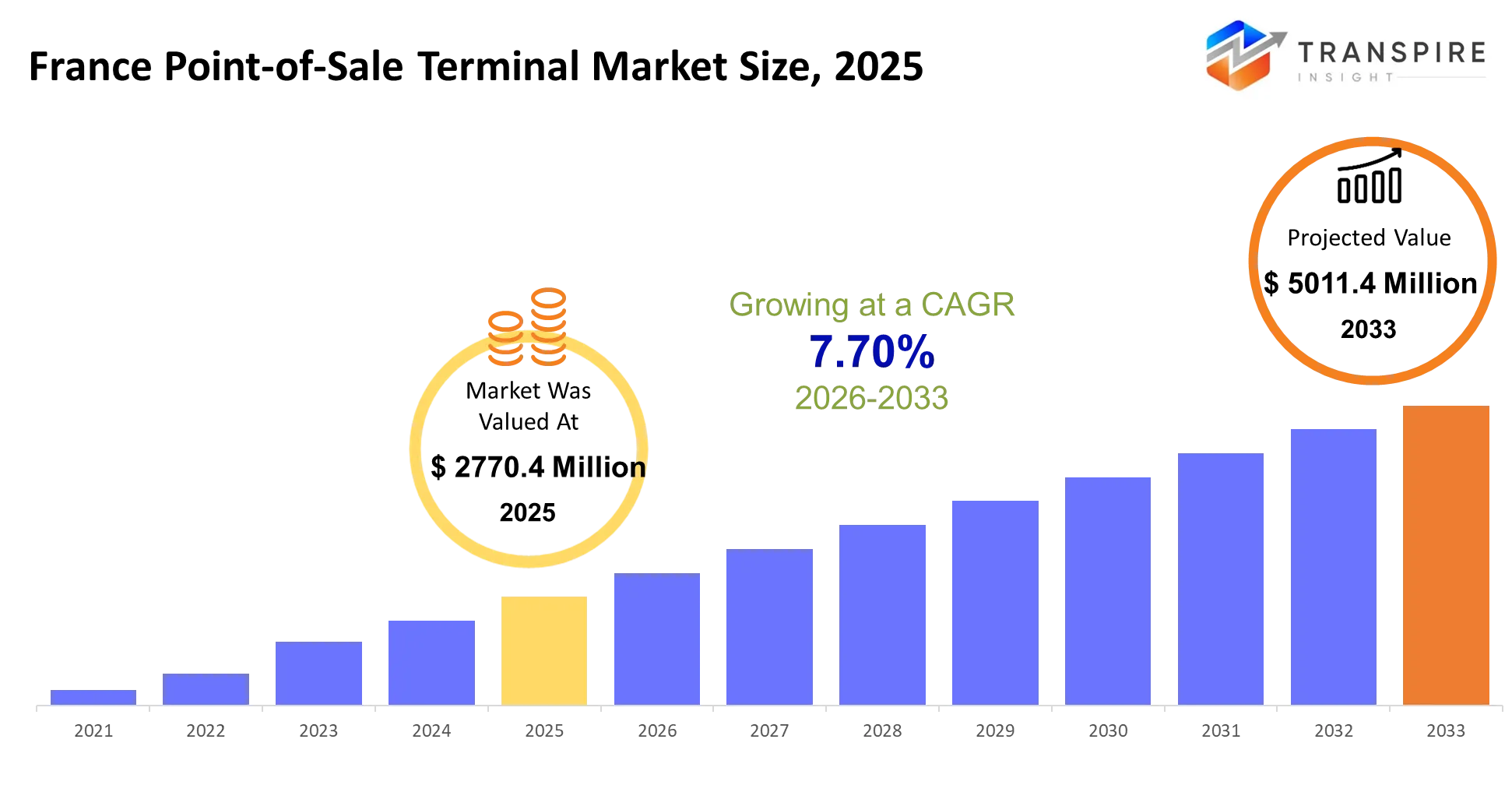
- France Point-of-Sale Terminal Market Size 2025: USD 2770.4 Million
- France Point-of-Sale Terminal Market Size 2033: USD 5011.4 Million
- France Point-of-Sale Terminal Market CAGR: 7.70%
- France Point-of-Sale Terminal Market Segments: By Type (Fixed POS, Mobile POS, Cloud POS, Others); By Application (Retail, Hospitality, Healthcare, Entertainment, Others); By End-User (Retailers, Restaurants, SMEs, Enterprises, Others); By Component (Hardware, Software, Services, Others)
To learn more about this report,  Download Free Sample Report
France Point-of-Sale Terminal Market Summary
The France Point-of-Sale Terminal Market was valued at USD 2770.4 Million in 2025. It is forecast to reach USD 5011.4 Million by 2033. That is a CAGR of 7.70% over the period.
In France, point-of-sale terminals serve as the main payment system for all retail stores and hospitality venues and transport hubs and service outlets because they provide quick and safe contactless payment methods. The systems now support mobile wallets, QR-based payments, and cloud-linked transaction tracking which helps businesses track their sales and customer behavior in real time.
Over the last 3–5 years, the market has shifted from hardware-centric terminals to payment ecosystems which operate through software and maintain cloud connectivity. The COVID-19 pandemic changed buyer habits to prefer contactless and cashless payment methods while European countries implemented contactless payment requirements throughout their regions. The need for quicker implementation of modern interoperable POS systems became apparent because supply chain disruptions were happening. Retailers and enterprises now focus on integrated payment systems which will enhance their checkout process while decreasing operational obstacles and enabling them to implement multiple retail channels which will increase their business and vendor profits.
Key Market Insights
- The Île-de-France region controls 34 percent of the France Point-of-Sale Terminal Market because its retail and banking and corporate transaction systems operate at high density.
- The Southern France region will experience its most rapid development between 2025 and 2033 because tourism will recover and coastal cities will digitalize their hospitality services at a fast pace.
- The fixed POS terminals system continues to dominate the market because large retailers need to replace their hardware during scheduled equipment updates at their supermarkets and chain stores.
- The restaurant industry and delivery services continue to grow their mobile POS systems because they need payment systems that work at tableside.
- The cloud-connected smart terminals system has become the most rapidly expanding market segment because it uses API integration to connect with ERP and CRM and omnichannel retail systems.
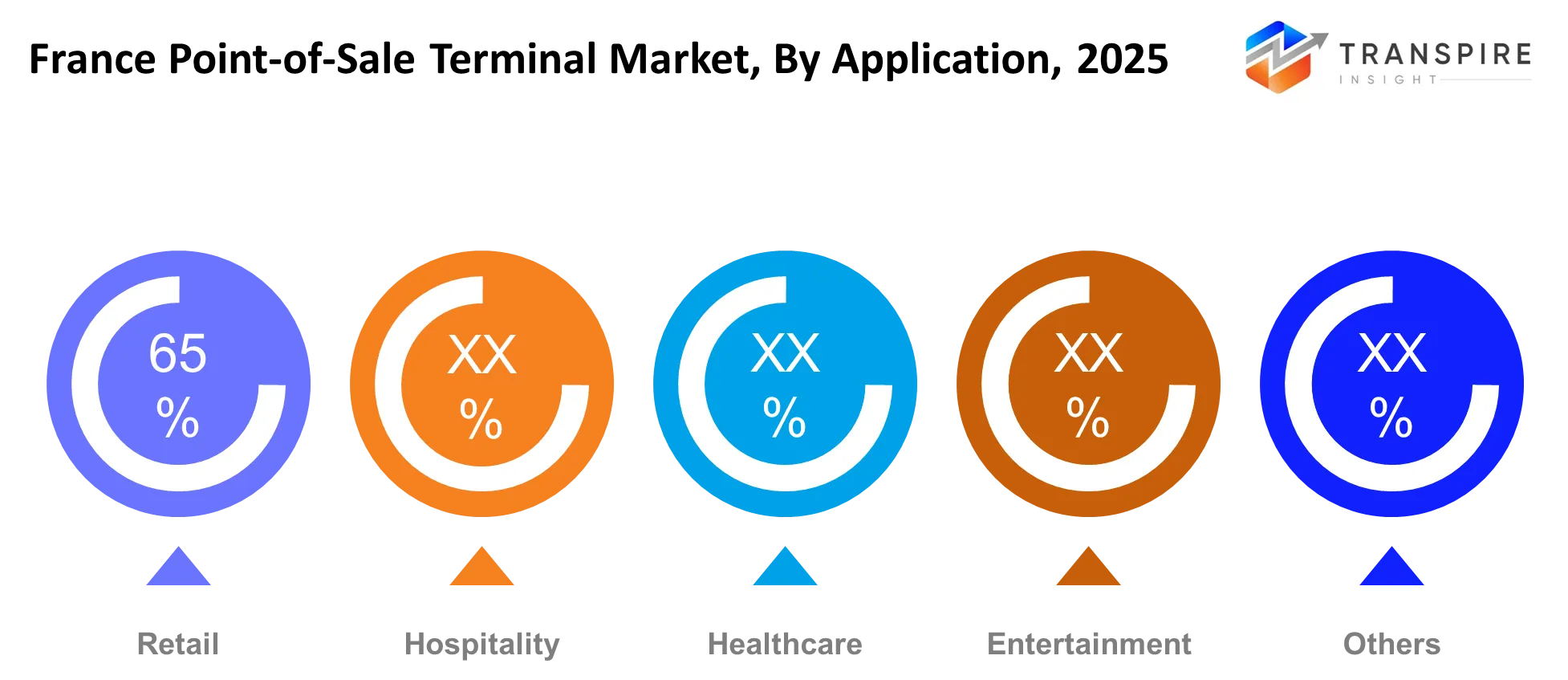
- Retail applications hold the market leadership position with approximately 45 percent market share because they process high transaction volumes and multiple channel checkout systems.
- The hospitality and food service sectors demonstrate their highest application growth which organizations achieve through their QR-based ordering systems and contactless billing systems.
- The large retail chains control more than 40 percent of the market because they implement centralized infrastructure upgrades and use standardized payment systems
- The subscription-based POS-as-a-service models enable SMEs to grow their business because these models decrease their operational costs.
- The France Point-of-Sale Terminal Market now demands integrated software ecosystems because digital payment systems have transformed payment processing requirements away from traditional hardware.
What are the Key Drivers, Restraints, and Opportunities in the France Point-of-Sale Terminal Market?
The rapid growth of contactless and digital payment systems which merchants from the retail and hospitality industries adopt as their main payment method creates the primary reason for the growth of the France Point-of-Sale Terminal Market. The European Union established EMV chip standard requirements through their regulatory standards which consumers adopted after the pandemic for using mobile wallets. Businesses are now upgrading legacy terminals to integrated systems that support real-time analytics, omnichannel checkout, and secure tokenized transactions, which directly increases transaction throughput and vendor revenues.
A major restraint is the high cost and operational complexity of replacing legacy POS infrastructure, especially for small and mid-sized enterprises. Many older systems require full hardware replacement rather than modular upgrades, which increases capital expenditure and slows adoption cycles. The payment gateways use different integration standards for their systems, which creates interoperability problems. This situation prevents the ecosystem from expanding smoothly and causes delays in digital transformation efforts.
The main opportunity exists in AI-powered cloud-based POS systems which unify payment processing, inventory control, and customer behavior insights into one complete solution. POS-as-a-service subscription systems are becoming popular among retailers in Paris and Lyon. Those retailers want to have systems which they can expand without needing to spend money upfront. Vendors who offer payment processing with data intelligence tools will create long-lasting revenue streams for their businesses.
What Has the Impact of Artificial Intelligence Been on the France Point-of-Sale Terminal Market?
The France Point-of-Sale Terminal Market experiences a transformation through artificial intelligence which enables retailers to conduct smarter transaction processing and fraud detection and gain immediate business insights. AI systems in contemporary point-of-sale systems use their algorithms to detect suspicious payment patterns which enables merchants to decrease fraud risk while meeting payment security requirements. The cloud-connected systems use machine learning models to study transaction data which helps them create better checkout systems and deliver personalized customer experiences at the point of sale for their customers.
Retailers use integrated POS platforms to create demand forecasts through predictive analytics and make inventory management decisions. The solution helps businesses achieve two goals which include decreasing stockouts and overstock situations and enhancing cash flow efficiency. The smart terminals use AI-powered diagnostics to perform predictive maintenance by detecting hardware problems before they cause system failures which leads to increased system availability for retail networks.
The high costs of system integration together with the lack of unified data systems across outdated POS systems create barriers for AI technology implementation. Small retailers continue to depend on systems which do not provide standardized data formats thus causing their models to lose precision and making it difficult to use AI technology at scale. In smaller retail locations, real-time AI processing faces limitations because of unpredictable internet connections which prevent the complete operation of edge-AI systems.
Key Market Trends
- Retailers began adopting cloud-based POS systems in 2025 when they stopped using traditional hardware systems and started employing complete digital payment solutions.
- The urban French population began using contactless payments more than traditional card swipes which resulted in new checkout methods for all retail establishments.
- The market for Android-based smart terminals grew in 2026 as businesses used application-based POS systems to replace their outdated hardware equipment.
- SMEs adopted subscription-based POS systems because these systems needed lower initial costs and provided better expansion options.
- Retailers used omnichannel systems to connect online and physical stores which resulted in better operational performance during 2025.
- All major French retail companies adopted AI-powered fraud detection systems as essential components of their new POS systems.
- The hospitality and delivery sectors started using mobile POS systems because QR code ordering systems became more popular.
- The hardware refresh cycle moved faster after 2024 because supply chain disruptions revealed weaknesses in older terminal systems.
- The number of fintech partnerships with banks reached higher levels in 2026 to support the development of integrated payment processing and data analysis systems.
- Retailers used data-driven POS systems to enhance customer loyalty programs while making instant sales decisions.
France Point-of-Sale Terminal Market Segmentation
By Type
The France Point-of-Sale Terminal Market contains fixed POS terminals as the most widely used terminal type because theyProvide their service to supermarkets, department stores and established retail chains. Retailers with large operations choose fixed systems because these systems handle high transaction volumes while providing reliable network access and connecting to their inventory management systems. The terminals match existing checkout systems which have been in use for many years, this fact creates delays in system updates and strengthens their current market position.
Restaurants and delivery services and pop-up shops are using mobile POS systems because they need payment methods which can be used anywhere. The systems help to decrease waiting times at checkout stations while enabling billing to occur outside traditional payment areas which is especially useful for high-volume hospitality locations. The demand for cloud POS solutions is increasing because these systems provide businesses with real-time data synchronization between their various locations while enabling them to conduct omnichannel retail activities. Mobile and cloud POS systems will change customer behavior during the forecast period, while fixed systems will remain the main point-of-sale solution until they lose market share to software-based systems.
By Application
The France Point-of-Sale Terminal Market remains dominated by retail because supermarkets and specialty stores use digital payment systems which create a high volume of transactions. Retailers choose to implement quick checkout solutions which allow customers to pay through both physical stores and online platforms. The requirement for ongoing transaction processing leads to persistent needs for advanced POS systems which businesses must maintain.
The hospitality sector shows rapid development because of new table-side ordering systems and restaurants and cafés begin using QR-based payment methods. The healthcare sector sees increasing growth because clinics and pharmacies turn their billing and patient payment processes into digital systems. Contactless payment systems are now being used by entertainment venues including cinemas and event spaces to enhance their customer service speed and decrease waiting times. Digital payment systems will receive modernization in service-based industries through hospitality and healthcare sectors which will provide incremental growth for their digital payment systems.
To learn more about this report, Download Free Sample Report
By End-User
The France Point-of-Sale Terminal Market has its main customer group from retailers because they use integrated checkout systems at their various store formats. The users demand fast processing of payments together with secure payment methods and the ability to connect their systems with inventory management and CRM software. Retail businesses that operate at high volume require ongoing system upgrades together with essential maintenance support.
Restaurants are experiencing rapid adoption of digital POS solutions as they shift toward contactless ordering and automated billing workflows. Subscription-based POS models enable SMEs to expand their customer base because these models require lower initial costs while supporting business growth. Enterprises maintain steady demand through centralized payment infrastructure across multi-location operations. Over the forecast period, SMEs are expected to show the fastest growth. The cloud-based POS platforms will enable advanced payment technologies which normally require specialized skills to operate.
By Component
The France Point-of-Sale Terminal Market maintains its main market share through hardware products because retail and hospitality businesses use card readers and terminals and integrated checkout systems throughout their operations. Secure transaction processing requires physical infrastructure which maintains its importance for secure operations in high-volume retail environments. Legacy terminal replacement cycles create ongoing demand for hardware products.
The software segment experiences the most rapid growth because retailers begin to adopt cloud-based POS systems and analytics dashboards and payment orchestration technologies. The solutions provide businesses with the ability to monitor their sales activities in real time while gaining customer insights and connecting multiple sales channels. The demand for installation and maintenance and managed POS support services grows especially among small and medium enterprises that do not have their own IT staff. The software and service layers will generate increasing business value during the forecast period while hardware products will function as basic access points within complete digital payment solutions.
What are the Key Use Cases Driving the France Point-of-Sale Terminal Market?
The France Point-of-Sale Terminal Market uses retail checkout processing for its main application because this system uses fixed and smart POS terminals to process multiple in-store transactions which include payment processing and billing and inventory synchronization. The retail sector demands this use case because large retail chains need payment systems that provide both security and speed and support multiple payment methods.
The hospitality industry uses mobile point-of-sale systems for restaurant table-side payment processing while delivery and quick-service restaurants utilize mobile POS systems. The needs of small and medium-sized enterprises and franchise operators drive market growth because they need transaction systems that provide flexible payment options and fast customer service.
The retail industry uses AI-powered self-service checkout machines and contactless payment systems which operate without staff supervision in transportation hubs and advanced retail environments. The applications exist in their initial development phase yet they are progressing forward because businesses in urban areas prioritize automated systems and efficient workforce management.
|
Report Metrics |
Details |
|
Market size value in 2025 |
USD 2770.4 Million |
|
Market size value in 2026 |
USD 2980.9 Million |
|
Revenue forecast in 2033 |
USD 5011.4 Million |
|
Growth rate |
CAGR of 7.70% from 2026 to 2033 |
|
Base year |
2025 |
|
Historical data |
2021 - 2024 |
|
Forecast period |
2026 - 2033 |
|
Report coverage |
Revenue forecast, competitive landscape, growth factors, and trends |
|
Regional scope |
France |
|
Key company profiled |
Ingenico, Verifone, NCR, Square, PAX, Clover, Toast, Shopify POS, Lightspeed, Oracle, Diebold Nixdorf, Fujitsu, Samsung, HP, Zebra |
|
Customization scope |
Free report customization (country, regional & segment scope). Avail customized purchase options to meet your exact research needs. |
|
Report Segmentation |
By Type (Fixed POS, Mobile POS, Cloud POS, Others); By Application (Retail, Hospitality, Healthcare, Entertainment, Others); By End-User (Retailers, Restaurants, SMEs, Enterprises, Others); By Component (Hardware, Software, Services, Others) |
Which Regions are Driving the France Point-of-Sale Terminal Market Growth?
The Île-de-France region continues to maintain its position as the dominant area in the French Point-of-Sale Terminal Market because it contains many retail headquarters and banking centers and areas with high consumer activity. The Paris metropolitan area serves as a central location where financial organizations test new technologies and contactless payment systems and cloud-based payment systems. The area has extensive infrastructure because it contains shopping malls and retail spaces that connect to metro stations and business districts. The system allows enterprise retailers to implement improved POS terminal systems at a faster pace. The area demonstrates a higher rate of technology spread because it functions differently from the other regions in France.
Provence-Alpes-Côte d'Azur region maintains stable demand from visiting customers who spend money in retail and hospitality businesses which operate in the area. The region does not depend on technology testing to expand because its development focuses on maintaining operational services through investments in dependable POS systems by hotels and restaurants and seasonal retail businesses. The region maintains economic strength through its constant tourist arrivals and its established network of hospitality businesses. The digital payment system must meet regulatory requirements which operators must apply in all situations to achieve progressive modernization. The system serves as a consistent business partner which delivers reliable value instead of producing disruptive technological advancements.
The coastal areas and small cities in Southern France experience the highest growth rates because small and medium enterprises adopt digital technologies and tourism activities return to normal after the pandemic period. The hospitality industry has modernized through recent investments while municipal authorities have supported cashless payment systems to drive mobile and cloud-based POS system adoption. Small businesses and franchise stores are moving away from cash-based systems towards unified payment processing solutions.
Who are the Key Players in the France Point-of-Sale Terminal Market and How Do They Compete?
The France Point-of-Sale Terminal Market shows moderate consolidation because both global payment hardware providers and fintech software platforms are actively competing in the market. The present market situation shows established companies protecting their existing hardware systems while new companies introduce cloud-based subscription POS solutions to the market. The main area of competition has changed from hardware dependability to software systems, which connect different systems, and complete ownership expenses. Merchants who use payment processing with analytics and merchant services from vendors experience higher retention rates.
Ingenico uses advanced banking links and secure EMV-certified equipment to establish itself as the leading solution for enterprise retail systems. Its advantage lies in long-term contracts with European financial institutions, supported by continuous upgrades toward Android-based smart terminals. Verifone provides payment orchestration services for multiple channels and creates unique value through its ability to process both in-store and online transactions, which it expands through partnerships with acquirers and payment processors.
Square (Block) offers affordable mobile POS systems through its plug-and-play solution, which serves small and medium-sized enterprises while creating ecosystem lock-in through its payment applications and financial services. NCR Voyix increases its market share in large retail and hospitality chains through its ability to connect POS systems with inventory management and self-service kiosk operations. SumUp expands aggressively across small merchants through mobile-first devices and subscription pricing, which enables the company to quickly enter small and medium-sized businesses in European secondary cities.
Company List
Ingenico
Verifone
NCR
Square
PAX
Clover
Toast
Shopify POS
Lightspeed
Oracle
Diebold Nixdorf
Fujitsu
Samsung
HP
Zebra
Recent Development News
In January 2026, Ingenico announced certification of its next-generation Android-based smart POS terminals for EU payment compliance. The certification enables broader rollout across French retailers requiring EMV, PCI DSS, and cloud integration readiness, supporting large-scale terminal upgrades.
https://ingenico.com
What Strategic Insights Define the Future of the France Point-of-Sale Terminal Market?
The France Point-of-Sale Terminal Market is developing toward software-defined payment systems which operate from cloud-based environments because their hardware functions only as a means to access system capabilities. Over the next 5–7 years, growth will be shaped by integration depth with fintech platforms, real-time data analytics, and omnichannel commerce orchestration. The retail industry undergoes this change because businesses adopt digital technologies and payment systems merge with customer data analysis platforms.
The increasing platform concentration represents a hidden danger because multiple ecosystem providers control payment systems and merchant information which creates dependency issues for both retailers and equipment manufacturers. Another emerging opportunity is the rise of fully autonomous checkout environments in transport hubs and smart retail zones, particularly in urban France.
Market participants need to adopt modular POS systems which enable them to connect with various payment processing solutions and their corresponding analytics systems. The companies that maintain their hardware and software systems as joint entities will experience business losses because agile fintech-based companies will take their market share.
France Point-of-Sale Terminal Market Report Segmentation
By Type
- Fixed POS
- Mobile POS
- Cloud POS
- Others
By Application
- Retail
- Hospitality
- Healthcare
- Entertainment
- Others
By End-User
- Retailers
- Restaurants
- SMEs
- Enterprises
- Others
By Component
- Hardware
- Software
- Services
- Others
Frequently Asked Questions
Find quick answers to common questions.
The confirmed 2033 market size figure in USD 5011.4 Million.
Key segments for the France Point-of-Sale Terminal Market are By Type (Fixed POS, Mobile POS, Cloud POS, Others); By Application (Retail, Hospitality, Healthcare, Entertainment, Others); By End-User (Retailers, Restaurants, SMEs, Enterprises, Others); By Component (Hardware, Software, Services, Others).
Major France Point-of-Sale Terminal Market players are Ingenico, Verifone, NCR, Square, PAX, Clover, Toast, Shopify POS, Lightspeed, Oracle, Diebold Nixdorf, Fujitsu, Samsung, HP, Zebra.
The France Point-of-Sale Terminal Market size is USD 2770.4 Million in 2025.
The France Point-of-Sale Terminal Market CAGR is 7.70% from 2026 to 2033.
Ingenico
Verifone
NCR
Square
PAX
Clover
Toast
Shopify POS
Lightspeed
Oracle
Diebold Nixdorf
Fujitsu
Samsung
HP
Zebra
Recently Published Reports
-
Apr 2026
Fiber Optic Faceplates Market
Fiber Optic Faceplates Market Size, Share & Analysis Report By Type (< 300 mm2, 300-350 mm2, and > 350 mm2, By Application (Night Vision, Holographic Imaging, Medical, and Others), and Geography (North America, Europe, Asia-Pacific, Middle East and Africa, South and Central America), 2021 - 2031
-
Apr 2026
High Temperature Superconductors Market
High Temperature Superconductors Market Size, Share & Analysis Report By Type (1G HTS, and 2G HTS), By Application (Power Cable, Fault Current Limiter, and Transformer), and Geography (North America, Europe, Asia-Pacific, Middle East and Africa, South and Central America), 2021 - 2031
-
Apr 2026
Industrial Plugs and Socket Market
Industrial Plugs and Socket Market Size, Share & Analysis Report By Type (Industrial Plugs, Industrial Sockets), By Current (Up to 32 A, 32 to 125 A, Above 125 A), By Protection (Dustproof and Splash Proof, Waterproof, Explosion Proof), By End User (Heavy Industries, Oil and Gas, Chemicals and Pharmaceuticals, Power Generation, Others), and Geography (North America, Europe, Asia-Pacific, Middle East and Africa, South and Central America), 2021 - 2031
-
Apr 2026
InGaAs Avalanche Photodiodes Market
InGaAs Avalanche Photodiodes Market Size, Share & Analysis Report By Type (1100 - 1700 nm, and 1000 - 1600 nm), By Application (Missile Warning System, Muzzle Flash Detection, Wafer Defect Inspection, Laser Rangefinders, and Others), and Geography (North America, Europe, Asia-Pacific, Middle East and Africa, South and Central America), 2021 - 2031