
South Korea Anhydrous Hydrogen Fluoride Market Size & Forecast:
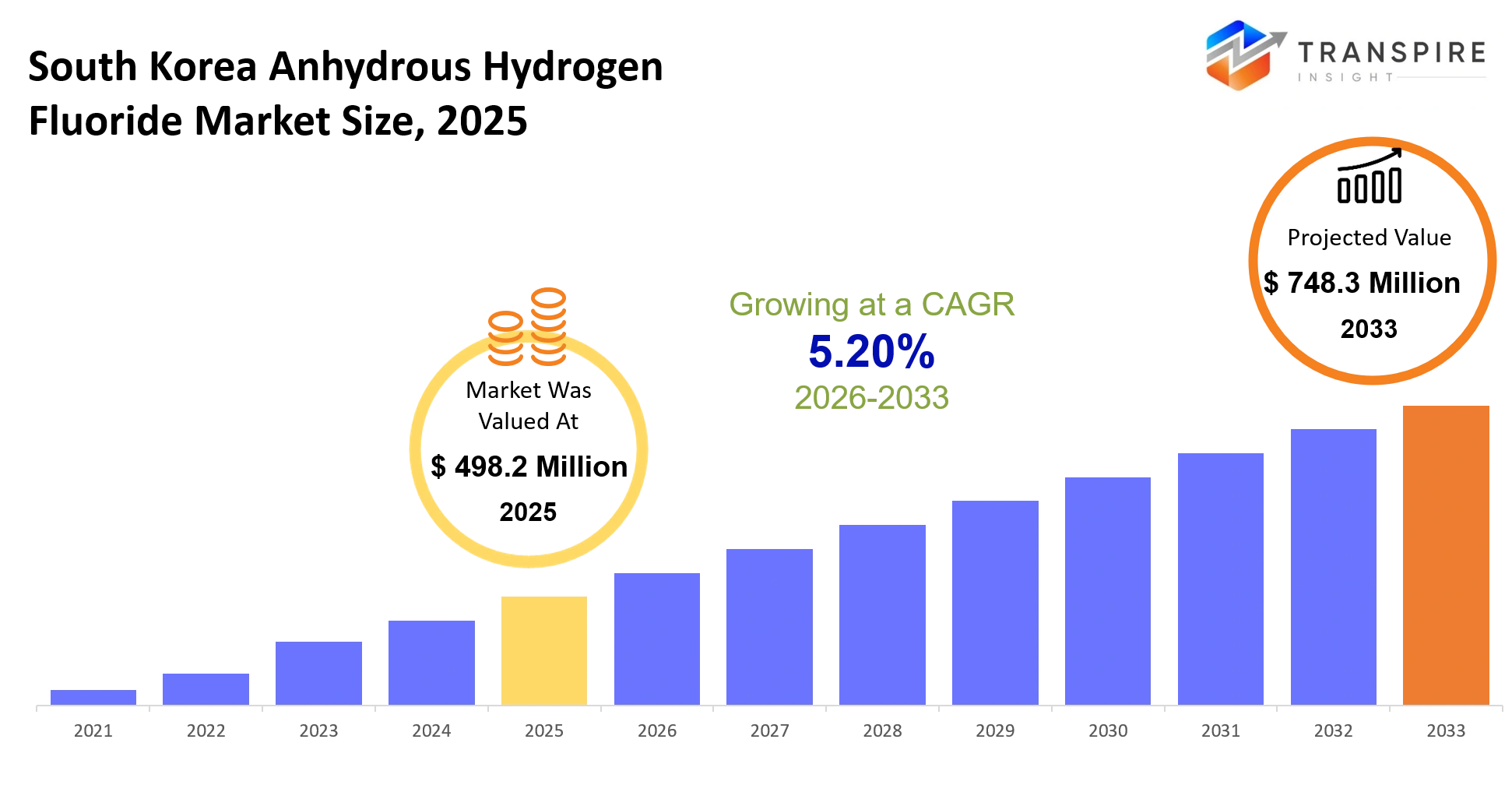
- South Korea Anhydrous Hydrogen Fluoride Market Size 2025: USD 498.2 Million
- South Korea Anhydrous Hydrogen Fluoride Market Size 2033: USD 748.3 Million
- South Korea Anhydrous Hydrogen Fluoride Market CAGR: 5.20%
- South Korea Anhydrous Hydrogen Fluoride Market Segments: By Grade (Electronic Grade, Industrial Grade, Others); By Application (Semiconductors, Chemicals, Metal Processing, Glass Etching, Others); By End User (Electronics, Chemical Industry, Manufacturing, Others); By Distribution (Direct Sales, Distributors, Others)
To learn more about this report,  Download Free Sample Report
South Korea Anhydrous Hydrogen Fluoride Market Summary
The South Korea Anhydrous Hydrogen Fluoride Market was valued at USD 498.2 Million in 2025. It is forecast to reach USD 748.3 Million by 2033. That is a CAGR of 5.20% over the period.
The South Korea anhydrous hydrogen fluoride market plays this sort of critical role in the country semiconductor and display manufacturing ecosystem where ultra-high-purity hydrogen fluoride is used for wafer cleaning and etching, processes that really enable advanced chip production. And it is not just about chemical supply either , it directly affects production yields, process precision, and the overall competitiveness tied to downstream electronics exports.
Over the past five years, the market has been moving through a structural change toward domestic supply chain development and localization, kind of like a steady pivot. This shift got faster after export restrictions imposed by Japan in 2019 , which exposed vulnerabilities linked to South Korea's heavy dependence on imported high-purity materials. After that, semiconductor manufacturers started increasing procurement from local producers and they also put money into supply diversification strategies.
That realignment has changed how the market grows. As chipmakers expand capacity for advanced logic and memory semiconductors, demand is leaning more and more toward locally sourced, high-purity hydrogen fluoride that can satisfy very strict process requirements. So the outcome is stronger revenue prospects for domestic suppliers, tighter integration between chemical producers and semiconductor manufacturers, and a more durable materials ecosystem supporting South Korea long-term technology goals.
Key Market Insights
- The Gyeonggi Province area seems to dominate the South Korea Anhydrous Hydrogen Fluoride Market, grabbing more than 45% share in 2025 , mostly because the semiconductor cluster is concentrated there , kinda concentrated, you know.
- Electronic-grade anhydrous hydrogen fluoride is leading too, with about 70% of the market in 2025 , and it is really pulled forward by the strict, tight requirements of semiconductor manufacturing.
- Industrial-grade anhydrous hydrogen fluoride stays as the second-largest group, it is helped along by chemical processing along with specialized industrial uses.
- For the forecast period, ultra-high-purity grades look set to be the fastest-growing segment, especially as advanced node production keeps expanding.
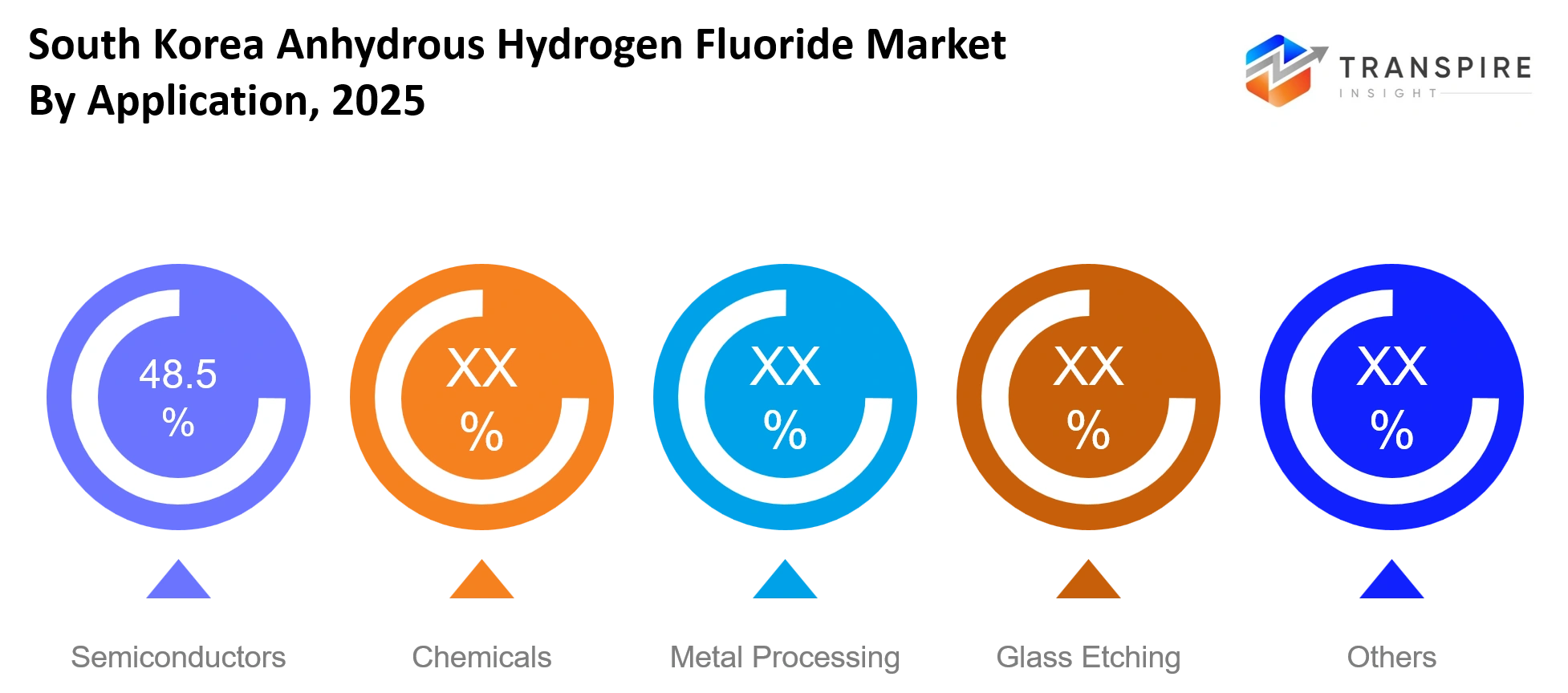
- When it comes to applications, semiconductor etching plus wafer cleaning basically dominate, making up close to 65% of the South Korea Anhydrous Hydrogen Fluoride Market demand in 2025.
- And display panel manufacturing is still a notable application segment, largely because South Korea has a strong electronics manufacturing ecosystem, which keeps feeding the demand.
- Advanced semiconductor fabrication is, kind of the fastest-growing application through 2030, supported by AI chip and memory production investments, in general.
- Semiconductor manufacturers seem to hold the largest market share—actually exceeding 60% of total consumption in 2025 across domestic production facilities, overall.
- Electronics and display manufacturers are still the second-largest end user category within the South Korea Anhydrous Hydrogen Fluoride Market , though the ranking depends on sourcing cycles.
- Foundry and advanced chip producers are emerging as the quickest-growing end user segment because the technology node complexity keeps rising, year after year, you know.
What are the Key Drivers, Restraints, and Opportunities in the South Korea Anhydrous Hydrogen Fluoride Market?
The most powerful driver pushing the South Korea anhydrous hydrogen fluoride market forward is, honestly, the country’s ongoing investment in advanced semiconductor manufacturing. A kind of turning point showed up after Japan’s 2019 export restrictions on key semiconductor materials, that situation really laid bare supply chain weak spots, and then both government-backed efforts and industry-led localization programs started moving pretty fast. From that point on, chipmakers have been leaning harder toward hydrogen fluoride that’s sourced locally and kept at very high purity levels, mainly for wafer etching and cleaning steps. Now, as South Korea keeps expanding output of advanced memory chips and AI-focused semiconductors , suppliers who can actually satisfy ultra-high purity specifications are landing bigger orders and more durable supply agreements. That then turns into higher revenues and deeper market reach, bit by bit, but clearly.
Still, the biggest obstacle is technical complexity when it comes to producing semiconductor-grade anhydrous hydrogen fluoride. Hitting the required purity thresholds for next-gen chip lines takes special equipment, tight quality control systems, and a long stretch of process fine-tuning. In other words it’s a structural hurdle, because newcomers can’t quickly build the manufacturing know-how or the qualification record that major semiconductor producers ask for. So, participation tends to stay clustered among a small set of suppliers, which slows down capacity growth and ends up limiting possible revenue expansion.
There is a major growth opportunity in the expansion of next-generation semiconductor fabrication plants for AI accelerators and also high bandwidth memory, honestly it feels like, a clear direction. As these sites are built, the investments in advanced chip production lines need larger amounts of ultra-high purity process chemicals, and it adds up fast. Suppliers that craft higher-purity formulations and that work tightly with domestic foundries , plus memory makers, can take a bigger portion of the materials spending ahead, because once these facilities move into commercial production the demand keeps climbing.
What Has the Impact of Artificial Intelligence Been on the South Korea Anhydrous Hydrogen Fluoride Market?
Artificial intelligence and more advanced digital technologies are, kinda quietly, improving operational efficiency all through South Korea’s anhydrous hydrogen fluoride value chain , especially inside high-purity chemical plants that end up serving the semiconductor industry. Producers are rolling out AI enabled process control systems that keep watching temperature, pressure, impurity levels, and reaction situations in real time. In practice these automated setups can change production parameters without anyone stepping in manually, which lets manufacturers keep the ultra high purity expectations that advanced semiconductor fabrication really depends on.
Then there’s machine learning , used for predictive maintenance of the big critical machinery, like distillation columns, compressors, storage systems, and purification units. By looking at sensor readings alongside historical operating habits, these models can spot early signals of wear and tear before anything breaks down. That helps limit unexpected downtime, increases the working life of assets, and also improves overall plant utilization. On top of that, digital twins and advanced analytics platforms back production optimization by anticipating output quality, and by pointing out process bottlenecks that can drag down yields and raise operating costs.
Because of these shifts, plants can see higher equipment availability, more stable product quality, reduced maintenance spending, and better energy efficiency. Still, AI adoption has a noticeable snag. Creating dependable predictive models needs huge amounts of high quality operational data, and in many specialty chemical procedures the historical datasets are limited , which can weaken model accuracy and delay rollouts across different production sites.
Key Market Trends
- Since 2019, semiconductor manufacturers have slowly started to reduce their reliance on Japanese imports a bit, and at the same time they accelerated the qualification of domestic high-purity hydrogen fluoride suppliers, because well, the whole supply story felt more fragile than before.
- Between 2020 and 2025, localization initiatives ended up changing procurement strategy in practice, manufacturers prioritized supply security, while still treating product purity requirements like a strict must, not just a nice-to-have.
- Demand then moved more toward ultra-high-purity grades, especially as memory and logic chip producers adopted newer semiconductor process nodes, and the tolerances got tighter.
- Domestic producers increasingly poured investment into purification technologies, so they could actually compete with long-standing Japanese suppliers in those premium use cases where the specifications are unforgiving.
- Over the longer term, supply agreements became common-er, particularly after supply chain disruptions highlighted what can go wrong with concentrated international sourcing networks.
- After 2022, AI-driven process monitoring gained momentum, and it helped manufacturers with impurity control, which also reduced day-to-day production variability that used to be harder to manage.
- Semiconductor expansion projects in Gyeonggi and Chungcheong provinces, more or less redirected industry investment toward capacity additions and a deeper specialty chemical integration, rather than just importing finished inputs.
- Companies like Soulbrain, Foosung, and SK Materials improved their competitive position through technology upgrades, plus more direct collaboration with chipmakers, so it wasn’t only about volume.
- Quality certification timelines also got more stringent , as semiconductor manufacturers tightened material performance expectations for advanced fabrication processes, even when the business side wanted faster approvals.
- Since 2023, buyers have been evaluating suppliers more often based on production resilience, technical support capabilities, and consistent purity performance, and not price alone, which kind of changes how everyone negotiates.
South Korea Anhydrous Hydrogen Fluoride Market Segmentation
By Grade :
Electronic grade anhydrous hydrogen fluoride takes the main share in the South Korea Anhydrous Hydrogen Fluoride Market, because it is used a lot for semiconductor wafer cleaning and etching steps. Those high purity needs push production control tighter and also force steady supply contracts from chip makers across fabrication clusters.
Industrial grade, meanwhile, supports metal processing, glass etching, and various chemical treatment jobs where purity standards are a bit lower but usage keeps staying consistent from plant to plant. Other grades show up in smaller amounts, and mostly for specialized industrial work where careful chemical handling matters but there is no semiconductor-level requirement really, not the advanced kind.
By Application :
Semiconductors dominate usage in the South Korea market, since fabrication sites depend on ultra-high purity material for precision etching and cleaning during the newer chip production cycles. Growth in memory and logic output helps lock in long-term consumption across the major production hubs.
Chemical processing, metal treatment, and glass etching act as secondary application areas , where the material performance supports surface modification and controlled cleaning functions. Other applications remain smaller in scale, but they still show up in certain industrial processes that need stable chemical reactivity and controlled usage conditions, too.
To learn more about this report, Download Free Sample Report
By End User :
The electronics sector kind of leads the demand in the South Korea Anhydrous Hydrogen Fluoride Market, mostly because semiconductor and display manufacturing sites are running at high production volumes. When the supply stays consistent, it supports fabrication efficiency and gives steadier output across the integrated production lines, overall.
Meanwhile the chemical industry and broader manufacturing segments use the material for processing and treatment steps, so it helps with multiple industrial workflows. There are also other end users ,like specialized operators with limited consumption levels, and they keep demand fairly steady but smaller, tied to more niche industrial requirements.
By Distribution :
Direct sales are the main route in the South Korea Anhydrous Hydrogen Fluoride Market, since semiconductor manufacturers prefer long-term agreements with chemical producers. This helps ensure stable high purity supply and it reduces procurement risk during critical production cycles ,too.
Distributors and other alternative channels serve the smaller industrial buyers who dont always sign direct supplier contracts. These options provide wider access for regional users and for smaller plants where direct procurement is less practical, mainly because lower volumes and limited purchasing scale make it harder.
What are the Key Use Cases Driving the South Korea Anhydrous Hydrogen Fluoride Market?
In South Korea, anhydrous hydrogen fluoride is mostly used for semiconductor wafer etching plus cleaning while chips are being made, sort of. It becomes the main driver because advanced memory and logic manufacturing really depends on ultra-high purity chemicals, so that the yield stays steady and defects can be kept lower, generally speaking.
Close by, there is demand in chemical processing, metal treatment, and glass etching kind of operations. These are tied to electronics as well as manufacturing industries. And they are growing, since the downstream plants are asking for more careful surface handling and a stable chemical response across different production environment settings. Even small variations, you know.
For newer use cases, advanced semiconductor nodes aimed at AI chips, along with high bandwidth memory, are getting more attention. Ultra-clean processing is crucial there. Growth is also showing up in display manufacturing, and in EUV-related cleaning steps, as fabrication facilities move toward stricter process control, and localization gets more important over time.
|
Report Metrics |
Details |
|
Market size value in 2025 |
USD 498.2 Million |
|
Market size value in 2026 |
USD 524.6 Million |
|
Revenue forecast in 2033 |
USD 748.3 Million |
|
Growth rate |
CAGR of 5.20% from 2026 to 2033 |
|
Base year |
2025 |
|
Historical data |
2021 - 2024 |
|
Forecast period |
2026 - 2033 |
|
Report coverage |
Revenue forecast, competitive landscape, growth factors, and trends |
|
Country scope |
South Korea |
|
Key company profiled |
Soulbrain, Stella Chemifa, Morita Chemical, Koura, Honeywell, Solvay, Dongwoo Fine-Chem, OCI, Foosung, Daikin, Sinochem, Gujarat Fluorochemicals, Navin Fluorine, Derivados del Fluor, Linde |
|
Customization scope |
Free report customization (country, regional & segment scope). Avail customized purchase options to meet your exact research needs. |
|
Report Segmentation |
By Grade (Electronic Grade, Industrial Grade, Others); By Application (Semiconductors, Chemicals, Metal Processing, Glass Etching, Others); By End User (Electronics, Chemical Industry, Manufacturing, Others); By Distribution (Direct Sales, Distributors, Others) |
Which Regions are Driving the South Korea Anhydrous Hydrogen Fluoride Market Growth?
Gyeonggi Province kind of leads the South Korea Anhydrous Hydrogen Fluoride Market, mostly because it has a dense semiconductor production ecosystem, plus a solid policy push for advanced materials localization. In practice, large fabrication clusters work in tight rhythm with chemical suppliers, so the supply delays get shorter ,and process control looks better overall. On top of that ,the presence of major electronics firms supports longer term purchasing agreements for high-purity inputs, which makes everything feel more locked in. There is also a fairly mature logistics and industrial infrastructure network, which keeps chemical distribution stable and helps continuous production cycles keep moving.
Chungcheong Province shows up as a more steady contributor, but it’s also structurally different. It’s driven by steady industrial expansion rather than sheer concentration. The area has a diversified manufacturing mix, including chemicals and mid scale electronics production, and it does not lean only on extreme purity levels. Investment behavior looks less swingy here, with companies often choosing operational consistency over quick capacity scaling. Also, regulatory deployment across industrial zones stayed fairly uniform, so the demand for process chemicals stays predictable. That overall balance makes the region a dependable revenue foundation inside the wider market structure, even if it’s not the main spotlight.
Gyeongsang Province is kind of emerging as the fastest-growing region, pushed along by some fairly recent investments in new semiconductor fabrication and advanced materials parks. In other words, the government-backed infrastructure upgrades and industrial diversification policies, that came in after 2023 have basically sped up plant construction activity, like more than expected. Also, the addition of AI chip and display related facilities has bumped up the demand for high-purity chemical inputs, which is not a small thing. So for investors and new entrants, this momentum looks like it will mean wider procurement opportunities and those early-stage supply agreements stretching from 2026 to 2033, overall.
Who are the Key Players in the South Korea Anhydrous Hydrogen Fluoride Market and How Do They Compete?
The competitive landscape for the South Korea Anhydrous Hydrogen Fluoride Market looks moderately consolidated, so basically a small set of established suppliers controls a lot of the high-purity supply. Most incumbents keep an edge thanks to long qualification cycles with semiconductor fabs and very strict purity certification requirements, so it’s not really “quick to switch” once a buyer is satisfied. In practice, competition is shaped less by price and more by process technology, contamination control know-how, and that long-term supply reliability piece. New entrants get hit by structural hurdles too because semiconductor customers tend to favor proven steadiness rather than untested capacity ,and that keeps incumbents dominant across the more advanced fabrication supply chains.
Soulbrain Co., Ltd. seems to go for technology-led differentiation by supplying ultra-high-purity hydrogen fluoride, kind of bundled with semiconductor-grade chemical systems. They reinforce their standing through close technical collaboration with chipmakers and ongoing investment in purification process improvements, not just a one-time upgrade. Foosung Co., Ltd. leans into a vertically integrated approach, which helps cost efficiency while still keeping supply stable for industrial and electronics uses. Their expansion plan includes additional capacity within domestic production bases, so they can keep up with the semiconductor-related demand trajectory that keeps growing.
SK Materials Co., Ltd. uses its placement inside the bigger semiconductor ecosystem , to grab long term orders and speed up material qualification runs a bit faster than most. Basically, they put attention on advanced gas and chemical purification methods that fit the newer chip fabrication demands. On the supplier side , Japanese names like Stella Chemical Corporation and MORITA CHEMICAL INDUSTRIES CO., LTD. keep their edge with ultra high-purity know how , plus certification levels that are recognized worldwide. What helps them move forward is expansion via strategic alliances with global semiconductor manufacturers, so they can keep reliable access to high value purchasing networks.
Company List
- Soulbrain
- Stella Chemical
- Morita Chemical
- Koura
- Honeywell
- Solvay
- Dongwoo Fine-Chem
- OCI
- Foosung
- Daikin
- Sinochem
- Gujarat Fluorochemicals
- Navin Fluorine
- Derivados del Fluor
- Linde
Recent Development News
In March 2025, BGF EcoMaterials (via BGFecospecialty) secured a contract with Toyo Engineering Korea for the construction of a 50,000 tons-per-year anhydrous hydrogen fluoride production facility in Ulsan. The project is expected to strengthen South Korea’s domestic HF supply for semiconductor manufacturing and reduce import dependency for critical fluorine-based materials. Source https://www.toyo-eng.com/
In March 2025, Hahn & Company finalized its acquisition of SK Specialty, one of the global leaders in semiconductor specialty gases used across advanced chip manufacturing processes. The deal strengthens investment flows into Korea’s specialty gas sector, indirectly supporting downstream hydrogen fluoride and etching gas supply stability for semiconductor fabs.
Source https://www.koreatimes.co.kr/
What Strategic Insights Define the Future of the South Korea Anhydrous Hydrogen Fluoride Market?
The South Korea Anhydrous Hydrogen Fluoride Market is sort of changing direction, moving into deeper integration with advanced semiconductor manufacturing ecosystems, where material purity and supply security will end up deciding the long term positioning over the next five to seven years. That direction is being pushed by rapid scaling of AI driven chip fabrication and by tighter process node requirements, which makes fabs rely more on ultra high purity etching materials—not just bigger volumes. There’s also a less obvious risk that sits in the supply chain concentration, like when chipmakers depend on a limited group of qualified producers, which can suddenly create bottlenecks if certification delays, or capacity disruptions start to happen.
At the same time there’s an emerging opportunity in more localized ultra high purity chemical clusters setting up near new semiconductor mega fabs around Gyeonggi and Chungcheong, where placing everything closer together helps lower logistics risk and can speed up material validation. Another shift that doesn’t get mentioned enough is how AI enabled process qualification is becoming more important, since it can shorten the supplier onboarding cycle if widely adopted across fabs. For market participants, the most actionable move is to invest in ongoing purity enhancement and lock in early stage qualification agreements with next generation fabrication projects, so demand stays embedded for the long run as semiconductor supply chains keep evolving.
South Korea Anhydrous Hydrogen Fluoride Market Report Segmentation
By Grade
- Electronic Grade
- Industrial Grade
By Application
- Semiconductors
- Chemicals
- Metal Processing
- Glass Etching
By End User
- Electronics
- Chemical Industry
- Manufacturing
By Distribution
- Direct Sales
- Distributors
Frequently Asked Questions
Find quick answers to common questions.
The expected South Korea Anhydrous Hydrogen Fluoride Market size is USD 748.3 Million in 2033.
Key segments for the South Korea Anhydrous Hydrogen Fluoride Market are By Grade (Electronic Grade, Industrial Grade, Others); By Application (Semiconductors, Chemicals, Metal Processing, Glass Etching, Others); By End User (Electronics, Chemical Industry, Manufacturing, Others); By Distribution (Direct Sales, Distributors, Others).
Major South Korea Anhydrous Hydrogen Fluoride Market players are Soulbrain, Stella Chemifa, Morita Chemical, Koura, Honeywell, Solvay, Dongwoo Fine-Chem, OCI, Foosung, Daikin, Sinochem, Gujarat Fluorochemicals, Navin Fluorine, Derivados del Fluor, Linde.
The South Korea Anhydrous Hydrogen Fluoride Market size is USD 498.2 Million in 2025.
The South Korea Anhydrous Hydrogen Fluoride Market CAGR is 5.20% from 2026 to 2033.
- Soulbrain
- Stella Chemical
- Morita Chemical
- Koura
- Honeywell
- Solvay
- Dongwoo Fine-Chem
- OCI
- Foosung
- Daikin
- Sinochem
- Gujarat Fluorochemicals
- Navin Fluorine
- Derivados del Fluor
- Linde
About the Authors

Pankaj Ghogare Patil
I am Pankaj Ghogare Patil, a Senior Research Analyst at Transpire Insight, specializing in the Pharmaceutical, Chemicals & Materials, Healthcare IT, and Biotechnology industry. My expertise lies in conducting comprehensive market research, analyzing industry trends, evaluating competitive landscapes, and translating complex data into actionable insights. At Transpire Insight, I closely follow emerging technologies, regulatory developments, and market innovations to create accurate, well-researched, and informative content that helps businesses and professionals make informed decisions. I am committed to producing credible, evidence-based articles that reflect industry best practices while making technical topics accessible and valuable for a broad audience.

Chakradhar Khansole
Chakradhar serves as the Research Director at Transpire Insight, bringing over 8 years of experience in technology, innovation, and strategic market intelligence. He specializes in transforming complex market data into actionable business insights that enable organizations to make informed, growth-oriented decisions. Recognized for his strategic vision and analytical expertise, Chakradhar leads high-impact research initiatives, delivering comprehensive market assessments, competitive intelligence, and forward-looking industry analysis.
Recently Published Reports
-
May 2026
Healthcare Polymer Packaging Market
Healthcare Polymer Packaging Market Size, Share & Analysis Report By Packaging Type (Syringes, IV Bottles and Pouches, Clamshells, Blisters, Bottles & Jars, Containers, Tubes, IV Parental Packaging, Others), By Type (Regulated, Non-regulated), By Polymer Type (LDPE (Low-Density Polyethylene), HDPE (High-Density Polyethylene), Homo-polymer (Homo), Random Copolymer (Random), Block Copolymer (Block), PET, Polystyrene, Polyvinyl Chloride, Polyamide/EVOH, Others), and Geography (North America, Europe, Asia-Pacific, Middle East and Africa, South and Central America), 2021 - 2031
-
Apr 2026
Hydrophilic Tape (Waterstop) Market
Hydrophilic Tape (Waterstop) Market Size, Share & Analysis Report By Type (Bentonite-Based Hydrophilic Tape, Rubber-Based Hydrophilic Tape), By Application (Residential Buildings, Commercial Buildings, Infrastructure Projects), and Geography (North America, Europe, Asia-Pacific, Middle East and Africa, South and Central America), 2021 - 2031
-
Apr 2026
Metalens Market
Metalens Market Size, Share & Analysis Report By Type (Visible Light Metalens, and Infrared Metalens), By Application (Consumer Electronics, Automotive Electronics, Industrial, Medical, and Others), and Geography (North America, Europe, Asia-Pacific, Middle East and Africa, South and Central America), 2021 - 2031
-
Apr 2026
PBT Resin Market
PBT Resin Market Size, Share & Analysis Report By Type (Reinforced PBT Resin, Unreinforced PBT Resin), By Processing Method (Injection Molding, Extrusion, Blow Molding, Others), By End-User (Automotive, Electrical & Electronics, Consumer Appliances, Industrial Machinery, Medical Devices, Packaging, Others), and Geography (North America, Europe, Asia-Pacific, Middle East and Africa, South and Central America), 2021 - 2031