
Asia Pacific Polyvinylidene Fluoride (PVDF) Market Size & Forecast:
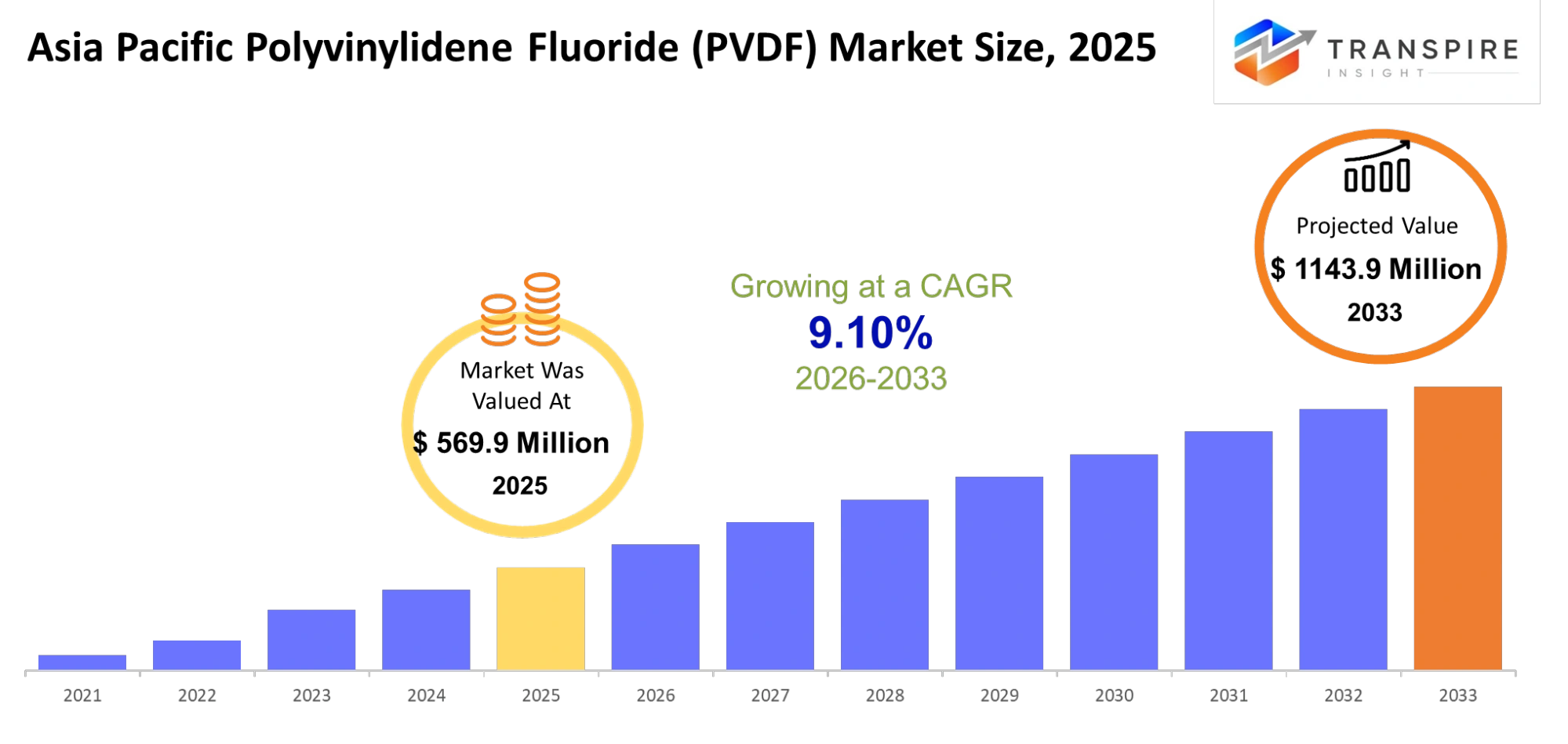
- Asia Pacific Polyvinylidene Fluoride (PVDF) Market Size 2025: USD 569.9 Million
- Asia Pacific Polyvinylidene Fluoride (PVDF) Market Size 2033: USD 1143.9 Million
- Asia Pacific Polyvinylidene Fluoride (PVDF) Market CAGR: 9.10%
- Asia Pacific Polyvinylidene Fluoride (PVDF) Market Segments: By Type (Homopolymer, Copolymer, Suspension PVDF, Emulsion PVDF, Powder, Others); By Application (Lithium-ion Batteries, Coatings, Pipes & Fittings, Membranes, Wires & Cables, Others); By End-User (Chemical, Electrical & Electronics, Automotive, Energy, Construction, Others); By Form (Powder, Granules, Pellets, Sheets, Films, Others)
To learn more about this report,  Download Free Sample Report
Asia Pacific Polyvinylidene Fluoride (PVDF) Market Summary:
The Asia Pacific Polyvinylidene Fluoride (PVDF) Market size is estimated at USD 569.9 Million in 2025 and is anticipated to reach USD 1143.9 Million by 2033, growing at a CAGR of 9.10% from 2026 to 2033.
The specialty polymers industry in Asia Pacific will show changes in demand for high-performance materials according to environmental regulations through its assessment of the Polyvinylidene Fluoride (PVDF) market. The manufacturers in China Japan South Korea and India will start to produce their products according to cleaner processing methods because the government authorities require them to decrease their emissions and improve their management of dangerous substances. Lithium-ion battery manufacturers will change their supply needs because electric mobility demand will increase. Buyers who purchase materials for coatings and electronics will demand stronger and purer products which will lead to polymerization process improvements. Local producers will invest in advanced processing technologies to meet evolving performance benchmarks and secure long-term regional competitiveness.
What Has the Impact of Artificial Intelligence Been on the Asia Pacific Polyvinylidene Fluoride (PVDF) Market ?
The specialty polymers industry now undergoes an AI-driven transformation which changes its data analysis methods and decision-making processes because this transformation brings measurable effects that impact the Asia Pacific polyvinylidene fluoride PVDF market. Companies are increasingly adopting AI in asia pacific polyvinylidene fluoride (pvdf) market analysis to process large datasets, identify emerging market trends, and refine competitive strategies. The demand forecasting process uses machine learning tools which study consumption patterns from various industrial sectors including batteries and coatings and electronics to help manufacturers produce matching quantities with actual market demand.The asia pacific polyvinylidene fluoride (pvdf) market experiences improved planning accuracy because this shift decreases uncertainty.
The use of artificial intelligence in asia pacific polyvinylidene fluoride (pvdf) market operations enables production efficiency improvements through the development of automated systems that use advanced maintenance prediction technologies. The advanced algorithms track equipment performance to minimize operational downtime while they achieve material usage efficiency at the same time, which results in decreased operational expenses. Predictive analytics technology works together with supply chain management systems to enhance inventory management and logistics forecasting, which guarantees on-schedule product delivery while reducing production waste. The technologies enable companies to enhance their response times when there are changes in the availability of raw materials or the needs of their customers.
Key Market Trends & Insights:
- China controls more than 45% of the Asia Pacific polyvinylidene fluoride PVDF market because its battery manufacturing operations and domestic production facilities support its market position in 2025.
- The electric mobility and energy storage sectors drive India to become the fastest-growing area with a projected growth rate above 7% during the period from 2026 to 2030.
- The market leader for suspension PVDF maintains a share above 50% in 2025 because businesses use it widely in their coating and industrial operations.
- The battery-grade PVDF market segment experiences fast expansion because of the growing demand which will last until 2030.
- The lithium-ion battery market holds the largest share with nearly 40% in 2025 because consumers show strong interest in electric vehicles and consumer electronics products.
- The fastest-growing application of water treatment membranes will occur because multiple regions experience both infrastructure development and new environmental regulations.
- The electrical and electronics industry leads the market with a more than 35% share because it needs high-performance materials for its insulation and semiconductor applications.
- Companies are directing their attention to product development through battery-grade PVDF because it provides them with a competitive advantage to fulfill new market demands and increase their market presence.
- The company strengthens its manufacturing capabilities through its planned expansion in China and Southeast Asia which also creates better connections to those regions.
- The company creates competitive advantage through its battery manufacturer partnerships while technological advancements enhance its polymer processing abilities.
Asia Pacific Polyvinylidene Fluoride (PVDF) Market Segmentation
By Type:
The use of Homopolymer will remain extensive because it provides excellent chemical resistance and thermal stability which makes it suitable for industrial applications and coating purposes. Copolymer will gain traction where flexibility and impact resistance are required. Suspension PVDF will dominate bulk usage, while emulsion PVDF will support niche, high-purity applications in coatings and membranes.
By Application:
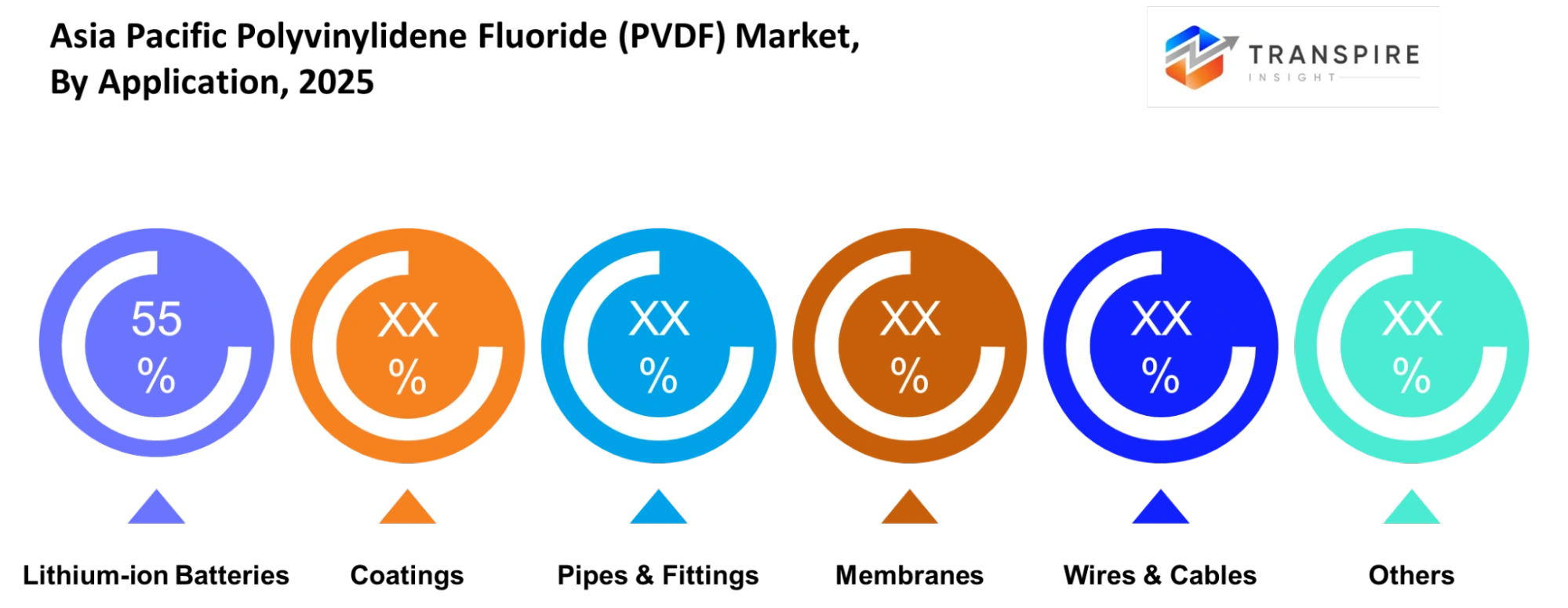
The first group shows its first applications through lithium-ion batteries and two additional fields of use which include coatings and pipes and fittings and membranes and wires and cables and others. The construction industry will continue to use coatings for both building purposes and industrial safety protection. Pipes and fittings will see increased adoption in water treatment and chemical processing because these materials offer durability and protection against corrosion.
To learn more about this report, Download Free Sample Report
By End-User:
The electrical and electronics sector will become the main driver of consumption because of its need for insulation material and semiconductor components. The automotive sector will boost its demand for this technology because of its electric vehicle manufacturing activities. The chemical and energy sectors will use PVDF to manage corrosive materials while construction will implement protective materials that maintain structural integrity and operational efficiency over time.
By Form:
Powder form will remain the preferred option for coatings and fine processing applications because it offers better handling capabilities. The manufacturing and molding operations will use granules and pellets as their fundamental production materials. The electronics and insulation industries will increasingly utilize sheets and films because their thin uniform layers provide steady performance and long-lasting durability.
What are the Main Challenges for the Asia Pacific Polyvinylidene Fluoride (PVDF) Market Growth?
The asia-pacific polyvinylidene fluoride (pvdf) market suffers from multiple operational and technical difficulties which prevent the development of operations and the improvement of production capacity. PVDF production requires precise polymerization control, because any small errors will result in product performance difficulties during its use in high-demand applications which include batteries and electronics. Supply chain disruptions which affect essential raw materials like fluorspar create additional operational difficulties. The operational difficulties which affect the Asia Pacific PVDF market lead to two main outcomes which include production delays and extra operational expenses.
The expansion of businesses faces two main challenges which include manufacturing barriers and commercialization obstacles. The production process still needs high levels of energy and requires complete adherence to environmental and safety standards which developed Asia Pacific countries enforce. The combination of increasing compliance expenses and new chemical regulations creates market challenges which small manufacturing companies need to exit. The delay in developing new PVDF grades for battery applications creates two negative outcomes which include extended time before reaching market release and reduced ability to compete.
Emerging economies face two main problems which prevent them from adopting new technologies because they need to develop both their infrastructure and their technical expertise. Advanced industries cannot use PVDF because two factors exist: qualified workers are not available and processing facilities are not sufficient. The high costs of materials in comparison to traditional options create financial obstacles for businesses in cost-sensitive markets which depend on PVDF materials. The high material costs of PVDF compared to its conventional alternatives create obstacles which prevent its adoption in cost-sensitive industries thereby hindering the development of the Asia Pacific PVDF market.
The industry faces two main challenges which include competition from substitute products and unpredictable price changes. The market demand for products will experience sustained growth challenges because alternative high-performance polymers and regional price changes will affect future demand trends.
Regional Insights
The Asia Pacific Polyvinylidene Fluoride (PVDF) market will develop through distinct patterns because industrial production capacity and government regulations and consumer needs create different development patterns in each region. China will lead because of its strong battery manufacturing and chemical production capabilities while Japan and South Korea will focus on developing advanced technological solutions through their production of high-quality products. India and Southeast Asia will experience increased energy resource demand because of their continuous infrastructure growth and their dedication to developing the energy sector.
China will continue to dominate the market because it operates extensive production facilities and maintains established supply chains which serve the electronics and electric vehicle sectors. Japan and South Korea will focus their efforts on developing innovative solutions and precise manufacturing capabilities while driving their economic growth through international trade. India will experience steady economic growth because its domestic market demand keeps rising while Southeast Asia becomes an attractive destination for investments as businesses establish their manufacturing operations and build their local delivery systems.
Recent Development News
In March 2026, Arkema announced expansion of its Kynar® PVDF production capacity. The company revealed a 20% capacity increase at its Changshu, China facility to support rising demand from batteries, coatings, and electronics across Asia-Pacific. https://www.arkema.com
In March 2026, Arkema confirmed a strategic investment in advanced PVDF manufacturing infrastructure. The expansion project will strengthen supply reliability and innovation capabilities, supported by its global R&D network to meet accelerating regional demand in energy storage and semiconductor applications. https://finance.yahoo.com
|
Report Metrics |
Details |
|
Market size value in 2025 |
USD 569.9 Million |
|
Market size value in 2026 |
USD 621.8 Million |
|
Revenue forecast in 2033 |
USD 1143.9 Million |
|
Growth rate |
CAGR of 9.10% from 2026 to 2033 |
|
Base year |
2025 |
|
Historical data |
2021 - 2024 |
|
Forecast period |
2026 - 2033 |
|
Report coverage |
Revenue forecast, competitive landscape, growth factors, and trends |
|
Regional scope |
Asia Pacific ( China, India, Japan, South Korea, Australia, Rest of Asia Pacific) |
|
Key company profiled |
Arkema, Solvay, Kureha, Daikin, 3M, Dongyue Group, Shanghai Ofluorine, Gujarat Fluorochemicals, Zhejiang Fotech, Sinochem, BASF, SABIC, Toray, Mitsubishi Chemical, Honeywell |
|
Customization scope |
Free report customization (country, regional & segment scope). Avail customized purchase options to meet your exact research needs. |
|
Report Segmentation |
By Type (Homopolymer, Copolymer, Suspension PVDF, Emulsion PVDF, Powder, Others); By Application (Lithium-ion Batteries, Coatings, Pipes & Fittings, Membranes, Wires & Cables, Others); By End-User (Chemical, Electrical & Electronics, Automotive, Energy, Construction, Others); By Form (Powder, Granules, Pellets, Sheets, Films, Others) |
How Can New Companies Establish a Strong Foothold in the Asia Pacific Polyvinylidene Fluoride (PVDF) Market ?
New entrants who want to establish their presence in the Asia Pacific polyvinylidene fluoride (PVDF) market must concentrate on specific market segments because established companies already control the entire market. The two specific markets which include battery-grade PVDF for electric vehicles and membrane technologies used in water treatment create high-demand opportunities which clients can access. The two markets which show high growth potential help emerging businesses develop their products through three main aspects which include performance reliability and economical production methods.
The business will use innovation strategies as its main method to create unique product value. New companies can invest in advanced polymer processing, sustainable production methods, and improved material purity to address industry pain points such as high energy consumption and environmental compliance. The business will use strategic relationships with battery manufacturers electronics companies and regional distributors to improve its market reach. The asia pacific polyvinylidene fluoride (pvdf) market uses collaborative efforts to help companies enter the market more easily while their operations expand the business at an accelerated rate.
The emerging companies already implement this strategy in their operations. Startups like Shanghai-based energy material firms focus on developing localized PVDF supply chains which will help lithium-ion battery producers decrease their need for imported materials while they enhance their supply chain operations. Another group of innovators is developing eco-friendly PVDF alternatives with lower emissions during production, aligning with stricter regulations. The two companies will establish their competitive advantage through innovation which they will combine with their regional partnerships.
Key Asia Pacific Polyvinylidene Fluoride (PVDF) Market Company Insights
The Asia Pacific Polyvinylidene Fluoride PVDF Market will develop into a competitive market because existing global manufacturers and new local companies will battle for market share. The major companies will keep their market control through their extensive resources and their cutting-edge technologies and their agreements which ensure them continuous access to supplies whereas the local companies will concentrate on building their market presence through effective cost management and production facilities that serve their specific area.
The leading companies in the market will spend money on expanding their production facilities and developing new products to meet the increased demand from the battery and electronics sectors. The establishment of strategic partnerships with end-use industries will enable companies to enhance their supply stability and drive innovation. The regional competitors will concentrate on establishing price advantages while reducing delivery times and they will use ongoing technology advancements to create unique products which will establish their market presence.
Company List
- Arkema
- Solvay
- Kureha
- Daikin, 3M
- Dongyue Group
- Shanghai Ofluorine
- Gujarat Fluorochemicals
- Zhejiang Fotech
- Sinochem
- BASF
- SABIC
- Toray
- Mitsubishi Chemical
- Honeywell
What are the Key Use-Cases Driving the Growth of the Asia Pacific Polyvinylidene Fluoride (PVDF) Market ?
The asia pacific polyvinylidene fluoride (pvdf) market experiences strong growth because of its increasing usage in lithium-ion batteries which power electric vehicles and energy storage systems. PVDF serves as an essential binder material which maintains the structural integrity and functional efficiency of battery cells. The rising demand for electricity in China South Korea and Japan drives market growth through this application which will continue to expand its future operational capacity.
Protective coatings and industrial infrastructure represent another major application that drives growth in the asia pacific polyvinylidene fluoride (pvdf) market. PVDF-based coatings provide extensive protection in construction sites chemical plants and marine environments because they can withstand both corrosion and ultraviolet radiation and dangerous chemical substances. The material functions as an asset protection solution which decreases required maintenance work for industrial projects of large size.
The electronics and semiconductor industry increasingly recognizes PVDF for its exceptional insulation capabilities and its extremely pure chemical composition. The material functions in wires and cables and advanced electronic components which need assured operational reliability. The Asia Pacific semiconductor industry expansion creates higher demand which drives the persistent growth of the asia pacific polyvinylidene fluoride (pvdf) market.
Water treatment and filtration systems represent a major growing application sector. PVDF membranes provide excellent resistance to chemicals while maintaining their strength properties which makes them ideal for use in wastewater treatment and desalination facilities. The increased investment in clean water infrastructure development will drive more people to adopt new systems while creating chances for fresh technological advancements.
Asia Pacific Polyvinylidene Fluoride (PVDF) Market Report Segmentation
By Type
- Homopolymer
- Copolymer
- Suspension PVDF
- Emulsion PVDF
- Powder
- Others
By Application
- Lithium-ion Batteries
- Coatings
- Pipes & Fittings
- Membranes
- Wires & Cables
- Others
By End-User
- Chemical
- Electrical & Electronics
- Automotive, Energy
- Construction
- Others
By Form
- Powder
- Granules
- Pellets
- Sheets
- Films
- Others
Frequently Asked Questions
Find quick answers to common questions.
The approximate Asia Pacific Polyvinylidene Fluoride (PVDF) Market size for the market will be USD 1143.9 Million in 2033.
Key segments for the Asia Pacific Polyvinylidene Fluoride (PVDF) Market are By Type (Homopolymer, Copolymer, Suspension PVDF, Emulsion PVDF, Powder, Others); By Application (Lithium-ion Batteries, Coatings, Pipes & Fittings, Membranes, Wires & Cables, Others); By End-User (Chemical, Electrical & Electronics, Automotive, Energy, Construction, Others); By Form (Powder, Granules, Pellets, Sheets, Films, Others).
Major Asia Pacific Polyvinylidene Fluoride (PVDF) Market players are Arkema, Solvay, Kureha, Daikin, 3M, Dongyue Group, Shanghai Ofluorine, Gujarat Fluorochemicals, Zhejiang Fotech, Sinochem, BASF, SABIC, Toray, Mitsubishi Chemical, Honeywell.
The Asia Pacific Polyvinylidene Fluoride (PVDF) Market size is USD 569.9 Million in 2025.
The Asia Pacific Polyvinylidene Fluoride (PVDF) Market CAGR is 9.10%.
- Arkema
- Solvay
- Kureha
- Daikin, 3M
- Dongyue Group
- Shanghai Ofluorine
- Gujarat Fluorochemicals
- Zhejiang Fotech
- Sinochem
- BASF
- SABIC
- Toray
- Mitsubishi Chemical
- Honeywell
Recently Published Reports
-
Dec 2024
Healthcare Polymer Packaging Market
Healthcare Polymer Packaging Market Size, Share & Analysis Report By Packaging Type (Syringes, IV Bottles and Pouches, Clamshells, Blisters, Bottles & Jars, Containers, Tubes, IV Parental Packaging, Others), By Type (Regulated, Non-regulated), By Polymer Type (LDPE (Low-Density Polyethylene), HDPE (High-Density Polyethylene), Homo-polymer (Homo), Random Copolymer (Random), Block Copolymer (Block), PET, Polystyrene, Polyvinyl Chloride, Polyamide/EVOH, Others), and Geography (North America, Europe, Asia-Pacific, Middle East and Africa, South and Central America), 2021 - 2031
-
Jan 2025
Hydrophilic Tape (Waterstop) Market
Hydrophilic Tape (Waterstop) Market Size, Share & Analysis Report By Type (Bentonite-Based Hydrophilic Tape, Rubber-Based Hydrophilic Tape), By Application (Residential Buildings, Commercial Buildings, Infrastructure Projects), and Geography (North America, Europe, Asia-Pacific, Middle East and Africa, South and Central America), 2021 - 2031
-
Jan 2025
Metalens Market
Metalens Market Size, Share & Analysis Report By Type (Visible Light Metalens, and Infrared Metalens), By Application (Consumer Electronics, Automotive Electronics, Industrial, Medical, and Others), and Geography (North America, Europe, Asia-Pacific, Middle East and Africa, South and Central America), 2021 - 2031
-
Jan 2025
PBT Resin Market
PBT Resin Market Size, Share & Analysis Report By Type (Reinforced PBT Resin, Unreinforced PBT Resin), By Processing Method (Injection Molding, Extrusion, Blow Molding, Others), By End-User (Automotive, Electrical & Electronics, Consumer Appliances, Industrial Machinery, Medical Devices, Packaging, Others), and Geography (North America, Europe, Asia-Pacific, Middle East and Africa, South and Central America), 2021 - 2031