
South Korea Acrylic Fiber Market Size & Forecast:
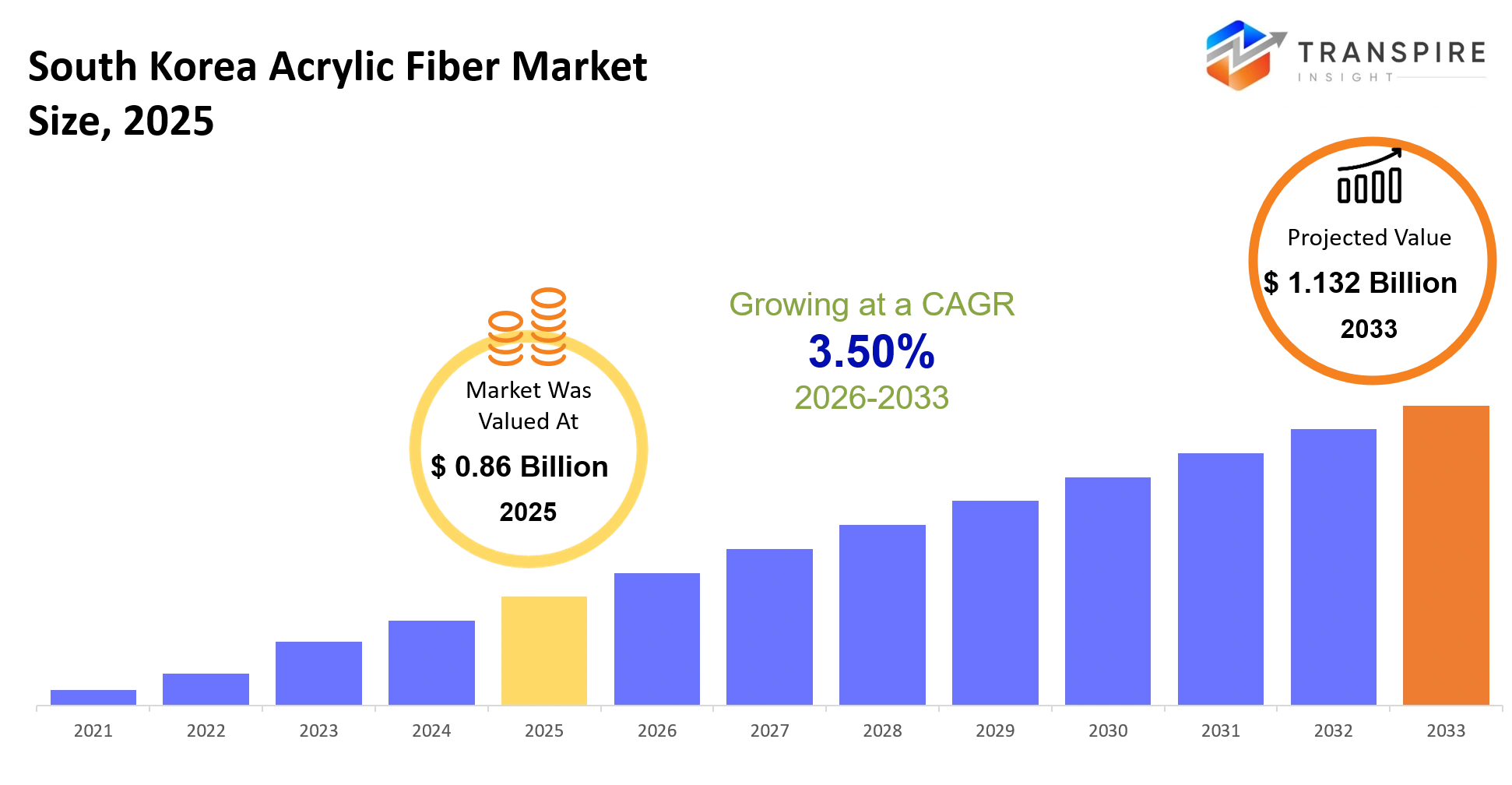
- South Korea Acrylic Fiber Market Size 2025: USD 0.86 Billion
- South Korea Acrylic Fiber Market Size 2033: USD 1.132 Billion
- South Korea Acrylic Fiber Market CAGR:3.50%
- South Korea Acrylic Fiber Market Segments:By Type (Staple Fiber, Filament Fiber, Tow Fiber, Others); By Application (Apparel, Home Furnishing, Industrial Textiles, Others); By End User (Textile, Automotive, Industrial, Others) ,By South Korea Acrylic Fiber Market Summary
To learn more about this report,  Download Free Sample Report
South Korea Acrylic Fiber Market Summary
The South Korea Acrylic Fiber Market was valued at USD 0.86 Billion in 2025. It is forecast to reach USD 1.132 Billion by 2033. That is a CAGR of 3.50% over the period.
The South Korea Acrylic Fiber Market is very important for providing fibers that're light, strong and affordable. These fibers are used in things like clothes, home textiles, industrial fabrics and clothes for cold weather. Acrylic fibers help companies make products that're soft like wool keep their color and can withstand bad weather all while keeping costs low. This makes them very useful for people who buy things and for companies that use them.
In the five years the market has changed a lot. Now people want fibers that're stronger, better for the environment and can be recycled. This change happened faster because there were problems with getting the materials needed to make fibers and the prices of these materials were not stable. So companies started to get their materials from places and invested in new technologies to make their products better and more consistent.
Now the market is growing because more people are using special textiles, high-end clothes and home products that are functional. As people who make these products want them to be better, longer and look good, the companies that make acrylic fibers are making more money and selling more products. They are doing this by making products that meet the needs of their customers.
Key Market Insights
- The South Korea Acrylic Fiber Market is getting bigger and bigger because people are using textiles making nice clothes and coming up with new ways to make fibers.
- The South Korea Acrylic Fiber Market is going to keep growing until 2030 because people want textiles that can do things new products are being made. People's tastes are changing.
- Gyeonggi Province is the place for the South Korea Acrylic Fiber Market with about 35 percent of the market in 2025 and this is because it has good textile factories and roads.
- The Chungcheong region is growing the fastest during this time. This is because companies are building more textile and fiber factories there.
- Most of the South Korea Acrylic Fiber Market is made up of acrylic fiber, which will be about 60 percent of the market in 2025 because people use it a lot to make clothes and things for the home.
- Tow fiber is the most used and specialty and modified acrylic fibers are growing the fastest between 2025 and 2030.
- The South Korea Acrylic Fiber Market is mostly used for making clothes, which's about 45 percent of the market in 2025 because people want clothes that are light and feel like wool.
- Technical textiles are becoming more popular because they need to be strong and last a long time and people are using new materials.
- Most of the South Korea Acrylic Fiber Market goes to textile factories, which's more than 50 percent and car and industrial fabric makers are growing the fastest.
- Big companies, like Toray Industries, Mitsubishi Chemical, Taekwang Industrial, Hyosung, Aksa Akrilik and Dralon GmbH are doing well because they are making lots of things with the help of technology.
What are the Key Drivers, Restraints, and Opportunities in the South Korea Acrylic Fiber Market?
Driver
The advancement of high-performance fabrics is what's driving the growth of the South Korea acrylic fiber market. Over the last several years, the clothing manufacturers have begun using stronger, inexpensive materials in their clothing and industrial fabric. This trend started when wool became too expensive and/or difficult to source fiber from, so manufacturers began to use acrylic fibers as an alternative. Because of this trend, manufacturers have also received larger contracts for clothing, blankets, upholstery, and other specialty textiles. Manufacturers of fiber are now producing greater amounts of high-quality fiber, resulting in increased profits.
Restraint
The major challenge for the market is that it relies on a chemical, called acrylonitrile, which is derived from petroleum, and is typically a high-cost item. Because the process for creating acrylic fibers is dependent upon the use of petroleum, there are not many viable alternatives available today. When the price of acrylonitrile rises, manufacturers are forced to deal with reduced profit margins or will be unable to increase their pricing structure, thus hindering expansion. Additionally, some textile manufacturers will reduce their total purchasing volume due to reduced intermediate manufacturing capability.
Opportunity
There is a chance for the market to grow if companies can make new and recycled acrylic fibers for special textiles. Some companies are investing in technology to recycle fibers and make textiles in a circular way. This is creating ways for companies to make money. Some areas where these new fibers are being used are, in car interiors, filters and special fabrics. Companies that can make and sell these fibers can get into the premium part of the market and help the industry grow even more. The South Korea Acrylic Fiber Market can really benefit from these acrylic fibers.
What Has the Impact of Artificial Intelligence Been on the South Korea Acrylic Fiber Market?
The South Korea Acrylic Fiber Market is changing a lot because of intelligence and new digital technologies. These things are making manufacturing help with quality control and making production planning easier. Companies that make acrylic fiber are using intelligence to control their processes. This means they can watch what is happening during polymerization, spinning and dyeing all the time. The systems can adjust the temperature, pressure and chemicals on their own to make sure the fibers are always the same and to reduce waste and energy use.
Machine learning is also helping companies predict what will happen in their production facilities. By looking at data from sensors on pumps, reactors and spinning equipment companies can see patterns that might mean something is going wrong. This helps maintenance teams fix problems before they cause equipment to fail, which reduces downtime and makes the equipment longer. In places where fibers are made using predictive maintenance has made equipment more available and reduced maintenance costs compared to just doing maintenance on a schedule.
Digital twins and advanced analytics platforms are also helping companies make fibers, make them more consistent and get them out faster. These tools let companies try out changes before they actually make them, which reduces risks and helps get products out faster.
With all these benefits it is still hard for companies to use artificial intelligence because it is expensive to set up and it is hard to connect old equipment to new digital systems. Also to make intelligence work well companies need a lot of good data, from their production processes, which can be hard to get when everything is a little different. The South Korea Acrylic Fiber Market and acrylic fiber producers are working on these problems to make the most of intelligence and digital technologies.
Key Market Trends
- Since 2021, textile manufacturers have introduced a new variety of acrylic fibers used for sportswear. This is due to the increasing costs associated with traditional acrylics, which has resulted in decreased purchases of the less expensive types of acrylic fibers.
- Acrylonitrile prices were swinging wildly between 2022 and 2025, leading to producers modifying their contracts for sourcing supplies of raw materials.
- Hyosung and Taekwang are now making fibers that have value. This helps them compete better with producers in other countries.
- There is a need for technical textiles since 2020. People who use fabrics want lighter materials for things like filters and protective clothing.
- Some manufacturers started using AI to watch their processes. They saw that production became more consistent and there were equipment downtimes after 2023.
- Fibers made from material have become popular from 2022 to 2025. Clothing companies, over the world want materials that have recycled content. They are demanding these materials.
- After the pandemic exposed the risks associated with relying upon low-margin products, textile export businesses began shifting their focus towards producing high-end textile products.
- Investing in automatic spinning machines and quality control checking will increase efficiency in production, via both shortened production cycles and improved yields from rotary.
- Acrylic fiber blends that are soft against the skin and provide warmth are now the preferred purchase for consumers. As a result, there has been an increase in the introduction of innovative textile products for apparel and home textile products.
- Beginning after 2023, collaborative efforts between fiber manufacturers and textile processors will continue to further create sustainable materials.
South Korea Acrylic Fiber Market Segmentation
By Type
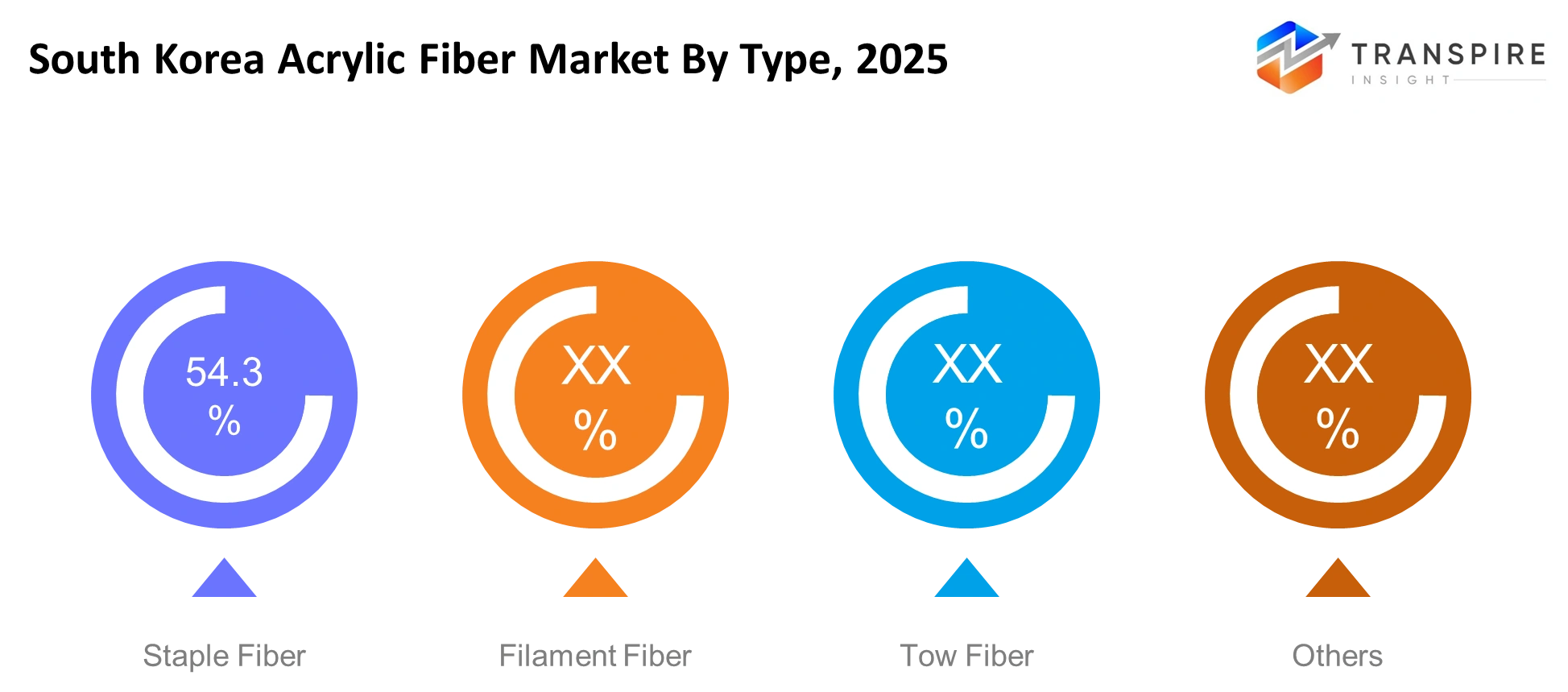
Acrylic fiber is really important in the textile industry. The staple fiber type is used a lot in clothes, blankets and things for the home. This is because it is easy to work with and feels soft. It also has some properties that're like wool. People who make clothes and home things like to use fiber because it is strong and comfortable. They are always trying to make it better so it will be used more.
Filament fiber is used for textiles that need to be strong and look good. It is good for making high-quality fabrics that last a long time. Some people like to use filament fiber for textiles and technical fabrics. As manufacturing gets better filament fiber will be used more and more.
Tow fiber is a part of textile production. It is a bunch of fibers that are all together. This makes it easy for manufacturers to make kinds of textiles. A lot of people want to make textiles and in large quantities so tow fiber is really useful. As technology improves tow fiber will be used more.
There are also some acrylic fibers that are used for industrial and technical things. These fibers have properties like being able to withstand high temperatures and being resistant to flames. Manufacturers are always making fibers that can be used in different ways. This will create opportunities for acrylic fibers.
To learn more about this report, Download Free Sample Report
By Application
Acrylic fibers are used a lot in clothes. They are used to make sweaters, sportswear and winter clothes. Acrylic fibers are soft. Keep their color well. They are also cheaper than some materials. People like to wear clothes that're comfortable and last a long time so acrylic fibers are really popular. As textile manufacturing gets better acrylic fibers will be used more in clothes.
Acrylic fibers are also used in home furnishings like carpets, curtains and blankets. They are strong. Look good and they can withstand wear and tear. People want their home furnishings to be attractive and last a time so acrylic fibers are really useful. As technology improves acrylic fibers will be used more and more in home furnishings.
Acrylic fibers are used in textiles like filters, insulation and protective clothing. They are strong. Can withstand tough conditions. Manufacturers are always making textiles that can be used in different ways. This will create opportunities for acrylic fibers.
There are also some uses for acrylic fibers that are not as common. Manufacturers can make fibers that have unique properties. This allows them to make products that are tailored to industries. As technology improves acrylic fibers will be used in more ways.
By End User
The textile industry uses acrylic fibers a lot. This is because acrylic fibers are used to make different textile products like clothes and blankets. Manufacturers are always trying to make their products better and more efficient. As technology gets better the textile industry will keep using fibers.The automotive industry also uses fibers. They use them to make car parts and special car fabrics. Acrylic fibers are very strong and lightweight which is great. They also look really good. Manufacturers are always trying to make their products better so they will keep using fibers.
Industrial users also use fibers. They use them in things, like filters, insulation and protective clothing. Acrylic fibers are very strong. Can handle tough conditions. As industries get bigger the use of fibers will keep growing.
What are the Key Use Cases Driving the South Korea Acrylic Fiber Market?
The biggest use of acrylic fiber is in making clothes, sweaters, sportswear, winter clothes and knitted wear. People like acrylic fiber because it feels soft like wool, keeps its color well, provides warmth and is cheaper than some natural materials. These qualities make acrylic fiber a choice for making a lot of textiles.
Acrylic fiber is also being used more in home furnishings and industrial textiles. Companies use it to make carpets, sofa covers, blankets, filters and insulation products because it lasts long and can withstand wear. The growth in buildings and industrial activities is helping to increase the use of acrylic fiber in these areas.
New chances are opening up in technical textiles and car interior materials. Companies that make fibers are creating types of acrylic fiber with better performance for protective fabrics, lightweight car parts and high-end industrial uses. More investment in materials and eco-friendly fiber technologies is expected to create new business opportunities in the future.
|
Report Metrics |
Details |
|
Market size value in 2025 |
USD 0.86 Billion |
|
Market size value in 2026 |
USD 0.89 Billion |
|
Revenue forecast in 2033 |
USD 1.132 Billion |
|
Growth rate |
CAGR of 3.50% from 2026 to 2033 |
|
Base year |
2025 |
|
Historical data |
2021 - 2024 |
|
Forecast period |
2026 - 2033 |
|
Report coverage |
Revenue forecast, competitive landscape, growth factors, and trends |
|
Regional scope |
South Korea |
|
Key company profiled |
Aksa Akrilik, Dralon, Aditya Birla, Pasupati Acrylon, Indian Acrylics, Taekwang, Tong-Hwa Synthetic Fiber, Mitsubishi Chemical, Formosa Plastics, Kaltex, Montefibre, Exlan, Sinopec, Jilin Chemical, Thai Acrylic |
|
Customization scope |
Free report customization (country, regional & segment scope). Avail customized purchase options to meet your exact research needs. |
|
Report Segmentation |
By Type (Staple Fiber, Filament Fiber, Tow Fiber, Others); By Application (Apparel, Home Furnishing, Industrial Textiles, Others); By End User (Textile, Automotive, Industrial, Others) |
Which Regions are Driving the South Korea Acrylic Fiber Market Growth?
Asia Pacific leads the market and accounts for the largest share of global revenue due to its extensive maritime trade network and concentration of major commercial ports. Countries across the region have strengthened compliance with international marine regulations while continuing to expand port infrastructure to support growing cargo volumes. The region also operates one of the world’s largest merchant fleets, creating sustained demand for advanced maritime solutions and vessel upgrades. A strong ecosystem of shipbuilders, marine equipment suppliers, classification societies, and logistics operators further reinforces its market leadership.
Europe ranks as the second-largest regional market, but its position is supported by a different set of strengths. Rather than relying primarily on fleet expansion, the region benefits from economic stability, mature maritime institutions, and consistent investment by shipowners in operational efficiency. Regulatory implementation remains predictable, allowing market participants to plan long-term compliance and modernization strategies with confidence. This stable business environment ensures steady revenue generation and makes Europe a dependable contributor to overall market performance.
The Middle East and Africa is expected to record the fastest growth during the 2026–2033 period as governments accelerate investments in maritime infrastructure and fleet modernization. Several countries have expanded port development programs and introduced initiatives aimed at improving shipping efficiency and attracting international trade activity. Rising investments in strategic logistics corridors and coastal industrial zones have also increased demand for modern maritime technologies and services. This growth momentum creates significant opportunities for new entrants and investors seeking exposure to emerging maritime markets with expanding long-term potential.
Who are the Key Players in the South Korea Acrylic Fiber Market and How Do They Compete?
The South Korea Acrylic Fiber Market exhibits a moderately consolidated competitive structure, with a limited number of large-scale producers controlling significant production capacity while regional and specialty manufacturers compete in selected application segments. Competition is driven primarily by production efficiency, fiber quality, product customization, and the ability to supply textile manufacturers consistently amid fluctuating raw material costs. Established producers continue to defend market share through capacity optimization and differentiated fiber grades, while niche suppliers focus on specialty applications such as technical textiles, outdoor fabrics, and high-performance apparel materials.
Aksa Akrilik competes through scale-driven manufacturing and a broad acrylic fiber portfolio that serves apparel, home furnishing, and industrial textile markets. Its integrated production capabilities help reduce costs and ensure supply reliability. Dralon differentiates itself through premium-quality fibers with strong color retention and durability characteristics, making it particularly attractive for upholstery and outdoor textile applications. The company continues to strengthen its position by expanding specialty fiber offerings and targeting higher-value end-use segments.
Aditya Birla emphasizes product innovation and global distribution reach, allowing it to serve diverse textile customers across multiple regions while maintaining consistent quality standards. Taekwang leverages its proximity to domestic textile manufacturing clusters and focuses on responsive customer service and tailored fiber specifications for local demand. Mitsubishi Chemical pursues technology-focused growth by developing advanced acrylic fiber solutions with enhanced performance characteristics, supporting expansion into technical textile applications where product performance creates a stronger competitive advantage than price alone.
Company List
- Aksa Akrilik
- Dralon GmbH
- Aditya Birla Group
- Pasupati Acrylon
- Indian Acrylics Limited
- Taekwang Industrial
- Tong-Hwa Synthetic Fiber
- Mitsubishi Chemical
- Formosa Plastics Corporation
- Kaltex Fibers
- Montefibre
- Exlan Corporation
- Sinopec
- Jilin Chemical Fiber Group
- Thai Acrylic Fibre
Recent Development News
In September 2025, Mitsubishi Chemical Corporation and Honda Motor Co., Ltd. jointly developed and commercialized recycled acrylic resin for the door visors of the new N-ONE e: electric vehicle. The project marked the first use of chemically recycled acrylic resin in automotive door visors, demonstrating the growing commercial viability of advanced acrylic material recycling and supporting sustainability initiatives across the acrylic value chain.https://www.mcgc.com
In November 2025, Aksa Akrilik expanded commercialization of its patented Acryluna OnceDye acrylic fiber technology. The product enables acrylic-cellulosic blends to be dyed with reactive dyes in a single process, reducing water, energy, and chemical consumption while improving dyeing efficiency, strengthening the industry's focus on sustainable fiber innovation.https://www.etextilemagazine.com.
In 2025, Aksa Akrilik accelerated investment in advanced fiber technologies through the expansion of its Mithra high-performance fiber platform. The investment broadened the company’s specialty fiber portfolio and reinforced its strategy to move beyond conventional acrylic fibers into higher-value technical material applications, supporting long-term competitiveness in fiber markets.https://www.aksa.com
What Strategic Insights Define the Future of the South Korea Acrylic Fiber Market?
The South Korea Acrylic Fiber Market is changing. It is focusing on quality, performance and eco-friendly products. This is just making more. This change will happen over the next five to seven years. Demand from textiles, functional clothing, outdoor furniture and special industrial uses will grow faster than traditional textiles.This shift is happening because of rules, people wanting strong materials and companies trying to stand out.
The market has a risk. Acrylonitrile feedstock prices can be unpredictable. Also synthetic and recycled fibers are becoming more available. If raw material costs rise producers might face margin pressure.At the time recycled and chemically regenerated acrylic fibers are a new opportunity. Many brands are committing to sourcing. This area is gaining momentum. Is still underdeveloped.
Companies should invest in fibers and eco-friendly technologies. They should also partner with others in the textile industry. Those that focus on acrylic solutions and performance fibers will have an advantage. They will have pricing power and a competitive edge, by 2033.
South Korea Acrylic Fiber Market Report Segmentation
By Type
- Staple Fiber
- Filament Fiber
- Tow Fiber
- Others
By Application
- Apparel
- Home Furnishing
- Industrial Textiles
- Others
By End User
- Textile
- Automotive
- Industrial
- Others
Frequently Asked Questions
Find quick answers to common questions.
The expected South Korea Acrylic Fiber Market size for the market will be USD 1.132 Billion in 2033.
Key segments for the South Korea Acrylic Fiber Market are ,By Type (Staple Fiber, Filament Fiber, Tow Fiber, Others); By Application (Apparel, Home Furnishing, Industrial Textiles, Others); By End User (Textile, Automotive, Industrial, Others)
Major South Korea Acrylic Fiber Market players are Aksa Akrilik, Dralon, Aditya Birla, Pasupati Acrylon, Indian Acrylics, Taekwang, Tong-Hwa Synthetic Fiber, Mitsubishi Chemical, Formosa Plastics, Kaltex, Montefibre, Exlan, Sinopec, Jilin Chemical, Thai Acrylic
The South Korea Acrylic Fiber Market size is USD 0.86 Billion in 2025.
The South Korea Acrylic Fiber Market CAGR is 3.50% from 2026 to 2033.
- Aksa Akrilik
- Dralon GmbH
- Aditya Birla Group
- Pasupati Acrylon
- Indian Acrylics Limited
- Taekwang Industrial
- Tong-Hwa Synthetic Fiber
- Mitsubishi Chemical
- Formosa Plastics Corporation
- Kaltex Fibers
- Montefibre
- Exlan Corporation
- Sinopec
- Jilin Chemical Fiber Group
- Thai Acrylic Fibre
About the Authors

Pankaj Ghogare Patil
I am Pankaj Ghogare Patil, a Senior Research Analyst at Transpire Insight, specializing in the Pharmaceutical, Chemicals & Materials, Healthcare IT, and Biotechnology industry. My expertise lies in conducting comprehensive market research, analyzing industry trends, evaluating competitive landscapes, and translating complex data into actionable insights. At Transpire Insight, I closely follow emerging technologies, regulatory developments, and market innovations to create accurate, well-researched, and informative content that helps businesses and professionals make informed decisions. I am committed to producing credible, evidence-based articles that reflect industry best practices while making technical topics accessible and valuable for a broad audience.

Chakradhar Khansole
Chakradhar serves as the Research Director at Transpire Insight, bringing over 8 years of experience in technology, innovation, and strategic market intelligence. He specializes in transforming complex market data into actionable business insights that enable organizations to make informed, growth-oriented decisions. Recognized for his strategic vision and analytical expertise, Chakradhar leads high-impact research initiatives, delivering comprehensive market assessments, competitive intelligence, and forward-looking industry analysis.
Recently Published Reports
-
May 2026
Healthcare Polymer Packaging Market
Healthcare Polymer Packaging Market Size, Share & Analysis Report By Packaging Type (Syringes, IV Bottles and Pouches, Clamshells, Blisters, Bottles & Jars, Containers, Tubes, IV Parental Packaging, Others), By Type (Regulated, Non-regulated), By Polymer Type (LDPE (Low-Density Polyethylene), HDPE (High-Density Polyethylene), Homo-polymer (Homo), Random Copolymer (Random), Block Copolymer (Block), PET, Polystyrene, Polyvinyl Chloride, Polyamide/EVOH, Others), and Geography (North America, Europe, Asia-Pacific, Middle East and Africa, South and Central America), 2021 - 2031
-
Apr 2026
Hydrophilic Tape (Waterstop) Market
Hydrophilic Tape (Waterstop) Market Size, Share & Analysis Report By Type (Bentonite-Based Hydrophilic Tape, Rubber-Based Hydrophilic Tape), By Application (Residential Buildings, Commercial Buildings, Infrastructure Projects), and Geography (North America, Europe, Asia-Pacific, Middle East and Africa, South and Central America), 2021 - 2031
-
Apr 2026
Metalens Market
Metalens Market Size, Share & Analysis Report By Type (Visible Light Metalens, and Infrared Metalens), By Application (Consumer Electronics, Automotive Electronics, Industrial, Medical, and Others), and Geography (North America, Europe, Asia-Pacific, Middle East and Africa, South and Central America), 2021 - 2031
-
Apr 2026
PBT Resin Market
PBT Resin Market Size, Share & Analysis Report By Type (Reinforced PBT Resin, Unreinforced PBT Resin), By Processing Method (Injection Molding, Extrusion, Blow Molding, Others), By End-User (Automotive, Electrical & Electronics, Consumer Appliances, Industrial Machinery, Medical Devices, Packaging, Others), and Geography (North America, Europe, Asia-Pacific, Middle East and Africa, South and Central America), 2021 - 2031