
South Korea Rayon Fibers Market Size & Forecast:
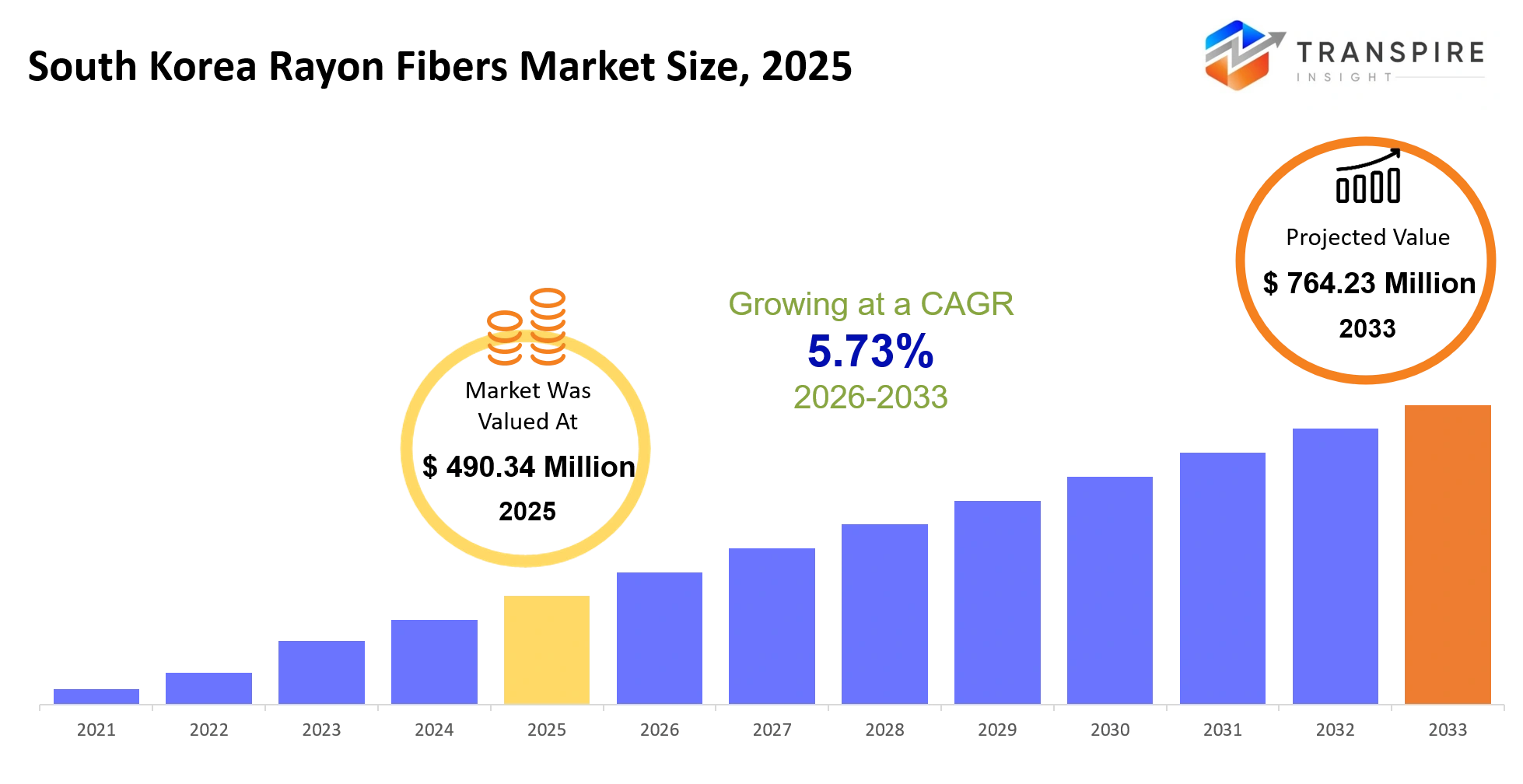
- South Korea Rayon Fibers Market Size 2025: USD 490.34 Million
- South Korea Rayon Fibers Market Size 2033: USD 764.23 Million
- South Korea Rayon Fibers Market CAGR: 5.73%
- South Korea Rayon Fibers Market Segments: By Product Type (Viscose Rayon, Modal Rayon, Lyocell Rayon, High Wet Modulus Rayon, Others); By Application (Textiles, Home Furnishings, Medical Textiles, Industrial Fabrics, Others); By End User (Apparel Industry, Home Textile Industry, Healthcare Sector, Industrial Manufacturers, Others); By Form (Staple Fibers, Filament Yarns, Nonwoven Rayon, Others).
To learn more about this report,  Download Free Sample Report
South Korea Rayon Fibers Market Summary
The South Korea Rayon Fibers Market was valued at USD 490.34 Million in 2025. It is forecast to reach USD 764.23 Million by 2033. That is a 5.73% CAGR over the period.
South Korea Rayon Fibers Market kind a helps manufacturers who are hunting for soft, breathable,and still pretty cost-effective materials for clothing, home textiles, hygiene uses, and even industrial fabric needs, Rayon also works like a bridge between natural fibers and synthetic fibers, it gives comfort, flexibility, and pretty steady processing results when you’re running large-scale production lines.
In the past several years the whole market sort of shifted in a more sustainable and traceable fiber direction. Textile producers are now placing greater emphasis on certified wood-based rayon and cleaner production methods, primarily to align with corporate sustainability goals and export market expectations. One big trigger for this change was the tougher global environmental rules and supply chain requirements, which made companies re-check how they source raw materials and how they handle processing.
Right now, market growth is tightly connected to South Korea’s advanced textile and apparel ecosystem, When brands try to offer distinctive fabrics with smaller environmental footprints, rayon gets pulled into a wider set of value-added products. This, in turn, supports higher output volumes,and it strengthens revenue creation across the supply chain.
Key Market Insights
- Gyeonggi Province kind of dominates the South Korea Rayon Fibers Market, making up about 30%+ of the industry share in 2025, mostly because it has a solid textile manufacturing ecosystem and a lot of closely connected suppliers there, so the whole thing runs more smoothly.
- South Gyeongsang Province kinda holds a big market share too, backed by well known industrial clusters and some fiber processing facilities that have been around.
- In the Chungcheong region, the market is likely going to be the fastest growing area during the forecast period, mostly due to industrial investments and the diversification of manufacturing, which keeps things moving forward..
- Viscose rayon seems to lead the market with about 60% or more share in 2025, and it’s backed by heavy usage across apparel and even home textile uses, sort of everywhere.
- High tenacity rayon fibers sort of stand as the second-largest segment, because their growing role in industrial fabrics and specialty products is increasingly obvious.
- Modal and specialized regenerated cellulose fibers are seen as the fastest growing chunk through 2030, mostly because premium textile requirements are pushing things along, plus sustainability goals kinda keep feeding the momentum.
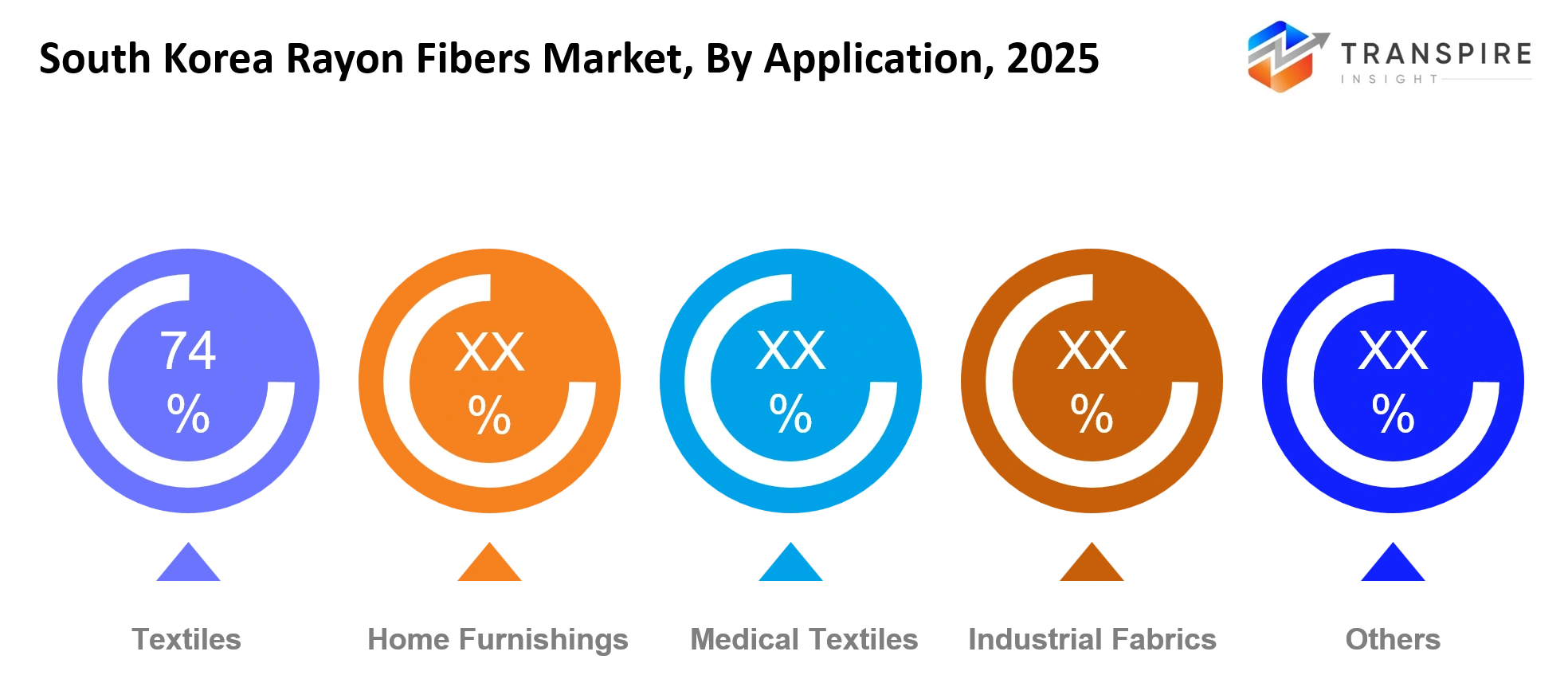
- Apparel and fashion textiles take in more than 50% of the South Korea Rayon Fibers Market revenue, so yeah, basically it’s the most dominant application segment. It’s sort of clear, you know, that this area leads the whole share.
- Home furnishing textiles tend to hold a notable share, since people seem to want soft, reliable, and breathable fabrics all the time.
- Hygiene goods and nonwoven uses are expected to see the fastest growth during the forecast period, more or less.
- Textile and garment manufacturers kinda dominate end-user demand, with an estimated 65%+ market share in 2025.
What are the Key Drivers, Restraints, and Opportunities in the South Korea Rayon Fibers Market?
A key force accelerating the South Korea Rayon Fibers Market is the textile industry’s shift toward traceable and certified cellulose-based raw materials. This transition really started picking up speed when global apparel brands tightened their supplier rules and then rolled out more strict sourcing standards across their procurement networks. South Korean textile manufacturers, which supply both local and international fashion brands, have responded by adding certified viscose and specialty rayon fibers to their product lines. In practice, this has widened the use of rayon in premium clothing and functional textile segments, helping manufacturers win higher value contracts and improve revenue generation via differentiated products not just price wars.
The most significant restraint on overall market growth is South Korea’s dependence on imported wood pulp and rayon feedstock materials. This issue is structural because the country has limited domestic forestry resources, and it doesn’t have the necessary scale to reach self sufficiency in critical inputs. Because of that, manufacturers stay exposed to swings in global pulp prices, transportation expenses, and even supply chain disruptions. These cost uncertainties can squeeze profit margins, and they often make companies more hesitant about long term production expansion. That hesitation then slows investment decisions and can limit how fast the market gets adopted in cost-sensitive segments.
A major opportunity comes from next-generation regenerated cellulose fibers, including modal and lyocell-based products. Investments in advanced fiber technologies across Asia are building good conditions for South Korean textile producers to move into higher-performance applications. For instance, premium sportswear, technical textiles, and functional appa
What Has the Impact of Artificial Intelligence Been on the South Korea Rayon Fibers Market?
Artificial intelligence and advanced digital technologies are being used more and more, kind of reshaping the way things run across South Korea’s rayon fiber manufacturing field. Many producers are now rolling out AI-enabled process control setups, to automate key steps inside viscose production, like pulp prep, chemical dosing, spinning, and then quality inspection. These kinds of systems sort of watch production variables all the time and they tweak the operating parameters in real time, so makers can keep fiber consistency steadier, while also trimming down material loss.
Also, machine learning approaches are getting more use for predictive maintenance across spinning lines, pumps, filtration machines, and chemical recovery units. When manufacturers analyze vibration traces, temperature swings, and equipment performance signals, they can spot possible failures early, before those failures turn into sudden stoppages. A few textile and fiber producers have mentioned better equipment uptime, and even reduced maintenance expenses as schedules start becoming more data led rather than plain calendar led.
Then there are digital analytics platforms too, which help with production optimization by forecasting things like raw material usage, energy spend, and output quality. This makes it possible for plants to push resource efficiency up, cut down production variation and generally meet environmental performance expectations more reliably. The outcome tends to be longer operational uptime, stronger yield numbers, and a more efficient use of chemicals and energy across the whole manufacturing chain.
Still, AI adoption faces a major obstacle that keeps recurring. Blending advanced analytics with older, legacy production infrastructure takes a lot of upfront capital, and a lot of facilities keep dealing with scattered or disconnected data systems, which then hurts the precision and overall usefulness of machine learning models.
Key Market Trends
- Since 2021, South Korean textile suppliers have started to more heavily use certified wood-pulp rayon, to cover sourcing needs from international apparel brands, I guess, you could say it like that. The move is basically an effort to meet those external requirements, period, and it looks more common year after year.
- Modal and specialty regenerated cellulose fibers have gained share, as manufacturers now aim at premium fashion, sportswear and functional textile uses. It’s kind of a shift towards better hand feel and performance, not just the usual basics, so the demand is moving more and more into these particular niches.
- From 2020 to 2025, supply chain hiccups kinda pushed fiber producers to diversify their pulp sourcing approach, and also cut down on reliance on one single-region supplier too much. In other words, they were forced into a more “multi area” arrangement, so if one geography got weird or stalled, the whole workflow didn’t just stop.
- Leading global suppliers like Lenzing and Birla Cellulose, kind of expanded those traceability programs, and it sort of nudged downstream manufacturers to strengthen supply chain transparency more and more, yes.
- Textile exporters are now putting more weight on fibers with verified environmental credentials, as European and North American buyers begin tightening their buying rules. In other words, the market kinda leans toward greener sources and safer supply chains, even when the requirements get a bit stricter over time.
- Since around 2022, AI enabled process control systems have shown up more and more, helping manufacturers dial down production variability, and also keep fiber quality more consistent. In other words it’s less “hit and miss”, more repeatable.
- Over the last five years, investments in chemical recovery technologies kind of ramped up, as producers tried to get more resource efficiency, and also cut down their day to day operating costs.
- Demand has gradually shifted from commodity rayon grades toward specialty fibers, that offer enhanced softness, durability and moisture management performance. In other words it’s less about plain fabric outcomes and more about that refined touch and better resilience, with moisture handled more efficiently, in everyday use.
- Manufacturers are doing more collaboration with apparel brands on product development, kind of moving past the normal supplier tie ins and instead heading into longer term innovation partnerships, where it feels less like “just deliver” and more like working together continuously.
- Lately competition has been kinda moved toward sustainability certifications, traceability features, and those premium fiber portfolios more than pure production volume, just alone, People are looking for the extra proof, the auditable pathways, and the right kind of fiber mix, not only how much is produced.
South Korea Rayon Fibers Market Segmentation
By Product Type:
Viscose rayon still keeps a strong lead, because it is used so much across apparel, home textiles, and daily consumer stuff. People seem to like it for a mix of reasons, such as softness, breathability, and overall cost-effectiveness. So, viscose becomes a preferred material for really large-scale textile production. Garment manufacturers keep buying consistently, so consumption stays fairly steady in both domestic and export markets. Also, production improvements have helped raise fiber quality a bit, which makes it easier for manufacturers to handle the performance requirements that keep changing.
Modal fibers are getting more attention lately in premium clothing, mainly for better softness and durable feel. Meanwhile, lyocell-based products are also advancing steadily, as textile producers want fibres with efficient production characteristics and strong fabric performance. High-tenacity rayon fibers still matter a lot in industrial and specialty textile uses where strength, and reliability are not negotiable. And as consumers and brands keep pushing for more differentiated textile products, specialty regenerated cellulose fibers should see broader adoption across different industries too.
By Application:
Apparel still looks like the biggest application area, sort of held up by all that use in shirts, dresses, sportswear, and fashion centric products. Fabric manufacturers often keep turning to rayon because it feels comfortable, it gives good drape, and it stays flexible across a bunch of clothing categories. Premium fashion brands are now more and more adding advanced cellulose fibers into their collections, aiming to nudge product quality upward and also boost market appeal. This movement keeps doing that thing where it opens doors for higher-value textile production, for a while at least.
Home textiles are another key segment too, with bed linens, curtains, and upholstery fabrics fitting in there. People keep wanting soft, comfy household materials, so rayon based textiles keep getting chosen. At the same time, hygiene products and nonwoven materials are also growing, since manufacturers are developing absorbent yet lightweight solutions for consumers and healthcare use. On top of that, technical textile applications are rising as well, which creates extra opportunities for specialty fiber producers looking for steadier, longer-term growth.
To learn more about this report, Download Free Sample Report
By End User:
Textile and garment manufacturers take up the largest part of fiber consumption, mainly because of how much they produce across fashion and apparel. In other words, those big manufacturing setups need a steady fiber quality and also dependable supply chains, otherwise production targets get hard to keep. More buyers from abroad are asking for stricter sourcing rules, so the use of certified and traceable materials is going up, bit by bit. All those things still end up shaping the buying decisions throughout the whole industry.
Home textile producers are a further major end user group because demand stays fairly consistent for bedding, furnishings, and those decorative fabrics too. At the same time, healthcare product manufacturers are increasing their use of rayon-based materials, for hygiene uses and nonwoven applications. Industrial users keep moving the market as well, through specialty fabric production and technical applications, in a more practical, almost engineering way. With end user expectations spreading into more directions, it should push development toward novel fiber grades and more advanced textile solutions.
By Form:
Staple fiber still stays the most used type, mostly because it matches the spinning processes that textile manufacturing really depends on. Many apparel and home textile producers lean on staple fibers to make yarn and then build up fabric, more or less. When processing stays steady and the fiber works for lots of different needs, it keeps a strong market footprint. Also the fiber is getting better over time, with ongoing upgrades in properties, so the need keeps rising across many textile kinds.
Filament rayon fits best where you want a smoother touch, a nicer look, and fairly even performance all the way through. So demand for filament products keeps going up, especially in premium fabrics and those specialty textile areas where differentiation actually matters. Meanwhile, blended fiber is also getting more attention; manufacturers mix rayon with other materials to reach specific fabric qualities. Product development will keep creating openings for both staple and filament forms, in quite a range of textile uses.
What are the Key Use Cases Driving the South Korea Rayon Fibers Market?
The largest part of rayon fiber use comes from making apparel, kind of straightforward. Clothing producers rely on rayon a lot in shirts, dresses, casual wear, and fashion textiles, because the material gives softness, comfort, moisture absorption, and also that decent draping behavior. Because of these features, rayon becomes a practical option for both local brands and export-oriented garment manufacturers, which keeps demand steady across very high output scales.
After apparel, rayon use seems to be moving into home furnishing items and hygiene related materials. Bedding, curtains, and upholstery fabrics increasingly include rayon to push comfort, and improve how the fabric actually performs. At the same time, nonwoven material makers are stretching rayon usage into wipes, personal care goods, and healthcare applications, where absorbency and softness have real importance.
New chances are also showing up in technical textiles, and in fabrics that are made for performance. Companies are looking into advanced regenerated cellulose fibers for sportswear, functional clothing, and specialized industrial materials. Premium textile products that need a mix of durability, comfort, and lightweight traits are likely to open new growth routes during the forecast period, especially as product innovation keeps moving forward and fiber engineering know how continues to improve.
|
Report Metrics |
Details |
|
Market size value in 2025 |
USD 490.34 Million |
|
Market size value in 2026 |
USD 517.29 Million |
|
Revenue forecast in 2033 |
USD 764.23 Million |
|
Growth rate |
CAGR of 5.73% from 2026 to 2033 |
|
Base year |
2025 |
|
Historical data |
2021 - 2024 |
|
Forecast period |
2026 - 2033 |
|
Report coverage |
Revenue forecast, competitive landscape, growth factors, and trends |
|
Regional scope |
South Korea |
|
Key company profiled |
Lenzing AG, Aditya Birla Group, Kelheim Fibres, Sateri, Fulida Group, Tangshan Sanyou, Thai Rayon, Eastman Chemical, Grasim Industries, Daicel Corporation, Toray Industries, Hyosung, Teijin Limited, Mitsubishi Chemical, Indorama Ventures. |
|
Customization scope |
Free report customization (country, regional & segment scope). Avail customized purchase options to meet your exact research needs. |
|
Report Segmentation |
By Product Type (Viscose Rayon, Modal Rayon, Lyocell Rayon, High Wet Modulus Rayon, Others); By Application (Textiles, Home Furnishings, Medical Textiles, Industrial Fabrics, Others); By End User (Apparel Industry, Home Textile Industry, Healthcare Sector, Industrial Manufacturers, Others); By Form (Staple Fibers, Filament Yarns, Nonwoven Rayon, Others). |
Which Regions are Driving the South Korea Rayon Fibers Market Growth?
Gyeonggi Province still seems to be the leading zone in South Korea's rayon fibers market, mostly because there’s a dense cluster of textile manufacturers, processing sites, and supply chain networks around it. The industrial groundwork there is pretty strong, so fiber producers can keep smooth links with fabric manufacturers and apparel companies without too much friction. Plus, the research institutions and technology providers in the vicinity help with product development and little (but steady) process upgrades. All of this makes the manufacturing environment feel,sort of, already “set”, and it keeps reinforcing the province’s top position while pulling in new industrial investment, again and again.
South Gyeongsang Province has a slightly different part to play. It leans more on a stable industrial foundation and older, well-proven manufacturing capabilities. Instead of trying to win only by scale, the region does better with steady production activity and practical relationships with downstream textile producers. Industrial diversification also acts as a cushion because it lowers the risk of being hit hard when one end-use sector rises or falls. So in the end, South Gyeongsang becomes a reliable contributor to industry revenue and long-term production ability, not just a temporary driver.
Then there’s the Chungcheong region, which is showing the most noticeable growth momentum. New manufacturing investments and industrial expansion projects are changing the local textile scene. Companies are adopting more advanced production methods, so they’re more willing to set up or expand operations there. Transport connections are getting better too, and the area’s industrial development is steadily growing. During 2026–2033, this should open doors for fiber manufacturers, technology suppliers, and investors who are looking for access to these emerging production hubs, in other words, the next wave of industrial locations.
Who are the Key Players in the South Korea Rayon Fibers Market and How Do They Compete?
Competition in the South Korean Rayon Fibers Market is moderately consolidated, with a cluster of large global cellulose fiber producers that supply a significant share of the market. How companies position themselves is not only about production volume though, it also comes down to fiber quality, sustainability proof, traceability systems sometimes, and whether they can really support premium textile applications. The established players keep defending share mostly via long-standing relationships with textile manufacturers. But lately, the competition seems to be shifting more toward specialty fibers rather than just commodity-grade products. At the same time, the move toward certified sourcing and higher-performance materials has made technology, plus product differentiation, much more important than before.
Lenzing AG keeps pushing technology innovation with sustainability-driven product development, which is sort of their main angle. They differentiate using branded fiber portfolios, certified sourcing programs, and a strong level of traceability that appeals to international apparel brands. By continuing to invest in specialty cellulose fibers and collaborating across textile supply chains, they aim to access more premium market segments. Aditya Birla Group, through its fiber business, emphasizes large-scale production capabilities together with sustainability initiatives. With that value chain integration, they gain greater control over raw material sourcing and production efficiency, enabling them to remain competitive across international markets.
Sateri has tried to stand out by putting money into responsible fiber production and digital traceability platforms, so transparency in the supply chain improves. Its growth efforts keep leaning toward specialty cellulose products and partnerships with downstream textile manufacturers. Tangshan Sanyou competes via manufacturing scale, alongside ongoing
Company List
- Lenzing AG
- Aditya Birla Group
- Kelheim Fibres
- Sateri
- Fulida Group
- Tangshan Sanyou
- Thai Rayon
- Eastman Chemical
- Grasim Industries
- Daicel Corporation
- Toray Industries
- Hyosung
- Teijin Limited
- Mitsubishi Chemical
- Indorama Ventures
Recent Development News
In February 2026, Lenzing AG announced plans to become the majority owner of TreeToTextile AB. The transaction is intended to accelerate the industrialization of next-generation cellulosic fibers and strengthen Lenzing’s position in advanced sustainable fiber technologies.
Source: https://www.lenzing.com
In March 2026, Birla Cellulose launched Livaeco™ Lyocell at Confluence 2026 in Coimbatore. The new fiber combines closed-loop production technology, FSC-certified wood pulp sourcing, and blockchain-enabled traceability, supporting the industry's shift toward premium sustainable textiles.
Source: https://www.indiantextilemagazine
In April 2026, Lenzing AG introduced a three-tier cellulosic fiber portfolio for protective wear at Techtextil 2026. The launch expanded the company’s specialty fiber offering for personal protective equipment applications and strengthened its presence in high-performance textile segments.
Source: https://www.fibre2fashion.com
What Strategic Insights Define the Future of the South Korea Rayon Fibers Market?
Over the next five to seven years, the South Korea Rayon Fibers Market will probably edge even more toward specialty cellulose fibers, with traceable supply paths and higher-performance textile use cases… not just chasing production volume like everyone else. The push behind this change is mainly the rising weight of global sourcing standards. These standards are starting to reward producers that can show transparency, steady output, and environmental performance throughout the whole value chain. So, value creation will shift more and more into product differentiation and tech- driven manufacturing know-how, kind of less about “quantity” and more about how well you do it.
There is also a quieter risk, one that’s easy to miss: raw material concentration. If manufacturers depend on imported wood pulp, they’re exposed to supply disruptions, price swings, and geopolitical trade uncertainties that can hit the production economics pretty fast. Even if downstream demand stays strong, margin pressure might not get fully absorbed if the feedstock keeps behaving unstably.
At the same time, an emerging opportunity is the development of advanced regenerated cellulose fibers for technical textiles, performance apparel, and functional fabric applications. Market participants should put emphasis on investments in specialty fiber development, digital traceability systems and longer-term raw material partnerships. The idea is to improve resilience, and lock in access to premium market niches before competitive intensity really ramps up.
South Korea Rayon Fibers Market Report Segmentation
By Product Type
- Viscose Rayon
- Modal Rayon
- Lyocell Rayon
- High Wet Modulus Rayon
- Others
By Application
- Textiles
- Home Furnishings
- Medical Textiles
- Industrial Fabrics
- Others
By End User
- Apparel Industry
- Home Textile Industry
- Healthcare Sector
- Industrial Manufacturers
- Others
By Form
- Staple Fibers
- Filament Yarns
- Nonwoven Rayon
- Others
Frequently Asked Questions
Find quick answers to common questions.
The expected South Korea Rayon Fibers Market size for the market will be USD 764.23 Million in 2033.
Key segments for the South Korea Rayon Fibers Market are By Product Type (Viscose Rayon, Modal Rayon, Lyocell Rayon, High Wet Modulus Rayon, Others); By Application (Textiles, Home Furnishings, Medical Textiles, Industrial Fabrics, Others); By End User (Apparel Industry, Home Textile Industry, Healthcare Sector, Industrial Manufacturers, Others); By Form (Staple Fibers, Filament Yarns, Nonwoven Rayon, Others).
Major South Korea Rayon Fibers Market players are Lenzing AG, Aditya Birla Group, Kelheim Fibres, Sateri, Fulida Group, Tangshan Sanyou, Thai Rayon, Eastman Chemical, Grasim Industries, Daicel Corporation, Toray Industries, Hyosung, Teijin Limited, Mitsubishi Chemical, Indorama Ventures.
The South Korea Rayon Fibers Market size is USD 490.34 Million in 2025.
The South Korea Rayon Fibers Market CAGR is 5.73% from 2026 to 2033.
- Lenzing AG
- Aditya Birla Group
- Kelheim Fibres
- Sateri
- Fulida Group
- Tangshan Sanyou
- Thai Rayon
- Eastman Chemical
- Grasim Industries
- Daicel Corporation
- Toray Industries
- Hyosung
- Teijin Limited
- Mitsubishi Chemical
- Indorama Ventures
About the Authors

Pankaj Ghogare Patil
I am Pankaj Ghogare Patil, a Senior Research Analyst at Transpire Insight, specializing in the Pharmaceutical, Chemicals & Materials, Healthcare IT, and Biotechnology industry. My expertise lies in conducting comprehensive market research, analyzing industry trends, evaluating competitive landscapes, and translating complex data into actionable insights. At Transpire Insight, I closely follow emerging technologies, regulatory developments, and market innovations to create accurate, well-researched, and informative content that helps businesses and professionals make informed decisions. I am committed to producing credible, evidence-based articles that reflect industry best practices while making technical topics accessible and valuable for a broad audience.

Chakradhar Khansole
Chakradhar serves as the Research Director at Transpire Insight, bringing over 8 years of experience in technology, innovation, and strategic market intelligence. He specializes in transforming complex market data into actionable business insights that enable organizations to make informed, growth-oriented decisions. Recognized for his strategic vision and analytical expertise, Chakradhar leads high-impact research initiatives, delivering comprehensive market assessments, competitive intelligence, and forward-looking industry analysis.
Recently Published Reports
-
May 2026
Healthcare Polymer Packaging Market
Healthcare Polymer Packaging Market Size, Share & Analysis Report By Packaging Type (Syringes, IV Bottles and Pouches, Clamshells, Blisters, Bottles & Jars, Containers, Tubes, IV Parental Packaging, Others), By Type (Regulated, Non-regulated), By Polymer Type (LDPE (Low-Density Polyethylene), HDPE (High-Density Polyethylene), Homo-polymer (Homo), Random Copolymer (Random), Block Copolymer (Block), PET, Polystyrene, Polyvinyl Chloride, Polyamide/EVOH, Others), and Geography (North America, Europe, Asia-Pacific, Middle East and Africa, South and Central America), 2021 - 2031
-
Apr 2026
Hydrophilic Tape (Waterstop) Market
Hydrophilic Tape (Waterstop) Market Size, Share & Analysis Report By Type (Bentonite-Based Hydrophilic Tape, Rubber-Based Hydrophilic Tape), By Application (Residential Buildings, Commercial Buildings, Infrastructure Projects), and Geography (North America, Europe, Asia-Pacific, Middle East and Africa, South and Central America), 2021 - 2031
-
Apr 2026
Metalens Market
Metalens Market Size, Share & Analysis Report By Type (Visible Light Metalens, and Infrared Metalens), By Application (Consumer Electronics, Automotive Electronics, Industrial, Medical, and Others), and Geography (North America, Europe, Asia-Pacific, Middle East and Africa, South and Central America), 2021 - 2031
-
Apr 2026
PBT Resin Market
PBT Resin Market Size, Share & Analysis Report By Type (Reinforced PBT Resin, Unreinforced PBT Resin), By Processing Method (Injection Molding, Extrusion, Blow Molding, Others), By End-User (Automotive, Electrical & Electronics, Consumer Appliances, Industrial Machinery, Medical Devices, Packaging, Others), and Geography (North America, Europe, Asia-Pacific, Middle East and Africa, South and Central America), 2021 - 2031