
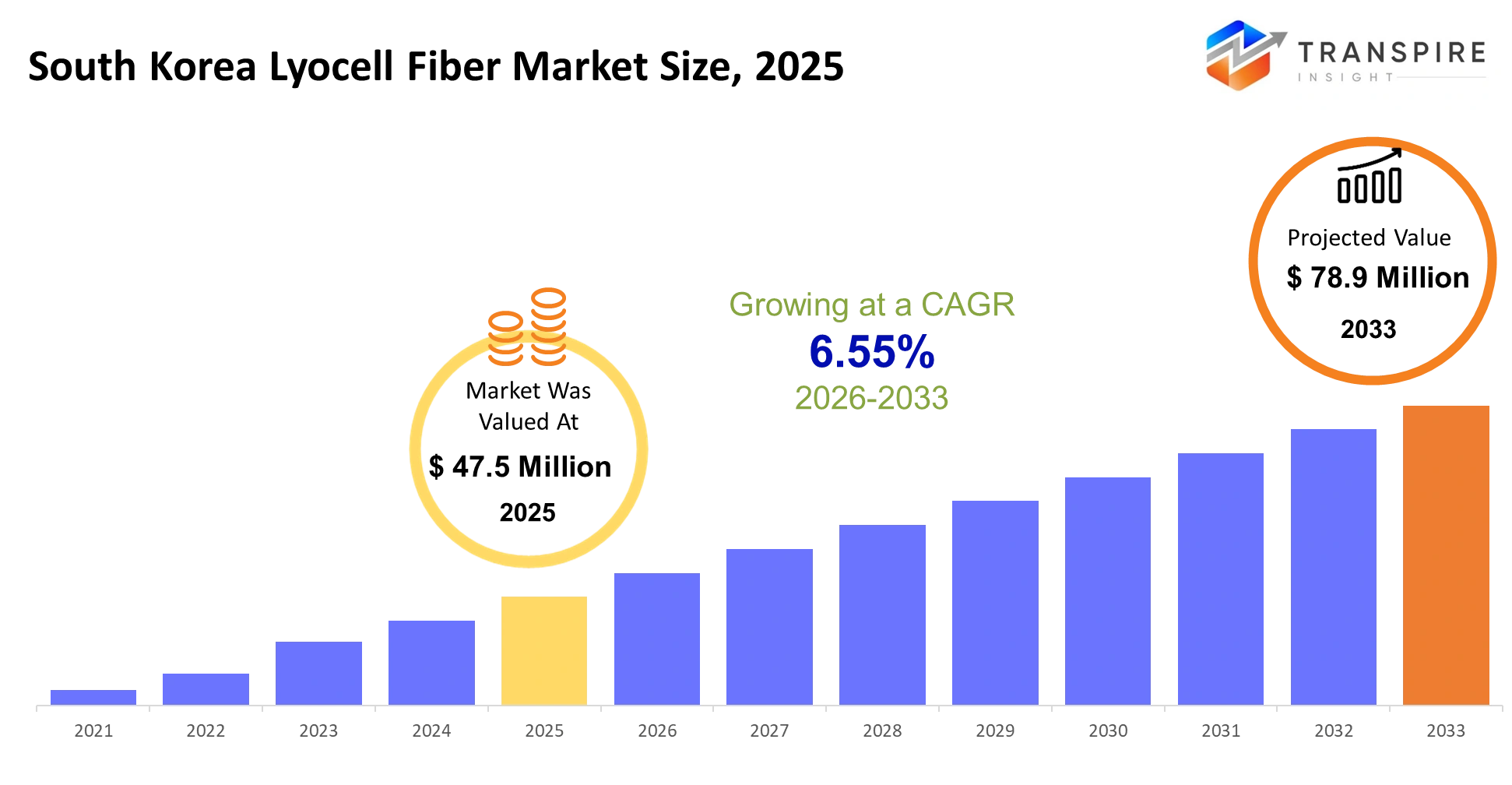
South Korea Lyocell Fiber Market Size & Forecast:
- South Korea Lyocell Fiber Market Size 2025: USD 47.5 Million
- South Korea Lyocell Fiber Market Size 2033: USD 78.9 Million
- South Korea Lyocell Fiber Market CAGR: 6.55%
- South Korea Lyocell Fiber Market Segments: By Application (Textiles, Apparel, Home Furnishings), By End-User (Textile Industry, Apparel Industry), By Form (Staple Fiber, Filament Fiber)
To learn more about this report,  Download Free Sample Report
South Korea Lyocell Fiber Market Summary:
South Korea Lyocell Fiber Market size was estimated at USD 47.5 Millionin 2025 and is anticipated to reach USD 78.9 Million by 2033, growing at a CAGR of 6.55% from 2026 to 2033.
The lyocell fiber market in South Korea operates within the nation's advanced textile and materials sector because cleaner production methods and better fabric performance have become standard practice in the industry. The study will show how local companies manage their export requirements while customers increasingly demand information about fabric origins and environmental effects.Korean customers now prefer textiles that provide softness and breathability because they support their sustainable lifestyle choices and this trend will shape their future material selection. The existing textile mills must modify their production processes to create fiber products which comply with environmental regulations that national regulatory bodies have established.
Companies will achieve more accurate production methods through their investments in closed-loop systems which include solvent recovery technologies that enable waste reduction and operational efficiency enhancements. Fashion brands and home textile manufacturers will search for fibers which can be traced back to their sources and this demand will force suppliers to implement digital systems that track products and provide certification. The market will show a gradual increase in lyocell blended with other fibers to produce fabrics designed for Korea's different seasonal weather conditions. The market will develop through these modifications because it now values dependable products which provide clear information about their material properties.
Key Market Trends & Insights:
- The South Korea Lyocell Fiber Market moves towards sustainable textile manufacturing because people now understand the importance of eco-friendly materials in both the fashion and home furniture sectors. The industry will experience continuous growth because manufacturers develop biodegradable materials while domestic brands employ environmental stewardship to market their products and choose their materials.
- The South Korea Lyocell Fiber Market meets the premium fabric needs of the market because it provides softness and breathability and durability. The market will grow because urban customers prefer high-quality textiles which will drive the development of local production facilities to decrease import dependencies.
- The South Korea Lyocell Fiber Market benefits from technological advancements which enhance fiber processing and finishing methods that produce superior texture and performance results. Companies will achieve better production results through the use of advanced manufacturing systems while lyocell blending with other fibers will enable new uses across various textile products.
- The South Korea Lyocell Fiber Market shows increasing use in medical textiles and hygiene products which belong to non-apparel industries. The market will grow because people want safe materials which do not harm their skin while regulations will promote lyocell fiber use in specialized industrial applications and healthcare uses through sustainable solutions.
- The South Korea Lyocell Fiber Market experiences supply chain changes that develop progressively while companies focus on sourcing their wood pulp raw materials through sustainable methods. The market players will enhance their relationships with certified suppliers through their production methods while maintaining operational visibility which helps them achieve international sustainability requirements.
South Korea Lyocell Fiber Market Segmentation
By Application
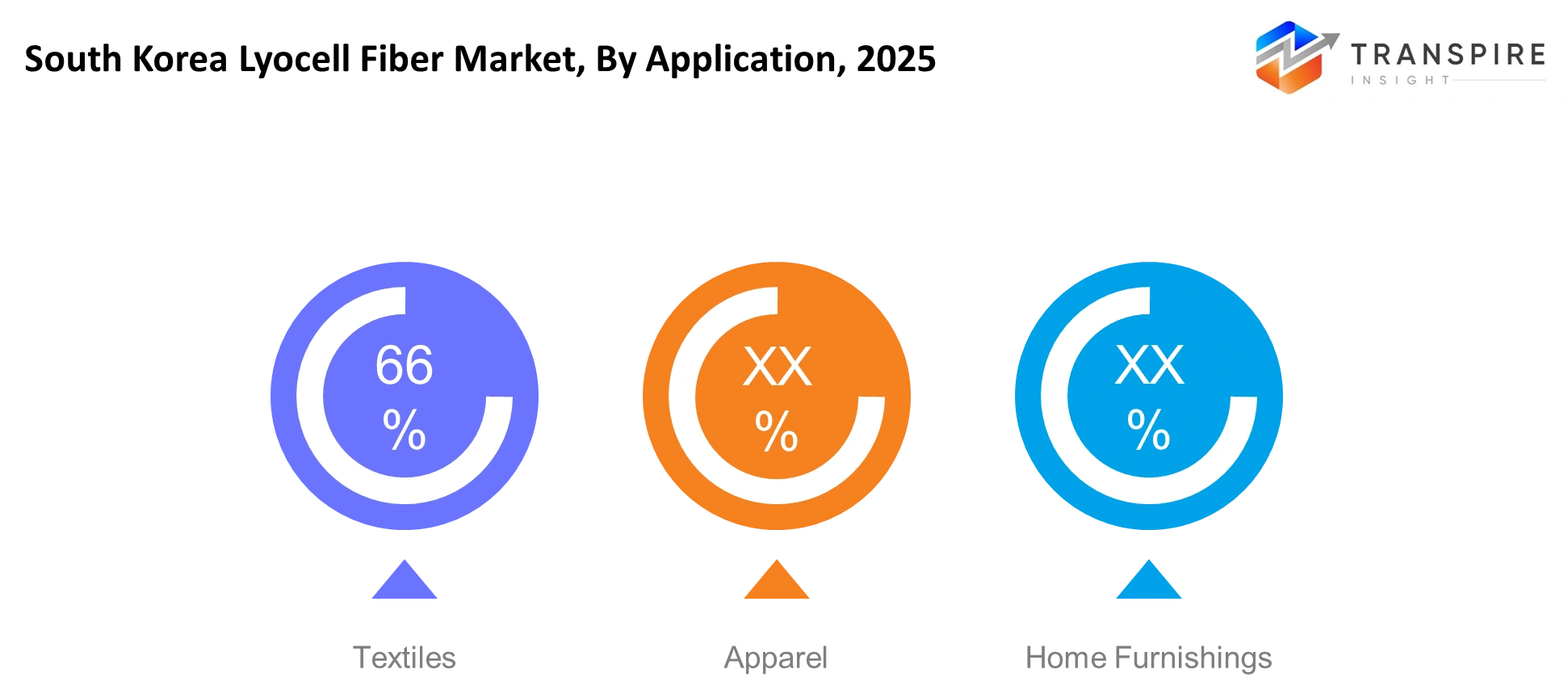
- Textiles: The South Korean Lyocell Fiber Market experiences continuous expansion because customers prefer soft and breathable textiles. The moisture control and durability of Lyocell fiber make it suitable for production of all types of textiles. Manufacturers select this fiber because it delivers constant quality and smooth texture and allows them to create fabrics with better performance through material blending.
- Apparel: The South Korean Lyocell Fiber Market in apparel displays growing demand for fashion that combines comfort with environmental sustainability. Light garments made from Lyocell fiber provide a soft texture and maintain structural integrity. Apparel brands use this fiber because it feels comfortable against the skin and creates an attractive drape which works well for casualwear and activewear and high-end fashion lines.
- Home Furnishings: The South Korean Lyocell Fiber Market in home furnishings shows a rising trend for using the material in bedsheets and curtains and upholstery. Lyocell fiber creates a smooth finish which retains its strength through multiple washing cycles. Demand grows because people want clean and durable and visually appealing furnishing materials that create comfortable and long-lasting household spaces.
To learn more about this report, Download Free Sample Report
By End-User
- Textile Industry: The South Korean textile sector has established permanent usage of Lyocell fibers because they deliver dependable fiber quality combined with straightforward processing methods. Textile manufacturers value lyocell for blending flexibility and uniform output. The production units emphasize efficiency and sustainable practices which enable them to use larger amounts of lyocell fiber throughout their textile manufacturing operations.
- Apparel Industry: The South Korean Lyocell Fiber Market establishes itself as a major force in the apparel industry because of strong demand from fashion and clothing producers. Designers now use Lyocell fiber because it provides both soft and strong material properties. Apparel companies use this fiber to fulfill evolving market demands for customer comfort and product appearance and sustainable materials, while they maintain their product quality throughout different clothing lines.
By Form
- Staple Fiber: The South Korean Lyocell Fiber market offers staple fibers which enable spinning processes used to create yarn. Cotton and polyester blending with staple fibers results in fabrics which have better strength and texture. The demand for this product remains constant because it can be used in various textile applications and it meets the needs of large-scale production across multiple fabric types.
- Filament Fiber: The South Korean Lyocell Fiber market shows rising demand for filament fibers because they support premium applications. Filament fibers provide a continuous smooth structure which improves both the aesthetic and structural performance of fabrics. The use of this material has grown within premium textiles and apparel because its fine finish and shine and durability enhance product value.
Country Insights
- The South Korea Lyocell Fiber Market displays continuous growth because textile factories produce high volumes and manufacturers increasingly use sustainable materials. The demand for sustainable fibers continues to grow because they receive more recognition in both apparel and home furnishing markets. Local manufacturers dedicate resources to develop environmentally friendly production techniques which enable them to achieve sustainable industrial growth and resource conservation.
- The South Korea Lyocell Fiber Market receives technological advantages through advanced technology adoption and maintains product consistency through its efficient supply chain system. The research institutions and manufacturers work together to develop new methods that strengthen fibers while making them softer and more durable. The expanding interest from international fashion brands boosts the country's textile export capacity which helps establish its status as a producer of premium textile products.
- The South Korea Lyocell Fiber Market shows increasing demand because consumers now prefer biodegradable fabrics which also provide skin comfort. Government policies which support green industries enable companies to expand their operations while they invest in sustainable fiber manufacturing. The rising use of medical textiles and specialty fabrics generates fresh growth opportunities which enable various industries to expand their operations.
Recent Development News
March 2026 – Expansion of lyocell production capacity in Asia (impacting South Korea supply chain)
The Austrian company Lenzing established its first Asian manufacturing plant for non-woven lyocell production by expanding its VEOCEL™ lyocell fiber operations in Thailand. The operation enables faster delivery times while enhancing supply chain strength throughout Asian textile manufacturing centers.
January 2026 – Biodegradable textile collaboration with lyocell in Asia
The textile industry developed its first biodegradable textile lining collection through a partnership with Lenzing which produced the new collection from lyocell fibers. The collection targets apparel manufacturers across all Asian markets which include South Korea. The fashion industry now needs more sustainable materials based on increasing demand from regional fashion supply chains.
|
Report Metrics |
Details |
|
Market size value in 2025 |
USD 47.5 Million |
|
Market size value in 2026 |
USD 50.6 Million |
|
Revenue forecast in 2033 |
USD 78.9 Million |
|
Growth rate |
CAGR of 6.55% from 2026 to 2033 |
|
Base year |
2025 |
|
Historical data |
2021 - 2024 |
|
Forecast period |
2026 - 2033 |
|
Report coverage |
Revenue forecast, competitive landscape, growth factors, and trends |
|
Country scope |
South Korea |
|
Key company profiled |
Lenzing AG, Birla Cellulose (Aditya Birla Group), Sateri Holdings Ltd., Tangshan Sanyou Group, Xinxiang Chemical Fiber Co. Ltd., Thai Rayon Public Company Ltd., Aditya Birla Chemicals, Eastman Chemical Company, Mitsubishi Chemical Group Corporation, Asahi Kasei Corporation, Fulida Group Holding Co. Ltd., Zhejiang Yaojiang Industrial Group, Baoding Swan Fiber Co. Ltd., Nanjing Chemical Fiber Co. Ltd., Kelheim Fibres GmbH. |
|
Customization scope |
Free report customization (country, regional & segment scope). Avail customized purchase options to meet your exact research needs. |
|
Report Segmentation |
By Application (Textiles, Apparel, Home Furnishings), By End-User (Textile Industry, Apparel Industry), By Form (Staple Fiber, Filament Fiber) |
Key South Korea Lyocell Fiber Company Insights
- The South Korean Lyocell Fiber market demonstrates equilibrium between sustainable development and industrial efficiency because companies use their production systems to meet market demands. The top manufacturers sustain their international reputation through strict manufacturing practices and environmental compliance while developing domestic textile networks.
- The South Korean Lyocell Fiber market enters a growth period because companies introduce new products and international markets drive their demand while businesses concentrate on their product excellence and operational continuity. The fashion sustainability movement directly impacts market growth because companies that produce environmentally friendly products and maintain consistent supply capabilities will continue to attract customers.
South Korea Lyocell Fiber Market Companies:
- Lenzing AG
- Birla Cellulose (Aditya Birla Group)
- Sateri Holdings Ltd.
- Tangshan Sanyou Group
- Xinxiang Chemical Fiber Co. Ltd.
- Thai Rayon Public Company Ltd.
- Aditya Birla Chemicals
- Eastman Chemical Company
- Mitsubishi Chemical Group Corporation
- Asahi Kasei Corporation
- Fulida Group Holding Co. Ltd.
- Zhejiang Yaojiang Industrial Group
- Baoding Swan Fiber Co. Ltd.
- Nanjing Chemical Fiber Co. Ltd.
- Kelheim Fibres GmbH.
South Korea Lyocell Fiber Market Segmentation
By Application
- Textiles
- Apparel
- Home Furnishings
By End-User
- Textile Industry
- Apparel Industry
By Form
- Staple Fiber
- Filament Fiber
Frequently Asked Questions
Find quick answers to common questions.
The Approximate South Korea Lyocell Fiber Market size for the Market will be USD 78.9 Million in 2033.
Key Segments for the South Korea Lyocell Fiber Market are By Application (Textiles, Apparel, Home Furnishings), By End-User (Textile Industry, Apparel Industry), By Form (Staple Fiber, Filament Fiber).
Major South Korea Lyocell Fiber Market players are Lenzing AG, Birla Cellulose (Aditya Birla Group), Sateri Holdings Ltd., Tangshan Sanyou Group, Xinxiang Chemical Fiber Co. Ltd., Thai Rayon Public Company Ltd., Aditya Birla Chemicals, Eastman Chemical Company, Mitsubishi Chemical Group Corporation, Asahi Kasei Corporation, Fulida Group Holding Co. Ltd., Zhejiang Yaojiang Industrial Group, Baoding Swan Fiber Co. Ltd., Nanjing Chemical Fiber Co. Ltd., Kelheim Fibres GmbH.
The Current South Korea Lyocell Fiber Market size is USD 47.5 Million in 2025.
The South Korea Lyocell Fiber Market CAGR is 6.55%.
- Lenzing AG
- Birla Cellulose (Aditya Birla Group)
- Sateri Holdings Ltd.
- Tangshan Sanyou Group
- Xinxiang Chemical Fiber Co. Ltd.
- Thai Rayon Public Company Ltd.
- Aditya Birla Chemicals
- Eastman Chemical Company
- Mitsubishi Chemical Group Corporation
- Asahi Kasei Corporation
- Fulida Group Holding Co. Ltd.
- Zhejiang Yaojiang Industrial Group
- Baoding Swan Fiber Co. Ltd.
- Nanjing Chemical Fiber Co. Ltd.
- Kelheim Fibres GmbH.
Recently Published Reports
-
May 2026
Healthcare Polymer Packaging Market
Healthcare Polymer Packaging Market Size, Share & Analysis Report By Packaging Type (Syringes, IV Bottles and Pouches, Clamshells, Blisters, Bottles & Jars, Containers, Tubes, IV Parental Packaging, Others), By Type (Regulated, Non-regulated), By Polymer Type (LDPE (Low-Density Polyethylene), HDPE (High-Density Polyethylene), Homo-polymer (Homo), Random Copolymer (Random), Block Copolymer (Block), PET, Polystyrene, Polyvinyl Chloride, Polyamide/EVOH, Others), and Geography (North America, Europe, Asia-Pacific, Middle East and Africa, South and Central America), 2021 - 2031
-
Apr 2026
Hydrophilic Tape (Waterstop) Market
Hydrophilic Tape (Waterstop) Market Size, Share & Analysis Report By Type (Bentonite-Based Hydrophilic Tape, Rubber-Based Hydrophilic Tape), By Application (Residential Buildings, Commercial Buildings, Infrastructure Projects), and Geography (North America, Europe, Asia-Pacific, Middle East and Africa, South and Central America), 2021 - 2031
-
Apr 2026
Metalens Market
Metalens Market Size, Share & Analysis Report By Type (Visible Light Metalens, and Infrared Metalens), By Application (Consumer Electronics, Automotive Electronics, Industrial, Medical, and Others), and Geography (North America, Europe, Asia-Pacific, Middle East and Africa, South and Central America), 2021 - 2031
-
Apr 2026
PBT Resin Market
PBT Resin Market Size, Share & Analysis Report By Type (Reinforced PBT Resin, Unreinforced PBT Resin), By Processing Method (Injection Molding, Extrusion, Blow Molding, Others), By End-User (Automotive, Electrical & Electronics, Consumer Appliances, Industrial Machinery, Medical Devices, Packaging, Others), and Geography (North America, Europe, Asia-Pacific, Middle East and Africa, South and Central America), 2021 - 2031