

Global Textile Coatings Market Size & Forecast:
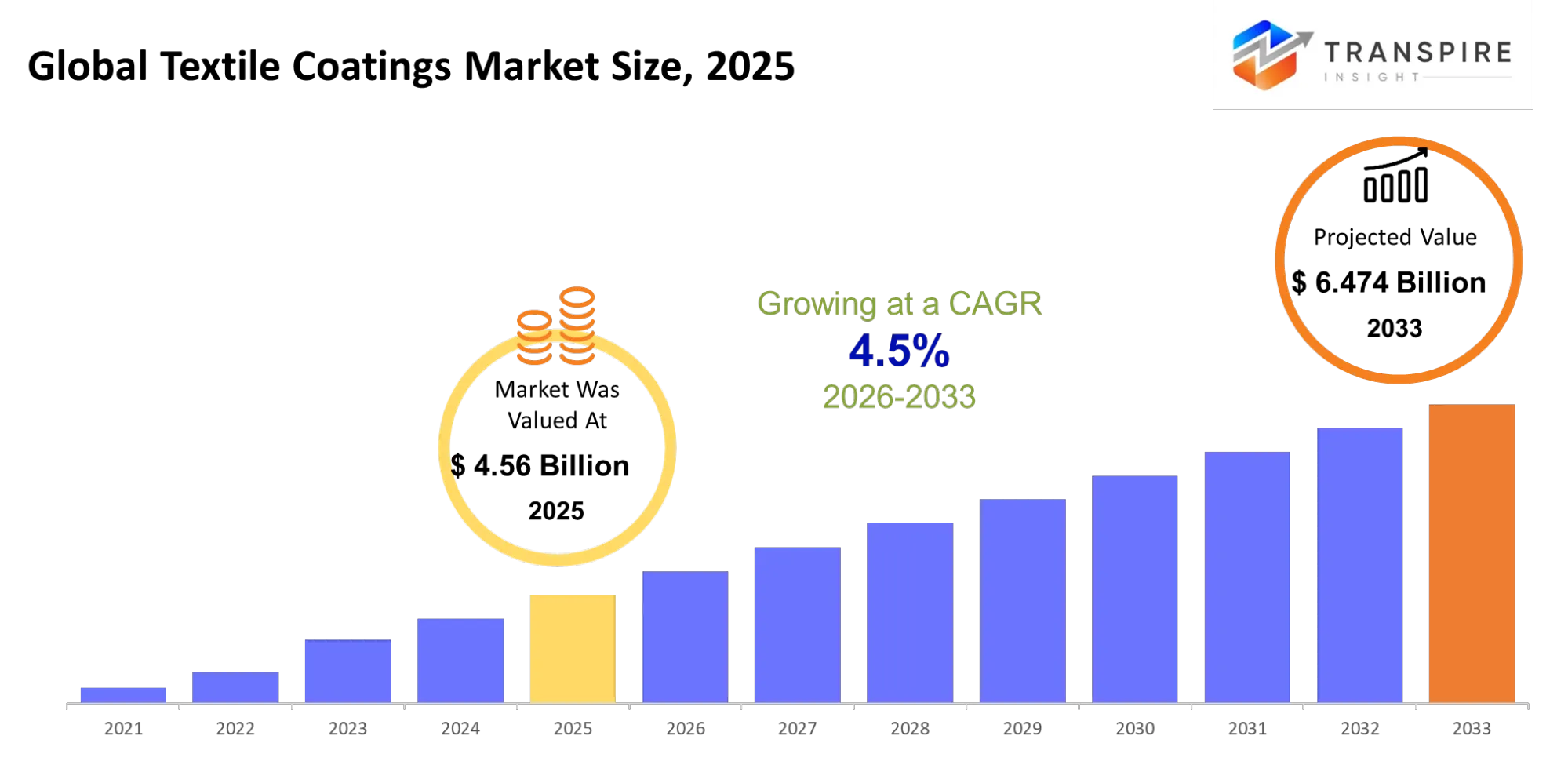
- Global Textile Coatings Market Size 2025: USD 4.56 Billion
- Global Textile Coatings Market Size 2033: USD 6.474 Billion
- Global Textile Coatings Market CAGR: 4.5% (2026–2033)
- Global Textile Coatings Market Segments: By Type (PVC Coatings, PU Coatings, Acrylic Coatings, Silicone Coatings, Fluoropolymer Coatings, Bio-based Coatings, Others); By Application (Protective Clothing, Automotive Textiles, Industrial Fabrics, Medical Textiles, Outdoor Textiles, Others); By End-User (Textile Manufacturers, Automotive OEMs, Healthcare Providers, Defense Organizations, Others); By Technology (Water-based Coatings, Solvent-based Coatings, Hot-melt Coatings, UV-curable Coatings, Others)
To learn more about this report,  Download Free Sample Report
Global Textile Coatings Market Summary
The Global Textile Coatings Market size is estimated at USD 4.56 Billion in 2025 and is anticipated to reach USD 6.474 Billion by 2033, growing at a CAGR of 4.5% from 2026 to 2033. Instead of just weaving standard yarn, this industry bonds thin, high-performance polymer layers onto raw fabrics to lock out water, stall fire, or take a serious beating. Over the last few years, processing mills have rapidly dropped old-school, toxic solvent baths to embrace cleaner water-based and plant-derived formulas. This whole shakeup comes down to tight global laws on VOC emissions that give chemical blenders no choice but to rebuild their processing lines from the ground up. In early 2026, big names like BASF and Dow poured serious capital into launching green coating plants across Asia to get ahead of these legal crackdowns. At the same time, with car companies chasing tough new materials for EV interiors and military tech pushing for lighter ballistic armor, fabric mills are snapping up these advanced coatings as fast as they can to meet demanding specs.
Key Market Insights
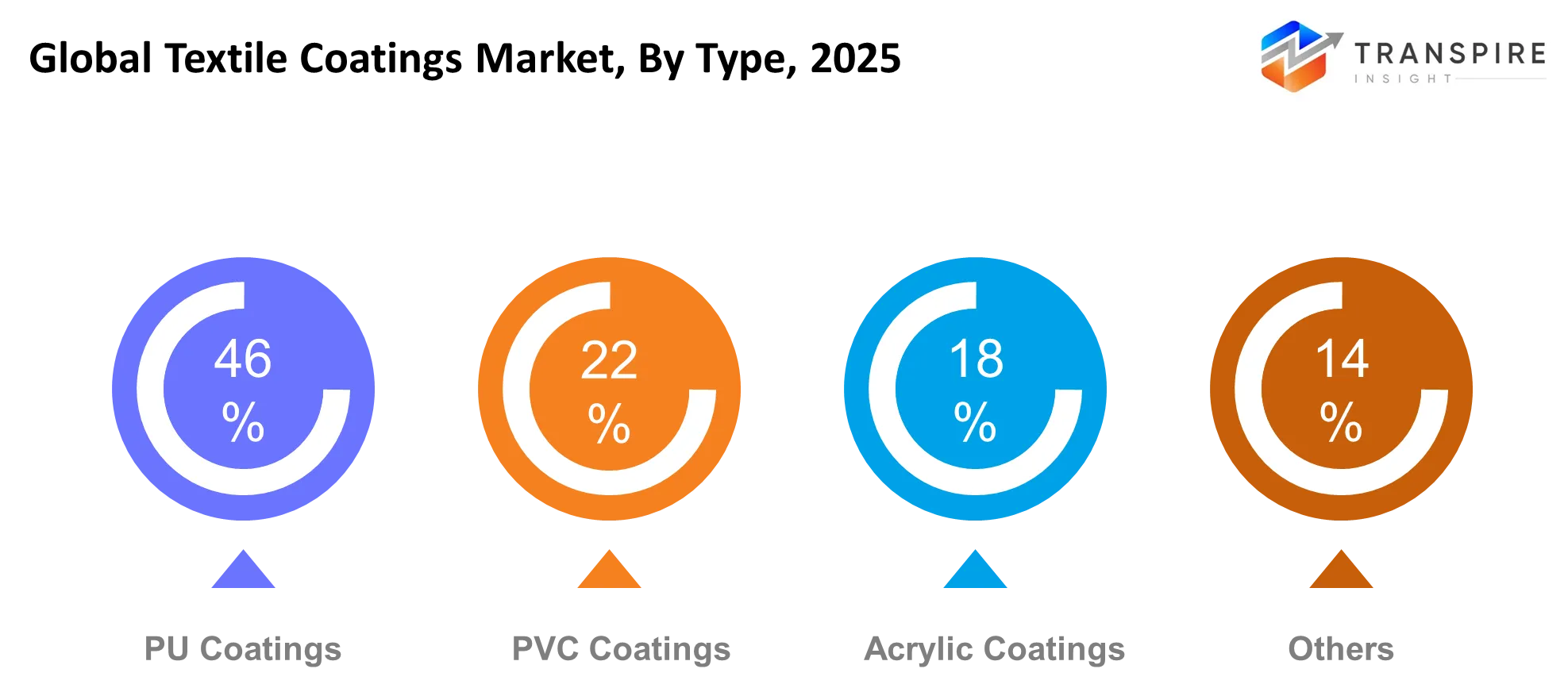
- Dominating the industry with a 46% share, PU Coatings are driving a massive technological shift toward waterborne systems, highlighted by Covestro's 2026 rollout of partially bio-based INSQIN polyurethane platforms for highly demanding technical textiles.
- Expanding rapidly at a 13.2% CAGR, Bio-based Coatings represent the most urgent technological movement in the market as mills ditch fossil feedstocks, prompting Covestro to introduce mass-balanced polymer systems that maintain extreme abrasion resistance while slashing carbon footprints.
- Controlling a massive 41% regional share, the Asia Pacific market is undergoing a structural behavioral shift toward sustainable mass production, leading BASF in 2026 to drastically expand its Zhanjiang Verbund chemical site to feed the soaring local demand for eco-friendly textile formulations.
- Holding a 27% share and accelerating at a 12.1% CAGR, Europe is enforcing strict anti-VOC mandates, which sparked a technological movement for Covestro to heavily promote its Platilon TPU films and low-VOC waterborne PU coatings at Techtextil 2026.
- Securing a 23% share, the North American sector is witnessing a major behavioral shift toward eco-engineered performance gear, prompting Dow to introduce its DOWSIL™ IE-8749 Emulsion, which eliminates toxic fluorocarbons while maintaining durable water repellency through multiple wash cycles.
- Making up a solid 22% share, legacy PVC Coatings are facing intense pressure from a technological movement toward cleaner automotive textiles, pushing formulators like Lubrizol to engineer advanced water-borne seat coatings that easily pass rigorous modern flame retardancy and anti-fogging tests.
- Representing 18% of the market, Acrylic Coatings and similar polymer finishes are experiencing a behavioral shift toward consumer comfort, leading Dow to launch advanced silicone polymers that provide a softer hand-feel for durable fabrics without relying on regular heat treatments.
- Encompassing the remaining 14% share in specialized coatings, there is a radical technological shift toward smart protective clothing, perfectly demonstrated by Covestro's 2026 development of TPU film substrates that allow for the seamless integration of flexible printed electronics and electroluminescent lighting.
What are the Key Drivers, Restraints, and Opportunities in the Global Textile Coatings Market?
Driver:
Strict rules demanding tough, fire-retardant, and waterproof protective fabrics across industrial sites and auto plants are pushing this market forward. The shift gained steam as rising ESG targets and state-backed production plans forced a move toward long-lasting, eco-conscious materials. This has fast-tracked the switch to premium, high-margin functional layers over cheap, basic fabrics.
In April 2026, the Indian government greenlit 52 new applications under Round III of its PLI Scheme for Textiles, throwing massive weight behind technical textile production and triggering a major spike in the procurement of advanced coating formulas. [https://www.pib.gov.in/PressReleasePage.aspx?PRID=2250951]
Restraint:
The biggest roadblock in the market is the massive pile of cash required to swap out legacy solvent-based coating setups for modern machinery that can process water-borne and plant-based formulas. This remains a tough structural hurdle because mid-sized fabric mills simply can't absorb these heavy upfront retrofit costs while battling volatile price swings for raw polymers and synthetic fibers. Consequently, a huge chunk of the global supply chain remains stuck on the sidelines with outdated machinery.
Opportunity:
A massive future shift lies in the commercialization of smart, conductive coatings and antimicrobial nano-coatings for the healthcare and defense sectors. For example, investing heavily in flexible printed electronics seamlessly embedded within polyurethane-coated protective clothing allows manufacturers to capture premium, high-margin contracts from advanced military and medical procurement networks.
What Has the Impact of Artificial Intelligence Been on the Global Textile Coatings Market?
Textile mills are rapidly replacing manual formulation vats with automated, data-driven production lines. Instead of relying on a technician's intuition or running endless trial-and-error batches, chemical blenders use machine learning algorithms to calculate intricate polymer ratios, lock in exact machine speeds, and maintain tight quality control right on the shop floor.
This predictive approach dramatically cuts down product development timelines. Rather than wasting weeks on physical tests, algorithms scan historical batch records to forecast exactly how a new water-borne or bio-based coating will handle extreme physical stress. On the operational front, smart computer vision setups track high-speed coating lines around the clock. These systems automatically tweak roller pressure, curing heat, and chemical flow rates on the fly to guarantee a uniform surface finish, preventing raw material waste before a bad batch can ruin an entire roll of fabric.
The main bottleneck remains the steep upfront investment and equipment compatibility. Retrofitting older, analog coating machinery with advanced AI sensors and digital infrastructure is simply too expensive and technically complex for mid-sized textile mills to execute smoothly.
Throughout 2026, technology companies like Smartex.ai have been installing AI-driven camera systems directly onto active production lines to detect fabric and coating flaws instantly, reducing scrap material and sharpening quality control. [https://www.screenprintindia.com/ai-in-textile-market-size-to-worth-usd-68-44-billion-by-2035-report/]
Key Market Trends:
- Factories are abandoning legacy chemical baths. Tightening pollution crackdowns mean mills must switch to clean, waterborne polyurethanes if they want to keep operating.
- Crude oil feedstocks are losing ground. Material formulators are gradually shifting to plant-based bio-resins that keep fabrics rugged without spiking carbon footprints.
- Outdoor and technical apparel brands are completely purging fluorinated chemicals. They are adopting modern, fluorine-free repellents to dodge increasingly heavy environmental fines.
- Passive fabric sheets are no longer enough for engineering teams. Instead, they are embedding conductive inks and flexible sensors straight into TPU films to track vitals on the move.
- Industrial coaters are actively replacing virgin polymers. Chemical bases made from recycled plastics are now preferred to hit aggressive corporate sustainability targets.
- Slow, manual eye checks on fast assembly lines are disappearing. Mill managers are deploying smart camera networks to catch tiny coating micro-flaws before rolls are wrapped.
- Defense suppliers are phasing out thick, rigid body armor shells. They now opt for ultra-light, flexible polymer layers that stop fragments without slowing down soldiers.
- Healthcare buyers are rejecting basic disposable sheets. They are demanding advanced antimicrobial coatings that won't degrade or warp during intense, high-heat sterilization.
Global Textile Coatings Market Segmentation
By Type
PU Coatings easily hold the top market position by type, commanding a dominant share because they provide the baseline flexibility and wear resistance needed for modern technical apparel. Right behind them, Bio-based Coatings are expanding the fastest. The growth logic here is split: classic PVC and acrylic formulations generate steady revenue through sheer industrial volume, while bio-resins are surging because technical brands need to swap out fossil fuels without losing rugged performance. Looking forward, the lines between these categories will shift dramatically. As global bans on toxic solvents and PFAS tighten, manufacturers will be forced to phase out traditional fluoropolymer and solvent-heavy formulas, making clean waterborne polyurethanes and plant-derived alternatives the absolute industry standard.
To learn more about this report, Download Free Sample Report
By Application
Automotive Textiles and Protective Clothing completely anchor this segment, processing the vast majority of coating volume. The unique growth logic is tied straight to strict safety mandates and the EV boom; electric vehicle cabins require ultra-low-emission materials that lower cabin noise, while industrial workwear demands durable fire and water resistance. On the flip side, Medical Textiles and Outdoor Fabrics represent fast-growing, high-margin niches where performance matters far more than bulk. Ultimately, the application landscape will split. Heavy industrial fabrics will continue demanding massive shipments of standard durable barriers, while the high-tech apparel and healthcare sectors will force coaters to develop advanced antimicrobial and breathable layers that can survive intense, high-heat sterilization cycles.
By End-User
Textile Manufacturers and Automotive OEMs are the heavyweight buyers here, essentially dictating the chemical supply chain terms for everyone else. Defense Organizations and Healthcare Providers pull steady, high-margin numbers, but massive mills drive the actual market structure. Their unique growth logic comes straight from the corporate sustainability transition; as global brands face intense pressure to hit green benchmarks, they force coaters to completely reformulate their lines. The biggest future implication is how these products are developed. Rather than buying standard off-the-shelf formulas, massive end-users will require highly tailored, custom polymer variations engineered to work flawlessly with their specific automated production setups.
By Technology
Water-based formulations are rapidly capturing the market's top spot, steadily forcing out old-school, solvent-heavy systems. At the same time, hot-melt and UV-curable setups are emerging as the fast-moving tech pockets of the industry. The driving logic here comes down to regulatory survival. Factories have no choice but to adopt waterborne chemistry if they want to stay operational as global VOC limits tighten. Looking ahead, this technological swap will permanently reshape factory floors. Heavy thermal drying ovens, which burn massive amounts of energy just to bake off chemical solvents, are headed for retirement. In their place, rapid UV-curing lines and advanced moisture-curing setups are rolling in to cut both emissions and plant overhead.
What are the Key Use Cases Driving the Global Textile Coatings Market?
Car manufacturers apply polyurethane formulations directly onto interior seating, door panels, and airbag materials. This thin chemical barrier provides the extreme scrape resistance and stain protection needed to survive years of passenger friction while helping dampen road noise.
Outside the automotive world, heavy industrial operations require these specialty treatments to build rugged protective workwear. Processing mills back uniform fabrics with thick, fire-retardant layers, shielding refinery and foundry crews from sudden thermal flashes or hazardous chemical splashes on the job.
Healthcare settings represent a newer frontier, adopting medical textiles treated with antimicrobial nano-coatings. These formulas block bacterial growth on hospital gowns and surgical drapes without peeling or breaking down during intense, high-heat sterilization cycles.
|
Report Metrics |
Details |
|
Market size value in 2025 |
USD 4.56 Billion |
|
Market size value in 2026 |
USD 4.756 Billion |
|
Revenue forecast in 2033 |
USD 6.474 Billion |
|
Growth rate |
CAGR of 4.5% from 2026 to 2033 |
|
Base year |
2025 |
|
Historical data |
2022 - 2024 |
|
Forecast period |
2026 - 2033 |
|
Report coverage |
Revenue forecast, competitive landscape, market shares, growth factors, and trends |
|
Regional scope |
United States; Canada; Mexico; United Kingdom; Germany; France; Italy; Spain; Denmark; Sweden; Norway; China; Japan; India; Australia; South Korea; Thailand; Brazil; Argentina; South Africa; Saudi Arabia; United Arab Emirates |
|
Key companies profiled |
Covestro, BASF, Huntsman, Solvay, DuPont, Archroma, Rudolf Group, Dow, Evonik, Wacker Chemie, Lubrizol, Clariant, Tanatex Chemicals, Kisco, OMNOVA Solutions |
|
Customization scope |
Free report customization (country, regional & segment scope). Avail customized purchase options to meet your exact research needs. |
|
Report Segmentation |
By Type (PVC Coatings, PU Coatings, Acrylic Coatings, Silicone Coatings, Fluoropolymer Coatings, Bio-based Coatings, Others); By Application (Protective Clothing, Automotive Textiles, Industrial Fabrics, Medical Textiles, Outdoor Textiles, Others); By End-User (Textile Manufacturers, Automotive OEMs, Healthcare Providers, Defense Organizations, Others); By Technology (Water-based Coatings, Solvent-based Coatings, Hot-melt Coatings, UV-curable Coatings, Others) |
Which Regions are Driving the Global Textile Coatings Market Growth?
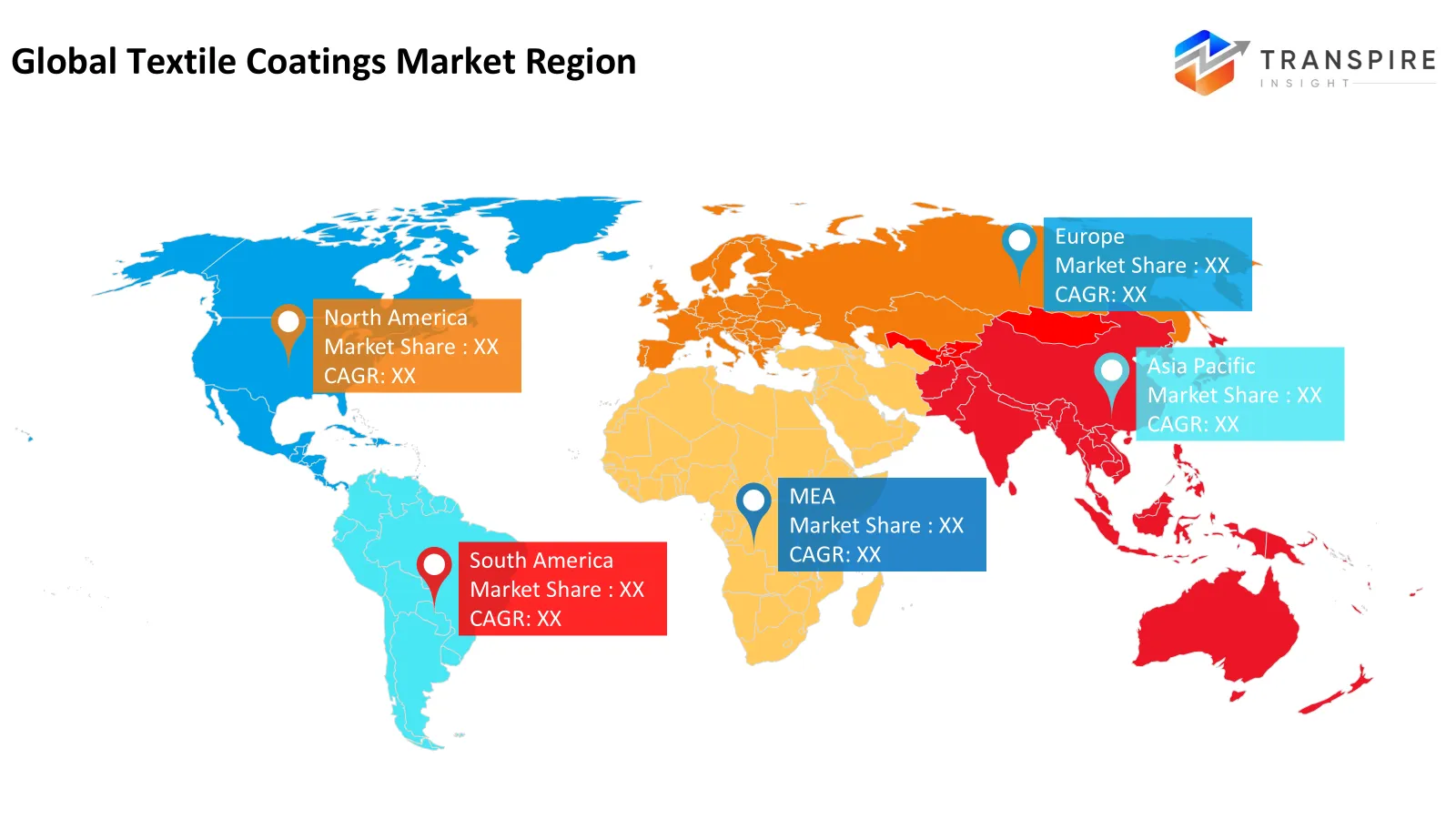
Asia Pacific commands the global landscape by holding a dominant 41% share of total market revenue. This heavy footprint relies on an expansive network of high-capacity textile mills, integrated raw material logistics, and massive industrial infrastructure. Soaring domestic demand for passenger cars and technical apparel ensures that regional factories keep their treatment lines running at maximum speed. Ultimately, the relentless expansion of automotive production across key manufacturing hubs provides a highly predictable, high-volume pipeline for volume-driven polymer suppliers.
North America secures a highly stable 23% of the industry's overall value through specialized applications. The region bypasses mass-market apparel to focus almost entirely on high-margin fields like defense aerospace, medical textiles, and freight logistics. Rigid workplace safety laws combined with strict government procurement guidelines protect local coaters from sudden retail shifts or economic downturns. This entrenched structural support guarantees a steady, multi-year demand for technical fabrics engineered to endure harsh chemical and physical stress. In February 2026, chemical formulator Sun Chemical expanded its production footprint in Delaware through a $10 million facility investment, optimizing North American raw material outputs for heavy-duty pigment and polymer production meant for advanced technical and industrial coatings.
Europe has emerged as the fastest-growing geographical market, expanding at an aggressive 12.1% CAGR to capture 27% of total value. This sudden acceleration stems from a total regulatory shakeup rather than basic volume gains, as strict continent-wide restrictions on toxic chemical compounds force processing mills to abandon legacy formulas. The immediate push for environmental compliance opens a massive commercial window for advanced chemical suppliers who can deliver scalable, eco-safe polymers. Consequently, regional finishing plants are rapidly retrofitting their equipment to stay competitive under sharpening carbon limits. In April 2026, Daikin Chemical Europe launched its expanded portfolio of fluorine-free, hydrocarbon-based water repellents at the Techtextil trade fair in Frankfurt, directly addressing incoming European regulatory bans and providing regional finishing mills with immediate, eco-compliant alternatives.
To learn more about this report, Download Free Sample Report
Who are the Key Players in the Global Textile Coatings Market and how do they Compete?
Strict environmental mandates and a massive push for sustainable chemistry are entirely rewriting how textile coating suppliers compete. Traditional price wars are essentially dead. Today, the actual battlefront revolves around chemical compliance, as companies aggressively purge hazardous solvents and banned fluorinated chemicals from their legacy formulas simply to stay ahead of upcoming regulatory bans.
Covestro is confronting this industry pivot by centering its commercial strategy on its INSQIN waterborne polyurethanes and plant-derived bio-resins. Their development teams refuse to stop at basic environmental compliance. Instead, they formulate specialized coatings that maintain heavy-duty scrape protection and excellent fabric give while completely eliminating volatile organic compounds from the mix. Meeting the resulting surge in orders has meant pouring capital into expanding factory outputs throughout Europe and Asia. This aggressive scaling secures their role as a direct, bulk supplier for technical garment brands requiring strict, independent eco-certifications.
Huntsman carves out its market share by executing a targeted, technical niche strategy focused entirely on high-stress environments like aerospace cockpits, automotive cabins, and protective military gear. Their core competitive edge lies in formulating specialized chemical barriers that maintain absolute flame retardancy under punishing operational conditions. Expanding their global footprint has meant leaning heavily on joint ventures and building dedicated technical facilities right next to major industrial manufacturing zones. Operating these regional hubs lets their chemical engineers ship custom-tailored polymer variations straight to localized plants on demand.
Global Textile Coatings Market Companies
- Covestro
- BASF
- Huntsman
- Solvay
- DuPont
- Archroma
- Rudolf Group
- Dow
- Evonik
- Wacker Chemie
- Lubrizol
- Clariant
- Tanatex Chemicals
- Kisco
- OMNOVA Solutions
Recent Development News
In March 2026, Tata Chemicals finalized its buyout of Novabay Pte. Ltd. Snagging this entity hands the manufacturer an immediate anchor point in international specialized chemicals, allowing them to tap directly into high-value raw material streams. [https://textileinsights.in
In April 2026, Covestro rolled out its newly integrated Pontacol thermoplastic film line alongside fresh textile coating polymers at the Techtextil trade fair. Combining these tech portfolios grants finishing mills instant access to durable, hot-melt bonding solutions that altogether eliminate traditional wet chemistry steps. [https://www.covestro.com
In December 2025, Fineotex Chemical Limited bought out Texas-based CrudeChem Technologies Group. Bringing this plant into the fold lets the firm generate advanced industrial formulas directly on North American soil rather than counting on long, cross-border shipping lanes. [https://fineotex.com/news/
What Strategic Insights Define the Future of the Global Textile Coatings Market?
The Global Textile Coatings Market is rapidly pivoting toward extreme material circularity and closed-loop chemical processing. While most manufacturers scramble for surface-level green compliance, an overlooked hidden risk lies in the looming global supply chain bottleneck for bio-based chemical blocks; escalating competition with the aviation biofuel sector could trigger severe feedstock shortages by the decade's end. Conversely, a highly lucrative opportunity is emerging in engineering conductive, graphene-infused smart coatings for real-time biometric data tracking in military and clinical textiles. Capitalizing on this shifting landscape requires players to aggressively transition away from standard multi-layered materials toward mono-material polyurethanes that allow for flawless post-consumer recycling. Forging direct, long-term sourcing partnerships with agricultural waste processors will successfully insulate raw material pipelines from volatile petrochemical pricing shocks.
Global Textile Coatings Market Segmentation
By Type
- PVC Coatings
- PU Coatings
- Acrylic Coatings
- Silicone Coatings
- Fluoropolymer Coatings
- Bio-based Coatings
- Others
By Application
- Protective Clothing
- Automotive Textiles
- Industrial Fabrics
- Medical Textiles
- Outdoor Textiles
- Others
By End-User
- Textile Manufacturers
- Automotive OEMs
- Healthcare Providers
- Defense Organizations
- Others
By Technology
- Water-based Coatings
- Solvent-based Coatings
- Hot-melt Coatings
- UV-curable Coatings
- Others
Regional Outlook
North America
- United States
- Canada
- Mexico
Europe
- Germany
- United Kingdom
- France
- Spain
- Italy
- Rest of Europe
Asia Pacific
- Japan
- China
- Australia & New Zealand
- South Korea
- India
- Rest of Asia Pacific
South America
- Brazil
- Argentina
- Rest of South America
Middle East & Africa
- Saudi Arabia
- United Arab Emirates
- South Africa
- Rest of the Middle East
Frequently Asked Questions
Find quick answers to common questions.
The global textile coatings market size was valued at USD 4.56 Billion in 2025 and is poised to reach USD 6.474 Billion by 2033, expanding at a 4.5% CAGR.
Key segments for the global textile coatings market are Type (PVC Coatings, PU Coatings, Acrylic Coatings, Silicone Coatings, Fluoropolymer Coatings, Bio-based Coatings, Others), Application (Protective Clothing, Automotive Textiles, Industrial Fabrics, Medical Textiles, Outdoor Textiles, Others), End-User (Textile Manufacturers, Automotive OEMs, Healthcare Providers, Defense Organizations, Others), and Technology (Water-based Coatings, Solvent-based Coatings, Hot-melt Coatings, UV-curable Coatings, Others).
Accelerating automotive assembly lines require highly durable interior surfaces, while massive military upgrade programs demand advanced fire-resistant apparel. Simultaneously, sharpening global environmental policies are forcing mills to rapidly ditch toxic solvent-based systems in favor of clean, waterborne alternatives.
The global market is led by major manufacturers including Covestro, BASF, Huntsman, Solvay, DuPont, Archroma, Rudolf Group, Dow, Evonik, Wacker Chemie, Lubrizol, Clariant, Tanatex Chemicals, Kisco, and OMNOVA Solutions.
Asia Pacific controls a massive 41% of global market revenue. This baseline dominance is sustained by an immense concentration of high-output commercial mills, tightly bound chemical supply chains, and booming local automotive factories that keep regional polymer production running at peak capacity.
Excellent profit margins are emerging in engineering graphene-infused, conductive layers for real-time biometric tracking arrays in specialized field apparel. Furthermore, converting standard manufacturing processes to handle mono-material polyurethanes opens a major commercial pathway for brands focused on infinite chemical recycling.
- Covestro
- BASF
- Huntsman
- Solvay
- DuPont
- Archroma
- Rudolf Group
- Dow
- Evonik
- Wacker Chemie
- Lubrizol
- Clariant
- Tanatex Chemicals
- Kisco
- OMNOVA Solutions
About the Authors

Pankaj Ghogare Patil
I am Pankaj Ghogare Patil, a Senior Research Analyst at Transpire Insight, specializing in the Pharmaceutical, Chemicals & Materials, Healthcare IT, and Biotechnology industry. My expertise lies in conducting comprehensive market research, analyzing industry trends, evaluating competitive landscapes, and translating complex data into actionable insights. At Transpire Insight, I closely follow emerging technologies, regulatory developments, and market innovations to create accurate, well-researched, and informative content that helps businesses and professionals make informed decisions. I am committed to producing credible, evidence-based articles that reflect industry best practices while making technical topics accessible and valuable for a broad audience.

Chakradhar Khansole
Chakradhar serves as the Research Director at Transpire Insight, bringing over 8 years of experience in technology, innovation, and strategic market intelligence. He specializes in transforming complex market data into actionable business insights that enable organizations to make informed, growth-oriented decisions. Recognized for his strategic vision and analytical expertise, Chakradhar leads high-impact research initiatives, delivering comprehensive market assessments, competitive intelligence, and forward-looking industry analysis.
Recently Published Reports
-
May 2026
Healthcare Polymer Packaging Market
Healthcare Polymer Packaging Market Size, Share & Analysis Report By Packaging Type (Syringes, IV Bottles and Pouches, Clamshells, Blisters, Bottles & Jars, Containers, Tubes, IV Parental Packaging, Others), By Type (Regulated, Non-regulated), By Polymer Type (LDPE (Low-Density Polyethylene), HDPE (High-Density Polyethylene), Homo-polymer (Homo), Random Copolymer (Random), Block Copolymer (Block), PET, Polystyrene, Polyvinyl Chloride, Polyamide/EVOH, Others), and Geography (North America, Europe, Asia-Pacific, Middle East and Africa, South and Central America), 2021 - 2031
-
Apr 2026
Hydrophilic Tape (Waterstop) Market
Hydrophilic Tape (Waterstop) Market Size, Share & Analysis Report By Type (Bentonite-Based Hydrophilic Tape, Rubber-Based Hydrophilic Tape), By Application (Residential Buildings, Commercial Buildings, Infrastructure Projects), and Geography (North America, Europe, Asia-Pacific, Middle East and Africa, South and Central America), 2021 - 2031
-
Apr 2026
Metalens Market
Metalens Market Size, Share & Analysis Report By Type (Visible Light Metalens, and Infrared Metalens), By Application (Consumer Electronics, Automotive Electronics, Industrial, Medical, and Others), and Geography (North America, Europe, Asia-Pacific, Middle East and Africa, South and Central America), 2021 - 2031
-
Apr 2026
PBT Resin Market
PBT Resin Market Size, Share & Analysis Report By Type (Reinforced PBT Resin, Unreinforced PBT Resin), By Processing Method (Injection Molding, Extrusion, Blow Molding, Others), By End-User (Automotive, Electrical & Electronics, Consumer Appliances, Industrial Machinery, Medical Devices, Packaging, Others), and Geography (North America, Europe, Asia-Pacific, Middle East and Africa, South and Central America), 2021 - 2031