
South Korea Acrylic Resins Market Size & Forecast:
- South Korea Acrylic Resins Market Size 2025: USD 2.1 Billion
- South Korea Acrylic Resins Market Size 2033: USD 4.4 Billion
- South Korea Acrylic Resins Market CAGR: 9.71%
- South Korea Acrylic Resins Market Segments: By Type (Thermoplastic Acrylic Resins, Thermosetting Acrylic Resins, Water-based Acrylic Resins, Solvent-based Acrylic Resins, Others); By Application (Paints & Coatings, Adhesives & Sealants, Plastics, Textiles, Others); By End User (Construction Industry, Automotive Industry, Electronics Industry, Packaging Industry, Others); By Form (Liquid Resins, Powder Resins, Emulsion Resins, Others)
To learn more about this report,  Download Free Sample Report
South Korea Acrylic Resins Market Summary
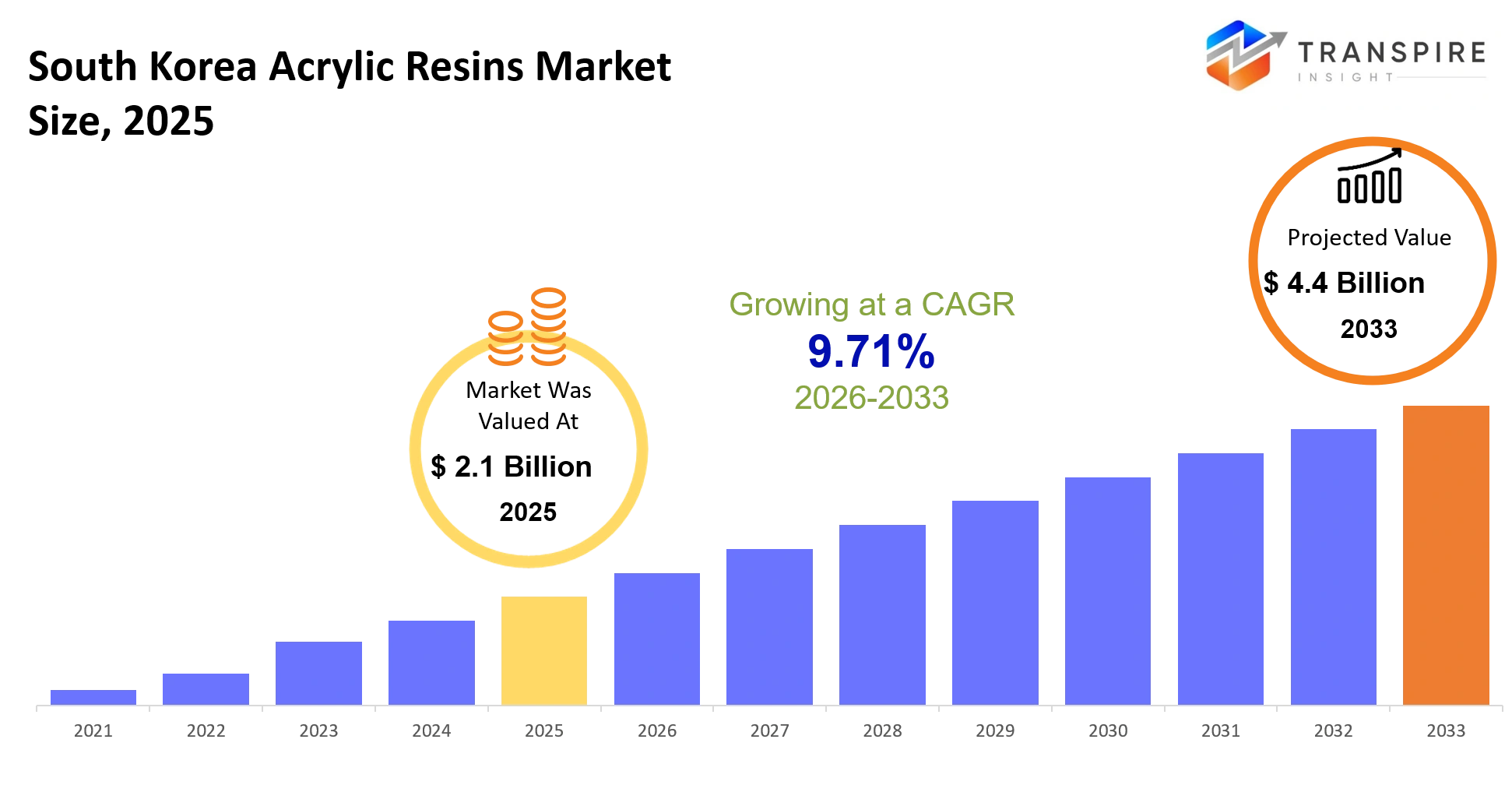
The South Korea Acrylic Resins Market was valued at USD 2.1 billion in 2025. It is forecast to reach USD 4.4 billion by 2033. That is a CAGR of 9.71% over the period.
Acrylic resins play a critical role in South Korea’s industrial ecosystem, kind of quietly but really important, because they give durability, weather resistance, grip, and that kind of surface cover for coatings, paints adhesives, construction materials, and automotive parts. Without them, manufacturers can’t easily stretch product life, keep a cleaner look, or hit the exact performance targets needed for tough real world industrial use.
In the last three to five years, the market has started shifting in a more noticeable way toward water based and low VOC acrylic resin technologies. This kind of thing happened when companies try to sort of respond to stricter environmental rules and sustainability targets. At the very same time, COVID 19 pandemic disruptions, plus the ups and downs in global petrochemical feedstock markets, mostly sort of showed weak spots in how the raw materials are gathered. So the producers ended up rethinking sourcing , adding more suppliers, and putting money into local production, to cut down the risk.
Right now, the market is growing because several demand drivers stack together, especially electric vehicle manufacturing, advanced electronics production, and infrastructure modernization projects. End users want coatings and adhesives that perform better, but also stay within environmental regulations, so the direction is moving toward premium acrylic resin formulations. That change doesn’t just push higher value products, it also encourages new ideas and opens up fresh revenue pathways for resin suppliers both inside and outside South Korea.
Key Market Insights
- The Seoul Capital Area seems to dominate the South Korea Acrylic Resins Market, taking up something like 45% of total industry revenue in 2025, or close enough. Gyeonggi Province also has a pretty solid stake because it’s packed with automotive, electronics, and chemical manufacturing facilities. Then there is Ulsan, which looks like the fastest-moving regional market through 2032, mainly pushed by petrochemical investments and those ongoing industrial expansion projects.
- On top of that, Southeastern industrial clusters keep pulling in strategic growth plans from resin manufacturers and also from downstream coating producers. In terms of resin type, water-based acrylic resins are leading the South Korea Acrylic Resins Market , with an estimated 38% market share in 2025. Meanwhile, solvent-based acrylic resins stay as the second-largest group, because their performance needs fit industrial and protective coatings rather well.
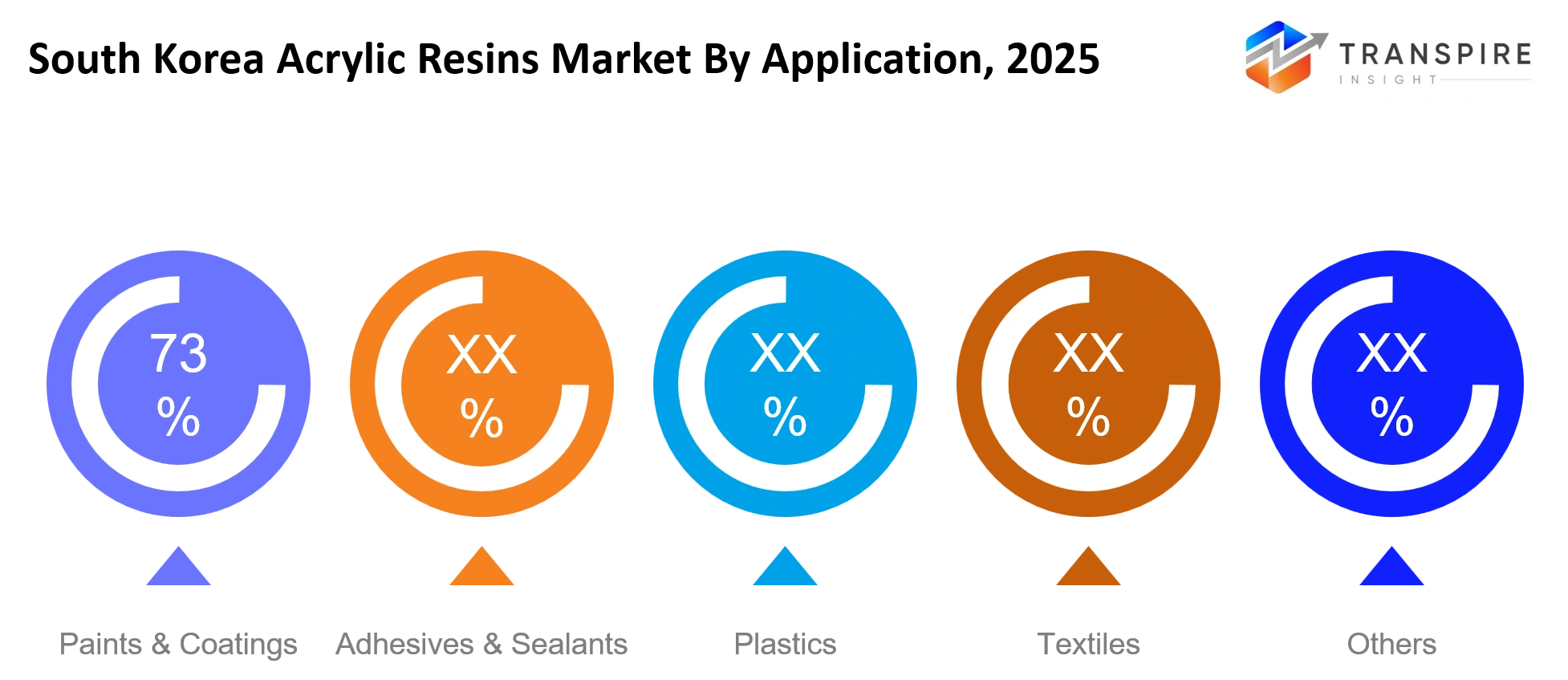
- UV-curable acrylic resins are the segment that’s growing quickest during 2025–2032, backed by electronics and specialty coating uses that keep showing up more often. At the same time, demand for low-VOC and environmentally compliant resin technologies is still reshaping product development strategies in a very noticeable way. When you take a look at apps, paints and coatings, they pretty much gobble up around 50% of all acrylic resin, so yeah it stays the dominant use category.
- Industrial protective coatings also keep a meaningful slice, mostly because of the constant infrastructure upkeep and manufacturing demands, even if that share shifts by location. Adhesives and sealants are projected to be the fastest-growing application category all the way through 2032, fueled by electronics and construction activity.
- . Finally, advanced coating technologies are gaining traction across automotive, and consumer electronics manufacturing , where switching to newer systems feels like it happens more frequently.
- Construction sector basically leads the market with something like 35% share , it’s mostly backed by residential and commercial infrastructure projects.
- Automotive manufacturing stays as the second biggest end user segment because the use of durable coating systems is going up.
- Electronics and semiconductor industries are showing up as the fastest-growing end user category during the forecast window, more or less.
- High performance materials are getting pretty decent adoption in precision manufacturing and for advanced industrial applications too.
What are the Key Drivers, Restraints, and Opportunities in the South Korea Acrylic Resins Market?
- Driver: The strongest growth driver in the South Korea Acrylic Resins Market is kind of this shift toward water based, and low VOC coating technologies across automotive, construction, and industrial production lines. It seems buyers want more eco-friendly coatings and a cleaner manufacturing approach, so demand keeps moving in that direction, quietly but steadily.. The change got a push from stricter environmental rules, especially those covering solvent emissions and indoor workplace air quality, not just outdoor pollution. So as makers swap out older solvent based blends, they look for higher grade acrylic resins that still manage durability, hold, and weather protection. In practice, this has boosted the worth of specialty resin products and opened up fresh revenue lanes for suppliers who can deliver high performance, compliant formulations. The end result is a more solid uptake across coatings, adhesives, and protective surface uses.
- Restraint: Still, volatility in petrochemical feedstock pricing is probably the biggest structural headache the market faces. Acrylic resins lean heavily on raw materials sourced from crude oil and petrochemical processing. When global supply gets hit, plus energy costs swing, and geopolitical uncertainty keeps rising, input costs get dragged around with it. Since resin producers can’t really rework production routes or pivot away from key feedstocks quickly, margin pressure keeps showing up all along the value chain. This kind of instability also tends to slow down buying choices and reduces the appetite for investment in new product development, which in turn, dampens the possible market revenue.
- Opportunity: A big future chance seems to be showing up in South Korea as it keeps expanding its electric vehicle and semiconductor manufacturing. That whole space needs advanced coatings , encapsulants, and specialty materials with really strong performance traits. When companies put money into next-gen battery facilities and semiconductor fabrication lines, it kind of quietly makes the outlook better for high-value acrylic resin usage . Basically, the suppliers who can craft specialized formulations for thermal management, protective coatings, and even precision electronics will probably grab a bigger piece of the premium industrial demand over the next ten years . Also, it’s like the whole thing helps acrylic resin feel more like a necessary material, not just some add-on.
What Has the Impact of Artificial Intelligence Been on the South Korea Acrylic Resins Market?
In South Korea, Artificial intelligence together with newer digital technologies is quietly changing how acrylic resin is made. The big shift seems to be better process control, smoother production output, and steadier product quality. Several major chemical producers are rolling out AI driven monitoring setups, they keep watch on what’s happening inside reactors, temperature trends, pressure levels, and even how fast raw materials are being used. This kind of automation lets plant teams keep the resin characteristics more consistent, while also cutting down on process slipping and material waste.
At the same time machine learning is getting used for predictive maintenance of key machinery reactors, pumps, compressors and even mixing systems. Rather than sitting around until something breaks, these models look at sensor readings along with past operating behavior to catch early signals that a failure might be coming, so those unplanned shutdowns get less frequent. Then the companies lean on predictive analytics to tune batch processing, forecast energy needs in advance, and raise production yields. For that reason, quite a few facilities say they see better equipment uptime, smaller maintenance costs, reduced energy consumption, and a more sensible, kinda disciplined way to handle raw materials.
Digital twins, and these advanced simulation platforms, also help with performance tuning kinda by letting manufacturers try out process changes in a virtual way, before they actually push them to the production line. That way there is less operational risk, and the product development cycle moves faster, at least in theory or when everything is set up correctly. Still, there’s one big snag that keeps showing up. The integration cost for AI platforms with legacy manufacturing infrastructure is still really high. A lot of older chemical plants, need serious upgrades just to enable real-time data collection, so it becomes a hurdle for broad AI rollout even though the tech has already shown solid operational perks in practice.
Key Market Trends
- Since 2020, manufacturers have basically sped up the move from solvent-based products to water-based acrylic resins , to keep up with stricter VOC emission standards or at least that’s the general idea.
- Electronics producers also ramped up uptake of specialty acrylic formulations between 2021 and 2025, mainly to support advanced semiconductor packaging and display uses that are getting more demanding by the month.
- After the COVID-19 pandemic, raw material price volatility kind of shook things up, and resin suppliers ended up diversifying sourcing plans, while also strengthening their domestic supply networks, a bit more than before.
- Companies like LG Chem and LOTTE Chemical leaned into investment in high-performance materials , rather than just trying to win on production volume alone.
- Also, demand coming from electric vehicle manufacturers pushed product design toward lightweight coatings with stronger durability, chemical resistance, and thermal stability.
- Since around 2022, digital process control plus AI- based production monitoring has become more common, which helped manufacturers cut waste and keep batch results more consistent.
- UV-curable acrylic resin technologies have gained traction in industrial coatings and electronics too, mostly because the curing cycles are faster and energy consumption stays lower.
- In construction , buyers more and more specified coating systems that last longer, so suppliers had to develop weather-resistant formulations , with better adhesion , and generally more reliable performance.
- Collaboration between resin producers and downstream coating manufacturers increased since 2021 , and that shortened product development timelines , while making customization easier in practice.
- Finally, sustainability goals adopted by major industrial customers changed purchasing behavior toward low-emission formulations, with environmental performance characteristics that are verified, not just claimed.
South Korea Acrylic Resins Market Segmentation
By Type
- Thermoplastic acrylic resins keep a pretty important spot due to flexibility, see through clarity, and the general ease of processing. There is still strong demand across coatings, plastics, and consumer goods where durability and looks both really matter, and it shows. At the same time, thermosetting acrylic resins are getting more attention too especially in areas that call for tougher chemical resistance, plus a longer working lifetime. A lot of industrial manufacturers end up choosing these materials for high end coatings and very specialized surface protection.
- Meanwhile, water-based acrylic resins keep getting more adoption, mostly because the environmental rules really push for lower VOC output. In construction, automotive, and industrial work theyre increasingly preferred, not just for performance, but also for safer handling and compliance perks, that sort of thing. Solvent-based acrylic resins still stay relevant where excellent adhesion and stable performance are needed, even when conditions get demanding. And then, other resin types cover these niche uses, where very specific technical properties are basically the whole point, for how the final product performs overall.
By Application
- Paints and coatings are basically the biggest use case because they get used all over, think buildings, cars, industrial machinery, and even broader infrastructure jobs. Acrylic resins make a noticeable difference too, since they can boost surface sturdiness, handle weather better, and also keep the look more attractive. Steady spending on building work and manufacturing keeps consumption relatively stable in this part. And, product innovation keeps moving along, improving coating results and how efficiently the materials can be applied.
- Adhesives and sealants also open up solid opportunities, especially when industries want dependable bonding for modern production lines. Plastics in particular can do better with acrylic based materials, mainly for impact strength, clarity, and nicer surface feel. Textile manufacturers use acrylic resins to upgrade fabric behavior as well as finishing traits. Then the other applications, they still add extra pull through niche industrial needs and consumer product demands, so it does not really stop there.
To learn more about this report, Download Free Sample Report
By End User
- The construction sector still stays a big user of acrylic resins, mostly because they back protective layers, ornamental coatings, and general construction materials. Ongoing city development programs along with remodeling jobs keep pushing demand into a kind of steady rhythm, even when things feel a bit uneven. The long service life plus weather durability makes acrylic based offerings fit for lots of building uses. Still, market players keep refining advanced blends, trying to stay in step with changing job needs, and new specs come up all the time.
- In the automotive world , acrylic resins show up in paint systems and also in various parts where durability matters and the surface appearance should look good. Electronics teams are also leaning more into specialty mixes, especially for screen assemblies, semiconductor packing, and other precision pieces. Packaging businesses like acrylic materials too, since they can serve protective roles and functional duties that help overall product quality. On top of that, other downstream industries add more openings through industrial manufacturing, as well as focused production tasks, where material consistency is a constant requirement.
By Form
- Liquid resins are used a lot, mostly because they’re easy to work with and the processing is flexible, plus they tend to match up well with multiple production methods. In practical terms paints, coatings, adhesives ,and other industrial products often lean on these kind of formulations. They also show solid performance traits, and because handling is efficient, adoption stays strong in several industries, even when requirements get stricter. Meanwhile product development efforts keep pushing toward better quality and smoother day to day operations.
- Powder resins, on the other hand, pull in attention for reasons like durability, material efficiency, and also a lower environmental footprint when you apply them. Emulsion resins keep growing too, especially inside water based systems, where regulatory compliance and consistent performance are still a big deal. There are also other resin formats meant for specialized uses, situations that call for unusual handling, tailored processing, or specific technical characteristics. With continued innovation, these more advanced resin versions should see even wider use across different industrial sectors.
What are the Key Use Cases Driving the South Korea Acrylic Resins Market?
The biggest part of acrylic resin use is coming from protective and decorative coatings that get used in construction , and also across infrastructure work. In South Korea, residential buildings, commercial sites, and industrial facilities all end up needing coating systems that give weather resilience, solid surface durability and a long, reliable service period. On top of that, the ongoing renovation cycle and the constant stream of new builds create pretty steady demand for these materials.
You can also see adoption widening in automotive manufacturing and in electronics production. Car makers tend to rely on acrylic-based coatings to lift overall appearance, strengthen scratch resistance, and defend against environmental wear. Meanwhile, electronics manufacturers are more often adding specialized acrylic material into display panels , semiconductor packaging and other electronic components. In those areas precision behavior and reliability are still the big priorities.
Looking ahead, some newer openings are forming around electric vehicle battery systems and advanced semiconductor manufacturing facilities. Material needs are shifting toward thermal management, better protection for components, and high-performance industrial coatings, which adds extra pull. At the same time, sustainable coating techniques plus UV-curable resin uses are showing real promise, since many producers want quicker production steps and stronger environmental compliance during the forecast period.
|
Report Metrics |
Details |
|
Market size value in 2025 |
USD 2.1 Billion |
|
Market size value in 2026 |
USD 2.3 Billion |
|
Revenue forecast in 2033 |
USD 4.4 Billion |
|
Growth rate |
CAGR of 9.71% from 2026 to 2033 |
|
Base year |
2025 |
|
Historical data |
2021 - 2024 |
|
Forecast period |
2026 - 2033 |
|
Report coverage |
Revenue forecast, competitive landscape, growth factors, and trends |
|
Regional scope |
South Korea |
|
Key company profiled |
Arkema, BASF, Dow, Mitsubishi Chemical, LG Chem, Sumitomo Chemical, Nippon Shokubai, Evonik Industries, DIC Corporation, Covestro, Hanwha Solutions, OCI Company Ltd., Kumho Petrochemical, Röhm GmbH, Saudi Acrylic Acid Company |
|
Customization scope |
Free report customization (country, regional & segment scope). Avail customized purchase options to meet your exact research needs. |
|
Report Segmentation |
By Type (Thermoplastic Acrylic Resins, Thermosetting Acrylic Resins, Water-based Acrylic Resins, Solvent-based Acrylic Resins, Others); By Application (Paints & Coatings, Adhesives & Sealants, Plastics, Textiles, Others); By End User (Construction Industry, Automotive Industry, Electronics Industry, Packaging Industry, Others); By Form (Liquid Resins, Powder Resins, Emulsion Resins, Others) |
Which Regions are Driving the South Korea Acrylic Resins Market Growth?
The Seoul Capital Area leads the market due to the concentration of electronics manufacturing, advanced research facilities, and major corporate headquarters. Strong environmental compliance standards encourage the adoption of high-performance and low-emission resin technologies across multiple industries. Close links between material suppliers, coating producers, and end-user industries support continuous product development and commercialization. A well-established industrial ecosystem allows manufacturers to scale production efficiently while maintaining access to skilled labor and innovation resources.
The southeastern region, particularly Ulsan and nearby industrial centers, serves as a reliable contributor through a different set of advantages. Large petrochemical complexes provide stable access to key raw materials, helping manufacturers manage production costs and supply continuity. Compared with the capital region, growth depends less on research activity and more on integrated industrial operations and long-standing manufacturing networks. Consistent investment from chemical producers and downstream industries supports steady revenue generation even during periods of economic uncertainty.
The Chungcheong region is emerging as the fastest-growing area due to expanding semiconductor, battery, and advanced manufacturing investments. New production facilities and industrial development programs have increased demand for specialty materials used in high-value applications. Greater investment in technology-focused industrial parks has created fresh opportunities for resin suppliers seeking new customer bases. Growth across this region will attract additional market entrants between 2026 and 2033, particularly companies focused on specialty formulations and advanced industrial applications.
Who are the Key Players in the South Korea Acrylic Resins Market and How Do They Compete?
Competition in the South Korea Acrylic Resins Market remains moderately consolidated, with a mix of domestic chemical manufacturers and global specialty material suppliers competing for high-value applications. Technology performance and application-specific expertise have become more important than pure price competition, particularly in electronics, automotive coatings, and industrial materials. Established companies continue to defend market share through research investments, production scale, and long-term customer relationships. At the same time, specialty suppliers are finding opportunities in premium segments where customized formulations and technical support create differentiation.
LG Chem focuses on technology innovation and product development for advanced industrial applications. Strong integration across the petrochemical value chain provides cost advantages and supply reliability. The company differentiates itself through investments in specialty materials that support electric vehicles, electronics, and sustainable coating systems. LOTTE Chemical leverages large-scale manufacturing capabilities and feedstock access to maintain operational efficiency while expanding higher-margin material offerings. Continued investment in specialty chemicals and strategic collaborations helps strengthen market reach and product diversity.
BASF competes through formulation expertise and a broad portfolio of performance materials designed for demanding industrial environments. Global research capabilities allow faster development of low-emission and high-durability resin solutions that meet changing customer requirements. Arkema focuses on niche specialization, particularly in advanced coating technologies and sustainable materials. Mitsubishi Chemical Group emphasizes high-performance products for electronics and industrial manufacturing, using technical partnerships and application-focused development programs to expand business opportunities across emerging growth sectors.
Company List
- Arkema
- BASF
- Dow
- Mitsubishi Chemical
- LG Chem
- Sumitomo Chemical
- Nippon Shokubai
- Evonik Industries
- DIC Corporation
- Covestro
- Hanwha Solutions
- OCI Company Ltd.
- Kumho Petrochemical
- Röhm GmbH
- Saudi Acrylic Acid Company
Recent Development News
"In February 2025, LG Chem announced the commercial production of 100% plant-based bio-acrylic acid derived from vegetable oils. The launch expands the availability of sustainable feedstocks for acrylic resin manufacturing and supports the development of lower-carbon coatings, adhesives, and specialty materials.https://www.indianchemicalnews.com
"In March 2025, LG Chem confirmed plans to begin commercial-scale production of bio-acrylic acid during the second quarter of 2025. The investment strengthens South Korea’s position in sustainable acrylic value chains and creates new opportunities for bio-based resin formulations across industrial applications.https://www.ofimagazine.com
"In December 2025, LG Chem submitted a petrochemical restructuring plan to the South Korean government as part of an industry-wide capacity optimization initiative. The restructuring effort is expected to improve operational efficiency and reshape competitive dynamics across downstream acrylic and specialty chemical markets.https://www.reuters.com
What Strategic Insights Define the Future of the South Korea Acrylic Resins Market?
The South Korea Acrylic Resins Market is moving toward a more specialized and technology-driven structure over the next five to seven years. Growth will increasingly come from high-performance applications in electric vehicles, semiconductors, advanced electronics, and industrial coatings rather than from traditional volume-driven demand. Continued investment in domestic manufacturing capacity and the push for lower-emission materials will accelerate this transition and support greater value creation across the supply chain.
One risk that remains underappreciated is market concentration within key raw material inputs. Dependence on a limited number of petrochemical feedstocks and suppliers could expose manufacturers to pricing volatility, supply disruptions, and margin pressure even during periods of healthy demand growth.
A significant emerging opportunity lies in bio-based acrylic materials and next-generation formulations designed for battery technologies and semiconductor production. Companies that invest early in these areas may secure long-term advantages. A practical strategic recommendation is to expand partnerships with electronics and battery manufacturers, allowing resin producers to co-develop specialized materials and establish stronger positions in rapidly growing end-use sectors before competitive intensity increases.
South Korea Acrylic Resins Market Report Segmentation
-
By Type
- Thermoplastic Acrylic Resins
- Thermosetting Acrylic Resins
- Water-based Acrylic Resins
- Solvent-based Acrylic Resins
- Others
-
By Application
- Paints & Coatings
- Adhesives & Sealants
- Plastics
- Textiles
- Others
-
By End User
- Construction Industry
- Automotive Industry
- Electronics Industry
- Packaging Industry
- Others
-
By Form
- Liquid Resins
- Powder Resins
- Emulsion Resins
- Others
Frequently Asked Questions
Find quick answers to common questions.
The expected South Korea Acrylic Resins Market size will be USD 4.4 Billion in 2033.
Key segments for the South Korea Acrylic Resins Market are By Type (Thermoplastic Acrylic Resins, Thermosetting Acrylic Resins, Water-based Acrylic Resins, Solvent-based Acrylic Resins, Others); By Application (Paints & Coatings, Adhesives & Sealants, Plastics, Textiles, Others); By End User (Construction Industry, Automotive Industry, Electronics Industry, Packaging Industry, Others); By Form (Liquid Resins, Powder Resins, Emulsion Resins, Others).
Major South Korea Acrylic Resins Market players are Arkema, BASF, Dow, Mitsubishi Chemical, LG Chem, Sumitomo Chemical, Nippon Shokubai, Evonik Industries, DIC Corporation, Covestro, Hanwha Solutions, OCI Company Ltd., Kumho Petrochemical, Röhm GmbH, Saudi Acrylic Acid Company.
The South Korea Acrylic Resins Market size is USD 2.1 Billion in 2025.
The South Korea Acrylic Resins Market CAGR is 9.71% from 2026 to 2033.
- Arkema
- BASF
- Dow
- Mitsubishi Chemical
- LG Chem
- Sumitomo Chemical
- Nippon Shokubai
- Evonik Industries
- DIC Corporation
- Covestro
- Hanwha Solutions
- OCI Company Ltd.
- Kumho Petrochemical
- Röhm GmbH
- Saudi Acrylic Acid Company
About the Authors

Pankaj Ghogare Patil
I am Pankaj Ghogare Patil, a Senior Research Analyst at Transpire Insight, specializing in the Pharmaceutical, Chemicals & Materials, Healthcare IT, and Biotechnology industry. My expertise lies in conducting comprehensive market research, analyzing industry trends, evaluating competitive landscapes, and translating complex data into actionable insights. At Transpire Insight, I closely follow emerging technologies, regulatory developments, and market innovations to create accurate, well-researched, and informative content that helps businesses and professionals make informed decisions. I am committed to producing credible, evidence-based articles that reflect industry best practices while making technical topics accessible and valuable for a broad audience.

Chakradhar Khansole
Chakradhar serves as the Research Director at Transpire Insight, bringing over 8 years of experience in technology, innovation, and strategic market intelligence. He specializes in transforming complex market data into actionable business insights that enable organizations to make informed, growth-oriented decisions. Recognized for his strategic vision and analytical expertise, Chakradhar leads high-impact research initiatives, delivering comprehensive market assessments, competitive intelligence, and forward-looking industry analysis.
Recently Published Reports
-
May 2026
Healthcare Polymer Packaging Market
Healthcare Polymer Packaging Market Size, Share & Analysis Report By Packaging Type (Syringes, IV Bottles and Pouches, Clamshells, Blisters, Bottles & Jars, Containers, Tubes, IV Parental Packaging, Others), By Type (Regulated, Non-regulated), By Polymer Type (LDPE (Low-Density Polyethylene), HDPE (High-Density Polyethylene), Homo-polymer (Homo), Random Copolymer (Random), Block Copolymer (Block), PET, Polystyrene, Polyvinyl Chloride, Polyamide/EVOH, Others), and Geography (North America, Europe, Asia-Pacific, Middle East and Africa, South and Central America), 2021 - 2031
-
Apr 2026
Hydrophilic Tape (Waterstop) Market
Hydrophilic Tape (Waterstop) Market Size, Share & Analysis Report By Type (Bentonite-Based Hydrophilic Tape, Rubber-Based Hydrophilic Tape), By Application (Residential Buildings, Commercial Buildings, Infrastructure Projects), and Geography (North America, Europe, Asia-Pacific, Middle East and Africa, South and Central America), 2021 - 2031
-
Apr 2026
Metalens Market
Metalens Market Size, Share & Analysis Report By Type (Visible Light Metalens, and Infrared Metalens), By Application (Consumer Electronics, Automotive Electronics, Industrial, Medical, and Others), and Geography (North America, Europe, Asia-Pacific, Middle East and Africa, South and Central America), 2021 - 2031
-
Apr 2026
PBT Resin Market
PBT Resin Market Size, Share & Analysis Report By Type (Reinforced PBT Resin, Unreinforced PBT Resin), By Processing Method (Injection Molding, Extrusion, Blow Molding, Others), By End-User (Automotive, Electrical & Electronics, Consumer Appliances, Industrial Machinery, Medical Devices, Packaging, Others), and Geography (North America, Europe, Asia-Pacific, Middle East and Africa, South and Central America), 2021 - 2031