
Middle East and Africa Sportswear Market Size & Forecast:
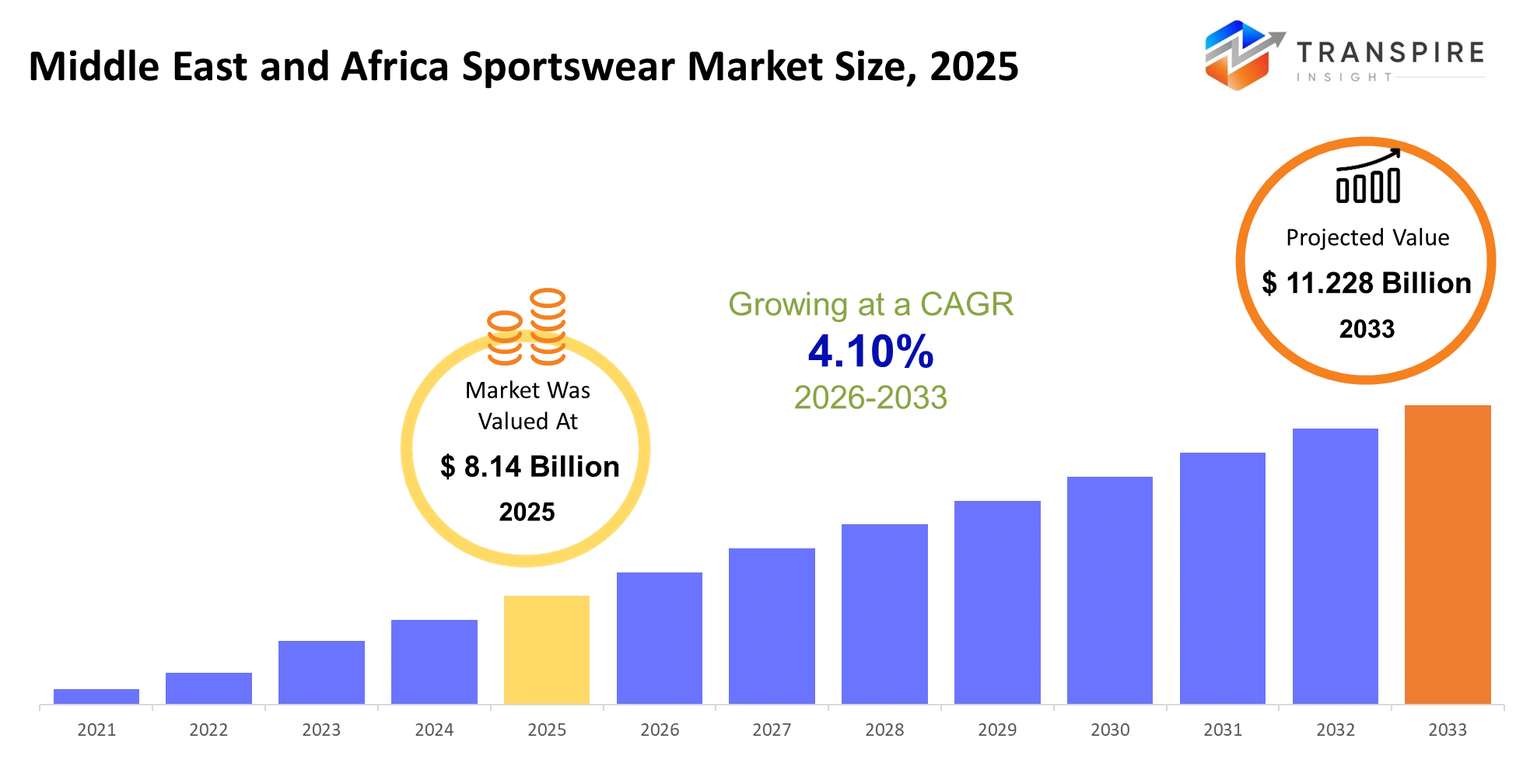
- Middle East and Africa Sportswear Market Size 2025: USD 8.14 Billion
- Middle East and Africa Sportswear Market Size 2033: USD 11.228 Billion
- Middle East and Africa Sportswear Market CAGR: 4.10%
- Middle East and Africa Sportswear Market Segments: By Type (Apparel, Footwear, Accessories, Others); By Application (Running, Training, Sports, Casual Wear, Fitness, Others); By End-User (Men, Women, Kids, Athletes, Fitness Enthusiasts, Others); By Distribution (Online, Retail Stores, Brand Outlets, Others).
To learn more about this report,  Download Free Sample Report
Middle East and Africa Sportswear Market Summary
The Middle East and Africa Sportswear Market was valued at USD 8.14 Billion in 2025. It is forecast to reach USD 11.228 Billion by 2033. That is a CAGR of 4.10% over the period.
The Middle East and Africa sportswear market is kinda backing a wider movement toward fitness- driven living, organized sports, and that performance minded fashion people wear even when they are not training. These sportswear items are no longer just for athletic activity, they blend comfort, durability, and weather ready features, plus general style appeal so they can work for daily city life too. Over the past five years, the whole market kind of changed shape, shifting away from store led sales into models that are influenced online and also direct-to-consumer, so both international and local brands can reach shoppers more smoothly even when the markets are fragmented and not that easy to connect.
One big reason the shift happened was because there were government backed wellness and sports investment plans, especially in Saudi Arabia and the UAE . In those places, official programs expanded gyms, backed women’s sports involvement, and basically made public fitness activities more common. At the same time, after the pandemic, supply chain trouble really highlighted how much the industry relied on imported materials and manufacturing that happened overseas, so brands ended up having to tweak where they source from and they needed to create tougher regional delivery and distribution routes. All of that kind of nudged more capital into online retail, increased localized product assortments, and it also made the premium athleisure segment grow at a faster pace.As a result, brands gained more control over pricing and saw stronger repeat buying, for both global labels and regional sportswear companies.
Key Market Insights
- The Gulf region sort of dominated the Middle East and Africa Sportswear Market, with almost 38% of revenue share in 2025, mostly because premium shoppers kept spending more.
- North Africa meanwhile came up as the fastest-growing regional market from 2026 to 2033 , thanks to e-commerce logistics improving and that broader middle-class demand rising.
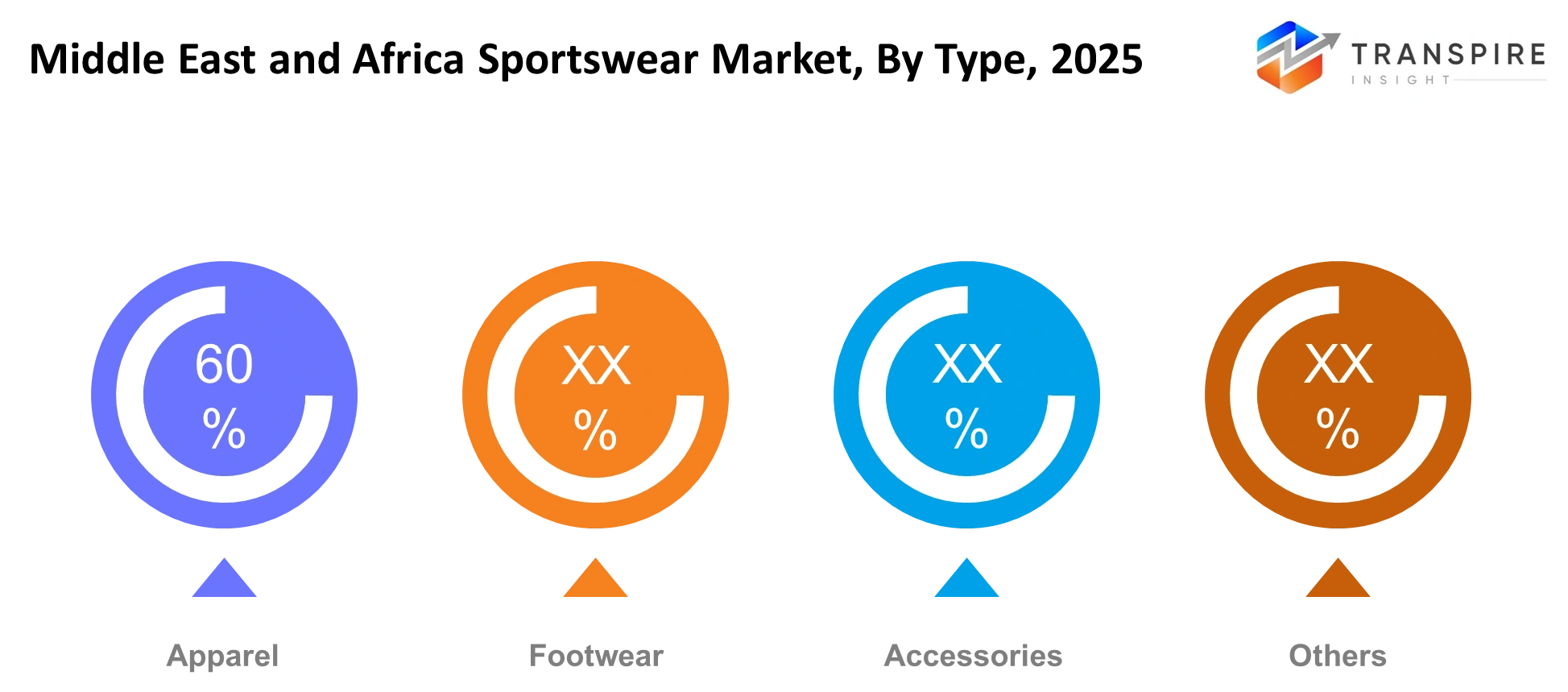
- Apparel also took over more than 45% of the overall industry size in 2025, since athleisure kind of moved from “fitness only” outfits into everyday fashion, you know, all the time.
- Footwear stayed the second-biggest segment too, driven by running communities , football involvement and gym signups that kept climbing after 2023.
- Smart sports accessories had the quickest forecast growth , because wearable-linked fitness ecosystems are getting more traction among younger urban buyers.
- Casual wear basically led application demand at around 40% market share, helped by hybrid work routines and comfort first fashion preferences.
- Women’s activewear showed the fastest-growing application category after the Gulf wellness reforms, which expanded women’s participation in gyms and outdoor sports activities .
- Men were the top end-user segment in 2025, mostly tied to stronger spending on football apparel, performance footwear , and branded athletic merchandise.
- Female consumers also had the strongest growth momentum as modest-performance sportswear collections gained more visibility across Saudi Arabia and the UAE.
- Adidas and Nike pushed their direct-to-consumer platforms harder to manage regional inventory better and boost digital customer interaction.
What are the Key Drivers, Restraints, and Opportunities in the Middle East and Africa Sportswear Market?
The strongest driver behind the sportswear demand lift across the Middle East and Africa, seems to be the fast growth of government-supported fitness and sports participation schemes, especially in Saudi Arabia and the UAE. National transformation efforts like Saudi Vision 2030 pushed more funding into gyms , women’s sports leagues , marathon events, and also school athletics, which basically widens the pool of buyers for performance clothing plus footwear. Because of that, sportswear shopping stopped being only for professional athletes, and it turned into everyday lifestyle spending. That’s why international brands can now pull in more revenue from premium athleisure lines, direct-to-consumer channels, and product rollouts that are more local in feel, not just broad global launches.
The biggest restraint is still the same thing though, heavy reliance on imported raw materials and overseas manufacturing networks. A lot of regional distributors and apparel firms continue to source technical fabrics, footwear pieces, and performance materials from Asian suppliers. This creates a kind of “always on” structural risk around shipping interruptions, currency swings, and changing import duties. And since the regional manufacturing base is limited, production can’t be localized quickly enough. So inventory refresh cycles get slowed down, and profitability tends to drop during supply chain instability periods.
A key opportunity is kinda showing up now, especially through women-focused and modest-performance sportswear categories across Gulf markets. Female presence in gyms , running groups and outdoor fitness activities has climbed noticeably after regulatory changes expanded access to more structured sports and wellness spaces. Brands that are working on climate-adaptive materials, inclusive sizing, and activewear collections that feel culturally in tune are in a good position to take advantage of long-term growth. This could matter a lot more for consumer groups that are still not fully served , say underserved segments between 2026 and 2033, where the demand is likely to stay kinda under-served for a while too.
What Has the Impact of Artificial Intelligence Been on the Middle East and Africa Sportswear Market?
Artificial intelligence and more sophisticated digital technologies are quietly reshaping exhaust gas cleaning technology, mostly by pushing automation forward, supporting emissions compliance, and raising vessel operating efficiency. In practice , ship operators are more often deploying AI-enabled scrubber performance systems that keep watching sulfur oxide emissions, washwater condition, pressure changes, and fuel consumption in real time. These automated control platforms can tweak water flow rates and chemical dosing, kind of on their own, without the usual manual fuss, so vessels stay within International Maritime Organization sulfur rules. At the same time , crews see less operational burden, because a lot of the routine check-ups get handled automatically. A few marine technology providers also bundle cloud based compliance dashboards so that fleet managers can review scrubber status across several vessels from one centralized control center.
Meanwhile, machine learning is making predictive maintenance within marine emission control systems more capable. The AI logic looks at vibration patterns, corrosion signals, pump behavior, and sensor responses, then flags likely equipment trouble before any shutdown happens. That strategy reduces unexpected downtime, improves overall equipment availability, and can lower maintenance costs. It may also reduce fuel inefficiencies that come from scrubbers being poorly optimized. Some shipping operators even mention real numbers—like measurable fuel savings and longer maintenance intervals—after they start using predictive analytics platforms. Still, wider AI adoption has friction, because connectivity at sea can be inconsistent and operational datasets are often fragmented, which can pull down model accuracy when conditions get messy, like they always do out there on the water.
Key Market Trends
- Since 2022, Saudi Arabia and the UAE basically started putting more public money into sports infrastructure, which made the demand for premium fitness apparel and high-performance footwear speed up a bit, honestly.
- Also after 2023, Adidas and Nike leaned a bit harder into direct-to-consumer channels, so in the end they leaned less on third party retailers, and were able to move faster when local stock situations got weird or tight.
- Women’s activewear demand climbed pretty sharply after 2021 , because Gulf wellness initiatives kind of pushed more women to join gyms, marathons, and those outdoor sport programs that keep showing up everywhere.
- Meanwhile between 2023 and 2026, African football sponsorship spending went up, and that clearly nudged Puma and Adidas to beef up club relationships, plus use a more localized merchandise setup, rather than the same old one size play.
- Online sportswear purchases rose quite a bit across Egypt, Morocco, and South Africa, mainly because mobile payments became more common and same day delivery networks improved after 2024.
- At the same time shoppers started favoring multifunction athleisure stuff more than outfits that were only sport specific, so the brands began mixing fashion styling with technical performance details , just to keep people interested.
- Since 2025 , regional distributors also diversified how they sourced products, partly to limit exposure to disruptions coming from Asian manufacturing, and to manage the currency related swings that hit import costs.Smart fitness integration gathered traction after wearable adoption widened, which then pulled interest toward biometric-enabled apparel and connected training ecosystems, you know.
- Modest-performance sportswear moved from a kind of niche thing into a more serious growth segment, because regional brands rolled out culturally tuned collections after 2023.
- And sustainability expectations got stronger from 2024 to 2026, so international players started using recycled materials and building lower-emission regional supply chain initiatives.
Middle East and Africa Sportswear Market Segmentation
By Type
Apparel still ends up holding the largest share of revenue, mainly because athleisure demand just keeps growing among city consumers, fitness participants , and younger demographics. You can see it in the steady appetite for performance t-shirts, leggings, hoodies and even modest activewear, which helps keep sales moving across both premium and mid-range options . The seasonal refresh routines, plus celebrity-driven fashion vibes, also push people into repeat buying patterns that footwear and accessories probably can’t match at the same overall scale.
Footwear keeps a pretty strong growth path due to more people joining in running, football, gym training, and outdoor fitness routines. Performance oriented product upgrades—like lighter cushioning, more breathable fabrics, and sport-specific builds—keep showing up as key reasons customers decide to buy. Going forward, growth should lean toward multifunctional footwear that blends athletic usefulness with everyday fashion, so brands will likely pour more effort into localized design strategies along with direct to consumer sales models.
Accessories and other categories are smaller in total impact, though they’re gaining attention through wearable fitness technology, sports bags, caps and hydration products. As fitness culture spreads, and outdoor recreation becomes more common, brands get more chances for cross-selling through connected product ecosystems. Over the forecast period, accessories are expected to benefit from premiumization and smart device integration, which should open doors for niche manufacturers and technology-focused entrants.
To learn more about this report, Download Free Sample Report
By Application
Right now casual wear and fitness applications, kinda take the lead in demand because more consumers just wear sportswear for everyday moments , not only for athletic stuff. In the Gulf economies and also in major African cities, urban lifestyles and hybrid work culture keep pushing this segment forward, along with that growing wish for comfort driven apparel. And honestly fashion forward athleisure collections help too , they pull in younger buyers who want clothing that can move from social settings to professional days, then back to recreational moments, all without much effort.
The running and training part keeps growing because organized fitness participation is showing up more often. Think marathons, gym memberships, and those wellness campaigns, they’re becoming more regular across the region. What people ask for most are high performance fabrics, sweat resistant materials, and ergonomic footwear. This is especially noticeable among middle income professionals and consumers who are more health conscious. On top of that, sports focused applications—like football related apparel and footwear—stay pretty steady too, mostly because football has such a strong cultural footprint across African markets.
For what comes next, future growth should come from specialized applications like women’s outdoor fitness apparel, yoga wear, and climate adaptive sports clothing built for high temperature environments. Product teams are also paying more attention to multifunctional designs, trying to balance comfort durability, and style across multiple activity areas. Investors, meanwhile, will likely lean toward brands that can react fast to lifestyle changes and to digitally influenced consumer habits.
By End-User
Men are still the biggest consumer group mostly, because more participation in organized sports, gym routines, and football related buying is happening across both the Middle East and Africa. Premium footwear, training clothing, and licensed sports merchandise keep pulling in strong repeat purchases within this customer set. A well established sports culture and higher average spend on branded athletic items also help keep the overall market feeling stable among male shoppers.
Women are the fastest-growing end-user group. This is mainly tied to rising sports involvement, better wellness awareness, and government initiatives that encourage female fitness, especially in Gulf countries. You can see demand moving up for modest performance apparel, yoga wear and more day-to-day athleisure pieces across most city areas. Brands that show inclusive sizing, culturally matched visuals, and more fashion forward collections are starting to stand out within this segment, a bit faster than others.
Kids, athletes, and fitness enthusiasts keep creating notable niche openings for specialized product development. Professional athletes boost the need for advanced performance technologies, while fitness enthusiasts are leaning more toward apparel that works with wearable tech, plus recovery focused products too. Over the forecast period, companies that focus on youth sports programs and school athletics are expected to build long term customer retention benefits. They do this through early brand visibility, and loyalty building tactics that start when customers are younger.
By Distribution
Retail stores and brand outlets currently dominate sales , because shoppers still lean toward in person product trials for footwear sizing, checking fabric feel, and choosing premium apparel with more confidence. Shopping malls and branded retail spaces stay especially influential across the Gulf countries , where experiential retail and a luxury style positioning really shape what people buy. Exclusive in store product launches , plus sports celebrity collaborations , also keep foot traffic steady for global brands.
Online distribution channels are growing fast due to better digital payment systems, quicker delivery infrastructure, and more smartphone adoption across urban , and semi urban areas. E-commerce platforms keep pulling in younger buyers who want more variety, promotional pricing, and direct access to international collections that aren’t always easy to find through local stores. Social commerce and influencer led marketing efforts are further speeding up online conversion , especially within fashion focused sportswear categories.
Looking ahead, distribution growth will likely revolve around omnichannel retail models , where physical stores connect smoothly with personalized digital shopping. Brands putting money into AI based recommendations, virtual fitting tools, and regional fulfillment networks should improve customer loyalty while also trimming inventory inefficiencies. Investors and retailers will also start putting more weight on agile supply chains and locally tailored e-commerce partnerships, to back long term expansion across regional markets that are still underserved.
What are the Key Use Cases Driving the Middle East and Africa Sportswear Market?
In the Middle East and Africa, athleisure and fitness apparel are still the main thing, like, the dominant use cases, mainly because more people are going to the gym, more running communities are popping up, and there are government-backed wellness campaigns pushing the idea forward. Demand is especially high with city consumers who want versatile clothing, stuff that mixes athletic performance with everyday fashion ,without it feeling too “sports only” you know.
At the same time, football apparel and performance footwear are getting more noticeable traction across schools, amateur leagues, and youth training academies. This is happening most in African markets, where football participation is still expanding steadily. Women’s activewear is also growing quickly in the Gulf countries as more women join fitness programs, sports clubs, and even outdoor activities so the whole ecosystem is widening.
Newer or emerging applications are starting to show up too, like smart sportswear that comes with biometric tracking features and climate-adaptive fabrics built for extreme heat conditions that are pretty common across the region. There’s also modest-performance apparel, aimed at female athletes and outdoor recreation users, and that one looks like it could have solid long-term potential, especially as regional brands try to reach underserved consumer segments.
|
Report Metrics |
Details |
|
Market size value in 2025 |
USD 8.14 Billion |
|
Market size value in 2026 |
USD 8.474 Billion |
|
Revenue forecast in 2033 |
USD 11.228 Billion |
|
Growth rate |
CAGR of 4.10% from 2026 to 2033 |
|
Base year |
2025 |
|
Historical data |
2021 - 2024 |
|
Forecast period |
2026 - 2033 |
|
Report coverage |
Revenue forecast, competitive landscape, growth factors, and trends |
|
Regional scope |
Middle East and Africa (Saudi Arabia, United Arab Emirates, South Africa, Rest of Middle East and Africa) |
|
Key company profiled |
Nike, Adidas, Puma, Under Armour, Reebok, ASICS, New Balance, Columbia, Decathlon, Anta, Li-Ning, Fila, Lululemon, Skechers, VF Corporation. |
|
Customization scope |
Free report customization (country, regional & segment scope). Avail customized purchase options to meet your exact research needs. |
|
Report Segmentation |
By Type (Apparel, Footwear, Accessories, Others); By Application (Running, Training, Sports, Casual Wear, Fitness, Others); By End-User (Men, Women, Kids, Athletes, Fitness Enthusiasts, Others); By Distribution (Online, Retail Stores, Brand Outlets, Others). |
Which Regions are Driving the Middle East and Africa Sportswear Market Growth?
The Gulf region kind of leads the Middle East and Africa sportswear market, and Saudi Arabia with the UAE are taking the largest slice when it comes to premium apparel demand. This kind of pull is backed by higher disposable income , plus aggressive government investment in sports participation, and then national wellness programs that are tied into economic diversification plans like Saudi Vision 2030. Big sporting events, modern retail infrastructure, and solid e-commerce penetration have basically built an ecosystem where international brands can expand fast using direct-to-consumer setups and franchise arrangements. The whole area also benefits from a young urban population, high brand awareness, and more interest in athleisure products that blend style with performance capabilities , so it feels like fashion meets function.
South Africa is the second-largest regional contributor, but the market mood there is not the same as in the Gulf economies. Growth looks more like stable consumer preference, less about luxury positioning and more about performance footwear, football apparel, and activewear that stays affordable. The country has a fairly mature retail network, a deep sporting culture, and import distribution channels that are relatively consistent, which helps multinational brands and regional distributors get steadier revenue expectations. On top of that, long-term sponsorship agreements with football clubs, schools, and fitness organizations keep feeding recurring demand even when economic expansion slows down a bit.
North Africa is showing up as the fastest-growing regional market, mainly in Egypt and Morocco, where expanding middle-class groups and rising adoption of digital commerce are changing how sportswear gets bought.Over the last while, investments in shopping malls, logistics infrastructure and online retail fulfillment networks have made it easier to reach international brands, not only the big city folks. At the same time, governments are also putting more support behind youth sports participation and domestic textile manufacturing, which i guess helps create a sort of good atmosphere for regional production partnerships. Between 2026 to 2033 , all of this momentum is expected to bring in fresh players, mainly those looking for cheaper operating costs and a chance to get in early in consumer markets that are still under served.
Who are the Key Players in the Middle East and Africa Sportswear Market and How Do They Compete?
The Middle East and Africa sportswear market is still kinda moderately fragmented, in the sense that global brands are side by side with fast-growing regional distributors and also digitally native apparel labels, that move pretty quickly. The competition now feels more about how a brand positions itself , plus product innovation and regional retail reach, not just price. Big international players keep trying to defend their market share with localized campaigns, exclusive store agreements and direct-to-consumer channels. Meanwhile, newer entrants are going after gaps in the market like women’s activewear, modest sports apparel, and that performance lifestyle mix which is basically everyday wear but with tech. The Gulf countries, especially Saudi Arabia and the UAE, have turned into the strategic battlegrounds, because disposable income keeps rising, government-backed fitness initiatives get more momentum, and e-commerce penetration keeps expanding bit by bit.
Adidas kind of differentiates itself with localized collaborations and football-first branding across both North Africa and Sub-Saharan Africa. Its tie-ins with regional airlines, football federations, and lifestyle retailers help it stay visible in a premium athleisure expansion way. They’re not only pushing sales, but also building that brand presence across channels that matter. Nike goes another direction, focusing on performance technology and more digital engagement, it relies on connected fitness ecosystems and limited-edition product drops to keep consumer loyalty, especially with younger urban buyers. Nike has also accelerated regional growth by leaning harder into e-commerce integration and expanding franchise retail in Gulf markets.
Puma, on the other hand, leans into football sponsorships and a youth-focused streetwear identity, so it’s got strong traction across African markets where football culture basically pulls apparel demand along. Its partnerships and club sponsorship approach create visibility while keeping marketing costs lower compared to some rivals , which helps it stay aggressive.Under Armour kinda sets itself apart with compression wear that’s all about performance, plus connected fitness technologies, mostly directed at premium consumers and professional athletes. Meanwhile, Anta Sports seems to be growing its presence using strategic investments and those value based premium products, kind of positioning itself so it can grab middle-income consumers who want that international style sportswear, but at lower price points.
Company List
- Nike
- Adidas
- Puma
- Under Armour
- Reebok
- ASICS
- New Balance
- Columbi
- Decathlon
- Anta
- Li-Ning
- Fila
- Lululemon
- Skechers
- VF Corporation
Recent Development News
“In April 2026, Adidas entered a partnership with Saudia to launch the ‘Made to Fly’ travel apparel collection across Saudi Arabia, the UAE, Egypt, and Morocco. The collaboration expanded adidas’ lifestyle positioning in the MENA region while signaling growing convergence between sportswear, travel, and premium athleisure categories.
Source: https://www.saudia.com/fr-OM
“In January 2026, Anta Sports acquired a 29.06% stake in Puma SE for approximately €1.5 billion. The investment strengthened Puma’s capital position and highlighted increasing Asian influence over global sportswear expansion strategies, including operations across Middle Eastern and African markets.
Source: https://en.wikipedia.org
What Strategic Insights Define the Future of the Middle East and Africa Sportswear Market?
The Middle East and Africa sportswear market is, kind of , moving away from price only buying toward demand that is digitally influenced and more about lifestyle, but this is also being nudged by more young people, broader fitness participation and some government backed wellness actions across Gulf countries. In the next 5–7 years, growth will probably show up more in premium athleisure, plus localized product customization, and omnichannel retail setups, rather than just chasing mass market volume. There’s also a less obvious risk that is sitting under the surface—supply chain concentration. If brands keep relying on imported technical fabrics and Asian manufacturing hubs, then regional players can get hit by currency swings, trade disruptions, and tighter margins as sustainability requirements keep getting stricter. Meanwhile, a new chance is forming around sportswear that performs modestly but is designed for women, especially in Saudi Arabia and the UAE, where social reform and increased participation in sport are changing what people want to wear. Players in the market should lean into regional manufacturing partnerships and use AI driven demand forecasting, so they can cut down on inventory waste and stay more responsive as consumer preferences evolve fast.
Middle East and Africa Sportswear Market Report Segmentation
By Type
- Apparel
- Footwear
- Accessories
- Others
By Application
- Running
- Training
- Sports
- Casual Wear
- Fitness
- Others
By End-User
- Men
- Women
- Kids
- Athletes
- Fitness Enthusiasts
- Others
By Distribution
- Online
- Retail Stores
- Brand Outlets
- Others
Frequently Asked Questions
Find quick answers to common questions.
The estimated Middle East and Africa Sportswear Market size is USD 11.228 Billion in 2033.
Key segments for the Middle East and Africa Sportswear Market are By Type (Apparel, Footwear, Accessories, Others); By Application (Running, Training, Sports, Casual Wear, Fitness, Others); By End-User (Men, Women, Kids, Athletes, Fitness Enthusiasts, Others); By Distribution (Online, Retail Stores, Brand Outlets, Others).
Major Middle East and Africa Sportswear Market players are Nike, Adidas, Puma, Under Armour, Reebok, ASICS, New Balance, Columbia, Decathlon, Anta, Li-Ning, Fila, Lululemon, Skechers, VF Corporation.
The Middle East and Africa Sportswear Market size is USD 8.14 Billion in 2025.
The Middle East and Africa Sportswear Market CAGR is 4.10% from 2026 to 2033.
- Nike
- Adidas
- Puma
- Under Armour
- Reebok
- ASICS
- New Balance
- Columbi
- Decathlon
- Anta
- Li-Ning
- Fila
- Lululemon
- Skechers
- VF Corporation
Recently Published Reports
-
Apr 2026
Bottled Water Market
Bottled Water Market Size, Share & Analysis Report By Product Type (Still Bottled Water, Carbonated Bottled Water, Functional Bottled Water, and Others), By Packaging (PET, Cans, and Others), By Sales Channel (Supermarkets/Hypermarkets, Convenience Stores/Drug Stores, Grocery Stores/Club Stores, Foodservice, and Others) and Geography (North America, Europe, Asia-Pacific, Middle East and Africa, South and Central America), 2021 - 2032
-
Apr 2026
Color Cosmetic Packaging Market
Color Cosmetic Packaging Market Size, Share & Analysis Report By Application (Mascara Packaging, Liquid Packaging, and Liquid Face), By Type (Tubes & Bottles, Pens & Markers, Compacts & Containers, and Droppers & Pumps), and Geography (North America, Europe, Asia-Pacific, Middle East and Africa, South and Central America), 2021 - 2031
-
Apr 2026
External Microphone For Camera Market
External Microphone For Camera Market Size, Share & Analysis Report By Type (Shotgun Microphone, Lavalier Microphone, and Others), By Application (Digital Camera, Professional Video Camera, and Others), and Geography (North America, Europe, Asia-Pacific, Middle East and Africa, South and Central America), 2021 - 2031
-
Apr 2026
Foot Orthotic Insoles Market
Foot Orthotic Insoles Market Size, Share & Analysis Report By Type (Pre-fabricated, and Custom-made), By Material (Thermoplastic, Composite Carbon Fiber, and Others), By Distribution Channel (Drug Stores, Hospitals & Clinics, and Others), and Geography (North America, Europe, Asia-Pacific, Middle East and Africa, South and Central America), 2021 - 2031