

North America Wound Assessment Market Size & Forecast:
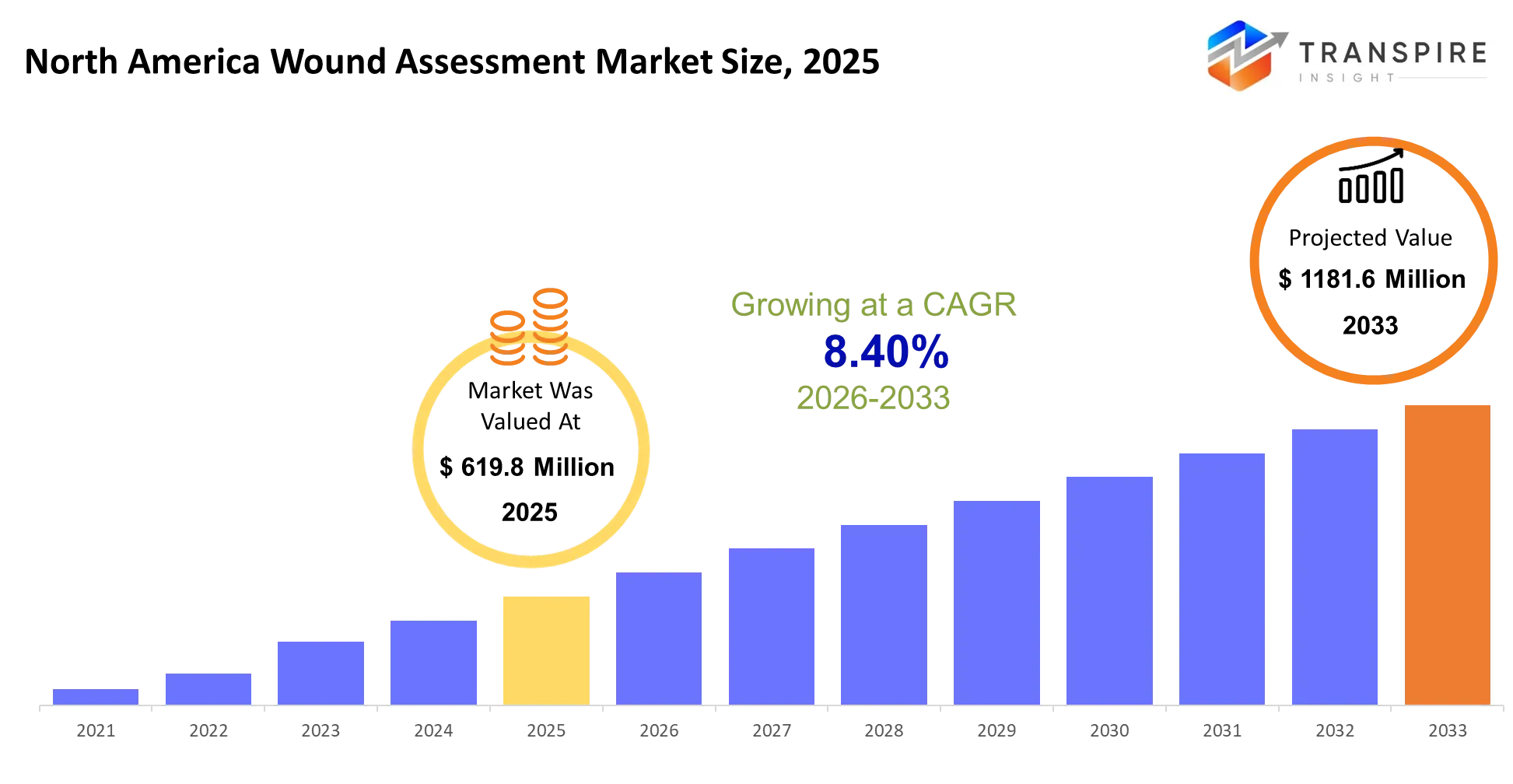
- North America Wound Assessment Market Size 2025: USD 619.8 Million
- North America Wound Assessment Market Size 2033: USD 1181.6 Million
- North America Wound Assessment Market CAGR: 8.40%
- North America Wound Assessment Market Segments: By Type (Digital Assessment, Manual Assessment, Imaging Systems, Software Tools, Others), By Application (Chronic Wounds, Acute Wounds, Burns, Ulcers, Others), By End-User (Hospitals, Clinics, Homecare, Others), By Technology (AI-based, Imaging, Sensors, Others).
To learn more about this report,  Download Free Sample Report
North America Wound Assessment Market Summary:
The North America Wound Assessment Market size is estimated at USD 619.8 Million in 2025 and is anticipated to reach USD 1181.6 Million by 2033, growing at a CAGR of 8.40% from 2026 to 2033. The North America wound assessment market kind of matters a lot , because it helps hospitals, outpatient clinics, and long-term care providers figure out how severe a wound is, if it’s actually healing the right way, and when they should step in to avoid complications like infection, tissue loss or even amputation. You can see these tools being used more and more for diabetic ulcer management, for tracking surgical recovery, and for chronic wound care programs, where waiting too long can seriously change patient outcomes and also raise hospital costs.
In the last five years, the whole space has moved from manual visual checks toward AI-powered imaging platforms, plus digital wound documentation systems that connect to electronic health records. This shift got a faster push after the COVID-19 pandemic messed up in-person visits and made providers lean harder on remote wound monitoring and telehealth routines. When healthcare systems dealt with staffing shortages , and reimbursement got tighter, clinicians started using automated assessment technologies to cut down on documentation time and to make treatment decisions more consistent. Now that change is showing up as stronger recurring software revenue , more interest in connected imaging devices, and wider rollout across home healthcare and post-acute care environments.
Key Market Insights
- In 2025, the United States basically dominated the North America wound assessment market , taking almost 78% share, largely because its healthcare infrastructure is more advanced, and yeah, more stable in practice too.
- For Canada, the fastest growth shows up during the forecast period, it seems driven by more home healthcare investment and the rising uptake of digital care, including remote follow ups and such.
- After 2021 cross border healthcare technology partnerships helped speed up the rollout of wound imaging software across clinical networks in North America , and clinicians kinda started using those tools sooner than before.
- For market revenue , digital wound measurement devices led the field with about 42% share in 2025, mainly since they improve clinical documentation accuracy in a quicker, more consistent way.
- Wound imaging software then became the second biggest segment, because hospitals kept integrating AI driven analytics into electronic medical records—like it wasn’t optional anymore.
- AI-enabled wound assessment platforms are projected to grow the most rapidly through 2032, supported by predictive healing analysis plus remote monitoring features that are becoming common.
- Cloud based wound management solutions also gathered major momentum, since healthcare providers leaned toward scalable, interoperable clinical data systems, rather than isolated setups.
- When it comes to wound categories, chronic wound management made up over 48% of the North America wound assessment industry size in 2025, tied to the prevalence of diabetic ulcers, and the ongoing need for long term tracking.
- Pressure ulcer assessment still brings in a lot of revenue across long term care facilities and rehabilitation centers throughout North America, so it stays important.
- Post surgical wound monitoring is the fastest-growing application segment , as hospitals adopt digital recovery tracking along with infection prevention protocols.
- Finally, telehealth enabled wound evaluation platforms saw stronger demand growth after 2020, because providers expanded virtual patient management programs and kept going with it.
What are the Key Drivers, Restraints, and Opportunities in the North America Wound Assessment Market?
The strongest force that’s accelerating the North America wound assessment market, seems tied to a healthcare system shift toward data-driven chronic wound management. Hospitals and post-acute care providers are getting hit with financial penalties linked to preventable complications, readmissions, and longer-than-expected recovery times, especially for diabetic foot ulcers and pressure injuries. This whole pressure sort of got worse after the telehealth infrastructure expanded quickly during, and even after, the COVID-19 period. So, providers started putting money into AI-enabled wound imaging, tools for automated measurement, and cloud based documentation systems that help lower assessment variability, and make treatment follow-ups easier to track. In turn these technologies back reimbursement optimization and operational efficiency, which keeps fueling recurring software revenue, and also broader enterprise adoption.
Now, the market’s biggest structural obstacle is still fragmented interoperability across healthcare IT ecosystems. A lot of hospitals continue running legacy electronic health record platforms that can’t easily mesh with advanced wound imaging software or AI analytics. Swapping them out or upgrading them needs serious capital spending, cybersecurity validation, and clinician retraining. And because procurement cycles in healthcare are slow, plus very regulated, this limitation keeps delaying technology rollout at mid-sized hospitals and long-term care facilities, which in practice, suppresses near-term revenue growth.
At the same time there’s a pretty clear growth chance, around home-based wound care that is supported by remote monitoring platforms. North America’s aging population , and the increasing volume of outpatient treatment, are pushing providers to handle chronic wounds outside the usual hospital environment.
What Has the Impact of Artificial Intelligence Been on the North America Wound Assessment Market?
Artificial intelligence and newer digital technologies are quietly reshaping how wounds get checked. Instead of people looking, judging, and making their best guess from a visual scan, clinicians are moving toward data based clinical analysis, which is more repeatable, and a bit more “measurable” in practice. Lately, more healthcare teams are rolling out AI imaging platforms that can automatically size wound boundaries, sort tissue types, flag possible infection risks, and then output standardized healing summaries. Supposedly this saves a lot of manual note time, and it also helps keep documentation consistent, across hospitals, outpatient clinics, and even home healthcare situations. Plus, some integrated wound digital management platforms seem to handle compliance tracking too, because they can save time stamped wound photos and treatment timelines right inside electronic health record systems.
Then there are machine learning models, they’re being used for the whole trajectory prediction piece, basically forecasting how a wound is likely to heal, and also spotting who might be headed toward complications. Think diabetic foot ulcers, pressure injuries, that sort of thing. These systems look at past healing behaviors, patient conditions, and image based tissue shifts, and in turn they help clinicians step in earlier and adjust treatment plans more precisely. A number of providers mention faster assessment cycles, fewer hospital readmissions, and better care coordination when remote monitoring programs are in place. There’s also the telehealth angle: AI supported wound imaging makes it easier for clinicians to evaluate chronic wounds without constant in person checkups.
But, even with the benefits, takeup is still held back by integration hassles and uneven data quality. A lot of health systems are still stuck with fragmented, older IT infrastructure. Meanwhile the AI models often need huge sets of standardized wound images to keep performance steady across different patient groups, and across different care settings where lighting, workflows, and documentation styles can vary.
Key Market Trends
- Since 2020 hospitals have been kind of speeding up the adoption of AI wound imaging platforms, to make assessments more consistent and also to take some of the clinician documentation burden down by real measurable margins, if you will.
- After COVID-19 remote wound monitoring use jumped fast. Providers started folding telehealth workflows into chronic ulcer and post-surgical recovery programs, not long after the shift.
- From 2021 through 2025, home healthcare agencies ramped up spending on smartphone based wound assessment tools, mainly to keep aging patients supported outside the hospital walls.
- Big names like 3M and Smith+Nephew moved their strategy toward cloud-connected wound management ecosystems , instead of sticking to standalone imaging hardware.
- More and more healthcare systems leaned on interoperable software platforms too, especially after reimbursement models began tying chronic wound outcomes to day to day operational performance and readmission reduction.
- AI powered predictive healing analytics started showing up as a differentiator, because many providers wanted earlier intervention for diabetic foot ulcers and pressure injuries, in a more proactive way.
- Meanwhile long term care facilities increased their digital wound documentation use starting around 2022. The idea was to tighten compliance tracking and lower liability risk during regulatory audits.
- Wound assessment vendors also widened partnerships with electronic health record providers , to smooth out clinical workflows and keep enterprise software around longer, basically improving software retention rates at scale.
- Portable 3D wound imaging devices got more attention in ambulatory surgical centers , largely because clinicians needed quicker and more accurate post operative monitoring. that requirement mattered.
- Smaller and mid-sized healthcare providers sometimes delayed deployments due to interoperability headaches with older electronic medical record systems, which kinda slowed the broader market standardization effort.
North America Wound Assessment Market Segmentation
By Type
Digital assessment systems are sitting in the strongest spot within this type segment, kinda because healthcare providers keep putting more weight on standardized wound measurement, image documentation and even more automated reporting. Imaging systems along with software tools got real traction across both hospitals and outpatient centers after telehealth integration helped remote patient monitoring become way more common. Still, manual assessment methods haven’t disappeared, especially in smaller clinics and rural facilities where budget limits make advanced tech harder to roll out, but the overall market share keeps drifting down since workflow automation is becoming more and more valuable.
Software wound analytics platforms appear to be growing faster than the hardware side, mainly because subscription based deployment makes the initial investment less heavy for healthcare organizations. Also, demand is shifting toward connected assessment ecosystems that link straight into electronic health record platforms. Looking ahead, development in this segment will probably revolve around portable imaging devices , AI supported measurement tools, and cloud wound documentation systems, which should create better recurring revenue for manufacturers while also boosting day to day operational efficiency for healthcare buyers.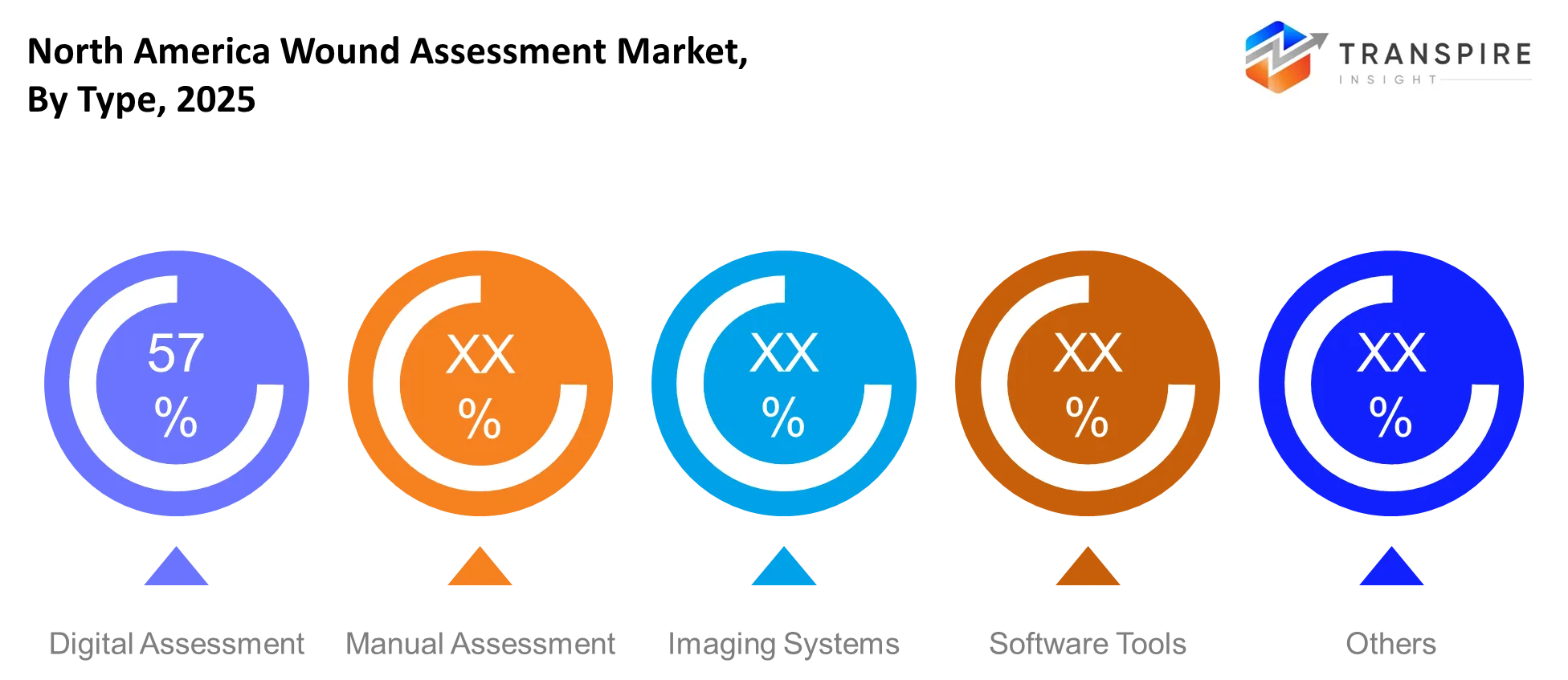
To learn more about this report, Download Free Sample Report
By Application
Chronic wound applications seem to take the lead in the application segment because diabetic foot ulcers, pressure injuries, and venous leg ulcers basically need long term monitoring, plus repeated clinical evaluation, and that’s hard to avoid. In most healthcare systems, a lot of effort and money gets funneled into chronic wound management, since delayed care can push hospitalization rates up, which then lifts the whole care cost. Acute wounds and burns still bring in pretty steady demand, especially in emergency care and during surgical recovery, but the pace of growth is slower, mainly because the treatments are shorter and less drawn out.
Pressure ulcer management, by the way, picked up digital wound assessment technologies more aggressively once facilities had to meet stricter quality reporting, and patient safety requirements. For burn care applications, teams are leaning more on advanced imaging systems, not just for better tissue evaluation accuracy, but also to limit unnecessary surgical intervention. Going forward, new market expansion will probably show up in post-acute care and remote monitoring programs, where chronic wound tracking becomes sort of a necessity for cutting readmissions. Investors and solution providers are also increasingly focused on predictive healing analytics and telehealth compatible assessment tools, since they fit long duration wound management strategies better.
By End-User
Hospitals kinda keep the leading position in the end-user segment, since big healthcare networks have more purchasing power, better IT infrastructure, and lots more patient volumes that force continuous wound evaluation. Specialty clinics meanwhile still take a pretty good portion, mainly as multidisciplinary wound treatment centers keep spreading through the bigger urban healthcare systems. Then there’s homecare services which are showing up as the fastest-growing end-user category, mostly because people are leaning more toward outpatient recovery models and because cost-cutting initiatives are everywhere across North American healthcare systems.
Home-based wound monitoring went up a lot once remote care reimbursement policies became more supportive, after the pandemic period. Skilled nursing facilities and rehabilitation centers are still adopting portable wound assessment tools too, to help with compliance reporting and to keep treatment consistency steadier. Budget limits and workforce shortages though still slow things down in smaller, independent clinics. Going forward, growth will probably lean toward end-users who can bundle remote diagnostics with AI-driven documentation and connected care platforms, which sets up longer-term chances for technology vendors delivering scalable , interoperable clinical solutions.
By Technology
AI based technologies are kind of the fastest growing part of the tech space right now, mostly because healthcare providers keep wanting predictive analytics, automated wound classification and also real time healing progression kind of views. Imaging technologies still seem to lead overall market use, since most clinicians rely heavily on high resolution wound visualization and digital measurement functions, and well that’s just become the norm. Sensor based systems are still earlier on in adoption, but they look like they could really take off for moisture detection, infection monitoring, and pressure injury prevention use cases. Traditional assessment technologies also remain in play in cost sensitive facilities, especially where digital integration is still limited by infrastructure constraints .
Machine learning models really picked up steam after healthcare organizations saw the day to day operational upside of cutting down subjective clinical interpretation, while also getting better documentation accuracy. Cloud connected imaging platforms are expanding too and they increasingly enable enterprise wide wound management across hospitals, clinics, and homecare networks. Looking ahead, future investment activity will likely focus on AI assisted predictive healing systems, smartphone compatible imaging applications, and sensor integrated monitoring devices that help improve treatment precision, while also reducing long term care costs for providers and payers.
What are the Key Use Cases Driving the North America Wound Assessment Market?
Chronic wound management kinda stays the main use case, and it is still what drives adoption across hospitals, plus specialty wound care centers. For example diabetic foot ulcers and pressure injuries need repeated imaging, constant measurement, and healing analysis, so digital assessment platforms become essential if the goal is to lower complications and, also, bring down readmission costs.
Post surgical wound monitoring, and also burn assessment apps, are getting more interest lately among ambulatory surgical centers, and rehab facilities. Providers are starting to lean on AI enabled imaging tools, for documenting recovery progress and for helping with reimbursement compliance too. This also helps keep treatment more consistent across outpatient care, which is kinda what everyone wants.
Remote wound evaluation at home healthcare is another emerging use, with strong long term potential. Smartphone based imaging platforms, paired with predictive healing analytics, are starting to back up monitoring for elderly patients especially, in rural areas where access to specialized wound care is, well, still pretty limited.
|
Report Metrics |
Details |
|
Market size value in 2025 |
USD 619.8 Million |
|
Market size value in 2026 |
USD 671.8 Million |
|
Revenue forecast in 2033 |
USD 1181.6 Million |
|
Growth rate |
CAGR of 8.40% from 2026 to 2033 |
|
Base year |
2025 |
|
Historical data |
2021 - 2024 |
|
Forecast period |
2026 - 2033 |
|
Report coverage |
Revenue forecast, competitive landscape, growth factors, and trends |
|
Country scope |
North America (Canada, The United States, and Mexico) |
|
Key company profiled |
Smith & Nephew, 3M, ConvaTec, Coloplast, Molnlycke, Medtronic, GE Healthcare, Siemens Healthineers, Philips, Tissue Analytics, Swift Medical, WoundVision, Hitachi, Fujifilm, Canon Medical |
|
Customization scope |
Free report customization (country, regional & segment scope). Avail customized purchase options to meet your exact research needs. |
|
Report Segmentation |
By Type (Digital Assessment, Manual Assessment, Imaging Systems, Software Tools, Others), By Application (Chronic Wounds, Acute Wounds, Burns, Ulcers, Others), By End-User (Hospitals, Clinics, Homecare, Others), By Technology (AI-based, Imaging, Sensors, Others) |
Which Regions are Driving the North America Wound Assessment Market Growth?
The United States sort of leads the regional picture, mainly because there’s strong healthcare digitization, a high level of chronic wound incidents, and a wide take up of AI based clinical imaging systems. On top of that, federal reimbursement rules are starting to nudge hospitals toward fewer readmissions, and better wound healing results, so the money flow really backs investment in more advanced assessment platforms. Big hospital groups, along with integrated electronic health record systems, plus dedicated wound care centers, all combine to make a pretty mature environment for rolling out the tech. Big industry players also keep research collaborations going with providers across the country, which speeds up commercialization of predictive wound analytics and also remote monitoring tools.
Canada comes in as the second-largest regional contributor, but the behavior there feels different, because the adoption pace is influenced more by long-term public healthcare planning rather than by aggressive private investment. The provincial healthcare systems keep building digital care infrastructure but in a more measured way, which means procurement cycles for wound assessment software and imaging solutions stay fairly steady. Home healthcare and elder care programs end up carrying more weight in Canada’s overall market setup, especially for chronic ulcer management and remote patient monitoring. With fairly consistent healthcare funding, and telehealth integration happening slowly but surely , the region ends up being a dependable provider of recurring technology demand even if deployment timelines are a bit longer.
Mexico is showing up as the fastest-growing regional market, mostly because private healthcare investment is expanding and the whole urban hospital setup is being modernized. In the last few years, healthcare providers have been adopting digital wound documentation systems more and more, to help with surgical recovery monitoring and also with diabetic ulcer management. At the same time, diabetes prevalence keeps climbing, and people have better access to outpatient care networks, so demand is getting stronger for portable imaging, plus AI-assisted wound evaluation tools. All this momentum, kind of makes a clear path for medical device manufacturers and software providers who want to expand across cost-sensitive, but still rapidly modernizing, healthcare settings between 2026 and 2033.
Who are the Key Players in the North America Wound Assessment Market and How Do They Compete?
North America’s wound assessment market still looks, kind of, moderately fragmented, you know, with big medtech companies rubbing shoulders with more specialized digital health players that lean into AI wound analytics. What’s happening more and more is that the fight is not so much about hardware pricing, but more about how well the software fits in, how reliably the imaging works, and how fast the workflow feels in day to day use. The older providers keep trying to defend share by leaning hard on enterprise hospital relationships, plus electronic health record integration features. At the same time newer entrants seem to go after the less covered areas, like remote monitoring, and even predictive wound analysis. In the end buyers tend to judge vendors by interoperability, clinical automation, telehealth compatibility, and the ability to keep and manage data over the long run, not just by standalone imaging stuff.
Smith+Nephew keeps putting emphasis on digital wound management ecosystems, like an entire set up where advanced dressings, imaging systems, and clinical analytics are stitched together into one treatment workflow. The company also benefits from wound documentation tools that connect with chronic care management programs which makes their stance stronger in bigger hospital networks. 3M, on the other hand, tends to differentiate with wide healthcare infrastructure reach, and a lot of established relationships with acute care facilities. Their investment in connected wound monitoring platforms, plus infection prevention technologies, helps them cross-sell across surgical settings and post-acute care environments.
Tissue Analytics kind of competes by using AI wound imaging software, aimed at quick mobile rollout for outpatient care and home healthcare use. They really focus on predictive healing analytics, plus smartphone based assessment tools that help shrink the clinician documentation time. Then there’s WoundVision, they specialize in more advanced optical imaging methods that can spot tissue changes before pressure injuries get actually visible, which helps them stand out in long term care and preventive wound management. And for Mölnlycke Health Care, they keep growing through partnerships with healthcare systems, tied to chronic wound treatment standardization and digital care integration across North American clinical networks , yeah.
Company List
- Smith & Nephew
- 3M
- ConvaTec
- Coloplast
- Molnlycke
- Medtronic
- GE Healthcare
- Siemens Healthineers
- Philips
- Tissue Analytics
- Swift Medical
- WoundVision
- Hitachi
- Fujifilm
- Canon Medical
Recent Development News
In May 2026, Convatec Showcases Advanced Wound Care Innovation Pipeline at EWMA 2026: Convatec announced new advanced wound care innovations and evidence-based technologies at EWMA 2026, including developments focused on wound hygiene and clinical assessment workflows. The company emphasized expanding its innovation pipeline to improve healing outcomes and clinician decision-making in chronic wound care.
Source: https://www.businesswire.com
In February 2026, Solventum Reports Strong 2026 Demand for Wound Care Products: Medical technology company Solventum reported better-than-expected quarterly results in February 2026, driven largely by rising demand for wound care and sterilization products across North American hospitals. The update highlighted continued healthcare provider investment in advanced wound management and assessment solutions amid growing chronic wound cases.
Source: https://www.reuters.com
What Strategic Insights Define the Future of the North America Wound Assessment Market?
The North America wound assessment market is moving, structurally, toward these integrated predictive care platforms that mash together AI imaging with remote monitoring and then loop in longitudinal patient data, all inside one clinical workflow. The main push behind that shift isn’t just chronic wound prevalence , but also the growing financial strain on healthcare systems to curb avoidable hospital visits, lower clinician workload, and reduce reimbursement leakage that shows up when wound outcomes aren’t great. In the next five to seven years, recurring revenue that’s software-driven is probably going to beat out standalone hardware sales, because providers keep looking for interoperability and enterprise scale analytics.
One risk that feels a bit underrecognized is how clinical wound data is getting concentrated inside a limited set of proprietary software ecosystems. If interoperability standards don’t really mature, healthcare providers could end up with vendor lock-in, higher switching expenses, and fragmented patient records, which would in turn slow down wider technology adoption.
On the opportunity side, there’s a big emerging opening for AI assisted wound triage tools, especially for home healthcare and rural telemedicine networks. This becomes more compelling as reimbursement rules increasingly support decentralized care delivery. Market players should focus on partnerships with electronic health record providers and homecare networks, so they can secure longer term platform integration before procurement standards become even more consolidated.
North America Wound Assessment Market Report Segmentation
By Type
- Digital Assessment
- Manual Assessment
- Imaging Systems
- Software Tools
- Others
By Application
- Chronic Wounds
- Acute Wounds
- Burns
- Ulcers
- Others
By End-User
- Hospitals
- Clinics
- Homecare
- Others
By Technology
- AI-based
- Imaging
- Sensors
- Others
Frequently Asked Questions
Find quick answers to common questions.
The Approximate North America Wound Assessment Market size for the Market will be USD 1181.6 Million in 2033.
The key segments of the North America Wound Assessment Market are By Type (Digital Assessment, Manual Assessment, Imaging Systems, Software Tools, Others), By Application (Chronic Wounds, Acute Wounds, Burns, Ulcers, Others), By End-User (Hospitals, Clinics, Homecare, Others), By Technology (AI-based, Imaging, Sensors, Others).
Major Players in the North America Wound Assessment Market are Smith & Nephew, 3M, ConvaTec, Coloplast, Molnlycke, Medtronic, GE Healthcare, Siemens Healthineers, Philips, Tissue Analytics, Swift Medical, WoundVision, Hitachi, Fujifilm, Canon Medical.
The Current Market size of the North America Wound Assessment Market is USD 619.8 Million in 2025.
The North America Wound Assessment Market CAGR is 8.40%
- Smith & Nephew
- 3M
- ConvaTec
- Coloplast
- Molnlycke
- Medtronic
- GE Healthcare
- Siemens Healthineers
- Philips
- Tissue Analytics
- Swift Medical
- WoundVision
- Hitachi
- Fujifilm
- Canon Medical
Recently Published Reports
-
May 2026
Biosimilars Market
Biosimilars Market By Product Type (Monoclonal Antibodies, Recombinant Hormones, Erythropoietin, G-CSF, Others), By Indication (Oncology, Autoimmune Diseases, Blood Disorders, Diabetes, Others), By Manufacturing Type (In-House Manufacturing, Contract Manufacturing), By Distribution Channel (Hospital Pharmacies, Retail Pharmacies, Online Pharmacies), By Industry Analysis, Size, Share, Growth, Trends, and Forecasts 2021-2033
-
Apr 2026
Gastrointestinal Endoscopy Market
Gastrointestinal Endoscopy Market By Type (Rigid Gastrointestinal Endoscope, Flexible Gastrointestinal Endoscopes, Disposable Gastrointestinal Endoscope), By Procedure Type (Colonoscopy, Gastroscopy, Duodenoscopy, Enteroscopy, Flexible Sigmoidoscopy, Others), By Application (Diagnosis, Treatment), By End-Users (Hospitals, Ambulatory Surgical Centers, Specialty Clinics, Laboratories, Others), By Industry Analysis, Size, Share, Growth, Trends, and Forecasts 2021-2033
-
Apr 2026
Rare Inherited Metabolic Disorder Drug Market
Rare Inherited Metabolic Disorder Drug Market By Drug Class (Enzyme Replacement Drugs, Gene Therapy Drugs, Substrate Reduction Drugs, Small Module Drugs, Protein Drugs), By Route of Administration(Parenteral, Oral, Intrathecal), By Clinical Development (Marketed Drugs, Late Stage Clinical Phase III, Early Stage Clinical Phase I-II, Preclinical Candidates), By Indication (Lysosomal Storage Disorders, Urea Cycle Disorders, Amino Acid Metabolic Disorders, organic Acidemias, Peroximal Disorders), By Industry Analysis, Size, Share, Growth, Trends, and Forecasts 2021-2033
-
Jan 2026
Pharmaceutical Cleanroom Technology Market
Pharmaceutical Cleanroom Technology Market By Product (Equipment, Consumables, Services); By Cleanroom Type (Standard Cleanrooms, Modular Cleanrooms); By End Use (Pharmaceutical Companies, Biotechnology Companies), By Industry Analysis, Size, Share, Growth, Trends, and Forecasts 2021-2033