

North America Systemic Mastocytosis Treatment Market Size & Forecast:
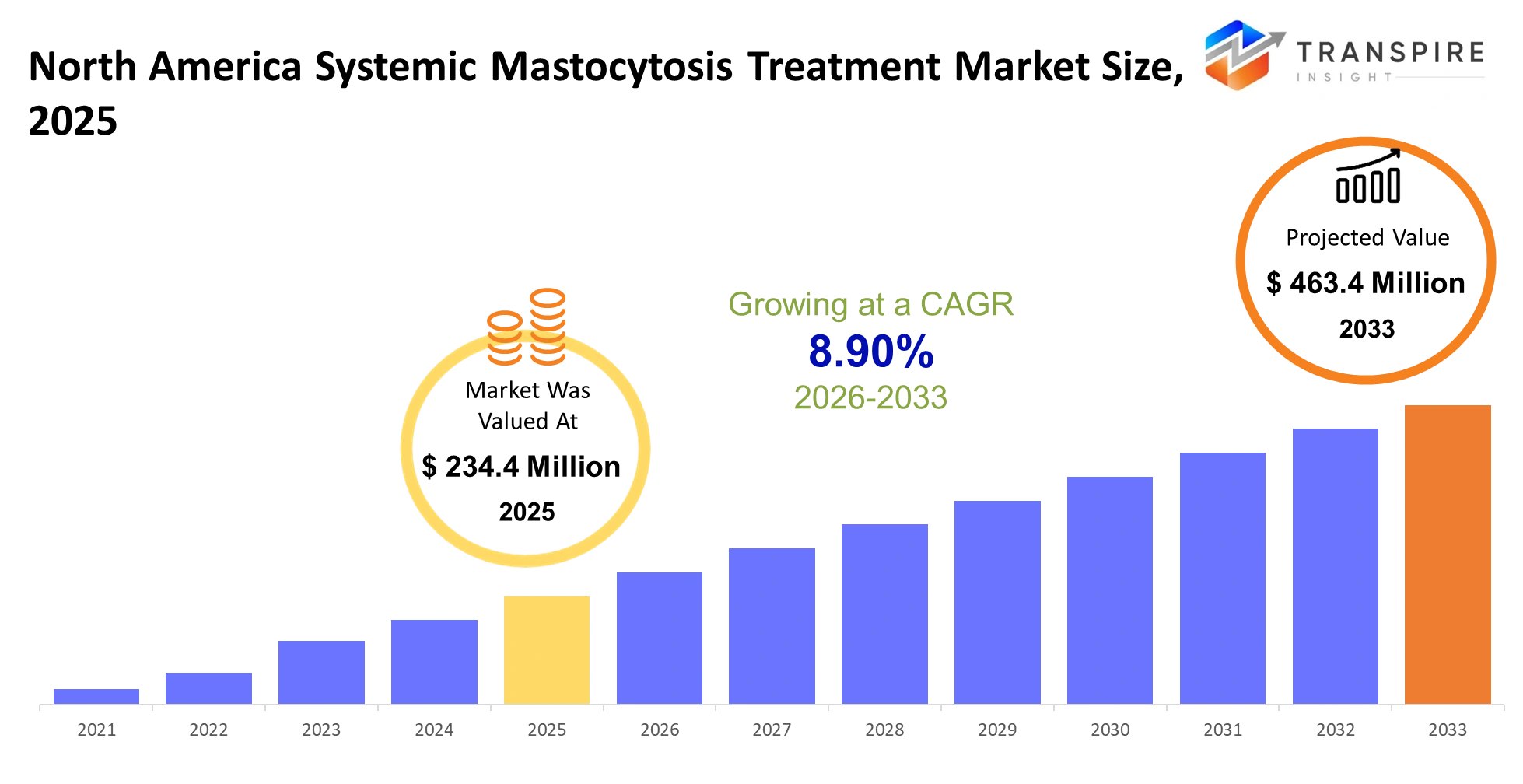
- North America Systemic Mastocytosis Treatment Market Size 2025: USD 234.4 Million
- North America Systemic Mastocytosis Treatment Market Size 2033: USD 463.4 Million
- North America Systemic Mastocytosis Treatment Market CAGR: 8.90%
- North America Systemic Mastocytosis Treatment Market Segments: By Type (Tyrosine Kinase Inhibitors, Chemotherapy, Immunotherapy, Steroids, Others), By Application (Indolent SM, Aggressive SM, Mast Cell Leukemia, Others), By End-User (Hospitals, Clinics, Others), By Distribution (Hospital Pharmacy, Retail, Online, Others).
To learn more about this report,  Download Free Sample Report
North America Systemic Mastocytosis Treatment Market Summary:
The North America Systemic Mastocytosis Treatment Market size is estimated at USD 234.4 Million in 2025 and is anticipated to reach USD 463.4 Million by 2033, growing at a CAGR of 8.90% from 2026 to 2033. The North America systemic mastocytosis treatment market kind of tackles a very specialized clinical problem, you know, keeping abnormal mast cells from piling up in a way that can lead to intense allergic episodes, organ issues, ongoing gastrointestinal troubles and even hematologic disease getting worse. In real day to day practice, this market usually ends up backing hospitals, specialty oncology centers, and immunology clinics that use targeted regimens along with symptom-control medicines and long term disease stewardship tools, which can help keep patients more stable and lower the number of urgent emergency visits.
Over the past five years, the whole approach seems to have moved away from just general relief measures, and towards more precise therapies that aim at KIT gene variants, especially for more advanced systemic mastocytosis situations. That shift went faster after regulatory approvals for newer generation tyrosine kinase inhibitors showed clear survival related and disease-control gains in everyday treatment environments. And meanwhile, the COVID-19 period sort of revealed weak spots in how rare disease is identified, so healthcare systems started to widen molecular testing programs plus strengthen specialist referral routes. Now, as recognition improves and clinicians spot patients earlier, time on treatment is stretching out, specialty drug use is going up, and companies are getting better recurring income from ongoing management of chronic illness rather than the more one-off care patterns.
Key Market Insights
- The United States basically dominated the North America Systemic Mastocytosis Treatment Market, sitting at over 82% market share in 2025 because of advanced rare disease infrastructure (and yeah, that kind of stuff really matters in practice).
- Canada shows the fastest growing regional momentum through 2032, backed by expanding hematology research funding and better orphan drug reimbursement frameworks, which makes adoption smoother in a way.
- Across North America, clinical trial activity keeps moving faster, and that keeps system mastocytosis treatment market forecast growth on track while also helping specialty drug commercialization speed up.
- Targeted therapies led the North America Systemic Mastocytosis Treatment Market in 2025, contributing almost 48% of the total industry size, so it’s clearly the main “where the money goes” category right now.
- Symptomatic treatment therapies stayed in the second place category, since antihistamines and corticosteroids continue to support long-term patient management strategies, and clinicians seem to rely on them pretty consistently.
- Tyrosine kinase inhibitors are projected to be the fastest growing segment through 2032, driven by more KIT D816V mutation focused treatment adoption in real-world settings.
- Precision diagnostics integration is also improving, letting doctors select therapy with higher accuracy. This ends up supporting better therapy success rates and stronger pharmaceutical market penetration.
- Advanced systemic mastocytosis treatment applications captured around 57% market share in 2025, mainly because unmet clinical needs are still high and the disease burden is quite complex.
- Indolent systemic mastocytosis management is now emerging as the fastest-growing application segment, thanks to expanding early stage diagnosis rates across specialty clinics, where more cases are being caught earlier.
- Hospitals and specialty oncology centers led the market, taking close to 61% of revenue share in 2025, mostly due to multidisciplinary rare disease treatment capabilities that don’t really exist everywhere.
What are the Key Drivers, Restraints, and Opportunities in the North America Systemic Mastocytosis Treatment Market?
The strongest growth driver in the North America systemic mastocytosis treatment market is that fairly quick turn toward mutation-targeted therapy , especially after regulatory approvals for KIT D816V-focused tyrosine kinase inhibitors. Before that, clinicians were mostly sticking with earlier style approaches, basically relying on symptom suppression via antihistamines, corticosteroids, and mast cell stabilizers, which only gave narrow control in more advanced disease settings. Once precision therapies came in , the physician treatment pathway kind of shifted because these medicines showed clear, measurable drops in mast cell burden and also fewer hospitalizations. That change then supported longer treatment persistence, raised specialty prescribing volumes, and boosted steady pharmaceutical revenue through longer duration therapy cycles. And payers got more comfortable reimbursing these expensive orphan drugs too, when the clinical evidence pointed to less emergency care use and also better progression-related outcomes.
Still, the market’s largest structural snag is delayed and inconsistent diagnosis. Systemic mastocytosis brings symptoms that frequently overlap with gastrointestinal disorders, allergic reactions, and hematologic diseases so misdiagnosis happens pretty often. To confirm the condition, you need specialized molecular testing, bone marrow biopsy know-how and access to rare disease physicians, but that support is still mostly locked in a handful of academic centers. This kind of service gap slows patient discovery, pushes back therapy start times, and in the end it restrains adoption rates for treatment options while trimming the practical patient pool that drug makers can reach.
A big opportunity is kinda showing up as expanded genomic screening gets stitched into community oncology networks across the United States, and Canada, not just the big academic places. Big hospital groups are putting more and more money into next generation sequencing platforms that can flag KIT mutations sooner in the diagnostic flow . Since molecular testing is getting more reachable, even mid-sized regional treatment centers can start handling systemic mastocytosis patients close to home, instead of sending them only to tertiary hospitals . If this keeps moving, it could widen patient access a lot, speed up prescription volumes for focused therapies, and give fuel to the next round of market expansion.
What Has the Impact of Artificial Intelligence Been on the North America Systemic Mastocytosis Treatment Market?
Artificial intelligence and newer digital tools are slowly starting to reshape the North America systemic mastocytosis treatment market, mostly because they boost diagnostic accuracy, speed up which treatment to choose, and help fine tune rare disease workflows in day to day practice. For example AI driven pathology platforms are now assisting hematologists in spotting unusual mast cell patterns from bone marrow biopsy images. This cuts down on manual review time, and it also helps make early detection more steady though, sometimes consistency can still vary. At the same time machine learning is getting folded into genomic analysis systems so it can flag KIT mutations and estimate how a patient might respond to targeted tyrosine kinase inhibitors. In practice that means clinicians can personalize the therapy choice faster, without needing quite as many back and forth steps.
Meanwhile advanced digital health platforms are also cleaning up operational flow across specialty oncology networks. Automated clinical decision support tools can basically flag higher-risk patients by looking at lab values, symptom movement, and prior treatment history. The end result is fewer diagnostic delays, delays that historically stretched for multiple years in many cases. On top of that, pharmaceutical companies are using predictive analytics for rare disease trial recruitment, and to forecast therapy utilization patterns. That supports inventory planning too and lowers specialty drug distribution inefficiencies which is not a small thing. All of these factors tend to support better adherence, quicker referral coordination, and stronger patient monitoring results overall.
Still, there is a tough snag with AI adoption. Systemic mastocytosis is rare, and real world data sets are limited. Because the patient population is small, model training can be less accurate, and predictive algorithm reliability may drop across different demographics and across clinical environments, even when the tools look good in initial testing.
Key Market Trends
- Since 2021, hospitals have increasingly been adopting KIT mutation testing which has been cutting down diagnostic delays, and also helping clinicians choose targeted therapy more accurately in advanced systemic mastocytosis patients.
- Blueprint Medicines kinda reshaped prescribing habits after next-generation tyrosine kinase inhibitor approvals, basically showed stronger progression control than conventional, symptom focused treatment strategies which were used before.
- From 2020 to 2025 , specialty oncology clinics expanded rare disease referral networks. That helped with earlier stage patient identification across different regional healthcare systems, not only the big ones.
- At the same time, pharmaceutical companies shifted investment focus toward orphan drug pipelines, largely because premium reimbursement models improved revenue visibility for long-duration therapies in rare disease areas.
- Community oncology centers started integrating next-generation sequencing platforms more often, after molecular testing costs fell close to 25% compared with the 2019 benchmark level ( so it became easier to justify).
- Payers then tightened what counts as acceptable evidence for high-cost therapies, so drug manufacturers had to push harder for stronger real-world outcomes, and longer term survival datasets as well.
- After COVID-19 disruptions, which made diagnostic bottlenecks more obvious, healthcare providers accelerated digital pathology adoption. The idea was to improve remote specialist collaboration and make biopsy interpretation faster , with less back and forth.
- In Canada, healthcare systems expanded rare hematologic disease funding programs between 2022 and 2025, which improved access to targeted treatments outside major academic centers.
- And biopharmaceutical firms have been pursuing academic partnerships more and more, to speed up mast cell disorder research, biomarker discovery, and precision therapy clinical trial enrollment efficiency too.
North America Systemic Mastocytosis Treatment Market Segmentation
By Type
Tyrosine kinase inhibitors keep a leading place in the treatment landscape, mostly because targeted therapies tend to show better disease control and longer progression-free survival, especially in advanced systemic mastocytosis situations. Once the regulatory approvals landed for KIT D816V-focused drugs, many physicians started leaning harder toward precision based treatment routes, most notably in specialty oncology centers. Steroids and a range of supportive symptom-based options still pull consistent demand, since quite a lot of patients need ongoing management for allergic issues and gastrointestinal complications over time. Chemotherapy is still relevant for the harsher disease presentations and mast cell leukemia, even if toxicity concerns and the fact that the benefits don’t last as long tend to limit wider use. Immunotherapy is still kind of at an earlier phase overall, it’s being kept alive by more clinical research momentum and biomarker centered trials.
Looking ahead, growth for this segment will probably revolve around combination strategies and next generation kinase inhibitors, the idea being to make responses last longer while also lowering adverse events. Pharmaceutical companies are ramping up investment into orphan drug pipelines too, and healthcare providers continue to put targeted treatment protocols first, particularly those that tie back to measurable clinical outcomes and premium reimbursement frameworks.

To learn more about this report, Download Free Sample Report
By Application
Indolent systemic mastocytosis is kind of the main application segment , since bigger diagnosed patient groups need ongoing disease handling and pretty regular symptom-control treatment. The survival numbers stay fairly steady, and patients tend to stick to their long-term therapy plans too, so it helps keep pharmaceutical revenue fairly stable in this group . Aggressive systemic mastocytosis sits in a smaller population, but it drives a lot more spending per case, because the more severe presentations often call for targeted therapies, inpatient stays , and close, intensive monitoring.
Mast cell leukemia stays very specialized, largely because it is uncommon and the disease can worsen really fast, so commercial volume doesn’t spread widely, but the research attention gets more focused. Other mast cell disorders still get notice, mainly as diagnostic power keeps improving through molecular testing being built in and expanded hematology referral routes . Overall application trends are starting to lean toward earlier identification ,and more personal treatment decision-making. Drug developers are pushing for treatments that tackle both disease progression and patient quality of life, while healthcare systems keep upgrading genomic testing capacity to get classification right and shape better long-term care pathways.
By End-User
Hospitals hold the biggest end-user share, sorta because systemic mastocytosis diagnosis and treatment are pretty complex, so you end up needing multidisciplinary coordination hematologists, oncologists, allergists , plus pathology specialists. With advanced diagnostic infrastructure, actual access to bone marrow testing, and specialty infusion capabilities still getting more traction, the hospital lead keeps getting reinforced across the whole treatment ecosystem.
Meanwhile clinics are showing up as the fastest-growing end-user segment, mostly tied to expanded outpatient targeted therapy administration and all the follow-up disease monitoring services. Also, better access to genomic testing platforms within community oncology networks has helped regional clinics see, and manage, more patients locally instead of depending fully on tertiary care institutions.
Other healthcare facilities, like academic research centers, keep playing a role too, especially around clinical trial enrollment and rare disease treatment innovation. Overall, end-user dynamics seem to be moving toward decentralized care models where specialty know how is balanced with cost efficiency. At the same time , healthcare providers are increasingly asking for integrated digital monitoring tools and coordinated referral systems, since that improves treatment continuity while also cutting the delays caused by limited specialist access.
By Distribution
Hospital pharmacies pretty much dominate the whole distribution picture because those expensive orphan drugs and the more targeted therapies tend to need carefully managed dispensing, specialized storage, and really close physician supervision. A lot of advanced systemic mastocytosis treatments also come with prior authorization hurdles and complicated reimbursement models, which ends up reinforcing the institutional pharmacy networks role, not just in theory but in actual day to day operations. Retail pharmacies still show up with a decent footprint, but more as a supporting actor, mainly for symptom-focused options like antihistamines, corticosteroids, and gastrointestinal therapies that people keep using over longer periods.
Online pharmacy channels are slowly getting bigger too, mostly because more specialty drug delivery programs are being adopted, and because remote patient management platforms have become more mainstream, especially after healthcare systems sped up digital service integration, around the pandemic period. Then there are the other routes, for example specialty distributors, which stay relevant for biologics and rare disease therapeutics that need temperature controlled logistics and ongoing compliance monitoring. Looking ahead, distribution trends will probably lean toward integrated specialty pharmacy ecosystems, where reimbursement assistance, digital patient tracking, and coordinated home delivery services can be bundled together, and that should help adherence rates and lower the chances of therapy interruption happening in practice.
What are the Key Use Cases Driving the North America Systemic Mastocytosis Treatment Market?
The main thing pushing treatment adoption is the use of advanced systemic mastocytosis management in specialty oncology and hematology centers. Targeted tyrosine kinase inhibitors are seeing the most demand, because severe disease progression really needs continuous therapy, lots of monitoring in the background, and a more “in-hospital” multidisciplinary care coordination, like the team has to stay tightly aligned.
Also, secondary applications are quietly growing across outpatient clinics that handle indolent systemic mastocytosis and chronic mast cell activation symptoms. Community oncology networks are starting to lean on genomic testing, plus ongoing long term symptom control strategies, to cut down on referral wait times to specialists and also keep patients engaged longer in the regional health ecosystem.
Newer use cases are showing up too, such as AI-supported diagnostic screening and precision biomarker led treatment selection in academic research hospitals. Some early stage clinical programs are even looking at combination therapies and next generation immunologic approaches, meant to strengthen response durability for patients dealing with treatment resistant mast cell disorders.
|
Report Metrics |
Details |
|
Market size value in 2025 |
USD 234.4 Million |
|
Market size value in 2026 |
USD 255.2 Million |
|
Revenue forecast in 2033 |
USD 463.4 Million |
|
Growth rate |
CAGR of 8.90% from 2026 to 2033 |
|
Base year |
2025 |
|
Historical data |
2021 - 2024 |
|
Forecast period |
2026 - 2033 |
|
Report coverage |
Revenue forecast, competitive landscape, growth factors, and trends |
|
Country scope |
North America (Canada, The United States, and Mexico) |
|
Key company profiled |
Novartis, Pfizer, Blueprint Medicines, Roche, AstraZeneca, Merck, Bristol Myers Squibb, AbbVie, Eli Lilly, Sanofi, GSK, Takeda, Bayer, Johnson & Johnson, Amgen. |
|
Customization scope |
Free report customization (country, regional & segment scope). Avail customized purchase options to meet your exact research needs. |
|
Report Segmentation |
By Type (Tyrosine Kinase Inhibitors, Chemotherapy, Immunotherapy, Steroids, Others), By Application (Indolent SM, Aggressive SM, Mast Cell Leukemia, Others), By End-User (Hospitals, Clinics, Others), By Distribution (Hospital Pharmacy, Retail, Online, Others). |
Which Regions are Driving the North America Systemic Mastocytosis Treatment Market Growth?
North America sort of leads the systemic mastocytosis treatment space, mostly because the United States still has the region’s most solid rare disease infrastructure, plus a pretty favorable reimbursement environment, and also a strong precision oncology setup. Those federal orphan drug incentives, along with accelerated regulatory routes, pushed pharmaceutical companies to put more emphasis on commercialization of targeted therapies across a range of advanced mast cell disorders. At the same time, big academic medical centers, integrated genomic testing networks, and specialty oncology clinics keep helping with quicker diagnosis and wider access to treatment compared with most other international markets. On top of that, the ongoing back and forth between biopharmaceutical firms, hematology specialists, and patient advocacy groups seems to keep clinical trials high, and it supports recurring specialty drug revenue too, even year after year.
Europe is the second major regional contributor, though the momentum isn’t exactly the same as North America. Here, healthcare expansion tends to lean more on centralized reimbursement systems and coordinated public healthcare delivery, so the pathway feels a bit different. Nations like Germany, France, and the United Kingdom keep adoption steady through organized rare disease frameworks, plus ongoing funding for hematology research programs over the long run. Physician comfort with mast cell disorders has kept improving, largely due to cross border clinical partnerships and broader diagnostic standardization efforts. Because of that baseline steadiness, European markets can usually maintain consistent demand for pharmaceuticals even when pricing talks drag on, and reimbursement timelines slow down the launch of premium targeted therapies.
Asia-Pacific is kinda emerging as the fastest growing regional market, after a bunch of healthcare systems expanded their molecular diagnostics investment and also built more specialty oncology capacity right after the pandemic period. China, Japan, and South Korea pushed genomic testing adoption forward and updated rare disease policy modernization during 2022 to 2025, and that has made the pathways for earlier mastocytosis diagnosis feel more solid. At the same time, hospital infrastructure is widening a bit, and access to targeted oncology drugs is getting better too, so treatment availability is now moving beyond the big metropolitan research centers. All of this together is building real momentum , and it creates meaningful opportunities for pharmaceutical manufacturers, diagnostic firms and specialty care investors who want long term expansion across underpenetrated rare disease markets from 2026 to 2033.
Who are the Key Players in the North America Systemic Mastocytosis Treatment Market and How Do They Compete?
The competitive landscape is still kind of moderately consolidated, because only a limited set of biopharmaceutical companies keep the most advanced targeted treatments and rare disease pipelines. Nowadays the real contest is less about pure price pressure and more about precision oncology know-how, running through regulatory steps quicker, and showing long term clinical outcomes. Not just the usual numbers, more the substance of it. Bigger established pharma groups defend their share via expanded indication approvals and genomic-led treatment platforms. Meanwhile smaller biotechnology firms slip in through more niche mast cell disorder research efforts. In practice, clinical differentiation, physician uptake within specialty hematology networks, and reimbursement positioning kinda steer most of the market’s competitive calls now.
Blueprint Medicines has pushed its advantage by developing a targeted KIT D816V inhibitor that was designed for advanced systemic mastocytosis patients. They stand apart with mutation-first precision therapies supported by deep engagement from hematology specialists, plus strong rare disease clinical trial delivery. On top of that, partnerships with diagnostic providers and academic cancer centers improved patient matching, and helped speed up treatment adoption across North America. Novartis keeps challenging the space with a broader oncology operating structure and global regulatory know-how, which helps them commercialize earlier and penetrate physician networks. Their strong hospital relationships, plus diversified hematologic oncology portfolios, give Novartis cross specialty prescribing benefits that smaller biotech players can’t really copy as easily.
Pfizer is expanding in a kind of precision medicine way , with investments in what they call biomarker-led oncology partnerships too , and that seems to help strengthen access to those rare disease treatment channels. They also lean on advanced genomic research capabilities along with large scale specialty distribution systems , which then improves therapy accessibility across various regional healthcare networks. Meanwhile AbbVie is more centered on immunology and hematologic disease integration strategies , and that opens up room for combination therapy development plus some more broad specialist engagement. Bristol Myers Squibb , on the other hand, differentiates with deep oncology research infrastructure and even pretty aggressive clinical development programs aiming at resistant hematologic conditions. And all of this continued investment in next generation targeted therapies , plus data driven treatment optimization, is helping these companies compete on clinical outcomes rather than mostly conventional pricing strategies.
Company List
- Novartis
- Pfizer
- Blueprint Medicines
- Roche
- AstraZeneca
- Merck
- Bristol Myers Squibb
- AbbVie
- Eli Lilly
- Sanofi
- GSK
- Takeda
- Bayer
- Johnson & Johnson
- Amgen
Recent Development News
In February 2026, Long-Term PATHFINDER Trial Results Strengthen Blueprint Medicines’ Advanced SM Portfolio: new PATHFINDER trial data highlighted durable efficacy of avapritinib in advanced systemic mastocytosis patients. The update showed continued response rates and biomarker reductions after nearly four years of follow-up, supporting the company’s long-term commercialization strategy in North America and strengthening physician confidence in targeted KIT inhibition therapies.
Source: https://www.onclive.com
In February 2026, Blueprint Medicines (Sanofi) Presents Four-Year AYVAKIT Data in Systemic Mastocytosis: Blueprint Medicines announced new long-term clinical findings for AYVAKIT (avapritinib) in indolent systemic mastocytosis during a major hematology meeting in North America. The company reported sustained symptom improvement and long-term safety outcomes from the PIONEER study, reinforcing the commercial and clinical positioning of the therapy in the U.S. rare disease market.
Source: https://www.blueprintmedicines.com
What Strategic Insights Define the Future of the North America Systemic Mastocytosis Treatment Market?
The North America systemic mastocytosis treatment market seems to be edging, kind of fast, toward much more personalized mutation-specific care models, backed by integrated genomic diagnostics and those long-duration targeted therapy management programs. In the next five to seven years , the real competitive edge will probably hinge on how well companies stitch together molecular testing, real-world clinical proof, and specialty distribution networks into some one unified treatment ecosystem. It’s not just “new pharma” being pushed, more like a wider move where rare hematologic diseases get treated like precision managed chronic care categories, with that recurring revenue kind of upside.
But there’s a less visible risk too, market concentration around a small set of approved targeted therapies plus specialized diagnostic pathways. If reimbursement pressure gets tighter or the treatment options don’t broaden the way expected, healthcare systems could run into pricing imbalance ,and also supply fragility because so much depends on a small group of manufacturers. At the same time, decentralized genomic screening inside community oncology networks is showing up as an emerging opportunity, though it’s still underpenetrated. Firms that lean in early on regional diagnostic partnerships, and also AI-supported patient identification tools, may end up with better referral momentum and faster therapy adoption. So strategically, focus should slide away from drug commercialization only, toward building integrated rare disease management infrastructure instead .
North America Systemic Mastocytosis Treatment Market Report Segmentation
By Type
- Tyrosine Kinase Inhibitors
- Chemotherapy
- Immunotherapy
- Steroids
- Others
By Application
- Indolent SM
- Aggressive SM
- Mast Cell Leukemia
- Others
By End-User
- Hospitals
- Clinics
- Others
By Distribution
- Hospital Pharmacy
- Retail
- Online
- Others
Frequently Asked Questions
Find quick answers to common questions.
The approximate North America Systemic Mastocytosis Treatment Market size for the market will be USD 463.4 Million in 2033.
The key segments of the North America Systemic Mastocytosis Treatment Market are By Type (Tyrosine Kinase Inhibitors, Chemotherapy, Immunotherapy, Steroids, Others), By Application (Indolent SM, Aggressive SM, Mast Cell Leukemia, Others), By End-User (Hospitals, Clinics, Others), By Distribution (Hospital Pharmacy, Retail, Online, Others).
Major players in the North America Systemic Mastocytosis Treatment Market are Novartis, Pfizer, Blueprint Medicines, Roche, AstraZeneca, Merck, Bristol Myers Squibb, AbbVie, Eli Lilly, Sanofi, GSK, Takeda, Bayer, Johnson & Johnson, Amgen.
The current market size of the North America Systemic Mastocytosis Treatment Market is USD 234.4 Million in 2025.
The North America Systemic Mastocytosis Treatment Market CAGR is 8.90%.
- Novartis
- Pfizer
- Blueprint Medicines
- Roche
- AstraZeneca
- Merck
- Bristol Myers Squibb
- AbbVie
- Eli Lilly
- Sanofi
- GSK
- Takeda
- Bayer
- Johnson & Johnson
- Amgen
Recently Published Reports
-
May 2026
Biosimilars Market
Biosimilars Market By Product Type (Monoclonal Antibodies, Recombinant Hormones, Erythropoietin, G-CSF, Others), By Indication (Oncology, Autoimmune Diseases, Blood Disorders, Diabetes, Others), By Manufacturing Type (In-House Manufacturing, Contract Manufacturing), By Distribution Channel (Hospital Pharmacies, Retail Pharmacies, Online Pharmacies), By Industry Analysis, Size, Share, Growth, Trends, and Forecasts 2021-2033
-
Apr 2026
Gastrointestinal Endoscopy Market
Gastrointestinal Endoscopy Market By Type (Rigid Gastrointestinal Endoscope, Flexible Gastrointestinal Endoscopes, Disposable Gastrointestinal Endoscope), By Procedure Type (Colonoscopy, Gastroscopy, Duodenoscopy, Enteroscopy, Flexible Sigmoidoscopy, Others), By Application (Diagnosis, Treatment), By End-Users (Hospitals, Ambulatory Surgical Centers, Specialty Clinics, Laboratories, Others), By Industry Analysis, Size, Share, Growth, Trends, and Forecasts 2021-2033
-
Apr 2026
Rare Inherited Metabolic Disorder Drug Market
Rare Inherited Metabolic Disorder Drug Market By Drug Class (Enzyme Replacement Drugs, Gene Therapy Drugs, Substrate Reduction Drugs, Small Module Drugs, Protein Drugs), By Route of Administration(Parenteral, Oral, Intrathecal), By Clinical Development (Marketed Drugs, Late Stage Clinical Phase III, Early Stage Clinical Phase I-II, Preclinical Candidates), By Indication (Lysosomal Storage Disorders, Urea Cycle Disorders, Amino Acid Metabolic Disorders, organic Acidemias, Peroximal Disorders), By Industry Analysis, Size, Share, Growth, Trends, and Forecasts 2021-2033
-
Jan 2026
Pharmaceutical Cleanroom Technology Market
Pharmaceutical Cleanroom Technology Market By Product (Equipment, Consumables, Services); By Cleanroom Type (Standard Cleanrooms, Modular Cleanrooms); By End Use (Pharmaceutical Companies, Biotechnology Companies), By Industry Analysis, Size, Share, Growth, Trends, and Forecasts 2021-2033