

North America Rheumatology Therapeutics Market Summary
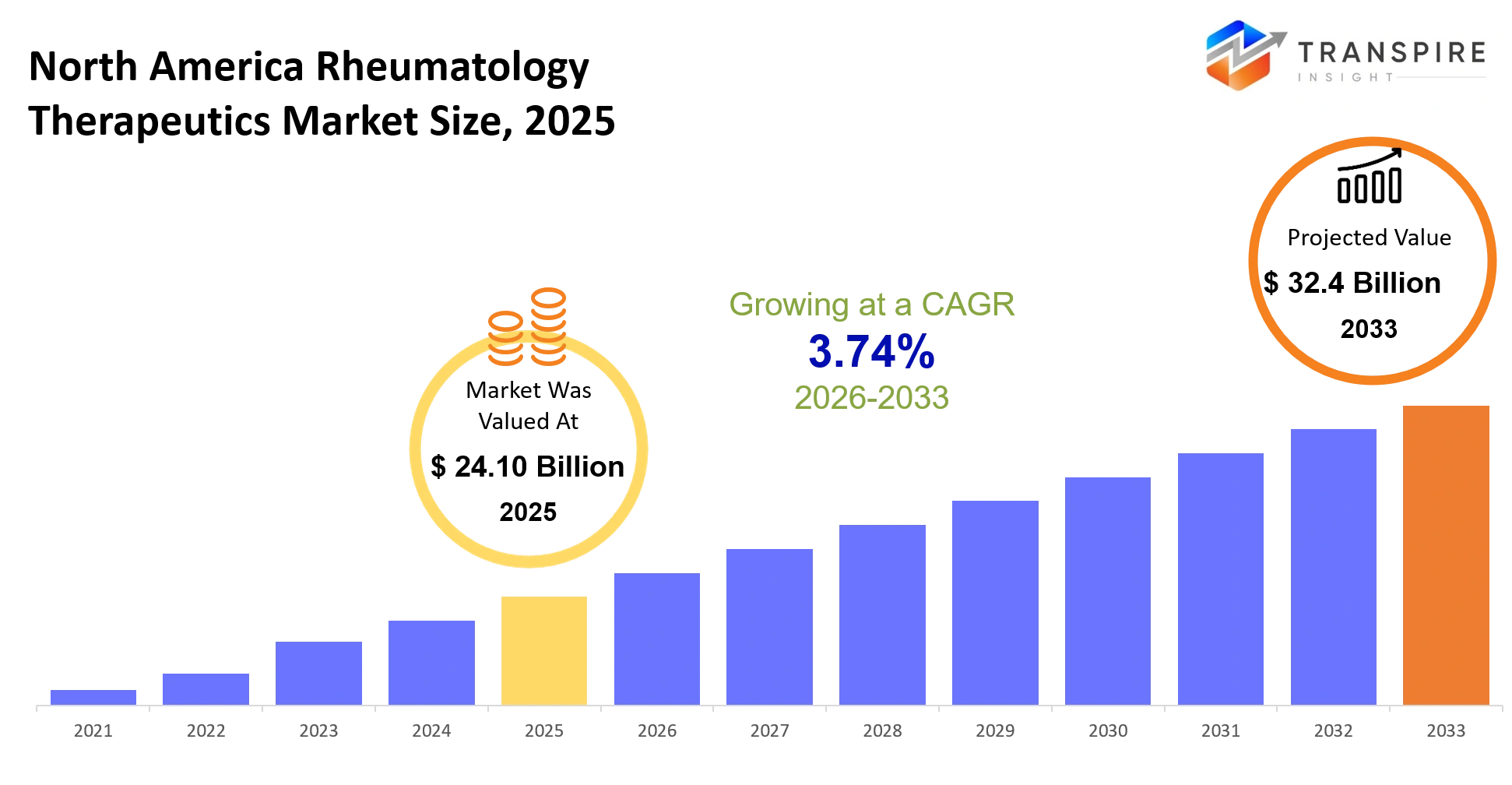
As per Transpire Insight Analysis the North America Rheumatology Therapeutics Market size is estimated at USD 24.10 Billion in 2025 and is anticipated to reach USD 32.4 Billion by 2033, growing at a CAGR of 3.74% from 2026 to 2033.
The North America Rheumatology Therapeutics Market helps manage chronic autoimmune plus inflammatory conditions by allowing physicians to monitor disease advancement , reduce joint breakdown, and strengthen long-term patient movement as well as day to day quality of life . In other words its more like a steady care pathway, not just a quick fix , so patients can keep doing what matters with less pain and interruption . These options have a real role in lowering hospital visits, limiting disability, and helping people keep doing normal routines. In the last three to five years the whole market has leaned more and more into precision type treatment plans, with biologics and targeted small molecules moving into everyday clinical workflows, kind of steadily. At the same time, the growth of biosimilars together with updated reimbursement rules has made access easier for more patients. Meanwhile, the COVID-19 pandemic first sort of scrambled the regular appointments, but it also pushed telehealth adoption ahead, and kept disease management efforts going in a more steady, sort of sustained way. Even now, as earlier diagnosis , personalized prescribing, and wider reach of advanced therapies keep changing how care is delivered, healthcare providers are reaching patients sooner. That supports stronger therapy utilization and creates ongoing revenue possibilities across the regional landscape.
North America Rheumatology Therapeutics Market Size & Forecast:
- North America Rheumatology Therapeutics Market Size 2025: USD 24.10 Billion
- Expected Market Value 2033: USD 32.4 Billion
- Forecast CAGR: 3.74%
- Leading region in 2025: United States
- Fastest Growing region: Canada
- Key Profile: Cytiva, PerkinElmer, Ahlstrom, Whatman, QIAGEN, Thermo Fisher Scientific, Roche Diagnostics, Puritan Medical Products, Copan Diagnostics, Hardy Diagnostics, Bio-Rad Laboratories, Cardinal Health, Sarstedt, Greiner Bio-One, EKF Diagnostics
Key Market Insights
- North America still has the lead in the market, like pretty much the center of attention, with the United States contributing around 88% of the regional market share in 2025, due to strong specialty care infrastructure that keeps getting more advanced.
- Canada is forecast to grow the fastest across the 2025–2032 window, mostly because biologic reimbursement programs keep rolling out through provincial healthcare systems, and that keeps boosting uptake, sort of.
- On the product side, biologic therapies are the big one, taking nearly 58% market share in 2025 , since many physicians are increasingly leaning toward targeted, disease-modifying treatment approaches.
- Conventional disease modifying antirheumatic drugs are still sort of in the next slot, as the second-largest segment, helped by familiar prescribing habits and cost effective, first line care routines that people know already.
- JAK inhibitors are projected to be the fastest growing therapeutic segment through 2032, mostly since the dosing feels convenient as a pill routine, and the clinical evidence keeps widening across more autoimmune diseases.
- For application demand, rheumatoid arthritis basically takes the top position with roughly 61% market share in 2025, linked to increased diagnosis rates and the continuing long term treatment needs.
- Psoriatic arthritis is anticipated to show the quickest lift through the forecast window, since targeted biologics are getting broader labeling and there is more real world clinical adoption over time.
- When it comes to end users, hospitals and specialty rheumatology clinics lead, holding about 54% market share, because complex biologic therapies really do need specialist oversight.
- Finally, ambulatory infusion centers are likely to become the fastest-growing end-user category through 2032, as outpatient biologic administration keeps expanding throughout North America, quietly but steadily.
What are the Key Drivers, Restraints, and Opportunities in the North America Rheumatology Therapeutics Market?
Primary market expansion is being pushed by the shift toward precision immunology and more aimed biologic management. Newer clinical protocols , broader insurance coverage for these advanced therapies, plus a wider biosimilar supply have helped clinicians step in earlier for many rheumatic diseases. More and more physicians are choosing targeted medicines before irreversible joint damage ever takes hold. When treatment starts sooner , patients tend to do better over the long run, and the period of therapy can last longer too. In practice this turns into recurring pharmaceutical revenue while also lifting biologic uptake across hospitals, specialty practices, and outpatient infusion centers.
Still, the biggest structural obstacle stays with the expensive and complicated nature of advanced biologics. Manufacturing throughput, cold-chain logistics, payer discussions, and drawn out reimbursement authorizations can't really be scaled overnight. Because of that, access for patients gets delayed, and prescribing flexibility becomes narrower in certain healthcare systems. From the Transpire Insight review of regional procurement announcements and launch timing, supply chain concentration remains the key execution worry. Late formulary clearances and procurement lead times dampen revenue growth, and they also postpone the market adoption of newly approved therapies.
The next growth phase is probably coming from precision medicine, kind of driven by biomarker–guided prescribing plus artificial intelligence assisted clinical decision support and all that next generation immunology research. Pharmaceutical companies keep stepping up their investment in targeted drug discovery and companion diagnostic tools. Also the expanded biosimilar competition is giving more room for broader patient access, which sounds simple but matters a lot. And as healthcare providers start weaving predictive treatment selection into day to day routines, therapy effectiveness should rise too while still backing stronger longer term commercial performance across the regional therapeutics industry.
What Has the Impact of Artificial Intelligence Been on the North America Rheumatology Therapeutics Market?
Artificial intelligence and digital technologies are kinda transforming rheumatology therapeutics, by helping to streamline clinical workflows , boost patient monitoring ,and also accelerate pharmaceutical development. AI powered clinical decision-support systems help physicians sift through lab results, imaging reports, and disease activity indices, then they nudge clinicians toward more personalized treatment paths. Digital monitoring platforms keep gathering patient reported outcomes so care teams can notice flare trends sooner, and adjust therapy before major joint deterioration really takes hold.
Machine learning is doing something similar across the wider therapeutics industry in the region too. Drug developers lean on predictive algorithms to surface promising molecular targets , refine clinical trial enrollment, and anticipate treatment response among different patient groups. Healthcare providers, on their side, use predictive analytics to estimate medication demand, support biologic inventory logistics , and reduce the risk of therapy interruptions. Overall, these moves help with better resource utilization , less operational waste , and smoother treatment continuity across specialty care networks.
Even so, AI adoption still runs into real constraints. Working with fragmented electronic health record systems remains expensive and technically messy. Real world clinical datasets often lack consistent standards between healthcare providers, which can reduce model performance for complicated autoimmune conditions. On top of that, data privacy rules plus regulatory validation requirements keep slowing broad deployment. So rollout tends to be gradual rather than immediate, even when interest stays high.
Key Market Trends
- Competition for biosimilars kinda really heated up after 2023, so access to treatment got better, but at the same time it kept steady pricing pressure on the established biologic makers.
- JAK inhibitors also got more, uh physicians buy in, between 2023 and 2025. The reason was that longer term clinical evidence backed wider use in practice , not just the initial indications.
- Pharma companies bumped up investment in biomarker-driven development, which helped make personalized treatment approaches more reliable across multiple autoimmune disorders.
- After 2022, outpatient infusion networks grew a lot, and that shifted biologic administration away from the usual inpatient hospital settings, for many patients.
- During 2024, digital patient monitoring platforms became more routine, and that allowed earlier spotting of disease progression, so treatment continuity improved too, even when symptoms changed quickly.
- Strategic licensing deals and immunology collaborations increased across 2023–2025, as manufacturers extended their late-stage development pipelines and pushed them forward.
- On the production side, manufacturing spending focused more on biologics and biosimilars , and it improved regional supply resilience after those pandemic related production disruptions.
- Regulatory backing for biosimilar approvals got stronger after 2023, which encouraged more competition and generally broader patient access across North America.
- Companies like AbbVie, Amgen, Pfizer , and Eli Lilly expanded immunology portfolios through acquisitions, pipeline work, and indication expansions somewhere between 2023 and 2025.
North America Rheumatology Therapeutics Market Segmentation
By Drug Type :
Biologics are in the lead, since they use targeted mechanisms and it helps reign in autoimmune activity , plus it slows the long-term joint injury. Overall, wider clinical acceptance and treatment results that look good keep backing a steady routine in specialty care. JAK inhibitors are getting more momentum too, because oral dosing is simply more convenient for a lot of treatment plans. DMARDs still feel like the backbone for early disease handling , mainly because the clinical record is strong and shows long-term use holds up.
NSAIDs and corticosteroids also keep their place for symptom easing , especially when flare ups show up ,and they remain relevant within combo approaches. Biosimilars widen access by reducing therapy costs and they also create more producer rivalry. Combination therapies are getting more attention these days, because clinicians are trying to reach better disease control for people with complicated profiles. Beyond that, other therapies keep strengthening the menu, because ongoing studies bring in newer targeted routes and also open up upcoming commercial pathways.
By Disease Type :
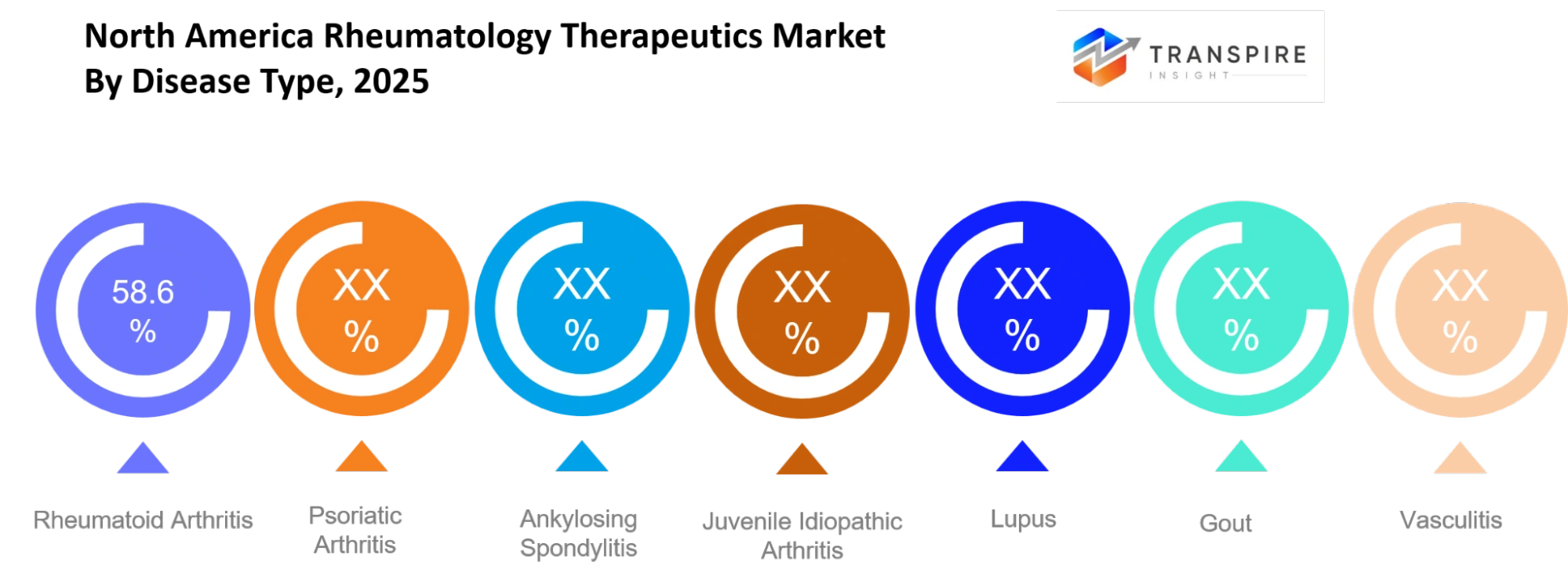
Rheumatoid arthritis turns out to be the biggest slice of the disease segment because long-term treatment is still needed so people can avoid irreversible joint harm, honestly it feels like that never really changes. Early detection and refreshed clinical guidance keep pushing the market toward more frequent adoption of advanced therapeutic options. Psoriatic arthritis is also moving ahead at a steady pace since targeted medicines are showing better real world clinical results across several patient cohorts. Ankylosing spondylitis follows suit too, it gets a boost from wider access to biologic and targeted therapies that help mobility and overall disease control.
Juvenile idiopathic arthritis plus lupus keep pulling in more research focus , mainly because personalized treatment approaches are advancing day by day. Gout management keeps broadening as improved uric acid control treatments roll out along with tighter clinical monitoring routines. Vasculitis therapy benefits from targeted immunology research, and there are also more therapeutic options appearing. The remaining autoimmune disorders keep generating extra product development chances and room for market growth.
By Route of Administration :
Subcutaneous injection still stays a preferred way to deliver biologic therapies, mostly because they help with long-term disease management, and it tends to be convenient. Oral therapies keep growing fast as newer targeted medicines show up, they give more treatment flexibility and are often better received by patients. Intravenous infusion remains a big deal for advanced biologics, especially when a controlled clinical supervision is needed. How treatment is chosen depends on disease severity , the actual therapeutic response, and what the physician recommends.
Intramuscular injection and topical therapies also continue to show up in a few selected clinical situations, where symptom control is the main goal. Combination therapy helps with treatment optimization because it lets clinicians use more than one therapeutic approach, all within a structured care plan. Extended-release formulations make dosing easier, and they also support treatment adherence across longer periods of time. Meanwhile, other administration routes keep emerging, since pharmaceutical innovation broadens the range of therapeutic options that are available.
By End User :
Hospitals still sit at the top as the biggest end-user segment , because advanced biologic therapies usually need specialist oversight and that multidisciplinary care feel. Rheumatology clinics keep pushing deeper into long-term disease management, with a more tailored approach to specialized diagnosis, ongoing monitoring, and treatment planning. Specialty clinics also keep expanding their service capacity as patient volumes keep moving up across different autoimmune categories. Ambulatory infusion centers keep pulling in more utilization , mainly because outpatient biologic administration helps boost treatment efficiency a bit.
Academic medical centers back innovation via clinical research, plus the continual evaluation of emerging therapies. Home healthcare services are growing too, as selected biologic treatments become more doable for supervised home administration. Research institutes continue contributing to drug discovery and clinical development, which in turn helps strengthen future treatment pipelines. Then there are other healthcare facilities that keep supporting wider patient access through regional care networks.
By Distribution Channel :
Hospital pharmacies keep the leading spot, because advanced therapies usually start inside specialized care facilities, not so much out in the open. Specialty pharmacies keep growing too, with special handling for biologics, patient education that’s more focused and reimbursement support services that really help. Retail pharmacies still matter a lot for more traditional therapies that need steady long term dispensing. Online pharmacies keep getting wider acceptance, mainly since digital healthcare services keep getting better at prescription management and, honestly, making medicine access easier.
Government supply programs help keep treatment availability steady across qualifying healthcare systems, and also through public reimbursement initiatives. Direct sales channels make manufacturer–provider relationships stronger for certain therapeutic products that fit that model. Then there are the other distribution paths that continue to evolve as healthcare delivery keeps getting more flexible. If distribution networks keep getting investment, treatment availability should improve, and access can stay efficient across the regional therapeutics industry.
What are the Key Use Cases Driving the North America Rheumatology Therapeutics Market?
Rheumatoid arthritis treatment is still the main use case, mostly because keeping the disease under control long term takes continuous therapeutic care. In other words, patients arent just treated once and that's it. Hospitals and rheumatology clinics drive the biggest share of purchasing activity too, since specialists routinely prescribe biologics, DMARDs, and targeted therapies. The goal is to limit joint damage, keep mobility intact , and reduce expensive complications that can creep in over time.
For psoriatic arthritis and ankylosing spondylitis, treatment is also growing, but the pattern looks a bit different. It keeps spreading through specialty clinics and ambulatory infusion centers. There is more reimbursement backing now, plus broader biosimilar availability, and updated clinical guidelines. Together these factors make it easier for healthcare providers to introduce advanced therapies earlier in the treatment pathway for patients who qualify.
Looking ahead, emerging opportunities are showing up in a few places. Biomarker-guided selection of therapy is one direction, and digital disease monitoring programs are another, especially when they are paired with advanced therapeutics. Academic medical centers and research institutes continue evaluating these ideas through clinical studies. Meanwhile precision medicine efforts, along with companion diagnostics, are expected to help with more tailored therapy decisions throughout the forecast period.
|
Report Metrics |
Details |
|
Market size value in 2025 |
USD 24.10 Billion |
|
Market size value in 2026 |
USD 25.05 Billion |
|
Revenue forecast in 2033 |
USD 32.4 Billion |
|
Growth rate |
CAGR of 3.74% from 2026 to 2033 |
|
Base year |
2025 |
|
Historical data |
2021 - 2024 |
|
Forecast period |
2026 - 2033 |
|
Report coverage |
Revenue forecast, competitive landscape, growth factors, and trends |
|
Regional scope |
North America (Canada, The United States, and Mexico) |
|
Key company profiled |
Cytiva, PerkinElmer, Ahlstrom, Whatman, QIAGEN, Thermo Fisher Scientific, Roche Diagnostics, Puritan Medical Products, Copan Diagnostics, Hardy Diagnostics, Bio-Rad Laboratories, Cardinal Health, Sarstedt, Greiner Bio-One, EKF Diagnostics . |
|
Customization scope |
Free report customization (country, regional & segment scope). Avail customized purchase options to meet your exact research needs. |
|
Report Segmentation |
By Drug Type (Biologics, JAK Inhibitors, DMARDs, NSAIDs, Corticosteroids, Biosimilars, Combination Therapies, Others); By Disease Type (Rheumatoid Arthritis, Psoriatic Arthritis, Ankylosing Spondylitis, Juvenile Idiopathic Arthritis, Lupus, Gout, Vasculitis, Others); By Route of Administration (Oral, Subcutaneous Injection, Intravenous Infusion, Intramuscular Injection, Topical, Combination Therapy, Extended-Release Formulations, Others); By End User (Hospitals, Rheumatology Clinics, Specialty Clinics, Ambulatory Infusion Centers, Academic Medical Centers, Home Healthcare, Research Institutes, Others); By Distribution Channel (Hospital Pharmacies, Retail Pharmacies, Specialty Pharmacies, Online Pharmacies, Government Supply, Direct Sales, Others) |
Which Regions are Driving the North America Rheumatology Therapeutics Market Growth?
Canada is the dominant regional driver, making up around 88% of the overall revenue in North America. The combo of solid reimbursement policies, more rigorous regulatory supervision, and wide access to specialized medical services helps keep therapeutic uptake going, year over year. Large pharmaceutical companies, research groups, specialty pharmacies, and biologic manufacturing networks also reinforce the whole regional health system, mostly through continuous investment plus reliable product supply. If innovation in immunology stays on track, biosimilar adoption keeps widening, and healthcare budgets remain steady, Canada should keep its leadership position across the forecast window.
Mexico shows a noticeably different growth pattern, since public and private healthcare continue expanding side by side, while pharmaceutical funding stays fairly consistent. Regulatory updates and slow but real progress in specialty-care access build a calmer setup for therapy adoption, without needing fast or dramatic pricing revisions. Collaboration with local distributors, along with improved specialty medicine availability, extends commercial reach across major urban healthcare centers. With relatively stable economic conditions and long-term healthcare spending commitments, Mexico remains a dependable contributor for generating regional revenue.
Mexico is also expected to show the quickest growth in the 2026–2033 stretch, because healthcare modernization programs, broader reimbursement pathways, and the higher availability of biosimilars help patients reach care. In recent months, regulatory improvements have sped up product approvals , and they also pushed multinational pharmaceutical companies to beef up their commercial operations. Meanwhile, more money is flowing into specialty clinics, plus outpatient infusion services, and that keeps widening treatment capacity across the big metropolitan hubs. With stronger market access in place, the region should offer appealing openings for manufacturers , distribution partners and even investors looking for long-term regional expansion.
Who are the Key Players in the North America Rheumatology Therapeutics Market and How Do They Compete?
Competition still feels moderately consolidated because major global pharmaceutical players hold a meaningful portion of the newer immunology treatments. In practice, competitive position is influenced by product innovation , clinical outcomes, pipeline momentum and market access agreements far more than pricing by itself. Meanwhile, long-time manufacturers keep upgrading their portfolios via ongoing research funding, and biosimilar companies add another layer of rivalry by rolling out more affordable care options.
AbbVie stands out with steady immunology work plus lifecycle management for biologic therapies , reinforced by expanded clinical indications. Pfizer improves its competitive stance through biosimilar development and portfolio moves that increase access, helping broaden treatment availability across multiple autoimmune disorders. Amgen tends to focus on biologics as well as biosimilars backed by big-scale manufacturing strengths, which supports supply consistency and commercial spread.
Johnson & Johnson grows immunology presence through more targeted research spend and fresh clinical evidence that backs wider therapeutic use. Bristol Myers Squibb leans into novel oral options and precision-oriented treatment strategies aimed at addressing unmet clinical needs, while also protecting long term pipeline value. Strategic collaborations, acquisition activity and continued investment in next generation immunology platforms will keep being key drivers for competitive growth across the forecast period.
Company List
- Cytiva
- PerkinElmer
- Ahlstrom
- Whatman
- QIAGEN
- Thermo Fisher Scientific
- Roche Diagnostics
- Puritan Medical Products
- Copan Diagnostics
- Hardy Diagnostics
- Bio-Rad Laboratories
- Cardinal Health
- Sarstedt
- Greiner Bio-One
- EKF Diagnostics
Recent Development News
In June 2026, AbbVie announced the acquisition of Apogee Therapeutics for approximately US$10.9 billion to strengthen its immunology pipeline. The transaction expands AbbVie's portfolio of therapies for inflammatory diseases and reinforces long-term investment in autoimmune treatment development, supporting future innovation relevant to rheumatology therapeutics. Source https://www.reuters.com/
In April 2025, AbbVie received U.S. FDA approval for RINVOQ (upadacitinib) for the treatment of adults with giant cell arteritis (GCA). The approval added a new rheumatology indication to the company's JAK inhibitor portfolio and strengthened competitive positioning in immune-mediated inflammatory diseases. Source https://www.nasdaq.com/
What Strategic Insights Define the Future of the North America Rheumatology Therapeutics Market?
Over the next five to seven years, the North America Rheumatology Therapeutics Market is going to lean more toward precision immunology , supported by biomarker based treatment selection, expanded biosimilar availability, and a heavier use of real-world clinical evidence when clinicians are deciding. In the end this movement should boost treatment efficiency, and also nudge wider adoption of targeted therapies across various healthcare systems.
There’s also a bit of a less visible risk, and it is tied to supply chain concentration for biologic manufacturing where production capacity is limited, or regulatory disruptions could slow down product availability , even if commercial demand stays healthy.
At the same time, an important opportunity is forming around companion diagnostics, basically matching patients with the therapy that works best before treatment really starts. This is being helped along by progress in molecular testing and digital clinical platforms. Market players will likely gain by putting money into regional manufacturing capacity, building strategic diagnostic partnerships, and keeping supply networks diversified, so resilience improves while long-term commercial competitiveness strengthens across the therapeutic landscape.
North America Rheumatology Therapeutics Market Report Segmentation
By Drug Type
- Biologics
- JAK Inhibitors
- DMARDs
- NSAIDs
- Corticosteroids
- Biosimilars
- Combination Therapies
By Disease Type
- Rheumatoid Arthritis
- Psoriatic Arthritis
- Ankylosing Spondylitis
- Juvenile Idiopathic Arthritis
- Lupus
- Gout
- Vasculitis
By Route of Administration
- Oral
- Subcutaneous Injection
- Intravenous Infusion
- Intramuscular Injection
- Topical
- Combination Therapy
- Extended-Release Formulations
By End User
- Hospitals
- Rheumatology
- Clinics
- Specialty Clinics
- Ambulatory Infusion Centers
- Academic Medical Centers
- Home Healthcare
- Research Institutes
By Distribution Channel
- Hospital Pharmacies
- Retail Pharmacies
- Specialty Pharmacies
- Online Pharmacies
- Government Supply
- Direct Sales
Frequently Asked Questions
Find quick answers to common questions.
The expected North America Rheumatology Therapeutics Market size for the market will be USD 32.4 Billion in 2033.
Key segments for the North America Rheumatology Therapeutics Market are By Drug Type (Biologics, JAK Inhibitors, DMARDs, NSAIDs, Corticosteroids, Biosimilars, Combination Therapies, Others); By Disease Type (Rheumatoid Arthritis, Psoriatic Arthritis, Ankylosing Spondylitis, Juvenile Idiopathic Arthritis, Lupus, Gout, Vasculitis, Others); By Route of Administration (Oral, Subcutaneous Injection, Intravenous Infusion, Intramuscular Injection, Topical, Combination Therapy, Extended-Release Formulations, Others); By End User (Hospitals, Rheumatology Clinics, Specialty Clinics, Ambulatory Infusion Centers, Academic Medical Centers, Home Healthcare, Research Institutes, Others); By Distribution Channel (Hospital Pharmacies, Retail Pharmacies, Specialty Pharmacies, Online Pharmacies, Government Supply, Direct Sales, Others).
Major North America Rheumatology Therapeutics Market players are Cytiva, PerkinElmer, Ahlstrom, Whatman, QIAGEN, Thermo Fisher Scientific, Roche Diagnostics, Puritan Medical Products, Copan Diagnostics, Hardy Diagnostics, Bio-Rad Laboratories, Cardinal Health, Sarstedt, Greiner Bio-One, EKF Diagnostics.
The North America Rheumatology Therapeutics Market size is USD 24.10 Billion in 2025.
The North America Rheumatology Therapeutics Market CAGR is 3.74% from 2026 to 2033.
- Cytiva
- PerkinElmer
- Ahlstrom
- Whatman
- QIAGEN
- Thermo Fisher Scientific
- Roche Diagnostics
- Puritan Medical Products
- Copan Diagnostics
- Hardy Diagnostics
- Bio-Rad Laboratories
- Cardinal Health
- Sarstedt
- Greiner Bio-One
- EKF Diagnostics
About the Authors

Pankaj Ghogare Patil
I am Pankaj Ghogare Patil, a Senior Research Analyst at Transpire Insight, specializing in the Pharmaceutical, Chemicals & Materials, Healthcare IT, and Biotechnology industry. My expertise lies in conducting comprehensive market research, analyzing industry trends, evaluating competitive landscapes, and translating complex data into actionable insights. At Transpire Insight, I closely follow emerging technologies, regulatory developments, and market innovations to create accurate, well-researched, and informative content that helps businesses and professionals make informed decisions. I am committed to producing credible, evidence-based articles that reflect industry best practices while making technical topics accessible and valuable for a broad audience.

Chakradhar Khansole
Chakradhar serves as the Research Director at Transpire Insight, bringing over 8 years of experience in technology, innovation, and strategic market intelligence. He specializes in transforming complex market data into actionable business insights that enable organizations to make informed, growth-oriented decisions. Recognized for his strategic vision and analytical expertise, Chakradhar leads high-impact research initiatives, delivering comprehensive market assessments, competitive intelligence, and forward-looking industry analysis.
Recently Published Reports
-
Apr 2026
AI in Diabetic Retinopathy Market
AI in Diabetic Retinopathy Market Size, Share & Analysis Report By Type (Screening AI Systems, Diagnostic AI Systems, and Predictive AI Models), By Application Segment (Hospitals, Ophthalmology Clinics, Diagnostic Centers, and Research and Development), and Geography (North America, Europe, Asia-Pacific, Middle East and Africa, South and Central America), 2021 - 2031
-
Apr 2026
Psychometric Tests Market
Psychometric Tests Market Size, Share & Analysis Report By Type (Personality Tests, Ability/Aptitude Tests, Skill/Knowledge Tests, and Others), By Application (Talent Acquisition and Talent Management), and Geography (North America, Europe, Asia-Pacific, Middle East and Africa, South and Central America), 2021 – 2031
-
Apr 2026
Rare Biological Sample Collection Market
Rare Biological Sample Collection Market Size, Share & Analysis Report By Type (Isolation Kits & Reagent, Blood Collection Tubes, and Others), By Application (Oncology, Transcriptomics, Pharmacogenomics, and Others), and Geography (North America, Europe, Asia-Pacific, Middle East and Africa, South and Central America), 2021 – 2031
-
Jul 2026
Diabetic Retinopathy Market
Diabetic Retinopathy Market Size, Share & Analysis Report By Type (Proliferative Diabetic Retinopathy, and Diabetic Macular Edema (DME)), By Treatment Type (Anti VEGF Drug, Steroid Implants, Laser Surgeries, and Vitrectomy), and Geography (North America, Europe, Asia-Pacific, Middle East and Africa, South and Central America), 2021 – 2031
Our Clients







