

North America Radioligand Therapy Market Size & Forecast:
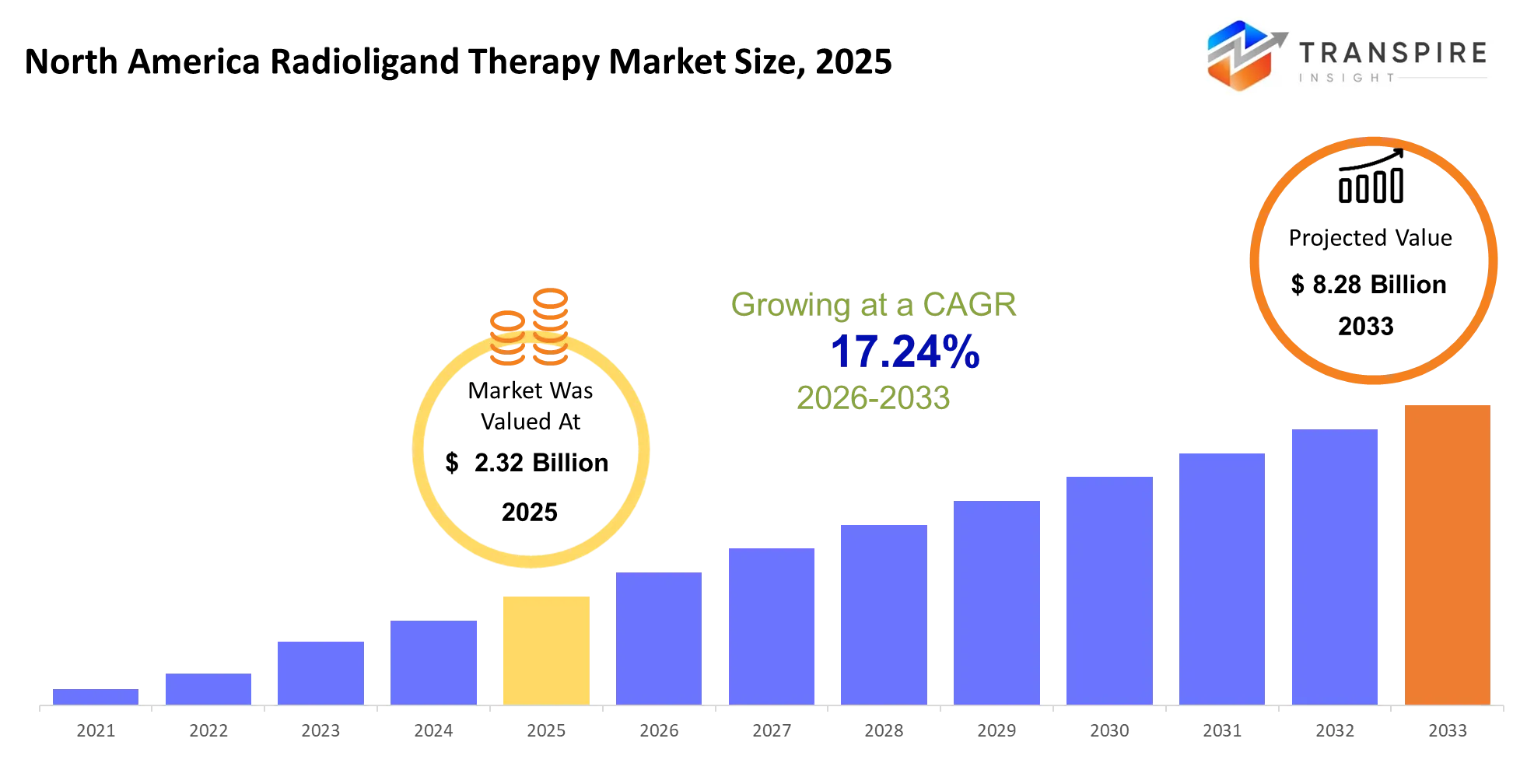
- North America Radioligand Therapy Market Size 2025: USD 2.32 Billion
- North America Radioligand Therapy Market Size 2033: USD 8.28 Billion
- North America Radioligand Therapy Market CAGR: 17.24%
- North America Radioligand Therapy Market Segments: By Product Type (Targeted Radioligand Therapy, Alpha-emitting Therapy, Beta-emitting Therapy, Others); By Application (Prostate Cancer, Neuroendocrine Tumors, Breast Cancer, Lung Cancer, Others); By End User (Hospitals, Cancer Treatment Centers, Research Institutes, Others); By Isotope Type (Lutetium-177, Actinium-225, Iodine-131, Others)
To learn more about this report,  Download Free Sample Report
North America Radioligand Therapy Market Summary
The North America Radioligand Therapy Market was valued at USD 2.32 Billion in 2025. It is forecast to reach USD 8.28 Billion by 2033. That is a CAGR of 17.24% over the period.
The North America Radioligand Therapy market sort of delivers targeted cancer care by attaching radioactive isotopes to tumor specific molecules, so oncologists can knock out malignant cells while still trying to keep damage to healthy tissue under control. What’s practical here is that it supports precision treatment pathways for prostate and neuroendocrine cancers inside hospital nuclear medicine spaces, plus those specialized oncology centers. The overall thing is pretty much that it turns diagnostic imaging clues into therapeutic action within one clinical framework, not like separate lanes.
In the past 3 to 5 years, the market has been moving in a more structural direction toward integrated theranostic care models, where imaging and therapy run as a connected workflow, rather than separate steps. One big trigger was the post-pandemic supply chain disruption in medical isotopes, and it revealed how dependent the system was on a few global production routes. That situation pushed domestic capacity expansion across the United States. Together, this has sped up adoption, because treatment availability now relies on isotope security nearly as much as on clinical demand. Meanwhile, as manufacturing scales up and patient stratification gets sharper thanks to advanced imaging, revenue growth seems to follow treatment scalability more than it does isolated drug approvals.
Key Market Insights
- In 2025 the United States sort of dominates the North America Radioligand Therapy Market, with almost 80% share, mostly because the country has advanced nuclear medicine infrastructure and also quicker regulatory approvals.
- Canada meanwhile looks like the fastest-growing regional contributor through 2030 , fueled by centralized healthcare funding and wider oncology imaging networks that keep getting added.
- When you look at products, targeted beta-emitting therapies end up taking the largest product share. This is tied to established clinical protocols and broad hospital adoption across cancer centers, even when workflows get complex.
- Alpha-emitting therapies appear to be the fastest-growing segment too, with momentum coming from more clinical trials that use actinium-225 based precision oncology treatments.
- For applications, prostate cancer brings in the biggest demand , taking more than 60% share in the North America Radioligand Therapy Market. That happens largely due to strong adoption of PSMA-targeted therapy.
- Neuroendocrine tumor treatment is described as the fastest-growing application segment, because theranostic workflows keep expanding in specialized oncology hospitals where the process is already pretty standardized.
- By end user hospitals stay in front, they hold the highest share , and the reason is integrated nuclear medicine departments plus reimbursement-backed delivery systems for treatment.
- Cancer treatment centers show the fastest growth, mainly as outpatient precision oncology expands quickly, along with PET guided treatment planning that gets implemented sooner rather than later.
- On the competitive side, Novartis leads with strategy that leans on vertical integration of radioligand manufacturing, plus expanded U.S. production facilities.
- Lantheus strengthens its position through leadership in PSMA diagnostic imaging, which in turn shapes early patient identification pipelines.
What are the Key Drivers, Restraints, and Opportunities in the North America Radioligand Therapy Market?
Driver: The North America Radioligand Therapy market is mainly pushed by the pretty fast clinical adoption of PSMA based treatments for metastatic prostate cancer, after solid survival results and regulatory go-aheads in the recent years. That pivot, away from broad chemotherapy toward precision radiopharmaceuticals, really boosts referral traffic into nuclear medicine departments, where outpatient delivery setups help move patients through faster. In practice this translates into a direct lift for hospital revenue cycles, since these therapies are given in repeated dosing routines, not just a one time oncology event.
Restraint: The biggest structural bottleneck remains the concentration of isotope supply, with especially heavy dependence on a small set of global production lines for lutetium-177, plus newer constraints affecting actinium-225. This situation drives scheduling turbulence for treatment sites, and it makes them start sorting by urgency, prioritizing higher risk patients whenever shortages hit. And because isotope production needs specialized reactor or accelerator type infrastructure, with long construction and commissioning timelines, the whole issue cannot be fixed quickly. So you end up with delayed therapy starts, missed treatment windows, and that suppresses revenue performance across oncology networks
Opportunity: A notable emerging opening sits in decentralized isotope production, along with more integrated theranostic platforms , especially when there are investments aimed at domestic manufacturing in the United States. Novartis and a few radiopharma players are growing localized output capacity while pairing it with AI driven imaging tools that make patient selection more streamlined, quicker and more consistent.As cyclotron-based production kinda scales up, and hospital networks start to use integrated imaging-therapy workflows, the market gains potential to expand treatment access beyond those big academic centers, into regional cancer hospitals. This could unlock a wider and more distributed revenue base, you know, not just in the major places, but also everywhere else.
What Has the Impact of Artificial Intelligence Been on the North America Radioligand Therapy Market?
Artificial intelligence is kind of reshaping the North America Radioligand Therapy workflow, in a way that boosts precision during imaging interpretation, therapy planning, and yes, isotope utilization. More and more hospitals and cancer centers now rely on AI assisted PET/CT analysis tools. These tools tend to automate lesion detection and quantify PSMA expression, so the clinicians face less manual reading variability and treatment eligibility decisions can move faster, which in practice matters a lot. On top of that, digital treatment planning systems are increasingly embedding AI models to fine-tune radiopharmaceutical dosing, based on tumor burden, renal function, and prior response history, and this helps make clinical decision consistency more uniform across oncology networks.
Also, machine learning models are being deployed to forecast isotope demand and improve scheduling for cyclotron- and reactor-based production. The goal is to reduce supply bottlenecks that used to disrupt continuity of therapy. In early rollouts at some leading cancer centres, people report improvements that look like shorter patient onboarding cycles, and a more efficient use of therapy slots. That, in turn, supports higher daily treatment throughput without adding new infrastructure. And then there is AI driven predictive analytics, which helps with adverse event monitoring by flagging patients who may be at higher risk of hematologic toxicity earlier in the treatment cycle.
Still, adoption is not smooth everywhere. It gets slowed down by limited standardized training datasets across radiopharmaceutical modalities, which limits how well models generalize from one institution to another. Integration costs are another issue, because the AI systems have to connect with imaging platforms, hospital EHRs, and nuclear medicine workflows. That kind of plumbing, frankly, drags on large scale deployment even when clinical interest stays strong.
Key Market Trends
- Hospitals have been moving away from all that experimental radiopharmaceutical stuff and leaning into more standardized PSMA based treatment routes across prostate cancer care pathways, since around 2023. And yes, it kind of looks like the whole system got steadier not just faster.
- Novartis, in particular, expanded its U.S. radioligand manufacturing capacity during 2025–2026, which should reduce anxiety about isotope dependence and make the domestic supply chain feel less fragile.
- After 2024, many clinical centers adopted PET guided patient stratification in a broader way, so therapy targeting got more precise and the “can we treat this person now” decisions moved quicker .
- Meanwhile, Actinium-225 programs started picking up speed as oncology companies reworked pipelines, redirecting attention toward alpha emitting therapies for tougher, treatment resistant metastatic tumor groups.
- Between 2024 and 2026, payer reimbursement frameworks also shifted, increasingly tying radioligand therapy access to evidence from real world outcomes, not only traditional coverage logic but also survival metrics.
- Lantheus strengthened its diagnostic position by expanding PSMA imaging uptake, so competition drifted more toward upstream control of patient identification, instead of focusing so hard on drug pricing alone.
- Also, supply chain localization got pushed harder after isotope shortages made reactor reliance risks feel more obvious. That triggered investments in domestic production infrastructure across North America, like it was overdue.
- Finally, cancer specialty centers expanded their theranostic service lines post 2024, blending imaging and therapy delivery into a more unified outpatient oncology treatment model, which sounds neat but probably takes real coordination.
North America Radioligand Therapy Market Segmentation
By Product Type
Targeted radioligand therapy is still sort of holding the lead in the North America Radioligand Therapy product picture, mostly because oncology has strong clinical backing, and because regulatory entry has been quick enough for late-stage cancer care. Alpha emitting therapies don’t take as much share, but they get a lot of attention, since they’re very precise, and they can be brutally effective against tumor tissue even in small metastatic sites. Beta emitting therapies keep fairly stable use, because there are well known clinical protocols and also because many centers can actually access them without too much friction. Other experimental formats stay more niche, partly due to fewer approvals and those usual infrastructure limitations you always see with radiopharmaceutical programs.
This segment is moving forward mainly due to a stronger tilt toward precision oncology tools, those that can lower systemic toxicity while also improving survival results. Alpha emitters pick up speed as isotope production capabilities keep improving, while beta emitters still ride on physician familiarity and reimbursement steadiness ( you know, the practical side ). Supply chain integration for isotopes, that becomes a clear differentiator across all product types. Looking ahead, expansion is likely to favor developers that secure isotope access and prove scalable manufacturing, particularly for next generation alpha based therapies.
By Application
Prostate cancer is the top application segment in the North America Radioligand Therapy market, mainly due to broad uptake of PSMA targeted treatments, plus the high prevalence of advanced stage patients. Neuroendocrine tumors come in as the second most established application, and it’s supported by long standing clinical use of radiopharmaceuticals in specialist oncology settings. Breast and lung cancer remain in earlier adoption phases, and their pace is held back by ongoing clinical validation plus narrower approved indications. Other oncology applications are still exploratory, and they’re spread across clinical trial environments.
Growth in applications is being driven by expanding diagnostic precision, and somehow also by better patient stratification via molecular imaging. Prostate cancer demand remains mostly stable, partly because of repeat-dosing potential and the strong survival data supporting it. Neuroendocrine use cases benefit from integrated theranostic workflows typically handled in tertiary care hospitals. Looking ahead, more expansion will likely hinge on label extensions and combination therapies, especially alongside immuno-oncology drugs, and that could broaden adoption well past the current late stage treatment pathways.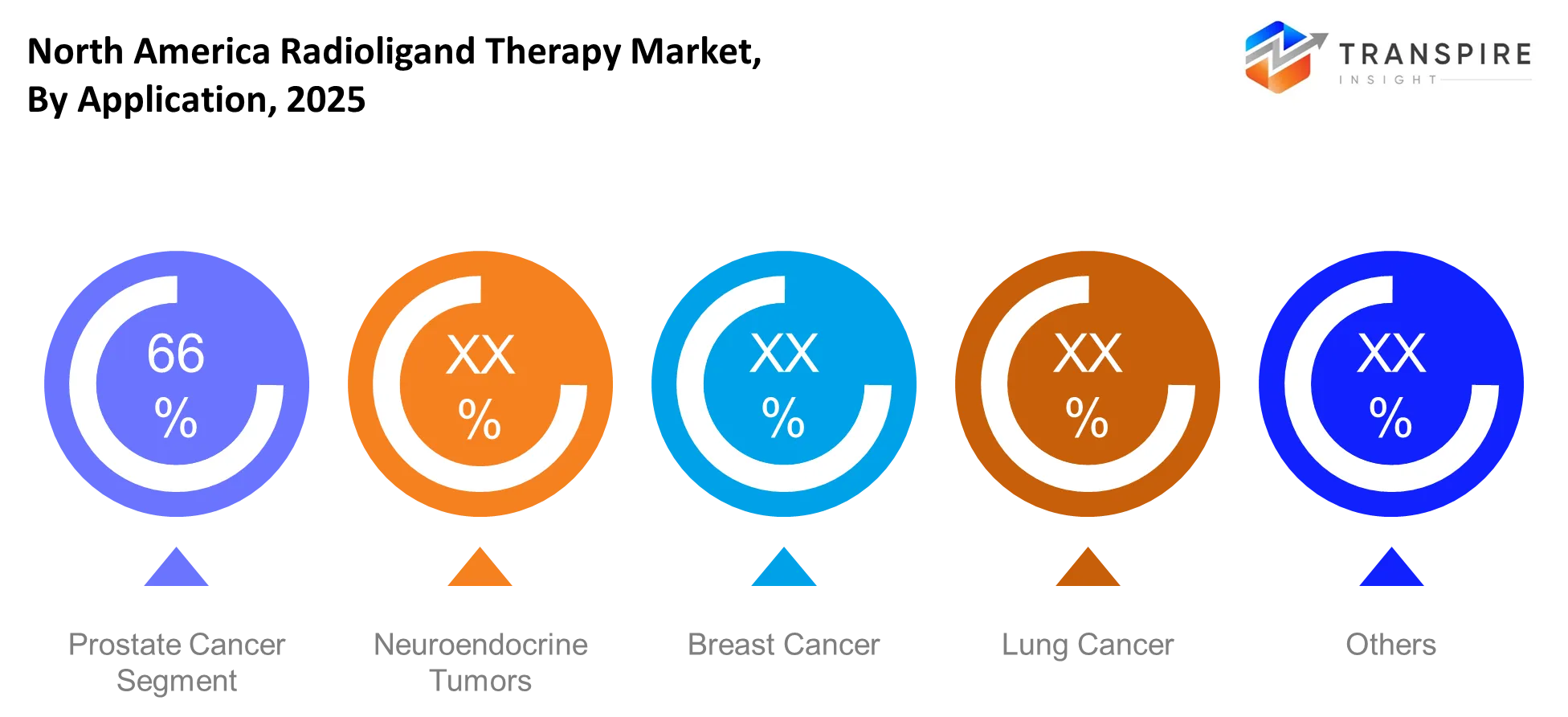
To learn more about this report, Download Free Sample Report
By End User
In the North America Radioligand Therapy market , Hospitals lead end user adoption because they have access to nuclear medicine departments, plus the oncology infrastructure that supports coordinated care. Cancer treatment centers are climbing fast as a segment because they focus on precision oncology, and they can manage complex treatment protocols without too much friction. Research institutes matter a lot for early stage clinical trials and isotope based innovation, though their commercial share is comparatively smaller. The rest of the end users are more scattered, and tend to be very local.
The growth pattern really seems tied to institutional capability, not just patient volume. Hospitals gain traction through reimbursement frameworks and established referral pipelines, while specialized cancer centers push innovation via protocol standardization and quicker adoption cycles. Research institutes help move the pipeline forward by validating new isotopes, and by stress testing combination therapies. Over the forecast horizon, expansion will likely tilt toward organizations that link imaging, therapy, and diagnostics into one kind of unified care pathway, which concentrates demand across advanced oncology networks.
By Isotope Type
Lutetium-177 kind of dominates isotope usage in the North America Radioligand Therapy market. This happens because its clinical efficacy has been proven, its radiation profile remains manageable, and an established manufacturing infrastructure already exists. Actinium-225 is still more constrained on supply, but it keeps drawing big attention for its really potent alpha-emitting behavior, and for how it fits resistant tumor categories. Iodine-131 keeps showing up in legacy work, especially thyroid cancer therapy, yet its role is slowly shrinking. As for the “other isotopes”, most of them stay in experimental or pilot use across various research contexts, and you know, not really mainstream yet.
The growth story is driven mostly by production scalability and supply chain resilience, not just by clinical demand. Lutetium-177 benefits as both reactor and non-reactor production routes expand, helping to keep availability steadier. Actinium-225 experiences serious demand pull while global supply stays limited, so it creates strategic weight for early supply chain investors. Where the market goes next will likely hinge on diversifying isotope sourcing. That means emerging production technologies will influence who ends up competitive among manufacturers and healthcare providers, pretty directly.
What are the Key Use Cases Driving the North America Radioligand Therapy Market?
In the North America Radioligand Therapy market, prostate cancer treatment still sort of leads the way, especially in metastatic castration-resistant situations where targeted delivery is expected to improve survival outcomes while keeping systemic side effects a bit more controlled. The demand is pulled along by rising incidence rates, plus there’s strong clinical validation behind PSMA-targeted approaches, and they are becoming more and more part of everyday oncology care pathways.
Beyond that, expansion is happening in neuroendocrine tumors and thyroid cancers, where oncology hospitals and specialty cancer centers are leaning into theranostic workflows, basically pairing imaging and treatment in the same program. These environments really gain from better patient stratification, using PET-based diagnostics, so advanced care units can choose therapy more precisely, rather than broadly.
On the newer side, there are emerging use cases tied to earlier-line intervention in high-risk cancers and also personalized retreatment cycles that are guided by real-time molecular imaging. Research hospitals and clinical trial networks are additionally looking at combination regimens alongside immunotherapy, this could widen adoption beyond late-stage oncology into more integrated precision treatment programs, where the whole plan feels more continuous.
|
Report Metrics |
Details |
|
Market size value in 2025 |
USD 2.32 Billion |
|
Market size value in 2026 |
USD 2.72 Billion |
|
Revenue forecast in 2033 |
USD 8.28 Billion |
|
Growth rate |
CAGR of 17.24% from 2026 to 2033 |
|
Base year |
2025 |
|
Historical data |
2021 - 2024 |
|
Forecast period |
2026 - 2033 |
|
Report coverage |
Revenue forecast, competitive landscape, growth factors, and trends |
|
Regional scope |
North America (Canada, The United States, and Mexico) |
|
Key company profiled |
Novartis, Bayer, Curium Pharma, Telix Pharmaceuticals, POINT Biopharma, Eli Lilly, AstraZeneca, Bristol Myers Squibb, ITM Isotope Technologies Munich, Fusion Pharmaceuticals, Lantheus Holdings, GE HealthCare, Siemens Healthineers, Eckert & Ziegler, Jubilant Radiopharma |
|
Customization scope |
Free report customization (country, regional & segment scope). Avail customized purchase options to meet your exact research needs. |
|
Report Segmentation |
By Product Type (Targeted Radioligand Therapy, Alpha-emitting Therapy, Beta-emitting Therapy, Others); By Application (Prostate Cancer, Neuroendocrine Tumors, Breast Cancer, Lung Cancer, Others); By End User (Hospitals, Cancer Treatment Centers, Research Institutes, Others); By Isotope Type (Lutetium-177, Actinium-225, Iodine-131, Others) |
Which Regions are Driving the North America Radioligand Therapy Market Growth?
The United States really dominates the North America Radioligand Therapy market because it has this advanced oncology framework, plus an early go ahead on targeted radiopharmaceuticals from regulators. Also, there’s a lot going for it— dense PET imaging networks, already set theranostics centers, and reimbursement pathways that basically move patients toward new treatments quicker. On top of that, federal backing for nuclear medicine research and domestic isotope production adds supply chain safety, so less wobble later. Then there’s the whole mature ecosystem of big hospital systems and specialty oncology networks, which helps clinical uptake happen fast, and it supports repeat treatment cycles, more or less.
Canada is smaller, but it still feels structurally steady in the regional market. It leans on universal healthcare coverage, and centralized drug authorization via Health Canada. Growth there is tied to steady public financing for oncology care, along with solid nuclear medicine departments across provinces like Ontario and Alberta. In contrast to the United States, Canada tends to keep adoption in a more controlled mode, connected to health technology assessments it can slow commercialization a bit, but it usually means long term integration is more predictable. There’s also cross border collaboration with U.S. research institutions, which makes it easier to join next generation radiopharmaceutical trials and participate in them more often.
Mexico is showing up as the fastest-growing adoption frontier, and that’s mostly due to rising private healthcare investment, plus a gradual modernization of oncology infrastructure. In practice, private hospital chains have been expanding, and they’ve gotten more involved in international clinical networks, so access to advanced diagnostic imaging and targeted cancer therapies is improving. COFEPRIS is working on regulatory alignment too, which helps approvals move faster for imported radiopharmaceuticals. Over the 2026 to 2033 period, this growth signals an entry opportunity for suppliers that can build distribution partnerships and establish early clinical training networks in underpenetrated oncology centers.
Who are the Key Players in the North America Radioligand Therapy Market and How Do They Compete?
The North America Radioligand Therapy market looks like it’s moderately consolidated, in the sense that a small band of vertically integrated players control most of the approved therapies, while a wider crowd of radiopharmaceutical firms compete across imaging, isotope sourcing, and late-stage pipelines, sort of all at once. Here the fight isn’t really about price , it’s more about who can manage isotope sourcing, maintain clinical infrastructure and reach physicians through access networks. It’s also getting reshaped by groups that can tie together manufacturing, distribution, and diagnostic pairing, not just the ones pushing a single-drug concept.
Novartis kind of anchors the market with its dual presence in Pluvicto and Lutathera and a strategy centered on vertically integrated radioligand manufacturing. Its growing U.S. production footprint lowers supply risk, and it improves hospital contracting leverage because therapy availability is less uncertain. Lantheus shows strength mainly via diagnostic leadership, especially with PSMA-PET imaging agents, that effectively place it upstream in patient identification workflows, so it can influence therapy choice even if it doesn’t fully own the key therapeutic isotopes.
Telix Pharmaceuticals differentiates with rapid radiopharmaceutical development, plus commercialization partnerships, and it leans into an imaging-first stance to build “therapy adjacency” relationships over time. NorthStar Medical Radioisotopes adds another angle by shoring up the supply chain, focusing on domestic isotope production, which cuts down reliance on reactor-based imports, and that part matters for continuity. Curium also expands by leaning on a diversified radiopharma portfolio and an international distribution network, and it leans on manufacturing scale to lock in long-term institutional contracts, you know, the steady kind.
Company List
- Novartis
- Bayer
- Curium Pharma
- Telix Pharmaceuticals
- POINT Biopharma
- Eli Lilly, AstraZeneca
- Bristol Myers Squibb
- ITM Isotope Technologies Munich
- Fusion Pharmaceuticals
- Lantheus Holdings
- GE HealthCare
- Siemens Healthineers
- Eckert & Ziegler
- Jubilant Radiopharma
Recent Development News
“In November 2025, Novartis announced the opening of a new radioligand therapy manufacturing facility in Carlsbad, California. The facility expands its U.S. production network to strengthen supply reliability and increase manufacturing capacity for precision oncology treatments, particularly Pluvicto and Lutathera, across western U.S. patient markets.”https://www.novartis.com
“In January 2026, Novartis announced plans to build a new radioligand therapy manufacturing facility in Winter Park, Florida. The investment expands its U.S. production footprint to better serve southeastern patient demand and strengthens its end-to-end radiopharmaceutical supply chain under a broader $23 billion infrastructure program.”https://www.novartis.com
What Strategic Insights Define the Future of the North America Radioligand Therapy Market?
North America Radioligand Therapy market is kind of moving toward a more tightly stitched precision oncology ecosystem, where targeted radiopharmaceuticals move care away from hospital-centric infusion oncology toward more specialized outpatient theranostics centers, but it still feels like the same story in a different coat. The momentum is fueled by the widening clinical indications for prostate cancer and neuroendocrine cancers, plus stronger payer acceptance of reimbursement models that are tied to outcomes.
The next phase, not surprisingly, will be shaped by closer, almost inseparable integration between diagnostic imaging and therapeutic isotopes, so patients can get stratified earlier, and dosing cycles can repeat on a more regular basis. That rhythm should help sustain recurring revenue streams. Still, there’s a less obvious risk sitting in the background: dependence on isotope supply chains that are constrained. In particular lutetium-177 production is concentrated, and if reactor downtime hits, the whole flow can get stuck, even if demand stays strong and loud.
At the same time, alpha-emitting isotopes like actinium-225, and more decentralized production technologies are starting to show up as a strategic opening. Also, AI-enabled treatment selection platforms are emerging alongside that, as a kind of navigation layer for decisions. Market participants should focus on locking in isotope manufacturing partnerships, and co-developing end to end theranostic platforms, so they can hold onto both the clinical position and the supply chain position before capacity tightens up.
North America Radioligand Therapy Market Report Segmentation
By Product Type
- Targeted Radioligand Therapy
- Alpha-emitting Therapy
- Beta-emitting Therapy
- Others
By Application
- Prostate Cancer
- Neuroendocrine Tumors
- Breast Cancer
- Lung Cancer
- Others
By End User
- Hospitals
- Cancer Treatment Centers
- Research Institutes
- Others
By Isotope Type
- Lutetium-177
- Actinium-225
- Iodine-131
- Others
Frequently Asked Questions
Find quick answers to common questions.
The North America Radioligand Therapy Market size is USD 8.28 Billion in 2033.
Key Segments for the North America Radioligand Therapy Market are By Product Type (Targeted Radioligand Therapy, Alpha-emitting Therapy, Beta-emitting Therapy, Others); By Application (Prostate Cancer, Neuroendocrine Tumors, Breast Cancer, Lung Cancer, Others); By End User (Hospitals, Cancer Treatment Centers, Research Institutes, Others); By Isotope Type (Lutetium-177, Actinium-225, Iodine-131, Others).
Major North America Radioligand Therapy Market Players are Novartis, Bayer, Curium Pharma, Telix Pharmaceuticals, POINT Biopharma, Eli Lilly, AstraZeneca, Bristol Myers Squibb, ITM Isotope Technologies Munich, Fusion Pharmaceuticals, Lantheus Holdings, GE HealthCare, Siemens Healthineers, Eckert & Ziegler, Jubilant Radiopharma.
The Current North America Radioligand Therapy Market size is USD 2.32 Billion in 2025.
The North America Radioligand Therapy Market CAGR is 17.24% from 2026 to 2033.
- Novartis
- Bayer
- Curium Pharma
- Telix Pharmaceuticals
- POINT Biopharma
- Eli Lilly, AstraZeneca
- Bristol Myers Squibb
- ITM Isotope Technologies Munich
- Fusion Pharmaceuticals
- Lantheus Holdings
- GE HealthCare
- Siemens Healthineers
- Eckert & Ziegler
- Jubilant Radiopharma
Recently Published Reports
-
May 2026
Biosimilars Market
Biosimilars Market By Product Type (Monoclonal Antibodies, Recombinant Hormones, Erythropoietin, G-CSF, Others), By Indication (Oncology, Autoimmune Diseases, Blood Disorders, Diabetes, Others), By Manufacturing Type (In-House Manufacturing, Contract Manufacturing), By Distribution Channel (Hospital Pharmacies, Retail Pharmacies, Online Pharmacies), By Industry Analysis, Size, Share, Growth, Trends, and Forecasts 2021-2033
-
Apr 2026
Gastrointestinal Endoscopy Market
Gastrointestinal Endoscopy Market By Type (Rigid Gastrointestinal Endoscope, Flexible Gastrointestinal Endoscopes, Disposable Gastrointestinal Endoscope), By Procedure Type (Colonoscopy, Gastroscopy, Duodenoscopy, Enteroscopy, Flexible Sigmoidoscopy, Others), By Application (Diagnosis, Treatment), By End-Users (Hospitals, Ambulatory Surgical Centers, Specialty Clinics, Laboratories, Others), By Industry Analysis, Size, Share, Growth, Trends, and Forecasts 2021-2033
-
Apr 2026
Rare Inherited Metabolic Disorder Drug Market
Rare Inherited Metabolic Disorder Drug Market By Drug Class (Enzyme Replacement Drugs, Gene Therapy Drugs, Substrate Reduction Drugs, Small Module Drugs, Protein Drugs), By Route of Administration(Parenteral, Oral, Intrathecal), By Clinical Development (Marketed Drugs, Late Stage Clinical Phase III, Early Stage Clinical Phase I-II, Preclinical Candidates), By Indication (Lysosomal Storage Disorders, Urea Cycle Disorders, Amino Acid Metabolic Disorders, organic Acidemias, Peroximal Disorders), By Industry Analysis, Size, Share, Growth, Trends, and Forecasts 2021-2033
-
Jan 2026
Pharmaceutical Cleanroom Technology Market
Pharmaceutical Cleanroom Technology Market By Product (Equipment, Consumables, Services); By Cleanroom Type (Standard Cleanrooms, Modular Cleanrooms); By End Use (Pharmaceutical Companies, Biotechnology Companies), By Industry Analysis, Size, Share, Growth, Trends, and Forecasts 2021-2033