

North America Radioembolization Therapy Market Size & Forecast:
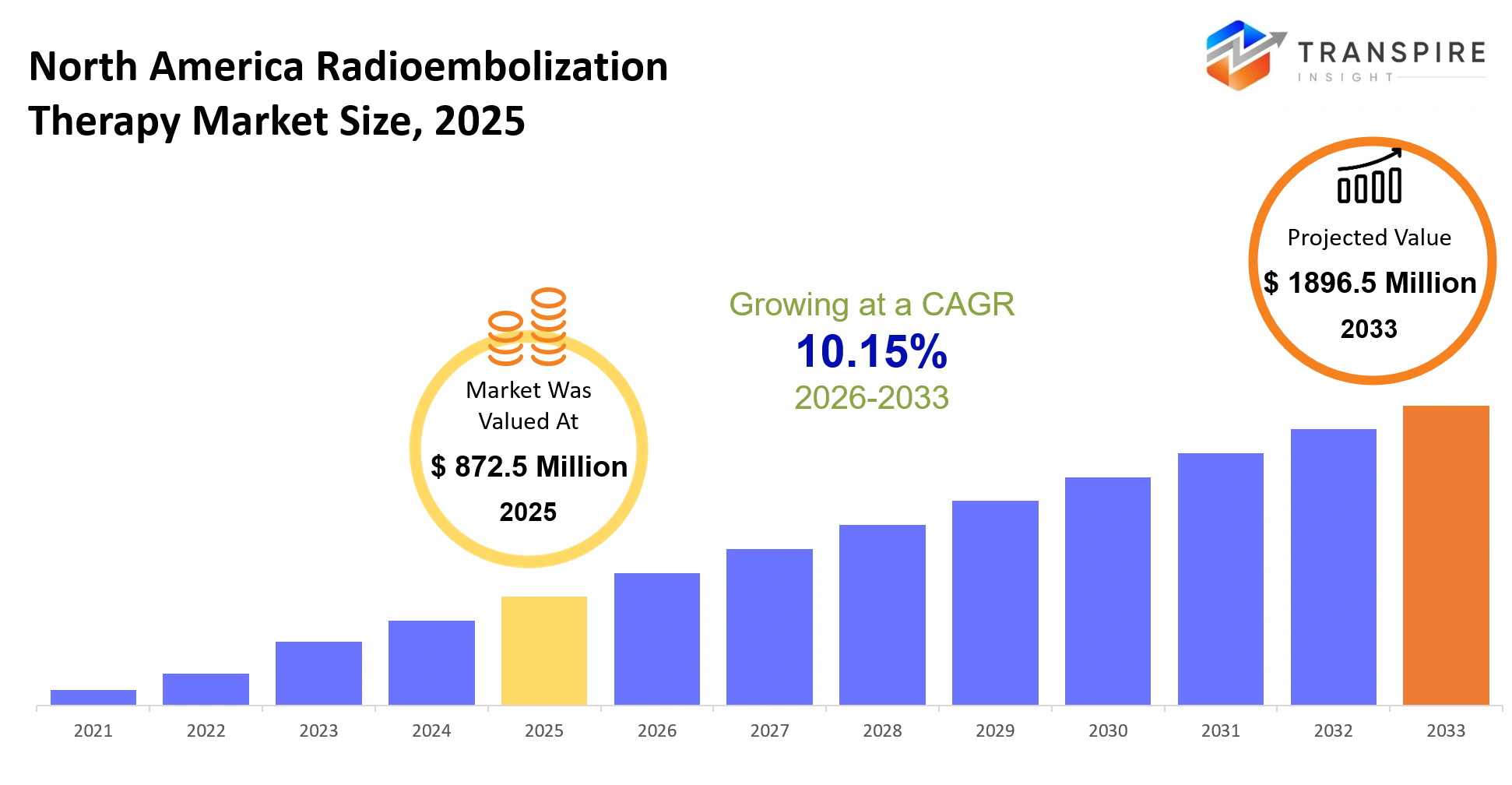
- North America Radioembolization Therapy Market Size 2025: USD 872.5 Million
- North America Radioembolization Therapy Market Size 2033: USD 1896.5 Million
- North America Radioembolization Therapy Market CAGR: 10.15%
- North America Radioembolization Therapy Market Segments: By Product Type (Yttrium-90 Microspheres, Glass Microspheres, Resin Microspheres, Others); By Application (Liver Cancer, Metastatic Colorectal Cancer, Neuroendocrine Tumors, Others); By End User (Hospitals, Oncology Centers, Specialty Clinics, Others); By Procedure Type (Selective Internal Radiation Therapy, Transarterial Radioembolization, Others)
To learn more about this report,  Download Free Sample Report
North America Radioembolization Therapy Market Summary
The North America Radioembolization Therapy Market was valued at USD 872.5 Million in 2025. It is forecast to reach USD 1896.5 million by 2033. That is a CAGR of 10.15% over the period.
The North America Radiation Treatment Planning Solutions Market is increasingly heading toward an AI-first, cloud-native oncology ecosystem where planning, imaging, and treatment delivery work as a unified digital workflow. This is being fueled by ongoing oncology workforce shortages and treatment complexity that keeps climbing, so providers are leaning more on automation and adaptive decision support rather than mostly manual planning methods. In the next 5 to 7 years, revenue growth should increasingly shift toward subscription-based platforms that support continuous model learning and cross-site clinical collaboration.
There’s also a quieter risk that doesn’t get mentioned as much—like overdependence on proprietary AI models that sit inside a small circle of bundled vendor ecosystems. As hospitals consolidate their technology stacks, you can end up with competitive concentration that may restrict interoperability and quietly shrink buyers bargaining power. That can leave hospitals exposed to longer term switching costs and innovation slowdowns. Even if headline growth stays strong, this kind of structural dependency could still dampen multi-vendor innovation cycles.
On the opportunity side, something more novel is federated-learning treatment optimization networks, where hospitals train a shared AI model without exchanging patient-level data. It’s already seeing early pull in large US cancer research consortia, and it could open the door to scalable precision improvements. Market players should push for open-architecture platforms and also invest in interoperability standards, just to avoid lock-in, while still capturing the next wave of collaborative, data-driven oncology planning systems.
Key Market Insights
- The United States really seems to dominate the North American Radioembolization Therapy Market, with roughly 75% share by 2025, mostly because it has advanced interventional oncology infrastructure in place.
- And for Canada, it is coming in as the fastest-moving regional contributor from 2026–2030, mainly because reimbursement for liver cancer treatment procedures has expanded.
- Also, the fact that lots of high-volume procedures are concentrated in major US cancer centers helps keep regional dominance strong across tertiary care hospitals in general.
- Yttrium-90 (Y-90) microspheres are still leading, taking more than 60% share, largely tied to strong clinical performance for hepatic tumor targeting.
- After that, radioembolization delivery systems land as the second-largest piece,and they benefit from wider procedural uptake inside interventional radiology units.
- Meanwhile, biodegradable microsphere innovation looks like the quickest growing slice through 2026–2031, driven by incremental gains in safety plus precision and overall better control.
- For applications, hepatocellular carcinoma treatment holds nearly 65% share across the North America Radioembolization Therapy Market because the disease burden is high.
- Liver metastases that stem from colorectal cancer are, sort of, showing the fastest growth. At the same time there is a rising uptake, especially alongside multidisciplinary oncology teams, and it feels like more sites are lining up with that approach.
- Then again, a broader use in neuroendocrine tumors is starting to pop up too, as hospitals fine tune, and broaden their interventional oncology protocols.
- In practice hospitals dominate the end user demand, with something like 70% share. A lot of facilities run combined oncology and interventional radiology departments, and because of that coordination, diffusion tends to go smoother, and faster.
What are the Key Drivers, Restraints, and Opportunities in the North America Radioembolization Therapy Market?
The North America Radioembolization Therapy Market is mostly powered by a growing clinical preference for minimally invasive, focused liver cancer care. This movement really picked up after hepatocellular carcinoma rates kept climbing and after better clinical data started backing Y-90 microsphere therapy, as sort of a more measured option versus systemic chemotherapy. Also, as interventional radiology departments are spreading across major US hospitals, more procedures are getting done, which pushes device utilization up and keeps recurring income flowing from embolic materials, plus the delivery systems.
The biggest drawback, though, is the high level of procedural complexity and the fact that specialists are not always easy to find. In practice, this limitation is kind of structural, since the therapy relies on well trained interventional radiologists and constant multidisciplinary oncology coordination, and that sort of capability can’t be scaled overnight. A lot of secondary hospitals also don’t yet have the nuclear medicine handling workflows and the right post-procedure imaging support, so adoption gets delayed. As a result, revenue expansion stays concentrated in major urban cancer centers rather than spreading widely.
A notable opening is starting to show up via the growth of outpatient interventional oncology centers, especially where they’re backed by hospital linked ambulatory care networks. For instance, in the United States integrated cancer programs are increasingly moving liver cancer procedures into same day treatment routes, supported by advanced catheter based delivery tools. This shift is being reinforced by stronger investment in precision microsphere technologies, and it could broaden procedural access across mid sized healthcare facilities, which in turn could unlock new revenue channels in the North America Radioembolization Therapy Market.
What Has the Impact of Artificial Intelligence Been on the North America Radioembolization Therapy Market?
Artificial intelligence and advanced imaging analytics are starting to reshape radioembolization workflows in North America, sorta, by pushing procedural accuracy and also making clinical call-making feel more steady. In interventional oncology systems AI powered image segmentation basically takes over tumor border outlining and vascular mapping, so clinicians spend less time on manual planning, and the Y-90 microsphere placement turns out more consistent. Because of these automation aids, the treatment planning stage runs more efficiently within radiology scrubber performance systems, especially in big liver cancer centers where things have to move fast and the turnaround matter a lot.
On top of that, machine learning models help with predictive optimization, by looking at patient imaging, liver perfusion data, and also earlier treatment results, to guess how the radiation dose might distribute and how well the embolization may work. Hospitals then use these predictive signals to fine-tune catheter positioning and to curb non target radiation exposure. The end result tends to be better procedural success rates and fewer situations where patients need repeat interventions. From an operational view, several leading US oncology centers report clear reductions in procedure planning time, plus a smoother use of staff and equipment, which helps drive down per case treatment costs while boosting interventional radiology throughput.
Still there’s a major snag, the integration cost is high and imaging datasets can be fragmented across hospital networks. A lot of AI tools need standardized angiographic and nuclear imaging inputs, but those inputs aren’t consistent from one institution to another, so adoption can slow down. Even so, the ongoing investment in interoperable imaging platforms keeps expanding the role of digital technologies across the North America Radioembolization Therapy Market.
Key Market Trends
- Radioembolization took off more after 2020, when hospitals started moving away from systemic chemotherapy and toward those more localized, liver-cancer style approaches.
- Y-90 microsphere cases rose pretty steadily, kind of swapping out older embolic methods because the targeting stayed more on-the-mark, and survival results looked better overall.
- Sirtex Medical, meanwhile expanded clinical collaborations across US oncology centers, which helped with physician coaching and made procedures feel more standardized, really since 2022.
- After 2021 hospitals also put more money into interventional radiology suites, so they could manage higher throughput for the complicated liver-directed therapies, and honestly keep up with demand.
- You could see outpatient shift trends after 2023 too, because ambulatory centers began handling more of those minimally invasive embolization procedures, more frequently.
- Boston Scientific got more serious about catheter-based delivery improvements, that strengthened procedural precision, and it also lowered the non-target embolization risks.
- On imaging, integration got much better after 2022, with fusion CT and MRI workflows letting teams do more accurate pre-procedural tumor mapping.
- And supply chain localization for radioactive microspheres increased after 2021, so dependence on a few limited global isotope production hubs went down a lot.
- Finally, clinical guidelines changed after 2020 and started including earlier-stage liver cancer patients, so the population eligible for treatment grew quite a bit.
North America Radioembolization Therapy Market Segmentation
By Product Type
Yttrium-90 microspheres basically keep the dominant position in the North America Radioembolization Therapy Market, mainly because they have strong clinical validation for liver-directed cancer care, and a lot of hospitals already use them. These products take the largest procedural share due to their proven tumor targeting efficiency,and they also fit well with the established interventional radiology workflows. Glass and resin microspheres come next, and theyre supported by specialized dosing requirements and patient-by-patient treatment planning—yeah, the kind that clinicians really need for complex cases.
In terms of momentum, growth here is pushed by a rising interest in precision embolization therapies that reduce side effects for the neighboring liver tissue, while also aiming at better survival results. Glass microspheres are kinda getting more attention for higher dose use cases, while resin types also end up backing adaptive dosing in more difficult metastatic scenarios. Looking ahead it seems the demand will drift toward the next generation microspheres that bring better biocompatibility plus more readable imaging traceability, so yeah manufacturers are probably going to lean harder into material innovation and into tighter radiopharmaceutical integration .
By Application
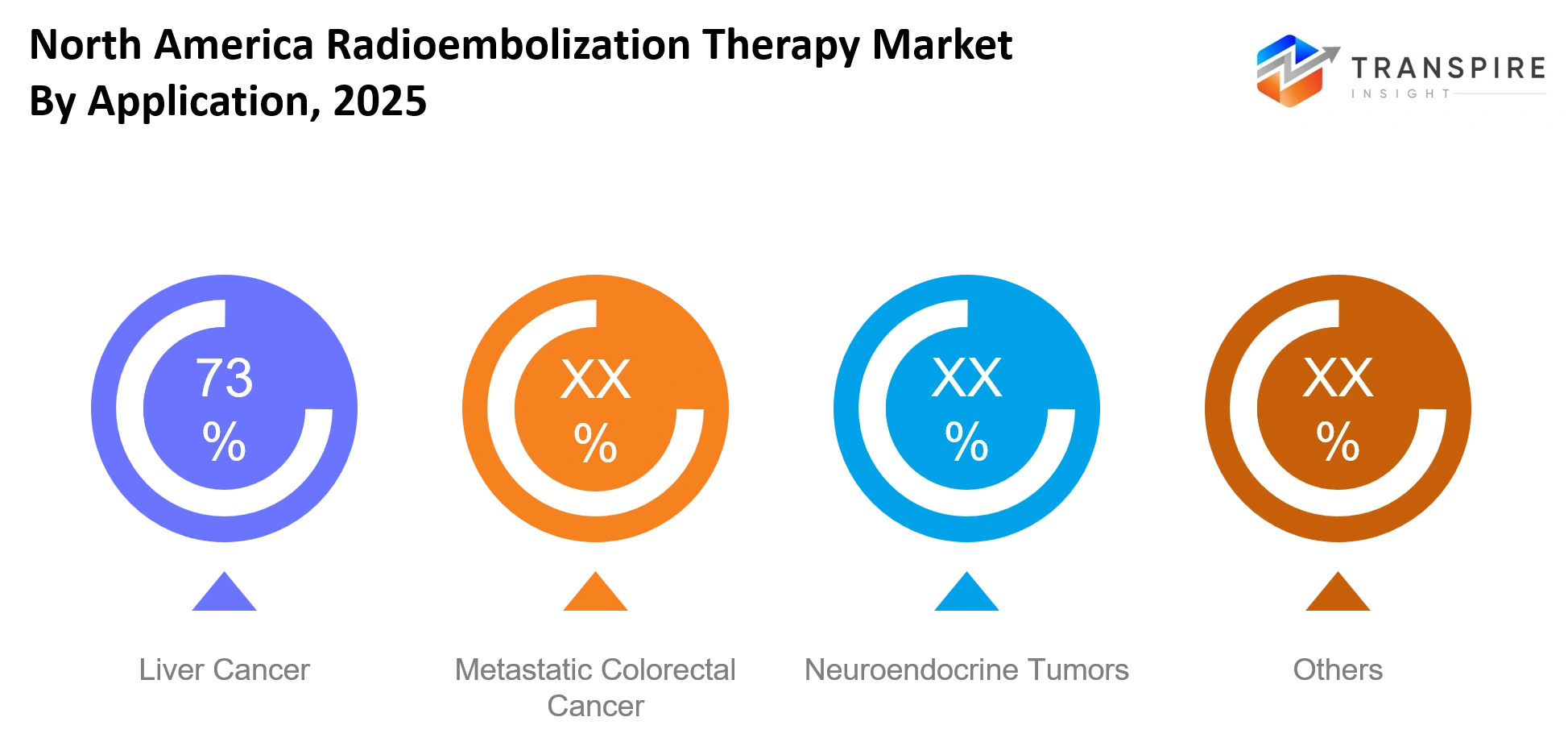
Liver cancer stays as the top application, mostly because hepatocellular carcinoma is quite common and clinical guidelines already back radioembolization as a legitimate treatment route. This segment holds the biggest share since hospitals lean toward targeted liver-directed therapies for patients who cannot go for surgical resection, or it just isnt available, for them.After that, metastatic colorectal cancer is a major application too, with broader treatment eligibility showing up over time and expanding the overall patient pool.
Growth in this segment kind of keeps getting pushed by earlier diagnosis rates, plus a greater tendency to use interventional oncology as a second line treatment approach. Neuroendocrine tumor treatment is also expanding because imaging diagnostics keep improving, and multidisciplinary oncology decision making is becoming more consistent, if you ask me. Over time the application demand should broaden toward multi tumor treatment protocols and that, in turn, nudges clinical integration of radioembolization into the usual oncology pathways.
To learn more about this report, Download Free Sample Report
By End User
Hospitals lead the end user adoption, mainly because integrated oncology departments exist there, and procedural capacity for complex interventional treatments is higher. This segment takes the largest share in the North America Radioembolization Therapy Market, since hospitals already have the needed imaging, nuclear medicine, and post procedure monitoring infrastructure. Oncology centers come next, with specialization in liver directed therapies increasing year over year.
Growth is supported by expansion of interventional radiology units and more referrals for minimally invasive cancer treatment options. Specialty clinics are starting to gain momentum too, especially as outpatient care models grow, and as procedural complexity becomes more standardized. Looking ahead, adoption will likely swing toward distributed oncology networks, which means scalable treatment delivery systems will matter more, along with improved procedural training models
By Procedure Type
Selective internal radiation therapy leads the procedure segment, mostly because it has precision targeting capability and it’s strongly adopted in liver cancer treatment protocols. It holds the biggest share too, because it allows localized radiation delivery while keeping systemic toxicity lower. Transarterial radioembolization comes after, and it stays common in advanced interventional oncology workflows, where it fits pretty smoothly.
Growth in this segment is, sort of, powered by improved imaging guidance systems and upgraded catheter navigation tech, which together raise procedural accuracy. Meanwhile adoption of transarterial methods is increasing especially when broader tumor coverage is needed or when complex vascular structures are involved. Looking ahead, future developments should center on hybrid procedural models, integrating real time imaging plus AI assisted navigation, to push better clinical outcomes and also procedural efficiency.
What are the Key Use Cases Driving the North America Radioembolization Therapy Market?
Radioembolization therapy is still mostly, like by far the main deal when it comes to treating liver cancer in North America. It’s being pushed along by the high rate of hepatocellular carcinoma, plus the fact that many patients really aren’t good candidates for surgery. So hospitals end up leaning on Y-90 microspheres, using this localized radiation approach, basically sending therapy straight into the liver tumors, which helps survival trends, while also cutting down systemic toxicity, and shortening the time people stay in the hospital.
Meanwhile metastatic colorectal cancer and neuroendocrine tumor cases are getting more attention, especially in specialized oncology centers and in hospital-based interventional radiology units. Those situations tend to work well when care is coordinated by multiple specialties and when teams use newer imaging methods to spot secondary lesions in the liver, then follow up with targeted embolization treatment based on what they find.
Newer or emerging use cases are also showing up, for example the downstaging of tumors that started out inoperable. There’s also growing interest in pairing radioembolization with immuno-oncology drugs. Research hospitals are increasingly evaluating radioembolization next to systemic regimens, hoping for better tumor response rates, and this momentum is tied to shifting clinical trial structures and more precise imaging protocols across North American cancer networks.
|
Report Metrics |
Details |
|
Market size value in 2025 |
USD 872.5 Million |
|
Market size value in 2026 |
USD 963.8 Million |
|
Revenue forecast in 2033 |
USD 1896.5 Million |
|
Growth rate |
CAGR of 10.15% from 2026 to 2033 |
|
Base year |
2025 |
|
Historical data |
2021 - 2024 |
|
Forecast period |
2026 - 2033 |
|
Report coverage |
Revenue forecast, competitive landscape, growth factors, and trends |
|
Regional scope |
North America (Canada, The United States, and Mexico) |
|
Key company profiled |
Boston Scientific, Sirtex Medical, BTG International, Terumo Corporation, Cardinal Health, Cook Medical, Nordion, GE HealthCare, Siemens Healthineers, Bayer, Novartis, Varian Medical Systems, Elekta, Merit Medical Systems, MIM Software |
|
Customization scope |
Free report customization (country, regional & segment scope). Avail customized purchase options to meet your exact research needs. |
|
Report Segmentation |
By Product Type (Yttrium-90 Microspheres, Glass Microspheres, Resin Microspheres, Others); By Application (Liver Cancer, Metastatic Colorectal Cancer, Neuroendocrine Tumors, Others); By End User (Hospitals, Oncology Centers, Specialty Clinics, Others); By Procedure Type (Selective Internal Radiation Therapy, Transarterial Radioembolization, Others) |
Which Regions are Driving the North America Radioembolization Therapy Market Growth?
The United States seems to be in the front of the North America Radioembolization Therapy Market, mostly because of its advanced interventional oncology infrastructure and solid reimbursement backing for minimally invasive cancer treatments. Large hospital networks, and specialized cancer centers . they regularly run Y-90 microsphere procedures, with integrated imaging and nuclear medicine departments helping along. Favorable FDA approvals, plus early clinical uptake of inventive embolization technologies, also helps keep procedures more standardized. There is a kind of mature “device + training + care team” ecosystem in place, with manufacturers, training programs and multidisciplinary oncology groups, which then keeps volumes high across urban medical hubs.
Canada is more like a steady secondary market, supported by universal healthcare coverage and centralized oncology planning systems, meaning consistent access to radioembolization therapy. In contrast to the United States, growth in Canada is steered by provincial funding cycles and standardized clinical pathways, not so much by private hospital competition. This setup drives gradual, but still dependable expansion of interventional radiology capacity in major academic hospitals. Plus, longer-term investment in cancer care infrastructure supports steady procedural growth across provinces, especially for liver cancer treatment initiatives.
Mexico looks like the fastest-growing region, mainly because of increasing investment in private oncology hospitals and wider access to interventional radiology services. Recent improvements in urban healthcare infrastructure, plus more frequent cross-border medical collaborations, have sped up adoption of radioembolization therapy. Growth is also supported by broader patient referrals for advanced liver cancer care in big metropolitan areas. Over the 2026–2033 period, this momentum creates strong entry opportunities for device manufacturers targeting cost-sensitive but rapidly modernizing healthcare systems.
Who are the Key Players in the North America Radioembolization Therapy Market and How Do They Compete?
Competition in the North America Radioembolization Therapy Market is sort of moderately consolidated, there is only a small set of global medtech firms that really control most microsphere supply, and also the delivery system integration. The incumbents try to keep their position using clinical proof, physician training efforts, and some longer-term hospital agreements. Meanwhile niche entrants still try to shake things up, by focusing on procedural refinements and better embolic materials, not just marketing. Overall, rivalry is mostly pulled by how well the technology works, especially precision targeting accuracy, catheter delivery control, and how compatible the whole workflow is with imaging inside interventional radiology suites.
Sirtex Medical seems to build an edge with tight specialization in Y-90 microsphere therapy. They tend to emphasize clinical consistency and use standardized dosing protocols across liver cancer conditions. Boston Scientific competes using a wider set of interventional oncology tools, and they combine catheter systems with embolization devices to help lock in hospital purchasing bundles. Both companies also push growth by running physician education programs and hospital partnerships, so adoption happens faster in busy, high-volume cancer centers
Merit Medical Systems keeps improving its position through cost-minded embolization devices that are tuned for mid-tier hospitals. The goal is scalable oncology capabilities without the extra complexity. Terumo Corporation differentiates by leaning into more advanced catheter navigation, plus imaging-compatible delivery systems, which can help with procedural precision in tougher vascular cases. These firms often expand through regional distributor coverage and by lining up targeted hospital collaborations across North America. Varian Medical Systems adds another layer by integrating radioembolization planning with their broader oncology treatment platforms, and that helps reinforce ecosystem lock-in via software plus imaging integration.
Company List
- Boston Scientific
- Sirtex Medical
- BTG International
- Terumo Corporation
- Cardinal Health
- Cook Medical
- Nordion
- GE HealthCare
- Siemens Healthineers
- Bayer
- Novartis
- Varian Medical Systems
- Elekta
- Merit Medical Systems
- MIM Software
Recent Development News
“In July 2025, Sirtex Medical announced FDA approval of SIR-Spheres® Y-90 resin microspheres for the treatment of unresectable hepatocellular carcinoma (HCC). The expanded indication made it the only radioembolization therapy in the U.S. approved for both metastatic colorectal cancer liver metastases and HCC, significantly broadening clinical adoption in North America.https://www.prnewswire.com
“In March 2026, Boston Scientific secured FDA clearance for the ‘Any Day Dosing’ feature on its TheraSphere™ Y-90 Management Platform. The update expanded scheduling flexibility for Y-90 radioembolization treatments by introducing an additional calibration cycle, improving clinical workflow efficiency and access to therapy across North American treatment centers.https://evtoday.com
What Strategic Insights Define the Future of the North America Radioembolization Therapy Market?
The North America Radioembolization Therapy Market is kinda moving, overall, toward a more integrated interventional oncology setup where imaging, embolization delivery and post-procedure monitoring kinda work together in one clinical flow. This shift is pushed by the fact that liver cancer incidence keeps going up and there is a stronger preference for minimally invasive, outpatient-friendly options that lower hospital load while still improving patient results. Over the next 5 to 7 years, adoption should concentrate more in high throughput cancer centers that can actually handle precision guided, image heavy procedures at scale, without too much delay or friction.
A less obvious concern is the way supply can get concentrated around Y-90 isotope production, plus a reliance on a small number of manufacturing and irradiation locations. If isotope availability gets interrupted, or if regulations get stricter about radioactive material handling, then you can see procedural hold ups and some revenue swings too. That kind of risk stays structurally baked in, mainly because the infrastructure for production and distribution is pretty specialized and not easy to replicate.
There’s also a newer opportunity that’s more on the tech side, like AI assisted pre procedural planning platforms that tune microsphere distribution using patient specific vascular modeling. Initial pilots in US academic hospitals have reportedly shown better targeting accuracy and fewer repeat interventions, which matters a lot for clinical value and cost. Market players should really lean into vertical integration across imaging, planning, and delivery systems, so they can capture more of the procedural value and also reduce dependency on a fragmented supply chain that can be unpredictable.
North America Radioembolization Therapy Market Report Segmentation
By Product Type
- Yttrium-90 Microspheres
- Glass Microspheres
- Resin Microspheres
- Others
By Application
- Liver Cancer
- Metastatic Colorectal Cancer
- Neuroendocrine Tumors
- Others
By End User
- Hospitals
- Oncology Centers
- Specialty Clinics
- Others
By Procedure Type
- Selective Internal Radiation Therapy
- Transarterial Radioembolization
- Others
Frequently Asked Questions
Find quick answers to common questions.
The expected North America Radioembolization Therapy Market size is USD 1896.5 Million in 2033.
Key segments for the North America Radioembolization Therapy Market are By Product Type (Yttrium-90 Microspheres, Glass Microspheres, Resin Microspheres, Others); By Application (Liver Cancer, Metastatic Colorectal Cancer, Neuroendocrine Tumors, Others); By End User (Hospitals, Oncology Centers, Specialty Clinics, Others); By Procedure Type (Selective Internal Radiation Therapy, Transarterial Radioembolization, Others)
Major North America Radioembolization Therapy Market players are Boston Scientific, Sirtex Medical, BTG International, Terumo Corporation, Cardinal Health, Cook Medical, Nordion, GE HealthCare, Siemens Healthineers, Bayer, Novartis, Varian Medical Systems, Elekta, Merit Medical Systems, MIM Software
The North America Radioembolization Therapy Market size is USD 872.5 Million in 2025.
The North America Radioembolization Therapy Market CAGR is 10.15% from 2026 to 2033.
- Boston Scientific
- Sirtex Medical
- BTG International
- Terumo Corporation
- Cardinal Health
- Cook Medical
- Nordion
- GE HealthCare
- Siemens Healthineers
- Bayer
- Novartis
- Varian Medical Systems
- Elekta
- Merit Medical Systems
- MIM Software
About the Authors

Pankaj Ghogare Patil
I am Pankaj Ghogare Patil, a Senior Research Analyst at Transpire Insight, specializing in the Pharmaceutical, Chemicals & Materials, Healthcare IT, and Biotechnology industry. My expertise lies in conducting comprehensive market research, analyzing industry trends, evaluating competitive landscapes, and translating complex data into actionable insights. At Transpire Insight, I closely follow emerging technologies, regulatory developments, and market innovations to create accurate, well-researched, and informative content that helps businesses and professionals make informed decisions. I am committed to producing credible, evidence-based articles that reflect industry best practices while making technical topics accessible and valuable for a broad audience.

Chakradhar Khansole
Chakradhar serves as the Research Director at Transpire Insight, bringing over 8 years of experience in technology, innovation, and strategic market intelligence. He specializes in transforming complex market data into actionable business insights that enable organizations to make informed, growth-oriented decisions. Recognized for his strategic vision and analytical expertise, Chakradhar leads high-impact research initiatives, delivering comprehensive market assessments, competitive intelligence, and forward-looking industry analysis.
Recently Published Reports
-
Jul 2026
Alopecia Treatment Market
Alopecia Treatment Market Size, Share & Analysis Report By Disease Type (Alopecia Areata, Cicatricial Alopecia, Traction Alopecia, Alopecia Totalis, Androgenetic Alopecia, Alopecia Universalis, and Other Disease Types), By Treatment Type (Topical Treatments, Oral Medications, Injectable Therapies, and Hair Transplantation), By Gender (Male, and Female), By Distribution Channel (Hospitals and Clinics, Retail Pharmacies, and Online Retailers), and Geography (North America, Europe, Asia-Pacific, Middle East and Africa, South and Central America), 2021 - 2031
-
Jul 2026
Medical Ultrasound Probe Market
Medical Ultrasound Probe Market Size, Share & Analysis Report By Type (Linear Type, Convex Type, Endocavitary Probe, Phased Array/Cardiac Probe, Transesophageal (TEE) Probe, and Others), By Application (Ophthalmology, Cardiology, Musculoskeletal, Oncology, Obstetrics & Gynecology, General Imaging, and Others), By End User (Hospitals & Clinics, Diagnostic Centers, Ambulatory Surgical Centers, and Others), and Geography (North America, Europe, Asia-Pacific, Middle East and Africa, South and Central America), 2021 – 2031
-
May 2026
Biosimilars Market
Biosimilars Market By Product Type (Monoclonal Antibodies, Recombinant Hormones, Erythropoietin, G-CSF, Others), By Indication (Oncology, Autoimmune Diseases, Blood Disorders, Diabetes, Others), By Manufacturing Type (In-House Manufacturing, Contract Manufacturing), By Distribution Channel (Hospital Pharmacies, Retail Pharmacies, Online Pharmacies), By Industry Analysis, Size, Share, Growth, Trends, and Forecasts 2021-2033
-
Apr 2026
Gastrointestinal Endoscopy Market
Gastrointestinal Endoscopy Market By Type (Rigid Gastrointestinal Endoscope, Flexible Gastrointestinal Endoscopes, Disposable Gastrointestinal Endoscope), By Procedure Type (Colonoscopy, Gastroscopy, Duodenoscopy, Enteroscopy, Flexible Sigmoidoscopy, Others), By Application (Diagnosis, Treatment), By End-Users (Hospitals, Ambulatory Surgical Centers, Specialty Clinics, Laboratories, Others), By Industry Analysis, Size, Share, Growth, Trends, and Forecasts 2021-2033