
North America Pharmaceutical Lipid-Based Excipients Market Summary
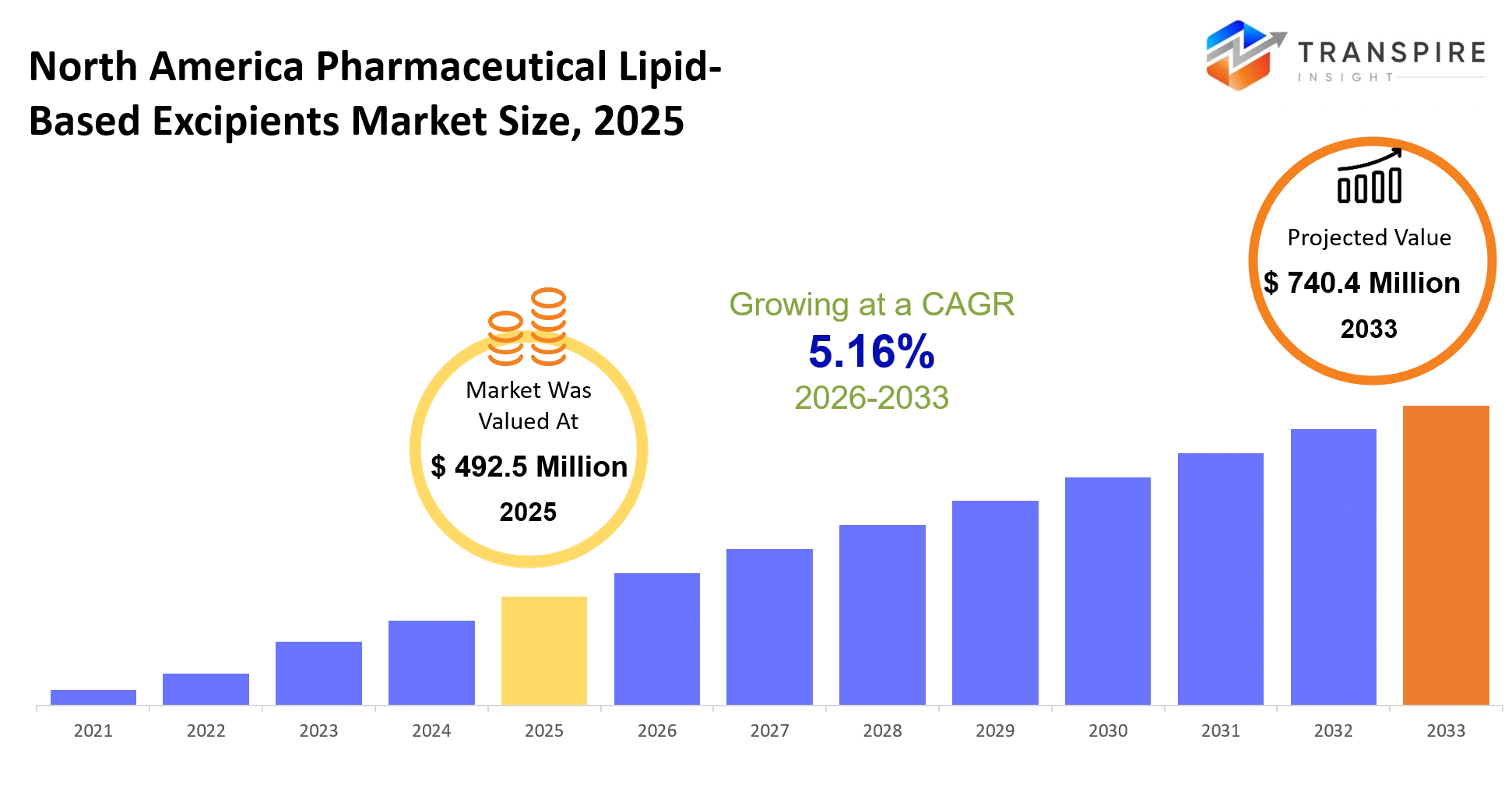
As per Transpire Insight Analysis the North America Pharmaceutical Lipid-Based Excipients Market size is estimated at USD 492.5 Million in 2025 and is anticipated to reach USD 740.4 Million by 2033, growing at a CAGR of 5.16% from 2026 to 2033.
North America pharmaceutical lipid based excipients market kind of backs up the creation of medicines that have a hard time dissolving, so drug makers can better improve absorption, keep stability, and maintain a steady therapeutic outcome. These excipients kinda do the practical groundwork in oral and injectable delivery, plus some advanced drug formulations, because they help pharmaceutical companies move complicated molecular candidates toward the market with stronger bioavailability and manufacturability. In the last three to five years, the whole market has leaned more toward formulation tactics meant for extremely potent and poorly water soluble drug candidates, which mirrors what is going on in current research pipelines. Then COVID-19 time brought supply chain disruptions, and that really showed weaknesses in getting specialty lipid ingredients, so manufacturers started diversifying suppliers, and pushing for stronger regional production, kind of on purpose. Now, since more innovative therapies need sophisticated delivery systems, pharmaceutical firms are getting lipid based formulation strategies earlier in the development timeline, which speeds up commercial adoption and also opens long term revenue paths for excipient makers through higher value formulation collaborations and a more specialized product portfolio.
North America Pharmaceutical Lipid-Based Excipients Market Size & Forecast:
- North America Pharmaceutical Lipid-Based Excipients Market Size 2025: USD 492.5 Million
- Expected Market Value 2033: USD 740.4 Million
- Forecast CAGR: 5.16%
- Leading region in 2025: United States
- Fastest Growing region: Canada
- Key Profile: Croda International, CordenPharma, Evonik Industries, BASF, IOI Oleo, Gattefossé, Lipoid GmbH, Merck KGaA, NOF Corporation, ABITEC Corporation, Avanti Polar Lipids, Pfizer CentreOne, Cargill, Kerry Group, DSM-Firmenich
Key Market Insights
- In 2025, the United States kind of dominated the regional market, taking around 82% market share, helped by advanced pharmaceutical production capacity and steady, maybe even stubborn formulation innovation.
- Canada is projected to be the fastest-growing regional market over 2025–2033. This is basically due to wider biopharmaceutical investments, plus more contract development work and those related services.
- For the product segment, solid lipid excipients led with close to 42% market share in 2025 . This happened as poorly soluble oral drug pipelines increasingly leaned on lipid-based formulation ideas.
- Liquid lipid excipients were basically the second-largest segment, with the lift mostly due to wider uptake in soft gel capsules, oral emulsion s,and certain specialized injections.
- Semi-solid lipid excipients are forecast to grow fastest through 2033, helped by better lipid delivery systems and controlled release drug products.
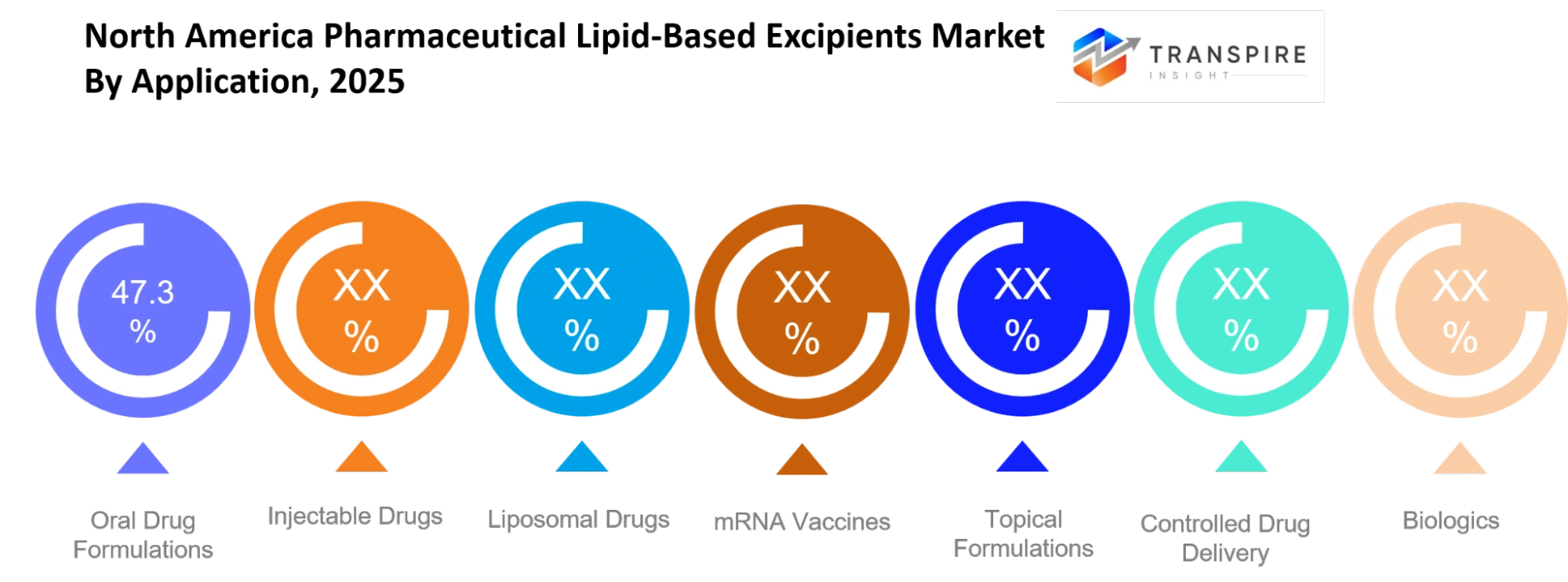
- For use cases, oral drug formulations remained #1, taking in around 58% of the market share in 2025.
- That suggests continuous work on bioavailability-enhancing oral dose technologies.
- Parenteral formulations are forecast to show the fastest growth through 2033, and that is tied to growing biologics, lipid nanoparticles, plus injectable therapeutics that keep expanding.
- On the end-user side, pharmaceutical manufacturers accounted for nearly 68% of revenue in 2025 . This was driven by ongoing investment in innovative formulation platforms, and also by commercial-scale production.
- Meanwhile, Contract Development and Manufacturing Organizations (CDMOs) are expected to become the faster growing end user group through 2033, as outsourcing in pharma keeps broadening, sort of everywhere at once.
What are the Key Drivers, Restraints, and Opportunities in the North America Pharmaceutical Lipid-Based Excipients Market?
The strongest driver is the transition toward poorly soluble, water-related drug candidates getting into pharmaceutical development pipelines. More than 70% of new chemical entities demand advanced formulation approaches in order to reach proper therapeutic performance, kinda. This technology shift has nudged manufacturers to bring lipid-based excipients into the formulation design earlier instead of waiting for late-stage optimization. When bioavailability comes up, it lowers reformulation risk and also cuts down commercialization timelines. So overall, development efficiency goes up and there is more demand for premium excipient portfolios. The downstream effect is higher formulation spending and tighter long-term supplier relationships across the regional pharmaceutical value chain too, you know.
The main restraint still remains the limited number of qualified suppliers who can actually produce pharmaceutical-grade lipid excipients while meeting strict regulatory standards. Expanding production needs specialized purification systems, regulatory validation, and those qualification cycles, which often drag past 18 months. Based on a Transpire Insight review of regional procurement announcements alongside launch schedules, supply chain concentration remains the key execution risk. This limitation pushes commercial launches later, reduces procurement flexibility, and dampens revenue opportunities for both excipient suppliers and pharmaceutical manufacturers alike.
The most powerful opportunity kind of sits in lipid nanoparticle platforms that support RNA therapeutics, gene therapies, and precision medicines. Investment in advanced biologics manufacturing keeps speeding up across the United States and Canada, really. New CDMO facilities, and formulation innovation centers are popping up too, expanding development capacity in that same moment. Those investments tend to generate steady need for specialized lipid excipients with higher purity standards and customized functionality, not just generic supply. Players that can co-develop formulation solutions alongside pharmaceutical innovators will be the ones who grab the next phase of market expansion, sooner than others.
What Has the Impact of Artificial Intelligence Been on the North America Pharmaceutical Lipid-Based Excipients Market?
Artificial intelligence is a kind of reworking of pharmaceutical lipid excipient manufacturing, mostly by assisting formulation development , keeping tighter production monitoring , and making regulatory compliance a bit more manageable to handle overall. It helps the process feel more fluid, even when there are lots of steps.With AI powered process analytical technologies they keep watching critical manufacturing inputs like particle size , lipid composition, and mixing consistency, so deviations get spotted early, before product quality gets pushed off track. On top of that, digital quality management platforms automate the paperwork and compliance tracking, which cuts down on manual reviews , while still supporting the strict kind of pharmaceutical rules.
Machine learning models are also being used more and more to forecast raw material availability, tune formulation performance, and estimate production needs from pharmaceutical development pipelines. This kind of prediction helps inventory planning, reduces unexpected shutdowns, and lets manufacturers match capacity with what customers are likely to need later. There are also digital twins and more advanced process simulations that help formulation scientists do the lipid combinations check, virtually first, before any physical testing happens, so development timelines get shorter and the experimental spending is reduced.
In day to day operations, these tools improve batch consistency, reduce material waste, boost overall production efficiency, and strengthen regulatory readiness. Still, big scale implementation is held back by high integration costs and the fact that standardized formulation datasets are not as widely available. A lot of specialized lipid formulations also produce proprietary process information that can’t be shared easily across companies, and that lowers model accuracy while slowing broader AI adoption across the regional pharmaceutical excipient industry.
Key Market Trends
- Since 2021, developers of pharmaceuticals have kind of moved their formulation strategies toward lipid-enabled delivery for poorly soluble drug molecules that are now getting into clinical development, and it’s been noticeable.
- After the pandemic caused supply disruptions, regional makers broadened their domestic lipid excipient output, basically because dependence on only a few global suppliers showed up pretty clearly between 2020 and 2023.
- Lipid nanoparticles have turned into a strategic investment focus, especially after commercial wins with mRNA platforms, which has then pushed more exploration into improved therapeutic delivery approaches.
- Since 2022, CDMOs have been expanding their pharmaceutical formulation skills, making outsourced development and commercial manufacturing easier for specialized lipid-based drug products.
- Regulatory attention to Quality by Design has also sped up adoption of digital process monitoring, plus advanced analytical technologies across excipient manufacturing sites.
- Evonik Industries, Croda International, and BASF SE have ramped up investment in specialized pharmaceutical excipient innovation, to back higher-value formulation initiatives.
- Pharma firms increasingly favor tailored lipid excipient options rather than off the shelf ingredients, so they can boost formulation performance and speed up product differentiation.
- Strategic partnerships between expedient suppliers and biotechnology companies have increased since 2023, which helps collaboration happen earlier during formulation as well as clinical development.
- Sustainability efforts are meanwhile nudging manufacturers to get better at renewable feedstock sourcing, improve production efficiency, and reduce waste across pharmaceutical lipid manufacturing processes.
North America Pharmaceutical Lipid-Based Excipients Market Segmentation
By Product Type:
Product type segmentation kind of spotlights the wide spectrum of lipid ingredients that get used in pharmaceutical formulation and drug delivery, in a practical way. Triglycerides and phospholipids keep showing up for oral and injectable formats, mainly because their compatibility with active pharmaceutical ingredients stays reliably strong. Fatty acids, and glycerides, also still matter a lot for helping solubility and stability in a range of therapeutic products. Lecithin is still in a valuable spot too, since it brings solid emulsification capability across multiple dosage forms.
Lipid nanoparticles have actually gathered a lot of commercial attention lately as advanced therapies plus nucleic acid medicines grow across North America. Solid lipids still back controlled release approaches, and they also contribute to better formulation stability in modern pharmaceutical products. Other specialized lipid excipients tend to cover more niche formulation needs, where tailored performance really is non-negotiable. And overall product innovation will likely keep pushing suppliers toward higher purity lipid materials, for upcoming pharmaceutical uses.
By Source:
Source-based segmentation kinda tracks how preferences for lipid ingredients keep shifting, but at the same time it sticks to consistent quality, and dependable performance. Natural lipids still get used a lot, largely because of strong biological compatibility, and the fact that they already have regulatory acceptance that is kind of well established. Synthetic lipids keep moving up in importance, especially when manufacturers need precise composition and also tight batch consistency. Plant-based lipids are getting more commercial attention due to steadier raw material availability, plus sourcing that can be more flexible.
Animal-derived lipids remain around in some selected pharmaceutical use cases even if adoption decisions get influenced heavily by regulatory requirements. Marine lipids help with specialized formulations where unique functional properties are basically required, or else the whole thing just does not work as intended. Bioengineered lipids and hybrid lipids open up new opportunities too, mostly through improved purity and tailored performance for advanced therapies. And then there are other specialty sources that still cover formulation needs that conventional lipid materials cannot really address.
By Application:
Application based segmentation sort of shows how lipid excipients enable a broad range of pharmaceutical products. Oral formulations keep holding the biggest portion because a lot of poorly soluble medicines need enhanced absorption, basically. For injectable drugs, there is a growing reliance on specialized lipid frameworks, they help with stability and delivery efficiency, too. Liposomal therapies are also pushing further into clinical practice, largely thanks to improved targeting and lower toxicity, which sounds simple but it matters.
More recently, mRNA vaccines helped lift the market value of advanced lipid technologies. This happened as vaccine development programs started moving faster and researchers leaned into new lipid systems. On top of that, topical products and controlled drug delivery approaches keep getting stronger benefits from refined drug release behaviors. Biologics bring yet more possibilities since many complicated therapies call for specialized formulation assistance. And as study efforts move ahead, other pharmaceutical uses will keep widening, especially as treatment choices become more sophisticated.
By End User:
End-user segmentation mirrors the many different groups that take part in pharma research, development, and production activities. Pharmaceutical companies grab the biggest portion, mainly because producing commercial drugs depends on consistent sourcing of top- level lipid excipients. Biotechnology firms keep growing their utilization, since newer therapies are still traveling through those development pipelines. CDMOs add momentum to the market, by offering outsourced formulation and manufacturing services to pharmaceutical customers around the world.
CROs help with formulation discovery, especially during early-stage development and clinical testing phases. Research institutes, plus academic labs, also contribute through formulation science and practical technology innovation. Vaccine manufacturers keep raising their investment in advanced lipid platforms after recent progress in nucleic acid therapeutics. Other end users back niche development initiatives, they rely on tailor-made formulation know-how, for that reason these players stay active.
By Function:
Function-based segmentation kinda shows how lipid excipients actually help with real pharmaceutical performance. Solubilizers still feel essential, since lots of active ingredients need better dissolution first, before effective absorption can take place. Emulsifiers help with formulation uniformity and also help the manufacturing stay steadier across various dosage forms, even when conditions get a bit different. Drug carriers keep being central to the whole thing, because they can enable targeted delivery and better therapeutic effectiveness, in a way that matters clinically.
Then, stabilizers protect fragile pharmaceutical ingredients during manufacturing as well as storage and shipping. Controlled release agents support improved treatment results by keeping drug release fairly consistent for extended periods, without too many swings. Absorption enhancers increase bioavailability especially for tough drug molecules, while encapsulation materials shield active compounds from degradation over time. Other functional lipid excipients keep covering specialized needs, as pharmaceutical technologies keep evolving.
What are the Key Use Cases Driving the North America Pharmaceutical Lipid-Based Excipients Market?
Oral drug formulations still seem like the biggest use case, because lipid based excipients help absorption of poorly soluble medicines, without truly changing the active pharmaceutical ingredients. In practice, pharmaceutical companies buy these materials to boost formulation performance , to help with manufacturing consistency, and also to meet regulatory quality requirements for products that are already commercial.
Injectable drugs and biologics keep creating fresh opportunities, especially now that biotechnology companies and CDMOs are expanding development of more complex therapies. Liposomal medicines are also getting more attention, since specialized lipid systems support better drug stability and more directed delivery, mainly for hospital based treatments and specialty care.
Some emerging use cases are basically lipid platforms for nucleic acid therapies and next generation personalized medicines. Research institutes, vaccine manufacturers, and biotech developers are still exploring advanced lipid systems that back innovative therapeutic platforms, while staying aligned with shifting regulatory expectations, around safety and stability, as well as product quality.
|
Report Metrics |
Details |
|
Market size value in 2025 |
USD 492.5 Million |
|
Market size value in 2026 |
USD 520.7 Million |
|
Revenue forecast in 2033 |
USD 740.4 Million |
|
Growth rate |
CAGR of 5.16% from 2026 to 2033 |
|
Base year |
2025 |
|
Historical data |
2021 - 2024 |
|
Forecast period |
2026 - 2033 |
|
Report coverage |
Revenue forecast, competitive landscape, growth factors, and trends |
|
Regional scope |
North America (Canada, The United States, and Mexico) |
|
Key company profiled |
Croda International, CordenPharma, Evonik Industries, BASF, IOI Oleo, Gattefossé, Lipoid GmbH, Merck KGaA, NOF Corporation, ABITEC Corporation, Avanti Polar Lipids, Pfizer CentreOne, Cargill, Kerry Group, DSM-Firmenich . |
|
Customization scope |
Free report customization (country, regional & segment scope). Avail customized purchase options to meet your exact research needs. |
|
Report Segmentation |
By Product Type (Triglycerides, Phospholipids, Fatty Acids, Glycerides, Lecithin, Lipid Nanoparticles, Solid Lipids, Others); By Source (Natural Lipids, Synthetic Lipids, Plant-Based Lipids, Animal-Derived Lipids, Marine Lipids, Bioengineered Lipids, Hybrid Lipids, Others); By Application (Oral Drug Formulations, Injectable Drugs, Liposomal Drugs, mRNA Vaccines, Topical Formulations, Controlled Drug Delivery, Biologics, Others); By End User (Pharmaceutical Companies, Biotechnology Companies, CDMOs, CROs, Research Institutes, Academic Laboratories, Vaccine Manufacturers, Others); By Function (Solubilizers, Emulsifiers, Drug Carriers, Stabilizers, Controlled Release Agents, Absorption Enhancers, Encapsulation Materials, Others) |
Which Regions are Driving the North America Pharmaceutical Lipid-Based Excipients Market Growth?
In 2025 The United States accounted for around 82% of the regional revenue which makes it the most dominant country for pharmaceutical lipid based excipients. There is strong regulatory scrutiny, more advanced manufacturing practices, and a fairly mature drug development atmosphere that keep backing this role. Also, a wide web of pharmaceutical businesses, biotechnology organizations, CDMOs, raw material suppliers and formulation specialists supports output capability and product novelty. Ongoing investment into advanced therapeutics and domestic manufacturing should help preserve U.S. leadership during the whole forecast horizon.
Canada is the second biggest regional market, mainly because pharmaceutical production leans toward higher value research, specialty treatments, and innovation. It is not really built around large scale manufacturing volumes. Regulatory conditions stay steady, and both public plus private investment remain consistent, so long term business confidence is maintained across the pharmaceutical development cycle. There’s also active cooperation between biotech firms, universities, and contract manufacturing organizations, which builds a dependable flow for formulation studies and later commercial manufacturing. This kind of steady ecosystem makes Canada a dependable part of the regional revenue picture while still enabling smooth growth across advanced pharmaceutical uses.
Canada is also expected to see the quickest growth over the 2026–2033 span, mainly because new investment in biologics manufacturing and advanced drug development facilities keeps expanding formulation capacity. In a way, government backing for life sciences, stronger home production skills , and extra funding for biotechnology innovation have already sped up commercial activity. Meanwhile, wider take up of lipid technologies for RNA therapeutics, biologics, and precision medicine keeps adding muscle to investment opportunities across the whole country. That momentum should end up building pretty attractive conditions for fresh suppliers, technology developers,and longer term investors who are looking to expand into specialized pharmaceutical materials.
Who are the Key Players in the North America Pharmaceutical Lipid-Based Excipients Market and How Do They Compete?
Competition across the North America pharmaceutical lipid-based excipients market stays moderately consolidated in a way that’s kinda expected, since product quality, formulation know-how and regulatory compliance together make the entry barrier pretty high. In practice, it’s more about technology advancement and specialized formulation support, not just price, that really drives who wins. The bigger, established players keep pushing their standing forward through new product development, while smaller or more specialized suppliers tend to compete by delivering customized lipid systems that fit advanced pharmaceutical use cases.
Croda International builds its competitive edge with pharmaceutical-grade lipid innovation mixed with tailored formulation assistance for difficult therapeutics. Evonik Industries sets itself apart by working on advanced lipid delivery technologies that back biologics, nucleic acid medicines, plus controlled drug delivery platforms. BASF SE pairs a wide range of excipients with ongoing investment in formulation research, so manufacturers can pull several high performance ingredients from one supplier.
ABITEC Corporation concentrates on targeted lipid technologies, made to help boost drug solubility and bioavailability, and that’s how it creates value for complicated formulation efforts. Gattefossé leans into specialized lipid excipients, backed by technical formulation expertise, which lets it collaborate closely with pharmaceutical teams while they’re still shaping the product. IOI Oleo GmbH strengthens regional competitiveness by adding pharmaceutical-grade production capacity and also staying consistent with raw material quality, which helps clients keep reliable long term supply continuity for commercial manufacturing.
Company List
- Croda International
- CordenPharma
- Evonik Industries
- BASF
- IOI Oleo
Gattefossé - Lipoid GmbH
- Merck KGaA
- NOF Corporation
- ABITEC Corporation
- Avanti Polar Lipids
- Pfizer CentreOne
Cargill - Kerry Group
- DSM-Firmenich
Recent Development News
In February 2026, Croda International commissioned a new super refining process at its Leek, UK facility and launched Super Refined Poloxamer 188 for pharmaceutical applications. The launch expanded Croda's portfolio of high-purity excipients for injectable formulations and bioprocessing, strengthening lipid-enabled drug formulation capabilities.
Source https://www.croda.com/
In February 2026, Croda International expanded its partnership with Certest to broaden its portfolio of more than 2,000 lipids for drug research and target additional opportunities in the generics segment. The collaboration supports pharmaceutical developers with a wider range of lipid technologies for advanced drug delivery and formulation development.
Source https://www.croda.com/
What Strategic Insights Define the Future of the North America Pharmaceutical Lipid-Based Excipients Market?
In North America, the pharmaceutical lipid-based excipients market is likely to drift toward more specialized formulation approaches that can handle complicated biologics , RNA therapies, and precision medicines, more than the usual broad-volume commodity excipients. Honestly the momentum comes from pharmaceutical research keep leaning into newer molecules that basically need advanced delivery technologies if they want commercial traction. There is also a quieter hazard , kind of easy to overlook, which is how pharmaceutical-grade lipid production is concentrated among a relatively small group of qualified suppliers. That situation can translate into pricing pressure and possible supply disruptions, especially if regulatory expectations tighten, or if critical feedstocks start to get constrained.
Still, a real opportunity seems to be forming around bioengineered lipid excipients, the kind built for next-generation gene therapies and tailored patient treatments, as regulatory pathways get clearer. Market players should get an edge by expanding regional manufacturing capacity, and by starting early formulation collaborations with biotechnology companies. That way, differentiated lipid technologies can get embedded during development, not only when everything is already in the commercial stage, and everybody is trying to win on timing.
North America Pharmaceutical Lipid-Based Excipients Market Report Segmentation
By Product Type
- Triglycerides
- Phospholipids
- Fatty Acids
- Glycerides
- Lecithin
- Lipid Nanoparticles
- Solid Lipids
By Source
- Natural Lipids
- Synthetic Lipids
- Plant-Based Lipids
- Animal-Derived Lipids
- Marine Lipids
- Bioengineered Lipids
- Hybrid Lipids
By Application
- Oral Drug
- Formulations
- Injectable Drugs
- Liposomal Drugs
- mRNA Vaccines
- Topical Formulations
- Controlled Drug Delivery
- Biologics
By End User
- Pharmaceutical Companies
- Biotechnology Companies
- CDMOs
- CROs
- Research Institutes
- Academic Laboratories
- Vaccine Manufacturers
By Function
- Solubilizers
- Emulsifiers
- Drug Carriers
- Stabilizers
- Controlled Release Agents
- Absorption Enhancers
- Encapsulation Materials
Frequently Asked Questions
Find quick answers to common questions.
The expected North America Pharmaceutical Lipid-Based Excipients Market size for the market will be USD 740.4 Million in 2033.
Key segments for the North America Pharmaceutical Lipid-Based Excipients Market are By Product Type (Triglycerides, Phospholipids, Fatty Acids, Glycerides, Lecithin, Lipid Nanoparticles, Solid Lipids, Others); By Source (Natural Lipids, Synthetic Lipids, Plant-Based Lipids, Animal-Derived Lipids, Marine Lipids, Bioengineered Lipids, Hybrid Lipids, Others); By Application (Oral Drug Formulations, Injectable Drugs, Liposomal Drugs, mRNA Vaccines, Topical Formulations, Controlled Drug Delivery, Biologics, Others); By End User (Pharmaceutical Companies, Biotechnology Companies, CDMOs, CROs, Research Institutes, Academic Laboratories, Vaccine Manufacturers, Others); By Function (Solubilizers, Emulsifiers, Drug Carriers, Stabilizers, Controlled Release Agents, Absorption Enhancers, Encapsulation Materials, Others).
Major North America Pharmaceutical Lipid-Based Excipients Market players are Croda International, CordenPharma, Evonik Industries, BASF, IOI Oleo, Gattefossé, Lipoid GmbH, Merck KGaA, NOF Corporation, ABITEC Corporation, Avanti Polar Lipids, Pfizer CentreOne, Cargill, Kerry Group, DSM-Firmenich.
The North America Pharmaceutical Lipid-Based Excipients Market size is USD 492.5 Million in 2025.
The North America Pharmaceutical Lipid-Based Excipients Market CAGR is 5.16% from 2026 to 2033.
- Croda International
- CordenPharma
- Evonik Industries
- BASF
- IOI Oleo
Gattefossé - Lipoid GmbH
- Merck KGaA
- NOF Corporation
- ABITEC Corporation
- Avanti Polar Lipids
- Pfizer CentreOne
Cargill - Kerry Group
- DSM-Firmenich
About the Authors

Pankaj Ghogare Patil
I am Pankaj Ghogare Patil, a Senior Research Analyst at Transpire Insight, specializing in the Pharmaceutical, Chemicals & Materials, Healthcare IT, and Biotechnology industry. My expertise lies in conducting comprehensive market research, analyzing industry trends, evaluating competitive landscapes, and translating complex data into actionable insights. At Transpire Insight, I closely follow emerging technologies, regulatory developments, and market innovations to create accurate, well-researched, and informative content that helps businesses and professionals make informed decisions. I am committed to producing credible, evidence-based articles that reflect industry best practices while making technical topics accessible and valuable for a broad audience.

Chakradhar Khansole
Chakradhar serves as the Research Director at Transpire Insight, bringing over 8 years of experience in technology, innovation, and strategic market intelligence. He specializes in transforming complex market data into actionable business insights that enable organizations to make informed, growth-oriented decisions. Recognized for his strategic vision and analytical expertise, Chakradhar leads high-impact research initiatives, delivering comprehensive market assessments, competitive intelligence, and forward-looking industry analysis.
Recently Published Reports
-
Jul 2026
Alopecia Treatment Market
Alopecia Treatment Market Size, Share & Analysis Report By Disease Type (Alopecia Areata, Cicatricial Alopecia, Traction Alopecia, Alopecia Totalis, Androgenetic Alopecia, Alopecia Universalis, and Other Disease Types), By Treatment Type (Topical Treatments, Oral Medications, Injectable Therapies, and Hair Transplantation), By Gender (Male, and Female), By Distribution Channel (Hospitals and Clinics, Retail Pharmacies, and Online Retailers), and Geography (North America, Europe, Asia-Pacific, Middle East and Africa, South and Central America), 2021 - 2031
-
Jul 2026
Medical Ultrasound Probe Market
Medical Ultrasound Probe Market Size, Share & Analysis Report By Type (Linear Type, Convex Type, Endocavitary Probe, Phased Array/Cardiac Probe, Transesophageal (TEE) Probe, and Others), By Application (Ophthalmology, Cardiology, Musculoskeletal, Oncology, Obstetrics & Gynecology, General Imaging, and Others), By End User (Hospitals & Clinics, Diagnostic Centers, Ambulatory Surgical Centers, and Others), and Geography (North America, Europe, Asia-Pacific, Middle East and Africa, South and Central America), 2021 – 2031
-
May 2026
Biosimilars Market
Biosimilars Market By Product Type (Monoclonal Antibodies, Recombinant Hormones, Erythropoietin, G-CSF, Others), By Indication (Oncology, Autoimmune Diseases, Blood Disorders, Diabetes, Others), By Manufacturing Type (In-House Manufacturing, Contract Manufacturing), By Distribution Channel (Hospital Pharmacies, Retail Pharmacies, Online Pharmacies), By Industry Analysis, Size, Share, Growth, Trends, and Forecasts 2021-2033
-
Apr 2026
Gastrointestinal Endoscopy Market
Gastrointestinal Endoscopy Market By Type (Rigid Gastrointestinal Endoscope, Flexible Gastrointestinal Endoscopes, Disposable Gastrointestinal Endoscope), By Procedure Type (Colonoscopy, Gastroscopy, Duodenoscopy, Enteroscopy, Flexible Sigmoidoscopy, Others), By Application (Diagnosis, Treatment), By End-Users (Hospitals, Ambulatory Surgical Centers, Specialty Clinics, Laboratories, Others), By Industry Analysis, Size, Share, Growth, Trends, and Forecasts 2021-2033