

North America Active Pharmaceutical Ingredients CDMO Market Size & Forecast:
- North America Active Pharmaceutical Ingredients CDMO Market Size 2025: USD 42.31 Billion
- North America Active Pharmaceutical Ingredients CDMO Market Size 2033: USD 79.17 Billion
- North America Active Pharmaceutical Ingredients CDMO Market CAGR: 6.11%
- North America Active Pharmaceutical Ingredients CDMO Market Segments: By Service Type (API Process Development, Custom API Manufacturing, Analytical Testing, Process Optimization, Scale-Up Services, Regulatory Support, Commercial API Manufacturing, Others); By API Type (Small Molecule APIs, Biologic APIs, Highly Potent APIs (HPAPIs), Peptide APIs, Sterile APIs, Fermentation APIs, Synthetic APIs, Others); By Application (Oncology Drugs, Cardiovascular Drugs, Infectious Diseases, CNS Drugs, Endocrine Disorders, Rare Diseases, Immunology, Others); By End User (Pharmaceutical Companies, Biotechnology Companies, Virtual Pharma Companies, Research Institutes, CROs, Government Organizations, Others); By Manufacturing Scale (Preclinical, Clinical Scale, Pilot Scale, Commercial Scale, Continuous Manufacturing, Batch Manufacturing, Technology Transfer, Others)
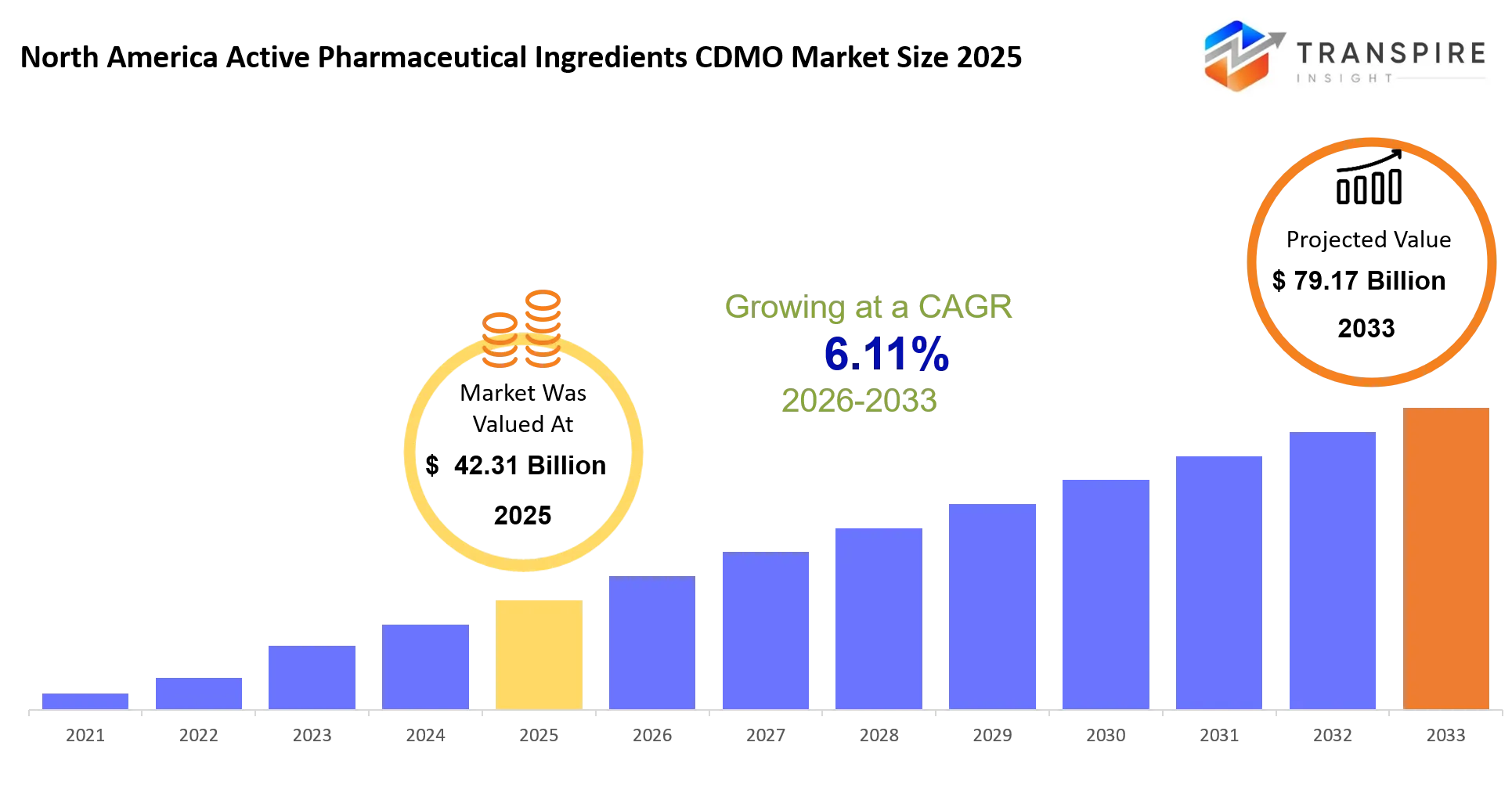
North America Active Pharmaceutical Ingredients CDMO Market Summary
The North America Active Pharmaceutical Ingredients CDMO Market was valued at USD 42.31 Billion in 2025. It is forecast to reach USD 79.17 Billion by 2033. That is a CAGR of 6.11% over the period.
The North America Active Pharmaceutical Ingredients (API) CDMO market lets pharmaceutical and biotechnology firms outsource the development , scale-up, and commercial manufacturing of APIs, so they can speed up timelines, dial in production costs, and tap specialized manufacturing know-how without having to sink money into dedicated facilities. In the last five years, the whole space has slowly moved toward high-potency APIs, more intricate synthetic workflows, and even integrated development-to-commercialization service models, especially because drug pipelines have gotten more niche and demanding. One big push behind this change was the supply chain disruption that COVID-19 really exposed, basically showing weaknesses tied to concentrated offshore API production . So, in response, manufacturers diversified where they buy from , built stronger ties with North American CDMOs, and aimed to bolster supply resilience, tighten regulatory supervision, and lower procurement exposure, which then led to ongoing investment in domestic manufacturing capability, advanced process technologies, and a more flexible production setup.
Key Market Insights
- North America kind of dominates the Active Pharmaceutical Ingredients CDMO market size with roughly 88% market share in 2025, pushed by modern manufacturing infrastructure and pretty solid regulatory compliance know-how.
- Canada looks like the fastest moving regional market during 2025–2032, it’s supported by more biopharmaceutical investments, research incentives that are favorable, and also a strategic ramp up of manufacturing capacity.
- On the service side, commercial API manufacturing leads overall, taking nearly 46% market share in 2025. This happens because companies keep outsourcing late-stage work and commercial-scale production in a steady way.
- API process development and scale-up stays right behind it as the second-largest service segment, since many firms want to compress technology transfer timelines before they start commercialization.
- High-potency API, HPAPI manufacturing services are expected to grow the quickest across 2025–2032, with oncology and targeted therapy pipelines expanding.
- When it comes to application demand, innovative pharmaceutical products dominate at about 63% market share in 2025, mainly fueled by development of complicated molecules, and specialty drug commercialization efforts too.
- Biologics and advanced therapeutic APIs are projected as the fastest-growing application segment over the forecast, because next-generation therapies move into clinical and commercial production.
- Big pharmaceutical companies bring in nearly 58% of end-user revenue in 2025, and they do it by using long-term outsourcing partnerships that help optimize manufacturing flexibility.
- Meanwhile, emerging biotechnology companies are becoming the fastest-growing end-user group from 2025–2032, basically trying to get integrated development, regulatory guidance, and commercial manufacturing capabilities in one place.
What are the Key Drivers, Restraints, and Opportunities in the North America Active Pharmaceutical Ingredients CDMO Market?
In many ways the most powerful driver shaping the North America Active Pharmaceutical Ingredients CDMO market is pharmaceutical supply chain localization, following disruptions that got exposed during the COVID-19 pandemic. Governments as well as big drug manufacturers kind of rethought the whole off shore reliance, and procurement approaches moved toward regional manufacturing resiliency. On top of that, regulatory incentives aimed at domestic production gave extra momentum, which in turn supported longer term outsourcing agreements. In response, firms started to broaden commercial scale facilities and put money into high potency API know how. So the outcome shows up as bigger contract values, better facility utilization, and a wider shift toward integrated development to commercial manufacturing services, especially for newer drug portfolios.
Now the big structural restraint still comes back to the cost and the overall complexity of building GMP-compliant API plants. Things like qualification, environmental approvals, validation, and regulatory inspections can take several years before a site actually turns commercial. There are also gaps in skilled workforce availability which slows down technology transfer and process validation. From the Transpire Insight take on regional procurement announcements and the timing of launches, supply chain concentration remains the core execution risk. These limits, keep capacity expansions pushed out, delay customer onboarding, and hold back potential contract revenue even when outsourcing activity looks strong on paper.
The most promising opportunity sits in continuous manufacturing , digital process analytical tech , and high potency API production platforms. Pharmaceutical innovators more and more want manufacturing that is flexible enough for smaller commercial batches , and also for faster product launches. Capital spending across the United States and Canada keeps growing , especially for specialized API facilities. With better automation paired with modular production setups you can cut changeover time a lot, boost production efficiency, and help open the next phase of contract manufacturing growth for complex therapeutics.
What Has the Impact of Artificial Intelligence Been on the North America Active Pharmaceutical Ingredients CDMO Market?
Artificial intelligence and digital manufacturing technologies are, kind of, reshaping API contract development and manufacturing across North America. The big promise is better production visibility, stronger quality assurance, and more reliable regulatory compliance, all together. AI-enabled manufacturing execution systems keep track in real time of reaction parameters, equipment conditions, and the batch records. This makes it easier for operators to notice deviations early, before they start messing with product quality. At the same time, machine learning is getting used more and more for predictive maintenance, raw-material planning, demand forecasting, and process optimization. As a result, facilities see less surprise downtime, and production scheduling gets smoother across multi-product plants.
Digital twins, along with more advanced process analytical technologies, lets manufacturers run simulations of different production scenarios. They can optimize reaction yields too, and they can speed up the technology transfer path from laboratory development into commercial manufacturing, which is usually slow. In practice, these improvements help with batch consistency, reduce material waste, and create stronger regulatory documentation. There is also better facility utilization, plus lower operational expenses. AI also helps with automated compliance reviews by flagging documentation inconsistencies ahead of regulatory inspections, so teams don’t get blindsided during audits.
Still, the adoption story is uneven across the regional API CDMO industry. Older manufacturing systems, fragmented production data, and the high integration costs are still acting like blockers for broad deployment. A lot of plants basically need to modernize their data infrastructure first, before advanced analytics can give consistently reliable predictions in complex pharmaceutical manufacturing environments.
Key Market Trends
- Since 2021, a lot of pharmaceutical companies have pushed harder on reshoring plans, like expanding North American API manufacturing capacity, to cut down on reliance on single-region supply webs.
- Between 2022 and 2025, continuous manufacturing tech has also become more commercially common, so production cycles get shorter, and the process stays more consistent, even when things get busy.
- At the same time, funding for high-potency API facilities has gone up a bunch, mainly because oncology plus precision medicine pipelines need very specific containment know-how and hands-on manufacturing skillsets.
- CDMOs are now often moving toward end-to-end development, meaning they do commercial manufacturing too, not just standalone production services, and that tends to lock in customers longer, plus contract values are better.
- Since 2023, digital quality management platforms have spread out more, which helps reduce manual documentation and makes audit readiness feel less stressful across regulated manufacturing operations.
- Pharma groups are also signing multi-year strategic outsourcing deals instead of one-off project based contracts, because they want steadier manufacturing, and stronger supply security overall.
- Thermo Fisher Scientific, Lonza, and Cambrex have expanded their North American manufacturing footprint too, through facility investments and more advanced technology rollouts since 2022.
- Meanwhile, regulators keep putting more weight on supply resilience, so companies respond by investing in domestic production infrastructure, and by using diversified sourcing, especially for essential pharmaceutical ingredients.
- And in the background, automation plus advanced analytics are getting used for predictive maintenance, process optimization, and batch release calls, so modern API production facilities run more efficiently, most times.
North America Active Pharmaceutical Ingredients CDMO Market Segmentation
By Service Type :
Service type segmentation shows how contract partners back pharmaceutical creation from the first stages of development into full-scale manufacturing, it’s kinda continuous. API process development helps establish dependable methods and repeatable production routines before commercial manufacturing even starts. Custom API manufacturing lets production follow client specifics, while analytical testing backs it up by confirming quality purity, and regulatory conformity.
On top of that, process optimization boosts manufacturing efficiency, and scale-up services ready lab approaches for higher volume output. Regulatory support is also there to help manufacturers satisfy approval rules and keep the documentation properly in place during product development. Commercial API manufacturing takes a major portion since big pharma output relies on seasoned contract manufacturers with certified sites. Meanwhile, other specialized services keep aiding clients with packaging coordination, technical consulting, and process validation—especially as production requirements shift.
By API Type :
API type segmentation mirrors the whole variety of pharmaceutical ingredients that are being made via contract manufacturing, sort of a patchwork thing. Small molecule APIs still take up a big share of the manufacturing activity since a lot of approved medicines lean on time tested chemical synthesis. Biologic APIs keep broadening too, especially as advanced therapies move into commercial production, and then highly potent APIs back targeted treatments that need specialized containment systems.
Peptide APIs and sterile APIs are also getting more attention, because newer therapies demand greater precision while the product is being made. Fermentation APIs enable biological manufacturing routes, while synthetic APIs are still relevant for more conventional pharmaceutical products. The other API categories then add extra flexibility for manufacturers, especially those serving niche therapeutic areas and newer drug technologies.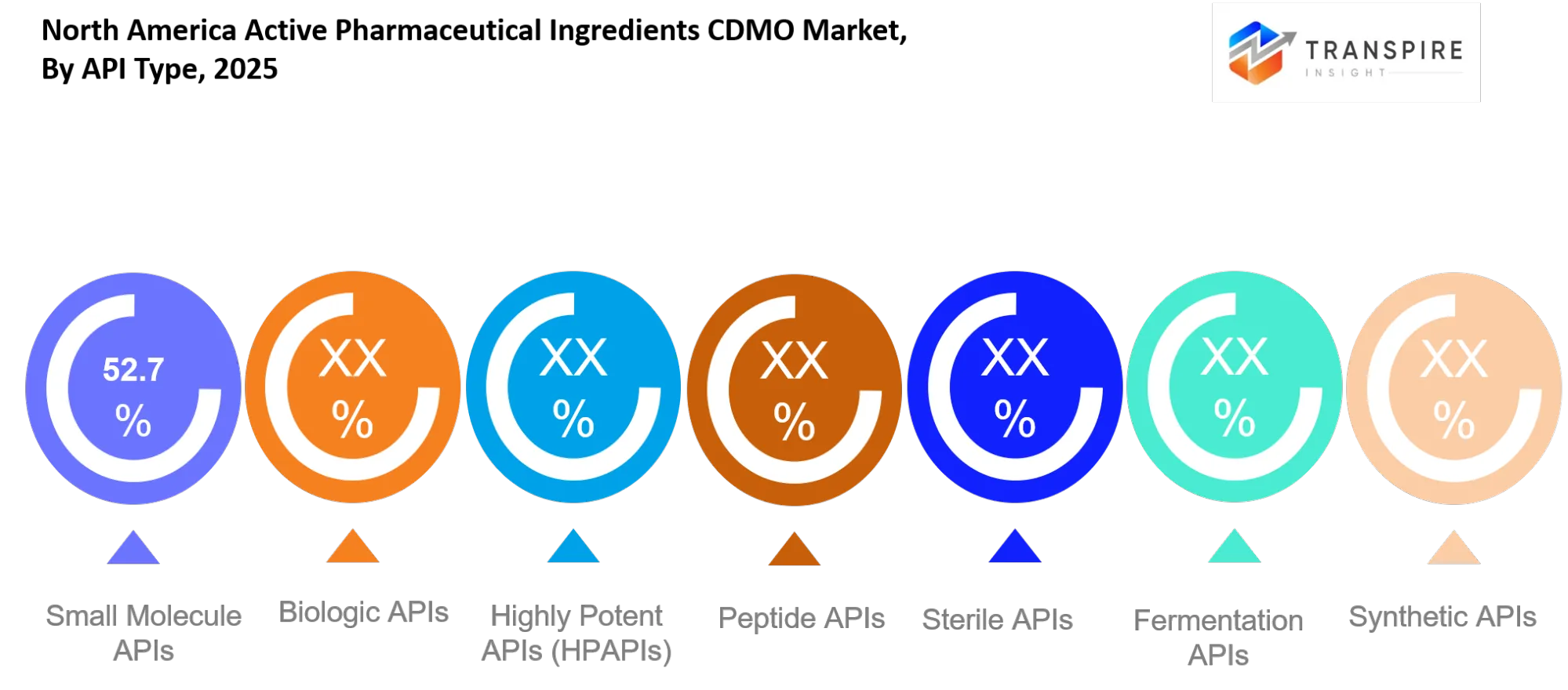
By Application :
Application segmentation kind of shows how contract manufacturing backs up different therapeutic fields throughout the pharmaceutical business. Oncology drugs stay as a top application, mostly because the cancer care pipelines keep bringing in complex active pharmaceutical ingredients. Cardiovascular drugs keep solid manufacturing momentum because treatment volumes stay pretty steady, and meanwhile infectious disease products stay relevant for public health preparedness, plus long term supply stability.
CNS drugs, endocrine disorder therapies, and immunology products keep asking for specialized manufacturing capabilities since production norms do not match up across drug classes. Rare disease treatments open up opportunities for more flexible production, with smaller batch sizes and tight quality requirements. The other therapeutic applications keep growing too, expanding manufacturing variety across contract development and production facilities.
By End User :
End-user segmentation kinda mirrors the wide customer set that uses outsourced manufacturing services. Pharmaceutical companies are still the biggest customer group, mainly because commercial production needs dependable manufacturing capacity and strong regulatory know-how. Biotechnology firms keep pushing deeper into outsourcing while also moving innovative therapies forward, via clinical work and market approval stuff.
Virtual pharma companies lean on contract manufacturers, since their in-house production setup stays rather restricted when products are still in development. Research institutes, CROs, and government organizations help with clinical research, public health initiatives, and more specialized pharmaceutical endeavors. Then, other end users keep showing up too, mostly through smaller targeted research campaigns and specialized development collaborations.
By Manufacturing Scale :
Manufacturing scale segmentation shows how production kinda moves along from research into commercial supply , with each step helping things along. Preclinical, clinical scale, and pilot scale manufacturing usually cover product evaluation, give room for process refinement, and also support the regulatory submissions , before larger production really ramps up. Then commercial scale manufacturing takes the biggest slice since approved medicines need steady high-volume production and that’s backed by validated manufacturing systems, otherwise it would be a mess.
Continuous manufacturing is getting more attention these days, because an efficient production setup and stronger process control can shorten manufacturing time. Batch manufacturing is still used a lot across many pharmaceutical products, mainly because people already know the established production practices, and regulators are more familiar with it. Technology transfer services also play a key role, enabling a smoother transition from development facilities to commercial manufacturing sites, while other manufacturing approaches offer flexibility when it comes to specialized production programs.
What are the Key Use Cases Driving the North America Active Pharmaceutical Ingredients CDMO Market?
The largest use case basically revolves around commercial API production for new pharmaceutical goods. Big pharma outfits buy contract development and manufacturing services, to lock in dependable production capacity, keep regulatory compliance steady, and speed up product launches without having to grow their own internal manufacturing setup. It sort of helps with uninterrupted supply while also trimming operational headaches.
On the biotechnology side, companies are using API process development and scale up support more and more, especially since clinical programs get more specialized over time. Analytical testing services are also getting more attention among contract research organizations and research institutes where solid quality validation, plus clean regulatory paperwork, are needed before anything clinical or commercial can actually move forward.
What’s starting to emerge includes manufacturing help for personalized medicines, as well as next generation peptide products and highly potent APIs. These are still kinda early, but they should receive upside from continued investment in precision therapeutics, smarter manufacturing technologies, and even tighter regulatory expectations for complicated pharmaceutical products across the whole forecast horizon.
|
Report Metrics |
Details |
|
Market size value in 2025 |
USD 42.31 Billion |
|
Market size value in 2026 |
USD 45.76 Billion |
|
Revenue forecast in 2033 |
USD 79.17 Billion |
|
Growth rate |
CAGR of 6.11% from 2026 to 2033 |
|
Base year |
2025 |
|
Historical data |
2021 - 2024 |
|
Forecast period |
2026 - 2033 |
|
Report coverage |
Revenue forecast, competitive landscape, growth factors, and trends |
|
Regional scope |
North America (Canada, The United States, and Mexico) |
|
Key company profiled |
Lonza, Catalent, Thermo Fisher Scientific, Cambrex, Siegfried, CordenPharma, Piramal Pharma Solutions, Curia, Recipharm, Evonik, Samsung Biologics, WuXi AppTec, Alcami, PCI Pharma Services, EuroAPI |
|
Customization scope |
Free report customization (country, regional & segment scope). Avail customized purchase options to meet your exact research needs. |
|
Report Segmentation |
By Service Type (API Process Development, Custom API Manufacturing, Analytical Testing, Process Optimization, Scale-Up Services, Regulatory Support, Commercial API Manufacturing, Others); By API Type (Small Molecule APIs, Biologic APIs, Highly Potent APIs (HPAPIs), Peptide APIs, Sterile APIs, Fermentation APIs, Synthetic APIs, Others); By Application (Oncology Drugs, Cardiovascular Drugs, Infectious Diseases, CNS Drugs, Endocrine Disorders, Rare Diseases, Immunology, Others); By End User (Pharmaceutical Companies, Biotechnology Companies, Virtual Pharma Companies, Research Institutes, CROs, Government Organizations, Others); By Manufacturing Scale (Preclinical, Clinical Scale, Pilot Scale, Commercial Scale, Continuous Manufacturing, Batch Manufacturing, Technology Transfer, Others) |
Which Regions are Driving the North America Active Pharmaceutical Ingredients CDMO Market Growth?
The United States kind of holds the strongest position in the North America Active Pharmaceutical Ingredients CDMO market, with an estimated market share around 82% in 2025. There is heavy regulatory attention, solid Good Manufacturing Practice standards and ongoing help for domestic pharmaceutical production, so the overall business setting stays pretty favorable. Also, a wide web of CDMOs, pharmaceutical manufacturers, technology providers and research organizations , helps reinforce production capability and supply chain reliability all over the country. Going forward, more investment in high-potency API sites, digital manufacturing systems and regional sourcing approaches should keep that edge in place across the forecast period.
Canada ends up as the second-largest regional market, not just because of production scale , but more because growth is supported by a good balance of biotechnology studies, pharmaceutical manufacturing, and public spending. A stable and predictable regulatory system, plus steady healthcare budgets encourages longer term manufacturing runs and contract development work. On top of that, government backing for life sciences innovation ,along with collaboration between universities and private firms, improves the local manufacturing know-how. These structural benefits make Canada a dependable location for recurring contract revenue and also for specialized API making, even when demand shifts.
Canada is also kind of the fastest growing regional market, because recent investments in pharmaceutical manufacturing infrastructure and biotechnology facilities have helped everything speed up , expansion is getting real. There are public funding programs and also incentive schemes for homegrown drug production that really have pushed capacity additions and modernization moves across several provinces. At the same time, a stronger attention on supply chain resilience has opened more outsourcing options for regional CDMOs that serve newer innovative pharmaceutical and biotechnology companies. So in the end, this whole momentum feels like it sets up good openings for investors and for new entrants that want long term expansion, spanning 2026-2033.
Who are the Key Players in the North America Active Pharmaceutical Ingredients CDMO Market and How Do They Compete?
In North America, the Active Pharmaceutical Ingredients CDMO market feels moderately consolidated, and most of the push is on manufacturing know-how, regulatory know-where, service integration, and the ability to run specialized production, not really on price alone. Big, established CDMOs keep improving their footing via plant expansion and ongoing investments in advanced manufacturing, and the smaller players try to carve out space by leaning into niche technologies along with flexible development services for newer, emerging pharmaceutical companies.
Lonza sets itself apart by running more of an end to end model, where integrated development and commercial manufacturing get backed by deep capability in high-potency APIs and biologics. Their capacity growth programs plus continuous funding into upgraded production technologies help keep those long term relationships solid even across complicated pharmaceutical programs. Thermo Fisher Scientific tends to win using a wide-ranging service catalog that blends research, development, analytical testing, and commercial manufacturing, so customers can move through multiple development phases with one provider, without juggling too many handoffs.
Cambrex kind of drives process development, analytical services , and that specialized small molecule manufacturing side of things. This is how they build value for customers who are working on complex pharmaceutical ingredients, and they have very demanding quality requirements to deal with, you know. Meanwhile, Almac Group leans into integrated analytical support, regulatory know-how, and flexible manufacturing setups for both clinical and commercial projects. The idea there is to help trim down development timelines, a bit more quickly than usual. Catalent then widens its competitive footprint by putting money into manufacturing, plus pulling together related services, so technology transfer happens faster, and commercial production runs more smoothly for pharmaceutical and biotechnology customers, overall.
Company List
Siegfried
CordenPharma
Piramal Pharma Solutions
Curia
Recipharm
Evonik
Samsung Biologics
WuXi AppTec
Alcami
PCI Pharma Services
EuroAPI
Recent Development News
In March 2026, Cambrex completed the initial engineering studies for its new large-scale active pharmaceutical ingredient manufacturing plant in Charles City, Iowa as part of its previously announced US$120 million investment. The milestone advanced domestic API manufacturing capacity and strengthened long-term supply chain resilience for pharmaceutical customers.
Source https://www.cambrex.com/
In October 2025, Cambrex announced a US$120 million investment to expand API manufacturing at its Charles City, Iowa facility. The expansion will increase large-scale manufacturing capacity by about 40%, support peptide therapeutics production, and reinforce U.S.-based pharmaceutical supply chains. Sourcehttps://www.cambrex.com/
What Strategic Insights Define the Future of the North America Active Pharmaceutical Ingredients CDMO Market?
Over the next five to seven years, the North America Active Pharmaceutical Ingredients CDMO market is probably going to drift toward a more specialized way of making APIs, sort of. That shift is tied to regional supply chain diversification, better process technologies and, in practice, more connected development-to-commercial manufacturing platforms, where teams don’t really “throw things over the wall” as much. Pharma companies will keep pushing for steadier manufacturing networks, the kind that can handle more complex therapies yet still manage faster commercialization timelines, even when conditions get a bit messy.
There’s also a quieter issue, not everyone talks about it, where reliance on a handful of suppliers for critical raw materials and intermediates keeps lingering. Even if domestic manufacturing capacity expands, this kind of bottleneck can still mess with production schedules. At the same time, there’s a meaningful opening coming from continuous manufacturing paired with digital process analytical technologies, especially because regulatory agencies seem more willing to accept newer production approaches.
So market participants should lean into investment for flexible manufacturing infrastructure, and also build strategic partnerships that blend specialized API know-how with advanced digital production systems. If they do that, their competitive stance should get stronger as pipelines get more complicated and quality expectations keep climbing.
North America Active Pharmaceutical Ingredients CDMO Market Report Segmentation
By Service Type
- API Process Development
- Custom API Manufacturing
- Analytical Testing
- Process Optimization
- Scale-Up Services
- Regulatory Support
- Commercial API Manufacturing
By API Type
- Small Molecule APIs
- Biologic APIs
- Highly Potent APIs (HPAPIs)
- Peptide APIs
- Sterile APIs
- Fermentation APIs
- Synthetic APIs
By Application
- Oncology Drugs
- Cardiovascular Drugs
- Infectious Diseases
- CNS Drugs
- Endocrine Disorders
- Rare Diseases
- Immunology
By End User
- Pharmaceutical Companies
- Biotechnology Companies
- Virtual Pharma Companies
- Research Institutes
- CROs
- Government Organizations
By Manufacturing Scale
- Preclinical
- Clinical Scale
- Pilot Scale
- Commercial Scale
- Continuous Manufacturing
- Batch Manufacturing
- Technology Transfer
Frequently Asked Questions
Find quick answers to common questions.
The Expected North America Active Pharmaceutical Ingredients CDMO Market size for the Market will be USD 79.17 Billion in 2033.
Key Segments for the North America Active Pharmaceutical Ingredients CDMO Market are Type By Service Type (API Process Development, Custom API Manufacturing, Analytical Testing, Process Optimization, Scale-Up Services, Regulatory Support, Commercial API Manufacturing, Others); By API Type (Small Molecule APIs, Biologic APIs, Highly Potent APIs (HPAPIs), Peptide APIs, Sterile APIs, Fermentation APIs, Synthetic APIs, Others); By Application (Oncology Drugs, Cardiovascular Drugs, Infectious Diseases, CNS Drugs, Endocrine Disorders, Rare Diseases, Immunology, Others); By End User (Pharmaceutical Companies, Biotechnology Companies, Virtual Pharma Companies, Research Institutes, CROs, Government Organizations, Others); By Manufacturing Scale (Preclinical, Clinical Scale, Pilot Scale, Commercial Scale, Continuous Manufacturing, Batch Manufacturing, Technology Transfer, Others).
Major North America Active Pharmaceutical Ingredients CDMO Market Players are Lonza, Catalent, Thermo Fisher Scientific, Cambrex, Siegfried, CordenPharma, Piramal Pharma Solutions, Curia, Recipharm, Evonik, Samsung Biologics, WuXi AppTec, Alcami, PCI Pharma Services, EuroAPI.
The Current North America Active Pharmaceutical Ingredients CDMO Market size is USD 42.31 Billion in 2025.
The North America Active Pharmaceutical Ingredients CDMO Market CAGR is 6.11% from 2026 to 2033.
Lonza
Catalent
Thermo Fisher Scientific
Cambrex
Siegfried
CordenPharma
Piramal Pharma Solutions
Curia
Recipharm
Evonik
Samsung Biologics
WuXi AppTec
Alcami
PCI Pharma Services
EuroAPI
About the Authors

Pankaj Ghogare Patil
I am Pankaj Ghogare Patil, a Senior Research Analyst at Transpire Insight, specializing in the Pharmaceutical, Chemicals & Materials, Healthcare IT, and Biotechnology industry. My expertise lies in conducting comprehensive market research, analyzing industry trends, evaluating competitive landscapes, and translating complex data into actionable insights. At Transpire Insight, I closely follow emerging technologies, regulatory developments, and market innovations to create accurate, well-researched, and informative content that helps businesses and professionals make informed decisions. I am committed to producing credible, evidence-based articles that reflect industry best practices while making technical topics accessible and valuable for a broad audience.

Chakradhar Khansole
Chakradhar serves as the Research Director at Transpire Insight, bringing over 8 years of experience in technology, innovation, and strategic market intelligence. He specializes in transforming complex market data into actionable business insights that enable organizations to make informed, growth-oriented decisions. Recognized for his strategic vision and analytical expertise, Chakradhar leads high-impact research initiatives, delivering comprehensive market assessments, competitive intelligence, and forward-looking industry analysis.
Recently Published Reports
-
Jul 2026
Alopecia Treatment Market
Alopecia Treatment Market Size, Share & Analysis Report By Disease Type (Alopecia Areata, Cicatricial Alopecia, Traction Alopecia, Alopecia Totalis, Androgenetic Alopecia, Alopecia Universalis, and Other Disease Types), By Treatment Type (Topical Treatments, Oral Medications, Injectable Therapies, and Hair Transplantation), By Gender (Male, and Female), By Distribution Channel (Hospitals and Clinics, Retail Pharmacies, and Online Retailers), and Geography (North America, Europe, Asia-Pacific, Middle East and Africa, South and Central America), 2021 - 2031
-
Jul 2026
Medical Ultrasound Probe Market
Medical Ultrasound Probe Market Size, Share & Analysis Report By Type (Linear Type, Convex Type, Endocavitary Probe, Phased Array/Cardiac Probe, Transesophageal (TEE) Probe, and Others), By Application (Ophthalmology, Cardiology, Musculoskeletal, Oncology, Obstetrics & Gynecology, General Imaging, and Others), By End User (Hospitals & Clinics, Diagnostic Centers, Ambulatory Surgical Centers, and Others), and Geography (North America, Europe, Asia-Pacific, Middle East and Africa, South and Central America), 2021 – 2031
-
May 2026
Biosimilars Market
Biosimilars Market By Product Type (Monoclonal Antibodies, Recombinant Hormones, Erythropoietin, G-CSF, Others), By Indication (Oncology, Autoimmune Diseases, Blood Disorders, Diabetes, Others), By Manufacturing Type (In-House Manufacturing, Contract Manufacturing), By Distribution Channel (Hospital Pharmacies, Retail Pharmacies, Online Pharmacies), By Industry Analysis, Size, Share, Growth, Trends, and Forecasts 2021-2033
-
Apr 2026
Gastrointestinal Endoscopy Market
Gastrointestinal Endoscopy Market By Type (Rigid Gastrointestinal Endoscope, Flexible Gastrointestinal Endoscopes, Disposable Gastrointestinal Endoscope), By Procedure Type (Colonoscopy, Gastroscopy, Duodenoscopy, Enteroscopy, Flexible Sigmoidoscopy, Others), By Application (Diagnosis, Treatment), By End-Users (Hospitals, Ambulatory Surgical Centers, Specialty Clinics, Laboratories, Others), By Industry Analysis, Size, Share, Growth, Trends, and Forecasts 2021-2033