

Middle East and Africa Field Service Management Market Size & Forecast:
- Middle East and Africa Field Service Management Market Size 2025: USD 1.35 Billion
- Middle East and Africa Field Service Management Market Size 2033: USD 3.67 Billion
- Middle East and Africa Field Service Management Market CAGR: 13.67%
- Middle East and Africa Field Service Management Market Segments: By Component (Software, Services, Consulting, Integration, Mobile Solutions, Analytics, Scheduling Tools, Others); By Deployment (Cloud, On-Premise, Hybrid, SaaS, Private Cloud, Others, Others, Others); By Application (Work Order Management, Dispatch Management, Asset Management, Inventory Management, Contract Management, Others, Others, Others); By End User (Telecom, Utilities, Healthcare, Manufacturing, IT Services, Government, Others, Others)
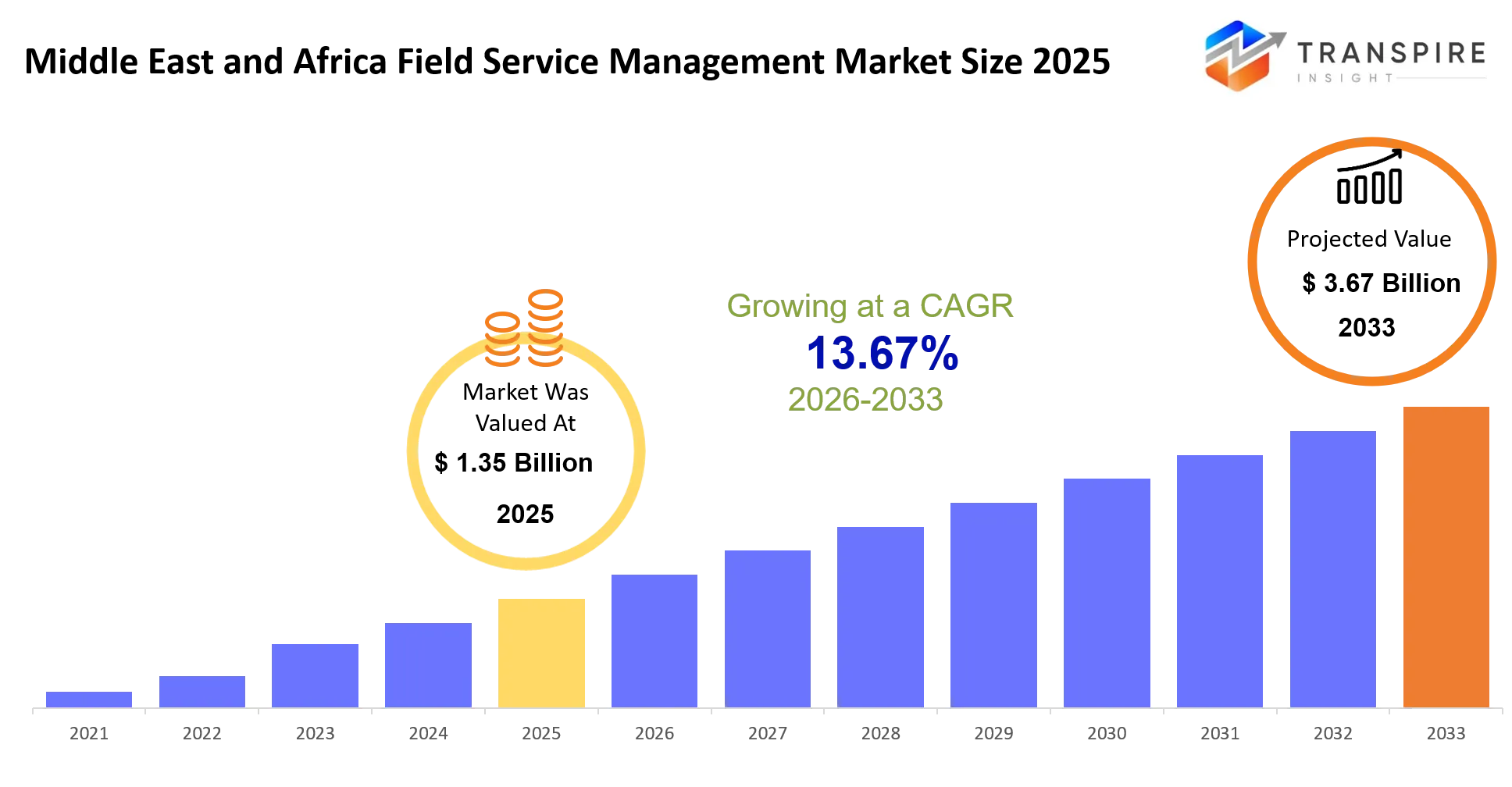
Middle East and Africa Field Service Management Market Summary
The Middle East and Africa Field Service Management Market was valued at USD 1.35 Billion in 2025. It is forecast to reach USD 3.67 Billion by 2033. That is a CAGR of 13.67% over the period.
Field service management solutions help organizations, sort of coordinate technicians, assets ,work orders and customer service tasks across scattered locations. In telecom, utilities, healthcare, manufacturing, and government services, these systems cut down downtime, lift workforce output, and keep field work still linked to central business applications. With real-time planning, route optimization, inventory clarity, and mobile workforce oversight, field service management has turned into a core operational instrument across the Middle East and Africa, basically.
Over the past five years, the market kind of moved away from paper- based and desktop centered routines toward cloud-connected, and mobile-first platforms. A big structural change has been the addition of artificial intelligence, predictive analytics, and IoT enabled monitoring into day-to-day service delivery. The COVID-19 disruption pushed digital transformation hard, so many organizations had to handle remote assets and traveling teams in a more efficient, organized way. As infrastructure efforts expand and service expectations get higher, enterprises are leaning into automation to lower operating costs and improve reaction times. This shift is also translating into steadier software subscription revenues, wider platform adoption, and longer term chances for more advanced field service ecosystems around the region.
Key Market Insights
- Middle East and Africa Field Service Management market adoption , kinda took off as enterprises moved away from manual workflows ,and leaned into automated scheduling plus mobile workforce platforms.
- Gulf countries made up about 38% of the regional revenue in 2025, helped by large scale infrastructure efforts and utility modernization initiatives.
- Cloud deployment was the main route, holding nearly 46% market share in 2025, mostly because costs were lower and scaling happened much quicker.
- SaaS based FSM platforms saw the quickest growth, with enterprise subscriptions climbing over 15% each year across major verticals,
- Work Order Management accounted for around 28% of application revenue in 2025, which points to the ongoing need for real time service coordination.
- Dispatch Management still sat as the second biggest application segment, as demand rose for technician routing along with resource optimization ,in the field.
- AI powered analytics became the fastest growing software category, since many organizations wanted predictive maintenance features and more automated service operations capabilities.
- Telecom operators stayed the largest end user group with close to 24% market share, supported by fiber expansion and 5G infrastructure projects.
- Healthcare organizations increased their FSM spend by roughly 12%–14% per year, targeting medical equipment servicing and compliance management.
- Key players such as Salesforce, Microsoft, Oracle, ServiceNow, and IFS are pushing harder in the market through AI innovation ,cloud expansion, and partnerships that are more strategic than before.
What are the Key Drivers, Restraints, and Opportunities in the Middle East and Africa Field Service Management Market?
The main push behind market expansion is the quick digitalization of day to day work in telecom , utilities , and industrial environments. Big spending on infrastructure, together with a growing bar for service quality has made manual workforce coordination kind of clunky and financially off. Now, many firms rely on field service platforms to handle dispatching automatically, fine tune technician utilization , and cut down service delays. Moving toward cloud computing plus mobile workforce applications also helped, since rollout expenses are typically lower, and operational visibility improves right away. In plain terms these advantages feed into higher software budgets and more dependable recurring subscription revenue.
The biggest restraint though stays with the integration issue, particularly when field service platforms need to connect with older enterprise systems. A lot of organizations in the region still run patchy ERP, CRM, and asset management setups, kind of stitched together. Integration efforts can demand heavy customization, longer deployment schedules. and special technical know-how. It is structural, because many enterprises can’t simply swap out what they already have, without throwing critical operations into disorder. So adoption moves slower and revenue realization drags for both customers and vendors.
One major opportunity sits in AI supported predictive service operations. Utilities , telecom companies, and manufacturing sites increasingly place IoT sensors that produce operational data, data that fits nicely into machine learning. Predictive maintenance , smarter scheduling, and automated service suggestions can noticeably raise workforce efficiency and reduce waste in day to day activities.
What Has the Impact of Artificial Intelligence Been on the Middle East and Africa Field Service Management Market?
Artificial intelligence has, kind of, reshaped field service operations away from those reactive maintenance models into more predictive and data-driven service ecosystems. In practice organizations are using AI algorithms to handle scheduling decisions, technician handoffs , route optimization, and even workforce planning. Some of the more advanced platforms look at old service logs , asset performance signals, plus technician availability, then they decide what dispatch approach is likely the most efficient. The result tends to be less driving time, higher first-time fix rates, and stronger workforce productivity.
Also machine learning is backing predictive maintenance efforts in a pretty direct way. Utilities, telecom providers, and manufacturers rely on sensor-generated data to spot equipment degradation before the actual failures show up. Predictive analytics then helps estimate when maintenance should happen, helps sort and prioritize incoming service requests, and supports spare-parts inventory planning. With that, organizations usually see better asset uptime, lower costs for emergency interventions, and overall better service-level performance.
Natural language processing tools are meanwhile improving customer support, not just by answering, but by automating ticket categorization and work-order creation. AI-based analytics provide operational visibility too, and that lets managers spot repeating service patterns, plus tune how field resources are allocated.
Still though, uptake isn’t fully smooth because integration costs can be high and data quality issues show up. A lot of organizations still run separate, disconnected systems which restrict the availability of consistent training data. On top of that, connectivity limitations in remote industrial areas can weaken the impact of real-time AI apps.
Key Market Trends
- Between 2021 and 2025, cloud based deployments sort of jumped ahead pretty fast, as enterprises started leaning less on on-premise service management systems.
- It felt like everyone was moving, you know, and it expanded significantly during that period.
- AI assisted scheduling also got better—technician utilization rates improved by around 15%–25% across big utility and telecom organizations, which is honestly a lot.
- Meanwhile mobile workforce applications became standard practice, with digital adoption for field technicians going past 70% in a number of Gulf infrastructure projects, too.
- Then IoT connected asset monitoring increased in utilities, and that supported predictive maintenance programs, which in turn reduced unplanned downtime by as much as 20%.
- Telecom operators seemed to accelerate their FSM investments after the region rolled out 5G networks and expanded fiber infrastructure, so the timing kinda mattered there.
- Service platforms like ServiceNow, Salesforce, and Microsoft also ramped up AI integration, so workflows could be automated, and decision making got smoother.
- In healthcare, providers moved toward digital service tracking, mainly to strengthen compliance management, and to keep equipment maintenance visibility clearer.
- Hybrid deployment models gained attention as companies tried to balance cloud scalability with local data governance needs.
- Also, strategic partnerships between software vendors and regional system integrators became more frequent after 2023, it wasn't just one off deals.
- Finally, analytics driven service optimization emerged as a major purchasing criterion, kind of replacing basic scheduling functionality, and becoming the main differentiator overall.
Middle East and Africa Field Service Management Market Segmentation
By Component
Software kinda works as the day to day operational basis of field service management, where it kinda manages work orders, customer details, asset records and also technician actions, all from one centralized platform. In practice services back the whole thing—implementation, system maintenance, upgrades and user training. This helps organizations get more out of the platform. Consulting meanwhile helps businesses figure out what operational needs they actually have, which deployment models fit best, and how to refine those service workflows, bit by bit. Integration solutions connect the field service platform with ERP, CRM, inventory and asset management systems so you end up with one more unified operational environment, and data visibility gets better across departments.
Mobile solutions let field technicians get to schedules, service history, customer info, and reporting tools straight from phones and tablets. This improves responsiveness, and usually productivity too, not in a small way. Then analytics tools turn the operational data into performance insights, which supports decisions, resource planning, and also predictive maintenance efforts. Scheduling tools handle the technician assignments, route planning, and appointment control, cutting down travel time and making service run more efficiently. The “others” category is more like everything specialized: customer communication utilities, workforce collaboration applications, reporting modules, and industry oriented extensions that are built for different end-user sectors and their particular operational requirements.
By Deployment
Cloud deployment has gained substantial adoption because it’s scalable, it keeps infrastructure requirements lower, and it supports remote accessibility which kind of fits modern service operations pretty well. SaaS platforms make deployment easier too, since they reduce maintenance responsibilities and allow faster feature updates, which helps teams move more quickly. Many organizations that want operational flexibility, now pick cloud based environments for workforce coordination, and also for asset management in a more smooth way.
On-premise deployment is still relevant though, especially for organizations with strict security and compliance needs. Hybrid models try to balance that cloud flexibility with local control over critical data and applications, so it’s not just one extreme. Private cloud environments give stronger governance capabilities, and the other deployment approaches serve specialized operational or regulatory requirements as well.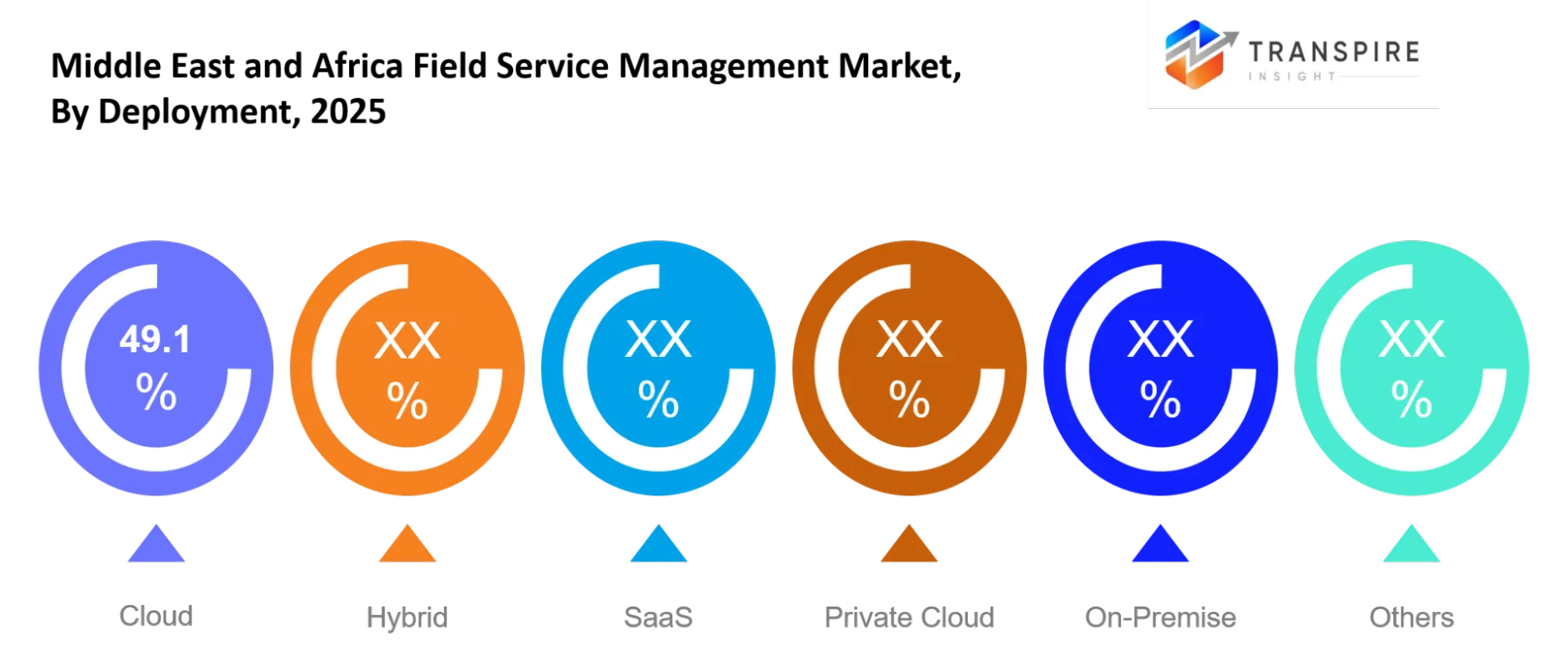
By Application
Work order management is basically one of those core operational routines, because service requests, maintenance actions, and technician assignments all hinge on tight task coordination, in a kind of chain reaction. Dispatch management helps service delivery get steadier and faster by juggling resource allocation and cutting response times, which sounds simple but it really isn’t. Put together, these applications let organizations push productivity up, and also lift service quality.
Asset management backs lifecycle tracking and helps with maintenance planning for essential equipment. Inventory management makes sure spare-parts are on hand, so you avoid the annoying operational delays. Contract management then supports following service agreements and compliance obligations, while other application categories handle more specialized needs across different industries.
By End User
Telecom organizations use field service platforms to support network maintenance, infrastructure deployment and customer service ops., though it can get a bit messy in real life. Utilities depend on digital workforce management to keep power, water, and energy distribution assets running smoothly. Healthcare providers apply these kinds of solutions for managing medical equipment servicing and regulatory compliance related tasks.
In manufacturing plants they often use service management tools for equipment maintenance and operational continuity. IT services organizations lean on technician coordination, as well as service request management, to improve customer support efficiency in the day to day. Government agencies are also increasingly adopting digital field operations platforms while other sectors, well they keep expanding use depending on industry-specific requirements.
What are the Key Use Cases Driving the Middle East and Africa Field Service Management Market?
The most significant use case involves work order execution and technician coordination across telecom networks, utility infrastructure, and industrial facilities. In these settings you have huge asset bases that need constant upkeep, fast fault resolution, and effective workforce deployment. Digital service management platforms can lower service interruptions, while boosting day to day operational performance, kind of keeping everything more aligned.
More additional applications are also starting to pick up momentum in healthcare equipment maintenance and manufacturing asset servicing. Hospitals use these systems to keep maintenance cycles for essential medical devices on track, while manufacturers lean on automated service workflows to reduce production downtime, and also increase equipment dependability.
What’s next includes smart city infrastructure management and IoT enabled predictive service operations. With connected sensors, advanced analytics, and AI driven scheduling, new opportunities are showing up for automated maintenance programs especially over utility networks and big public infrastructure projects.
|
Report Metrics |
Details |
|
Market size value in 2025 |
USD 1.35 Billion |
|
Market size value in 2026 |
USD 1.52 Billion |
|
Revenue forecast in 2033 |
USD 3.67 Billion |
|
Growth rate |
CAGR of 13.67% from 2026 to 2033 |
|
Base year |
2025 |
|
Historical data |
2021 - 2024 |
|
Forecast period |
2026 - 2033 |
|
Report coverage |
Revenue forecast, competitive landscape, growth factors, and trends |
|
Regional scope |
Middle East and Africa (Saudi Arabia, United Arab Emirates, South Africa, Rest of Middle East and Africa) |
|
Key company profiled |
Salesforce, Oracle, SAP, Microsoft, ServiceNow, IFS, IBM, ServiceMax, Trimble, FSM Global, Zinier, ClickSoftware, Praxedo, OverIT, FieldAware |
|
Customization scope |
Free report customization (country, regional & segment scope). Avail customized purchase options to meet your exact research needs. |
|
Report Segmentation |
By Component (Software, Services, Consulting, Integration, Mobile Solutions, Analytics, Scheduling Tools, Others); By Deployment (Cloud, On-Premise, Hybrid, SaaS, Private Cloud, Others, Others, Others); By Application (Work Order Management, Dispatch Management, Asset Management, Inventory Management, Contract Management, Others, Others, Others); By End User (Telecom, Utilities, Healthcare, Manufacturing, IT Services, Government, Others, Others) |
Which Regions are Driving the Middle East and Africa Field Service Management Market Growth?
In the Gulf region, market revenue keeps leading, mostly because people are spending heavily on digital foundations, modernization of utilities, and the big smart city efforts. Countries like the United Arab Emirates and Saudi Arabia have really pushed forward enterprise digital makeover plans, both in public and private areas. There is also solid cloud take up, plus more advanced telecom infrastructure, and then government-led technology drives that keep the market in front. Meanwhile a fairly mature mix of technology providers, system integrators, and enterprise users kind of locks in that regional advantage, year after year.
The wider Middle East, meanwhile , becomes the second biggest contributor and it looks a bit different, since the emphasis is on longer-term infrastructure build out as well as enterprise modernization. The region’s economic diversification schemes have nudged investment toward operational efficiency solutions across energy, transport, and the industrial space. Adoption tends to move slower than what you see in the Gulf, but it still feels steady and fairly easy to forecast. Because enterprises keep budgeting consistently, revenue generation stays dependable for most of the forecast window.
Africa is forecast to hit the quickest growth momentum all the way through 2033. More telecommunications capability is being rolled out, utility modernization programs are moving forward, and digital transformation initiatives are basically opening up fresh deployment chances. With better cloud accessibility and stronger mobile connectivity, it’s become less complicated for organizations chasing workforce optimization ideas to start implementing. So this path forward ends up creating appealing prospects for software vendors, integrators, and investors who want durable, long run regional expansion.
Who are the Key Players in the Middle East and Africa Field Service Management Market and How Do They Compete?
Competition stays somewhat concentrated , with global enterprise software vendors still carrying a lot of market weight, while regional specialists aim at smaller or niche needs. Technology innovation, cloud capability, integration flexibility, and AI functionality are usually the big drivers here. More and more vendors seem to fight not just with standalone scheduling tools, but through platform ecosystems, which then leads to better customer retention , and it opens up recurring revenue streams in practice.
Salesforce stands out because it offers deep CRM embedding and AI-driven service automation, so customer engagement connects more directly to field operations. ServiceNow leans into workflow orchestration, allowing organizations to combine service management across several operational functions. Microsoft takes a different angle by using cloud infrastructure , analytics, and business application integration to push enterprise adoption harder.
IFS highlights asset heavy sectors with advanced maintenance and service lifecycle management features. Oracle, on the other hand, pushes its ERP integration strengths and it supports large scale enterprise rollouts. Overall, vendors keep expanding via AI investments, regional partnerships, cloud service upgrades, and more industry specific solution building , aimed at handling messy operational requirements that don’t fit neatly anywhere else.
Company List
- Salesforce
- Oracle
- SAP
- Microsoft
- ServiceNow
- IFS
- IBM
- ServiceMax
- Trimble
- FSM Global
- Zinier
- ClickSoftware
- Praxedo
- OverIT
- FieldAware
Recent Development News
In April 2026, ServiceNow launched new AI-powered field service capabilities within its workflow platform. The release enhanced automated scheduling, technician assistance, and service resolution efficiency, strengthening enterprise automation adoption. https://www.servicenow.com/newsroom (ServiceNow Newsroom).
In September 2025, IFS announced strategic expansion of industrial AI and service management capabilities through new platform enhancements. The initiative strengthened predictive maintenance and field workforce optimization across asset-intensive industries.https://www.ifs.com/news (IFS News).
In May 2025, Salesforce introduced expanded AI functionality for Field Service operations through Agentforce integration. The update improved service automation, work-order handling, and customer support efficiency for enterprise users.https://www.salesforce.com/news/ (Salesforce News).
What Strategic Insights Define the Future of the Middle East and Africa Field Service Management Market?
The market is kind of moving toward autonomous service operations that are built around artificial intelligence, connected assets, and real time workforce orchestration, not just a casual trend. What really nudges this transition is the growing need to manage increasingly complex infrastructure networks, while also keeping operational costs controlled and service quality steady. In the next five to seven years, you can expect value creation to drift away from basic scheduling functionality, and toward predictive plus prescriptive service intelligence, like a quieter but stronger shift.
There is also a less obvious risk that people don’t always talk about. It is the technology concentration thing among a relatively small number of global platform providers. If you lean heavily on a tight cluster of software ecosystems, switching costs could climb fast , and enterprise customers might find they have less flexibility than they hoped. Still, at the same time, AI enabled predictive maintenance, when paired with smart city infrastructure, shows a real and meaningful emerging opportunity. This seems especially relevant across the Gulf and selected African growth markets.
So, market participants should, in practice, place priority on investments in interoperable platforms that can bind together workforce management, IoT data, analytics, and enterprise applications. The organizations that manage to build strong ecosystem partnerships and then show measurable operational outcomes will be the ones best able to secure long term market value.
Middle East and Africa Field Service Management Market Report Segmentation
By Component
- Software
- Services
- Consulting
- Integration
- Mobile Solutions
- Analytics
- Scheduling Tools
- Others
By Deployment
- Cloud
- On-Premise
- Hybrid
- SaaS
- Private Cloud
- Others
By Application
- Work Order Management
- Dispatch Management
- Asset Management
- Inventory Management
- Contract Management
- Others
By End User
- Telecom
- Utilities
- Healthcare
- Manufacturing
- IT Services
- Government
- Others
Frequently Asked Questions
Find quick answers to common questions.
The Expected Middle East and Africa Field Service Management Market size for the Market will be USD 3.67 Billion in 2033.
Key Segments for the Middle East and Africa Field Service Management Market are By Component (Software, Services, Consulting, Integration, Mobile Solutions, Analytics, Scheduling Tools, Others); By Deployment (Cloud, On-Premise, Hybrid, SaaS, Private Cloud, Others, Others, Others); By Application (Work Order Management, Dispatch Management, Asset Management, Inventory Management, Contract Management, Others, Others, Others); By End User (Telecom, Utilities, Healthcare, Manufacturing, IT Services, Government, Others, Others).
Major Middle East and Africa Field Service Management Market Payers are Salesforce, Oracle, SAP, Microsoft, ServiceNow, IFS, IBM, ServiceMax, Trimble, FSM Global, Zinier, ClickSoftware, Praxedo, OverIT, FieldAware.
The Current Middle East and Africa Field Service Management Market size is USD 1.35 Billion in 2025.
The Middle East and Africa Field Service Management Market CAGR is 13.67% from 2026 to 2033.
- Salesforce
- Oracle
- SAP
- Microsoft
- ServiceNow
- IFS
- IBM
- ServiceMax
- Trimble
- FSM Global
- Zinier
- ClickSoftware
- Praxedo
- OverIT
- FieldAware
About the Authors

Mayur Shinde
I am Mayur Shinde, a Senior Research Analyst at Transpire Insight, specializing in the Automotive & Transportation and Information & Communication Technology (ICT) Industry. My work focuses on analyzing emerging market trends, technological advancements, competitive landscapes, and industry developments to deliver accurate, data-driven insights. I am passionate about transforming complex market information into clear, actionable content that helps businesses, professionals, and decision-makers stay informed and make confident strategic decisions.

Chakradhar Khansole
Chakradhar serves as the Research Director at Transpire Insight, bringing over 8 years of experience in technology, innovation, and strategic market intelligence. He specializes in transforming complex market data into actionable business insights that enable organizations to make informed, growth-oriented decisions. Recognized for his strategic vision and analytical expertise, Chakradhar leads high-impact research initiatives, delivering comprehensive market assessments, competitive intelligence, and forward-looking industry analysis.
Recently Published Reports
-
Apr 2026
3D Optical Profiler Market
3D Optical Profiler Market Size, Share & Analysis Report By Type (Desktop 3D Optical Profiler, and Portable 3D Optical Profiler), By Technology (Confocal Technology, and White Light Interference), By End-Use Industry (Manufacturing, Research Institutions, Automotive, Aerospace and Defense, Medical Devices, and Other), and Geography (North America, Europe, Asia-Pacific, Middle East and Africa, South and Central America), 2021 - 2031
-
Apr 2026
Depth Sensor Market
Depth Sensor Market Size, Share & Analysis Report By Type (Infrared Depth Sensors, Time-of-Flight (ToF) Sensors, Stereo Vision Sensors, Structured Light Sensors, Ultrasonic Depth Sensors), By Application (Automotive, Robotics, Gaming, Consumer Electronics, Industrial Automation, Healthcare, Security & Surveillance, Others), By End Users (Automotive Manufacturers, Consumer Electronics Companies, Healthcare Providers, Industrial Companies, Security Agencies, Gaming Companies, Robotics Companies, Others), and Geography (North America, Europe, Asia-Pacific, Middle East and Africa, South and Central America), 2021 – 2031
-
Apr 2026
Digital Manufacturing Market
Digital Manufacturing Market Size, Share & Analysis Report By Component (Hardware, Software, and Services), By Technology (Robotics, 3D Printing, Internet of Things (IoT), and Others), By Application (Automotive and Transportation, Aerospace and Defense, Consumer Electronics, Industrial Machinery, and Others), By Process Type (Computer-Based Designing, Computer-Based Simulation, Computer 3D Visualization, Analytics, and Others), and Geography (North America, Europe, Asia-Pacific, Middle East and Africa, South and Central America), 2021 – 2031
-
Apr 2026
Digital Visa Services Market
Digital Visa Services Market Size, Share & Analysis Report By Type (Individual Travelers, Group Travelers), By Application (Tourism, Business Travel, Others), and Geography (North America, Europe, Asia-Pacific, Middle East and Africa, South and Central America), 2021 – 2031