
Global Healthcare IT Consulting Market Size & Forecast:
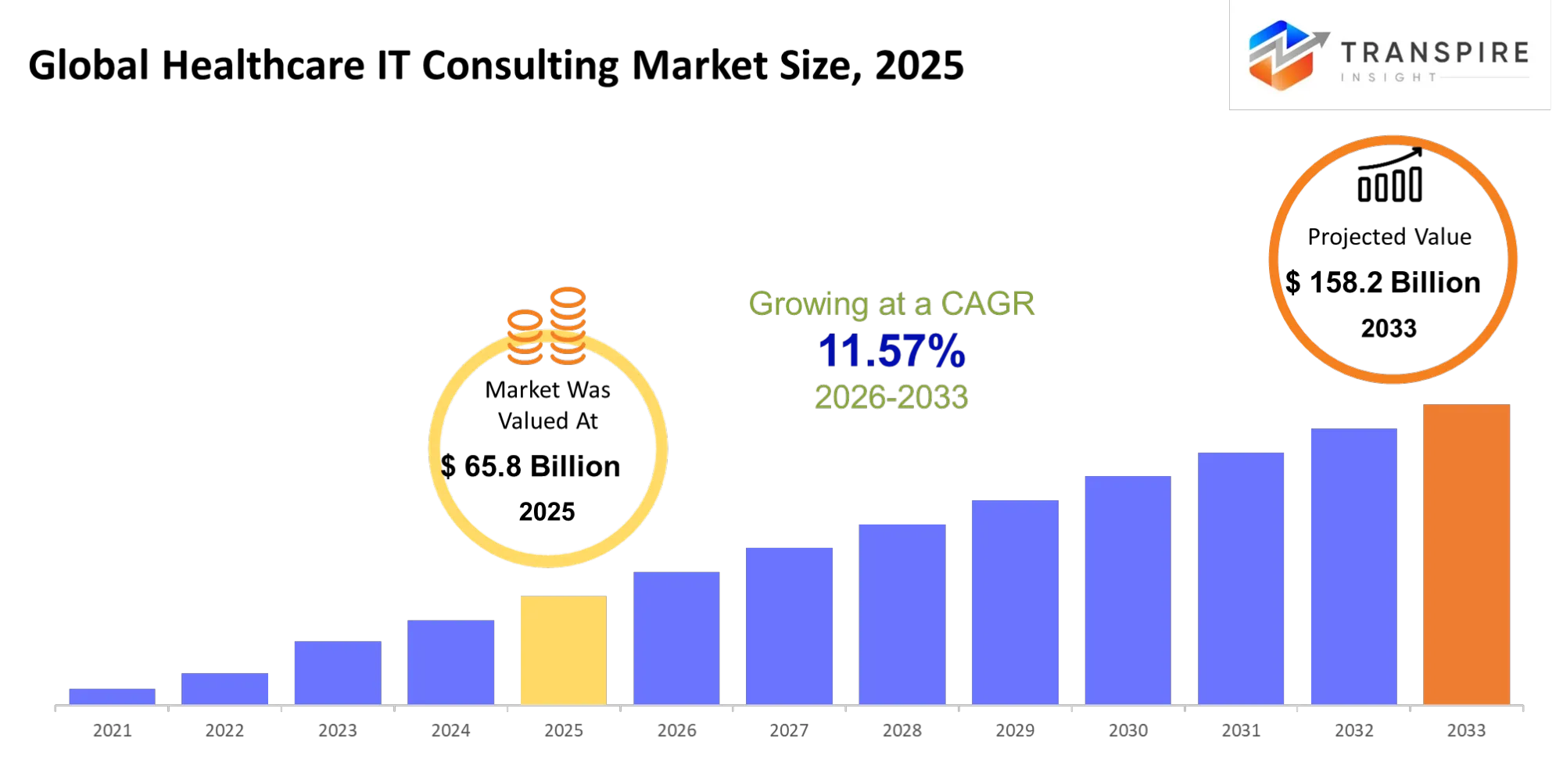
- Global Healthcare IT Consulting Market Size 2025: USD 65.8 Billion
- Global Healthcare IT Consulting Market Size 2033: USD 158.2 Billion
- Global Healthcare IT Consulting Market CAGR: 11.57%
- Global Healthcare IT Consulting Market Segments: By Service (Strategy Consulting, Implementation, Integration, Support), By Application (EHR, Telehealth, Data Analytics, Cybersecurity), By End-User (Hospitals, Clinics, Healthcare Providers, Governments)
Global Healthcare IT Consulting Market Summary
The Keyword size is estimated at USD 65.8 billion in 2025 and is anticipated to reach USD 158.2 billion by 2033, growing at a CAGR of 11.57% from 2026 to 2033. Europe is currently dominating the global healthcare IT consulting market. Moreover, a strong focus on developed data systems, cloud integration, and compliance support continues to strengthen the market share globally.
Electronic health records (EHRs), cloud systems, cybersecurity solutions, and data analytics tools are just a few of the digital technologies that the global healthcare IT consulting market assists hospitals, clinics, insurance companies, and healthcare organizations in planning, implementing, and managing. Practically speaking, consultants use technology to help healthcare providers streamline processes, reduce costs, and improve patient care.
The market has changed over the past three to five years from implementing simple IT systems to digital transformation and data-driven healthcare. The increasing use of cloud computing, artificial intelligence, and healthcare platforms has resulted in a significant structural change. The COVID-19 pandemic was a major real-world catalyst, increasing demand for digital infrastructure and remote healthcare services.
Key Global Healthcare IT Consulting Market Insights
- Healthcare organizations in Europe are increasingly demanding GDPR-compliant systems and connected healthcare platforms.
- European countries are investing in smart hospitals and cross-border healthcare data sharing to improve healthcare efficiency and patient outcomes.
- North America is showing a strong technological movement toward cloud-based healthcare systems, cybersecurity solutions, AI-powered analytics, and electronic health record (EHR) modernization.
- Asia-Pacific is experiencing the fastest technological movement due to rapid healthcare digitization, telemedicine expansion, mobile health applications, and government-supported digital health programs.
- Countries like India, China, and Japan are investing heavily in healthcare infrastructure modernization and cloud-based healthcare systems.
- Technologically, the European region is witnessing higher adoption of telemedicine, AI-based diagnostics, cloud healthcare platforms, and cybersecurity consulting services.
- Hospitals and healthcare organizations are focusing more on value-based care and digital patient engagement platforms across the world.
What are the Key Drivers, Restraints, and Opportunities in the Global Healthcare IT Consulting Market?
Drivers
The global healthcare IT consulting market is growing for many crucial reasons. As there are major changes going on for development in this industry. As the world is going digital, so is the transformation in the healthcare industry. The massive shift from paper-based records to Electronic Health Records (EHR) and the modernization of legacy IT systems require expert consultants to manage data migration and software integration. Laws like HIPAA in the U.S. and GDPR in Europe mandate strict data privacy and security protocols. Healthcare providers rely on consultants to navigate these complex legal frameworks to avoid heavy penalties. As hospitals use various specialized software, the need for these systems to "talk" to one another (interoperability) is critical. Consultants provide the technical bridges (like FHIR and API-led integration) to ensure seamless data exchange.
Restraints
As this market is growing rapidly, there are also a few drawbacks. High implementation and maintenance costs are a real problem in this industry. Consulting fees, software licenses, and hardware are restrictive for small to mid-sized healthcare providers, especially those in developing economies. Another problem in this industry is that while consultants help build security, the increasing frequency and sophistication of ransomware attacks make healthcare organizations hesitant to integrate too many external systems, fearing potential vulnerabilities.
Opportunities
There is an extremely large number of opportunities in the healthcare IT consultant market. Expansion in emerging markets can be the biggest opportunity. Countries across the Asia-Pacific and Middle East (e.g., India’s Ayushman Bharat or Saudi Arabia’s Vision 2030) are investing heavily in healthcare infrastructure, creating a massive new demand for digital strategy and implementation services. There is an increasing opportunity for consultants to implement Artificial Intelligence and Machine Learning tools that help doctors predict patient outcomes, optimize hospital workflows, and personalize treatment plans. Also, the permanent shift toward virtual care models provides an opportunity for consultants to build and optimize secure, user-friendly telehealth platforms and mobile health (mHealth) applications.
What Has the Impact of Artificial Intelligence Been on the Global Healthcare IT Consulting Market?
AI has revolutionized the healthcare IT consulting landscape, moving beyond mere system implementation to creating more sophisticated clinical intelligence platforms. In this field, AI is filling in the gap between conventional imaging methods and high-quality diagnostics. This technology helps to optimize and automate clinical workflows and allows for portable devices to perform complex tasks that would otherwise need to be done on a large and stationary piece of equipment.
Additionally, AI improves predictive capabilities by providing real-time 3D mapping and data analysis, making it easier for consultants to make well-crafted business cases for the widespread adoption in hospitals. Such improvements in operations can help to cut wait times and travel workload for patients and deliver meaningful cost savings to healthcare providers.
VentriPoint Diagnostics' VMS+™ 4.0 platform has been introduced in the market. It is an AI-powered system that converts standard 2D ultrasound images into a detailed 3D model of the heart. It does so by providing the same diagnostic capabilities as a multi-million dollar MRI machine with a portable workflow that is software-driven. This is a reflection of what IT consulting has become, the ability to deliver scalable, software-based solutions with both clinical validation and financial justification to medical departments.
Key Market Trends:
- AI assistants are being used by administrators for research, and consulting firms are fine-tuning their sites for "conversational" queries.
- Highly customized content is being produced for a few highly profitable hospital systems by marketing teams.
- In an effort to struggle with information overload, consultants are turning to short snippets of video, lasting upwards of 60 seconds, to help explain the complicated regulatory updates or the cybersecurity threat.
- As consultants are getting more attention, marketers are turning to "Zero-Party Data" tactics.
- Individual consultants within firms are encouraged to build personal brands.
- Firms are using interactive tools, such as "HIPAA Compliance Calculators" or "AI Readiness Surveys", on their websites.
- While AI is used to draft technical outlines and market research, the final content is always refined by clinical experts.
- There is a rise in consulting firms partnering with healthcare associations for webinars.
Global Healthcare IT Consulting Market Segmentation
By Service
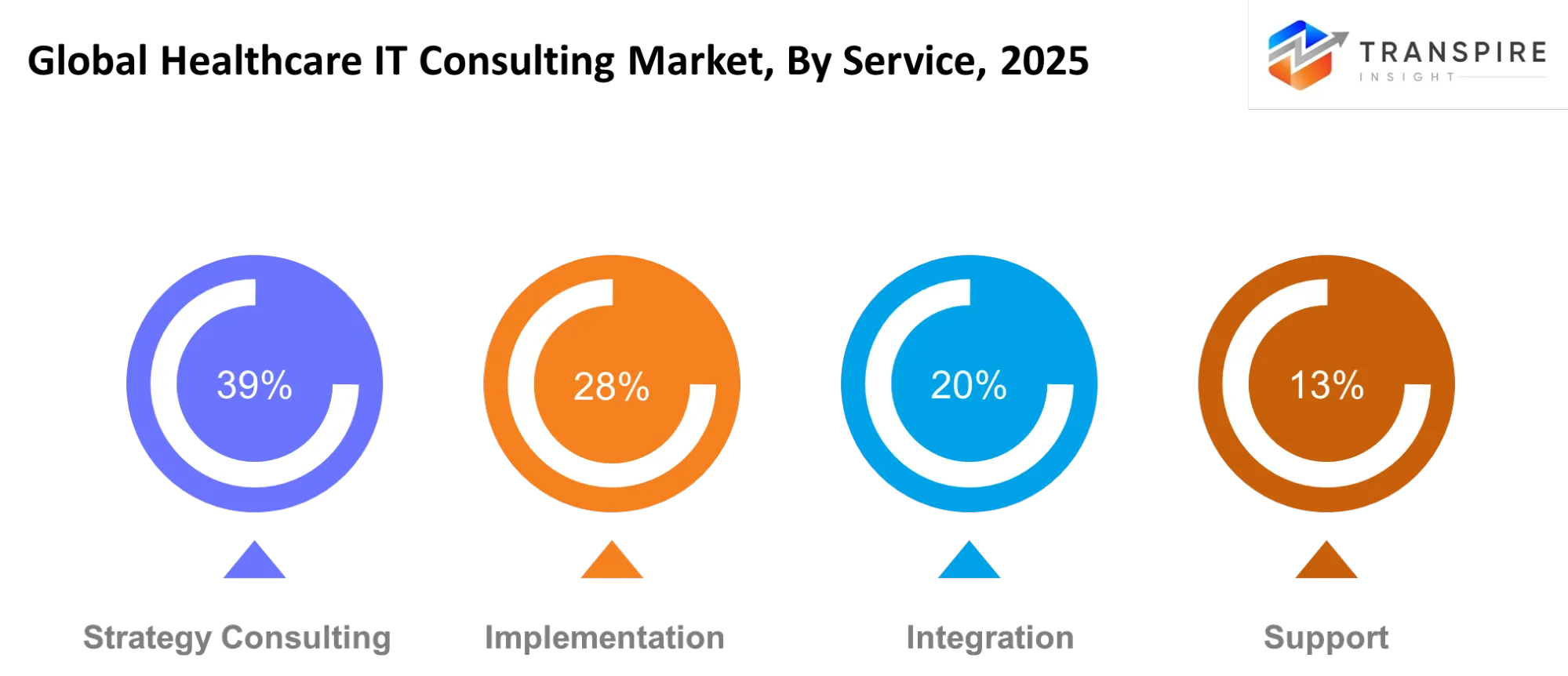
From a market perspective, the services segment forms the backbone of the industry, as software, without a proper setup, is worth nothing to anyone. The special growth principle here is that the software is not "one size fits all" but is created specifically to meet the workflow of a given hospital. In the long-term, consultants won't be tech installers anymore, but instead will become “long-term strategic partners” who will oversee the complete digital transformation of a hospital. The North American region is leading because of the HITECH Act, which offered billions in incentives to hospitals for the adoption of digital records. One obvious example is the hundreds of specialized consultants they've recruited to manage their massive move to Epic Systems over the duration of several years, allowing them to safely transport decades of patient records without interrupting the day-to-day work of surgeries and appointments.
By Application
This segment has a commanding share of the market as digital records (EHR) form the backbone of any contemporary clinic. The one-of-a-kind growth logic is now moving from storing data to "analyzing" it and using information to predict who's at risk of heart failure or stroke before it occurs. The implication for the future is a world of "proactive medicine," in which IT systems warn the doctor of problems before the patient experiences symptoms. Europe is leading in establishing the standards for this data. The strictest privacy laws in the world govern any application that is used in the hospital setting, under the GDPR (General Data Protection Regulation). One of these is Germany's Digital Healthcare Act (DVG), which enables doctors to prescribe "apps" as medicine. The experts there work to make sure that these apps are clinically verified and in full compliance with the privacy rules in Europe before they are utilized.
By End-User
The end-user market is growing from private hospitals to large-scale public health care programs run by the government. The special growth mechanism here is one of "connectivity," where a small rural clinic is connected to a large city hospital, enabling them to exchange knowledge on the fly. In the future, expect to see the emergence of the "Smart City" in which your health information flows automatically from pharmacies, laboratories, and health specialists. The Ayushman Bharat Digital Mission (ABDM) is a large policy in India that aims for a single health ID for all citizens. A great example is the Apollo Hospitals group, which has used consultants to develop an immense, easy-to-use platform that links patients in rural areas with the best specialists, thus bypassing the need for physical infrastructure in remote locations.
What are the Key Use Cases Driving the Global Healthcare IT Consulting Market?
Optimizing Electronic Health Records (EHR) in major hospital systems is the primary use case driving the market. In order to lower clinician burnout and guarantee that large-scale data migrations comply with strict legal requirements like HIPAA or GDPR, consultants concentrate on improving these platforms.
To disconnect hidden information, applications are growing into Data Analytics and compatibility. Consultants facilitate smooth information transmission across various systems in clinics and diagnostic labs, enabling healthcare providers to employ real-time data for more precise patient population health management.
AI-driven diagnostics and cybersecurity are the main emerging use cases. Consultants are developing "zero-trust" security frameworks to safeguard healthcare networks from increasingly complex worldwide ransomware attacks while deploying predictive algorithms for early illness identification in the fastest-growing locations.
Report Metrics
|
Report Metrics |
Details |
|
Market size value in 2025 |
USD 65.8 Billion |
|
Market size value in 2026 |
USD 73.5 Billion |
|
Revenue forecast in 2033 |
USD 158.2 Billion |
|
Growth rate |
CAGR of 11.57% from 2026 to 2033 |
|
Base year |
2025 |
|
Historical data |
2021 - 2024 |
|
Forecast period |
2026 - 2033 |
|
Report coverage |
Revenue forecast, competitive landscape, growth factors, and trends |
|
Regional scope |
United States; Canada; Mexico; United Kingdom; Germany; France; Italy; Spain; Denmark; Sweden; Norway; China; Japan; India; Australia; South Korea; Thailand; Brazil; Argentina; South Africa; Saudi Arabia; United Arab Emirates |
|
Key company profiled |
Accenture, Deloitte, PwC, Cognizant, Infosys, TCS, Wipro, HCLTech, IBM, Oracle, Cerner, Epic Systems, McKinsey, KPMG, Capgemini Furlab, Kaneka Corporation, Tissavel, Kopenhagen Fur, HengHua Textile. |
|
Customization scope |
Free report customization (country, regional & segment scope). Avail customized purchase options to meet your exact research needs. |
|
Report Segmentation |
By Service (Strategy Consulting, Implementation, Integration, Support), By Application (EHR, Telehealth, Data Analytics, Cybersecurity), By End-User (Hospitals, Clinics, Healthcare Providers, Governments). |
Which Regions are Driving the Global Healthcare IT Consulting Market Growth?
Europe Global Healthcare IT Consulting Market
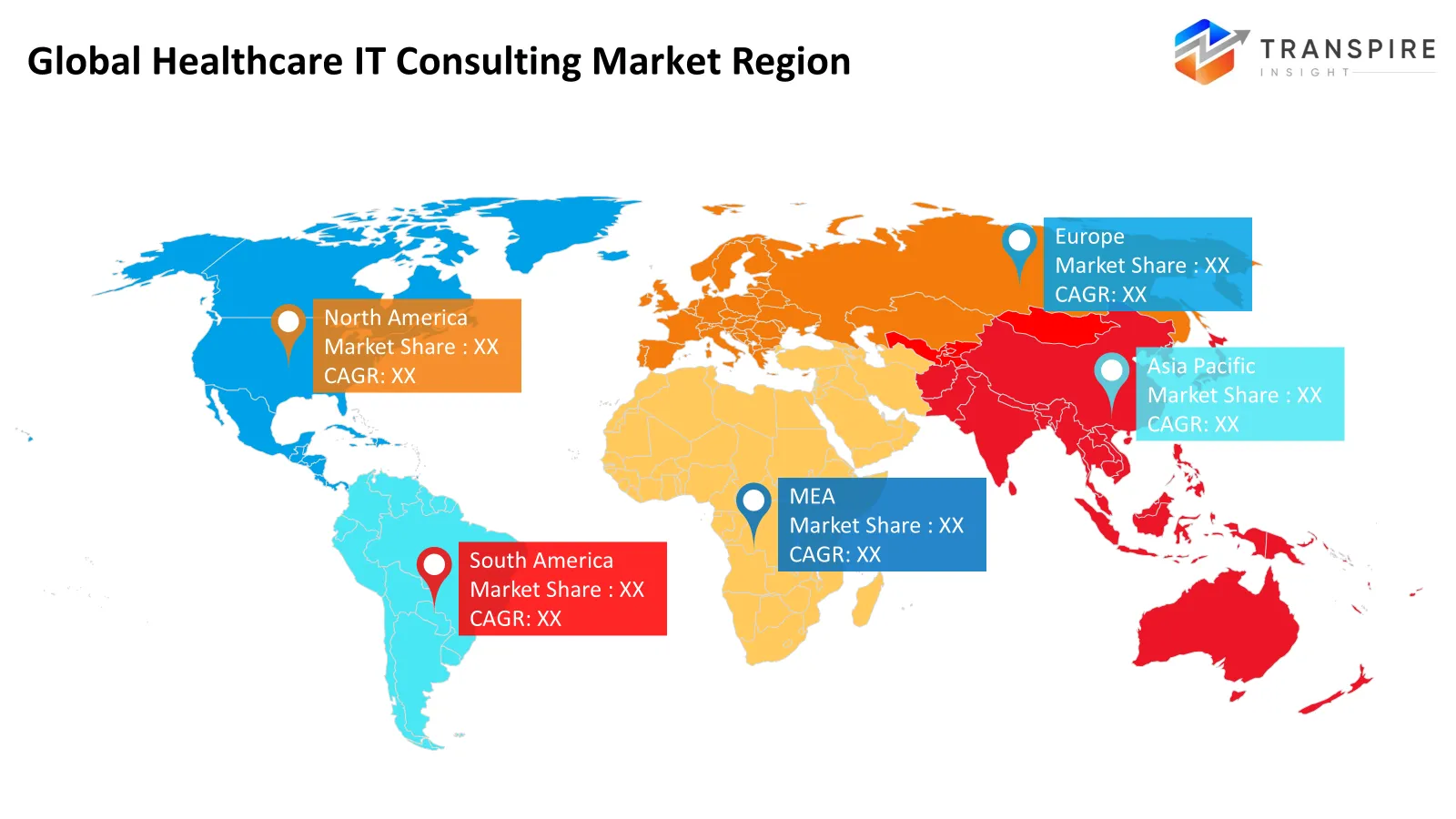
Due to its strict regulations and high requirements for patient data privacy, Europe now has a 39% market share in healthcare IT consulting. The General Data Protection Regulation (GDPR), which requires all healthcare providers to seek professional consultation for compliance and secure data processing, is the cornerstone of the region's strength. Moreover, there is a constant need for consultants to incorporate medical apps into official clinical processes due to advanced public infrastructure and government-backed programs like Germany's Digital Healthcare Act (DVG). This well-established ecosystem guarantees that Europe will continue to be the world standard for organized and morally sound digital health systems.
North America Healthcare IT Consulting Market
North America is the second region in innovation, concentrating more on the commercial optimization of healthcare delivery. North America's growth is fueled by the shift to value-based care models, where financial incentives are linked to patient results, whereas Europe is driven by privacy. Given the presence of major tech companies and an established venture capital ecosystem that consistently funds new AI and EHR improvements, the industry remains stable. High-level strategic consultants who can help hospital networks balance significant technology investments with long-term financial ROI are therefore continually needed.
Asia- Pacific Healthcare IT Consulting Market
Due to significant government investments in national digital health infrastructure, the Asia-Pacific region has recently emerged as the fastest-growing industry, with a CAGR of 15.9%. To reach large, rural populations, many Asian countries are "leapfrogging" straight to mobile-first healthcare and cloud-based diagnostics, in contrast to Western regions that are updating outdated systems. Hundreds of millions of people now have integrated digital health IDs thanks to initiatives like India's Ayushman Bharat Digital Mission. AI-driven telehealth and remote monitoring present this region's prospects, giving consultants a blank canvas on which to construct the most scalable digital health networks globally.
Who are the Key Players in the Global Healthcare IT Consulting Market and How do they Compete?
Businesses compete by striking a balance between the demand for AI-driven clinical efficiency and the requirement for huge data security. Management firms compete on the high-level plan and financial return on investment of digital transformations, while tech businesses concentrate on the actual "pipes" of the system.
By providing end-to-end digital transformations that connect hospital boardrooms to the operating room, Accenture, Deloitte, PwC, and KPMG set themselves apart through innovation-led strategy. To increase their clinical expertise, they grow by purchasing boutique AI companies. McKinsey employs a high-value, specialty approach, setting itself apart by expansion into global health policy and elite organizational reform.
Cognizant, Infosys, TCS, Wipro, and HCLTech compete using a cost-efficient innovation strategy, differentiating via high-scale offshore delivery models and rapid implementation of "as-a-service" platforms. They expand by establishing local "innovation hubs" near major medical universities. Meanwhile, Oracle (Cerner) and Epic Systems employ a product-niche strategy, differentiating through deep integration with their own Electronic Health Record platforms. They expand by locking in large hospital networks through long-term support contracts and proprietary AI diagnostics.
Healthcare IT Consulting Market Companies
- Accenture
- Deloitte
- PwC
- Cognizant
- Infosys
- TCS
- Wipro
- HCLTech
- IBM
- Oracle
- Cerner
- Epic Systems
- McKinsey
- KPMG
- Capgemini
Recent Development News
In April 2026, CGI Group was identified by Zacks Investment Research as a key player driving digital transformation in the healthcare sector through AI-enabled solutions and cloud-based platforms. This strategic focus helps the company address the growing need for digital healthcare consulting, stringent regulatory compliance, and cybersecurity within the healthcare IT market, providing a "silver lining" amidst broader macroeconomic challenges.
In May 2026, Legence (LGN) reported strong first-quarter revenue of $1.04 billion. This performance, which more than doubled from the previous year, was driven by strong organic growth in mission-critical building systems and the successful integration of acquisitions like The Bowers Group, leading the company to raise its full-year 2026 guidance.
What Strategic Insights Define the Future of the Global Healthcare IT Consulting Market?
The healthcare IT consulting market is heading toward unified, cloud-native interoperability ecosystems driven by the necessity to dismantle legacy data silos and integrate predictive AI engines.
A critical hidden risk is the acute shortage of cross-functional tech talent that deeply understands both clinical workflows and strict healthcare compliance frameworks, leading to high-friction software deployments and costly operational downtime.
Conversely, an emerging opportunity lies in hyper-specialized cybersecurity consulting, specifically securing vulnerable internet-of-medical-things (IoMT) hardware networks against sophisticated ransomware attacks.
To thrive, the strategic recommendation for consulting firms is to abandon generalized IT advisory models and build dedicated, clinical-AI validation practices. By heavily investing in proprietary interoperability sandboxes that actively train healthcare workers alongside system deployments, firms can mitigate implementation risks, protect patient data integrity, and secure long-term, high-margin enterprise partnerships.
Healthcare IT Consulting Market Segmentation
By Service
- Strategy Consulting
- Implementation
- Integration
- Support
By Application
- EHR
- Telehealth
- Data Analytics
- Cybersecurity
By End-User
- Hospitals
- Clinics
- Healthcare Providers
- Governments
Regional Outlook
North America
- United States
- Canada
- Mexico
Europe
- Germany
- United Kingdom
- France
- Spain
- Italy
- Rest of Europe
Asia Pacific
- Japan
- China
- Australia & New Zealand
- South Korea
- India
- Rest of Asia Pacific
South America
- Brazil
- Argentina
- Rest of South America
Middle East & Africa
- Saudi Arabia
- United Arab Emirates
- South Africa
- Rest of the Middle East & Africa
Frequently Asked Questions
Find quick answers to common questions.
The approximate healthcare IT consulting market size for the market will be USD 158.2 billion in 2033.
Key segments for the global healthcare IT consulting market are By Service (Strategy Consulting, Implementation, Integration, Support), By Application (EHR, Telehealth, Data Analytics, Cybersecurity), By End-User (Hospitals, Clinics, Healthcare Providers, Governments).
Major global healthcare IT consulting market players are Accenture, Deloitte, PwC, Cognizant, Infosys, TCS, Wipro, HCLTech, IBM, Oracle, Cerner, Epic Systems, McKinsey, KPMG, and Capgemini.
The healthcare IT consulting market size is USD 65.8 billion in 2025.
The global healthcare IT consulting market is expected to grow 11.57% during the forecast period 2026-2033.
- Accenture
- Deloitte
- PwC
- Cognizant
- Infosys
- TCS
- Wipro
- HCLTech
- IBM
- Oracle
- Cerner
- Epic Systems
- McKinsey
- KPMG
- Capgemini
About the Authors

Pankaj Ghogare Patil
I am Pankaj Ghogare Patil, a Senior Research Analyst at Transpire Insight, specializing in the Pharmaceutical, Chemicals & Materials, Healthcare IT, and Biotechnology industry. My expertise lies in conducting comprehensive market research, analyzing industry trends, evaluating competitive landscapes, and translating complex data into actionable insights. At Transpire Insight, I closely follow emerging technologies, regulatory developments, and market innovations to create accurate, well-researched, and informative content that helps businesses and professionals make informed decisions. I am committed to producing credible, evidence-based articles that reflect industry best practices while making technical topics accessible and valuable for a broad audience.

Chakradhar Khansole
Chakradhar serves as the Research Director at Transpire Insight, bringing over 8 years of experience in technology, innovation, and strategic market intelligence. He specializes in transforming complex market data into actionable business insights that enable organizations to make informed, growth-oriented decisions. Recognized for his strategic vision and analytical expertise, Chakradhar leads high-impact research initiatives, delivering comprehensive market assessments, competitive intelligence, and forward-looking industry analysis.
Recently Published Reports
-
Apr 2026
AI in Diabetic Retinopathy Market
AI in Diabetic Retinopathy Market Size, Share & Analysis Report By Type (Screening AI Systems, Diagnostic AI Systems, and Predictive AI Models), By Application Segment (Hospitals, Ophthalmology Clinics, Diagnostic Centers, and Research and Development), and Geography (North America, Europe, Asia-Pacific, Middle East and Africa, South and Central America), 2021 - 2031
-
Apr 2026
Psychometric Tests Market
Psychometric Tests Market Size, Share & Analysis Report By Type (Personality Tests, Ability/Aptitude Tests, Skill/Knowledge Tests, and Others), By Application (Talent Acquisition and Talent Management), and Geography (North America, Europe, Asia-Pacific, Middle East and Africa, South and Central America), 2021 – 2031
-
Apr 2026
Rare Biological Sample Collection Market
Rare Biological Sample Collection Market Size, Share & Analysis Report By Type (Isolation Kits & Reagent, Blood Collection Tubes, and Others), By Application (Oncology, Transcriptomics, Pharmacogenomics, and Others), and Geography (North America, Europe, Asia-Pacific, Middle East and Africa, South and Central America), 2021 – 2031
-
Jul 2026
Diabetic Retinopathy Market
Diabetic Retinopathy Market Size, Share & Analysis Report By Type (Proliferative Diabetic Retinopathy, and Diabetic Macular Edema (DME)), By Treatment Type (Anti VEGF Drug, Steroid Implants, Laser Surgeries, and Vitrectomy), and Geography (North America, Europe, Asia-Pacific, Middle East and Africa, South and Central America), 2021 – 2031
Our Clients







