
Asia Pacific Software Consulting Market Size & Forecast:
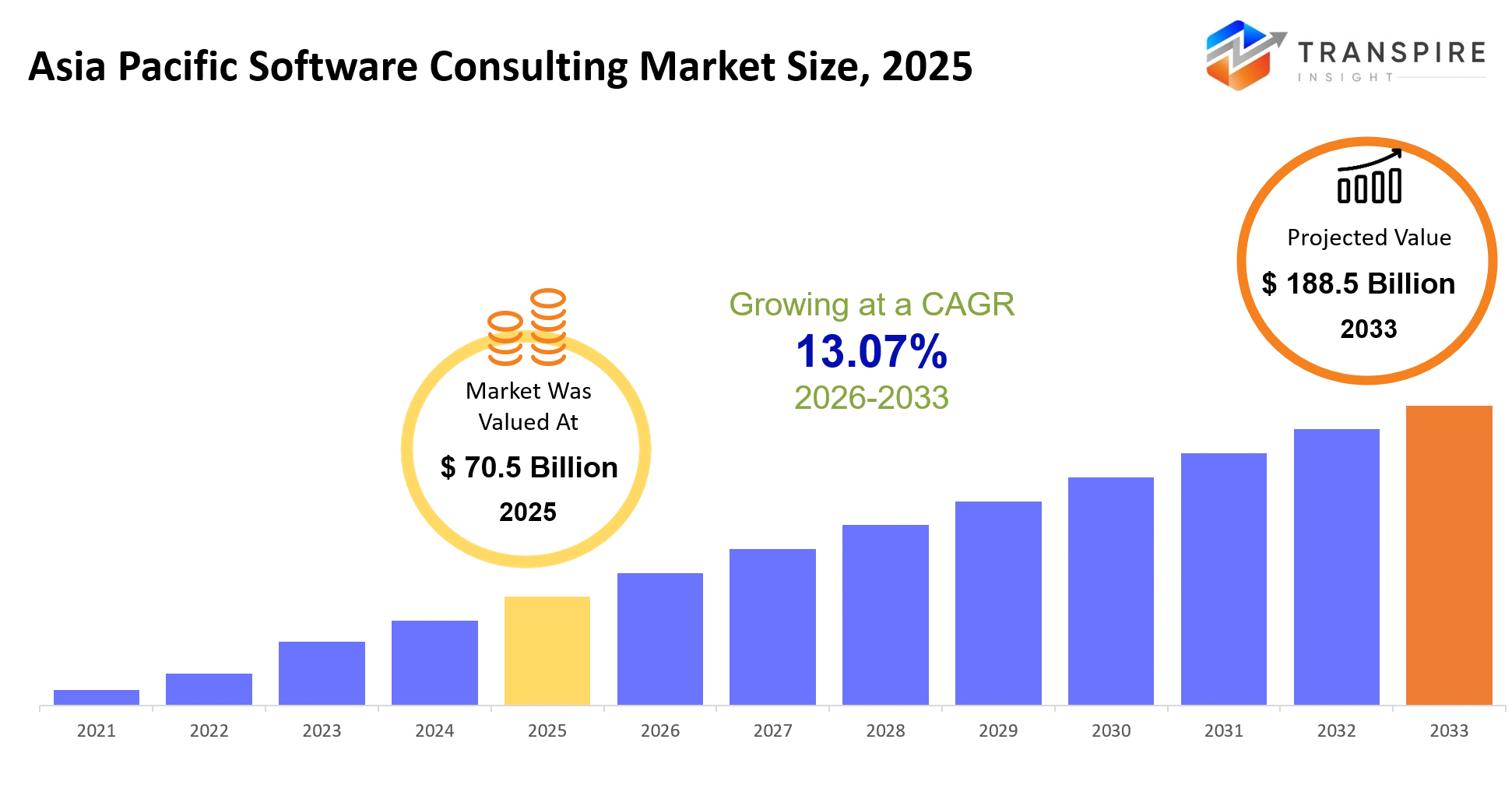
- Asia Pacific Software Consulting Market Size 2025: USD 70.5 Billion
- Asia Pacific Software Consulting Market Size 2033: USD 188.5 Billion
- Asia Pacific Software Consulting Market CAGR: 13.07%
- Asia Pacific Software Consulting Market Segments: By Service Type (IT Strategy, Cloud Consulting, ERP Consulting, Cybersecurity Consulting, Digital Transformation, Data Analytics, AI Consulting, Others); By Enterprise Size (Large, Medium, Small, Startups, Others); By Deployment (Cloud, On-Premise, Hybrid, Others); By End User (BFSI, Healthcare, Retail, Manufacturing, IT, Government, Others).
To learn more about this report,  Download Free Sample Report
Asia Pacific Software Consulting Market Summary
The Asia Pacific Software Consulting Market was valued at USD 70.5 Billion in 2025. It is forecast to reach USD 188.5 Billion by 2033. That is a CAGR of 13.07% over the period.
The Asia Pacific software consulting market, helps organizations somehow turn their technology spending into day to day operational results. In real life, software consultants walk enterprises, manufacturers, financial institutions, healthcare providers, and public agencies through things like system modernization, cloud migration, application integration, cybersecurity roadmapping, and data focused process enhancement. Their job is to lower implementation risk, keep software aligned with business objectives, and speed up digital transformation programs, pretty consistently.
In the last five years, the whole market has kind of shifted in a structural way, away from on-premise enterprise systems, toward cloud-native, AI enabled, and platform driven architectures. One big push was the COVID-19 pandemic, it showed the weak spots of older legacy setups and made companies support remote operations, faster digital customer engagement, and more resilient supply chains , at scale. Later, as businesses grew digital workflows, they also started asking for specialized know-how to connect complicated software environments and handle security together with compliance requirements. So consulting work has expanded from one-off deployment tasks to longer transformation collaborations, which then opens broader revenue potential, and also deepens adoption across many industries.
Key Market Insights
- Asia Pacific Software Consulting Market is a bit dominated by India and China, they hold something like 45–50% together of the regional consulting demand share in 2025, so yeah.
- Japan and South Korea also show solid enterprise modernization demand, especially for manufacturing and advanced automation consulting services.
- Australia keeps steady growth driven by regulated industries taking up compliance focused software consulting solutions .
- Application development and modernization services take the lead in the Asia Pacific Software Consulting Market with almost 30% share in enterprise engagements.
- Cloud migration consulting comes in second , mostly because SaaS adoption is speeding up and hybrid infrastructure transitions are happening across big enterprises.
- AI and data analytics consulting is kind of the fastest-growing segment, expanding sharply between 2024 and 2030 as enterprises scale automation and a lot of processes.
- Cybersecurity consulting is still gaining traction too, mainly because enterprise risk exposure keeps climbing, plus compliance mandates are getting more strict.
- Banking, Financial Services and Insurance (BFSI) actually dominates usage, with around 35% share, largely from heavy dependence on digital banking platforms , and related systems.
- Manufacturing looks like the fastest-growing application segment as Industry 4.0 adoption expands across export driven economies, you know.
- Retail and e-commerce consulting demand is rising fast as omnichannel platform integration kicks in, along with real-time inventory optimization needs, overall.
What Has the Impact of Artificial Intelligence Been on the Asia Pacific Software Consulting Market?
The main driver feels like rapid enterprise migration away from legacy infrastructure and toward cloud-native ecosystems, pushed harder by cost pressure and the need for scalable digital operations that can actually keep up. In banking, manufacturing, and retail, more organizations are relying on consulting firms to redesign architecture, stitch together applications, and roll out AI- driven workflows, you know, the whole package. This change tends to raise long-term consulting contracts and also strengthens recurring revenue models, especially when transformation work replaces what used to be one-time system upgrades.
A big restraint is that there’s still a persistent shortage of top-tier software architects and cloud engineers across multiple Asia Pacific economies. That structural talent gap, kind of quietly, slows down the project execution timelines and it lifts delivery costs for consulting providers. When demand runs ahead of skilled staff availability, enterprises can end up with delayed implementation cycles, so short-term revenue realization gets suppressed even if the pipeline keeps growing strong. And it stays hard to fix quickly, partly because training cycles are long, plus there is heavy global competition for that specialized digital talent.
One key opportunity sits in expanding AI-first enterprise consulting, especially for mid-market companies across Southeast Asia and India. As generative AI, and automation platforms, keep maturing, consulting firms can bundle advisory together with integration and managed AI services into one unified offering. For instance, regional banks adopting AI-based fraud detection and customer analytics seem to generate durable consulting demand. It’s expected that this transition will open the next growth phase of the Asia Pacific Software Consulting Market, mainly by shifting value away from only implementation and toward continuous optimization services.
Key Market Trends
- After 2022 supply chain disruptions, Enterprises kind of shifted from on-premise integration to cloud first consulting models, mostly because older systems had inefficiencies that became painfully obvious.
- Then post 2023, adoption of AI driven consulting frameworks rose a lot, with firms like IBM and Accenture expanding gen AI advisory services ,as if it was urgent enough to pivot fast.
- In Southeast Asia, SMEs moved from low digital maturity into quick SaaS adoption, which reshaped demand patterns for scalable consulting engagement models since 2021 and not just slowly.
- Also, regulatory tightening around data privacy in India and Australia pushed enterprises toward compliance focused consulting strategies during 2022 through 2025, and it sort of kept tightening in practice.
- Manufacturing players accelerated Industry 4.0 consulting demand ,by folding in IoT plus analytics after global logistics disruptions showed production visibility gaps.
- In banking, clients have reduced legacy core banking systems by nearly 30% since 2020 ,so modernization consulting providers like Tata Consultancy Services gained more traction.
- Cybersecurity consulting demand jumped after 2023 ransomware incidents, shifting budgets from reactive protection toward proactive risk architecture design, basically planning ahead more.
- And cloud hyperscale partnerships reshaped the competitive map, with Infosys and Cognizant expanding co-delivery consulting ecosystems across Asia Pacific markets, in a pretty coordinated way.
Asia Pacific Software Consulting Market Segmentation
By Service Type :
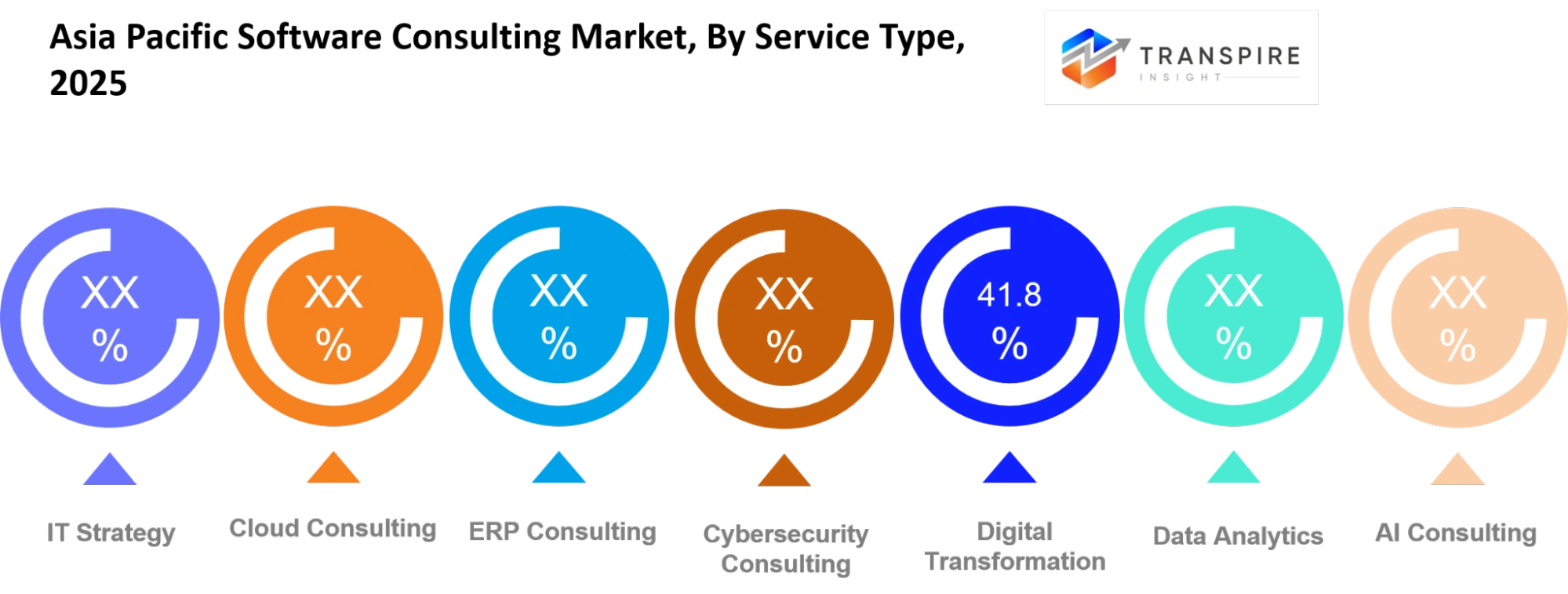
IT Strategy consulting basically helps enterprises map out technology roadmaps that stick with business outcomes and generally help close operational gaps, not just “document” things. Lately demand has shifted pretty strongly toward cloud consulting ,because orgs keep moving workloads off legacy setups. ERP consulting stays relevant too, with teams focusing on process harmonization across finance, supply chain, and human resources ,like a single tune.
On the security side, Cybersecurity consulting has grown, due to higher exposure to digital risks and also stricter compliance requirements across financial, and public sectors. Digital transformation consulting also comes in for end-to-end modernization programs, while data analytics and AI consulting have gained real traction as enterprises push for automation, forecasting style models, and real time decision systems.
To learn more about this report, Download Free Sample Report
By Enterprise Size :
Bigger enterprises still make up the main customer base, mostly because their infrastructure is complex and their IT stack is multi layered, so modernization never really stops. Medium sized organizations are adopting more quickly since cloud tools lower the initial setup cost and make advanced software easier to reach. Small businesses too are slowly leaning on external consulting support for their digital improvements.
Startups, on the other hand, show a strong reliance on consulting services for product development, scalable architecture, and quicker deployment windows. Their consulting demand has risen as funding conditions tend to reward rapid digital product growth, and sharper positioning in technology driven markets ,especially across Asia Pacific regions.
By Deployment :
Cloud deployment has become the go-to option as many enterprises drift away from expensive infrastructure upkeep and try to concentrate on digital operations that can scale . Also, consulting firms now offer migration help, integration work and optimization, across industries where everything needs to stay flexible and systems feel faster.
On-premise deployment still shows up in a few sectors , especially where there are strict data control expectations. Still, it has gone down a bit, mainly because the maintenance costs are higher than before. Meanwhile hybrid deployment keeps rising, because organizations try to balance security with flexibility, pairing cloud efficiency with internal, controlled environments for sensitive workloads and internal processes .
By End User :
For consulting demand, the BFSI space leads the list. That happens because digital banking keeps expanding, risk management stays a priority, and regulatory compliance still demands attention at every step. In healthcare, adoption is also up, driven by electronic health records, telemedicine capabilities, and patient management approaches that are data led , which in turn improve how services get delivered.
Retail and manufacturing are moving strongly toward digital platforms, automation, and supply chain optimization, rather than staying with older patterns . Meanwhile IT companies keep leaning on consulting for software architecture decisions and for scaling up systems. Government work too has increased , especially with digital public service programs and efforts to modernize administrative platforms in the background .
What are the Key Use Cases Driving the Asia Pacific Software Consulting Market?
Core adoption in the Asia Pacific Software Consulting Market is mostly pushed by big, digital transformation programs in banking, manufacturing, and enterprise IT systems. In practice organizations are leaning on consulting services to modernize old, almost stubborn infrastructure, migrate core applications to cloud platforms ,and stitch data systems across multiple departments. This scenario tends to bring the strongest demand, because enterprises really need ongoing technical backup to cut downtime, speed up daily operations, and handle these quite complex multi system setups.
When applications keep expanding, cybersecurity enhancement and ERP modernization become even more prominent, notably across BFSI and retail. Financial institutions typically hire consultants to reinforce fraud detection systems and to satisfy stricter compliance rules, yet retailers often prioritize omnichannel integration and real-time inventory control. Manufacturing firms meanwhile increase uptake for connected production systems, which helps with end-to-end visibility across supply chains.
On the newer side of things, emerging use cases show up as AI powered decision automation and predictive analytics, especially in healthcare and government services. Hospitals are starting to use consulting support for patient data modeling and early diagnosis systems, while public agencies look into smarter governance platforms to improve service delivery and make resource planning more efficient.
|
Report Metrics |
Details |
|
Market size value in 2025 |
USD 70.5 Billion |
|
Market size value in 2026 |
USD 79.8 Billion |
|
Revenue forecast in 2033 |
USD 188.5 Billion |
|
Growth rate |
CAGR of 13.07% from 2026 to 2033 |
|
Base year |
2025 |
|
Historical data |
2021 - 2024 |
|
Forecast period |
2026 - 2033 |
|
Report coverage |
Revenue forecast, competitive landscape, growth factors, and trends |
|
Regional scope |
Asia Pacific (India, China, Japan, Australia, South Korea, Rest of Asia Pacific) |
|
Key company profiled |
Accenture, Deloitte, IBM, Capgemini, TCS, Infosys, Wipro, Cognizant, HCLTech, PwC, EY, KPMG, Fujitsu, NTT Data, Tech Mahindra. |
|
Customization scope |
Free report customization (country, regional & segment scope). Avail customized purchase options to meet your exact research needs. |
|
Report Segmentation |
By Service Type (IT Strategy, Cloud Consulting, ERP Consulting, Cybersecurity Consulting, Digital Transformation, Data Analytics, AI Consulting, Others); By Enterprise Size (Large, Medium, Small, Startups, Others); By Deployment (Cloud, On-Premise, Hybrid, Others); By End User (BFSI, Healthcare, Retail, Manufacturing, IT, Government, Others). |
Which Regions are Driving the Asia Pacific Software Consulting Market Growth?
Asia is leading the Asia Pacific Software Consulting Market, pulled along by solid digital policy setups in India, China, Japan and South Korea. Public institutions are pushing cloud take up, AI integration, and enterprise digitization via national digital economy programs, kind of a big deal overall. Plus the technology clusters are dense, data center backbones are strong, and there’s a large base of enterprises in banking and manufacturing. That combination keeps demand for consulting steady, and it basically sparks ongoing modernization efforts, from older legacy systems to newer digital platforms, all at once
North America doesn’t belong to this regional slice, so the next big contributor is Oceania , mainly Australia and New Zealand. This area feels different from Asia because the growth is more guided by regulatory consistency and compliance driven modernization, instead of the fast digital scale expansion. With steadier economic conditions and more mature enterprise IT environments, the consulting demand stays pretty predictable across banking, mining, and public services. Companies tend to focus heavily on risk control, cybersecurity readiness, and long-run cloud migration planning, rather than quick experiments
Southeast Asia shows the fastest growth, mostly because SMEs are digitizing quickly. There are also new government backed investments into cloud infrastructure in Indonesia, Vietnam, and Thailand. More recently, data center capacity expansion along with digital identity initiatives has sped up enterprise software adoption. Compared with the more mature Asian markets, here the momentum comes from first time cloud migration and mobile first business models. That change should open up really strong chances for consulting providers trying to enter the Asia Pacific Software Consulting Market between 2026 and 2033.
Who are the Key Players in the Asia Pacific Software Consulting Market and How Do They Compete?
Competition in the Asia Pacific Software Consulting market is sort of moderately consolidated, where global consulting firms and big IT service providers kinda hold strong influence. Still, the competition is getting sharper, because cloud-native specialists and regional digital firms are expanding their presence, more and more. Most firms actually go head to head on things like technology capability, delivery speed, industry depth and the ability to steer large-scale transformation programs, not just price.
Accenture plays heavily with AI-led transformation consulting, and it builds its advantage via proprietary digital platforms plus cloud partnerships with hyperscalers. Where it feels strongest is how it ties strategy, design, and implementation together inside one transformation program across banking and manufacturing clients in Asia Pacific. This momentum is supported by regional innovation hubs, along with acquisitions of niche analytics and cloud engineering firms too.
IBM competes with hybrid cloud and enterprise architecture consulting, backed by research-driven AI capabilities. Its differentiation is largely the deep integration of automation tools and enterprise-grade security frameworks, especially for regulated industries. For growth, IBM leans into partnerships with governments and large enterprises, aiming at modernization of critical infrastructure systems.
Tata Consultancy Services leans on cost-efficient delivery centers and a solid footprint across India and Southeast Asia, so it can serve large-scale transformation programs. Its edge is the combination of strong domain expertise in BFSI and manufacturing, plus scalable global delivery models. Expansion continues through cloud partnerships, workforce scaling, and sector-specific consulting accelerators.
Company List
- Accenture
- Deloitte
- IBM
- Capgemini
- TCS
- Infosys
- Wipro
- Cognizant
- HCLTech
- PwC
- EY
- KPMG
- Fujitsu
- NTT Data
- Tech Mahindra
Recent Development News
In April 2026, Infosys announced a strategic collaboration with OpenAI to accelerate enterprise AI transformation and enable co-innovation using frontier AI models and Infosys Topaz, aimed at scaling agentic AI adoption across global consulting and software delivery engagements, strengthening its position in AI-led software consulting in the Asia Pacific enterprise market.
Source: https://www.eqs-news.com/news/
In April 2026, Infosys completed the acquisition of Optimum Healthcare IT, a healthcare-focused digital transformation and consulting firm, expanding its Asia Pacific–linked consulting capabilities in provider systems modernization and strengthening its industry-specific software consulting portfolio.
Source: https://www.infosys.com/
What Strategic Insights Define the Future of the Asia Pacific Software Consulting Market?
The Asia Pacific Software Consulting Market is kind of moving toward a model where the consulting value goes from project based delivery into more continuous digital transformation services. I mean, it’s not just about finishing a scope, it’s more like ongoing improvement, because enterprises now depend on cloud ecosystems , plus AI integration and real time data operations. Those setups need steady optimization, not a one time implementation, so consulting firms end up acting like embedded technology partners inside enterprise systems, rather than staying outside as only advisors.
At the same time, there’s a less obvious risk too, vendor concentration is slowly rising around a small group of hyperscalers and platform providers. That can reduce consulting flexibility, and in the long run it may press margins downward. When companies standardize on just a few dominant cloud ecosystems, differentiation across consulting may thin out, and then pricing power for mid tier firms can weaken a lot.
One important opportunity is emerging in AI governance and model risk consulting. This is especially relevant as governments across Asia Pacific start rolling out tougher rules on algorithm transparency and how data gets used. So there’s room for specialized advisory services centered on compliance, auditing, and responsible AI deployment. Market participants should build AI assurance capabilities early, and also form partnerships with regulators and cloud providers, so they can keep a stronger long term position.
Asia Pacific Software Consulting Market Report Segmentation
By Service Type
- IT Strategy
- Cloud Consulting
- ERP Consulting
- Cybersecurity Consulting
- Digital Transformation
- Data Analytics
- AI Consulting
By Enterprise Size
- Large
- Medium
- Small
- Startups
By Deployment
- Cloud
- On-Premise
- Hybrid
By End User
- BFSI
- Healthcare
- Retail
- Manufacturing
- IT
- Government
Frequently Asked Questions
Find quick answers to common questions.
The expected Asia Pacific Software Consulting Market size is USD 188.5 Billion in 2033.
Key segments for the Asia Pacific Software Consulting Market are By Service Type (IT Strategy, Cloud Consulting, ERP Consulting, Cybersecurity Consulting, Digital Transformation, Data Analytics, AI Consulting, Others); By Enterprise Size (Large, Medium, Small, Startups, Others); By Deployment (Cloud, On-Premise, Hybrid, Others); By End User (BFSI, Healthcare, Retail, Manufacturing, IT, Government, Others).
Major Asia Pacific Software Consulting Market players are Accenture, Deloitte, IBM, Capgemini, TCS, Infosys, Wipro, Cognizant, HCLTech, PwC, EY, KPMG, Fujitsu, NTT Data, Tech Mahindra.
The Asia Pacific Software Consulting Market size is USD 70.5 Billion in 2025.
The Asia Pacific Software Consulting Market CAGR is 13.07% from 2026 to 2033.
- Accenture
- Deloitte
- IBM
- Capgemini
- TCS
- Infosys
- Wipro
- Cognizant
- HCLTech
- PwC
- EY
- KPMG
- Fujitsu
- NTT Data
- Tech Mahindra
About the Authors

Mayur Shinde
I am Mayur Shinde, a Senior Research Analyst at Transpire Insight, specializing in the Automotive & Transportation and Information & Communication Technology (ICT) Industry. My work focuses on analyzing emerging market trends, technological advancements, competitive landscapes, and industry developments to deliver accurate, data-driven insights. I am passionate about transforming complex market information into clear, actionable content that helps businesses, professionals, and decision-makers stay informed and make confident strategic decisions.

Chakradhar Khansole
Chakradhar serves as the Research Director at Transpire Insight, bringing over 8 years of experience in technology, innovation, and strategic market intelligence. He specializes in transforming complex market data into actionable business insights that enable organizations to make informed, growth-oriented decisions. Recognized for his strategic vision and analytical expertise, Chakradhar leads high-impact research initiatives, delivering comprehensive market assessments, competitive intelligence, and forward-looking industry analysis.
Recently Published Reports
-
Apr 2026
3D Optical Profiler Market
3D Optical Profiler Market Size, Share & Analysis Report By Type (Desktop 3D Optical Profiler, and Portable 3D Optical Profiler), By Technology (Confocal Technology, and White Light Interference), By End-Use Industry (Manufacturing, Research Institutions, Automotive, Aerospace and Defense, Medical Devices, and Other), and Geography (North America, Europe, Asia-Pacific, Middle East and Africa, South and Central America), 2021 - 2031
-
Apr 2026
Depth Sensor Market
Depth Sensor Market Size, Share & Analysis Report By Type (Infrared Depth Sensors, Time-of-Flight (ToF) Sensors, Stereo Vision Sensors, Structured Light Sensors, Ultrasonic Depth Sensors), By Application (Automotive, Robotics, Gaming, Consumer Electronics, Industrial Automation, Healthcare, Security & Surveillance, Others), By End Users (Automotive Manufacturers, Consumer Electronics Companies, Healthcare Providers, Industrial Companies, Security Agencies, Gaming Companies, Robotics Companies, Others), and Geography (North America, Europe, Asia-Pacific, Middle East and Africa, South and Central America), 2021 – 2031
-
Apr 2026
Digital Manufacturing Market
Digital Manufacturing Market Size, Share & Analysis Report By Component (Hardware, Software, and Services), By Technology (Robotics, 3D Printing, Internet of Things (IoT), and Others), By Application (Automotive and Transportation, Aerospace and Defense, Consumer Electronics, Industrial Machinery, and Others), By Process Type (Computer-Based Designing, Computer-Based Simulation, Computer 3D Visualization, Analytics, and Others), and Geography (North America, Europe, Asia-Pacific, Middle East and Africa, South and Central America), 2021 – 2031
-
Apr 2026
Digital Visa Services Market
Digital Visa Services Market Size, Share & Analysis Report By Type (Individual Travelers, Group Travelers), By Application (Tourism, Business Travel, Others), and Geography (North America, Europe, Asia-Pacific, Middle East and Africa, South and Central America), 2021 – 2031