

United Kingdom Route Optimization Software Market Size & Forecast:
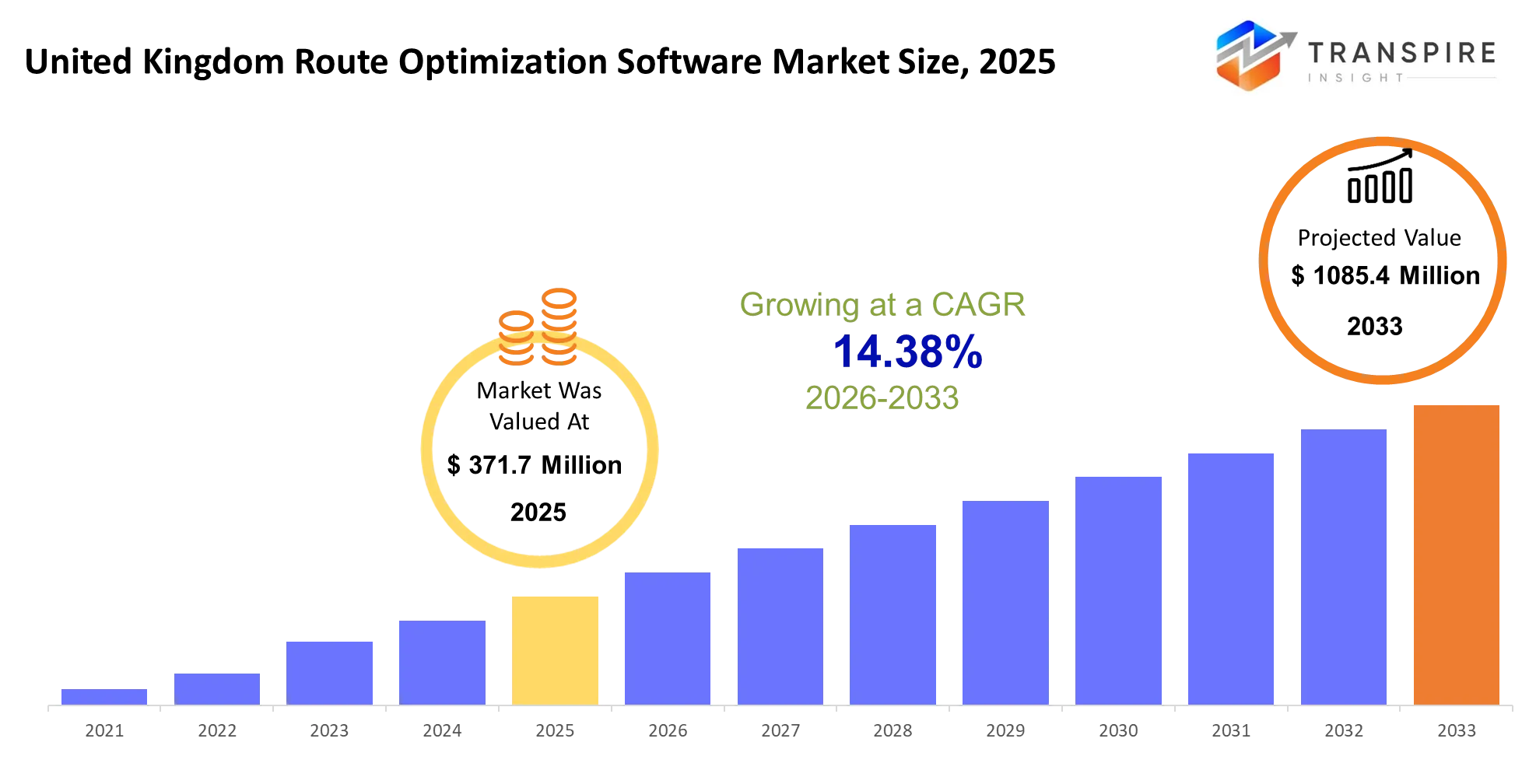
- United Kingdom Route Optimization Software Market Size 2025: USD 371.7 Million
- United Kingdom Route Optimization Software Market Size 2033: USD 1085.4 Million
- United Kingdom Route Optimization Software Market CAGR: 14.38%
- United Kingdom Route Optimization Software Market Segments: By Deployment (Cloud-based Software, On-premise Software, Hybrid Software, SaaS Platforms, AI-enabled Platforms, Mobile-based Platforms, API-integrated Platforms, Others); By Application (Logistics & Delivery, Field Service Management, Retail Distribution, Public Transportation, Waste Management, Emergency Services, E-commerce Deliveries, Others); By Technology (AI & ML Optimization, GPS Tracking, Real-time Traffic Analytics, Predictive Routing, IoT-enabled Routing, Geofencing, Others); By End User (Logistics Companies, Retailers, Government Agencies, Healthcare Providers, Transportation Companies, Others); By Enterprise Size (Large Enterprises, SMEs, Startups, Multi-national Firms, Others)
To learn more about this report,  Download Free Sample Report
United Kingdom Route Optimization Software Market Summary
The United Kingdom Route Optimization Software Market was valued at USD 371.7 Million in 2025. It is forecast to reach USD 1085.4 Million by 2033. That is a CAGR of 14.38% over the period.
In the United Kingdom, route optimization software is now something logistics operators, delivery fleets, and industrial service providers use to sort out the most efficient movement of goods and vehicles across jammed roadways, plus port-linked supply routes. Instead of clinging to fixed dispatch timetables, many companies lean on live traffic signals, changing fuel pricing inputs, and whatever capacity data is available, so they can keep nudging the itineraries around , and in effect reduce idle time, which feels minor but it really adds up.
Over the past five years, it looks like the market has been drifting away from rule based planning tools and toward cloud native platforms, often paired with AI guidance and real time telematics connections. That momentum really picked up as fuel prices swung more dramatically, and as low emission zone policies rolled out in more cities, particularly London. Under those pressures, inefficient routing turns out to be costly , not just in minutes lost but also in the overall bill. For that reason, enterprises are investing in optimization systems to tighten operating expenses, bolster delivery reliability, and satisfy stricter urban mobility limits , and usually that translates into more software rollouts and steadier recurring platform revenue.\
Key Market Insights
- London kind of dominates the United Kingdom Route Optimization Software Market , with an estimated 35–40% share, mostly because the city is dense and logistics, delivery demand just keeps building.
- Southeast England feels like the fastest-growing region, supported by warehouse expansion and more and more e-commerce fulfillment center density through 2024–2028, kind of steadily.
- Cloud based route optimization platforms are still leading the United Kingdom Route Optimization Software Market , with nearly 55% share, mainly for scalability and real time analytics uptake.
- On premise solutions remain the second-largest segment, chosen by regulated logistics and bigger enterprise fleet operators who want tighter data control and governance.
- AI powered predictive routing tools are the fastest-growing portion, expected to speed up adoption between 2025–2030, as prediction accuracy keeps improving.
- Last mile delivery optimization takes the lead with roughly 45% share, because e-commerce and rapid parcel distribution demand keep rising.
- Long haul freight optimization is moving the quickest in terms of application growth, since fuel efficiency and cross-border logistics efficiency are getting more attention.
- Logistics and transportation companies lead the United Kingdom Route Optimization Software Market , holding almost 50% share, due to fleet intensive operations that never really slow down.
- Retail and e-commerce end-users are the fastest-growing category too, as same day and next day delivery expectations keep getting more intense.
What are the Key Drivers, Restraints, and Opportunities in the United Kingdom Route Optimization Software Market?
The United Kingdom Route Optimization Software Market is mainly pushed along by the quick digitization of logistics tasks, where real time fleet coordination has become kinda non optional for keeping fuel spending down and reducing delivery delays. This change started, sorta, due to long lasting fuel price instability and also the introduction of tougher urban mobility rules, like the expansion of low emission zones across a number of major UK cities. So naturally, logistics firms are moving away from manual dispatch workflows toward AI enabled routing systems that keep recalculating delivery routes as conditions shift. And yeah, this also boosts software subscription income, since many enterprises are going to cloud based setups and more usage driven pricing, then they scale them across bigger vehicle fleets.
Now a big restraint in the United Kingdom Route Optimization Software Market is the integration headache with older enterprise resource planning tools and warehouse management systems. A lot of mid-sized logistics providers still run on scattered data environments, meaning a full rollout becomes expensive, plus it takes longer than everyone wants. That kind of friction slows adoption because companies end up paying for system migration, data standardization, and staff retraining before any efficiency wins show up. Because of that, revenue momentum is often held back in the near term, especially for operators who are very cost sensitive.
For opportunities, the best one sits in AI driven predictive logistics paired with 5G ready telematics across connected fleets. Early pilot projects in logistics corridors in Southeast England are already showing better route precision, mainly due to real time congestion forecasting. As the supporting infrastructure keeps improving, this should help unlock wider and faster scaling throughout the United Kingdom Route Optimization Software Market.
What Has the Impact of Artificial Intelligence Been on the United Kingdom Route Optimization Software Market?
Artificial intelligence is kind of reshaping the United Kingdom Route Optimization Software Market, by taking what used to be mostly dispatch planning and turning it into more fully automated data- driven fleet orchestration , sort of. In logistics and maritime-adjacent transport operations, AI now handles compliance tracking in a way that feels almost hands-free, like emissions reporting and vehicle utilization monitoring. it does this by pulling together telematics with routing platforms and the operational control systems, so instead of lots of manual checks there’s continuous route recalibration based on live traffic, fuel consumption, and delivery priority constraints.
Alongside that, machine learning models are being rolled out for predictive capabilities, including maintenance forecasting and fuel efficiency optimization. They look at historical vehicle performance and engine diagnostics, and then they flag potential failures before they show up, which helps fleet uptime and lowers the odds of those unplanned service interruptions. At the same time, emissions forecasting tools support operators so routing decisions match tighter UK environmental rules, especially in urban delivery corridors where regulation pressure can be pretty intense.
From an operational angle, companies often cite measurable outcomes, like 10–15% fuel savings and up to 20% improvement in fleet utilization once AI-driven optimization is really deployed. Those gains end up supporting profitability and they also speed up software adoption across bigger logistics networks, not just smaller fleets.
Still, there’s a big constraint that keeps coming up: the integration cost of AI systems with fragmented legacy fleet infrastructure. plus many operators deal with inconsistent real-world data quality, and that can reduce model accuracy in fast-changing urban traffic scenarios, which in turn slows broader scaling across the market.
Key Market Trends
- Logistics operators kinda moved away from the manual dispatch systems that people used before 2020, and now they use AI driven routing platforms that are hooked up to live telematics, sort of all at once.
- Since 2022, UK urban fleets have managed to cut idle routing by roughly 12% thanks to real time congestion aware optimization.
- After 2021, the whole e-commerce wave kept growing and that sped up adoption of dynamic last mile routing, which started replacing the older fixed delivery scheduling approach more and more.
- After 2023, cloud deployment took over from on premise systems, because enterprises liked the scalable subscription based fleet optimization software model a lot better, honestly.
- Fuel price spikes across 2022 to 2024 basically pushed logistics firms toward predictive routing tools , so they could trim operational fuel consumption in a meaningful way.
- Then the regulatory tightening under UK low emission zones made companies bring in emissions aware routing algorithms and apply them every day across fleet operations.
- Big vendors like Trimble and SAP also expanded their AI driven logistics modules between 2023 and 2025, to beef up the enterprise platform ecosystems.
- In 2024, adding 5G enabled telematics improved the accuracy of real time route recalculation across crowded UK urban transport corridors.
- But mid-sized logistics firms were slower, due to legacy system constraints by 2025, so the full scale digital transformation moved slower across those fragmented fleets.
United Kingdom Route Optimization Software Market Segmentation
By Deployment :
Cloud based and SaaS platforms kinda lead the adoption curve as logistics operators move away from fixed on-premise systems, you know. The shift after 2022 shows a really clear preference for scalable subscription models that can support real-time fleet updates, while also cutting infrastructure expenses, and letting teams integrate faster with transport and delivery networks across the United Kingdom.
AI enabled and API integrated platforms also get steady traction, mostly because enterprises can link routing systems with warehouse management and telematics tools , more or less smoothly. Hybrid deployment keeps showing up among regulated operators who really need partial on-site control, rather than going fully hosted. Mobile based systems help a lot with field work, improving driver coordination and lowering dispatch delays in dense urban delivery environments, where everything feels like it moves at once.
By Application :
Logistics and delivery stay dominant too, driven by rising parcel volumes and tighter delivery windows. Growth picked up after 2021 as e-commerce demand started reshaping routing priorities toward speed, better cost control, and dynamic scheduling across last-mile networks, basically.
Retail distribution and e-commerce deliveries are growing the fastest, especially as same-day delivery expectations become normal. Public transportation and waste management also adopt route optimization, aiming for less fuel burn and more schedule reliability. Emergency services use routing tools as well, to reduce response times, particularly in congested metropolitan zones.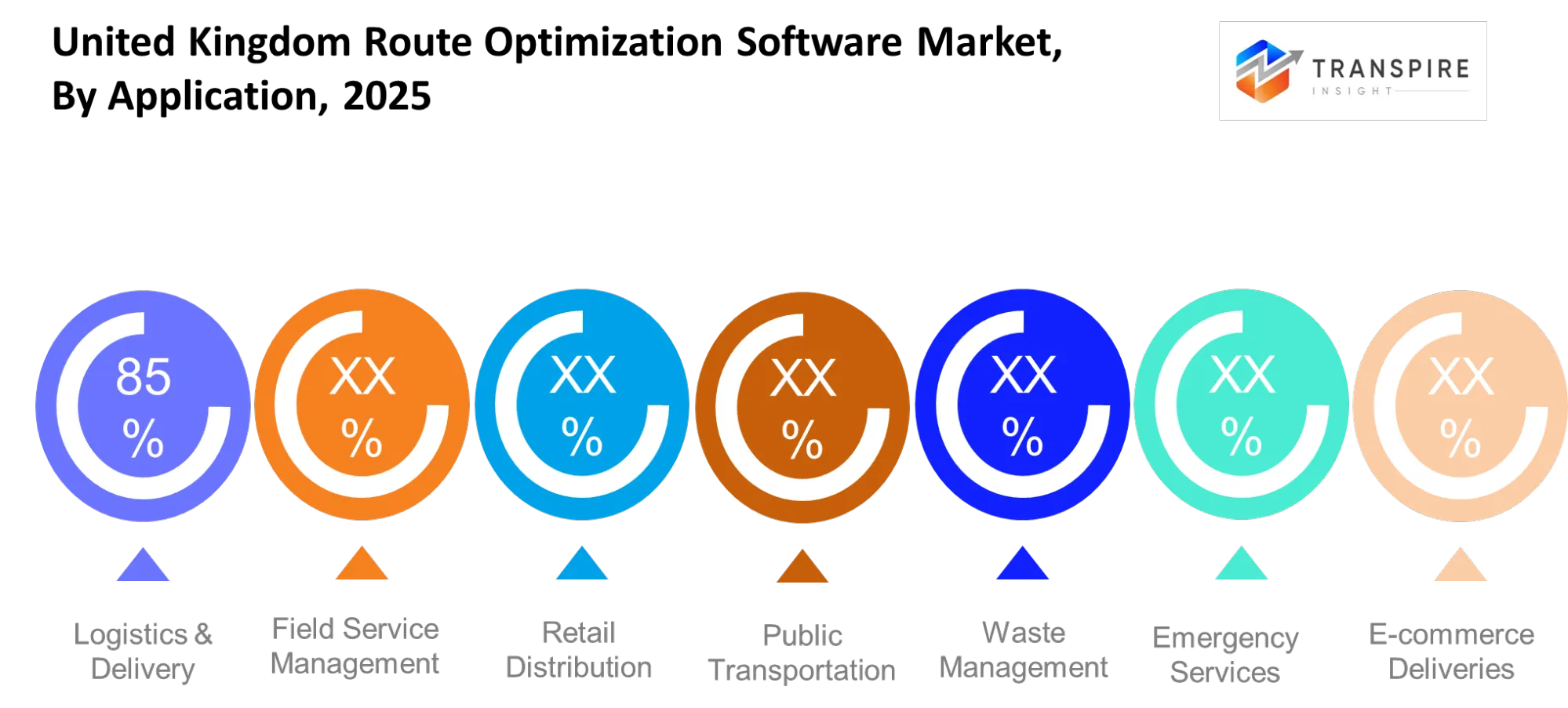
To learn more about this report, Download Free Sample Report
By Technology :
AI plus machine learning optimization push adoption forward, sort of steering routing systems away from rigid static planning, toward adaptive decision models. When you fold in real-time traffic analytics, route accuracy gets better even across busy congested UK roadways which is kind of the big deal.
Predictive routing together with IoT-enabled setups also helps operational forecasting, so delays get trimmed and fuel waste goes down . With GPS tracking and geofencing operators gain compliance monitoring plus fleet sight. Ever since 2023, the take up of real-time analytics has climbed, because companies keep having to deal with traffic patterns they can’t really predict, plus tighter delivery time pressure.
By End User :
Logistics businesses lead the way, mainly because fleet-heavy operations depend on constant route tweaks and careful cost optimization. Fuel prices keep rising, and urban delivery restrictions tighten up, which speeds up the deployment of this software across commercial transport routes.
Retailers, along with transport companies, keep expanding adoption for distribution efficiency and better customer service. Government organizations use routing solutions for public transit planning, and also for improving waste collection efficiency. Healthcare providers increasingly rely on optimized routing for medical supply distribution and urgent service coordination.
By Enterprise Size :
Big enterprises are usually out front, mostly because they have more intricate fleet structures, plus a higher ability to slot in advanced optimization platforms, so yeah they can do it faster. Their investment capacity also tends to be stronger, which makes AI driven routing systems and multi regional coordination across logistics operations feel more feasible, in practice.
SMEs move a bit slower but the adoption rate is climbing. This is partly because cloud based models lower the entry barrier, so it feels easier to start. Startups often lean on lighter SaaS routing tools, and that helps them scale growth without too much weight on internal teams. Then the multi-national firms, they often push for standardized routing platforms across UK operations, aiming for repeatable efficiency and a more centralized fleet control model.
What are the Key Use Cases Driving the United Kingdom Route Optimization Software Market?
In the United Kingdom Route Optimization Software Market the main, kind of obvious use case is last mile logistics coordination , where delivery firms use real time routing to keep up with huge parcel volumes and these tight delivery windows that everyone talks about. The need is mostly pulled along by ecommerce growth , plus that constant pressure to cut fuel expenses while still getting faster fulfillment through congested urban networks.
On the expansion side, you can also see field service scheduling for utility and telecom operators, plus retail distribution optimization that helps manage product flow , sort of like moving inventory between warehouses and shops in a cleaner way. Logistics companies, and even bigger retailers, lean on these platforms to reduce downtime, raise vehicle utilization , and handle the unpredictable swings in demand across regional supply chains.
Then there are the newer use cases , such as emergency response routing for public agencies and predictive maintenance-linked routing for transportation fleets. Healthcare providers are even testing route optimization for medical supply deliveries. These ideas are starting to gain traction , as data integration keeps getting smoother and the regulatory focus on efficiency and response time continues to grow stronger.
|
Report Metrics |
Details |
|
Market size value in 2025 |
USD 371.7 Million |
|
Market size value in 2026 |
USD 423.9 Million |
|
Revenue forecast in 2033 |
USD 1085.4 Million |
|
Growth rate |
CAGR of 14.38% from 2026 to 2033 |
|
Base year |
2025 |
|
Historical data |
2021 - 2024 |
|
Forecast period |
2026 - 2033 |
|
Report coverage |
Revenue forecast, competitive landscape, growth factors, and trends |
|
Regional scope |
Middle East and Africa (Saudi Arabia, United Arab Emirates, South Africa, Rest of Middle East and Africa) |
|
Key company profiled |
Descartes Systems Group, Verizon Connect, Oracle, SAP, Trimble, Route4Me, Omnitracs, HERE Technologies, Geotab, Samsara, Blue Yonder, Onfleet, FarEye, WorkWave, Google Maps Platform |
|
Customization scope |
Free report customization (country, regional & segment scope). Avail customized purchase options to meet your exact research needs. |
|
Report Segmentation |
By Deployment (Cloud-based Software, On-premise Software, Hybrid Software, SaaS Platforms, AI-enabled Platforms, Mobile-based Platforms, API-integrated Platforms, Others); By Application (Logistics & Delivery, Field Service Management, Retail Distribution, Public Transportation, Waste Management, Emergency Services, E-commerce Deliveries, Others); By Technology (AI & ML Optimization, GPS Tracking, Real-time Traffic Analytics, Predictive Routing, IoT-enabled Routing, Geofencing, Others); By End User (Logistics Companies, Retailers, Government Agencies, Healthcare Providers, Transportation Companies, Others); By Enterprise Size (Large Enterprises, SMEs, Startups, Multi-national Firms, Others) |
Which Regions are Driving the United Kingdom Route Optimization Software Market Growth?
London and Southeast England are leading the United Kingdom Route Optimization Software Market . This happens largely because the cities are packed densely with delivery activity and because regulators are quite strict under low-emission zone rules. Also, fleet density is high, fed by e-commerce, retail logistics, and third party delivery operators, so there is basically a constant need for real time route optimization tools . Another reason is that the digital backbone is strong there, and companies adopted cloud logistics platforms early, so it feels smoother to scale. On top of that, linking transport systems , warehouse hubs, and smart city traffic management improves day to day operations. In practice, this whole setup lets organizations deploy routing software broadly, and still keep consistent performance upgrades.
The Midlands and Northern England sit next as a fairly stable second region, and they are supported by industrial logistics corridors plus manufacturing tied freight movement. Unlike the capital led approach in London, this area leans more on long distance distribution between production centers, ports, and inland warehouses. Investment keeps coming at a steady pace, mostly because automotive, manufacturing, and retail supply chains are already established. Regulation adoption is not as fast , but many enterprises still push for cost control and dependable operations rather than rushing digital transformation. So demand stays steady and predictable for route optimization solutions across freight companies, carriers, and transport operators.
Scotland kind of represents the fastest-growing region, pushed by recent port modernization work and a noticeable jump in investment toward renewable energy logistics networks. In practice the expansion of offshore wind infrastructure has made the demand for better transport of heavy equipment, as well as service fleets, go up. On top of that, government-backed digital transport initiatives that got introduced after 2023 have also helped speed up the whole software adoption thing among regional logistics providers. So, this whole momentum feels like it points to a solid opening for vendors trying to enter the United Kingdom Route Optimization Software Market between 2026 and 2033, especially if they can provide scalable cloud-based and AI-enabled routing systems.
Who are the Key Players in the United Kingdom Route Optimization Software Market and How Do They Compete?
The United Kingdom Route Optimization Software Market kind of looks moderately consolidated at the enterprise level, but it stays a bit fragmented among mid-sized SaaS providers. You know, the big incumbents keep their ground mainly because they have deep enterprise integrations, while the newer entrants often push back hard using cloud-native and AI-first approaches. In practice, the back-and-forth is mostly about how accurate the algorithms are, how well the system handles real-time telematics, and whether it connects smoothly with ERP tools and warehouse systems. On top of that, buyers also care about pricing flexibility and deployment speed, particularly logistics firms dealing with tight cost pressures, kind of everyday.
Trimble Inc. improves its standing using advanced fleet telematics plus a full suite of logistics visibility tools, which helps transport operators get better routing precision. Descartes Systems Group leans into cloud-based trade and supply chain optimization, connecting route planning with customs processes and cross-border compliance tasks. PTV Group stands out with transport simulation models that logistics planners and public infrastructure operators can use for scenario checking. Verizon Connect on the other hand builds on telecom infrastructure, delivering continuous GPS tracking and real-time fleet coordination for delivery networks that are spread out.
SAP SE embeds route optimization straight inside its wider ERP environment, so big firms can bring logistics procurement and distribution data together in one place. Oracle Corporation expands its cloud logistics offering, pairing predictive routing with global supply chain management capabilities. Overall these companies fight by locking in enterprise ecosystems, pushing wider cloud adoption across UK logistics, and reinforcing partnerships with retailers and transport operators, to grow long-term platform usage.
Company List
- Descartes Systems Group
- Verizon Connect
- Oracle
- SAP
- Trimble
- Route4Me
- Omnitracs
- HERE Technologies
- Geotab
- Samsara
- Blue Yonder
- Onfleet
- FarEye
- WorkWave
- Google Maps Platform
Recent Development News
In May 2026, Ocado Group entered a strategic partnership with Asda. The agreement enables Asda to use Ocado’s software platform to manage online grocery fulfillment, delivery scheduling, and last-mile route optimization across its UK operations, strengthening automation and efficiency in route planning for one of the UK’s largest supermarket chains.
Source https://www.reuters.com/
In May 2026, Ocado Group announced an expanded technology deployment agreement with Asda. The company will replace Asda’s existing e-commerce and logistics systems with Ocado’s integrated routing and fulfillment software, improving delivery optimization, click-and-collect coordination, and real-time logistics management across UK store networks.
Source https://www.theguardian.com/
What Strategic Insights Define the Future of the United Kingdom Route Optimization Software Market?
The United Kingdom Route Optimization Software Market is basically sliding toward fully autonomous logistics orchestration, where routing decisions are tweaked all the time by AI, telematics, and these linked cloud ecosystems. What’s really pulling this change forward is how quickly real-time data is becoming available, coupled with the growing cost pressure in last mile delivery and freight work. Over the next 5–7 years, routing platforms will move beyond just telling users what to do, and they’ll turn into execution systems that actually steer fleet behavior and where resources get assigned.
There’s also a quieter risk, sort of hidden in plain sight. It’s the platform concentration issue, meaning a relatively small set of big enterprise software ecosystems end up controlling routing plus fleet and supply chain data streams. That, naturally, builds dependency risk for logistics operators, and it could also reduce switching ability if pricing changes or access conditions shift. On top of that, there’s the interoperability concern, because smaller regional providers may find it hard to plug in cleanly to the dominant ecosystems
At the same time, there’s an emerging chance that could matter a lot. Route optimization is starting to connect with carbon accounting systems, especially as UK sustainability reporting rules become stricter. When enterprises get ready for heavier emissions disclosure expectations, routing software that can tie the delivery route to verifiable carbon output will become more valuable. So market players should focus on open API frameworks, and build partnerships with compliance technology providers, so they can catch this next wave of demand that’s tied to regulation, and not just operational efficiency.
United Kingdom Route Optimization Software Market Report Segmentation
By Deployment
- Cloud-based Software
- On-premise Software
- Hybrid Software
- SaaS Platforms
- AI-enabled Platforms
- Mobile-based Platforms
- API-integrated Platforms
By Application
- Logistics & Delivery
- Field Service Management
- Retail Distribution
- Public Transportation
- Waste Management
- Emergency Services
- E-commerce Deliveries
By Technology
- AI & ML Optimization
- GPS Tracking
- Real-time Traffic Analytics
- Predictive Routing
- IoT-enabled Routing
- Geofencing
By End User
- Logistics Companies
- Retailers
- Government Agencies
- Healthcare Providers
- Transportation Companies
By Enterprise Size
- Large Enterprises
- SMEs
- Startups
- Multi-national Firms
Frequently Asked Questions
Find quick answers to common questions.
The United Kingdom Route Optimization Software Market size is USD 1085.4 Million in 2033.
Key Segments for the United Kingdom Route Optimization Software Market are By Deployment (Cloud-based Software, On-premise Software, Hybrid Software, SaaS Platforms, AI-enabled Platforms, Mobile-based Platforms, API-integrated Platforms, Others); By Application (Logistics & Delivery, Field Service Management, Retail Distribution, Public Transportation, Waste Management, Emergency Services, E-commerce Deliveries, Others); By Technology (AI & ML Optimization, GPS Tracking, Real-time Traffic Analytics, Predictive Routing, IoT-enabled Routing, Geofencing, Others); By End User (Logistics Companies, Retailers, Government Agencies, Healthcare Providers, Transportation Companies, Others); By Enterprise Size (Large Enterprises, SMEs, Startups, Multi-national Firms, Others).
Major United Kingdom Route Optimization Software Market Players are Descartes Systems Group, Verizon Connect, Oracle, SAP, Trimble, Route4Me, Omnitracs, HERE Technologies, Geotab, Samsara, Blue Yonder, Onfleet, FarEye, WorkWave, Google Maps Platform.
The Current United Kingdom Route Optimization Software Market size is USD 371.7 Million in 2025.
The United Kingdom Route Optimization Software Market CAGR is 14.38% from 2026 to 2033.
- Descartes Systems Group
- Verizon Connect
- Oracle
- SAP
- Trimble
- Route4Me
- Omnitracs
- HERE Technologies
- Geotab
- Samsara
- Blue Yonder
- Onfleet
- FarEye
- WorkWave
- Google Maps Platform
About the Authors

Mayur Shinde
I am Mayur Shinde, a Senior Research Analyst at Transpire Insight, specializing in the Automotive & Transportation and Information & Communication Technology (ICT) Industry. My work focuses on analyzing emerging market trends, technological advancements, competitive landscapes, and industry developments to deliver accurate, data-driven insights. I am passionate about transforming complex market information into clear, actionable content that helps businesses, professionals, and decision-makers stay informed and make confident strategic decisions.

Chakradhar Khansole
Chakradhar serves as the Research Director at Transpire Insight, bringing over 8 years of experience in technology, innovation, and strategic market intelligence. He specializes in transforming complex market data into actionable business insights that enable organizations to make informed, growth-oriented decisions. Recognized for his strategic vision and analytical expertise, Chakradhar leads high-impact research initiatives, delivering comprehensive market assessments, competitive intelligence, and forward-looking industry analysis.
Recently Published Reports
-
Apr 2026
3D Optical Profiler Market
3D Optical Profiler Market Size, Share & Analysis Report By Type (Desktop 3D Optical Profiler, and Portable 3D Optical Profiler), By Technology (Confocal Technology, and White Light Interference), By End-Use Industry (Manufacturing, Research Institutions, Automotive, Aerospace and Defense, Medical Devices, and Other), and Geography (North America, Europe, Asia-Pacific, Middle East and Africa, South and Central America), 2021 - 2031
-
Apr 2026
Depth Sensor Market
Depth Sensor Market Size, Share & Analysis Report By Type (Infrared Depth Sensors, Time-of-Flight (ToF) Sensors, Stereo Vision Sensors, Structured Light Sensors, Ultrasonic Depth Sensors), By Application (Automotive, Robotics, Gaming, Consumer Electronics, Industrial Automation, Healthcare, Security & Surveillance, Others), By End Users (Automotive Manufacturers, Consumer Electronics Companies, Healthcare Providers, Industrial Companies, Security Agencies, Gaming Companies, Robotics Companies, Others), and Geography (North America, Europe, Asia-Pacific, Middle East and Africa, South and Central America), 2021 – 2031
-
Apr 2026
Digital Manufacturing Market
Digital Manufacturing Market Size, Share & Analysis Report By Component (Hardware, Software, and Services), By Technology (Robotics, 3D Printing, Internet of Things (IoT), and Others), By Application (Automotive and Transportation, Aerospace and Defense, Consumer Electronics, Industrial Machinery, and Others), By Process Type (Computer-Based Designing, Computer-Based Simulation, Computer 3D Visualization, Analytics, and Others), and Geography (North America, Europe, Asia-Pacific, Middle East and Africa, South and Central America), 2021 – 2031
-
Apr 2026
Digital Visa Services Market
Digital Visa Services Market Size, Share & Analysis Report By Type (Individual Travelers, Group Travelers), By Application (Tourism, Business Travel, Others), and Geography (North America, Europe, Asia-Pacific, Middle East and Africa, South and Central America), 2021 – 2031