
South Korea Data Fabric Market Size & Forecast:
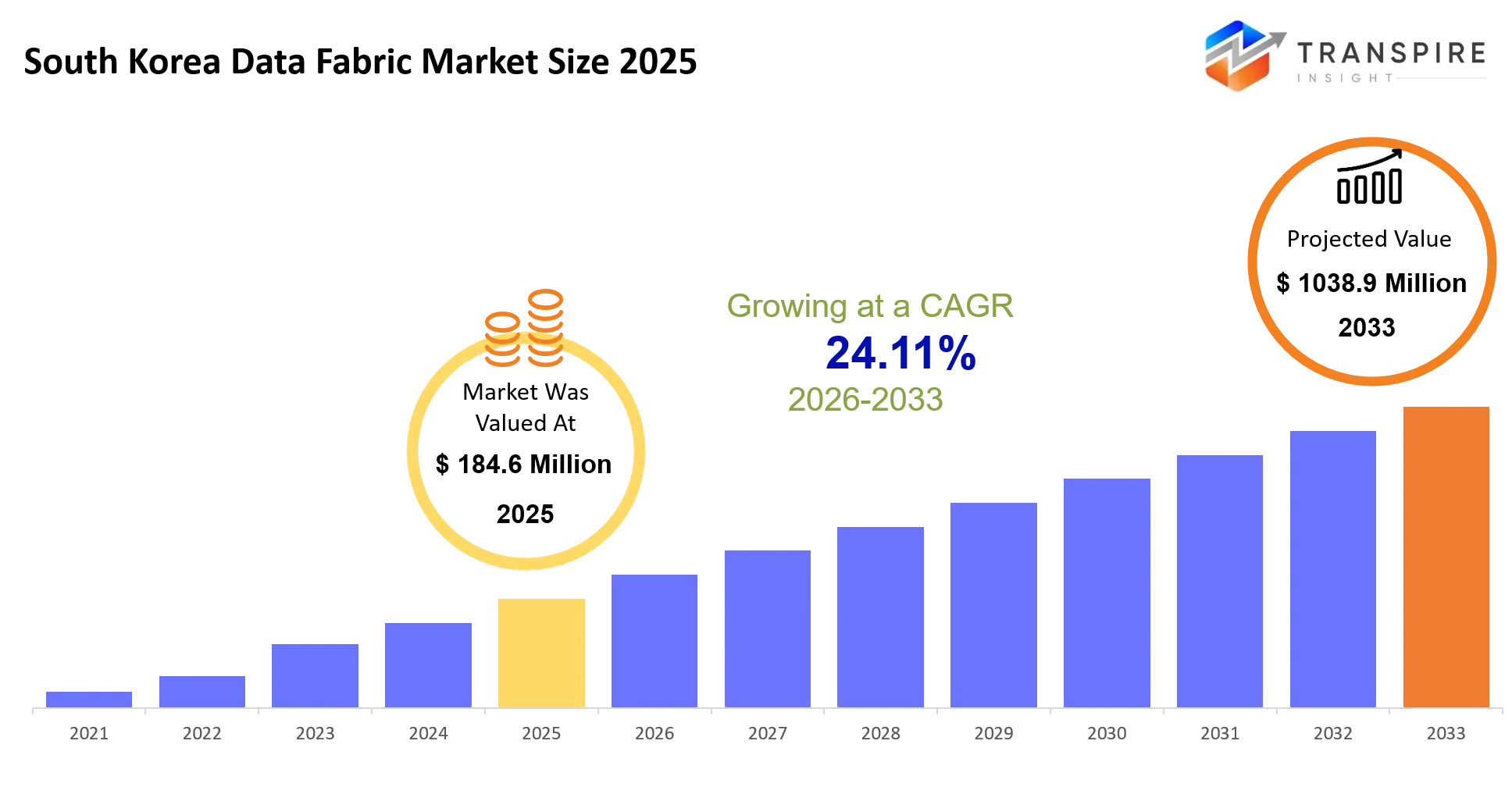
- South Korea Data Fabric Market Size 2025: USD 184.6 Million
- South Korea Data Fabric Market Size 2033: USD 1038.9 Million
- South Korea Data Fabric Market CAGR: 24.11%
- South Korea Data Fabric Market Segments: By Component (Data Integration, Data Governance, Metadata Management, Data Security, Analytics, Data Virtualization, Data Orchestration, Others); By Deployment (Cloud, On-Premise, Hybrid, Multi-Cloud, Private Cloud, SaaS, Edge Data Fabric, Others); By Application (Data Management, Business Intelligence, AI & ML, Customer Analytics, Risk Management, Compliance, Operational Analytics, Others); By End User (BFSI, Healthcare, Retail, Manufacturing, IT & Telecom, Government, Energy, Others)
South Korea Data Fabric Market Summary
The South Korea Data Fabric Market was valued at USD 184.6 Million in 2025. It is forecast to reach USD 1038.9 Million by 2033. That is a CAGR of 24.11% over the period.
A Top Tier Priority In the South Korean market, the data fabric layer is quickly rising to become the go-to enterprise solution for stitching together siloed data that exists within cloud environments, on-premises sources, manufacturing sites and enterprise applications. Specifically, data fabric solutions make it possible for enterprises to quickly retrieve trusted data; automate the analytics process; and support better business decisions without the need to redo legacy infrastructure. Data fabric solutions in South Korea have rapidly evolved in the last 3-5 years from relying on traditional, centralized data warehouses to a new wave of metadata-driven, AI-ready architecture that caters to a hybrid and multi-cloud reality. The market underwent this major shift to address many gaps that emerged with the onset of the COVID-19 pandemic – where businesses had to access disparate data sources to facilitate remote working arrangements and supply chains. Both South Korean manufacturers, banks, and telecommunication providers who are focused on getting the right data to the right place at the right time are spending on intelligent data orchestration software rather than just storage and integration. That is expanding the use of the data fabric across sectors and generating recurring software and services revenue.
Key Market Insights
- The South Korea Data Fabric Market is led by Seoul Metropolitan Area, holding more than 60% share in 2025 due to high enterprise IT expenditure.
- Gyeonggi Province is the second largest market by region, driven by semiconductor, manufacturing, and smart factory investments.
- Busan and the southeastern industrial hubs represent the fastest growing markets through 2032, driven by industrial digitization trends.
- Solution platforms are the largest market segment with about 68% of the total market share in 2025 due to the need for enterprise-wide data integration.
- Professional and managed services are the second largest market segment due to the growing need for expertise in implementation and governance.
- AI-enabled data orchestration solutions are the fastest growing market segment through 2032, supported by ongoing enterprise automation trends.
- Business intelligence & analytics applications held the largest share in 2025, accounting for around 35% of the market value due to enterprise demand for real-time decision making.
- Predictive analytics & AI model management applications are projected to be the fastest growing application segment through 2032.
- Manufacturing holds the majority of the South Korea Data Fabric Market, with approximately 30% share, backed by increasing adoption of smart factories and industrial IoT solutions.
- The Banking & Financial Services segment is poised to register rapid growth owing to increasing regulatory mandates for data compliance and security governance.
What are the Key Drivers, Restraints, and Opportunities in the South Korea Data Fabric Market?
Driving Factors The chief catalyst propelling the South Korea Data Fabric Market are increasing enterprise AI adoption and hybrid cloud transformation. Enterprises in South Korea typically use multiple cloud platforms while also having their existing on-premises systems, causing disparate data silos that retard analytics and decision making. The boom in generative AI that started in 2023 increased the demand for data fabrics that provide governed and trusted data pipelines. The market growth is directly linked to vendor sales of data fabric software licensing and managed services for enabling AI-powered applications for enterprises. Market Constraints Key restraint: Integrating legacy infrastructure into modern data fabric architectures Most organizations in Korea, specifically manufacturers, financial institutions and public sectors are still utilizing legacy IT infrastructure that have not been modernized for many decades.
These legacy systems generally have inconsistent and not standardized data, thus require a considerable financial investment, specialized talent, and a long time to replace and migrate into newer data architecture. It slows down deployment timelines, project delivery cycles, and increases costs for data fabric projects, leading to suppressing immediate revenue generation for vendors. Upcoming opportunity:
Industrial AI and Edge Analytics Large volumes of operational data are generated by smart factories that necessitate real-time integration and data governance. Companies offering AI powered data fabric which are optimized for industrial settings will be a substantial market, with major chipmakers, car and consumer electronics producers investing in autonomous systems in recent years.
What Has the Impact of Artificial Intelligence Been on the South Korea Data Fabric Market?
Here, AI is fundamentally transforming the South Korean Data Fabric platform by eliminating manual-driven data discovery, integration, and governance efforts with automation. Data Fabric metadata powered by AI can discover and categorize data sets; find relationships among both structured and unstructured information; and suggest relevant Data Fabric pipelines. These functions accelerate analytics deployment in the enterprise by significantly shortening time for data preparation. Machine learning algorithms play a crucial role in Predictive Data Quality Monitoring (PDQM); data anomaly detection and Workload management and Optimization(WMO).
Manufacturers use ML and PDQM on production equipment to predict equipment failures and anomaly even prior to the breakdown to minimize potential production downtime, and financial service organizations leverage AI-powered Data Fabrics to perform transaction anomaly detection and predict risky trends for risk analysis. By reducing delays in processing; increasing processing speeds and enhancing compliance. Natural Language Interfaces, and generative AI is also making enterprises' data more approachable for users with non-technical skills.
Instead of querying the vast amounts of data using complicated commands, users can interrogate any of the massive amounts of information using a conversation style query to shortening the process cycle for decision-making to a matter of minutes and increasing productivity; however there is one big obstacle on implementing AI - it's the cost of integration of the ML models to the legacy systems which is expensive and difficult for organizations in cases of inconsistent and broken data quality issues.
Key Market Trends
- In 2021, enterprises have transitioned from a sole reliance on centralized data warehouses to adopting hybrid architectures driven by metadata management capabilities that helped these organizations decrease data integration complexity and accelerate analytics.
- Generative ai adoption post 2023 reshuffled buyer priorities, with more companies investing in reliable data pipelines prior to deploying enterprise ai use cases at scale.
- Multi- and hybrid-cloud approaches have overtaken the first-generation pre-eminence of the single-cloud as more than 70% of large Korean businesses run applications and services across more than one cloud environment.
- Manufacturing companies, however, are following a different, more unified path to analytics-fusing their factory, IoT and enterprise data together. Spending, of course, is shifting away from stand-alone analytics tools toward live data orchestration.
- Enterprise data governance transitioned from just a regulatory compliance function to a strategic initiative as more stringent privacy regulations led to investments in automated lineage and cataloging tools.
- All the global vendors such as IBM, Microsoft, Oracle and SAP extended AI-powered solutions, bringing fierce competition for intelligent automation and industry-specific products.
- Buyers prefer to acquire subscription-based cloud deployments. As a result, vendors are shifting away from perpetual licenses to recurring revenue and managed service models.
- Cloud provider and system integrator alliances gained momentum after 2022 to enable faster enterprise deployment cycles and mitigate migration risks.
- Edge computing, one of the trends we observed, where executives from industrial companies start working with operational data closer to the offtakepoint in order to minimize the latency and enable faster decision making.
South Korea Data Fabric Market Segmentation
By Component :
Data Integration integrates disparate data sources to provide a central data view. Data Governance provides quality standards, policies for data ownership and regulatory compliance. Data Cataloging organizes and categorizes data. Data Quality ensures data consistency, accuracy and timeliness. Data Security protects data from breaches and cyber-threats.
Data Analytics translates raw information into business intelligence. Data Discovery facilitates finding relevant data. Data Federation provides an abstraction layer over multiple data sources without moving the data physically. Data Visualization represents information graphically for enhanced understanding. Data Orchestration automates data flow and management workflows across multiple systems. The set of data management tools also includes data monitoring tools, master data management, and operational and industry-specific data management tools.
By Deployment :
Cloud deployment model leverages third-party infrastructure, offering flexibility, scalability, and rapid implementation. On-premises deployment model involves housing data management solutions within an organization's physical data center, offering direct control over infrastructure and security. Hybrid cloud deployment model combines cloud services with on-premises solutions. Multi-cloud deployment model involves leveraging multiple public cloud service providers to build resilient systems with diverse workloads and increased efficiency.
Public Cloud offers cloud-based data management tools and services hosted by a third-party vendor on their infrastructure accessible via the internet. Private Cloud deploys data management tools on dedicated servers within a secure environment either managed in-house or by a third party. Other cloud solutions include SaaS, PaaS, Edge data Fabric.
By Application :
Data Management streamlines and curates business data over its lifecycle. Business Intelligence enhances data for reporting and dashboarding for strategic purposes. AI & ML automates analyses and finds patterns within vast data sets. Customer Analytics investigates consumer habits for enhancing products and services.
Risk Management proactively monitors and identifies operational and financial hazards. Compliance applications address regulatory and data protection standards. Operational Analytics enhances workflow efficiency and performance tracking. Other applications comprise forecasting, process improvement, and sector-specific solutions.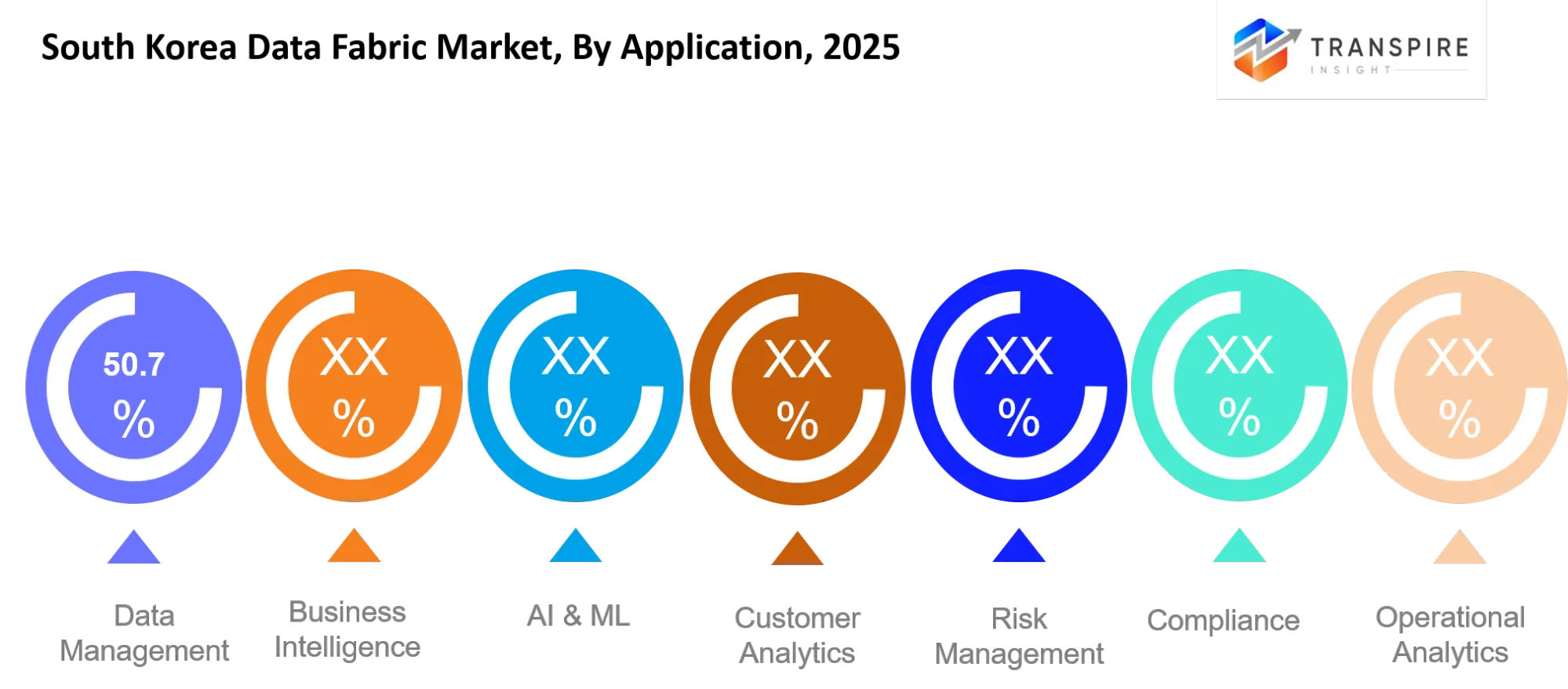
By End User :
BFSI sectors have improved fraud prevention, customer support, and regulatory adherence with data fabric. The healthcare sector enhances management of clinical records and patient histories. The retail industry uses customer and inventory analytics, while the manufacturing sector integrates operations and enterprise data for improved transparency.
IT and telecom enterprises manage their networks and optimize services through shared data access. Governments can provide more efficient public services. Energy businesses use real-time data to monitor equipment and performance, with other companies tailoring data platforms for diverse digital and strategic aims.
What are the Key Use Cases Driving the South Korea Data Fabric Market?
Enterprise Data Management & Business Intelligence are the Key Drivers In The Data Fabric Market in South Korea. The large manufacturers, telecom and financial sector are adopting the solutions to bring together their siloed data – distributed across cloud platforms, factory floor systems, legacy systems for better insights. Data fabric helps accelerate access to trusted data resulting in better decision-making capabilities, reduced reporting timelines, and greater operational visibility in real-time.
Use Cases to Accelerate the Pace In the Coming Years: Other important use cases include: 1. Customer Analytics – Banks utilize integrated data platforms to mitigate financial fraud, improve regulatory reporting, retailer's integrate customer’s, inventory and sales data to understand consumer patterns. 2. Risk Management – Banks are using data Fabric solutions to better assess risk exposure across different financial instruments. 3. Healthcare - The adoption of data Fabric solutions in healthcare will pick up speed, to build the next-generation patient data platforms and foster connected health ecosystems.
Use Cases - such as Generative AI Data Pipelines and Edge Analytics For smart factories are gradually building momentum, particularly among South Korean semiconductor and electronics companies, who intend to process vast amounts of real-time production data, ushering in future avenues for automation, predictions, and autonomous operations within the forecasted duration.
|
Report Metrics |
Details |
|
Market size value in 2025 |
USD 184.6 Million |
|
Market size value in 2026 |
USD 229.1 Million |
|
Revenue forecast in 2033 |
USD 1038.9 Million |
|
Growth rate |
CAGR of 24.11% from 2026 to 2033 |
|
Base year |
2025 |
|
Historical data |
2021 - 2024 |
|
Forecast period |
2026 - 2033 |
|
Report coverage |
Revenue forecast, competitive landscape, growth factors, and trends |
|
Country scope |
South Korea |
|
Key company profiled |
IBM, Oracle, SAP, Microsoft, Informatica, Talend, Denodo, Cloudera, Snowflake, Teradata, SAS, Qlik, TIBCO, Hitachi Vantara, Samsung SDS |
|
Customization scope |
Free report customization (country, regional & segment scope). Avail customized purchase options to meet your exact research needs. |
|
Report Segmentation |
By Component (Data Integration, Data Governance, Metadata Management, Data Security, Analytics, Data Virtualization, Data Orchestration, Others); By Deployment (Cloud, On-Premise, Hybrid, Multi-Cloud, Private Cloud, SaaS, Edge Data Fabric, Others); By Application (Data Management, Business Intelligence, AI & ML, Customer Analytics, Risk Management, Compliance, Operational Analytics, Others); By End User (BFSI, Healthcare, Retail, Manufacturing, IT & Telecom, Government, Energy, Others) |
Which Regions are Driving the South Korea Data Fabric Market Growth?
Seoul Metropolitan Area continues to be the largest region in South Korea Data Fabric Market due to high levels of enterprise density, high digital maturity and progressive government policies around AI and cloud transition. The presence of large financial institutions, telcos and international OEMs in the region will drive ongoing demand for integrated data platforms. Extensive digital transformation incentives and legislation from the government will also support strong regional adoption of data fabric solutions in both enterprise and government agencies. The established base of cloud vendors, application vendors and IT service providers also underpins regional prominence.
Gyeonggi Province is the second most important market, but the derivative trends differ from Seoul. Demand is driven by manufacturing clusters, semiconductor and electronics companies, which need direct access to production and operation data. Response to stable industrial investment and ongoing investments in smart factories is strong, thereby establishing a consistent drive for technology expenditure. Given the long-term spend on modernization programs and consistent enterprise investment, Gyeonggi is a significant contributor to market revenues.
Busan and southeastern industrial belts are fast becoming the most vibrant markets. Investment in smart ports, digitalisation of logistics and industrial AI is further shifting transport & manufacturing sectors towards connected data architectures. With growing trade volumes leading to larger investments in data integration platforms for end-to-end transparency and higher Efficiency, momentum into 2026-33 is likely to create compelling propositions for software vendors and Managed Service Providers or investors seeking exposure to industrial digitalisation.
Who are the Key Players in the South Korea Data Fabric Market and How Do They Compete?
The South Korean Data Fabric market is moderately concentrated, with a mix of global enterprise software vendors and more specialized data management firms vying for market position. Technology capabilities and service quality represent the core competitive battleground, while features related to artificial intelligence integration and hybrid cloud support are gaining traction in driving purchasing decisions. Incumbent vendors are shoring up market positions by improving their offerings, and startups are targeting growth opportunities with flexible deployments and industry-specific solutions.
IBM vies with a mix of artificial intelligence-infused automation and strong data governance offerings across its enterprise software portfolio. Its partnerships with local system integrators and a robust consulting business enable rapid deployment among regulated industries. Microsoft offers strong interoperability with its cloud services and applications, and can therefore integrate data across various environments more easily.
The company is doubling down on its generative AI expertise. Oracle’s efforts are focused on its powerful database technologies, and autonomous features that minimize data management overhead. Informatica offers strong metadata management and a suite of intelligent data cataloging tools that enhance data quality and governance. Each of these firms is expanding through cloud partnerships, the creation of industry-specific offerings and increasing reliance on the power of AI.
Company List
- IBM
- Oracle
- SAP
- Microsoft
- Informatica
- Talend
- Denodo
- Cloudera
- Snowflake
- Teradata
- SAS
- Qlik
- TIBCO
- Hitachi Vantara
- Samsung SDS
Recent Development News
In March 2026, Informatica announced deeper integration with Microsoft Fabric and launched general availability support for Microsoft Fabric Open Mirroring. The update enables enterprises to replicate and synchronize data across multiple sources in real time, strengthening unified data architectures and accelerating AI-ready data management.
Sourcehttps://www.informatica.com/
In March 2026, Informatica entered a strategic partnership expansion with Microsoft by extending Informatica Intelligent Data Management Cloud support for Microsoft Fabric and expanding Azure-based deployment infrastructure. The collaboration improves interoperability across cloud environments and helps enterprises deploy scalable data fabric platforms with lower integration complexity. Sourcehttps://www.salesforce.com/
What Strategic Insights Define the Future of the South Korea Data Fabric Market?
The South Korea Data Fabric Market will gravitate toward AI-native, autonomous data fabric over the next five to seven years, spurred by increased demand for real-time enterprise, operational, and edge data access to enable deeper AI usage and autonomous business operations. “The primary competitive advantage in the coming years will move beyond data integration to intelligent data governance, automated metadata management, and cross-cloud integration.”
The other often unseen risk lies in an increasing dependency on a small pool of global cloud and software vendors that hold their organizations hostage, which will reduce flexibility and force them into slow adoption. However, a key opportunity will likely lie in the emerging industrial edge data fabric to serve smart factories and semiconductor plants that are embracing automation and the automation of manufacturing processes.Market participants should aim to invest in industry-specific platforms and open architectures with reduced vendor lock-in to support a wider range of AI workloads in the long run.
South Korea Data Fabric Market Report Segmentation
By Component
- Data Integration
- Data Governance
- Metadata Management
- Data Security
- Analytics
- Data Virtualization
- Data Orchestration
By Deployment
- Cloud
- On-Premise
- Hybrid
- Multi-Cloud
- Private Cloud
- SaaS
- Edge Data Fabric
By Application
- Data Management
- Business Intelligence
- AI & ML
- Customer Analytics
- Risk Management
- Compliance
- Operational Analytics
By End User
- BFSI
- Healthcare
- Retail
- Manufacturing
- IT & Telecom
- Government
- Energy
Frequently Asked Questions
Find quick answers to common questions.
The South Korea Data Fabric Market size is USD 1038.9 Million in 2033.
Key Segments for the South Korea Data Fabric Market are By Component (Data Integration, Data Governance, Metadata Management, Data Security, Analytics, Data Virtualization, Data Orchestration, Others); By Deployment (Cloud, On-Premise, Hybrid, Multi-Cloud, Private Cloud, SaaS, Edge Data Fabric, Others); By Application (Data Management, Business Intelligence, AI & ML, Customer Analytics, Risk Management, Compliance, Operational Analytics, Others); By End User (BFSI, Healthcare, Retail, Manufacturing, IT & Telecom, Government, Energy, Others).
Major South Korea Data Fabric Market Players are IBM, Oracle, SAP, Microsoft, Informatica, Talend, Denodo, Cloudera, Snowflake, Teradata, SAS, Qlik, TIBCO, Hitachi Vantara, Samsung SDS.
The Current South Korea Data Fabric Market size is USD 184.6 Million in 2025.
The South Korea Data Fabric Market CAGR is 24.11% from 2026 to 2033.
- IBM
- Oracle
- SAP
- Microsoft
- Informatica
- Talend
- Denodo
- Cloudera
- Snowflake
- Teradata
- SAS
- Qlik
- TIBCO
- Hitachi Vantara
- Samsung SDS
About the Authors

Mayur Shinde
I am Mayur Shinde, a Senior Research Analyst at Transpire Insight, specializing in the Automotive & Transportation and Information & Communication Technology (ICT) Industry. My work focuses on analyzing emerging market trends, technological advancements, competitive landscapes, and industry developments to deliver accurate, data-driven insights. I am passionate about transforming complex market information into clear, actionable content that helps businesses, professionals, and decision-makers stay informed and make confident strategic decisions.

Chakradhar Khansole
Chakradhar serves as the Research Director at Transpire Insight, bringing over 8 years of experience in technology, innovation, and strategic market intelligence. He specializes in transforming complex market data into actionable business insights that enable organizations to make informed, growth-oriented decisions. Recognized for his strategic vision and analytical expertise, Chakradhar leads high-impact research initiatives, delivering comprehensive market assessments, competitive intelligence, and forward-looking industry analysis.
Recently Published Reports
-
Apr 2026
3D Optical Profiler Market
3D Optical Profiler Market Size, Share & Analysis Report By Type (Desktop 3D Optical Profiler, and Portable 3D Optical Profiler), By Technology (Confocal Technology, and White Light Interference), By End-Use Industry (Manufacturing, Research Institutions, Automotive, Aerospace and Defense, Medical Devices, and Other), and Geography (North America, Europe, Asia-Pacific, Middle East and Africa, South and Central America), 2021 - 2031
-
Apr 2026
Depth Sensor Market
Depth Sensor Market Size, Share & Analysis Report By Type (Infrared Depth Sensors, Time-of-Flight (ToF) Sensors, Stereo Vision Sensors, Structured Light Sensors, Ultrasonic Depth Sensors), By Application (Automotive, Robotics, Gaming, Consumer Electronics, Industrial Automation, Healthcare, Security & Surveillance, Others), By End Users (Automotive Manufacturers, Consumer Electronics Companies, Healthcare Providers, Industrial Companies, Security Agencies, Gaming Companies, Robotics Companies, Others), and Geography (North America, Europe, Asia-Pacific, Middle East and Africa, South and Central America), 2021 – 2031
-
Apr 2026
Digital Manufacturing Market
Digital Manufacturing Market Size, Share & Analysis Report By Component (Hardware, Software, and Services), By Technology (Robotics, 3D Printing, Internet of Things (IoT), and Others), By Application (Automotive and Transportation, Aerospace and Defense, Consumer Electronics, Industrial Machinery, and Others), By Process Type (Computer-Based Designing, Computer-Based Simulation, Computer 3D Visualization, Analytics, and Others), and Geography (North America, Europe, Asia-Pacific, Middle East and Africa, South and Central America), 2021 – 2031
-
Apr 2026
Digital Visa Services Market
Digital Visa Services Market Size, Share & Analysis Report By Type (Individual Travelers, Group Travelers), By Application (Tourism, Business Travel, Others), and Geography (North America, Europe, Asia-Pacific, Middle East and Africa, South and Central America), 2021 – 2031