

North America Neurovascular Embolization Devices Market Size & Forecast:
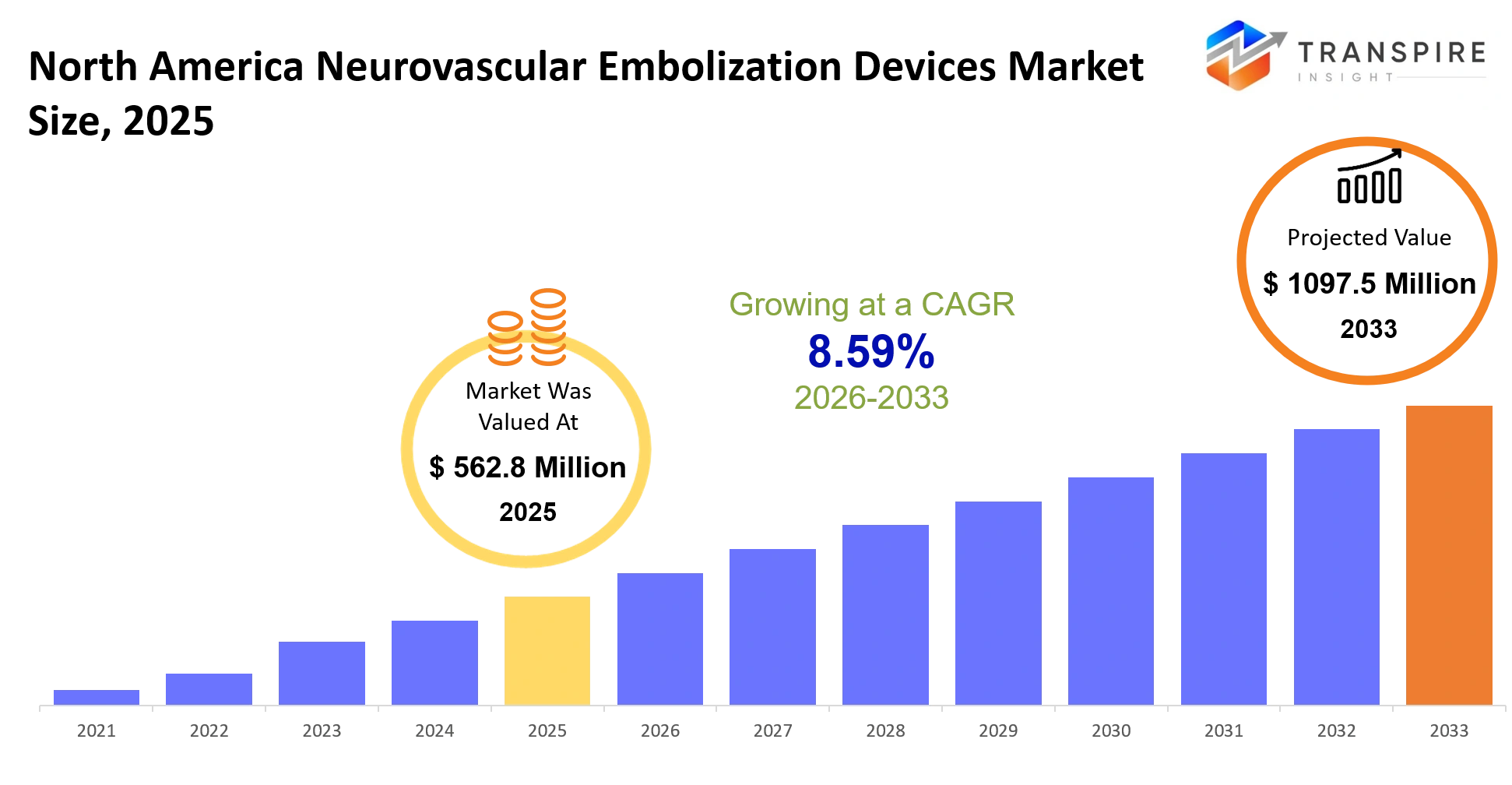
- North America Neurovascular Embolization Devices Market Size 2025: USD 562.8 Million
- North America Neurovascular Embolization Devices Market Size 2033: USD 1097.5 Million
- North America Neurovascular Embolization Devices Market CAGR: 8.59%
- North America Neurovascular Embolization Devices Market Segments: By Product Type (Coils, Liquid Embolic Agents, Flow Diverters, Stent-assisted Devices, Others), By Application (Brain Aneurysms, Arteriovenous Malformations, Stroke Management, Others), By End User (Hospitals, Neurosurgery Centers, Specialty Clinics, Others), By Material (Platinum-based Devices, Hydrogel-based Devices, Polymer-based Devices, Others).
To learn more about this report,  Download Free Sample Report
North America Neurovascular Embolization Devices Market Summary:
The North America Neurovascular Embolization Devices Market size is estimated at USD 562.8 Million in 2025 and is anticipated to reach USD 1097.5 Million by 2033, growing at a CAGR of 8.59% from 2026 to 2033. In North America , the neurovascular embolization devices market is basically dealing with a pretty critical clinical issue, which is stopping or rerouting that abnormal blood flow in the brain so you can avoid nasty outcomes like aneurysm rupture , hemorrhagic stroke, and arteriovenous malformations. These devices help doctors handle complicated neurovascular conditions by using minimally invasive procedures, so in practice there is less need for open surgery and patients often bounce back faster then people expect.
Over the last three to five years, the whole market seems to be shifting its shape toward more advanced flow diversion systems , intrasaccular platforms, and image-guided endovascular interventions. That change has widened the patient group that can be treated while also boosting procedural accuracy and supporting better long range outcomes. One big real world nudge has been the post-pandemic push across the healthcare system to shorten inpatient stays and reduce procedural load, which kinda sped up the take up of minimally invasive neurointerventional options.
Right now, the pace of market growth looks tightly tied to new technology and rising clinical comfort. As more supporting evidence gathers around device performance and as treatment pathways keep expanding, hospitals are investing in dedicated neurointerventional infrastructure. This is then feeding into higher case numbers , more frequent use of premium devices, and overall better revenue potential across the full neurovascular care chain.
Key Market Insights
- The United States basically dominates the North America Neurovascular Embolization Devices market, with something like 80% + market share in 2025, mostly because the advanced healthcare infrastructure is already well, established.
- Canada is showing the quickest regional growth during the forecast period, backed by a slowly expanding neurovascular treatment capacity and the ongoing development of a specialist workforce too.
- Procedural volumes keep climbing, and the reimbursement policies are still pretty favorable , so regional market size and revenue growth get another boost across North America.
- For device types, coil embolization devices take the biggest share, exceeding 35% in 2025, mainly due to their broad use for intracranial aneurysm treatment, in particular.
- Flow diversion devices sit in the second-largest segment, because they’re considered effective for managing those complex and wide-neck aneurysms.
- Liquid embolic agents are projected to be the fastest-growing segment through 2032, supported by rising adoption in arteriovenous malformation procedures.
- Also, demand for next-generation neurovascular embolization products is accelerating, since physicians want better procedural precision and longer-term outcomes , not just short results.
- When it comes to applications, intracranial aneurysm treatment leads , accounting for about 50% of the total market revenue in 2025.
- At the same time, treatment of arteriovenous malformations , or AVMs, is coming up as the quickest-growing application segment throughout the forecast window.
- And finally, broadening screening initiatives plus earlier diagnosis keep backing up procedure volumes across the major neurovascular disease categories year after year.
What are the Key Drivers, Restraints, and Opportunities in the North America Neurovascular Embolization Devices Market?
The biggest force pushing the North America neurovascular embolization devices market is basically the quick move toward minimally invasive neurointerventional care. this shift really picked up when clinical evidence showed that newer embolization coils, flow diverters, and liquid embolic agents can lower complications, cut down hospital days, and support better long term results than the older, more invasive surgical routes. hospitals and health systems have put more money into stroke and neurovascular centers, since acting faster helps people recover better while also improving operational efficiency. as more physicians start using endovascular methods for aneurysms and arteriovenous malformations, procedure numbers climb, and that tends to boost device utilization, revenue, and overall market momentum.
The main obstacle is the restricted supply of well-trained neurointerventional specialists. This issue is kind of structural because becoming truly skilled in complex neurovascular interventions takes years of focused education, hands on clinical training, and lots of case experience. even if demand increases, the workforce can’t just scale up overnight. so many facilities can’t reliably handle advanced embolization procedures, which creates sort of a treatment traffic jam, delaying uptake and reducing market reach. in turn, this staffing problem limits potential revenue by shrinking the number of eligible procedures that actually get done each year.
A big growth moment is in connecting artificial intelligence with more advanced imaging methods for neurovascular treatment planning. AI-driven imaging platforms can help with aneurysm evaluation, offer procedural guidance, and also inform device choice. When large health systems across the United States and Canada keep expanding their investments in digital neurology infrastructure, these tools may boost procedural precision, increase physician confidence a bit more, and back broader take up of next generation embolization devices.
What Has the Impact of Artificial Intelligence Been on the North America Neurovascular Embolization Devices Market?
Artificial intelligence plus advanced digital tech are quietly, and not so quietly, reshaping the North America neurovascular embolization devices market, mostly because they make procedural planning smoother, workflow feels faster, and treatment precision gets better. AI-enabled imaging platforms can automatically scan CT angiography and MR angiography studies, then interpret aneurysm morphology and flag vascular irregularities way before the intervention. In practice, this sort of automation cuts down on the usual manual image checking time, and it lets neurointerventional teams sort high-risk cases more efficiently, without that constant back-and-forth.
Meanwhile, machine learning models increasingly help with predictive, yes sort of “future-looking” decisions. They study huge datasets that include patient anatomy, procedural outcomes, and device performance, and then they can help clinicians estimate aneurysm rupture risk, fine tune device selection, and even approximate treatment success rates. On top of that, sophisticated visualization software, along with digital twin technologies, strengthens pre-procedural prep by mimicking blood flow behavior and potential embolization results ahead of time , so the team can adjust before anything starts.
All these features tend to raise procedural accuracy, shorten operating room time, and reduce the chance that patients need retreatment later on. Hospitals often get better use of resources, while physicians feel more confident when managing complicated neurovascular issues. So the take-up of premium embolization devices, and also image-guided approaches, keeps growing.
Still, one core limitation remains stubborn: high-quality, standardized clinical datasets aren’t always easy to get. A lot of AI models are trained on information from particular institutions, and that can reduce predictive reliability when the same model is moved to different patient groups, or across varying healthcare systems.
Key Market Trends
- Since 2020, hospitals kinda accelerated the move from surgical clipping to endovascular embolization, and they’ve been leaning more into advanced coils, plus flow diversion devices. It’s like, gradually but, clearly.
- Flow diverters got broader physician buy-in somewhere around 2021 to 2025, mainly because the long-term clinical evidence showed they work well for nasty, complex aneurysms and not only in short follow-ups.
- After 2022, neurovascular centers started integrating AI-enabled imaging platforms more often , which reduced the time spent on treatment planning, and also helped physicians feel more confident during procedures, even when cases were complicated.
- Manufacturers also changed where they put their R&D money , shifting toward intrasaccular devices and liquid embolics, sort of mirroring what the market wanted for anatomically tricky cerebrovascular lesions, especially those that are hard to reach.
- Then 2020 and 2021 brought supply chain disruptions, and several major companies responded by diversifying manufacturing locations , while also tightening inventory management practices, so they didn’t get stuck midstream.
- Companies like Medtronic, Stryker, and Penumbra expanded their product lines through acquisitions, partnerships, and kind of targeted investments in neurovascular tech. Not just one thing, more like a mix.
- At the same time, healthcare providers increasingly concentrated complex neurovascular procedures in specialized stroke centers, and that appeared to improve outcomes, while also increasing uptake of premium devices.
- Regulators started placing more emphasis on real-world clinical evidence, so manufacturers have expanded post-market studies and tried to generate long-term performance datasets that look more convincing over time.
- Digital treatment planning tools, which used to feel optional, have turned into standard workflow components at major academic hospitals and tertiary care centers , so teams use them by default now.
- Finally, cross-disciplinary collaboration between neurology, radiology, and neurosurgery teams increased a lot since 2021, which supports wider adoption of advanced embolization therapies, and honestly it feels like the whole system became more coordinated.
North America Neurovascular Embolization Devices Market Segmentation
By Product Type
By product type, coils keep the top market position, basically because of broad clinical buy in, long standing procedural protocols, and that familiar comfort most physicians already have with aneurysm treatment. Flow diverters are, kind of, the second most influential group, especially when we talk about complex, wide neck aneurysms that are hard to steer with more standard approaches. Liquid embolic agents are starting to gain traction, as neurointerventional specialists look for more effective answers for arteriovenous malformations and other troublesome vascular issues. Stent-assisted devices still matter a lot too, mainly by helping with embolization procedures that need extra structural stability, in real practice.
Growth patterns are not the same across all categories. Coils tend to ride procedural volume, while flow diverters and liquid embolics ride technology led adoption. Looking ahead, competition should mostly tighten around device accuracy, deliverability, and durable clinical results. Manufacturers that invest in improved device engineering and connected treatment platforms are probably going to lock in more value as treatment complexity increases, across different neurovascular care environments.
By Application
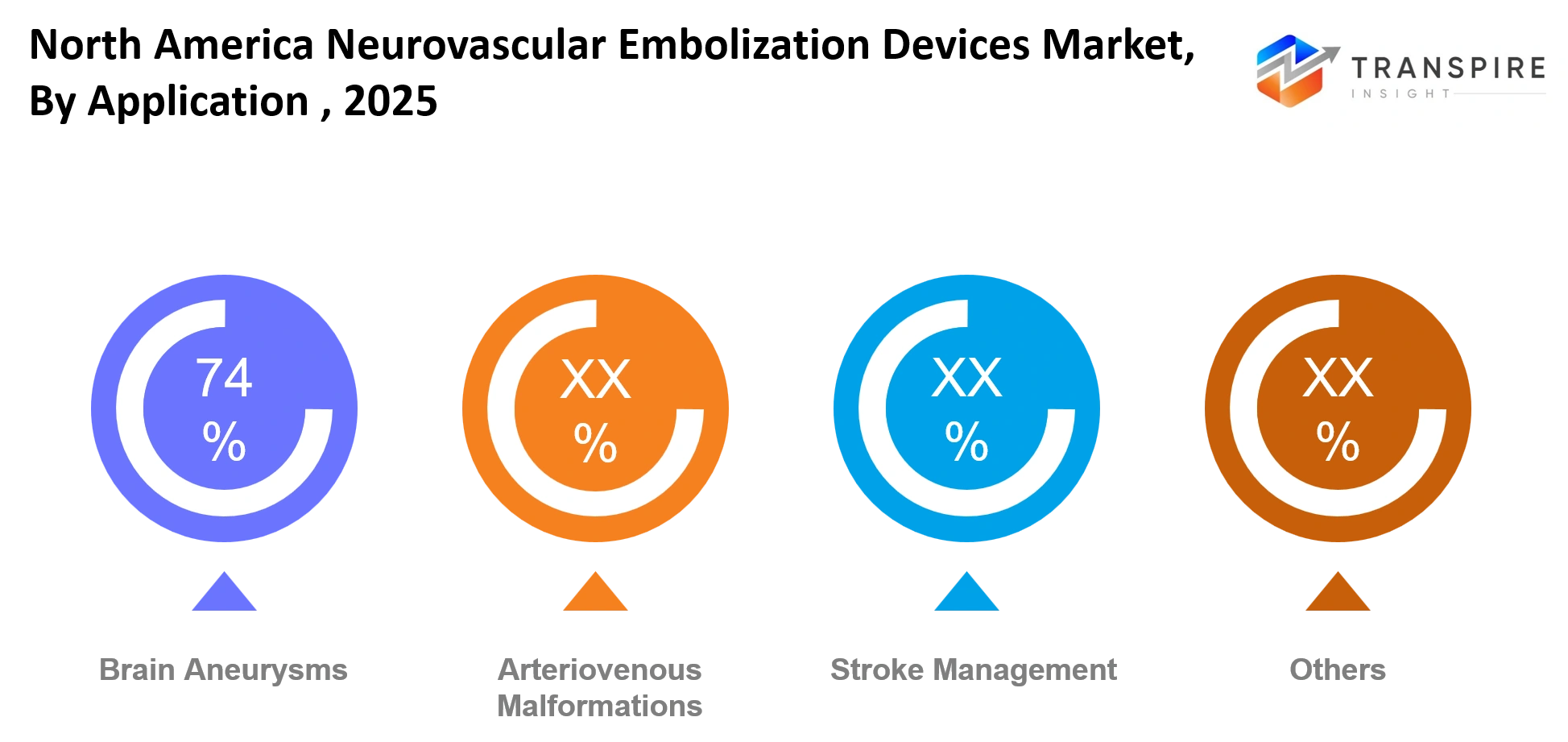
For application, treatment of brain aneurysms takes the biggest share, mostly because aneurysms are among the more frequently diagnosed and clinically meaningful neurovascular matters that end up needing embolization procedures. There are strong diagnostic skills and screening is getting used more often, so procedure volumes stay supported in this area. Arteriovenous malformations are another major application but in practice the care path often needs specialized knowledge and more careful device picking.
Stroke management is starting to look like a high potential segment too, as healthcare systems keep building more complete stroke care networks and they push faster intervention strategies. Other neurovascular conditions are a smaller slice, but it stays fairly consistent. Each application comes with its own clinical needs, which then shapes device selection and even the purchasing decisions around it. Looking ahead, growth should depend more and more on earlier diagnosis, wider reach to specialized care, and tighter integration with imaging technologies. Overall, these changes are expected to open opportunities for companies providing very focused , condition-specific embolization solutions.
To learn more about this report, Download Free Sample Report
By End-User
By end user, hospitals kinda dominate the market, because most neurovascular embolization actions still need advanced imaging setup, multidisciplinary know-how and specialized operating spaces. Big hospitals also tend to lean on established referral webs and more comprehensive stroke programs so they end up seeing higher procedural volumes than other care environments. Neurosurgery centers show up as an important segment, especially in areas where neurovascular know-how is concentrated, and where there are dedicated intervention capabilities.
Specialty clinics are more limited, mainly since there’s a lot less flexibility around procedural intricacy and the infrastructure that has to be in place. Overall demand is moving toward the institutions that can deliver full neurovascular care in one flow, from diagnosis, through follow up treatment. Capital spending on hybrid operating rooms, digital imaging systems, and specialized intervention suites keeps boosting the role of major healthcare facilities. Looking ahead, market growth will probably favor providers who can mix operational efficiency with clinical excellence, which then opens room for device manufacturers to form long-term partnerships with high volume treatment centers.
By Material
So, in terms of material, platinum based devices kinda hold the dominant position, mostly because the biocompatibility is proven, they are radiopaque enough, and they have that long standing clinical performance in embolization steps. Platinum coils stay broadly used too, since physicians can actually visualize them clearly, and also deploy them in these more complex interventions, without too much guess work. Now hydrogel based options are getting more attention, because their expansion properties can help aneurysm filling, and maybe lower recurrence rates. Polymer based devices are moving forward as well, with manufacturers aiming for materials that increase flexibility, durability, and even more treatment customization. Other material classes are more niche, but they still help push product innovation forward in the background.
Overall, material selection is starting to affect treatment effectiveness, the procedural efficiency, and the long term outcomes for patients. Research focus is drifting toward next generation materials, ones designed to support stronger healing responses, and better overall device performance. This whole direction should also drive strategic investment in material science, which then opens opportunities for manufacturers to take lab level innovation, and turn it into commercially viable neurovascular products.
What are the Key Use Cases Driving the North America Neurovascular Embolization Devices Market?
The main practical use for neurovascular embolization devices is, honestly, pretty tied to treating intracranial aneurysms inside hospitals and full-service stroke centers. In that context the demand ends up being the highest one, because once an aneurysm ruptures it can trigger a life-threatening hemorrhagic stroke, so clinicians push for fast, effective action almost immediately, you know, like a clinical priority.
After aneurysms, the use is getting broader too, especially for arteriovenous malformations and a bunch of other difficult cerebrovascular issues. More specialized neurosurgery centers now lean on modern embolic agents and flow diversion technologies. That helps them manage cases that previously really meant doing more invasive surgical approaches, so you can see gains in procedural efficiency and even patient recovery.
Then there are the newer, emerging ideas like pre-surgical vascular occlusion, plus very personalized treatment planning that’s supported by artificial intelligence and upgraded imaging platforms. Academic medical centers are already testing these routes, in order to raise accuracy in complicated neurovascular work, which basically opens up new opportunities for next-generation embolization technologies across the forecast period.
|
Report Metrics |
Details |
|
Market size value in 2025 |
USD 562.8 Million |
|
Market size value in 2026 |
USD 616.4 Million |
|
Revenue forecast in 2033 |
USD 1097.5 Million |
|
Growth rate |
CAGR of 8.59% from 2026 to 2033 |
|
Base year |
2025 |
|
Historical data |
2021 - 2024 |
|
Forecast period |
2026 - 2033 |
|
Report coverage |
Revenue forecast, competitive landscape, growth factors, and trends |
|
Country scope |
North America (Canada, The United States, and Mexico) |
|
Key company profiled |
Medtronic, Stryker, Terumo Corporation, Penumbra, MicroVention, Balt, Johnson & Johnson, Acandis, Phenox, Shape Memory Medical, Merit Medical Systems, InspireMD, Siemens Healthineers, Cook Medical, Abbott. |
|
Customization scope |
Free report customization (country, regional & segment scope). Avail customized purchase options to meet your exact research needs. |
|
Report Segmentation |
By Product Type (Coils, Liquid Embolic Agents, Flow Diverters, Stent-assisted Devices, Others), By Application (Brain Aneurysms, Arteriovenous Malformations, Stroke Management, Others), By End User (Hospitals, Neurosurgery Centers, Specialty Clinics, Others), By Material (Platinum-based Devices, Hydrogel-based Devices, Polymer-based Devices, Others). |
Which Regions are Driving the North America Neurovascular Embolization Devices Market Growth?
The United States is kind of the dominant regional market, mainly because it has a heavy concentration of comprehensive stroke centers, plus advanced neurointerventional facilities, and also those favorable reimbursement frameworks for minimally invasive procedures. In practice, strong adoption of flow diversion devices , embolization coils and image-guided interventions really helps keep procedure volumes high across major healthcare networks. On top of that, federal research funding and ongoing investment in neuroscience programs move things along, making it faster for new treatment technologies to show up. And there’s this pretty solid ecosystem of device manufacturers, academic medical centers, and specialized physicians, which basically helps the whole thing stay in a leadership position for the long run.
Canada comes in as the second-largest regional contributor, though the growth feels more tied to stability in the healthcare system, not so much to procedural scale. Provincial spending on stroke care pathways and neurovascular treatment capacity supports steady uptake of embolization technologies. Also, centralized healthcare planning tends to push evidence-based purchasing decisions, and it keeps long-term technology deployment more organized. All of this ends up creating predictable revenue streams for suppliers, and it makes Canada a dependable market even if the patient population is smaller.
Mexico is sort of emerging as the fastest growing market for healthcare, as the modernization of health facilities keeps expanding access to advanced neurovascular care. In the last while, investments in tertiary hospitals, improved diagnostic imaging capabilities and specialist training programs have helped treatment show up more often in major urban areas . At the same time private healthcare providers are more and more adopting minimally invasive neurointerventional procedures, partly because people are hunting for advanced treatment options . This overall momentum is then creating pretty attractive opportunities for manufacturers and investors who want early positioning in this expanding market through 2033.
Who are the Key Players in the North America Neurovascular Embolization Devices Market and How Do They Compete?
Competition in the North America neurovascular embolization devices market is sort of moderately consolidated, like a small group of global medical technology companies they still control a lot of procedure volumes. Most of the pushing comes from technological innovation, clinical evidence, physician training programs, and how well a company can deal with neurovascular conditions that are getting more and more complex over time. The bigger established manufacturers tend to protect their position by adding to their product collections and keeping long term hospital relationships, while the more specialized innovators try to stand out by bringing in differentiated embolization technologies. In the end, it depends less on pricing clashes and more on proving better procedural results, device dependability, and straightforward handling during high risk interventions.
Medtronic leans hard on technology innovation via a wide neurovascular portfolio, covering embolization, flow diversion, and access systems. This more integrated approach helps physicians pull multiple components from one supplier, which improves procedural steadiness. Stryker on the other hand differentiates itself through substantial investment in aneurysm care technologies and physician education efforts, these things help adoption among neurointerventional specialists. Both companies keep moving forward through targeted acquisitions, clinical research programs, and ongoing product improvements, aiming to better address complex aneurysm anatomy and the shifting treatment protocols.
Penumbra seems to pursue a kind of strategy that is centered on advanced neurovascular intervention technologies, plus the whole workflow efficiency idea. They have solid experience with catheter based systems, and that creates real synergies between embolization procedures and wider stroke care pathways. In that mix, MicroVention sort of differentiates itself with specialized neurovascular device development, including embolization coils and flow directed technologies, tuned for those difficult vascular anatomies. Then Johnson & Johnson MedTech leans on its global healthcare network, clinical support capabilities and the continued investment in next generation embolization platforms. Altogether these companies are expanding via hospital partnerships, by building clinical evidence, and by rolling out devices that enhance navigation, improve deployment accuracy , and support long term treatment durability.
Company List
- Medtronic
- Stryker
- Terumo Corporation
- Penumbra
- MicroVention
- Balt
- Johnson & Johnson
- Acandis
- Phenox
- Shape Memory Medical
- Merit Medical Systems
- InspireMD
- Siemens Healthineers
- Cook Medical
- Abbott
Recent Development News
In June 2026, Medtronic Beats Estimates and Highlights Strategic Device Investments: Medtronic reported stronger-than-expected quarterly results and disclosed continued investments and acquisitions aimed at expanding its medical-device portfolio. The company highlighted acquisitions including Scientia Vascular, a company active in catheter-based vascular technologies relevant to neurovascular and endovascular procedures. These investments support Medtronic’s long-term growth in minimally invasive vascular interventions.
Source: https://www.reuters.com
In May 2026, CereVasc Financing to Advance eShunt System Development: U.S.-based CereVasc announced new financing to accelerate development and commercialization of its neurovascular eShunt platform. The funding supports continued clinical and regulatory activities for technologies addressing neurological conditions through minimally invasive neurovascular procedures, reinforcing innovation within the North American neurovascular device sector.
Source: https://evtoday.com
What Strategic Insights Define the Future of the North America Neurovascular Embolization Devices Market?
The North America neurovascular embolization devices market seems to be drifting toward more customized, data centered intervention styles over the next five to seven years, kind of slowly but steadily. The main driver is basically the meeting point of better imaging, artificial intelligence, and the newer embolization tools, which together let physicians handle more and more intricate cerebrovascular cases with finer control. Once clinical judgment starts looking more forecasting, the edge may move away from just “a device” and go toward joined up treatment setups, where hardware, software, and procedural know how all work as one.
There’s also a quieter concern, about how concentrated the market gets and how much it leans on specialists. A small group of manufacturers tends to steer the core technology platforms, while only a narrow number of highly trained neurointerventional physicians actually run most of the hardest procedures. If something goes off course—like supply chain issues, reimbursement rules, or even workforce availability—then procedure numbers could drop even when the demand outlook still looks decent.
At the same time, there’s an emerging upside. AI assisted treatment planning, plus patient specific embolization approaches, could take off within growing regional stroke networks, especially in places of Canada and Mexico where care access is still thin. Market players should start earlier than later with clinical data collaborations and digital workflow platforms, because the next wave of buying decisions will probably lean toward options that prove clear gains in procedural speed and longer term results.
North America Neurovascular Embolization Devices Market Report Segmentation
By Product Type
- Coils
- Liquid Embolic Agents
- Flow Diverters
- Stent-assisted Devices
- Others
By Application
- Brain Aneurysms
- Arteriovenous Malformations
- Stroke Management
- Others
By End User
- Hospitals
- Neurosurgery Centers
- Specialty Clinics
- Others
By Material
- Platinum-based Devices
- Hydrogel-based Devices
- Polymer-based Devices
- Others
Frequently Asked Questions
Find quick answers to common questions.
The approximate North America Neurovascular Embolization Devices Market size for the market will be USD 1097.5 Million in 2033.
The key segments of the North America Neurovascular Embolization Devices Market are By Product Type (Coils, Liquid Embolic Agents, Flow Diverters, Stent-assisted Devices, Others), By Application (Brain Aneurysms, Arteriovenous Malformations, Stroke Management, Others), By End User (Hospitals, Neurosurgery Centers, Specialty Clinics, Others), By Material (Platinum-based Devices, Hydrogel-based Devices, Polymer-based Devices, Others).
Major players in the North America Neurovascular Embolization Devices Market are Medtronic, Stryker, Terumo Corporation, Penumbra, MicroVention, Balt, Johnson & Johnson, Acandis, Phenox, Shape Memory Medical, Merit Medical Systems, InspireMD, Siemens Healthineers, Cook Medical, Abbott.
The current market size of the North America Neurovascular Embolization Devices Market is USD 562.8 Million in 2025.
The North America Neurovascular Embolization Devices Market CAGR is 8.59%.
- Medtronic
- Stryker
- Terumo Corporation
- Penumbra
- MicroVention
- Balt
- Johnson & Johnson
- Acandis
- Phenox
- Shape Memory Medical
- Merit Medical Systems
- InspireMD
- Siemens Healthineers
- Cook Medical
- Abbott
About the Authors

Pankaj Ghogare Patil
I am Pankaj Ghogare Patil, a Senior Research Analyst at Transpire Insight, specializing in the Pharmaceutical, Chemicals & Materials, Healthcare IT, and Biotechnology industry. My expertise lies in conducting comprehensive market research, analyzing industry trends, evaluating competitive landscapes, and translating complex data into actionable insights. At Transpire Insight, I closely follow emerging technologies, regulatory developments, and market innovations to create accurate, well-researched, and informative content that helps businesses and professionals make informed decisions. I am committed to producing credible, evidence-based articles that reflect industry best practices while making technical topics accessible and valuable for a broad audience.

Chakradhar Khansole
Chakradhar serves as the Research Director at Transpire Insight, bringing over 8 years of experience in technology, innovation, and strategic market intelligence. He specializes in transforming complex market data into actionable business insights that enable organizations to make informed, growth-oriented decisions. Recognized for his strategic vision and analytical expertise, Chakradhar leads high-impact research initiatives, delivering comprehensive market assessments, competitive intelligence, and forward-looking industry analysis.
Recently Published Reports
-
Apr 2026
AI in Diabetic Retinopathy Market
AI in Diabetic Retinopathy Market Size, Share & Analysis Report By Type (Screening AI Systems, Diagnostic AI Systems, and Predictive AI Models), By Application Segment (Hospitals, Ophthalmology Clinics, Diagnostic Centers, and Research and Development), and Geography (North America, Europe, Asia-Pacific, Middle East and Africa, South and Central America), 2021 - 2031
-
Apr 2026
Psychometric Tests Market
Psychometric Tests Market Size, Share & Analysis Report By Type (Personality Tests, Ability/Aptitude Tests, Skill/Knowledge Tests, and Others), By Application (Talent Acquisition and Talent Management), and Geography (North America, Europe, Asia-Pacific, Middle East and Africa, South and Central America), 2021 – 2031
-
Apr 2026
Rare Biological Sample Collection Market
Rare Biological Sample Collection Market Size, Share & Analysis Report By Type (Isolation Kits & Reagent, Blood Collection Tubes, and Others), By Application (Oncology, Transcriptomics, Pharmacogenomics, and Others), and Geography (North America, Europe, Asia-Pacific, Middle East and Africa, South and Central America), 2021 – 2031
-
Jul 2026
Diabetic Retinopathy Market
Diabetic Retinopathy Market Size, Share & Analysis Report By Type (Proliferative Diabetic Retinopathy, and Diabetic Macular Edema (DME)), By Treatment Type (Anti VEGF Drug, Steroid Implants, Laser Surgeries, and Vitrectomy), and Geography (North America, Europe, Asia-Pacific, Middle East and Africa, South and Central America), 2021 – 2031
Our Clients







