Europe Liquid Embolics Market Size & Forecast:
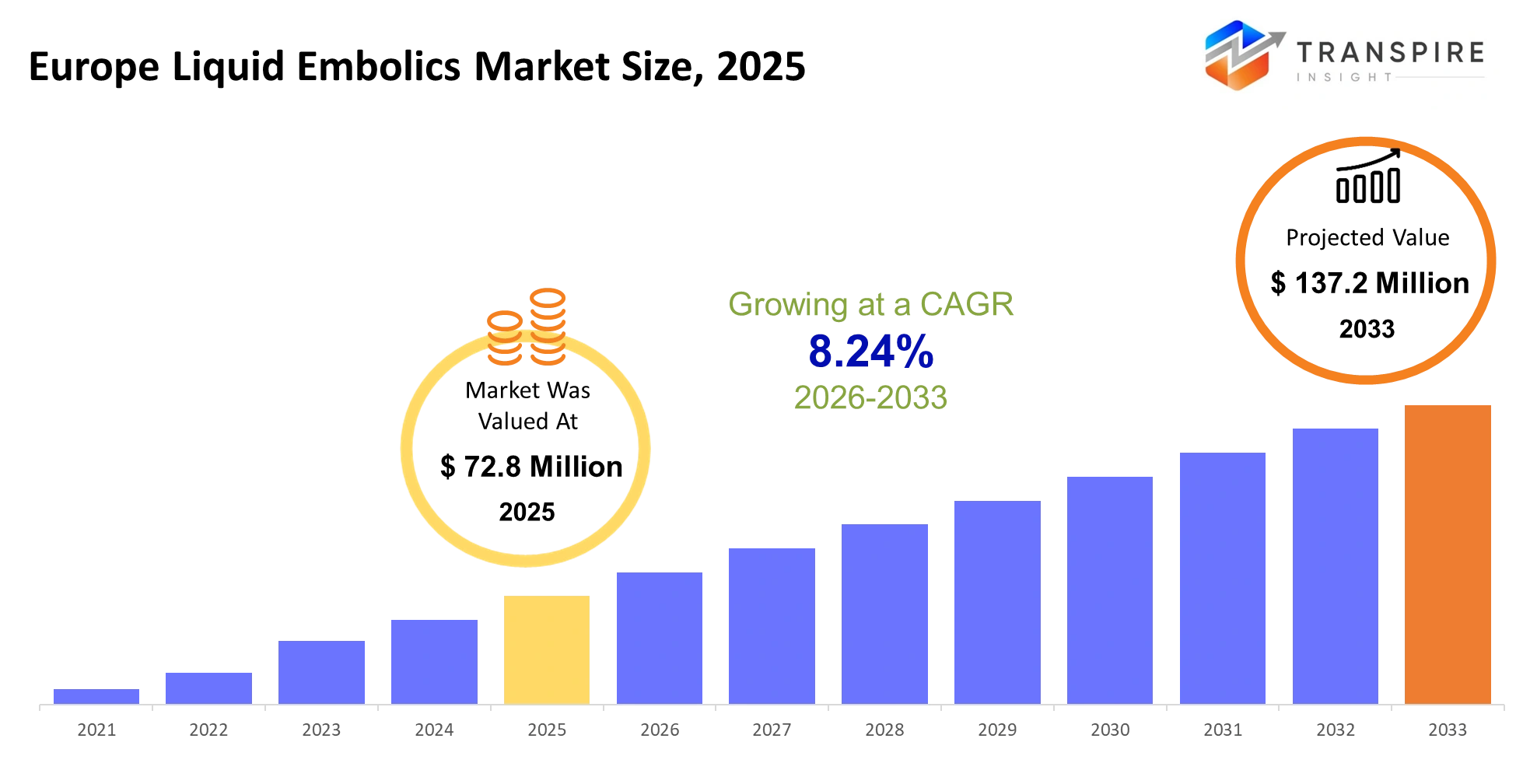
- Europe Liquid Embolics Market Size 2025: USD 72.8 Million
- Europe Liquid Embolics Market Size 2033: USD 137.2 Million
- Europe Liquid Embolics Market CAGR: 8.24%
- Europe Liquid Embolics Market Segments: By Type (NBCA, EVOH, Others), By Application (Neurovascular Disorders, Oncology, Peripheral Vascular Diseases, Others), By End-User (Hospitals, Specialty Clinics, Research Institutes, Others), By Procedure (Endovascular, Minimally Invasive, Others).
To learn more about this report,  Download Free Sample Report
Europe Liquid Embolics Market Summary:
The Europe Liquid Embolics Market size is estimated at USD 72.8 Million in 2025 and is anticipated to reach USD 137.2 Million by 2033, growing at a CAGR of 8.24% from 2026 to 2033. The Europe Liquid Embolics Market makes essential contributions to minimally invasive medical procedures which enable doctors to stop abnormal blood circulation in patients who have aneurysms, arteriovenous malformations, and tumors. These medical agents provide doctors with a method to block blood vessels in a safe way that eliminates the need for open surgery, which leads to decreased danger for patients and shorter healing periods and less demand on hospitals.
The market has experienced structural changes during the past three to five years because of new technologies in neurointerventional methods and material science which enable doctors to perform operations through image-guided catheter-based procedures. The post-pandemic buildup of elective and semi-urgent operations has emerged as the main reason driving hospitals to adopt treatment methods that require fewer resources and provide quicker results.
The combination of these factors has led to faster adoption rates. Hospitals prefer liquid embolics because these materials enable doctors to perform medical procedures with consistent results, which leads to increased patient capacity and improved efficiency of interventional treatment areas. The use of newer formulations has expanded into non-complex neuro cases, which includes oncology and peripheral applications, because clinicians have developed more confidence, which helps drive revenue growth.
Key Market Insights
- The Europe Liquid Embolics Market in Western Europe will achieve more than 55% market share by 2025 because of its superior healthcare systems and its medical technology adoption.
- The UK together with Germany and France generates the highest regional revenue because of its extensive neurointerventional procedures and effective reimbursement systems.
- The Eastern European region experiences the highest growth rate because its healthcare facilities become more accessible and investment levels increase which will drive growth from 2025 until 2030.
- The market for liquid embolics exists which contains Ethylene vinyl alcohol (EVOH) as its leading product because this material allows doctors to achieve precise surgical control while delivering successful clinical results.
- Cyanoacrylate-based embolics hold the second-largest share, widely used in peripheral embolization due to their affordable prices and their quick chemical bonding process.
- The market between 2025 and 2030 will experience rapid growth for polymer-based and bioresorbable embolics because these products provide users with both safety and precise results.
- The medical field uses neurovascular embolization as its main treatment method because it accounts for more than 50% of treatment procedures which include aneurysm control and arteriovenous malformation treatment throughout Europe.
- The field of oncology embolization develops at an accelerated rate because its use in tumor treatment will increase at a rate above 9% which will continue until 2030.
- The Europe Liquid Embolics Market designates hospitals as its primary market sector, which holds a market share of 70% because hospitals offer both interventional radiology and neurosurgery specialized services.
- Ambulatory surgical centers emerge as the fastest-growing end-user segment because they experience rapid growth through their ability to provide affordable services and quick patient processing.
What are the Key Drivers, Restraints, and Opportunities in the Europe Liquid Embolics Market?
The European Liquid Embolics Market experiences its main growth driver through the increasing preference for medical procedures that use both imaging technology and less invasive methods. The ongoing demand for European medical facilities to decrease both their patient intake and surgical risks reached its peak after COVID-19 created a backlog of patients who needed treatment. Doctors use liquid embolics to perform medical procedures that require less time and allow patients to leave the hospital sooner while experiencing fewer health problems compared to open surgical methods. Hospitals are now shifting their financial resources to support interventional radiology and neurovascular departments which results in increased treatment activities and ongoing product consumption that benefits supplier revenue forecasts.
Liquid embolics require high clinical expertise which prevents their effective implementation in medical settings. The distribution of neurointerventional specialists and advanced imaging systems needed for these procedures is not equal throughout Europe. The healthcare system needs to spend multiple years to create training programs which produce specialist doctors because there are budget restrictions that limit their ability to purchase medical imaging equipment. The market development of mid-tier hospitals and mid-tier markets gets restricted because hospitals lack funds to start new medical imaging technology.
The expansion of embolization into oncology through transarterial chemoembolization and tumor devascularization creates a significant opportunity. The development of polymer-based embolics with enhanced visibility and control features enables medical professionals to target tumor blood vessels with greater accuracy. Eastern European countries are developing their interventional oncology infrastructure through increased funding which will result in more hospitals adopting this treatment method. The combination of technological progress and regional healthcare funding will create new opportunities for market development.
What Has the Impact of Artificial Intelligence Been on the Europe Liquid Embolics Market?
The implementation of artificial intelligence together with sophisticated digital technologies will create new methods for European interventional procedures to conduct their embolization procedures which involve planning and executing and tracking their progress. AI-powered imaging systems enable automatic identification of lesions and vascular structures through angiography and CT scans which allows doctors to quickly find target blood vessels and precisely choose the best embolic materials. The systems of this technology create better treatment planning efficiency while maintaining consistent results throughout challenging neurovascular and oncology treatment scenarios.
Healthcare organizations use machine learning models to forecast the results and potential issues of medical procedures. The combination of historical patient information with imaging patterns and device performance data enables hospitals to predict risks which include non-target embolization and incomplete occlusion. The predictive capability helps with case selection while increasing the chances of successful procedures thus affecting both device usage and subsequent operations.
The combination of digital technology with interventional suites has brought operational improvements through better workflow management. The catheter laboratories show hospitals achieving faster procedure times while handling more patients which results in higher usage of embolic supplies and better financial returns from their expensive imaging systems.
European healthcare systems face a major challenge because their clinical data exists in separate systems which operate independently from one another. The AI models face problems because they must process inconsistent datasets which exist across multiple countries that lack proper data exchange systems that would connect their systems.
Key Market Trends
- German and French hospitals have redirected more than 30 percent of their intricate vascular operations toward catheter-based embolization methods since 2020 while decreasing their use of conventional neurosurgical methods.
- From 2021 through 2025, both Medtronic and Stryker Corporation worked to create EVOH-based products which enable better visibility during fluoroscopy procedures, thus improving their operational capabilities.
- European medical facilities responded to the post-pandemic surgical delays between 2021 and 2023 by increasing their focus on speedy interventional methods, which resulted in a 15 to 20 percent rise of embolic procedures performed in each interventional room.
- The European Union Medical Device Regulation (EU MDR) now requires medical devices to demonstrate clinical proof of their safety record because of its implementation since 2019, which has increased proof requirements for medical devices but has extended product approval times and protected patient safety through better testing of embolic devices.
- The use of interventional oncology treatment methods has continued to grow since 2022 because medical professionals started using embolization to treat liver tumors which required them to expand their treatment options beyond traditional neurovascular diseases.
- The nations of Eastern Europe have raised their financial support for interventional radiology by more than 25 percent since 2020 which allows them to quickly implement modern embolic medical devices in regions that previously lacked access to advanced treatment options.
- Healthcare facilities started using AI-powered imaging systems for their angiography procedures during the year 2024, which helped them achieve better accuracy in locating lesions while decreasing the time needed for common procedures at busy medical facilities.
- The shortage of medical professionals who specialize in neurointerventional treatments has become a more serious problem since 2021 because hospitals now need more procedures while they only have access to a small number of trained specialists.
- European companies now accelerate their adoption of new embolic products through their partnerships with academic institutions which conduct clinical testing, which has created a new competitive environment within the market.
Europe Liquid Embolics Market Segmentation
By Type
The market leads through EVOH-based liquid embolics because their superior control and cohesive properties enable them to operate with advanced microcatheter systems. NBCA-based agents remain widely used as a second major segment, particularly in peripheral embolization, because of rapid polymerization and lower cost. The market contains two main segments which include NBCA-based agents and other products that share a smaller space.
The various categories differ from each other through their distinct mechanisms of expansion. The growing demand for exactitude in neurovascular surgeries enables EVOH to gain market share whereas NBCA maintains its role in budget-restricted environments. The future requirements of the industry depend on advancements which enhance both visibility and delivery control systems. The next-generation formulations which manufacturers develop will create safe reproducible products that enable advanced materials to achieve market success through distinctive advantages.

To learn more about this report, Download Free Sample Report
By Application
The medical field shows most neurovascular disorders because doctors require immediate medical help and there exist established treatment options for both aneurysms and arteriovenous malformations. The oncology field stands as the second most important medical area because embolization now becomes part of liver cancer treatment methods which use tumor management approaches. Peripheral vascular diseases contribute a steady but smaller share of revenue which doctors maintain through their regular interventional work.
Each medical condition shows different patterns of growth. Neurovascular services exist because doctors need to treat patients who require specialist support while oncology services expand because patients now benefit from better treatment options. The future of oncology shows potential for wider clinical use which will lead to increased procedure demand and create new revenue opportunities for healthcare providers and their equipment manufacturers.
By End-User
The market is most effectively led through hospitals because they possess advanced imaging systems together with their specialist staff and their ability to handle high volumes of patients. Urban areas serve as the primary market for specialty clinics which provide interventional radiology services. Research institutes play a limited but important role in clinical validation and early-stage adoption of new embolic technologies.
The distribution of resources together with the difficulty of procedures determines growth patterns. Hospitals maintain their position as the primary providers for high-acuity cases while specialty clinics begin to take on simpler medical procedures because they operate more efficiently and at lower costs. The future of healthcare shows an increasing tendency toward decentralized treatment centers which will result in outpatient facilities needing to adopt new distribution methods and training programs for equipment manufacturers.
By Producer
The established clinical protocols together with liquid embolic delivery systems enable endovascular approaches to become the most common treatment method established through current medical guidelines. The healthcare industry experiences its fastest growth through minimally invasive techniques because medical facilities now prioritize shorter recovery times and decreased rates of complications.
The medical field uses other procedural methods to treat patients because these methods have greater risks and result in extended hospital admission periods. The combination of catheter technology advancements together with better imaging systems and operator expertise allows for increased success rates in medical procedures. The medical field will continue to expand its use of minimally invasive procedures to treat new medical conditions which will create a need for special embolic agents and lead to higher usage of interventional treatment methods.
What are the Key Use Cases Driving the Europe Liquid Embolics Market?
The primary application of this technology focuses on neurovascular embolization which specifically treats intracranial aneurysms and arteriovenous malformations. The medical facilities initiate this requirement because the conditions demand exact artery blockage procedures and they present extreme medical hazards. The use of liquid embolics allows for safe operation in fragile brain arteries through their ability to provide targeted treatment which decreases the need for surgical procedures.
The technology now serves two additional fields which include interventional oncology and peripheral vascular treatments. In hospital-based interventional radiology units the use of embolization for liver cancer treatment has become more common. Specialty clinics are also adopting these agents for peripheral embolization, especially in managing gastrointestinal bleeding and vascular malformations, where rapid intervention improves patient outcomes.
The medical field has identified two new applications which include tumor devascularization before surgery and control of bleeding during trauma emergencies. Medical professionals are adopting these methods in trauma centers which treat advanced cases and in oncology departments because they help achieve speedier bleeding management together with surgical readiness, which boosts patient survival rates.
|
Report Metrics |
Details |
|
Market size value in 2025 |
USD 72.8 Million |
|
Market size value in 2026 |
USD 78.8 Million |
|
Revenue forecast in 2033 |
USD 137.2 Million |
|
Growth rate |
CAGR of 8.24% from 2026 to 2033 |
|
Base year |
2025 |
|
Historical data |
2021 - 2024 |
|
Forecast period |
2026 - 2033 |
|
Report coverage |
Revenue forecast, competitive landscape, growth factors, and trends |
|
Regional scope |
Europe (Germany, United Kingdom, France, Italy, Spain and Rest of Europe) |
|
Key company profiled |
Medtronic, Stryker, Terumo, Johnson & Johnson, Abbott, Boston Scientific, MicroVention, Balt, Penumbra, Merit Medical, Cook Medical, AngioDynamics, Siemens Healthineers, GE Healthcare, Philips. |
|
Customization scope |
Free report customization (country, regional & segment scope). Avail customized purchase options to meet your exact research needs. |
|
Report Segmentation |
By Type (NBCA, EVOH, Others), By Application (Neurovascular Disorders, Oncology, Peripheral Vascular Diseases, Others), By End-User (Hospitals, Specialty Clinics, Research Institutes, Others), By Procedure (Endovascular, Minimally Invasive, Others). |
Which Regions are Driving the Europe Liquid Embolics Market Growth?
The combination of strict regulatory enforcement together with developed healthcare systems enables Western Europe to perform advanced interventional procedures. Germany France and the United Kingdom continue their commitment to public health through their established funding programs which support the implementation of neurovascular technologies. Health organizations use liquid embolics during intricate medical treatments because they receive reimbursement information together with established medical practices. The presence of multiple tertiary hospitals which employ educated medical professionals and establish research partnerships enables the organization to maintain its industry-leading position while developing new products.
Southern Europe serves as a stable second region which develops through economic recovery together with slow progress in healthcare services. Hospital facilities in Italy and Spain have experienced consistent growth which results in increased procedural volumes because of government funding. Western Europe maintains its demand for premium and cost-effective embolic products because organizations use their resources according to their financial capacity. This structure enables manufacturers to establish stable income streams which will guarantee demand patterns that remain unchanged throughout the year.
The investments that have developed healthcare facilities together with interventional radiology systems constitute the primary force behind Eastern Europe's rapid growth. The countries of Poland and the Czech Republic have established better access to cutting-edge imaging technology and less invasive surgical treatments since 2020. Hospitals have received modern upgrades together with training facilities for specialists because of the support from policy initiatives and EU funding programs. The period from 2026 to 2033 will present strong entry possibilities for manufacturers and investors because underserved regions will continue to adopt new technologies.
Who are the Key Players in the Europe Liquid Embolics Market and How Do They Compete?
The European market shows moderate consolidation because major global device manufacturers hold most market share while small companies focus on specialized market segments. Clinicians buy products based on clinical outcomes because competition between companies depends on technological performance and operational dependability instead of pricing.
Existing businesses maintain their market position through small product updates and doctor education programs while new companies introduce unique product designs and advanced delivery methods. The European Union medical device regulation (EU MDR) has established more stringent compliance requirements which benefit businesses possessing extensive clinical research data and well-established distribution systems.
Medtronic uses ongoing development of its Onyx liquid embolic system to compete by highlighting its ability to deliver products precisely and its supporting clinical research results which prove its value for neurovascular medical procedures. Stryker Corporation sets itself apart through its extensive neurovascular product line which combines embolic solutions with sophisticated catheter systems to deliver integrated packages that enhance procedural productivity. Both companies expand their reach through doctor education programs and partnerships with hospitals which help them gain market share while establishing obstacles for customers who want to switch products.
Terumo Corporation develops precise delivery systems while using its dominant position in interventional radiology to promote the use of embolic products for non-neurovascular applications. Merit Medical Systems establishes itself as a provider of affordable embolization solutions for peripheral medical procedures which attract budget-conscious healthcare facilities. Johnson & Johnson develops its business through targeted investments in surgical and interventional platforms that link various treatment methods while enhancing its market presence in advanced oncology operations.
Company List
- Medtronic
- Stryker
- Terumo
- Johnson & Johnson
- Abbott
- Boston Scientific
- MicroVention
- Balt
- Penumbra
- Merit Medical
- Cook Medical
- AngioDynamics
- Siemens Healthineers
- GE Healthcare
- Philips
Recent Development News
In April 2026, Clinical Adoption Momentum for Embolic Therapies in Neurology : A U.S. clinical update highlights multiple newly approved therapies, including embolization-based treatments, reflecting increasing institutional adoption. This signals growing clinical validation and demand for advanced embolic agents, benefiting global players active in Europe.
Source: https://www.neurologylive.com
In January 2026, Instylla Advances Commercial Launch of Hydrogel Liquid Embolic System: U.S.-based Instylla initiated the first commercial use of its Embrace™ hydrogel embolic system following FDA approval. The product targets hypervascular tumor embolization and represents a next-generation liquid embolic technology with strong implications for European adoption.
Source: https://instylla.com
What Strategic Insights Define the Future of the Europe Liquid Embolics Market?
The Europe Liquid Embolics Market is heading towards development of precision medical solutions which use embolic materials that work together with imaging systems and navigation systems and catheter systems. The hospital system needs to enhance operational efficiency while sustaining their medical results which creates a demand for advanced delivery systems that maintain predictable delivery patterns. The next five to seven years will see growth focused on high-value neurovascular and oncology applications which offer performance-based premium pricing.
Every specialized polymer and delivery component supply chain needs to reduce its distribution centers because this creates hidden danger for production stability. Production processes will face instability while creating pricing pressures which will decrease profit margins for all manufacturers who do not have multiple supplier options.
The use of embolics in interventional oncology procedures will become available in Eastern European countries through their developing healthcare systems. The companies which establish partnerships with regional cancer centers at an early stage will obtain sustained customer demand. To support operational growth and maintain market position companies should create local clinical partnerships and training programs.
Europe Liquid Embolics Market Report Segmentation
By Type
- NBCA
- EVOH
- Others
By Application
- Neurovascular Disorders
- Oncology
- Peripheral Vascular Diseases
- Others
By End-User
- Hospitals
- Specialty Clinics
- Research Institutes
- Others
By Procedure
- Endovascular
- Minimally Invasive
- Others
Frequently Asked Questions
Find quick answers to common questions.
The approximate Europe Liquid Embolics Market size for the market will be USD 137.2 Million in 2033.
The key segments of the Europe Liquid Embolics Market are By Type (NBCA, EVOH, Others), By Application (Neurovascular Disorders, Oncology, Peripheral Vascular Diseases, Others), By End-User (Hospitals, Specialty Clinics, Research Institutes, Others), By Procedure (Endovascular, Minimally Invasive, Others).
Major players in the Europe Liquid Embolics Market are Medtronic, Stryker, Terumo, Johnson & Johnson, Abbott, Boston Scientific, MicroVention, Balt, Penumbra, Merit Medical, Cook Medical, AngioDynamics, Siemens Healthineers, GE Healthcare, Philips.
The current market size of the Europe Liquid Embolics Market is USD 72.8 Million in 2025.
The Europe Liquid Embolics Market CAGR is 8.24%.
- Medtronic
- Stryker
- Terumo
- Johnson & Johnson
- Abbott
- Boston Scientific
- MicroVention
- Balt
- Penumbra
- Merit Medical
- Cook Medical
- AngioDynamics
- Siemens Healthineers
- GE Healthcare
- Philips
Recently Published Reports
-
Apr 2026
AI in Diabetic Retinopathy Market
AI in Diabetic Retinopathy Market Size, Share & Analysis Report By Type (Screening AI Systems, Diagnostic AI Systems, and Predictive AI Models), By Application Segment (Hospitals, Ophthalmology Clinics, Diagnostic Centers, and Research and Development), and Geography (North America, Europe, Asia-Pacific, Middle East and Africa, South and Central America), 2021 - 2031
-
Apr 2026
Psychometric Tests Market
Psychometric Tests Market Size, Share & Analysis Report By Type (Personality Tests, Ability/Aptitude Tests, Skill/Knowledge Tests, and Others), By Application (Talent Acquisition and Talent Management), and Geography (North America, Europe, Asia-Pacific, Middle East and Africa, South and Central America), 2021 – 2031
-
Apr 2026
Rare Biological Sample Collection Market
Rare Biological Sample Collection Market Size, Share & Analysis Report By Type (Isolation Kits & Reagent, Blood Collection Tubes, and Others), By Application (Oncology, Transcriptomics, Pharmacogenomics, and Others), and Geography (North America, Europe, Asia-Pacific, Middle East and Africa, South and Central America), 2021 – 2031
-
Apr 2026
Patient Lift Pendant Market
Patient Lift Pendant Market By Product Type (Wired Pendants, Wireless, Programmable), By Operation Type(Manual, Electric), By End-Users (Healthcare Professionals, Patients), By Application (Hospitals, Homecare, Rehabilitation Centers, Others), By Industry Analysis, Size, Share, Growth, Trends, and Forecasts 2021-2033
Our Clients
.jpg)