
South Korea Medical Devices Market Size & Forecast:
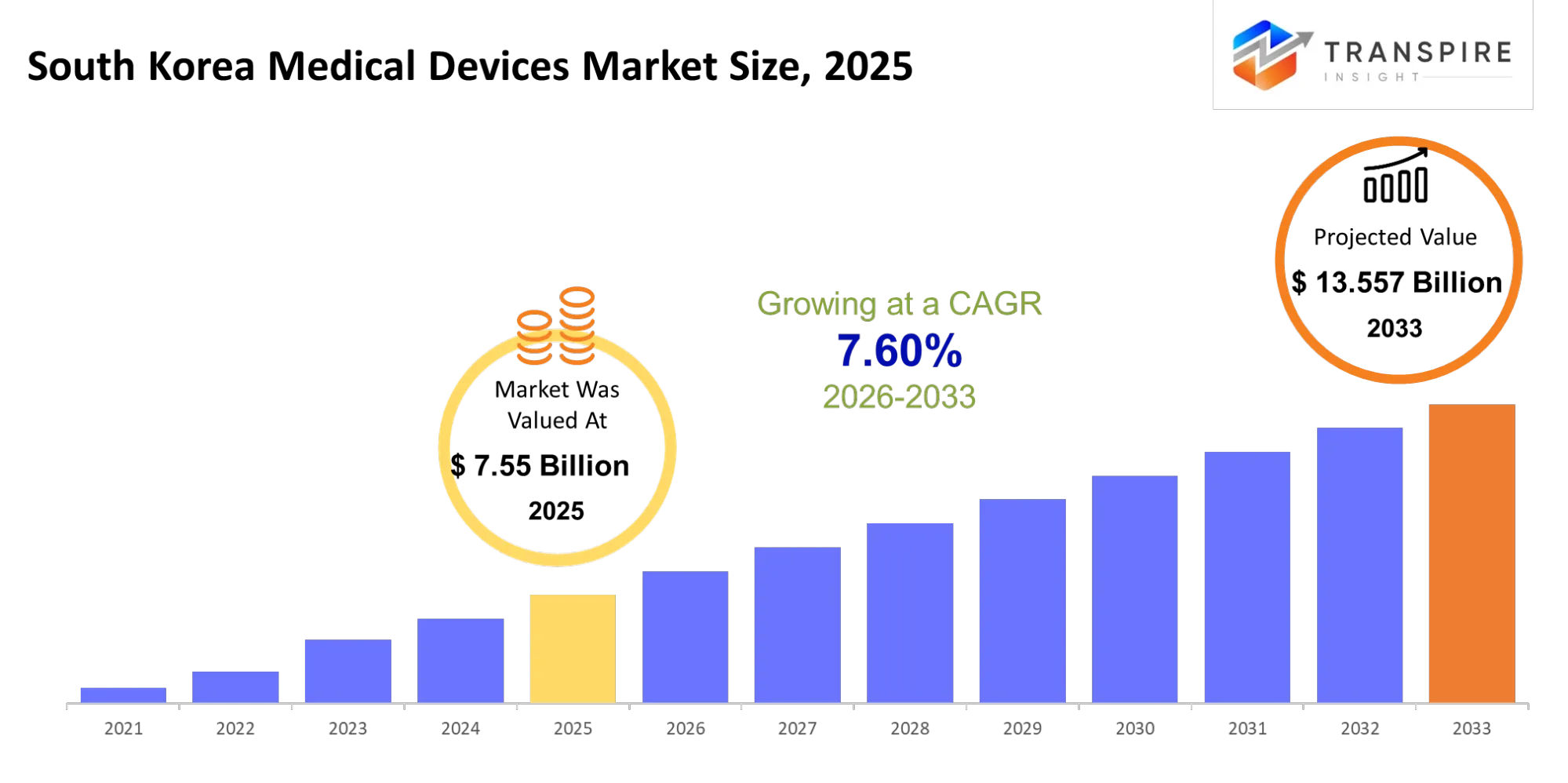
- South Korea Medical Devices Market Size 2025: USD 7.55 Billion
- South Korea Medical Devices Market Size 2033: USD 13.557 Billion
- South Korea Medical Devices Market CAGR: 7.60%
- South Korea Medical Devices Market Segments: By Device Type (Diagnostic Devices, Therapeutic Devices, Surgical Devices, Monitoring Devices, Others); By End User (Hospitals, Clinics, Ambulatory Centers, Others); By Application (Cardiology, Orthopedics, Imaging, Diabetes Care, Others)
To learn more about this report,  Download Free Sample Report
South Korea Medical Devices Market Summary
The South Korea Medical Devices Market was valued at USD 7.55 Billion in 2025. It is forecast to reach USD 13.557 Billion by 2033. That is a CAGR of 7.60% over the period.
South Korea’s medical devices market basically feeds hospitals, clinics and even homecare providers with diagnostic imaging setups, patient monitoring tools, surgical gear and these wearable devices that assist clinicians in noticing disease earlier, keeping chronic issues under better control, and running procedures with more accuracy, plus less risk. In the past 3-5 years the whole space has been moving toward software enabled and AI assisted diagnostics, while at the same time adoption of minimally invasive tools and portable devices is getting faster, because treatment is slowly leaving the big tertiary hospitals and going more into outpatient centers and home environments.
One big structural shift is how digital health platforms are getting woven into device ecosystems, and this is helped along by MFDS regulatory routes for software based medical technologies. The COVID-19 pandemic, kind of acted like a jolt, because it highlighted supply chain weak spots, but it also sped up demand for respiratory care imaging services and remote monitoring solutions. Overall these changes are making manufacturers localize production more often, and they’re focusing on connected devices that help improve throughput and long term cost efficiency inside Korea’s aging healthcare system.
Key Market Insights
- Seoul Capital Region is kinda leading the South Korea Medical Devices Market, with something like 45% share, mostly because of the more advanced hospital setup and that R&D cluster there.
- Meanwhile, the Southeastern industrial hubs are growing the quickest , backed by rising healthcare spending and more smart hospital rollouts up through the 2026 forecast window.
- On the demand side, what we see in the South Korea Medical Devices Market is that regional buying is getting more focused in big city tertiary care centers, plus specialized diagnostic networks.
- And when it comes to product types, diagnostic imaging actually takes the lead, holding around a 30% share, largely because MRI and CT systems keep getting upgraded.
- As for application , diagnostics application is the top one, with nearly 40% share, tied to the push for preventive healthcare initiatives, which people are pursuing more and more.
- Surgical applications are coming up pretty fast , as hospitals start using more robot assisted and minimally invasive surgical systems across the country.
- At the same time, chronic disease management apps are getting more attention too, mostly because the population is aging and the need for long term care keeps going.
- Hospitals still act as the top end user, holding more than 55% share in the South Korea medical devices market, mainly due to their strong equipment purchasing ability.
- Meanwhile, home healthcare is the fastest growing end user slice, helped along by telemedicine adoption and that demographic pressure from older people throughout the forecast period.
- Diagnostic centers are also stretching out steadily, since outsourced imaging demand keeps rising across the urban regions.
What are the Key Drivers, Restraints, and Opportunities in the South Korea Medical Devices Market?
The main growth driver is the quick melding of AI-enabled diagnostics together with advanced imaging setups across tertiary hospitals. This shift kinda started after MFDS regulatory clarity for software-based medical technologies, plus the post-pandemic demand for faster, higher-throughput clinical decision process. As hospitals roll out AI-assisted CT, MRI, and pathology tools, diagnostic precision goes up while turnaround times go down, and that directly pushes more procedures and higher equipment usage rates all over the South Korea Medical Devices Market.
A big structural restraint is that public healthcare procurement stays pretty cost-sensitive, and on top of that there are tight reimbursement controls. Even when hospitals want better devices, long approval cycles, plus budget ceilings tend to slow down adoption of premium machines and systems. That, in turn, delays revenue recognition for manufacturers and leads to patchy take-up of high-end technologies outside major metropolitan hospitals. So growth stays less scalable for the South Korea Medical Devices Market.
The most promising opportunity is the expansion of home-based, and also remote patient monitoring ecosystems. There are investments by Korean conglomerates in wearable biosensors and 5G-connected health platforms, and those are making it easier to manage chronic conditions continuously, without being stuck in hospital settings. For example, pilot programs in Seoul are combining wearable ECG monitoring with glucose tracking, and that’s generating more recurring revenue streams. It’s basically positioning the South Korea Medical Devices Market for a more decentralized care expansion phase.
What Has the Impact of Artificial Intelligence Been on the South Korea Medical Devices Market?
Artificial intelligence alongside advanced digital technologies are slowly reshaping South Korea’s scrubber performance systems and the wider marine emission control technology scene, by moving day to day operations away from hand checking into continuous, data fed optimization. With vessel exhaust gas cleaning systems, AI enabled control platforms are now sort of taking over scrubber monitoring, they merge sensor inputs such as SOx concentration readings, pressure differences, plus washwater condition metrics, so operators can stay within IMO emission standards in real time. This cuts down the need for manual inspection, and it also tends to make regulatory reporting more precise, across fleets that sail through Korean shipping corridors.
On the predictive side, machine learning models are being deployed too, for maintenance that aims to show up before trouble. They use older sensor behaviors to foresee things like scaling, pump wear, or chemical dosing inefficiencies before an actual breakdown happens. Operators who run these approaches often mention better vessel availability, along with calmer fuel and reagent consumption patterns, which helps keep operating expenses down, and keeps emission performance steadier even when the vessel load changes around.
Day to day, AI driven optimization is also assisting fleets with a tighter fuel to scrubber equilibrium, meaning better fuel use, plus less time lost to compliance related issues. Still, take-up isn’t fully smooth, because there’s not enough high quality maritime training data, and satellite connectivity can be spotty at sea. That combination limits real time model refreshes and makes cloud based analytics less reliable. On top of that, the integration expense to connect AI tools with older vessel systems is high, and that especially delays deployment for smaller operators across South Korea’s marine sector.
Key Market Trends
- After 2023, AI-assisted imaging adoption started rising in a pretty sharp way, and hospitals said their diagnostic turnaround times got cut about 20–30% across tertiary care networks,kind of fast actually.
- Procurement habits also moved around, from “just hardware buys” toward more integrated digital ecosystems, because many hospitals now lean more on software-enabled diagnostic platforms ,instead of using standalone devices.
- Meanwhile the regulatory side, like MFDS pathways, changed from 2022 up to 2025 and it made approvals feel quicker for software-based medical devices and AI diagnostic tools.
- Samsung Medison then pushed harder on AI ultrasound integration, and that seemed to speed up the domestic back and forth in Korea with the big global imaging manufacturers.
- And post-2020, the appetite for portable, plus point-of-care devices really grew, which reduced reliance on centralized hospital diagnostics, and generally made outpatient access better.
- Global OEMs like GE HealthCare and Siemens Healthineers shifted toward more locally based partnerships with Korean hospitals, to really strengthen market access and such.
- After the 2021 disruptions, supply chain diversification picked up, so manufacturers started regionalizing how they source components , and they aimed to cut down reliance on imports from just one country.
- Also, wearable medical devices adoption kind of accelerated from 2022 onward, mainly because there’s growing demand for aging population monitoring and , on top of that, government-supported digital health pilots helped push it forward.
- Meanwhile, hospitals also ramped up adoption of minimally invasive surgical systems, which improved recovery times and helped shorten inpatient stays across the major urban medical centers.
South Korea Medical Devices Market Segmentation
By Device Type :
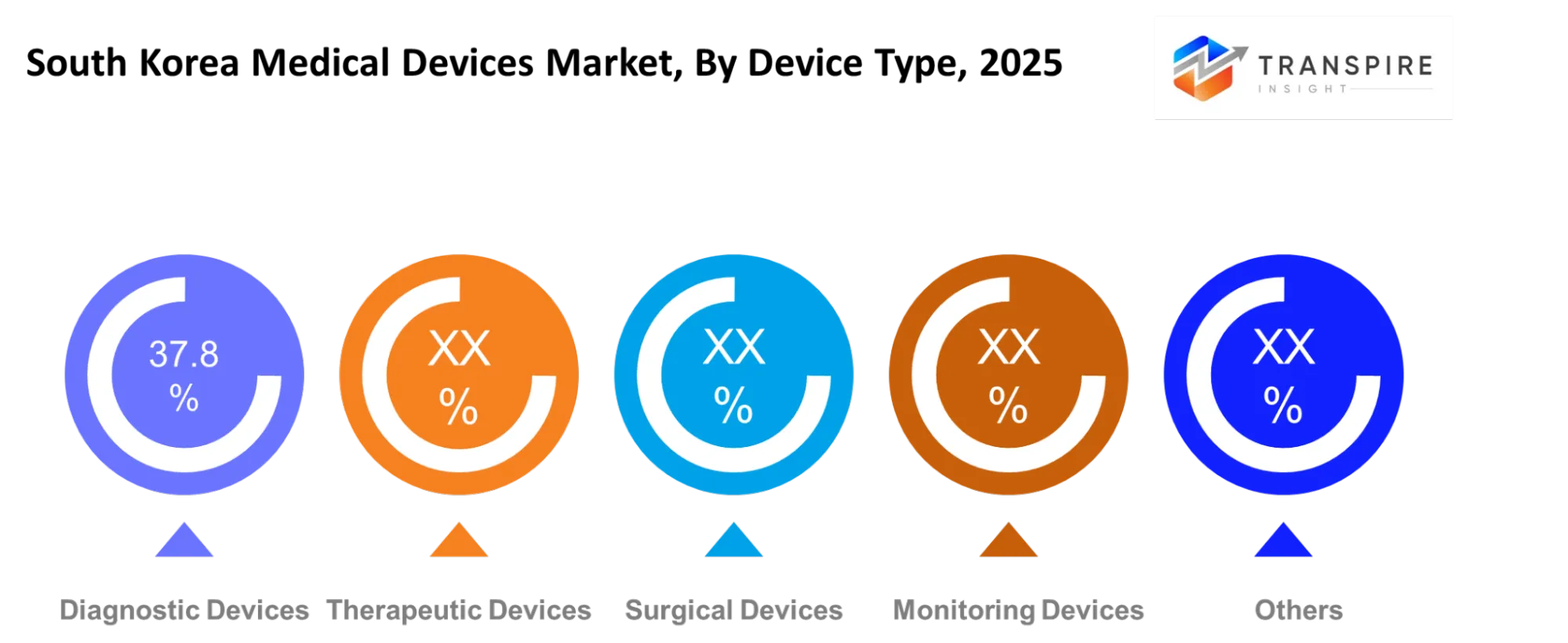
Diagnostic devices are leading demand in the South Korea medical devices market, kind of backed by imaging systems and that constant pressure for early disease detection needs. In day to day terms, hospitals keep investing in MRI, CT, and ultrasound upgrades, which helps with clinical accuracy and also speeds up the workflow, a bit more than before.
Therapeutic devices are also growing, mainly because chronic illness cases are rising and there’s more interest in targeted treatment systems. Surgical devices are shifting toward minimally invasive tools, while monitoring devices are expanding thanks to remote patient tracking solutions. There are also other categories , like support and auxiliary equipment, used across most healthcare facilities without much attention.
To learn more about this report, Download Free Sample Report
By End User :
Hospitals end up dominating the demand because they have stronger procurement capacity and the advanced infrastructure that supports complex procedures plus imaging systems. For the most part, broad adoption of advanced medical technologies is still concentrated in tertiary care networks, especially in urban areas.
Clinics are gradually expanding their use of compact diagnostic and monitoring tools for outpatient care. Ambulatory centers keep growing too, driven by same-day procedures and cost efficient treatment models. Other players include research institutes and specialty care facilities, which support niche medical services.
By Application :
Cardiology leads to this whole application demand driven by the rising cardiovascular cases , and also the ongoing need for continuous monitoring across different patient populations. In the clinic, advanced diagnostic and interventional systems help with quicker detection and a better treatment outcome, sort of consistently.
For Orthopedics it grows mainly because joint replacement procedures and sports injury treatments keep increasing, and they rely on newer surgical systems. Imaging is still very central for diagnosis across a bunch of diseases. Meanwhile Diabetes care is expanding through glucose monitoring devices as well as digital tracking tools that keep everything visible and coordinated.
What are the Key Use Cases Driving the South Korea Medical Devices Market?
Diagnostic imaging and earlier detection of disease are still kind of the big, main use case driving the South Korea Medical Devices Market. Hospitals depend a lot on MRI, CT, and ultrasound systems, so they can boost diagnostic speed and also raise clinical accuracy. With heavy patient volumes at tertiary hospitals, plus a clear push toward early treatment, it keeps forcing ongoing upgrades to imaging infrastructure. This ends up being the largest demand driver across most healthcare facilities, overall.
More use cases are expanding too, like minimally invasive surgeries and remote patient monitoring, which are getting used more often in hospitals and also in ambulatory surgical centers. Surgeons are starting to take advantage of advanced robotic assisted tools, aiming to cut recovery time and bring better precision. Meanwhile, clinics are layering in portable monitoring devices, to handle chronic conditions outside the usual inpatient flow. All these changes help lift demand across both the surgical device side and the monitoring device side.
On top of that, emerging use cases are starting to show up, including home based healthcare management and AI supported preventive screening programs. Wearables designed for continuous glucose monitoring plus cardiac tracking are getting more attention, especially for aging patients who need long term care. At the same time AI driven risk prediction tools are starting to back earlier decision making in specialized care networks. That suggests stronger digital integration coming soon, and not just in a small way.
|
Report Metrics |
Details |
|
Market size value in 2025 |
USD 7.55 Billion |
|
Market size value in 2026 |
USD 8.116 Billion |
|
Revenue forecast in 2033 |
USD 13.557 Billion |
|
Growth rate |
CAGR of 7.60% from 2026 to 2033 |
|
Base year |
2025 |
|
Historical data |
2021 - 2024 |
|
Forecast period |
2026 - 2033 |
|
Report coverage |
Revenue forecast, competitive landscape, growth factors, and trends |
|
Country scope |
South Korea |
|
Key company profiled |
Medtronic, GE HealthCare, Siemens Healthineers, Philips, Abbott, Boston Scientific, Stryker, Johnson & Johnson MedTech, Baxter, Becton Dickinson, Canon Medical, Olympus, Fujifilm, Samsung Medison, Mindray |
|
Customization scope |
Free report customization (country, regional & segment scope). Avail customized purchase options to meet your exact research needs. |
|
Report Segmentation |
By Device Type (Diagnostic Devices, Therapeutic Devices, Surgical Devices, Monitoring Devices, Others); By End User (Hospitals, Clinics, Ambulatory Centers, Others); By Application (Cardiology, Orthopedics, Imaging, Diabetes Care, Others) |
Which Regions are Driving the South Korea Medical Devices Market Growth?
Seoul Capital Region pretty much leads the South Korea Medical Devices Market , mainly because it has this bunch of top tier hospitals, regulatory institutions, and research universities all in one place. You can see it in how big medical centers, like the large university hospitals , push early uptake of advanced imaging, AI driven diagnostics, and even robotic surgery systems. Also, the fact that national regulatory bodies are around helps approvals move faster, and it makes collaboration between manufacturers and clinicians feel more direct. With a dense healthcare ecosystem, the market stays thirsty for high end medical technologies, and innovation fueled procurement keeps cycling without much pause.
Then there is the Busan–Ulsan–Gyeongnam area , which generates steadier revenue thanks to an industrial workforce that’s well established , plus healthcare infrastructure that really backs occupational and chronic care. In contrast to Seoul, growth here comes from continuous hospital investment that ties into industrial health screening and mid tier facility expansion. Local hospitals often lean toward reliable diagnostic and monitoring equipment, rather than constantly chasing cutting edge experimental setups. Since regional providers keep stable funding and do long term procurement planning, adoption remains consistent across general treatment as well as emergency services.
And honestly, the fastest growth is starting to show up in provinces like Daejeon and Sejong, mostly because government backed smart healthcare programs and digital hospital projects are ramping up. Newer investments in regional medical centers, along with telemedicine infrastructure, have widened access to advanced diagnostics beyond the biggest cities. This kind of shift lowers dependence on Seoul based facilities and improves overall distribution efficiency. For market entrants, this region is like a clear signal for longer term chances in connected devices, remote monitoring systems, and AI enabled diagnostic platforms across the 2026–2033 period .
Who are the Key Players in the South Korea Medical Devices Market and How Do They Compete?
South Korea’s medical devices market feels moderately consolidated, with global imaging and diagnostics brands plus a solid local manufacturer circle. The competition kinda revolves around AI-enabled imaging, system interoperability, and those longer term hospital service agreements, less so on price. Big players tend to hold or grow their share by building an integrated software ecosystem and clinical relationships, while newcomers get slowed down by strict regulatory validation and high adoption hurdles inside hospitals.
Siemens Healthineers leans hard on AI-assisted imaging and premium MRI platforms, tying them into the way hospitals actually run workflows, then locking in long-running contracts with major tertiary hospitals. GE HealthCare expands by covering more modalities and leaning into predictive maintenance analytics, which helps raise equipment uptime across hospital networks throughout Korea. Philips sticks out via connected patient monitoring systems that are common in ICUs, where devices are linked to centralized dashboards, supporting continuous care and remote monitoring options too.
Samsung Medison stays competitive by focusing on ultrasound specialization and AI-based imaging tools made for domestic hospital requirements, with support from a well established local distribution network. Canon Medical Systems plays in high-precision imaging and low-dose CT technology, and it keeps broadening partnerships with Korean hospitals, aiming to improve diagnostic safety and overall imaging efficiency across urban medical centers.
Company List
- Medtronic
- GE HealthCare
- Siemens Healthineers
- Philips
- Abbott
- Boston Scientific
- Stryker
- Johnson & Johnson MedTech
- Baxter
- Becton Dickinson
- Canon Medical
- Olympus
- Fujifilm
- Samsung Medison
- Mindray
Recent Development News
In May 2026, SEEANN secured a Series A investment led by KB Securities to scale production of patient-specific medical implants. The funding will be used to expand manufacturing capacity for Class 3 implants and accelerate global regulatory expansion, including planned FDA approval efforts, reinforcing Korea’s position in high-value personalized implant manufacturing.
Source https://en.wowtale.net/
What Strategic Insights Define the Future of the South Korea Medical Devices Market?
The South Korea Medical Devices Market is slowly, kind of, moving toward a digitally intergrated healthcare system where diagnostics, treatment and patient monitoring are more and more connected by AI-enabled platforms and cloud based hospital infrastructure. I mean you can see it in the way hospitals are trying to link everything together, rather than keeping it in separate silos. This change is pushed by long term pressure from an aging population, plus the need to raise hospital efficiency without actually expanding physical capacity. Over the next 5–7 years, value creation seems to be shifting toward software linked devices not just standalone hardware, and that will likely reshape procurement approaches and revenue models across providers.
There is also a less visible risk that people don’t talk about much. It’s the growing dependency on a small group of global technology providers for high-end imaging software and semiconductor-driven components. If cross-border regulatory alignment gets messy, or if chip supply tightens, device rollouts can slow down and hospitals may get stuck in upgrade cycles. This concentration risk is often underestimated because demand can look stable on the surface, even while the underlying supply or approvals situation is more fragile than it appears.
On the other hand, there’s a rising opportunity in regional smart hospital clusters being built outside Seoul, especially under government supported digital health expansion programs. Those areas are starting to test integrated remote diagnostics and AI triage systems at scale. So market participants may want to focus on partnerships with regional hospital networks and keep investing in interoperable, software-first devices, so they can secure longer term positioning in the South Korea Medical Devices Market.
South Korea Medical Devices Market Report Segmentation
By Device Type
- Diagnostic Devices
- Therapeutic Devices
- Surgical Devices
- Monitoring Devices
By End User
- Hospitals
- Clinics
- Ambulatory Centers
By Application
- Cardiology
- Orthopedics
- Imaging
- Diabetes Care
Frequently Asked Questions
Find quick answers to common questions.
The expected South Korea Medical Devices Market size is USD 13.557 Billion in 2033.
Key segments for the South Korea Medical Devices Market are By Device Type (Diagnostic Devices, Therapeutic Devices, Surgical Devices, Monitoring Devices, Others); By End User (Hospitals, Clinics, Ambulatory Centers, Others); By Application (Cardiology, Orthopedics, Imaging, Diabetes Care, Others).
Major South Korea Medical Devices Market players are Medtronic, GE HealthCare, Siemens Healthineers, Philips, Abbott, Boston Scientific, Stryker, Johnson & Johnson MedTech, Baxter, Becton Dickinson, Canon Medical, Olympus, Fujifilm, Samsung Medison, Mindray.
The South Korea Medical Devices Market size is USD 7.55 Billion in 2025.
The South Korea Medical Devices Market CAGR is 7.60% from 2026 to 2033.
- Medtronic
- GE HealthCare
- Siemens Healthineers
- Philips
- Abbott
- Boston Scientific
- Stryker
- Johnson & Johnson MedTech
- Baxter
- Becton Dickinson
- Canon Medical
- Olympus
- Fujifilm
- Samsung Medison
- Mindray
About the Authors

Pankaj Ghogare Patil
I am Pankaj Ghogare Patil, a Senior Research Analyst at Transpire Insight, specializing in the Pharmaceutical, Chemicals & Materials, Healthcare IT, and Biotechnology industry. My expertise lies in conducting comprehensive market research, analyzing industry trends, evaluating competitive landscapes, and translating complex data into actionable insights. At Transpire Insight, I closely follow emerging technologies, regulatory developments, and market innovations to create accurate, well-researched, and informative content that helps businesses and professionals make informed decisions. I am committed to producing credible, evidence-based articles that reflect industry best practices while making technical topics accessible and valuable for a broad audience.

Chakradhar Khansole
Chakradhar serves as the Research Director at Transpire Insight, bringing over 8 years of experience in technology, innovation, and strategic market intelligence. He specializes in transforming complex market data into actionable business insights that enable organizations to make informed, growth-oriented decisions. Recognized for his strategic vision and analytical expertise, Chakradhar leads high-impact research initiatives, delivering comprehensive market assessments, competitive intelligence, and forward-looking industry analysis.
Recently Published Reports
-
Apr 2026
AI in Diabetic Retinopathy Market
AI in Diabetic Retinopathy Market Size, Share & Analysis Report By Type (Screening AI Systems, Diagnostic AI Systems, and Predictive AI Models), By Application Segment (Hospitals, Ophthalmology Clinics, Diagnostic Centers, and Research and Development), and Geography (North America, Europe, Asia-Pacific, Middle East and Africa, South and Central America), 2021 - 2031
-
Apr 2026
Psychometric Tests Market
Psychometric Tests Market Size, Share & Analysis Report By Type (Personality Tests, Ability/Aptitude Tests, Skill/Knowledge Tests, and Others), By Application (Talent Acquisition and Talent Management), and Geography (North America, Europe, Asia-Pacific, Middle East and Africa, South and Central America), 2021 – 2031
-
Apr 2026
Rare Biological Sample Collection Market
Rare Biological Sample Collection Market Size, Share & Analysis Report By Type (Isolation Kits & Reagent, Blood Collection Tubes, and Others), By Application (Oncology, Transcriptomics, Pharmacogenomics, and Others), and Geography (North America, Europe, Asia-Pacific, Middle East and Africa, South and Central America), 2021 – 2031
-
Jul 2026
Diabetic Retinopathy Market
Diabetic Retinopathy Market Size, Share & Analysis Report By Type (Proliferative Diabetic Retinopathy, and Diabetic Macular Edema (DME)), By Treatment Type (Anti VEGF Drug, Steroid Implants, Laser Surgeries, and Vitrectomy), and Geography (North America, Europe, Asia-Pacific, Middle East and Africa, South and Central America), 2021 – 2031
Our Clients







