

North America Single-Use Surgical Instruments Market Size & Forecast:
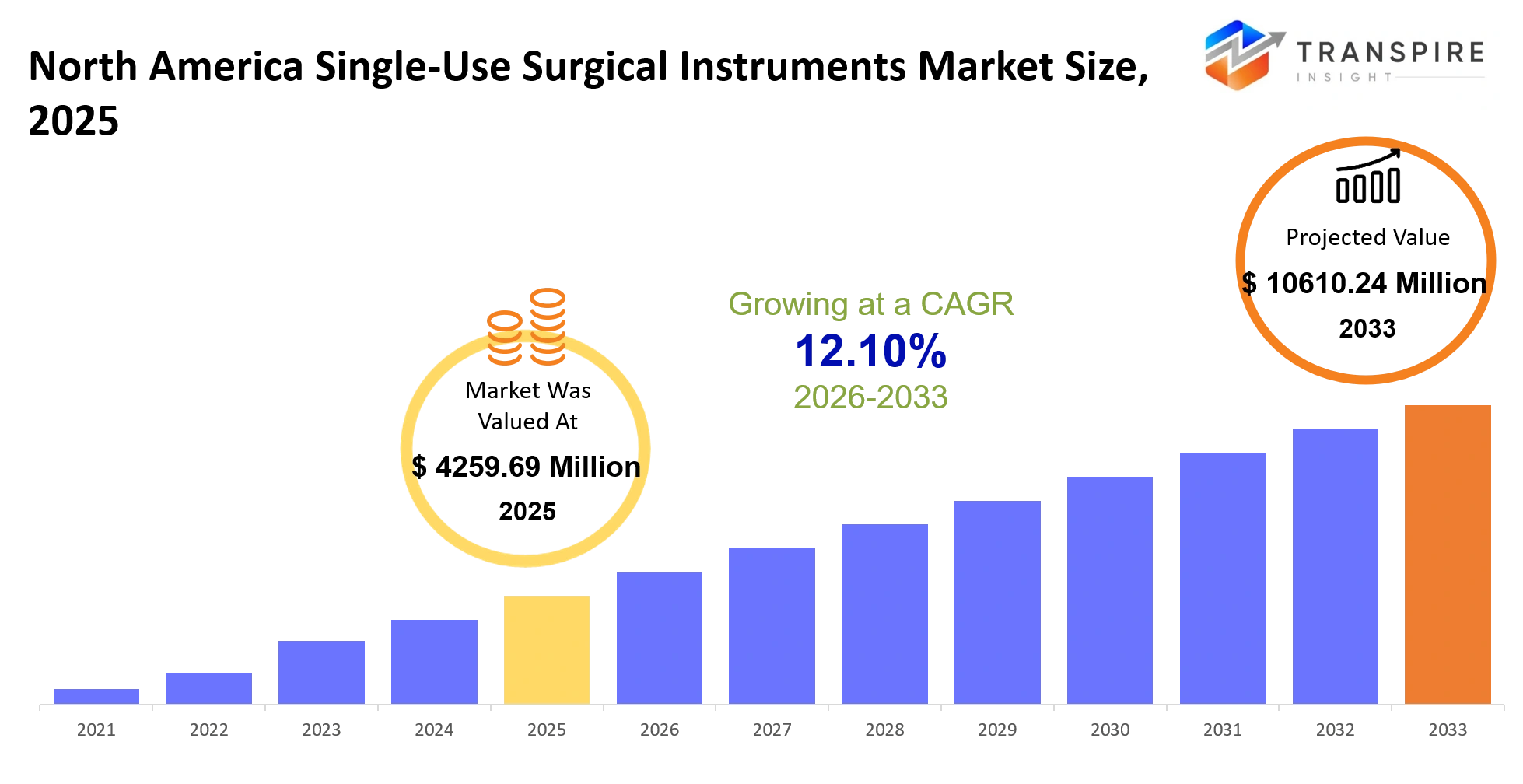
- North America Single-Use Surgical Instruments Market Size 2025: USD 4259.69 Million
- North America Single-Use Surgical Instruments Market Size 2033: USD 10610.24 Million
- North America Single-Use Surgical Instruments Market CAGR: 12.10%
- North America Single-Use Surgical Instruments Market Segments: By Product Type (Implantable Devices, Diagnostic Devices, Drug Delivery Devices, Imaging Devices, Others); By Application (Cardiology, Oncology, Orthopedics, Neurology, Others); By End User (Hospitals, Diagnostic Centers, Research Institutes, Others); By Technology (Nanocoatings, Nanocomposites, Nanorobotics, Nanofibers, Others).
To learn more about this report,  Download Free Sample Report
North America Single-Use Surgical Instruments Market Summary
The North America Single-Use Surgical Instruments Market was valued at USD 4259.69 Million in 2025. It is forecast to reach USD 10610.24 Million by 2033. That is a CAGR of 12.10% over the period.
North America’s single use surgical instruments market supports hospitals, ambulatory surgery centers, and specialty clinics by delivering sterile, ready to use tools that kinda remove the need for reprocessing between cases. In real practice, these instruments help lower contamination risks, cut down on operating room turnaround time, and make workflow management a bit easier in those high volume surgical settings where everything moves fast.
Over the last five years, the market has seen a kind of structural pivot toward disposable instrument adoption, mainly because healthcare providers keep pushing infection prevention together with operational efficiency. The COVID 19 pandemic acted like a big catalyst, showing weaknesses in sterilization capacity, and it also sped up procurement of single use devices across many healthcare systems. So the buying patterns changed, providers now tend to value consistency, traceability, and fewer reprocessing expenses, more than before
Right now, the growth story seems tied to expanding outpatient surgical volumes, stricter infection control protocols ,and ongoing labor constraints inside sterile processing departments. As facilities try to secure predictable performance and less operational fuss, adoption keeps climbing. That, in turn, supports continued revenue growth across the region, even when budgets are tight .
Key Market Insights
- The North America Single-Use Surgical Instruments Market keeps growing, kinda steady, because healthcare providers are really leaning into infection prevention, better procedural efficiency, and a more cost conscious surgical workflow, you know.
- The market outlook is still positive over the forecast period too, with outpatient surgeries rising, sterilization standards getting stricter, and healthcare facilities continuing to adopt disposable surgical devices, even when budgets feel tight.
- In the region, the United States kinda takes the lead, sitting at about 85%–90% of the North America market share in 2025, overall.
- Canada meanwhile is moving the quickest during 2025–2032 , and that push seems tied to fresh investments in healthcare infrastructure , plus the rising volumes of surgical procedures.
- When it comes to the products, disposable forceps are the front runner, with an estimated 30%–35% share in 2025, mostly because they are used across many surgical specialties, pretty consistently and without much fuss.
- Single-use scalpels come in next , holding the second-largest portion, mostly linked to routine procedure needs, and also infection control protocols, which stay pretty strict.
- Also disposable retractors are projected to grow the fastest through 2032 , since hospitals and clinics are aiming for a smoother workflow execution while keeping sterility assurance front and center.
- For applications, general surgery stays dominant, capturing about 40%–45% of market share in 2025, and that gap is unlikely to shrink fast.
- Orthopedic surgery is expanding in a noticeable way, driven by higher joint replacement procedures and sports injury cases.
- And in terms of end user type, hospitals lead the North America Single-Use Surgical Instruments Market, holding nearly 60%–65% of revenue share in 2025.
What are the Key Drivers, Restraints, and Opportunities in the North America Single-Use Surgical Instruments Market?
Driver: The strongest force pushing growth in the North America Single-Use Surgical Instruments Market is the healthcare sector’s growing emphasis on infection prevention and procedural efficiency. This change got real momentum after the COVID-19 pandemic laid bare operational bottlenecks in instrument sterilization, and reprocessing. Hospitals and ambulatory surgical centers are increasingly choosing disposable instruments to shrink contamination risks, speed up operating room turnover, and reduce the labor needs inside sterile processing departments . Since surgical volumes keep climbing, many providers are putting more money into procurement budgets for one-time devices, and that directly feeds market revenue growth
Restraint: The most important limitation is still the higher long-term procurement cost tied to disposable instruments, compared with reusable alternatives. This problem is kind of structural because healthcare reimbursement models and hospital purchasing policies often lean toward upfront acquisition costs rather than total operational savings. A lot of healthcare systems have already invested in sterilization infrastructure and built reprocessing workflows so switching at scale is economically hard in the short term. As a result, adoption tends to move slower in facilities that are more cost-sensitive, which in turn caps market penetration, and delays revenue expansion
Opportunity: A key opportunity is the rapid expansion of ambulatory surgical centers across North America. These sites typically run lean staffing models, and they’re focused on workflow fluidity, which creates pretty ideal conditions for single-use instrument adoption.Continued investment into outpatient surgical infrastructure, and doing more minimally invasive procedures will likely open fresh demand channels and help sustain the market’s next phase of expansion.
What Has the Impact of Artificial Intelligence Been on the North America Single-Use Surgical Instruments Market?
The prompt seems to point toward maritime scrubber systems, but the market being discussed is the North America Single-Use Surgical Instruments Market, so i’m aligning it to surgical stuff. Artificial intelligence, plus newer digital tools are, bit by bit, improving how single-use surgical instruments get manufactured, managed, and delivered across North America. A lot of manufacturers are now using AI-based quality inspection systems that can quietly spot microscopic defects, small dimensional shifts, and even packaging inconsistencies while the items are still being produced. In practice these automated lines reduce the amount of manual checking needed, and they tighten batch-level control which makes it easier for firms to keep regulatory compliance and still raise production throughput.
On top of that machine learning is giving predictive abilities through the whole supply chain. When models are trained with procedure volumes, seasonal demand swings, and inventory consumption rates, healthcare providers and distributors can estimate future instrument needs more accurately. That usually translates into fewer stockouts, less “ too much on hand ” inventory, and a procurement plan that feels more sensible, kind of. In factories, predictive maintenance algorithms are also keeping an eye on equipment performance and catching early signals of wear before the failures actually show up, which means unplanned downtime drops, and operational efficiency goes up, yes.
Overall it’s like these tech pieces deliver real, tangible improvements: quicker production cycles, lower inventory holding costs, improved supply availability, and a higher equipment uptime rate.Some manufacturers even mention fewer quality-related wastes, and fewer maintenance interruptions, which tends to support stronger operating margins.
However AI adoption still has a hard limitation, like it can, be kind of slow in practice. When you try to integrate AI platforms with older manufacturing systems and also the hospital procurement networks, you usually need a lot of funding, specialized know-how, and high quality data, all of that at once. That can slow the whole implementation, and it tends to cap the short term returns for smaller organizations, even if they want to move quickly.
Key Market Trends
- Since 2020, hospitals kind of started leaning more toward pre-sterilized instruments, which reduced how much they rely on in house reprocessing , and it also made it easier to shrink operating room turnaround times, if you know what i mean.
- Ambulatory surgical centers grew their procedural share from 2021 through 2025 and in turn they favored disposable instruments more often. That choice really simplifies the everyday workflow.
- After the pandemic disruptions, manufacturers shifted or diversified their production networks. This exposed weaknesses tied to concentrated global supply chains, so they had to adjust a bit, pretty quickly.
- Healthcare systems then moved away from purely price-based purchasing and leaned into total-cost evaluations. They started weighing labor savings, sterilization expenses, and infection related risks , more systematically.
- Between 2020 and 2025, procedure specific disposable kits got more traction. They helped providers standardize surgical workflows and cut down on instrument preparation time, without all that extra fuss.
- Companies like BD, Medtronic, Cardinal Health, and Teleflex increased spending on advanced packaging technologies. The point is better sterility assurance plus improved traceability, across the board.
- Regulatory scrutiny around infection prevention also tightened. So purchasing requirements got more strict , and that nudged facilities to adopt validated single-use surgical devices more broadly.
- Digital inventory management platforms became much more common after 2021. Hospitals used these tools to manage stock levels more tightly and reduce supply shortages.
- Manufacturers increasingly built in recyclable packaging materials, alongside waste reduction initiatives. That matched what healthcare organizations were doing as they expanded sustainability targets.
- Competition also shifted. Instead of just pushing broad product portfolios, companies leaned into specialty-focused offerings, building instruments tailored for orthopedic , cardiovascular, and minimally invasive procedures.
North America Single-Use Surgical Instruments Market Segmentation
By Product Type
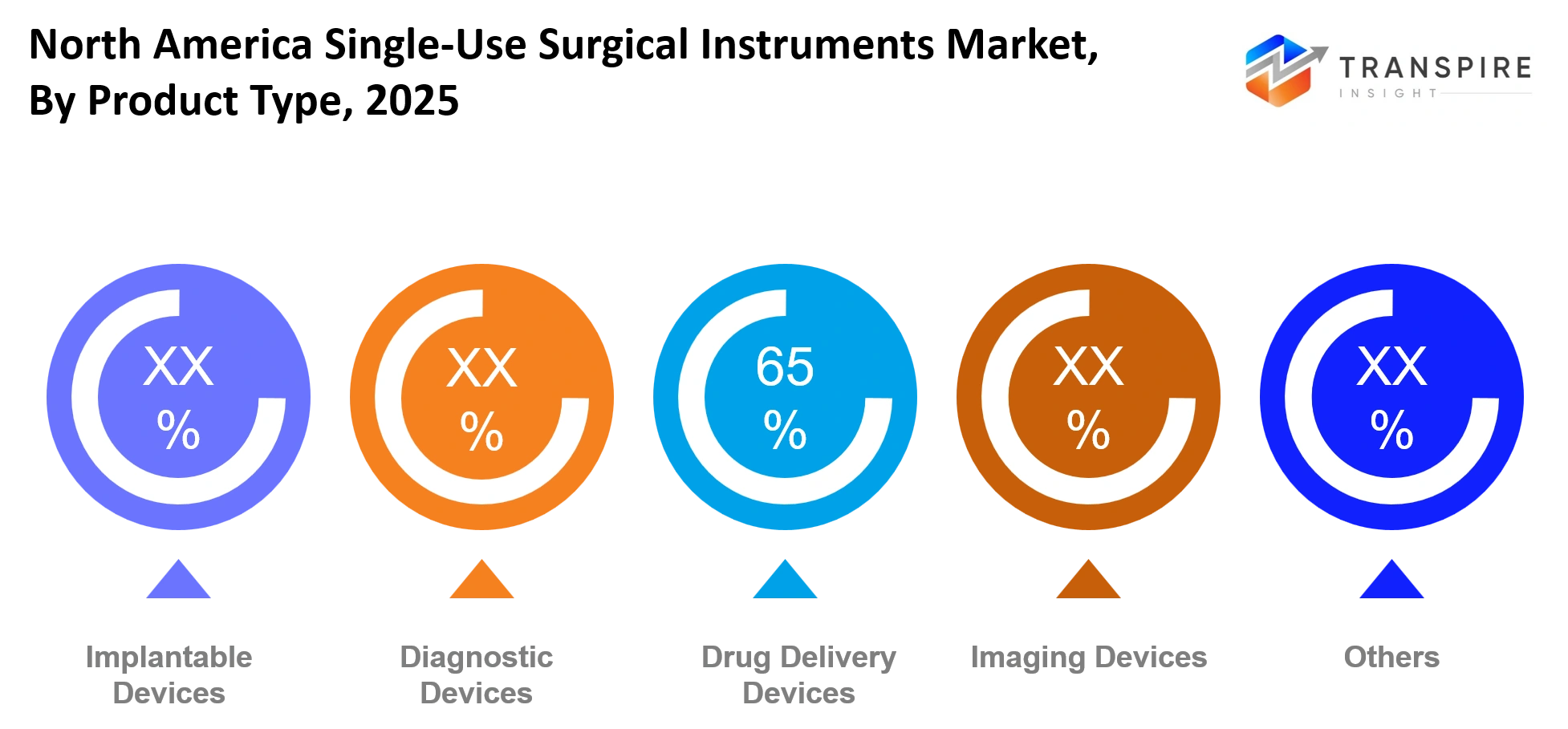
Currently implantable devices have the biggest market share, partly because long term therapeutic uses in cardiovascular, orthopedic, and neurological care keep demand steady over time. With advanced surface engineering and nanoscale material integration, biocompatibility, durability, and overall treatment results get better, which helps adoption across different healthcare systems. Drug delivery devices are also a major slice, backed by growing curiosity around targeted therapies, so efficacy goes up while systemic side effects tend to go down. Diagnostic and imaging devices keep picking up momentum too, since care providers want earlier disease detection, plus more accurate diagnostic detail.
Looking ahead, growth should lean more toward drug delivery and imaging devices as precision medicine strategies become more common. Product teams are putting resources into nanoscale carriers, smart contrast agents, and multifunctional platforms that kind of combine diagnosis with therapy in the same setup. Investors are more often pursuing solutions that support personalized care routes, while healthcare providers are expected to adopt approaches that raise clinical efficiency and improve patient results.
To learn more about this report, Download Free Sample Report
By Application
Cardiology still leads the market, because cardiovascular disorders are common and the need for advanced treatment tools keeps rising. Nanotechnology enabled devices make stents perform better, improve drug delivery precision, and enhance tissue compatibility, which supports broad clinical uptake. Oncology stays close behind, mainly due to targeted therapy needs and early stage cancer detection tools. Neurology and orthopedics are also expanding, as nanoscale materials help implants integrate better and improve therapeutic effectiveness.
The strongest kind of future momentum, is likely to come out of oncology related uses. Research activity, and funding too, keeps pushing ahead faster, into the development of nanoparticle driven therapeutics, imaging agents, and personalized treatment platforms. Product manufacturers are probably going to zero in on technologies that let them aim very precisely at diseased tissue, almost like selective navigation. At the same time healthcare organizations may start valuing solutions that can raise treatment effectiveness while cutting down adverse effects, and also lowering hospitalization rates.
By End User
Hospitals take the largest share of the market, largely because complex procedures, advanced treatment capabilities, and high patient volumes help broad adoption happen with less friction. Having specialized clinical teams available, and also larger procurement budgets, further reinforces market leadership. Diagnostic centers are another big segment as demand keeps rising for advanced imaging and early disease detection tools. Research institutes remain important too, by helping drive innovation, clinical validation, and even the commercialization of newer, emerging technologies.
Over the forecast period, diagnostic centers are expected to show solid expansion as healthcare systems put more weight on preventive care and precision diagnostics. Continued investment in advanced imaging infrastructure, and molecular testing capabilities will back up wider adoption. Product developers are likely to collaborate more closely with diagnostic providers, to speed up market penetration. Investors may lean toward organizations that sit right at the intersection of diagnostics, data analytics, and personalized medicine, which is where the momentum tends to cluster.
By Technology
Right now, Nanocoatings kinda rule the technology landscape, and manufacturers widely use them to boost biocompatibility, antimicrobial protection, corrosion resistance,and overall device longevity. You can see strong uptake across implants, surgical tools, and medical equipment, and that really backs up a solid market standing. Nanocomposites also keep a meaningful slice, mainly because of stronger mechanical performance and better material behavior. Meanwhile, Nanofibers are still getting more attention in wound care, tissue engineering, and regenerative medicine stuff.
Nanorobotics looks like the biggest longer-term possibility even if its current market footprint is smaller. New progress in microengineering, artificial intelligence, and precision medicine is opening up fresh routes for targeted intervention and less invasive procedures. Product teams are putting more research energy into handling both technical hurdles and regulatory barriers. If commercialization goes smoothly, it could really shift how treatments are designed across many therapeutic areas, which then creates big chances for investors, healthcare providers,and technology innovators.
What are the Key Use Cases Driving the North America Single-Use Surgical Instruments Market?
General surgery is still the main use case for single use surgical instruments across North America. In most hospitals they lean on disposable forceps, scalpels, and retractors to keep everything sterile, lower cross contamination worries, and handle big procedure days with faster operating room turnover,, which honestly matters a lot.
Orthopedic and cardiovascular work is starting to look like the next big secondary space. More ambulatory surgery centers are choosing pre sterilized instrument options for joint repair, sports medicine, and minimally invasive cardiac interventions. Part of that is because these places really care about workflow flow and also about simpler inventory control, less clutter, more predictability.
A few newer use cases also look like they could stick around for the long term. Robotic assisted surgery programs are moving toward specialized disposable instrument kits to help with precision tasks and outpatient specialty clinics are likewise increasing the use of single use tools for advanced diagnostic plus therapeutic interventions. If this keeps going, it could unlock extra income paths as care delivery continues shifting toward more decentralized settings, you know outside the big hospitals.
|
Report Metrics |
Details |
|
Market size value in 2025 |
USD 4259.69 Million |
|
Market size value in 2026 |
USD 4770.91 Million |
|
Revenue forecast in 2033 |
USD 10610.24 Million |
|
Growth rate |
CAGR of 12.10% from 2026 to 2033 |
|
Base year |
2025 |
|
Historical data |
2021 - 2024 |
|
Forecast period |
2026 - 2033 |
|
Report coverage |
Revenue forecast, competitive landscape, growth factors, and trends |
|
Regional scope |
North America (Canada, The United States, and Mexico) |
|
Key company profiled |
Abbott Laboratories, Medtronic, Boston Scientific, Johnson & Johnson, Stryker, GE HealthCare, Siemens Healthineers, Philips Healthcare, Thermo Fisher Scientific, Smith & Nephew, Zimmer Biomet, Baxter International, Becton Dickinson, Olympus Corporation, Bruker. |
|
Customization scope |
Free report customization (country, regional & segment scope). Avail customized purchase options to meet your exact research needs. |
|
Report Segmentation |
By Product Type (Implantable Devices, Diagnostic Devices, Drug Delivery Devices, Imaging Devices, Others); By Application (Cardiology, Oncology, Orthopedics, Neurology, Others); By End User (Hospitals, Diagnostic Centers, Research Institutes, Others); By Technology (Nanocoatings, Nanocomposites, Nanorobotics, Nanofibers, Others). |
Which Regions are Driving the North America Single-Use Surgical Instruments Market Growth?
North America still ends up in the lead, largely because of a nice regulatory environment, solid healthcare spending, and the fact that advanced medical technologies are everywhere by now. The United States brings in most of the regional revenue , mainly since big medical device makers, research groups, and hospital networks run at really large scale. With fairly consistent approval routes, plus solid intellectual property protection, companies feel more comfortable funding next-generation products. There is also this kind of well woven ecosystem—manufacturers, distributors, clinical research organizations, and healthcare providers — that keeps reinforcing the regional dominance, day after day.
Europe sits in the second spot, though the “why” here is mostly about steadiness, not overly bold expansion. Public healthcare systems in places like Germany , France, and the United Kingdom give procurement behavior that’s pretty predictable, including long-term purchasing programs. Regulatory harmonization under regional medical device frameworks helps make product commercialization feel more consistent, and it improves market entry. And then there’s steady investment in healthcare modernization along with clinical research, so Europe ends up being a reliable contributor to overall industry revenue.
Asia Pacific is the fastest-growing area, because healthcare infrastructure investment seems to be speeding up across China, India, South Korea , and Southeast Asia. A few recent government measures, especially those backing local medical technology manufacturing and expanding hospital capacity, have improved the conditions quite a lot. More patients are adopting advanced treatment technologies, and access to specialized care keeps increasing, which broadens the customer base. Overall growth in the region creates interesting options for newcomers, plus investors who want exposure to high-growth healthcare markets between 2026 and 2033.
Who are the Key Players in the North America Single-Use Surgical Instruments Market and How Do They Compete?
Competition in the North America Single-Use Surgical Instruments market still looks kind of moderately consolidated, but then you have this group of multinational med device companies with a big slice of revenue, while specialized manufacturers kind of zoom in on very specific procedural categories. In practice , the main ways people go at it are technology innovation product reliability infection-control performance and supply chain consistency, not just brand. Bigger established firms defend share via portfolio expansion, plus these more integrated healthcare solutions, and the smaller entrants tend to push procedure-specific tools and value oriented offerings for outpatient care settings. Also the move toward ambulatory surgery and that broader goal of cost efficient healthcare delivery has made competition feel sharper across both premium and mid tier product ranges.
Becton, Dickinson and Company (BD) stands out thanks to its wide distribution reach and a broad assortment of disposable surgical products , which helps healthcare systems bundle procurement into fewer purchasing decisions. BD keeps working on retention by adding supply chain investments and digital inventory management capabilities, sort of keeping the flow steady. Cardinal Health takes a different angle, leaning on scale, logistics expertise, and private label options that help hospitals control procurement costs without losing consistent product availability.
Medtronic focuses more on technology driven surgical solutions, and also on procedure specific instrument development, especially when it comes to minimally invasive and specialty procedures. Johnson & Johnson uses its surgical ecosystem and tries to integrate instruments with broader procedural workflows, so healthcare providers get more operational efficiencies rather than extra steps. Teleflex focuses on niche clinical applications and specialty care markets, expanding its position through targeted product innovation, clinician partnerships, and strategic acquisitions that broaden access to high-growth surgical segments.
Company List
- Abbott Laboratories
- Medtronic
- Boston Scientific
- Johnson & Johnson
- Stryker
- GE HealthCare
- Siemens Healthineers
- Philips Healthcare
- Thermo Fisher Scientific
- Smith & Nephew
- Zimmer Biomet
- Baxter International
- Becton Dickinson
- Olympus Corporation
- Bruker
Recent Development News
“In May 2026, Verathon announced the U.S. launch of CFlex™, a single-use flexible cystoscope cleared by the FDA.” The device strengthens adoption of disposable endoscopy in urology by improving visualization and eliminating sterilization steps, supporting faster outpatient and office-based procedures.
Source: https://www.verathon.com
“In May 2026, NovoSource received FDA 510(k) clearance for its SteriKnee™ single-use total knee instrument system.” The sterile, pre-assembled disposable surgical instrument platform reduces reliance on reusable instrument trays and streamlines orthopedic surgical workflows in high-volume knee replacement procedures.
Source: https://ryortho.com
What Strategic Insights Define the Future of the North America Single-Use Surgical Instruments Market?
North America Single-Use Surgical Instruments Market is kind of moving toward a mode that is centered on procedural efficiency , infection-risk reduction , and more decentralized health care delivery. Over the next five to seven years, growth is probably going to be shaped less by the usual hospital expansion, and more by the shift of surgical procedures to ambulatory surgical centers plus specialty outpatient facilities. In practice this shift rewards suppliers that can provide procedure specific instrument kits , dependable logistics , and inventory optimization know-how alongside the actual core products.
There’s also a quieter kind of risk that doesn’t always get noticed right away. Market concentration shows up across key raw materials, contract manufacturing partners and sterilization service providers, sort of like a narrow hallway of suppliers. If anything goes sideways inside those concentrated supply networks , you can end up with product shortages, pricing swings, and procurement headaches, even while the real clinical demand is still solid.
At the same time, an emerging chance is showing up through digitally enabled surgical supply ecosystems that blend disposable instruments with inventory tracking, predictive replenishment, and data-driven workflow management. Market participants may want to place heavier emphasis on integrated service models and outpatient focused product catalogs, because those capabilities are likely to become major differentiators in upcoming purchasing choices and longer term contract discussions.
North America Single-Use Surgical Instruments Market Report Segmentation
By Product Type
- Implantable Devices
- Diagnostic Devices
- Drug Delivery Devices
- Imaging Devices
- Others
By Application
- Cardiology
- Oncology
- Orthopedics
- Neurology
- Others
By End User
- Hospitals
- Diagnostic Centers
- Research Institutes
- Others
By Technology
- Nanocoatings
- Nanocomposites
- Nanorobotics
- Nanofibers
- Others
Frequently Asked Questions
Find quick answers to common questions.
The expected North America Single-Use Surgical Instruments Market size is USD 10610.24 Million in 2033.
Key segments for the North America Single-Use Surgical Instruments Market are By Product Type (Implantable Devices, Diagnostic Devices, Drug Delivery Devices, Imaging Devices, Others); By Application (Cardiology, Oncology, Orthopedics, Neurology, Others); By End User (Hospitals, Diagnostic Centers, Research Institutes, Others); By Technology (Nanocoatings, Nanocomposites, Nanorobotics, Nanofibers, Others).
Major North America Single-Use Surgical Instruments Market players are Abbott Laboratories, Medtronic, Boston Scientific, Johnson & Johnson, Stryker, GE HealthCare, Siemens Healthineers, Philips Healthcare, Thermo Fisher Scientific, Smith & Nephew, Zimmer Biomet, Baxter International, Becton Dickinson, Olympus Corporation, Bruker.
The North America Single-Use Surgical Instruments Market size is USD 4259.69 Million in 2025.
The North America Single-Use Surgical Instruments Market CAGR is 12.10% from 2026 to 2033.
- Abbott Laboratories
- Medtronic
- Boston Scientific
- Johnson & Johnson
- Stryker
- GE HealthCare
- Siemens Healthineers
- Philips Healthcare
- Thermo Fisher Scientific
- Smith & Nephew
- Zimmer Biomet
- Baxter International
- Becton Dickinson
- Olympus Corporation
- Bruker
About the Authors

Pankaj Ghogare Patil
I am Pankaj Ghogare Patil, a Senior Research Analyst at Transpire Insight, specializing in the Pharmaceutical, Chemicals & Materials, Healthcare IT, and Biotechnology industry. My expertise lies in conducting comprehensive market research, analyzing industry trends, evaluating competitive landscapes, and translating complex data into actionable insights. At Transpire Insight, I closely follow emerging technologies, regulatory developments, and market innovations to create accurate, well-researched, and informative content that helps businesses and professionals make informed decisions. I am committed to producing credible, evidence-based articles that reflect industry best practices while making technical topics accessible and valuable for a broad audience.

Chakradhar Khansole
Chakradhar serves as the Research Director at Transpire Insight, bringing over 8 years of experience in technology, innovation, and strategic market intelligence. He specializes in transforming complex market data into actionable business insights that enable organizations to make informed, growth-oriented decisions. Recognized for his strategic vision and analytical expertise, Chakradhar leads high-impact research initiatives, delivering comprehensive market assessments, competitive intelligence, and forward-looking industry analysis.
Recently Published Reports
-
Apr 2026
AI in Diabetic Retinopathy Market
AI in Diabetic Retinopathy Market Size, Share & Analysis Report By Type (Screening AI Systems, Diagnostic AI Systems, and Predictive AI Models), By Application Segment (Hospitals, Ophthalmology Clinics, Diagnostic Centers, and Research and Development), and Geography (North America, Europe, Asia-Pacific, Middle East and Africa, South and Central America), 2021 - 2031
-
Apr 2026
Psychometric Tests Market
Psychometric Tests Market Size, Share & Analysis Report By Type (Personality Tests, Ability/Aptitude Tests, Skill/Knowledge Tests, and Others), By Application (Talent Acquisition and Talent Management), and Geography (North America, Europe, Asia-Pacific, Middle East and Africa, South and Central America), 2021 – 2031
-
Apr 2026
Rare Biological Sample Collection Market
Rare Biological Sample Collection Market Size, Share & Analysis Report By Type (Isolation Kits & Reagent, Blood Collection Tubes, and Others), By Application (Oncology, Transcriptomics, Pharmacogenomics, and Others), and Geography (North America, Europe, Asia-Pacific, Middle East and Africa, South and Central America), 2021 – 2031
-
Jul 2026
Diabetic Retinopathy Market
Diabetic Retinopathy Market Size, Share & Analysis Report By Type (Proliferative Diabetic Retinopathy, and Diabetic Macular Edema (DME)), By Treatment Type (Anti VEGF Drug, Steroid Implants, Laser Surgeries, and Vitrectomy), and Geography (North America, Europe, Asia-Pacific, Middle East and Africa, South and Central America), 2021 – 2031
Our Clients







