

North America MRI Safe Implantable Defibrillator Devices Market Summary
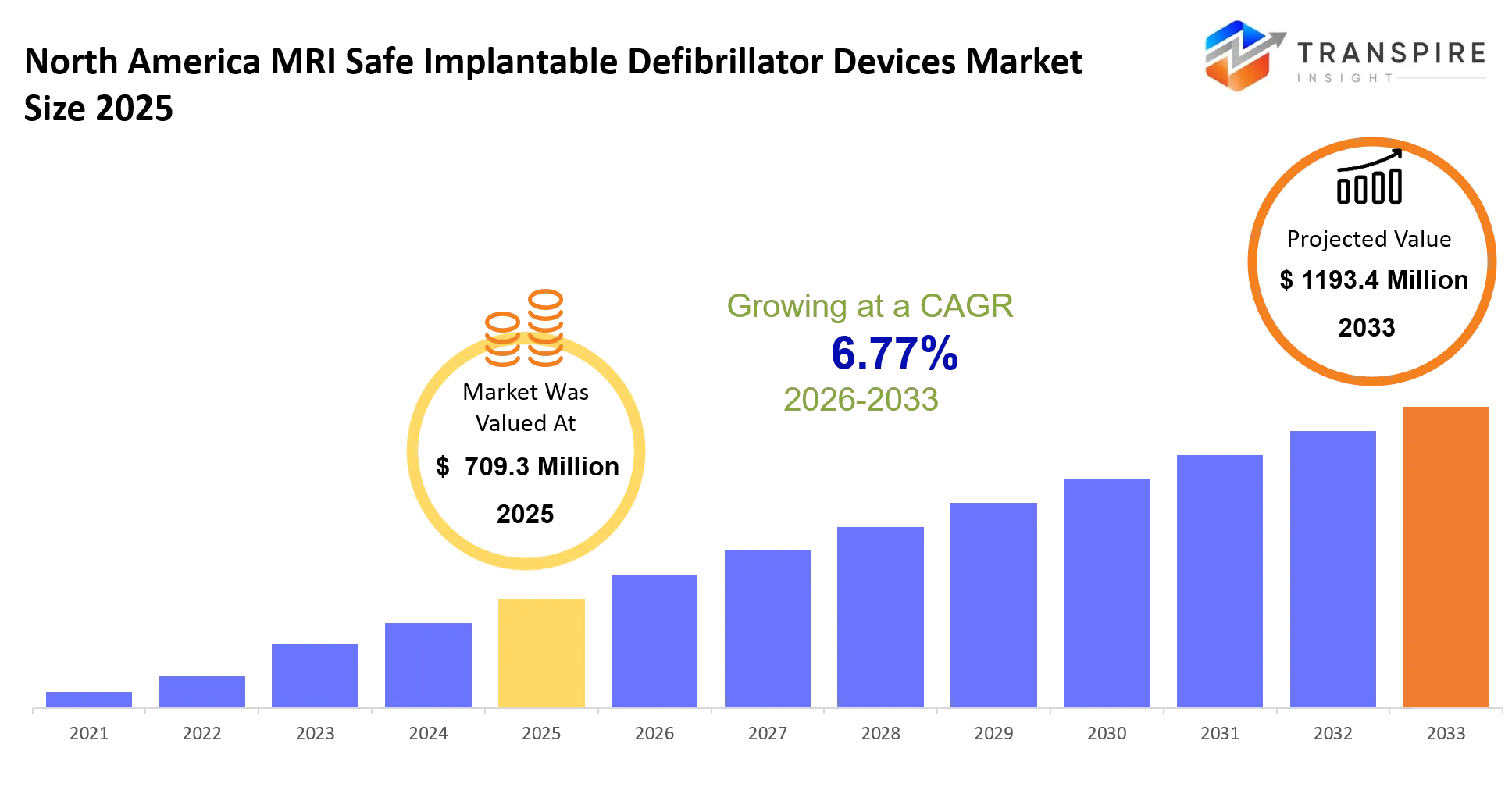
As per Transpire Insight Analysis, the North America MRI Safe Implantable Defibrillator Devices Market size is estimated at USD 709.3 Million in 2025 and is anticipated to reach USD 1193.4 Million by 2033, growing at a CAGR of 6.77% from 2026 to 2033.
North America’s market for MRI safe implantable defibrillator devices tackles a big clinical headache, because it lets people who already have implantable cardioverter defibrillators go through magnetic resonance imaging without hurting how well the device works, or without jeopardizing safety. With that feature, physicians can figure out neurological, orthopedic, cardiovascular, and oncological problems with more clarity, instead of postponing care, or depending on simpler imaging options that don’t show as much. Over the last five years, things in the market kind of turned from picky, selective adoption toward MRI compatibility, which is now becoming the norm people expect in fresh implantable defibrillator systems. Newer clinical guidelines , plus wider MRI availability across hospitals and clinics, helped push that shift along. During the COVID-19 pandemic elective cardiac procedures slowed down for a while, but at the same time it also made the real need obvious for ongoing diagnostic access, since delayed scans piled up and backed up treatment plans. Now as hospitals update their cardiac care pathways and they lean into diagnostic flexibility for the long run, healthcare providers are more often choosing MRI safe implantable defibrillators. That supports device replacement demand and it opens steady revenue opportunities for manufacturers.
North America MRI Safe Implantable Defibrillator Devices Market Size & Forecast:
- North America MRI Safe Implantable Defibrillator Devices Market Size 2025: USD 709.3 Million
- Expected Market Value 2033: USD 1193.4 Million
- Forecast CAGR: 6.77%
- Leading region in 2025: United States
- Fastest Growing region: Canada
- Key Profile: Medtronic, Abbott, Boston Scientific, Biotronik, MicroPort CRM, Zoll Medical, LivaNova, Philips Healthcare, GE HealthCare, Siemens Healthineers, Johnson & Johnson MedTech, Stryker, Baxter, Cardinal Health, Nihon Kohden
Key Market Insights
In 2025, the United States pretty much dominated the regional market , with something like an 84% market share, helped along by more mature electrophysiology infrastructure and also by really high implant procedure volumes .
Canada meanwhile is forecast to be the quickest moving regional market during 2025–2033, mainly because MRI capacity keeps expanding, and cardiac care investments keep coming in.
On the product side, MRI-safe implantable cardioverter defibrillators (ICDs) took the lead, hitting nearly 68% of the market share in 2025, largely due to replacement procedures plus a growing taste for new implants.
MRI-safe cardiac resynchronization therapy defibrillators (CRT-Ds) stayed in the second spot, with growth tied to heart failure treatment programs rolling out across dedicated hospitals.
For what comes next, next-generation wireless MRI-compatible defibrillator systems are expected to show the fastest rise all the way through 2033, with digital connectivity playing a role , along with better and longer lasting battery innovations.
Looking at applications, ventricular arrhythmia management remained the biggest category, around 61% share in 2025 , which points back to well known clinical guidelines and broad reimbursement backing.
Heart failure management with defibrillation therapy is predicted to become the fastest-growing application by 2033 as aging populations bring more complicated cardiac cases.
As for end users, hospitals and cardiac specialty centers accounted for close to 72% of market revenue in 2025, benefitting from integrated imaging plus electrophysiology services, all together in one place.
Finally, ambulatory surgical centers are likely to expand the quickest through the forecast window, since minimally invasive cardiac procedures keep shifting away from inpatient settings and into outpatient care.
What are the Key Drivers, Restraints, and Opportunities in the North America MRI Safe Implantable Defibrillator Devices Market?
The most powerful growth driver is kinda the shift toward MRI-compatible cardiac implant standards across North American healthcare systems. More and more clinical guidance, and also the hospital purchasing rules, keep tilting in favor of MRI-safe devices rather than the usual conventional alternatives, mainly because many patients end up needing more than one MRI examination over their lifetime. That shift in tech has already, sort of, changed what gets prioritized during procurement. Doctors can recommend implantable defibrillators without boxing in future diagnostic imaging. So the downstream effect is higher replacement activity, stronger uptake of premium devices, and better manufacturer revenue performance across hospital networks.
The main holdback is the high total cost of these advanced MRI-safe implantable defibrillator systems, plus the fact that reimbursement and procurement end up being pretty complex. Hospitals have to juggle capital budgets, longer term service agreements, and even physician training timelines before they go further with adoption. These structural obstacles won’t be fixed super fast since reimbursement updates and procurement cycles typically take several years. From the Transpire Insight review of regional procurement notices and launch timing, supply chain concentration stays the main execution risk. If component availability stays tight, it can delay product deliveries, push out replacement procedures, and in the end reduce or suppress the chance of annual revenue growth.
The next growth opportunity lies in integrating remote cardiac monitoring, artificial intelligence analytics, and connected electrophysiology platforms with MRI-safe implantable defibrillator devices. Healthcare systems keep investing in digital cardiac care infrastructure, even if it feels a bit incremental at times. With these setups in place, clinicians can catch issues earlier, drive stronger clinical outcomes, and also simplify follow-up care. Manufacturers who manage to blend MRI compatibility with more advanced digital capabilities should be positioned to grab premium market segments through the whole forecast period.
What Has the Impact of Artificial Intelligence Been on the North America MRI Safe Implantable Defibrillator Devices Market?
Artificial intelligence is, sort of transforming MRI-safe implantable defibrillator systems, by making clinical decision support work better, plus remote patient monitoring and even how the device lifecycle gets managed. More and more healthcare providers are using AI enabled software, to automate rhythm analysis, push higher risk patient warnings up front, and make compliance paperwork feel less painful for cardiac implant follow up programs, too. Machine learning models also give manufacturers a more precise sense of what’s coming, like component demand forecasting , they can then tune inventory arrangements and improve production pacing, which in turn helps reduce the odds of supply disruptions across the regional cardiac device market.
On top of that, predictive analytics has really upped patient management, because it can spot odd heart rhythm signatures before they become critical events. AI assisted algorithms sift through massive piles of device telemetry, so clinicians can line up interventions earlier, while also cutting down on unnecessary in person checkups. Together these capabilities support daily operations, extend monitoring capacity, and help clinicians choose therapy in a more individualized way. Digital platforms also enable faster data transfer, between electrophysiologists, imaging specialists, and hospitals, which strengthens care continuity for people who still need MRI exams after implantation.
Despite those benefits, AI adoption still runs into a few practical limits. Adding advanced analytics to older hospital information systems takes a lot of money and needs prolonged cybersecurity checks, not just a quick setup. Clinical algorithms also lean on huge and varied datasets in order to keep steady accuracy across different groups of patients, otherwise the results feel uneven. These roll out complications keep stretching timelines, so broader deployment is still slowed even if the technology offers clear operational plus clinical advantages.
Key Market Trends
- Since 2022, hospitals have been more and more standardizing the procurement side of MRI compatible implantable defibrillators , so they can reduce those future imaging limitations for heart patients.
- Manufacturers keep pushing out Bluetooth enabled remote surveillance features, which makes it easier for physicians to get real-time device readouts and patient rhythm information, pretty quickly too.
- Newer battery approaches that came in after 2023 are also stretching how long these devices last, which cuts down on repeat procedures and helps the longer term cost picture for healthcare systems.
- Meanwhile, strategic money into AI assisted cardiac monitoring platforms has been ramping up, and that’s helped teams catch arrhythmias faster, plus it makes outpatient follow ups feel more streamlined.
- On the supply side, component sourcing has shifted a bit since the recent supply chain disruptions, so manufacturers are not relying on one semiconductor or electronics source only—theyre diversifying suppliers.
- Some companies are also increasing their spend on MRI validation testing, basically to support broader compatibility with higher field imaging systems that are common across many North American hospitals.
- At the electrophysiology centers, they’re connecting digital patient management platforms with implantable defibrillator programs, which is improving treatment coordination, and also supporting better day to day operational efficiency.
- Medtronic, Boston Scientific, and Abbott still keep pushing connected cardiac rhythm management technologies forward , through ongoing product development and continuous software updates.
North America MRI Safe Implantable Defibrillator Devices Market Segmentation
By Product Type :
MRI Conditional ICDs are kind of holding the leading position, because hospitals and cardiac specialists prefer devices that make it possible for safe magnetic resonance imaging access during long-term treatment , and not just for a short window. Strong replacement activity and also broader acceptance of MRI-compatible cardiac implants keep supporting sales. After that MRI Conditional CRT-Ds sit as the second-largest group, mainly because they’re used more often in advanced heart failure management. Healthcare providers keep choosing these systems, aiming to improve therapy outcomes while still keeping imaging flexibility.
Dual Chamber ICDs are still widely used for patients who need coordinated rhythm management , while Single Chamber ICDs keep serving those cases with simpler clinical needs. Subcutaneous ICDs are getting more attention too, since less invasive implantation reduces lead related complications in selected patients. Leadless ICD Systems and Wearable Defibrillators continue drawing investment , as technology improves both patient comfort and monitoring capabilities. Other product categories support more specialized clinical requirements across different care settings, depending on what the patient really needs at the moment.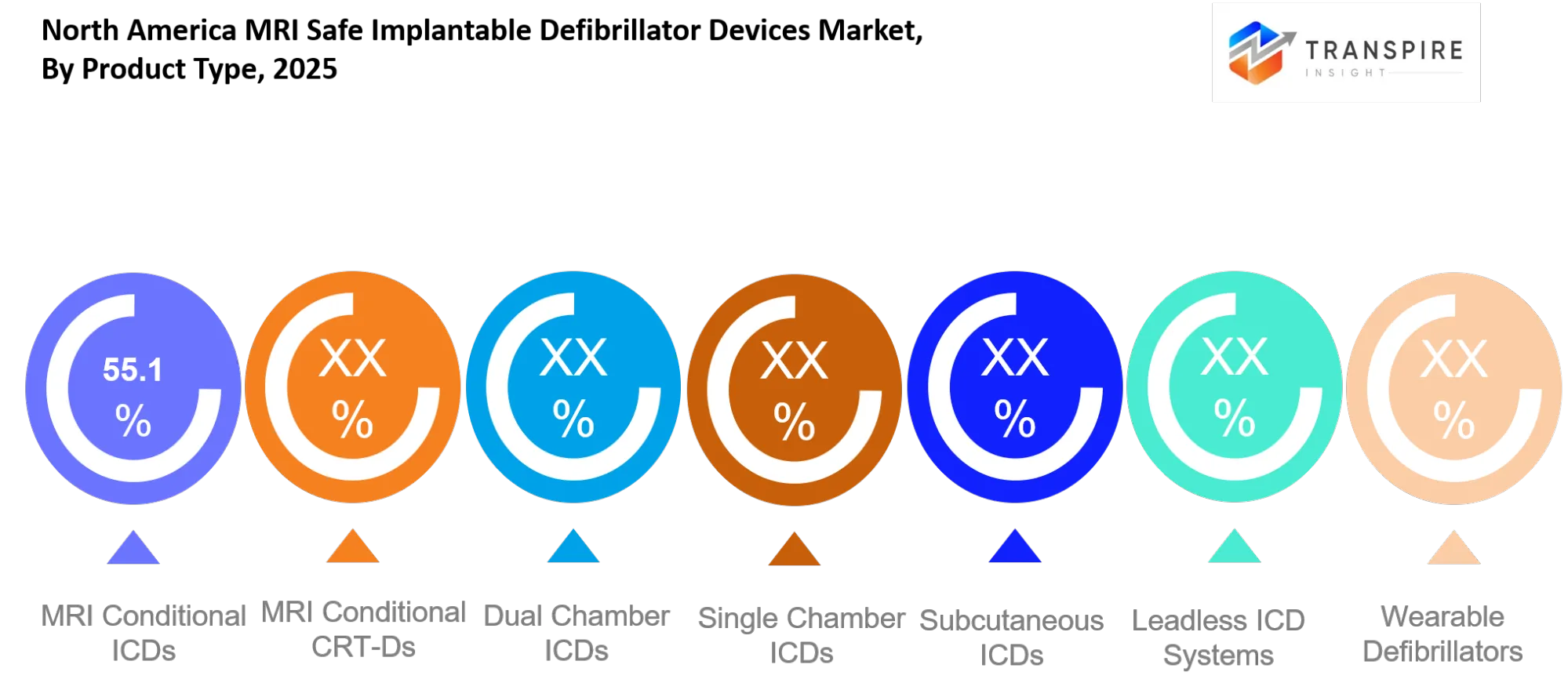
By Application :
Ventricular Tachycardia is perhaps the broadest use case, because quick defibrillation still stays core for stopping life threatening cardiac events in time. Clinical guidance keeps leaning toward implantable defibrillator therapy for people considered high risk. Ventricular Fibrillation also makes up a large portion, since fast rhythm adjustment really does improve survival. Heart Failure care keeps growing too, with more emphasis on cardiac resynchronization therapy that comes alongside defibrillation support.
Sudden Cardiac Arrest Prevention continues to keep procedure numbers fairly steady, mainly because preventive treatment is becoming the priority for eligible candidates. Cardiomyopathy management benefits as well, thanks to wider screening and earlier recognition across healthcare systems. Arrhythmia Management and Congenital Heart Disorders add more runway through specialized cardiac care programs. A few other applications further support sustained market demand, by tackling a range of cardiovascular conditions.
By End User :
Hospitals make up the biggest portion, mainly because there are advanced surgical set ups, imaging machines, and team based cardiology groups that help with implant procedures and after care. Bigger healthcare networks also have strong purchasing power, which helps them secure high end cardiac devices, consistently. Cardiac Centers come next as the second biggest segment, driven by special electrophysiology services and more patient referrals showing up over time. Ongoing investment into improved cardiac treatment keeps the procedure numbers rising and more steady.
Ambulatory Surgical Centers keep growing because minimally invasive heart procedures are getting more smooth and also more cost effective, over all. Specialty Cardiology Clinics, in the meantime, boost long term patient oversight and handle everyday device management. Research Institutes and Academic Hospitals back technology checking, plus clinical studies, that basically refine future product design. Emergency Care Centers and other nearby facilities also add support across the regional cardiac care route maps.
By Technology :
Wireless Monitoring drives tech adoption because constant device messaging helps with better patient follow-up, and it also cuts down on those unnecessary hospital trips. In healthcare, professionals are starting to fold connected monitoring into everyday cardiac care more and more. Bluetooth Connectivity keeps growing too, since secure data transfer still makes communication easier between implanted devices and the clinical systems.
MRI-Compatible Leads stay important, since safe imaging quality needs to be preserved even after implantation. AI-Based Monitoring is gaining steam thanks to quicker rhythm review ,and also because it can better spot signs of possible device trouble. Remote Monitoring Systems support outpatient care by enabling earlier clinical action, while also reducing the number of routine face to face checkups. Smart Battery Systems help extend device life, and Cloud-Based Monitoring makes it simpler to access data securely across hospital and clinic networks.
By Distribution Channel :
Direct Sales still feel like the main distribution lane, since manufacturers keep a close back-and-forth with hospitals, physicians, and big healthcare systems. With this setup technical support product training, and longer term service agreements kind of lock in the relationship, and keep it working. Hospital Procurement then tracks along pretty closely too, because hospitals run structured purchasing processes that usually rank clinical value, and lifecycle performance. Meanwhile Medical Device Distributors help widen product availability across regional healthcare facilities, in a more spread out way.
Group Purchasing Organizations keep shaping the purchasing choices as well, mostly by negotiating sharp pricing and extended supply agreements. Specialty Suppliers also come in handy when healthcare providers need a tailored product portfolio, plus solid technical expertise. Government Procurement creates openings through public healthcare investments, and institutional purchasing programs. And finally the other distribution channels, they basically round everything out by strengthening product availability across a variety of healthcare settings.
What are the Key Use Cases Driving the North America MRI Safe Implantable Defibrillator Devices Market?
The largest use case kind of shows up in how ventricular tachycardia is handled, mainly in hospitals and dedicated cardiac centers where MRI-safe implantable defibrillators help with long-term rhythm management, and they do it without really restricting future diagnostic imaging. Procurement teams in hospitals, plus electrophysiology specialists too , often gravitate toward these systems because a lot of cardiac patients will end up needing MRI examinations during ongoing care.
Then there’s heart failure management, and the prevention of sudden cardiac arrest, which keeps growing across specialty cardiology clinics and academic hospitals. Cardiac resynchronization therapy paired with MRI-compatible defibrillators supports these rather complex treatment plans, and ambulatory surgical centers increasingly adopt them as minimally invasive cardiac procedures become more common.
More recently, you can also see emerging opportunities tied to congenital heart disorder management, and AI-enabled remote follow-up for younger people or higher-risk patient groups. Research institutes, along with advanced healthcare networks, are testing connected monitoring platforms that mix MRI compatibility with digital analytics, which should help shape future clinical protocols and wider adoption across specialized cardiovascular care.
|
Report Metrics |
Details |
|
Market size value in 2025 |
USD 709.3 Million |
|
Market size value in 2026 |
USD 754.7 Million |
|
Revenue forecast in 2033 |
USD 1193.4 Million |
|
Growth rate |
CAGR of 6.77% from 2026 to 2033 |
|
Base year |
2025 |
|
Historical data |
2021 - 2024 |
|
Forecast period |
2026 - 2033 |
|
Report coverage |
Revenue forecast, competitive landscape, growth factors, and trends |
|
Regional scope |
North America (Canada, The United States, and Mexico) |
|
Key company profiled |
Medtronic, Abbott, Boston Scientific, Biotronik, MicroPort CRM, Zoll Medical, LivaNova, Philips Healthcare, GE HealthCare, Siemens Healthineers, Johnson & Johnson MedTech, Stryker, Baxter, Cardinal Health, Nihon Kohden . |
|
Customization scope |
Free report customization (country, regional & segment scope). Avail customized purchase options to meet your exact research needs. |
|
Report Segmentation |
By Product Type (MRI Conditional ICDs, MRI Conditional CRT-Ds, Dual Chamber ICDs, Single Chamber ICDs, Subcutaneous ICDs, Leadless ICD Systems, Wearable Defibrillators, Others); By Application (Ventricular Tachycardia, Ventricular Fibrillation, Heart Failure, Sudden Cardiac Arrest Prevention, Cardiomyopathy, Arrhythmia Management, Congenital Heart Disorders, Others); By End User (Hospitals, Cardiac Centers, Ambulatory Surgical Centers, Specialty Cardiology Clinics, Research Institutes, Academic Hospitals, Emergency Care Centers, Others); By Technology (Wireless Monitoring, Bluetooth Connectivity, AI-Based Monitoring, Remote Monitoring Systems, MRI-Compatible Leads, Smart Battery Systems, Cloud-Based Monitoring, Others); By Distribution Channel (Direct Sales, Hospital Procurement, Medical Device Distributors, Group Purchasing Organizations, Specialty Suppliers, Government Procurement, Others) |
Which Regions are Driving the North America MRI Safe Implantable Defibrillator Devices Market Growth?
The United States holds the dominant position with approximately 84% of regional revenue. Strong reimbursement frameworks, established cardiac care guidelines, and extensive MRI infrastructure support widespread adoption of MRI-safe implantable defibrillator devices. Major manufacturers, specialized electrophysiology centers, and advanced medical technology suppliers create a highly integrated healthcare ecosystem that supports continuous product availability and clinical innovation. Ongoing investment in hospital modernization and replacement of older cardiac devices will sustain market leadership throughout the forecast period.
Canada represents the second-largest regional market because healthcare delivery follows a stable, publicly funded model with consistent procurement planning. Provincial healthcare systems emphasize long-term clinical value, encouraging adoption of advanced cardiac devices that support future diagnostic imaging needs. Steady investment in hospital imaging capacity and specialized cardiac programs creates dependable purchasing patterns across major provinces. Predictable regulatory processes and disciplined healthcare spending make Canada a reliable source of recurring revenue for device manufacturers.
Canada is also projected to show the fastest growth through the 2026–2033 period , as expanded MRI capacity and continued investment in cardiac care improve access to advanced implant technologies. Broader roll out of connected healthcare systems and digital patient surveillance has strengthened the argument for MRI compatible defibrillator adoption. Hospitals are more often swapping older, legacy devices for newer platforms that deliver more diagnostic flexibility across the full patient lifecycle. That momentum should open appealing opportunities for manufacturers, technology partners, and investors looking for long-term expansion across the regional cardiac device industry.
Who are the Key Players in the North America MRI Safe Implantable Defibrillator Devices Market and How Do They Compete?
Competition still seems rather consolidated, mostly because just a limited group of worldwide cardiac device players handle most of the regional sales. And yeah, when hospitals buy, they usually look at technology innovation, clinical outcomes, MRI compatibility, plus remote monitoring features. Price alone is, sort of, less of a deciding factor. The big, already-known manufacturers keep pushing their product lines forward with ongoing research, tighter software integration, and real physician support, not so much competing on cost first.
Medtronic leans into MRI-compatible cardiac rhythm management systems, paired with remote monitoring platforms meant to help with long-term patient management. Abbott differentiates by using connected cardiac technologies and digital monitoring features that make physician follow-up easier. Boston Scientific is putting money into next generation implantable defibrillator platforms, with improved battery performance and more device connectivity, which helps adoption in major hospital networks.
BIOTRONIK highlights precision engineering, plus MRI-compatible technology intended for advanced electrophysiology programs. At the same time, it also grows digital healthcare solutions for clinicians. MicroPort CRM builds its presence via focused regional expansion, along with specialized cardiac rhythm management products aimed at specific clinical requirements. Overall, each company keeps investing in product development, clinical evidence, technology partnerships, and software capabilities to keep its competitive position strong, especially as hospitals prioritize long-term diagnostic flexibility and connected cardiac care.
Company List
Abbott
MicroPort CRM
LivaNova
Philips Healthcare
GE HealthCare
Siemens Healthineers
Johnson & Johnson MedTech
Stryker
Baxter
Cardinal Health
Nihon Kohden
Recent Development News
In June 2026, Boston Scientific received U.S. FDA Premarket Approval (PMA) supplement approval for a manufacturing process update covering its EMBLEM MRI implantable cardioverter defibrillator platform. The approval supports manufacturing optimization for MRI-compatible ICDs and reinforces long-term supply continuity for the North American market.
Source https://www.accessdata.fda.gov/
In April 2026, Medtronic received U.S. FDA PMA supplement approval for manufacturing process changes across its Amplia MRI, Claria MRI, Brava, and Cobalt CRT-D product families. The certification supports continued production of MRI-compatible cardiac resynchronization defibrillators and strengthens product availability for hospitals and electrophysiology centers. Sourcehttps://www.accessdata.fda.gov/
What Strategic Insights Define the Future of the North America MRI Safe Implantable Defibrillator Devices Market?
The North America MRI Safe Implantable Defibrillator Devices Market is heading toward more fully connected cardiac rhythm management setups, kind of like platforms that blend MRI compatibility, remote monitoring, and even digital decision support as the usual clinical routine. You can see this going in the direction of long-term hospital procurement plans that, instead of chasing just single-device performance, focus more on lifetime patient management.
There is also a less obvious risk, and it’s not as visible at first , it comes from supply chain concentration for specialized electronic components and MRI compatible materials, where fewer suppliers can mean production slowdowns and longer replacement periods even if demand stays solid.
On the flip side, there’s an emerging opportunity in combining artificial intelligence with cloud based cardiac monitoring, which may allow continuous therapy tuning and faster outpatient follow ups, especially as regional healthcare networks keep expanding. For manufacturers and investors, the biggest wins will likely come from reinforcing alliances with software providers, diversifying sourcing for critical components, and speeding up the creation of interoperable digital platforms, platforms that match the future purchasing rules from hospitals and the way clinical care models are evolving.
North America MRI Safe Implantable Defibrillator Devices Market Report Segmentation
By Product Type
- MRI Conditional ICDs
- MRI Conditional CRT-Ds
- Dual Chamber ICDs
- Single Chamber ICDs
- Subcutaneous ICDs
- Leadless ICD Systems
- Wearable Defibrillators
By Application
- Ventricular Tachycardia
- Ventricular Fibrillation
- Heart Failure
- Sudden Cardiac Arrest Prevention
- Cardiomyopathy
- Arrhythmia Management
- Congenital Heart Disorders
By End User
- Hospitals
- Cardiac Centers
- Ambulatory Surgical Centers
- Specialty Cardiology Clinics
- Research Institutes
- Academic Hospitals
- Emergency Care Centers
By Technology
- Wireless Monitoring
- Bluetooth Connectivity
- AI-Based Monitoring
- Remote Monitoring Systems
- MRI-Compatible Leads
- Smart Battery Systems
- Cloud-Based Monitoring
By Distribution Channel
- Direct Sales
- Hospital Procurement
- Medical Device Distributors
- Group Purchasing Organizations
- Specialty Suppliers
- Government Procurement
Frequently Asked Questions
Find quick answers to common questions.
The Expected North America MRI Safe Implantable Defibrillator Devices Market size for the Market will be USD 1193.4 Million in 2033.
Key Segments for the North America MRI Safe Implantable Defibrillator Devices Market are By Product Type (MRI Conditional ICDs, MRI Conditional CRT-Ds, Dual Chamber ICDs, Single Chamber ICDs, Subcutaneous ICDs, Leadless ICD Systems, Wearable Defibrillators, Others); By Application (Ventricular Tachycardia, Ventricular Fibrillation, Heart Failure, Sudden Cardiac Arrest Prevention, Cardiomyopathy, Arrhythmia Management, Congenital Heart Disorders, Others); By End User (Hospitals, Cardiac Centers, Ambulatory Surgical Centers, Specialty Cardiology Clinics, Research Institutes, Academic Hospitals, Emergency Care Centers, Others); By Technology (Wireless Monitoring, Bluetooth Connectivity, AI-Based Monitoring, Remote Monitoring Systems, MRI-Compatible Leads, Smart Battery Systems, Cloud-Based Monitoring, Others); By Distribution Channel (Direct Sales, Hospital Procurement, Medical Device Distributors, Group Purchasing Organizations, Specialty Suppliers, Government Procurement, Others).
Major North America MRI Safe Implantable Defibrillator Devices Market players are Medtronic, Abbott, Boston Scientific, Biotronik, MicroPort CRM, Zoll Medical, LivaNova, Philips Healthcare, GE HealthCare, Siemens Healthineers, Johnson & Johnson MedTech, Stryker, Baxter, Cardinal Health, Nihon Kohden.
The Current North America MRI Safe Implantable Defibrillator Devices Market size is USD 709.3 Million in 2025.
The North America MRI Safe Implantable Defibrillator Devices Market CAGR is 6.77% from 2026 to 2033.
Medtronic
Abbott
Boston Scientific
Biotronik
MicroPort CRM
Zoll Medical
LivaNova
Philips Healthcare
GE HealthCare
Siemens Healthineers
Johnson & Johnson MedTech
Stryker
Baxter
Cardinal Health
Nihon Kohden
About the Authors

Pankaj Ghogare Patil
I am Pankaj Ghogare Patil, a Senior Research Analyst at Transpire Insight, specializing in the Pharmaceutical, Chemicals & Materials, Healthcare IT, and Biotechnology industry. My expertise lies in conducting comprehensive market research, analyzing industry trends, evaluating competitive landscapes, and translating complex data into actionable insights. At Transpire Insight, I closely follow emerging technologies, regulatory developments, and market innovations to create accurate, well-researched, and informative content that helps businesses and professionals make informed decisions. I am committed to producing credible, evidence-based articles that reflect industry best practices while making technical topics accessible and valuable for a broad audience.

Chakradhar Khansole
Chakradhar serves as the Research Director at Transpire Insight, bringing over 8 years of experience in technology, innovation, and strategic market intelligence. He specializes in transforming complex market data into actionable business insights that enable organizations to make informed, growth-oriented decisions. Recognized for his strategic vision and analytical expertise, Chakradhar leads high-impact research initiatives, delivering comprehensive market assessments, competitive intelligence, and forward-looking industry analysis.
Recently Published Reports
-
Jul 2026
Alopecia Treatment Market
Alopecia Treatment Market Size, Share & Analysis Report By Disease Type (Alopecia Areata, Cicatricial Alopecia, Traction Alopecia, Alopecia Totalis, Androgenetic Alopecia, Alopecia Universalis, and Other Disease Types), By Treatment Type (Topical Treatments, Oral Medications, Injectable Therapies, and Hair Transplantation), By Gender (Male, and Female), By Distribution Channel (Hospitals and Clinics, Retail Pharmacies, and Online Retailers), and Geography (North America, Europe, Asia-Pacific, Middle East and Africa, South and Central America), 2021 - 2031
-
Jul 2026
Medical Ultrasound Probe Market
Medical Ultrasound Probe Market Size, Share & Analysis Report By Type (Linear Type, Convex Type, Endocavitary Probe, Phased Array/Cardiac Probe, Transesophageal (TEE) Probe, and Others), By Application (Ophthalmology, Cardiology, Musculoskeletal, Oncology, Obstetrics & Gynecology, General Imaging, and Others), By End User (Hospitals & Clinics, Diagnostic Centers, Ambulatory Surgical Centers, and Others), and Geography (North America, Europe, Asia-Pacific, Middle East and Africa, South and Central America), 2021 – 2031
-
May 2026
Biosimilars Market
Biosimilars Market By Product Type (Monoclonal Antibodies, Recombinant Hormones, Erythropoietin, G-CSF, Others), By Indication (Oncology, Autoimmune Diseases, Blood Disorders, Diabetes, Others), By Manufacturing Type (In-House Manufacturing, Contract Manufacturing), By Distribution Channel (Hospital Pharmacies, Retail Pharmacies, Online Pharmacies), By Industry Analysis, Size, Share, Growth, Trends, and Forecasts 2021-2033
-
Apr 2026
Gastrointestinal Endoscopy Market
Gastrointestinal Endoscopy Market By Type (Rigid Gastrointestinal Endoscope, Flexible Gastrointestinal Endoscopes, Disposable Gastrointestinal Endoscope), By Procedure Type (Colonoscopy, Gastroscopy, Duodenoscopy, Enteroscopy, Flexible Sigmoidoscopy, Others), By Application (Diagnosis, Treatment), By End-Users (Hospitals, Ambulatory Surgical Centers, Specialty Clinics, Laboratories, Others), By Industry Analysis, Size, Share, Growth, Trends, and Forecasts 2021-2033