United States Automated External Defibrillator (AED) Market Size & Forecast:
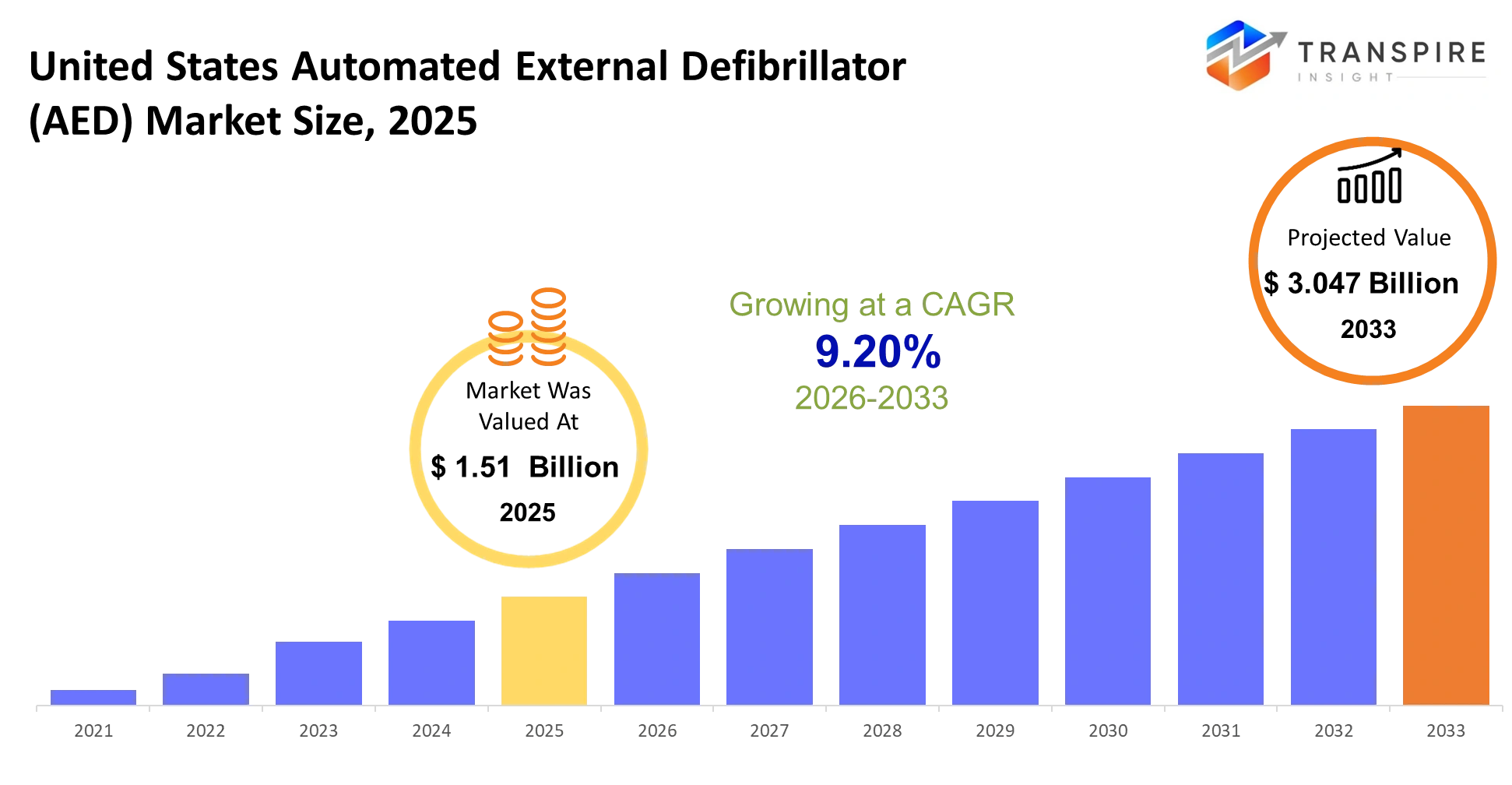
- United States Automated External Defibrillator (AED) Market Size 2025: USD 1.51 Billion
- United States Automated External Defibrillator (AED) Market Size 2033: USD 3.047 Billion
- United States Automated External Defibrillator (AED) Market CAGR: 9.20%
- United States Automated External Defibrillator (AED) Market Segments:By Type (Semi-automated, Fully Automated, Wearable, Portable), By Application (Hospitals, Public Access, Homecare, Emergency Services), By End-User (Hospitals, Clinics, Individuals, Government), By Technology (Manual Override, Voice Guided, Smart AED, Connected Devices), By Distribution (Direct Sales, Online, Distributors, OEM).
To learn more about this report,  Download Free Sample Report
United States Automated External Defibrillator (AED) Market Summary:
The United States Automated External Defibrillator (AED) Market size is estimated at USD 1.51 Billion in 2025 and is anticipated to reach USD 3.047 Billion by 2033, growing at a CAGR of 9.20% from 2026 to 2033. The United States Automated External Defibrillator (AED) market is experiencing continuous growth because people understand sudden cardiac arrest better and know they need immediate treatment. The rising need for emergency preparedness shows itself through increased use of AEDs in public areas and work environments and educational institutions. User-friendly product designs together with real-time monitoring capabilities function as technological improvements that drive higher product adoption rates. The United States healthcare system uses AEDs as essential emergency equipment because government programs and training initiatives create greater demand for these life-saving devices.
Key Market Trends & Insights:
- The current generation of AEDs includes voice prompts together with real-time feedback and remote monitoring capabilities. The new technology makes products more accessible because it enables users without training to operate devices.
- Most states implement regulations and mandates that support AED installation in public spaces and high-risk locations. The government funds training programmes which increase public access to equipment while preparing them for emergencies.
- Schools and workplaces implement AED systems to create safer environments. Organisations recognise the importance of medical emergency preparedness, which drives their continuous market expansion.
- The public and employees now face increasing requirements to complete CPR and AED training programmes. Training programmes help individuals learn how to use equipment, which builds their confidence while improving response times.
- Emergency services now use AEDs through modern technologies that enable wireless communication. The system enables emergency responses to happen faster while creating better coordination, which builds a more effective medical response system.
United States Automated External Defibrillator (AED) Market Segmentation
By Type
- Semi-automated: The devices which operate with semi-automated AED technology provide users with rescue instructions while requiring users to manually deliver electrical shocks. The devices achieve their widespread use because they provide users with operational control while maintaining safety measures. The devices function better than other options in workplaces and public spaces because they need only basic training to operate emergency procedures which work effectively but safely.
- Fully Automated: The fully automated AED systems operate shock delivery through their automated system, which needs no active user control. The system provides public access through its operational simplicity, which allows users to operate it in shopping malls and airport terminals. The devices are becoming more popular because they eliminate doubt, which leads to faster response times during critical heart emergencies.
- Wearable: The medical devices known as wearable AEDs were developed to monitor patients who have been identified as high-risk for cardiac events. The devices deliver continuous health monitoring through their ability to detect health issues in real time and provide instant medical intervention, which allows users to feel secure in non-clinical environments. The United States healthcare system shows increasing adoption of these solutions because they support preventive medicine and customised heart health monitoring.
- Portable: The emergency medical equipment includes portable AED devices which emergency personnel can easily transport because the devices are both compact and lightweight. The system enables emergency responders to quickly establish their operational base at any outdoor site because it is easy to move and set up. The increasing demand for rapid response systems is leading to their adoption by various industries.
By Application
- Hospitals: Hospitals serve as the main location where AEDs get used to provide quick treatment for cardiac emergencies that occur in their medical facilities. The devices function as vital components for patient safety, which medical facilities use together with their existing advanced medical equipment. The sustained demand for these products at healthcare facilities results from their ongoing system upgrades which become compatible with hospital operations.
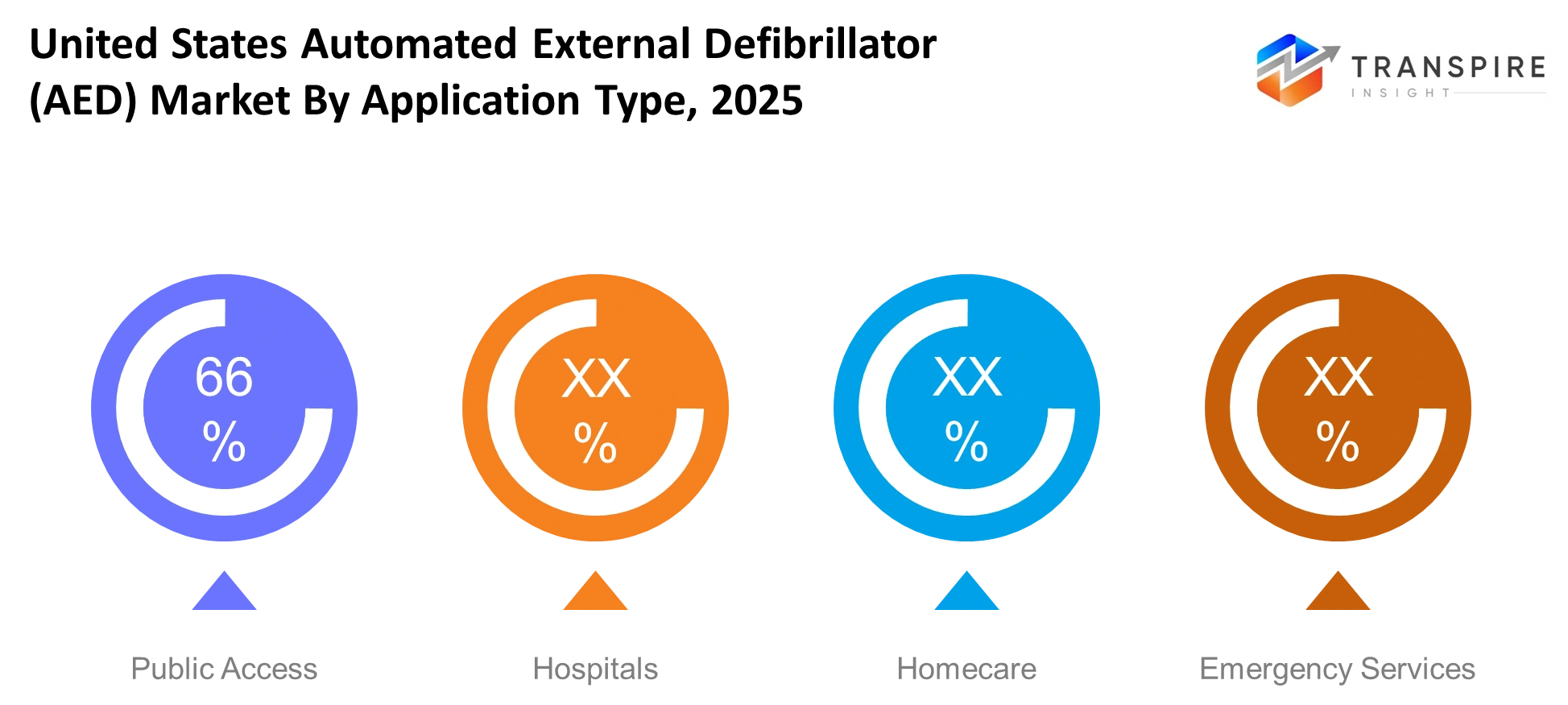
- Public Access: Public-access AEDs get installed at busy locations, which helps increase survival chances during sudden cardiac arrest events. More public spaces now have AEDs because people want to better prepare for emergencies that can happen at any time. Government programmes and community health and safety initiatives drive rapid growth in this particular market segment.
- Homecare: Homecare use of AEDs is increasing as individuals become more proactive about personal health. The devices offer families who have members that face high health risks peace of mind. The combination of simple operation and small-sized equipment enables people to handle emergency situations at home more effectively.
- Emergency Services: Emergency services use AEDs as essential equipment, which they need to deliver fast emergency medical treatment during life-threatening situations. The emergency medical services use advanced AED equipment which their ambulance teams and first responders carry to achieve quick medical response. The combination of ongoing education programmes and system upgrades which develop new technologies helps emergency responders save more lives.
To learn more about this report, Download Free Sample Report
By End-User
- Hospitals: The hospitals use AEDs as essential components of their complete emergency response systems. The hospitals need to keep their equipment in stock because they require dependable equipment which delivers immediate cardiac assistance. The process of establishing modern healthcare systems which improve hospital operations continues to advance medical facilities through time.
- Clinics: Clinics are increasing their AED usage to respond to sudden cardiac emergencies. The devices provide extra security to patients who visit smaller healthcare facilities. The rising demand for AEDs at clinics results from their need to establish emergency readiness because outpatient services continue to expand.
- Individuals: People who face cardiac risks have developed a growing need for AEDs according to current market trends. The ownership of personal devices demonstrates that people have become more conscious about their health and have taken steps to stay ready for emergencies. The devices provide better home and travel accessibility through their easy-to-use features and their portable design.
- Government: The presence of Government organizations in the installation of AED's on the public infrastructure and organizing awareness programs plays a decisive role. The installation process receives funding through various policies which create supporting initiatives. Their presence makes emergency services accessible to all people in the community while promoting essential emergency service training.
By Technology
- Manual Override: The existence of manual override capabilities in AEDs enables emergency-trained staff to manage situations which require their expertise. Advanced medical scenarios require this capability because medical experts must make critical decisions. Healthcare facilities and emergency medical services utilise these devices to deliver accurate medical treatment.
- Voice Guided: Voice-guided AEDs provide step-by-step instructions which enable all users to operate the device successfully. Emergency situations create prompts which help users to maintain their composure while emergency responders work to tackle the situation. People prefer to use this product because its design makes it easy to operate in all types of spaces.
- Smart AED: Smart AEDs use advanced technologies to function through their data tracking and performance monitoring features. The system provides usage statistics together with maintenance data which helps to establish dependable operational conditions. The new technologies create better device performance, which enables organisations to prepare for emergencies more effectively.
- Connected Devices: Emergency medical personnel can use connected AEDs to transmit their real-time status through network connections which enable remote tracking. The system maintains constant device availability because of its permanent connection to the network. The rising implementation of digital health solutions shows how these technologies enhance emergency response systems.
By Distribution
- Direct Sales: The direct sales system enables manufacturers to deliver AEDs straight to educational institutions and business organisations. This method enables better adaptability and operational assistance. Hospitals and large companies prefer this system because it delivers dependable solutions which match their unique needs.
- Online: The online distribution system is experiencing increased popularity because it provides customers with straightforward access to a broader range of products. Customers can assess product details and prices which enables them to choose their purchases. The expansion of e-commerce platforms has made AEDs more accessible to both individual customers and small businesses.
- Distributors: The distributors create links between manufacturers and different consumer markets which enables businesses to extend their reach into new markets. The company offers distribution services together with its expert knowledge of regional market conditions. This distribution method serves as a crucial link to connect remote areas with all healthcare facilities, which include smaller medical centres.
- OEM (Original Equipment Manufacturer): The partnership between OEM companies, together with their partner organisations, allows them to embed AED technology into their various healthcare system products. This method enables organisations to develop new products with better capacity to expand their operations. The system has emerged as the primary method used to create specialised devices which fulfil particular market and institutional requirements.
Country Insights
The United States Automated External Defibrillator (AED) market displays strong emergency readiness and healthcare advancement dedication. Public health programmes, together with public understanding of sudden cardiac arrest, have resulted in widespread AED installation across educational institutions and commercial buildings and airport terminals and public gathering areas. States have developed supportive regulations which make these devices accessible to people while requiring their installation in areas with heavy pedestrian traffic. Citizens receive emergency response training through ongoing programmes which enable them to handle emergency situations with confidence.
The adoption process receives additional support through technological developments which involve smart connectivity and easy-to-use control systems. Urban areas maintain the highest deployment rates, while rural communities advance their progress through governmental and non-profit organisation initiatives. The country demonstrates its dedication to life protection through its increasing focus on preventive medical care and fast emergency response systems. The U.S. AED market develops through increased product availability and public education and new technological developments which create an advanced healthcare system that responds better to emergencies.
Recent Development News
In February 2026, Hollister Senior Center installs AED, boosting safety preparedness: A community-focused initiative highlights how local institutions are prioritising emergency readiness. The addition of AED equipment along with staff training reflects growing grassroots adoption across the U.S.
In March 2026, School AED access gaps spark policy discussions in Connecticut: a student rescue case has renewed debate on AED availability in schools. Experts are calling for stronger mandates and funding to ensure consistent access and training.
|
Report Metrics |
Details |
|
Market size value in 2025 |
USD 1.51 Billion |
|
Market size value in 2026 |
USD 1.646 Billion |
|
Revenue forecast in 2033 |
USD 3.047 Billion |
|
Growth rate |
CAGR of 9.20% from 2026 to 2033 |
|
Base year |
2025 |
|
Historical data |
2021 – 2024 |
|
Forecast period |
2026 – 2033 |
|
Report coverage |
Revenue forecast, competitive landscape, growth factors, and trends |
|
Country scope |
United States |
|
Key company profiled |
Philips, Zoll Medical, Medtronic, Stryker, Nihon Kohden, Cardiac Science, Schiller, Defibtech, Physio-Control, GE Healthcare, Mindray, CU Medical, Metrax, AMI Italia, Progetti |
|
Customization scope |
Free report customization (country, regional & segment scope). Avail customized purchase options to meet your exact research needs. |
|
Report Segmentation |
By Type (Semi-automated, Fully Automated, Wearable, Portable), By Application (Hospitals, Public Access, Homecare, Emergency Services), By End-User (Hospitals, Clinics, Individuals, Government), By Technology (Manual Override, Voice Guided, Smart AED, Connected Devices), By Distribution (Direct Sales, Online, Distributors, OEM). |
Key United States Automated External Defibrillator (AED) Company Insights
The United States Automated External Defibrillator (AED) market operates through established healthcare firms and new technology startups which provide vital medical solutions. The major industry players direct their research efforts toward creating advanced devices which combine user-friendly interfaces with superior network capabilities and continuous performance assessment features. The public and private sectors will gain better access to services through companies which focus on developing affordable and space-saving products. Brands use three main strategies to establish their market presence through strategic partnerships , product launches , and training programs which help them increase brand recognition. The competitive environment pushes companies to develop new products which enhance product performance and boost customer trust.
Company List
- Philips
- Zoll Medical
- Medtronic
- Stryker
- Nihon Kohden
- Cardiac Science
- Schiller
- Defibtech
- Physio-Control
- GE Healthcare
- Mindray
- CU Medical
- Metrax
- AMI Italia
- Progetti
United States Automated External Defibrillator (AED) Market Report Segmentation
By Type
- Semi-automated
- Fully Automated
- Wearable
- Portable
By Application
- Hospitals
- Public Access
- Homecare
- Emergency Services
By End-User
- Hospitals
- Clinics
- Individuals
- Government
By Technology
- Manual Override
- Voice Guided
- Smart AED
- Connected Devices
By Distribution
- Direct Sales
- Online
- Distributors
- OEM
Frequently Asked Questions
Find quick answers to common questions.
The approximate United States Automated External Defibrillator (AED) Market size for the market will be USD 3.047 Billion in 2033.
The key segments of the United States Automated External Defibrillator (AED) Market are By Type (Semi-automated, Fully Automated, Wearable, Portable), By Application (Hospitals, Public Access, Homecare, Emergency Services), By End-User (Hospitals, Clinics, Individuals, Government), By Technology (Manual Override, Voice Guided, Smart AED, Connected Devices), By Distribution (Direct Sales, Online, Distributors, OEM).
Major players in the United States Automated External Defibrillator (AED) Market are Philips, Zoll Medical, Medtronic, Stryker, Nihon Kohden, Cardiac Science, Schiller, Defibtech, Physio-Control, GE Healthcare, Mindray, CU Medical, Metrax, AMI Italia, Progetti.
The current market size of the United States Automated External Defibrillator (AED) Market is USD 1.51 Billion in 2025.
The United States Automated External Defibrillator (AED) Market CAGR is 9.20%.
- Philips
- Zoll Medical
- Medtronic
- Stryker
- Nihon Kohden
- Cardiac Science
- Schiller
- Defibtech
- Physio-Control
- GE Healthcare
- Mindray
- CU Medical
- Metrax
- AMI Italia
- Progetti
Recently Published Reports
-
Dec 2024
AI in Diabetic Retinopathy Market
AI in Diabetic Retinopathy Market Size, Share & Analysis Report By Type (Screening AI Systems, Diagnostic AI Systems, and Predictive AI Models), By Application Segment (Hospitals, Ophthalmology Clinics, Diagnostic Centers, and Research and Development), and Geography (North America, Europe, Asia-Pacific, Middle East and Africa, South and Central America), 2021 - 2031
-
Feb 2025
Psychometric Tests Market
Psychometric Tests Market Size, Share & Analysis Report By Type (Personality Tests, Ability/Aptitude Tests, Skill/Knowledge Tests, and Others), By Application (Talent Acquisition and Talent Management), and Geography (North America, Europe, Asia-Pacific, Middle East and Africa, South and Central America), 2021 – 2031
-
Feb 2025
Rare Biological Sample Collection Market
Rare Biological Sample Collection Market Size, Share & Analysis Report By Type (Isolation Kits & Reagent, Blood Collection Tubes, and Others), By Application (Oncology, Transcriptomics, Pharmacogenomics, and Others), and Geography (North America, Europe, Asia-Pacific, Middle East and Africa, South and Central America), 2021 – 2031
-
Dec 2025
Patient Lift Pendant Market
Patient Lift Pendant Market By Product Type (Wired Pendants, Wireless, Programmable), By Operation Type(Manual, Electric), By End-Users (Healthcare Professionals, Patients), By Application (Hospitals, Homecare, Rehabilitation Centers, Others), By Industry Analysis, Size, Share, Growth, Trends, and Forecasts 2021-2033
Our Clients
.jpg)