

North America Keloid Treatment Market Size & Forecast:
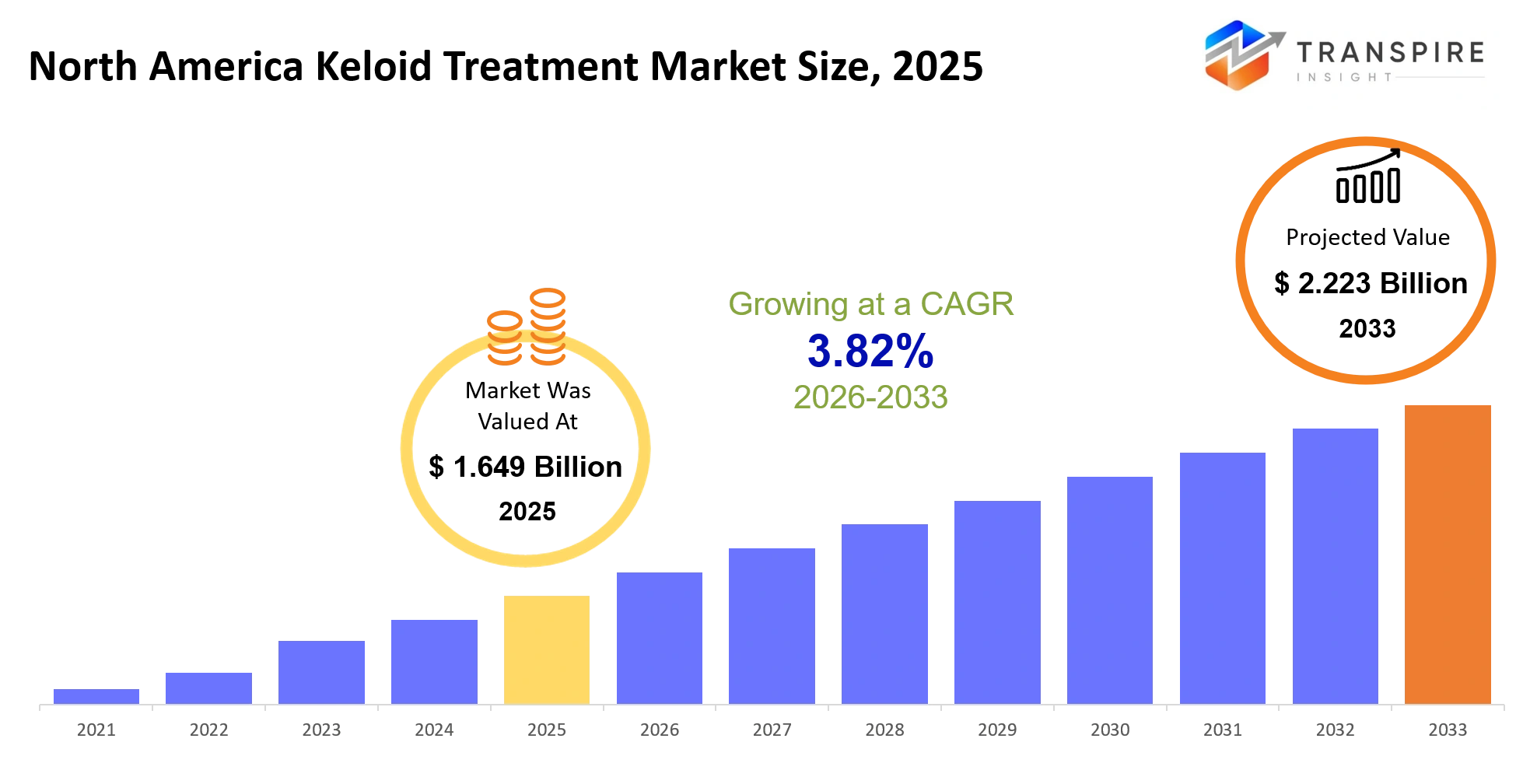
- North America Keloid Treatment Market Size 2025: USD 1.649 Billion
- North America Keloid Treatment Market Size 2033: USD 2.223 Billion
- North America Keloid Treatment Market CAGR: 3.82%
- North America Keloid Treatment Market Segments: By Treatment Type (Corticosteroid Injections, Cryotherapy, Laser Therapy, Surgical Excision, Radiation Therapy, Others); By Application (Ear Keloids, Chest Keloids, Facial Keloids, Shoulder Keloids, Others); By End User (Hospitals, Dermatology Clinics, Cosmetic Centers, Others); By Drug Type (Topical Treatments, Injectable Treatments, Combination Therapies, Others).
To learn more about this report,  Download Free Sample Report
North America Keloid Treatment Market Summary
The North America Keloid Treatment Market was valued at USD 1.649 Billion in 2025. It is forecast to reach USD 2.223 Billion by 2033. That is a CAGR of 3.82% over the period.
In North America, the keloid treatment market is mainly about trying to control that overgrown scar tissue that kinda shows up after surgery, trauma, burns, or acne. It can get pretty uncomfortable, with pain, itching, and that noticeable cosmetic worry, and it ends up dragging down overall patient well being, plus the usual post-surgical results. In real clinic flow dermatology and plastic surgery teams often blend steroid injections together with laser resurfacing, silicone based regimes, and lately some newer biologics. Over the past five years, the whole market has moved in a more “mixed approach” direction, away from standalone surgical removal and more toward combination, minimally invasive routines done in outpatient aesthetic spaces. Meanwhile, during the COVID-19 disruption, elective procedures were postponed, so a sort of backlog built up, meaning more untreated scars and later post-surgical complications. Once things normalized, that backlog bumped up the demand pretty fast for clinic based care. Put together, the protocol hybridization and the procedural pile up have raised revenue per patient in a measurable way, and helped wider adoption of device assisted options across dermatology networks.
Key Market Insights
- North America Keloid Treatment Market is moving more toward combination therapies, like mixing lasers, steroids and silicone based solutions, which helps with better scar remodeling, sort of in a more coordinated way.
- Also outpatient dermatology clinics kinda now dominate the delivery side, they take roughly one third share in the North America Keloid Treatment Market, mostly because it’s convenient and the procedural costs are usually lower.
- The United States is still the biggest player in the North America Keloid Treatment Market, with more than 70% share in 2025, mainly due to advanced dermatology infrastructure and a lot of cosmetic procedure volume.
- Canada meanwhile is the fastest growing regional market up to 2030, backed by growing aesthetic awareness, plus broader access to dermatologic care services.
- Steroid injections keep leading as the top segment in the North America Keloid Treatment Market, they’re widely used as first-line keloid suppression and for inflammation control.
- Silicone gel sheets take the next big portion, supported by strong post surgical adoption within outpatient recovery protocols.
- Laser based therapies are the fastest growing segment from 2024–2030, because they can target precisely and tend to reduce recurrence.
- Post surgical scar management is the main application in the North America Keloid Treatment Market, taking most of the treatment demand in clinical settings.
- Acne related keloids are growing the quickest, driven by more dermatology consultations among younger populations.
- Dermatology and plastic surgery clinics lead the North America Keloid Treatment Market, mostly because of higher procedural volume and recurring patient visits, over all.
What are the Key Drivers, Restraints, and Opportunities in the North America Keloid Treatment Market?
Driver: The main growth driver feels like the move toward minimally invasive, combo based scar management protocols, inside dermatology and plastic surgery clinics. People started leaning this way after fractional laser systems kept improving , and intralesional drug delivery techniques also got better, so efficacy went up while recovery time got shorter versus surgical excision. Because of that clinics across North America are doing more repeat outpatient procedures, which ramps up per patient treatment cycles. Then recurring revenue streams get reinforced across both aesthetic and therapeutic care setups, kind of steadily.
Restraint: One big structural limitation is the rather high recurrence rate of keloids after treatment, especially in patients who are genetically predisposed. This biological reality cant really be fixed by procedural refinement alone , and it keeps hurting the long-term effectiveness. In practice it causes repeated interventions , higher overall patient costs, and clinical outcomes that dont line up well. That mess slows down standardized adoption among smaller dermatology practices and it caps scalability across the North America Keloid Treatment Market too.
Opportunity: The best opportunity seems tied to biologic based and gene modulating therapies that are being tested in early stage clinical trials in the United States right now. For example AbbVie is looking into anti fibrotic pathways that target scar formation at the cellular level. If they make it to market and it works well, then long term outcomes could be reshaped and a new high value segment could open up within the North America Keloid Treatment Market, quite plausibly.
What Has the Impact of Artificial Intelligence Been on the North America Keloid Treatment Market?
Artificial intelligence and digital technologies are steadily, kind of reshaping the North America Keloid Treatment Market, mainly by pushing better diagnostic precision, planning, and a more consistent procedural rhythm across dermatology and plastic surgery practices.
In day to day clinical operations, AI powered imaging systems now back automated scar assessment, by reading lesion size, thickness, and vascular activity from high resolution dermatoscopic images. That lowers manual subjectivity, and it also helps clinicians “lock in” treatment selection between steroid injections, laser therapy, and silicone based protocols. Also some outpatient dermatology networks are using AI enabled workflow tools, to streamline patient scheduling, follow up monitoring and treatment history documentation, which boosts operational efficiency in busy, high volume clinics
On the predictive side, machine learning models are trained using longitudinal patient datasets, to anticipate recurrence risk and fine tune treatment intervals. In practice, these models support laser parameter decisions and help clinicians spot poor responders sooner during the treatment cycle, which then cuts down unnecessary repeat procedures and improves resource allocation across the North America Keloid Treatment Market.
Operationally, early adopters often describe a smoother planning consistency, quicker consultation cycles, and less procedural variation, and all of that seems to translate into improved clinic throughput and steadier revenue per patient.That said, adoption still gets slowed by limited, high quality labeled datasets for keloid progression, plus variability in real world imaging conditions, so model accuracy can drop. This makes large scale rollout harder for smaller dermatology practices, where data and infrastructure are tighter than in bigger centers.
Key Market Trends
- Since 2020, clinicians started moving away from full surgical keloid excision , and instead did this mix of laser sessions plus intralesional steroid protocols which kind of shortened recovery time and cut down on complications.
- Outpatient dermatology centers then grew their share to over 30 percent in big US cities, kind of replacing the hospital based scar revision work that had been more common from 2019 to 2025.
- After 2022 , AI scar imaging tools were more and more showing up inside everyday dermatology workflows, which helped standardize how lesions get measured, and also improved how clinics choose treatments across different sites.
- Because keloid recurrence stays stubbornly high, many patients end up cycling through repeated interventions, and that raises lifetime treatment costs, so clinics have been leaning into long term management protocols since 2021.
- Then in 2021, the post COVID backlog for elective dermatology visits caused a demand spike, and it pushed scar revision treatments harder across North American clinics.
- Silicone gel sheet adoption also changed direction between 2020 and 2024 , shifting toward OTC retail and digital pharmacy channels, and that generally improved patient adherence rates.
- On the pipeline side, biologic programs from firms like AbbVie and Merz Pharma moved forward through early trials , focusing on fibrotic pathways during 2022 through 2025.
- And after 2023, med spas plus aesthetic clinics expanded the amount of keloid services they advertise and deliver, so revenue gets diversified beyond the usual dermatology surgical centers, sort of.
North America Keloid Treatment Market Segmentation
By Treatment Type
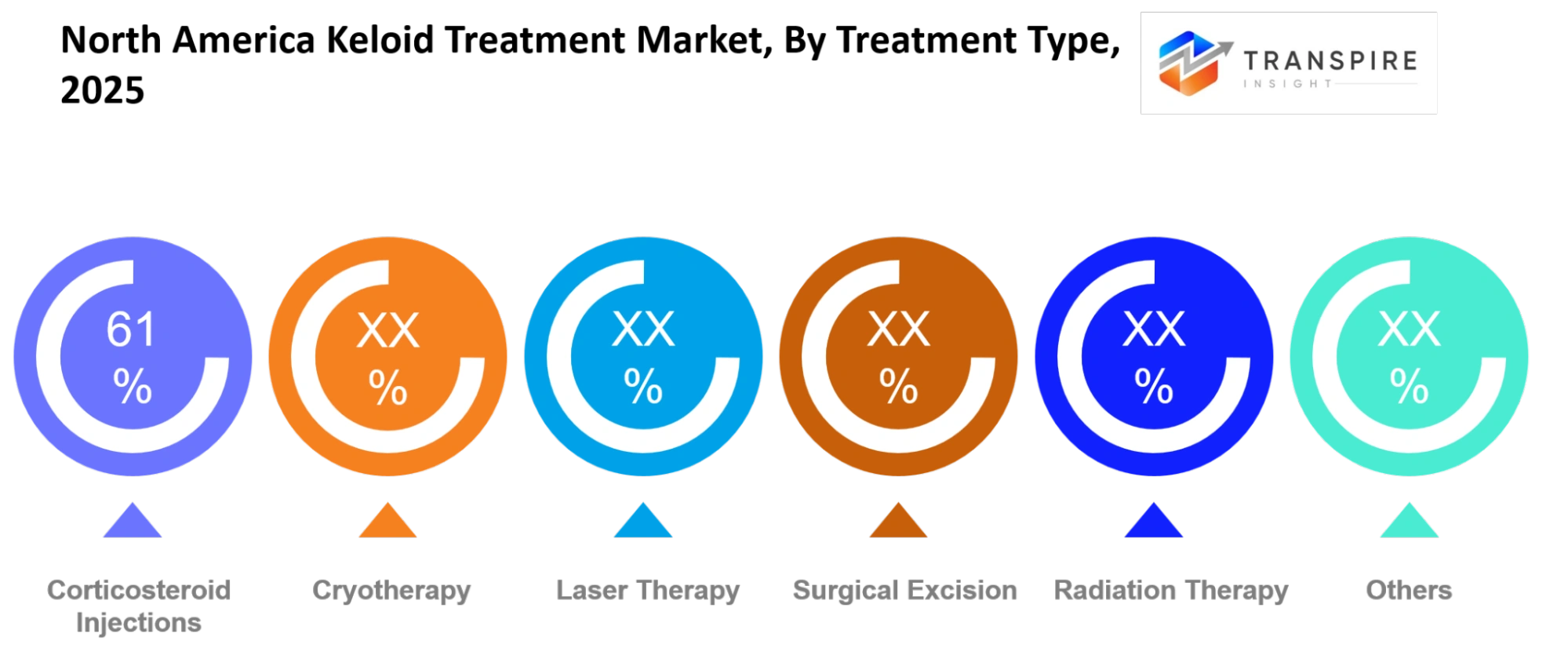
Corticosteroid injections kinda hold the dominant position in the North America Keloid Treatment Market , mainly because they are used as a first-line option in dermatology and plastic surgery clinics. Clinicians like it because of the predictable anti-inflammatory effects and the procedural side is pretty straightforward, you know, low complexity overall. After that laser therapy keeps growing fast as a more rapid modality, while surgical excision stays a smaller but still necessary tool for really severe or resistant situations .
This segment keeps moving forward as care shifts toward minimally invasive , repeatable treatment cycles that cut down downtime and also enhance cosmetic results. Cryotherapy and radiation therapy still sit in a more niche lane since they come with stricter procedural constraints , and response rates can be inconsistent. Also combination therapy is seeing more traction , because recurrence pressures clinicians to stack multiple modalities , rather than betting on one intervention only.
Over the forecast period, laser and combination-based protocols are expected to gain share as device costs come down and clinic adoption ramps up. Injectable therapies will stay central for maintenance routines. Product developers are likely to focus on hybrid treatment systems that blend pharmacological strategies with energy-based options.
To learn more about this report, Download Free Sample Report
By Application
Facial keloids take the largest share in the North America Keloid Treatment Market because facial areas carry high cosmetic sensitivity , and patients are more willing to pursue treatment. Chest and shoulder keloids follow not too far behind , largely tied to post-surgical scarring patterns and acne-related scars. Ear keloids remain smaller but still clinically steady as a segment , often associated with piercings.
Demand dynamics aren’t the same across every application site, mostly because skin tension varies, recurrence risk acts a bit different, and the visual impact can be more or less obvious depending on location. For facial treatments, the protocols tend to lean on precision laser approaches, but for the chest and shoulder zones you often need firmer combo therapies because the recurrence rates are higher, and it’s just harder to keep things stable. Ear keloids usually do better with steroid injections along with pressure therapy, that part is pretty consistent in practice.
Looking ahead, future expansion should cluster around facial and acne related use cases, since younger patients are more willing to seek early intervention. Device companies will likely keep investing in precision laser systems tuned for delicate skin areas. Investors, meanwhile, should notice steadier procedural volume in facial applications compared with other anatomical categories.
By End User
In the North America Keloid Treatment Market, dermatology clinics lead the end user segment, mainly due to high outpatient throughput and the fact they have scar management know how. Hospitals still hold a meaningful slice, especially for complicated surgical situations and radiation assisted treatments. Cosmetic centers are also moving fast, they’re basically expanding on top of demand for aesthetic oriented scar revision services.
This shift is being pushed by the decentralization of care, meaning patients are increasingly treated outside hospitals in outpatient or more aesthetic settings. Dermatology clinics benefit because patients often come back for repeat sessions, and operational costs run lower so profitability improves. Cosmetic centers are picking up momentum by bundling scar repair with broader skin enhancement services.
Over time, cosmetic centers are expected to grow the fastest as consumer driven aesthetic care keeps widening. Hospitals will keep a strong niche for complex cases, but they may lose share for more routine treatments. Equipment providers are also likely to design portable, clinic friendly systems so decentralized delivery becomes easier for providers.
By Drug Type
Injectable treatments kinda hold the leading position in the North America Keloid Treatment Market because of strong uptake of corticosteroid and the newer biologic formulations showing up. Topical treatments are still widely used for post procedure upkeep and for those earlier stage scars. Combination therapies are starting to gain real momentum, mainly as clinicians try to deal with the high recurrence rates and well, keep things steadier.
The rise in injectable therapies is mostly pushed by clinical comfort with direct lesion targeting and outcomes that are easier to measure. Topical options are limited when it comes to deeper or long standing keloids, so their standalone impact is kind of restricted. In practice combination protocols blend injectables with lasers or silicone based products, to support longer term control and reduce backslides.
Looking ahead, future expansion will likely lean toward combination therapies, especially as biologic drugs and advanced delivery systems move through clinical pipelines. Injectable biologics could re shape treatment norms for resistant keloids. Developers who focus on multi modal drug-device integration should end up with a competitive edge, across the usual clinical adoption cycles.
What are the Key Use Cases Driving the North America Keloid Treatment Market?
Core demand in the North America Keloid Treatment Market basically comes from post-surgical scar handling after dermatologic and plastic surgery procedures. Like, surgical incisions from cesarean deliveries, orthopedic repairs, and cosmetic work often lead to keloid formation, which then pushes people into repeat outpatient visits. In practice dermatology clinics lean on corticosteroid injections and laser therapy to keep things under control, but the recurrence risk stays pretty high if the intervention is not ongoing or sustained.
Meanwhile the expanding use cases are pretty clear too: acne-related facial keloids, and ear keloids that show up after piercings, are now getting treated more often in cosmetic centers as well as dermatology clinics. Acne scarring among younger groups has increased procedure volumes, while ear keloids create steady demand for less disruptive steroid options and pressure-based therapies. Together these use scenarios support repeat treatment cycles and help keep clinic-level revenue steadier year to year.
On the emerging side, there are early preventive scar intervention protocols that are starting to get folded into post-operative care pathways and oncology recovery programs. Hospitals are beginning to use more proactive keloid suppression after high-tension surgical closures. Also digital dermatology platforms, with AI-assisted monitoring, are showing some potential to widen remote scar management for outpatient populations, so patients can be followed without constantly being physically present in clinic.
|
Report Metrics |
Details |
|
Market size value in 2025 |
USD 1.649 Billion |
|
Market size value in 2026 |
USD 1.710 Billion |
|
Revenue forecast in 2033 |
USD 2.223 Billion |
|
Growth rate |
CAGR of 3.82% from 2026 to 2033 |
|
Base year |
2025 |
|
Historical data |
2021 - 2024 |
|
Forecast period |
2026 - 2033 |
|
Report coverage |
Revenue forecast, competitive landscape, growth factors, and trends |
|
Regional scope |
North America (Canada, The United States, and Mexico) |
|
Key company profiled |
Pfizer, Sanofi, Novartis, Merz Pharma, Bausch Health, Suneva Medical, Candela Medical, Cynosure, Lumenis, Integra LifeSciences, Smith & Nephew, Mölnlycke Health Care, AbbVie, Johnson & Johnson, Sonoma Pharmaceuticals. |
|
Customization scope |
Free report customization (country, regional & segment scope). Avail customized purchase options to meet your exact research needs. |
|
Report Segmentation |
By Treatment Type (Corticosteroid Injections, Cryotherapy, Laser Therapy, Surgical Excision, Radiation Therapy, Others); By Application (Ear Keloids, Chest Keloids, Facial Keloids, Shoulder Keloids, Others); By End User (Hospitals, Dermatology Clinics, Cosmetic Centers, Others); By Drug Type (Topical Treatments, Injectable Treatments, Combination Therapies, Others). |
Which Regions are Driving the North America Keloid Treatment Market Growth?
North America kind of leads the Keloid Treatment Market mainly because the United States, well, still brings most of the weight, and it’s backed by more advanced dermatology infrastructure plus high procedural volumes, especially across cosmetic and reconstructive surgery. There’s also strong reimbursement setups for medically necessary scar revision which sort of pushes clinicians to start early intervention sooner, in real practice settings. On top of that, specialized dermatology networks are widespread, and the adoption of laser-based therapies and injectable treatments feels really high, so the region stays dominant.
Canada, meanwhile, acts more stable, but it contributes less overall to the North America Keloid Treatment Market. In that country the growth is shaped less by sheer procedural intensity and more by steady healthcare access, plus organized dermatology referrals across both public and private systems. And unlike the United States, expansion in Canada seems tied to gradual integration of aesthetic dermatology into outpatient care, not so much to high-volume cosmetic demand. So the revenue stays predictable, but also more moderate.
Mexico is turning into the fastest-growing spot, mostly as private dermatology clinics attract more investment and medical tourism grows around lower-cost cosmetic procedures. Since around 2023, the increased availability of minimally invasive scar treatments in urban areas has helped patient uptake speed up. Looking at 2026–2033 , this momentum basically hints at strong entry opportunities for device makers and pharmaceutical firms that target cost-sensitive yet expanding outpatient treatment needs.
Who are the Key Players in the North America Keloid Treatment Market and How Do They Compete?
The North America Keloid Treatment Market looks kinda moderately fragmented, with major incumbents still competing pretty hard while dermatology focused innovators and aesthetic device specialists also show up. The fight mostly plays around clinical outcomes, recurrence reduction rates, and how well things slot into outpatient dermatology routines, not just price, and you can see that across tenders and day-to-day adoption. The more established brands try to keep their share by putting together bundled treatment ecosystems, combining consumables, devices and clinical protocols, like its one whole package, whereas smaller newcomers often zero in on laser tuning plus biologic driven scar modulation technologies.
3M boosts its position via silicone based scar management products meant for post surgical adherence, plus long duration wear, which sounds simple but matters a lot. What really differentiates them is the hospital procurement integration and these standardized wound care portfolios that get used across multiple surgical recovery pathways. Smith & Nephew leans into advanced wound care systems that link scar prevention with wider surgical recovery solutions, and they keep expanding through hospital partnerships, and post operative care bundles that clinicians already understand.
Merz Pharma moves ahead with injectable aesthetics and dermatology grade scar therapies, using clinical know how in minimally invasive treatment approaches. AbbVie pushes forward on biologic research aimed at fibrotic pathways, positioning itself for next generation keloid suppression not only symptom control, kinda like moving earlier in the process. Bausch Health expands by diversifying dermatology offerings and distributing through outpatient clinic networks, so access improves across high volume aesthetic centers, and adoption stays sticky because prescriptions keep coming back.
Company List
- Pfizer
- Sanofi
- Novartis
- Merz Pharma
- Bausch Health
- Suneva Medical
- Candela Medical
- Cynosure
- Lumenis
- Integra LifeSciences
- Smith & Nephew
- Mölnlycke Health Care
- AbbVie
- Johnson & Johnson
- Sonoma Pharmaceuticals
Recent Development News
In April 2025, Candela Medical announced the launch of the Vbeam Pro laser platform at the American Society for Laser Medicine and Surgery (ASLMS) Annual Meeting. The FDA-cleared pulsed dye laser system is designed for vascular and dermatologic conditions including scar remodeling applications relevant to hypertrophic scars and keloid management, strengthening its position in the energy-based scar treatment segment.
Source: https://finance.yahoo.com
In March 2025, Candela Medical announced the global launch of the Glacē™ treatment platform at the American Academy of Dermatology (AAD) Annual Meeting. While positioned primarily for skin purification and hydration, the system expands Candela’s aesthetic dermatology portfolio and is often used adjunctively in post-procedure skin recovery workflows that overlap with scar management treatment pathways.
Source: https://www.theaestheticguide.com
What Strategic Insights Define the Future of the North America Keloid Treatment Market?
The North America Keloid Treatment Market is kinda moving, toward protocol driven, minimally invasive scar management that also uses digital diagnostics and biologic intervention. In practice the treatment routes are expected to shift more and more away from just doing standalone procedures and toward standardized combination regimens that lower recurrence risk while also improving cosmetic results. This change is being pushed by more outpatient dermatology capacity, and also by a growing reliance on device assisted precision therapies that make recovery cycles shorter and raise procedural throughput, kind of at the same time.
There is a less obvious risk though, the clinical outcome variability and the lack of standardized long-term efficacy benchmarks, especially as new biologic and laser combination therapies keep appearing. That situation can make reimbursement alignment slower, and it may lead to uneven adoption across smaller dermatology practices, particularly if payers start tightening coverage criteria.
At the same time there is an emerging opportunity, AI guided scar mapping paired with next generation fibrotic pathway inhibitors, which could support more personalized keloid suppression plans for higher risk patients. This convergence is still early, but it is gaining attention across advanced dermatology research centers in the United States. Market participants should focus on building combination platforms that tie together diagnostics, treatment delivery, and post care monitoring, because standalone product approaches will face rising commoditization pressure over the next 5–7 years.
North America Keloid Treatment Market Report Segmentation
By Treatment Type
- Corticosteroid Injections
- Cryotherapy
- Laser Therapy
- Surgical Excision
- Radiation Therapy
- Others
By Application
- Ear Keloids
- Chest Keloids
- Facial Keloids
- Shoulder Keloids
- Others
By End User
- Hospitals
- Dermatology Clinics
- Cosmetic Centers
- Others
By Drug Type
- Topical Treatments
- Injectable Treatments
- Combination Therapies
- Others
Frequently Asked Questions
Find quick answers to common questions.
The expected North America Keloid Treatment Market size is USD 2.223 Billion in 2033.
Key segments for the North America Keloid Treatment Market are By Treatment Type (Corticosteroid Injections, Cryotherapy, Laser Therapy, Surgical Excision, Radiation Therapy, Others); By Application (Ear Keloids, Chest Keloids, Facial Keloids, Shoulder Keloids, Others); By End User (Hospitals, Dermatology Clinics, Cosmetic Centers, Others); By Drug Type (Topical Treatments, Injectable Treatments, Combination Therapies, Others).
Major North America Keloid Treatment Market players are Pfizer, Sanofi, Novartis, Merz Pharma, Bausch Health, Suneva Medical, Candela Medical, Cynosure, Lumenis, Integra LifeSciences, Smith & Nephew, Mölnlycke Health Care, AbbVie, Johnson & Johnson, Sonoma Pharmaceuticals.
The North America Keloid Treatment Market size is USD 1.649 Billion in 2025.
The North America Keloid Treatment Market CAGR is 3.82% from 2026 to 2033.
- Pfizer
- Sanofi
- Novartis
- Merz Pharma
- Bausch Health
- Suneva Medical
- Candela Medical
- Cynosure
- Lumenis
- Integra LifeSciences
- Smith & Nephew
- Mölnlycke Health Care
- AbbVie
- Johnson & Johnson
- Sonoma Pharmaceuticals
About the Authors

Pankaj Ghogare Patil
I am Pankaj Ghogare Patil, a Senior Research Analyst at Transpire Insight, specializing in the Pharmaceutical, Chemicals & Materials, Healthcare IT, and Biotechnology industry. My expertise lies in conducting comprehensive market research, analyzing industry trends, evaluating competitive landscapes, and translating complex data into actionable insights. At Transpire Insight, I closely follow emerging technologies, regulatory developments, and market innovations to create accurate, well-researched, and informative content that helps businesses and professionals make informed decisions. I am committed to producing credible, evidence-based articles that reflect industry best practices while making technical topics accessible and valuable for a broad audience.

Chakradhar Khansole
Chakradhar serves as the Research Director at Transpire Insight, bringing over 8 years of experience in technology, innovation, and strategic market intelligence. He specializes in transforming complex market data into actionable business insights that enable organizations to make informed, growth-oriented decisions. Recognized for his strategic vision and analytical expertise, Chakradhar leads high-impact research initiatives, delivering comprehensive market assessments, competitive intelligence, and forward-looking industry analysis.
Recently Published Reports
-
Jul 2026
Alopecia Treatment Market
Alopecia Treatment Market Size, Share & Analysis Report By Disease Type (Alopecia Areata, Cicatricial Alopecia, Traction Alopecia, Alopecia Totalis, Androgenetic Alopecia, Alopecia Universalis, and Other Disease Types), By Treatment Type (Topical Treatments, Oral Medications, Injectable Therapies, and Hair Transplantation), By Gender (Male, and Female), By Distribution Channel (Hospitals and Clinics, Retail Pharmacies, and Online Retailers), and Geography (North America, Europe, Asia-Pacific, Middle East and Africa, South and Central America), 2021 - 2031
-
Jul 2026
Medical Ultrasound Probe Market
Medical Ultrasound Probe Market Size, Share & Analysis Report By Type (Linear Type, Convex Type, Endocavitary Probe, Phased Array/Cardiac Probe, Transesophageal (TEE) Probe, and Others), By Application (Ophthalmology, Cardiology, Musculoskeletal, Oncology, Obstetrics & Gynecology, General Imaging, and Others), By End User (Hospitals & Clinics, Diagnostic Centers, Ambulatory Surgical Centers, and Others), and Geography (North America, Europe, Asia-Pacific, Middle East and Africa, South and Central America), 2021 – 2031
-
May 2026
Biosimilars Market
Biosimilars Market By Product Type (Monoclonal Antibodies, Recombinant Hormones, Erythropoietin, G-CSF, Others), By Indication (Oncology, Autoimmune Diseases, Blood Disorders, Diabetes, Others), By Manufacturing Type (In-House Manufacturing, Contract Manufacturing), By Distribution Channel (Hospital Pharmacies, Retail Pharmacies, Online Pharmacies), By Industry Analysis, Size, Share, Growth, Trends, and Forecasts 2021-2033
-
Apr 2026
Gastrointestinal Endoscopy Market
Gastrointestinal Endoscopy Market By Type (Rigid Gastrointestinal Endoscope, Flexible Gastrointestinal Endoscopes, Disposable Gastrointestinal Endoscope), By Procedure Type (Colonoscopy, Gastroscopy, Duodenoscopy, Enteroscopy, Flexible Sigmoidoscopy, Others), By Application (Diagnosis, Treatment), By End-Users (Hospitals, Ambulatory Surgical Centers, Specialty Clinics, Laboratories, Others), By Industry Analysis, Size, Share, Growth, Trends, and Forecasts 2021-2033