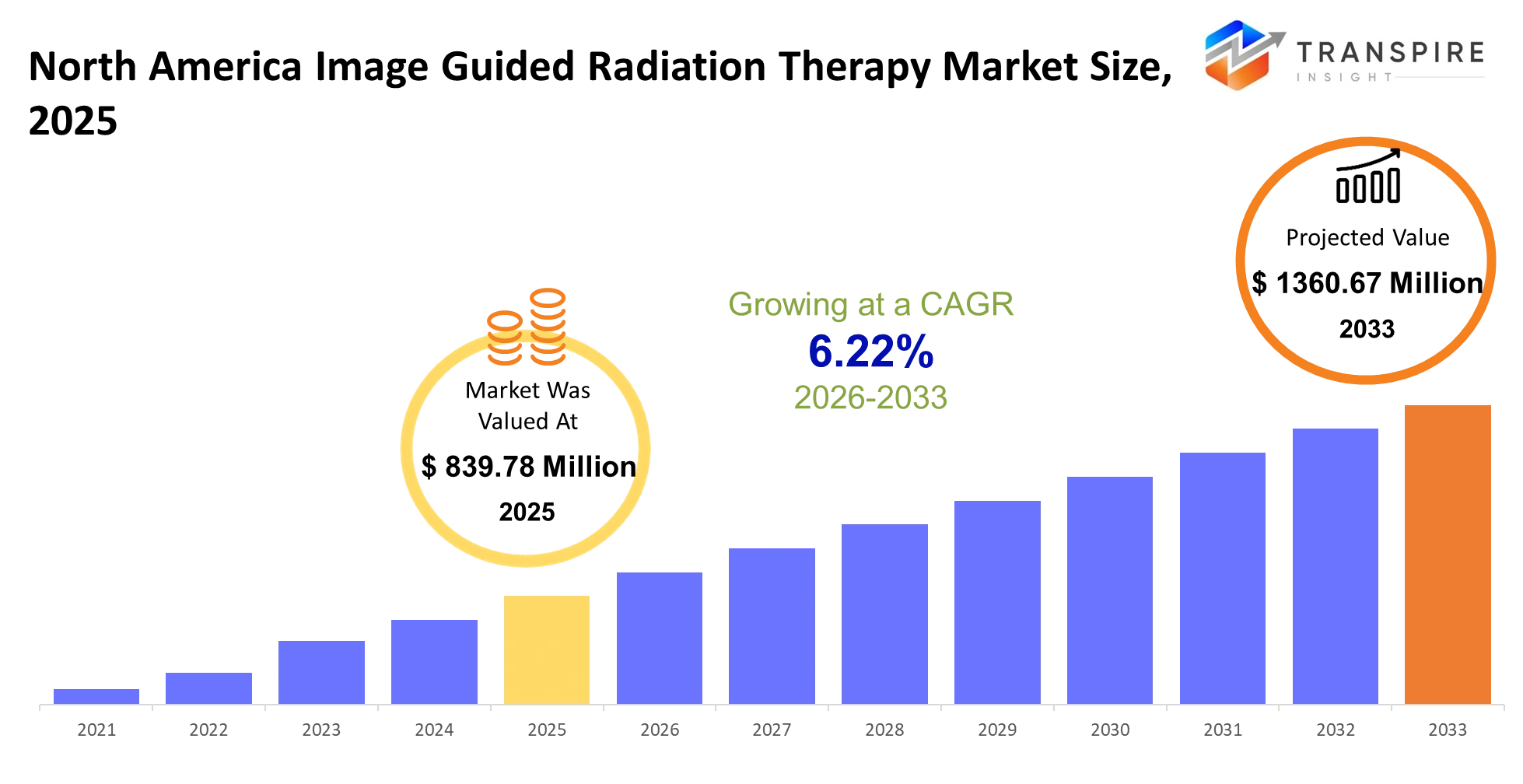
North America Image Guided Radiation Therapy Market Size & Forecast:
- North America Image Guided Radiation Therapy Market Size 2025: USD 839.78 Million
- North America Image Guided Radiation Therapy Market Size 2033: USD 1360.67 Million
- North America Image Guided Radiation Therapy Market CAGR: 6.22%
- North America Image Guided Radiation Therapy Market Segments: By Type (Cone Beam CT, MRI-guided, Ultrasound-guided, Optical Imaging, Others), By Application (Oncology, Brain Tumors, Prostate Cancer, Lung Cancer, Others), By End-User (Hospitals, Cancer Centers, Clinics, Others), By Component (Software, Hardware, Imaging Systems, Others).
To learn more about this report,  Download Free Sample Report
North America Image Guided Radiation Therapy Market Summary:
The North America Image Guided Radiation Therapy Market size is estimated at USD 839.78 Million in 2025 and is anticipated to reach USD 1360.67 Million by 2033, growing at a CAGR of 6.22% from 2026 to 2033. The North America Image Guided Radiation Therapy market kinda sits right at the overlap between precision oncology and hospital workflow optimization, so it’s not just about machines, it’s about how care actually flows. In real life, these image guidance systems let radiation oncologists aim at tumors with millimeter-level accuracy, while also trying to limit harm to the nearby organs, and that becomes extra important when the cancer is close to sensitive areas like the brain, lungs, or the prostate. More and more hospitals are leaning on these image-guided platforms to speed up the treatment preparation timeline, cut down on re-scans or repeat sessions , and raise patient throughput, all without drifting away from expected clinical results
In the last three to five years, the direction of the market seems to move away from separate or standalone radiation delivery setups, and more toward combined, AI-enabled treatment ecosystems. These ecosystems blend imaging, adaptive planning, and real-time tumor tracking, more or less in one coordinated workflow. That change picked up after the COVID-19 pandemic , because oncology care pathways got disrupted, and providers had to emphasize shorter yet more exact treatment cycles , which means fewer visits but still maintaining quality. And as cancer centers modernize their infrastructure and start shifting toward value-based care models , capital is flowing into platforms that push treatment consistency, help reduce complication risk, and also keep operations running smoothly over the long term. Ultimately, this tends to boost equipment utilization , and it strengthens recurring service revenue streams too.
Key Market Insights
- The United States basically dominated the North America Image Guided Radiation Therapy Market with something like over 82% market share in 2025, mostly because of its advanced oncology infrastructure which is very solid and already well established.
- Canada is still showing the fastest expansion through 2032, backed by public spending aimed at cancer imaging and radiotherapy modernization programs ,kind of a continuous push
- High healthcare expenditure plus solid reimbursement rules continue to nudge growth across the North America radiation therapy market, and also keep equipment replacement cycles moving at a steady pace.
- Computed tomography based IGRT systems held close to 38% of the industry share in 2025 because they offer sharper tumor localization accuracy during treatment,so clinicians trust them a lot.
- MRI guided radiation therapy showed up as the second-largest segment, and it is getting more attention for soft tissue cancer management and adaptive radiotherapy kinds of applications.
- AI enabled adaptive IGRT platforms are expected to be the fastest growing segment from 2026 to 2032, since workflow automation helps operations and precision targeting stays improved.
- Demand for hybrid imaging radiotherapy setups went up noticeably as oncology centers look for integrated treatment planning and real time imaging solutions, without too many separate steps.
- Prostate cancer care led the North America Image Guided Radiation Therapy Market, taking roughly 31% of the revenue share in 2025.
- For lung cancer, the outlook points to the fastest growth through 2032, driven by rising adoption of stereotactic body radiation therapy ,which has become more common.
- Head and neck cancers are also seeing emerging interest in image guided radiotherapy, and that is improving treatment accuracy while lowering radiation exposure to healthier tissues.
- Hospitals kept the leading market share at more than 56% in 2025, mostly due to large scale investments in advanced radiation oncology infrastructure which is being expanded.
What are the Key Drivers, Restraints, and Opportunities in the North America Image Guided Radiation Therapy Market?
The North America Image Guided Radiation Therapy Market is basically being pushed hardest by a clear shift toward precision oncology, plus the use of hypofractionated treatment styles. Cancer centers feel this in a very practical way, because payers and providers are starting to tie reimbursement more tightly to both treatment efficiency and clinical outcomes. And honestly once the pandemic hit it kind of accelerated everything, since oncology departments ran into capacity constraints , plus backlogs kept growing. So, as a result, many hospitals went ahead and invested in image-guided systems that can do real time tumor tracking, while also enabling adaptive radiation planning. With these setups, patient flow tends to improve, repeat procedures can drop, and hospitals can support higher value, premium priced treatment offerings. All of that, in turn, helps boost equipment utilization rates and keeps long term service revenue more stable.
Still, the biggest structural hurdle in the market is the heavy capital and infrastructure burden tied to the more advanced IGRT platforms. MRI guided, and AI enabled radiotherapy systems are not just “buy it and go”, they need multimillion dollar investments, special shielding, software integration, and oncology staff that are trained to operate them well. Smaller hospitals, plus regional treatment centers often can’t really make those costs work within their current reimbursement structures. This whole situation slows adoption outside the major urban cancer networks, and it also stretches out the replacement cycles. In the end that limits broader market penetration across mid-tier healthcare facilities.
AI driven adaptive radiotherapy is basically the next big growth window. Some vendors are building systems that automatically rework radiation plans, based on real time imaging gathered while the patient is actually in session. You can see it pretty clearly in major academic cancer centers across the United States and Canada , where they keep expanding their spend on cloud connected oncology platforms that bring together imaging analytics, workflow automation, and also predictive treatment modeling.
What Has the Impact of Artificial Intelligence Been on the North America Image Guided Radiation Therapy Market?
Artificial intelligence plus advanced digital technologies are shifting the North America Image Guided Radiation Therapy market in a pretty noticeable way, mainly by sharpening treatment precision, speeding up clinical workflows through automation, and improving how the equipment runs in the first place. AI powered treatment planning software is now able to auto contour tumors and compute radiation dose estimates, so manual planning that used to take multiple hours can in many oncology sites drop to under 30 minutes, sometimes even faster than that depending on the setup.
Hospitals are also mixing real time imaging analytics with adaptive radiotherapy platforms, and the idea is that radiation delivery can get adjusted automatically while the patient is on the table and the tumor is moving. in practice that tends to boost targeting accuracy and also cut down on extra exposure to surrounding healthy tissue, not just “more careful dosing” but really less collateral radiation.
Machine learning models are increasingly showing up for predictive maintenance of linear accelerators and imaging systems too. They look at equipment temperature, calibration drift, and component wear patterns, then healthcare providers can often spot an upcoming failure before any downtime becomes obvious. Some large cancer centers report clear improvements in machine uptime, smoother patient throughput, and reduced maintenance costs, with remote diagnostics plus AI assisted servicing platforms playing a big role there. Beyond operations, advanced digital oncology ecosystems also help with regulatory paperwork, treatment verification, and workflow coordination across multi-site healthcare networks, so teams aren’t constantly redoing steps.
Still, the catch is that integrating everything is costly and kind of technically demanding. A lot of mid-sized hospitals are stuck with older oncology infrastructure that doesn’t fully play nice with AI driven imaging and treatment management platforms, and that lack of compatibility can slow down wider deployment across regional healthcare systems.
Key Market Trends
- Since 2021 , U.S. cancer centers have kind of sped up the swap of standalone linear accelerators with integrated MRI-guided and CT-guided radiotherapy platforms, sort of all-in-one units.
- Adaptive radiotherapy adoption really ramped up after COVID 19 , as hospitals tried to push shorter treatment schedules that lower repeat patient visits and help with those scheduling bottlenecks that keep popping up.
- Varian Medical Systems and Elekta AB expanded AI enabled treatment planning software portfolios between 2022 and 2025 , aiming to strengthen workflow automation and make the day to day less painful.
- Oncology providers started shifting capital budgets toward cloud-connected radiation platforms more often, these platforms support remote diagnostics , predictive maintenance , and also multi site treatment coordination, yes that.
- MRI-guided radiation therapy installations grew noticeably across academic hospitals after 2023, because clinicians wanted better soft tissue imaging accuracy during treatment delivery , honestly it’s the main point.
- Canadian provincial healthcare systems increased spending on precision oncology infrastructure since 2022 , which in turn improved regional uptake of advanced image-guided radiotherapy technologies.
- Hospitals reported real reductions in treatment planning time once they deployed AI-driven contouring software, going from several hours of manual effort down to under 30 minutes, surprisingly fast.
- Competitive behavior moved away from mostly hardware-focused sales, toward long-term software , analytics, and service contracts that keep generating recurring revenue for equipment manufacturers.
- Smaller regional hospitals , meanwhile, delayed advanced IGRT adoption a bit longer, because multimillion dollar installation costs and staffing shortages still restricted modernization efforts for oncology infrastructure.
- Real-time tumor tracking technologies gained stronger clinical acceptance after studies suggested improved dose accuracy in lung and prostate cancer radiotherapy procedures, and that helped adoption stick.
North America Image Guided Radiation Therapy Market Segmentation
By Type
Cone Beam CT systems still kinda stay out in front, by type, mostly because hospitals and cancer centers use it a lot for real time imaging, day to day workflow efficiency, and it fits fairly well with the linear accelerator infrastructure they already have. MRI guided setups are also the fastest growing slice, not just because they show soft tissue in a cleaner way, but because they can adapt during treatment, especially for complicated cases like prostate, pancreas, and brain tumors. Ultrasound guided plus optical imaging systems are more of a niche fit, they’re picked when budgets are tighter and when the procedure is very specialized where adaptability and non-invasive imaging really matter.
Overall demand looks like it is moving toward integrated imaging platforms that mix precision targeting with automated planning steps. At the same time, the installation costs and the infrastructure upgrades that come along with MRI guided platforms are still what slows things down for mid-sized healthcare facilities. Looking ahead, new investment activity seems likely to bunch up around AI enabled imaging systems, cloud based treatment coordination, and hybrid imaging technologies that back personalized radiotherapy workflows, plus the longer term service and subscription style revenue approach equipment manufacturers keep pushing.
By Application
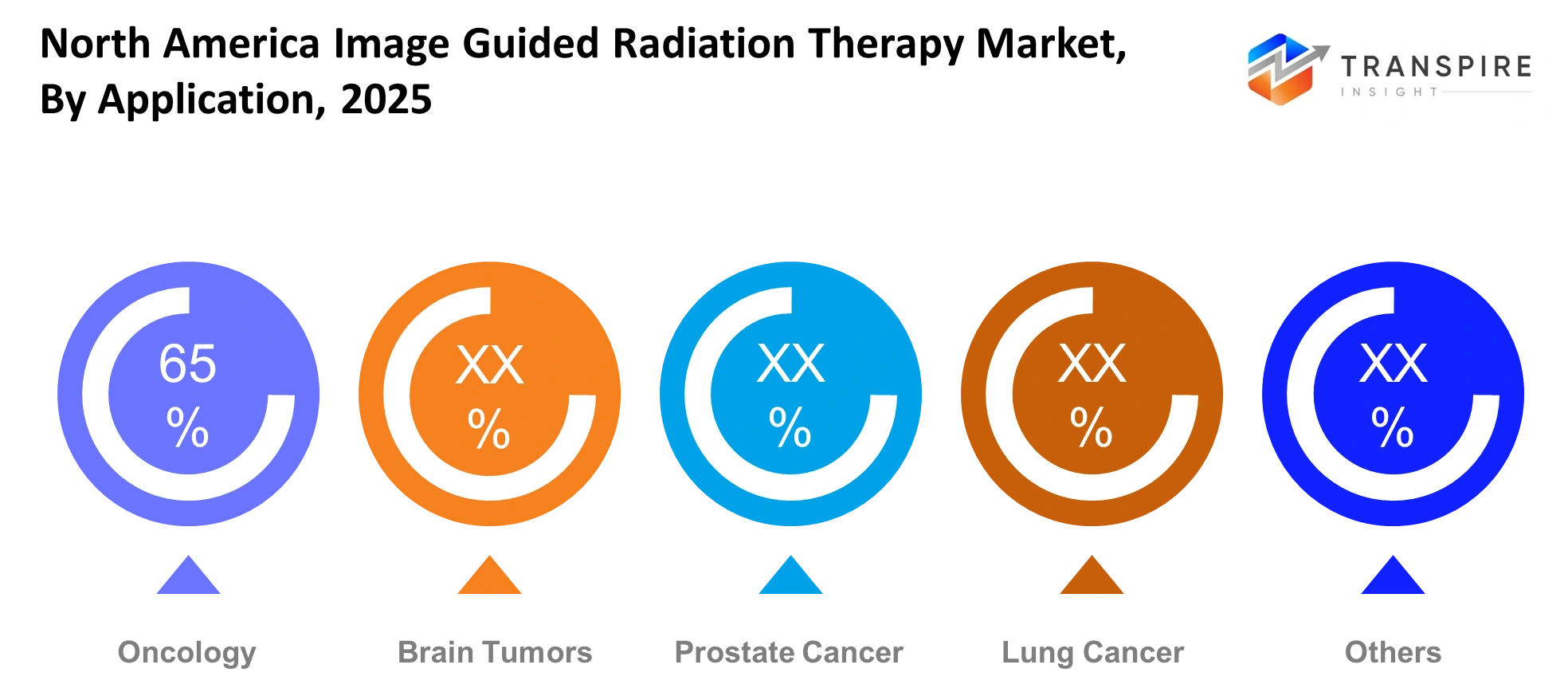
In the by-application view , oncology still sits as the main segment, mostly because image-guided radiation therapy keeps being a big deal for precise cancer care across a bunch of tumor types. Prostate cancer shows up with a noteworthy share of use, largely from tall procedure volumes, solid reimbursement frameworks, and a strong body of clinical proof that targeted radiotherapy really works in practice. Lung cancer, on the other hand, is showing up as the fastest growing application, since respiratory motion control and stereotactic body radiation therapy depend on advanced imaging accuracy while treatment is actually running. Brain tumor use is also climbing, as many providers move toward MRI-guided systems which can help reduce radiation to nearby neurological tissue.
Then you have other cancer classes, like head and neck malignancies, and they’re contributing too, because clinicians are putting more emphasis on adaptive treatment planning, rather than sticking to one static approach. Looking ahead, the market direction seems to lean toward disease-specific treatment platforms, AI-assisted tumor tracking, and real time adaptive radiotherapy workflows that boost overall efficiency while still enabling higher patient throughput across oncology networks.
To learn more about this report, Download Free Sample Report
By End-User
At end user level, hospitals kind of dominate the whole market, because big healthcare systems have the capital base, specialized oncology teams, and enough patient volume to keep advanced image guided radiotherapy units running. Cancer centers, meanwhile, are the fastest expanding slice as outpatient oncology care models keep pulling in funding across North America. In these places, they often lean harder on precision treatment tools, which help speed up day to day workflow, improve patient turnover, but still keep clinical accuracy at a high level.
Smaller clinics and treatment facilities still run into real operational friction tied to infrastructure costs, complicated software integration needs ,and also a bit less room in reimbursement flexibility. Demand is moving in a direction that favors central oncology hubs where imaging, treatment planning, and long-term patient monitoring can all live inside one digital environment. Also, strategic partnerships between care providers and tech companies are changing how things get bought ,with decision makers putting more weight on software compatibility plus remote diagnostic options. Looking ahead, growth should accelerate among regional cancer networks that want scalable radiotherapy infrastructure and integrated oncology management platforms.
By Component
In terms of component breakdown, hardware still seems to be the front runner, mainly because imaging devices together with linear accelerators and treatment delivery systems make up most of the capital spent across oncology centers. Imaging equipment keeps pulling in notable demand, since clinicians need sharper tumor localization and more adaptive planning, all the time. Meanwhile software is trending as the quickest-growing part, partly because providers are leaning more on AI assisted contouring, automated dose optimization, and cloud-linked workflow management tools.
It feels like the uptake of integrated oncology software platforms really picked up when healthcare systems wanted better day to day operational efficiency, and also shorter treatment planning timelines, especially after pandemic related care disruptions. Even so, hardware purchases are still held back a bit by the long procurement cycles, ongoing maintenance costs, and the installation hassle, more so in regional facilities with older infrastructure. Looking ahead, the market dynamics are likely to tilt toward recurring software revenue, predictive maintenance offerings, and data centered treatment optimization platforms, these should help strengthen operational efficiency while also improving long term clinical results across radiation oncology networks.
What are the Key Use Cases Driving the North America Image Guided Radiation Therapy Market?
Prostate cancer therapy still seems to be the main reason hospitals end up adopting image-guided radiation tech systems, especially across North American medical centers and oncology networks. A lot of patient flow, plus reimbursement that stays pretty friendly, and honestly the ongoing push for extremely accurate dose delivery … all of that keeps the demand steady for real-time imaging and adaptive radiotherapy platforms.
Lung cancer care and head-and-neck tumor treatment are also getting more traction. Specialty centers are leaning into stereotactic body radiation therapy and MRI-guided systems , and the idea is that these settings need solid motion tracking along with clear tissue visualization. That matters a lot in outpatient oncology locations where they want shorter treatment spans and, at the same time, more people being treated each day.
On top of that, newer use scenarios are starting to show up for adaptive radiotherapy in pancreatic and pediatric cancers, because clinicians want to reduce the radiation exposure to nearby organs as much as possible. Meanwhile academic research hospitals are looking at AI supported tumor response tracking, plus biologically guided radiotherapy strategies that might, over the forecast period, reshape precision oncology routines in a noticeable way.
|
Report Metrics |
Details |
|
Market size value in 2025 |
USD 839.78 Million |
|
Market size value in 2026 |
USD 891.93 Million |
|
Revenue forecast in 2033 |
USD 1360.67 Million |
|
Growth rate |
CAGR of 6.22% from 2026 to 2033 |
|
Base year |
2025 |
|
Historical data |
2021 - 2024 |
|
Forecast period |
2026 - 2033 |
|
Report coverage |
Revenue forecast, competitive landscape, growth factors, and trends |
|
Country scope |
North America (Canada, The United States, and Mexico) |
|
Key company profiled |
Varian Medical Systems, Elekta, Siemens Healthineers, GE Healthcare, Philips, Canon Medical, Accuray, Brainlab, Hitachi, Mevion, ViewRay, IBA Worldwide, Toshiba, Shimadzu, Fujifilm. |
|
Customization scope |
Free report customization (country, regional & segment scope). Avail customized purchase options to meet your exact research needs. |
|
Report Segmentation |
By Type (Cone Beam CT, MRI-guided, Ultrasound-guided, Optical Imaging, Others), By Application (Oncology, Brain Tumors, Prostate Cancer, Lung Cancer, Others), By End-User (Hospitals, Cancer Centers, Clinics, Others), By Component (Software, Hardware, Imaging Systems, Others). |
Which Regions are Driving the North America Image Guided Radiation Therapy Market Growth?
The United States is leading the North America Image Guided Radiation Therapy Market, mainly because big hospital networks keep putting money into precision oncology infrastructure and AI-enabled radiotherapy systems. There is also strong reimbursement help for advanced cancer procedures, so providers are more willing to swap older linear accelerators with integrated imaging platforms ,and similar tools. On top of that, the country has a fairly mature ecosystem. it includes major oncology research institutes, specialized cancer centers, software developers and medical device manufacturers. With clinical trials happening nonstop and adaptive radiotherapy technologies being taken up quickly, the market keeps its upper hand for a long time across both big cities and smaller regional healthcare systems.
Canada is the second-biggest regional contributor, but the growth story feels different from the United States, since public healthcare investment and long-range modernization plans influence what gets bought , and how fast. Provincial cancer agencies usually lean toward stable rollouts of advanced imaging and treatment technologies , instead of trying to expand infrastructure super rapidly. Meanwhile large academic hospitals plus more centralized oncology networks end up creating steady demand for MRI-guided systems, cloud-connected treatment planning software and precision radiotherapy upgrades. So there is this more structured procurement vibe, which gives equipment suppliers and service providers predictable revenue, even if the purchasing cycles end up longer than what you see in the U.S. market.
Mexico is kinda emerging as the fastest-growing regional market, mostly because there’s continued healthcare infrastructure buildout and a steady uptick of investment in private oncology care networks. Lately, the spread of cancer treatment facilities across the biggest urban zones has bumped up the demand for cost effective image guided radiotherapy systems, plus digital oncology platforms. Also, cross border healthcare partnerships , and the whole medical tourism pull are making it easier for private hospitals and niche cancer centers to adopt newer treatment technologies. For the 2026–2033 period, that whole momentum is likely to turn into pretty solid opportunities for companies that sell radiotherapy systems which can scale, lower cost imaging platforms, and service models that last over the long haul for the equipment.
Who are the Key Players in the North America Image Guided Radiation Therapy Market and How Do They Compete?
North America’s Image Guided Radiation Therapy market is still kinda moderately consolidated, and the big rivalry is less about price really, more about imaging accuracy, adaptive care software, and the longer-term oncology service side of things. Big global medical technology brands keep trying to hold their share, using full treatment ecosystems that tie together imaging, radiotherapy delivery, AI supported planning, and even remote diagnostics all in one flow. Also, the pressure is drifting toward more focused oncology technology companies that roll out MRI-guided platforms, cloud based workflow tools, and automation features meant to shrink the time for planning. Hospitals and cancer networks are now judging vendors by how well the systems talk to each other, how smooth the clinical workflow feels, how quick service is when something happens, and how easy upgrades will be later on. Not just by standalone hardware specs, like they used to.
Varian Medical Systems stands out with radiotherapy software that is tightly connected, plus imaging systems and oncology analytics platforms, aimed at large hospital groups running multi site treatment work. Their connection with digital oncology ecosystems , and the AI assisted treatment planning approach, helps keep service revenue more stable and improves customer stickiness. Elekta AB leans into MRI guided adaptive radiotherapy, especially for soft tissue cancer care where real time imaging clarity can directly support better clinical results. Their growth push includes research partnerships with university cancer centers, and cloud connected treatment management platform rollouts.
Accuray Incorporated tends to concentrate on those narrower precision radiotherapy needs using robotic treatment systems meant for carefully tracked tumor motion, especially in lung and prostate cancer sessions. This kind of focus , more or less, pulls in specialty oncology centers that want something more differentiated than the usual setup. Siemens Healthineers meanwhile leans hard on imaging know how and long standing hospital connections to roll out MRI guided oncology options, kind of tied into the wider diagnostic environment they already support. GE HealthCare keeps pushing ahead with AI powered imaging analytics along with workflow automation tools—things that can boost how well equipment gets used, and also back predictive care maintenance across radiation oncology units.
Company List
- Varian Medical Systems
- Elekta
- Siemens Healthineers
- GE Healthcare
- Philips
- Canon Medical
- Accuray
- Brainlab
- Hitachi
- Mevion
- ViewRay
- IBA Worldwide
- Toshiba
- Shimadzu
- Fujifilm
Recent Development News
In January 2026, Elekta Received FDA Clearance for Evo CT-Linac in the U.S.: Elekta received U.S. FDA 510(k) clearance for its Elekta Evo CT-Linac system, expanding availability of advanced image-guided adaptive radiation therapy across North America. The platform integrates AI-assisted imaging and CT-guided treatment workflows aimed at improving precision oncology care in U.S. hospitals and cancer centers.
Source: https://ir.elekta.com
In April 2026, FDA Clears New Radiation Therapy CT Systems for U.S. Market: The U.S. FDA cleared multiple CT systems for radiation therapy applications, including the Rembra RT and Areta RT platforms. The approvals strengthen the North American image-guided radiation therapy ecosystem by supporting improved imaging accuracy and treatment planning for oncology providers.
Source: https://www.diagnosticimaging.com
What Strategic Insights Define the Future of the North America Image Guided Radiation Therapy Market?
North America Image Guided Radiation Therapy Market is kind of moving, like structurally, toward fully adaptive , software-driven oncology ecosystems where imaging, treatment planning, and radiation delivery kinda run through integrated AI-assisted platforms. The main push behind it is the healthcare system’s growing emphasis on outcome-based reimbursement and day to day operational efficiency, which basically favors providers that can deliver faster , more precise cancer treatment with less trouble and shorter therapy cycles. In the next five to seven years competitive advantage will slowly shift away from just owning hardware , and toward software intelligence, data integration, and long-term oncology workflow oversight.
There is also a risk that feels slightly underrecognized, market concentration around a small set of major technology providers that control imaging software, treatment analytics, and the service infrastructure. That kind of dependency may lift switching costs for hospitals, and could also slow interoperability across multi-vendor oncology networks. But at the same time there’s an opportunity that’s getting more attention, biologically guided radiotherapy combined with AI-based tumor response modeling , especially in academic cancer systems across the United States and Canada. Market participants should probably focus on interoperable software platforms and set up strategic collaborations with oncology research institutions , so they can lock in longer-term positioning in precision cancer care.
North America Image Guided Radiation Therapy Market Report Segmentation
By Type
- Cone Beam CT
- MRI-guided
- Ultrasound-guided
- Optical Imaging
- Others
By Application
- Oncology
- Brain Tumors
- Prostate Cancer
- Lung Cancer
- Others
By End-User
- Hospitals
- Cancer Centers
- Clinics
- Others
By Component
- Software
- Hardware
- Imaging Systems
- Others
Frequently Asked Questions
Find quick answers to common questions.
The approximate North America Image Guided Radiation Therapy Market size for the market will be USD 1360.67 Million in 2033.
The key segments of the North America Image Guided Radiation Therapy Market are By Type (Cone Beam CT, MRI-guided, Ultrasound-guided, Optical Imaging, Others), By Application (Oncology, Brain Tumors, Prostate Cancer, Lung Cancer, Others), By End-User (Hospitals, Cancer Centers, Clinics, Others), By Component (Software, Hardware, Imaging Systems, Others).
Major players in the North America Image Guided Radiation Therapy Market are Varian Medical Systems, Elekta, Siemens Healthineers, GE Healthcare, Philips, Canon Medical, Accuray, Brainlab, Hitachi, Mevion, ViewRay, IBA Worldwide, Toshiba, Shimadzu, Fujifilm.
The current market size of the North America Image Guided Radiation Therapy Market is USD 839.78 Million in 2025.
The North America Image Guided Radiation Therapy Market CAGR is 6.22%.
- Varian Medical Systems
- Elekta
- Siemens Healthineers
- GE Healthcare
- Philips
- Canon Medical
- Accuray
- Brainlab
- Hitachi
- Mevion
- ViewRay
- IBA Worldwide
- Toshiba
- Shimadzu
- Fujifilm
Recently Published Reports
-
Apr 2026
AI in Diabetic Retinopathy Market
AI in Diabetic Retinopathy Market Size, Share & Analysis Report By Type (Screening AI Systems, Diagnostic AI Systems, and Predictive AI Models), By Application Segment (Hospitals, Ophthalmology Clinics, Diagnostic Centers, and Research and Development), and Geography (North America, Europe, Asia-Pacific, Middle East and Africa, South and Central America), 2021 - 2031
-
Apr 2026
Psychometric Tests Market
Psychometric Tests Market Size, Share & Analysis Report By Type (Personality Tests, Ability/Aptitude Tests, Skill/Knowledge Tests, and Others), By Application (Talent Acquisition and Talent Management), and Geography (North America, Europe, Asia-Pacific, Middle East and Africa, South and Central America), 2021 – 2031
-
Apr 2026
Rare Biological Sample Collection Market
Rare Biological Sample Collection Market Size, Share & Analysis Report By Type (Isolation Kits & Reagent, Blood Collection Tubes, and Others), By Application (Oncology, Transcriptomics, Pharmacogenomics, and Others), and Geography (North America, Europe, Asia-Pacific, Middle East and Africa, South and Central America), 2021 – 2031
-
May 2026
Patient Lift Pendant Market
Patient Lift Pendant Market By Product Type (Wired Pendants, Wireless, Programmable), By Operation Type(Manual, Electric), By End-Users (Healthcare Professionals, Patients), By Application (Hospitals, Homecare, Rehabilitation Centers, Others), By Industry Analysis, Size, Share, Growth, Trends, and Forecasts 2021-2033
Our Clients
.jpg)