
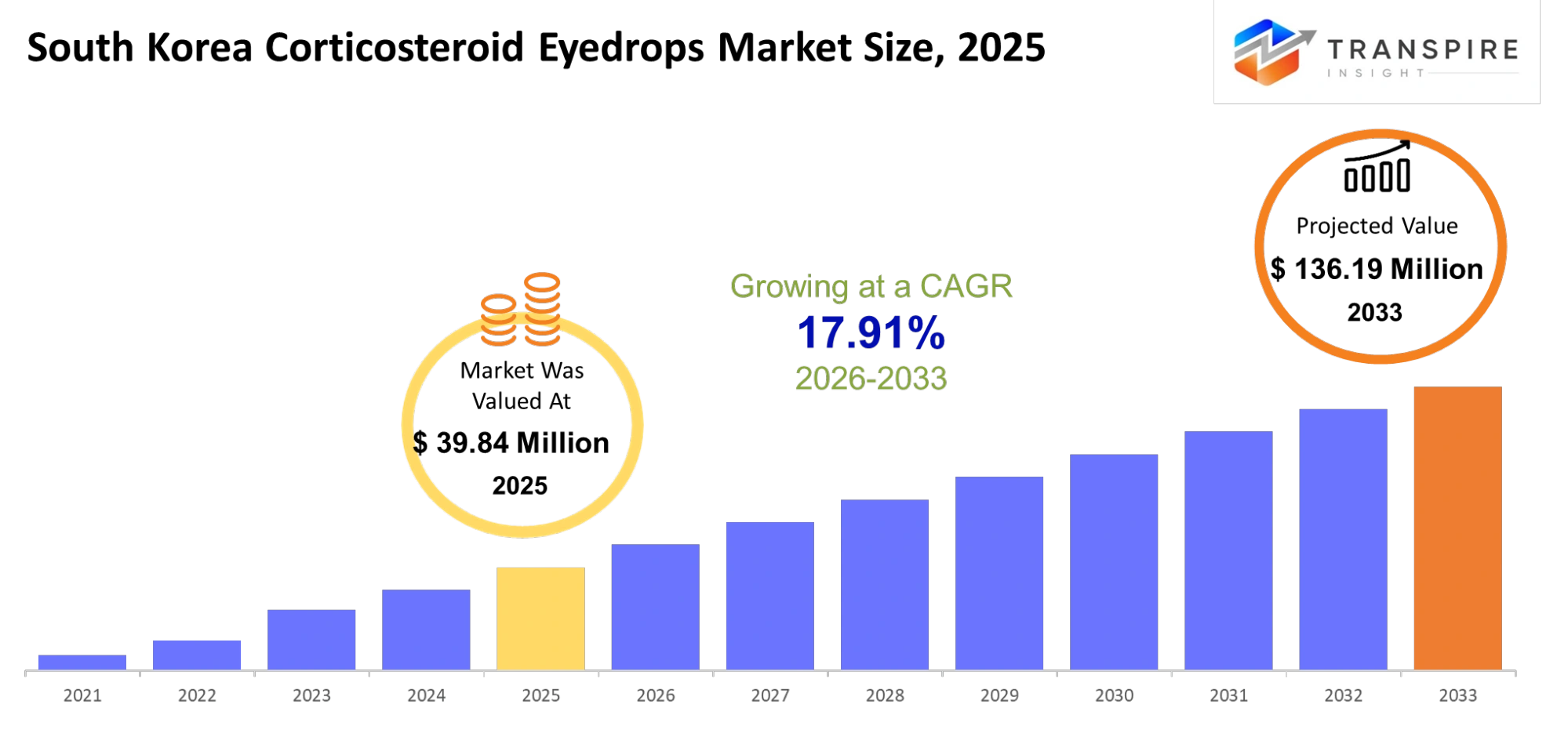
South Korea Corticosteroid Eyedrops Market Size & Forecast:
- South Korea Corticosteroid Eyedrops Market Size 2025: USD 39.84 Million
- South Korea Corticosteroid Eyedrops Market Size 2033: USD 136.19 Million
- South Korea Corticosteroid Eyedrops Market CAGR: 17.91%
- South Korea Corticosteroid Eyedrops Market Segments: By Type (Dexamethasone, Prednisolone, Fluorometholone, Loteprednol, Hydrocortisone, Others); By Application (Inflammation, Allergy, Post-surgery, Infection, Eye Disorders, Others); By End-User (Hospitals, Clinics, Pharmacies, Homecare, Eye Centers, Others); By Distribution (Hospital Pharmacy, Retail Pharmacy, Online Pharmacy, Specialty Stores, Direct Sales, Others)
To learn more about this report,  Download Free Sample Report
South Korea Corticosteroid Eyedrops Market Summary:
The South Korea Corticosteroid Eyedrops Market size is estimated at USD 39.84 Million in 2025 and is anticipated to reach USD 136.19 Million by 2033, growing at a CAGR of 17.91% from 2026 to 2033.
The South Korean market for corticosteroid eyedrops will undergo significant changes because of evolving medical practices and rising patient demands. The combination of new regulations that affect pharmaceutical industries together with advancements in precise drug delivery technology will change how doctors prescribe medications whereas increasing demands from customers will create a need for ophthalmic products that provide both safety and rapid effectiveness. The market participants will concentrate on developing better formulation stability together with enhanced patient comfort during their hospital protocols implementation and their distribution through expanding ophthalmology clinics which will establish their presence in both urban and semi-urban medical facilities. The market outlook will develop through research partnerships and new safety regulations which will shape product advantages and medical results across different treatment methods.
What Has the Impact of Artificial Intelligence Been on the South Korea Corticosteroid Eyedrops Market?
The South Korea corticosteroid eyedrops market has experienced operational changes because stakeholders now use digital tools to make better decisions. The AI-driven systems of the research market enable researchers to analyze extensive clinical and sales data which helps them understand changing market demands in the South Korean corticosteroid eyedrop market. Pharmaceutical planners use machine learning models to predict demand and track new market developments which enables them to adapt quickly to changing treatment methods and new regulations.
The South Korea corticosteroid eyedrops market benefits from smart automation and predictive analytics which enhance production processes and supply chain management by decreasing operational stoppages and improving asset distribution. artificial intelligence in South Korea corticosteroid eyedrops market operates formulation planning and quality control and distribution tracking which helps to improve operational accuracy. Continuous machine learning implementation enables companies to build better innovation pathways while developing customized ophthalmic products which help them gain market superiority and set new industry standards for future performance assessment.
Key Market Trends & Insights:
- South Korea's corticosteroid eyedrops market shows high concentration in urban areas because Seoul will generate almost 38 percent market share in 2025 through its advanced medical facilities and specialized eye treatment centers.
- The secondary metropolitan areas will become the fastest-growing market during the period from 2025 to 2030 because of better access to healthcare services.
- The South Korea corticosteroid eyedrops market product segmentation shows that low-dose corticosteroid formulations will control 42 percent market share in 2025 because their long-term use proves to be safer.
- The combination steroid-antibiotic eyedrops market segment will experience its strongest growth until 2030 because of the need to control infections after surgical procedures.
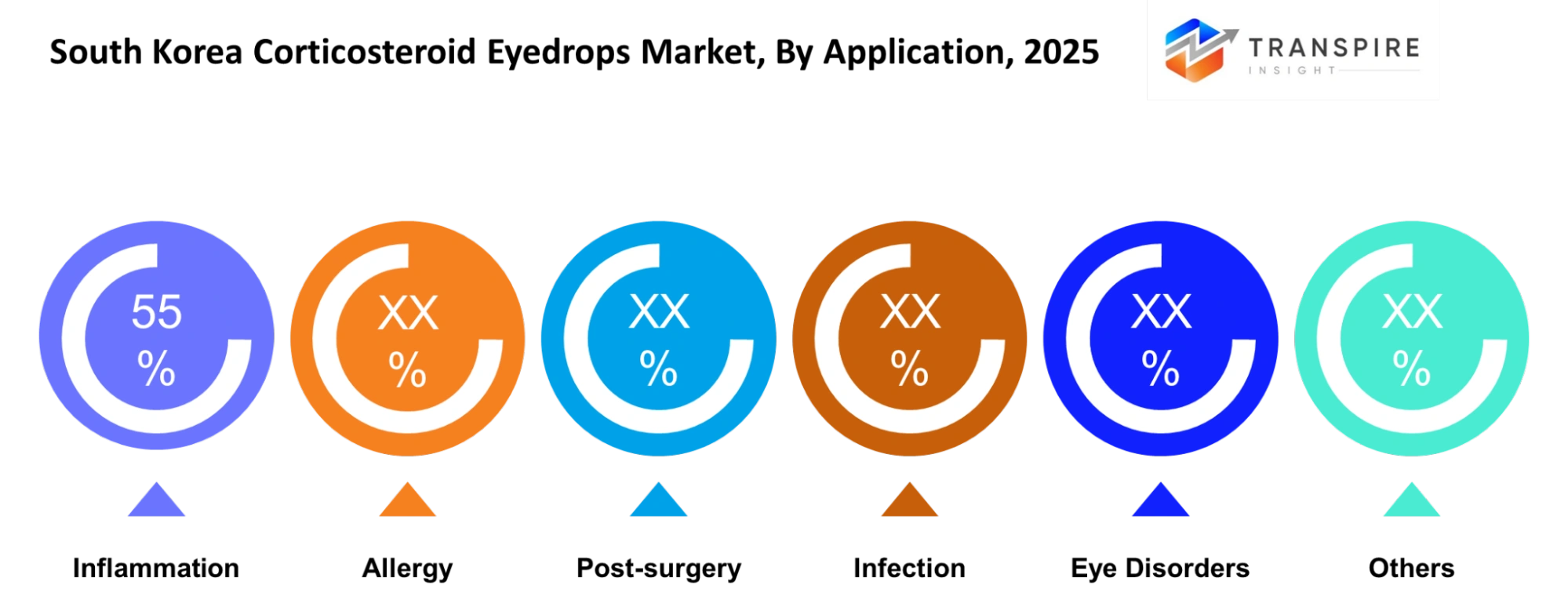
- The South Korea corticosteroid eyedrops market application distribution shows that postoperative inflammation management controls 45 percent of market share in 2025.
- The seasonal allergy problem has created high demand for allergic conjunctivitis treatment solutions.
- The South Korean corticosteroid eyedrops market hospitals account for prescription-based dispensing systems, which result in 55 percent market share, in 2025.
- The fastest-growing end-user segment will include eye clinics and specialty ophthalmic centers until 2030.
- The main companies which define the South Korean corticosteroid eyedrops market include Novartis Santen Pharmaceutical Bausch Lomb Alcon Pfizer and Hanmi Pharmaceutical.
- The South Korean corticosteroid eyedrops market players use AI-based clinical trials and formulation creation and partnership agreements to enhance their market power and grow their business in South Korea.
South Korea Corticosteroid Eyedrops Market Segmentation
By Type:
The South Korea Corticosteroid Eyedrops Market divides into different product categories which include Dexamethasone Prednisolone Fluorometholone Loteprednol Hydrocortisone and other products. Dexamethasone maintains strong market presence in South Korea through its prescription usage because of its powerful anti-inflammatory properties and extensive medical trust. Prednisolone maintains its market demand for moderate eye problems because hospitals prefer its controlled dosage system which allows them to treat patients effectively. Fluorometholone enables patients to use the medication safely for extended periods while patients choosing loteprednol experience better treatment results through its reduced side effects.
Hydrocortisone maintains a constant presence in the South Korean market for corticosteroid eyedrops but its applications are limited to mild cases which need brief treatment. The special treatment solutions use different medical formulas to meet unique needs that require customized approaches based on patient needs and their disease level. The overall type segmentation system creates equal distribution between powerful treatment medications and safe extended use eye care products which determine how doctors order medications in various medical environments.
By Application:
The South Korean market for corticosteroid eyedrops divides into different segments which serve various medical purposes including Inflammation Allergy Post-surgery Infection and Eye Disorders and Other uses. The South Korean market for corticosteroid eyedrops uses Inflammation treatment as its main function because of increased ocular irritation cases that stem from environmental exposure and screen usage. The demand for allergy-related products stays steady throughout the year particularly during times when urban residents experience seasonal changes which Affect their eye comfort and vision quality.
The South Korea Corticosteroid Eyedrops Market shows growing importance for post-surgery recovery care because ophthalmic procedures increase among elderly patients. Hospitals exercise strict medical oversight to manage infection-related medication use while uveitis and chronic irritation become reasons for hospitals and eye care centers to maintain high prescription rates.
To learn more about this report, Download Free Sample Report
By End-User:
The South Korea Corticosteroid Eyedrops Market divides into six segments based on end-user distribution which includes hospitals clinics pharmacies homecare facilities eye centers and other medical facilities. The South Korea Corticosteroid Eyedrops Market exists because hospitals are the main end users that treat patients with established prescription protocols.
Pharmacies support accessibility in the South Korea Corticeroid Eyedrops Market by making prescribed medicines available for customers to access easily. Home care usage remains limited but gradually expanding as patient awareness increases. Eye centers continue to grow steadily because patients increasingly demand specialized ophthalmic consultations and specific treatment options.
By Distribution:
The South Korea Corticosteroid Eyedrops Market distributes its products through six different channels which include Hospital Pharmacy Retail Pharmacy Online Pharmacy Specialty Stores Direct Sales and Other distribution methods. Hospital pharmacies dominate distribution in the South Korea Corticosteroid Eyedrops Market due to direct prescription linkage and controlled dispensing practices. Retail pharmacies maintain strong reach among outpatient consumers who seek regular medication refills and follow-up treatments which healthcare professionals prescribe.
Online pharmacy channels are gradually gaining traction in the South Korea Corticosteroid Eyedrops Market because digital healthcare adoption enables customers to make their purchases through online platforms. Specialty stores support limited but focused distribution whereas direct sales restrict their operations to institutional supply chains and organized procurement systems within healthcare networks.
What are the Main Challenges for the South Korea Corticosteroid Eyedrops Market Growth?
The South Korea corticosteroid eyedrops market continues to experience market constraints which arise from technical and operational restrictions because manufacturers need to maintain product stability while they work on creating consistent formulations. The storage conditions of multi-dose ophthalmic solutions create difficulties for maintaining their drug potency at all times.
The South Korea corticosteroid eyedrops market faces major production obstacles because manufacturers need to follow strict regulatory compliance requirements which include good manufacturing practices that extend production times. The approval process for ophthalmic corticosteroid products requires a lengthy period which prevents new formulations from entering the market more quickly. The combination of rising production costs together with quality assurance requirements creates challenges that reduce profitability while hindering business expansion. The South Korea corticosteroid eyedrops market demands regulatory processes which need less time and the ability to produce products more efficiently.
The South Korea corticosteroid eyedrops market faces challenges from both adoption issues and infrastructure limitations which especially impact smaller healthcare centers that lack access to advanced ophthalmic treatments. The restricted availability of specialized training in specific regions results in ineffective product application among healthcare professionals. Treatment access gaps arise from funding shortages which affect advanced eye care infrastructure, thus creating obstacles for the South Korea corticosteroid eyedrops market while preventing complete market expansion.
The South Korea corticosteroid eyedrops market faces growing uncertainty because of competitive market conditions and new treatment options. Traditional corticosteroid products face pricing challenges because of the increasing demand for non-steroidal treatment options and innovative drug delivery systems. The South Korea corticosteroid eyedrops market will experience market constraints because of rapid technological advancements and tighter safety standards, which will require ongoing product development to maintain market position.
Regional Insights
The South Korea Corticosteroid Eyedrops Market shows its highest sales volume through urban centers which contain advanced medical facilities and special eye care treatment centers. The cities of Seoul and Busan enable better eye care access through their advanced medical facilities which maintain higher eye care professional training standards. Patient education programs in these areas help patients understand treatment needs which leads to better treatment results.
The South Korea Corticosteroid Eyedrops Market shows two main distribution patterns which involve secondary cities and semi-urban areas. The adoption of the technology remains lower in these areas because residents need to travel farther to reach specialist services compared to people who live in metropolitan areas. The increasing financial investment into healthcare systems across various regions will lead to an equitable distribution of eye care services through time.
The South Korea Corticosteroid Eyedrops Market shows that rural areas still lack sufficient access to advanced eye care facilities which provide specialized ophthalmic treatments. The treatment outreach for corticosteroid therapies suffers from two main problems which include limited access to eye care facilities and insufficient knowledge about the treatment method. The upcoming market growth will benefit from government efforts to expand medical services across the region and telemedicine technology implementation.
Recent Development News
In January 2026, Formosa Pharmaceuticals announced an exclusive licensing agreement with Samil Pharmaceuticals to commercialize its corticosteroid-based clobetasol propionate ophthalmic suspension (APP13007) in South Korea, expanding its presence in the post-surgical ocular inflammation treatment market.https://biopharmaapac.com
In February 2026, Formosa Pharmaceuticals and Samil Pharmaceuticals formalized commercialization rights transfer and deal structuring (including milestone payments and royalties) for APP13007 corticosteroid eye drops in South Korea, strengthening cross-border ophthalmic drug partnerships in the region.https://flcube.com
|
Report Metrics |
Details |
|
Market size value in 2025 |
USD 39.84 Million |
|
Market size value in 2026 |
USD 42.99 Million |
|
Revenue forecast in 2033 |
USD 136.19 Million |
|
Growth rate |
CAGR of 17.91% from 2026 to 2033 |
|
Base year |
2025 |
|
Historical data |
2021 - 2024 |
|
Forecast period |
2026 - 2033 |
|
Report coverage |
Revenue forecast, competitive landscape, growth factors, and trends |
|
Regional scope |
South Korea |
|
Key company profiled |
Allergan, Novartis, Pfizer, Bausch & Lomb, Santen, Alcon, Roche, AbbVie, Johnson & Johnson, Sun Pharma, Cipla, Lupin, Hikma, Valeant, Teva |
|
Customization scope |
Free report customization (country, regional & segment scope). Avail customized purchase options to meet your exact research needs. |
|
Report Segmentation |
By Type (Dexamethasone, Prednisolone, Fluorometholone, Loteprednol, Hydrocortisone, Others); By Application (Inflammation, Allergy, Post-surgery, Infection, Eye Disorders, Others); By End-User (Hospitals, Clinics, Pharmacies, Homecare, Eye Centers, Others); By Distribution (Hospital Pharmacy, Retail Pharmacy, Online Pharmacy, Specialty Stores, Direct Sales, Others) |
How Can New Companies Establish a Strong Foothold in the South Korea Corticosteroid Eyedrops Market?
New companies entering the South Korea corticosteroid eyedrops market can establish a strong position by focusing on precision-based product differentiation and targeted clinical needs. The South Korea corticosteroid eyedrops market rewards firms that address unmet needs such as improved drug tolerance, preservative-free formulations, and safer long-term use options for chronic eye conditions. Startups like Selvas Healthcare (illustrative example in ophthalmic innovation space) show how niche positioning in eye care delivery systems can build early traction in competitive healthcare segments.
The South Korea corticosteroid eyedrops market will see hospitals and ophthalmology clinics and local distributors establish strategic partnerships to create better access to their products. Companies that integrate smart manufacturing practices and AI-supported quality control systems will improve production consistency and reduce regulatory delays. The collaboration with academic hospitals in South Korea will help validate clinical performance while building trust in new entrants within the South Korea corticosteroid eyedrops market.
Digital prescription tracking and patient monitoring tools which work with corticosteroid therapies will create additional technology advantages for businesses that focus on developing unique technologies. The South Korea corticosteroid eyedrops market will increasingly favor firms that combine pharmaceutical innovation with smart healthcare platforms. The startup "NeoVision Therapeutics" demonstrates how AI-based eye diagnosis tools together with personalized treatment mapping can help businesses create competitive advantages.
New companies in the South Korea corticosteroid eyedrops market will achieve sustainable business operations through their dedication to focused innovation and effective production methods and their development of strong local business relationships which help them meet changing medical requirements and compliance regulations.
Key South Korea Corticosteroid Eyedrops Market Company Insights
The competitive environment of the South Korea Corticosteroid Eyedrops Market shows active participation from international pharmaceutical firms and local Korean companies. The main companies dedicate their resources to developing innovative ophthalmic products which include safer methods for delivering corticosteroids and technologies that enhance patient adherence to treatment. The strict quality requirements together with the powerful procurement systems used by hospitals create a competitive environment which determines which products will be accepted and which will stay in the market for extended periods.
The South Korea corticosteroid eyedrops market shows competitive dynamics through the presence of major players which include Novartis Santen Pharmaceutical Alcon Bausch + Lomb Pfizer and Hanmi Pharmaceutical. The companies conduct research programs which enhance drug stability and decrease side effects through their investments. The companies establish strategic partnerships with hospitals and distribution companies to expand their product distribution while conducting their operations in clinical settings.
New entrants in the South Korea Corticosteroid Eyedrops Market focus on innovation in formulation design and digital healthcare integration to gain competitive advantage. The industry will use preservative-free solutions and personalized treatment methods as its main differentiation tools. The established brands apply strong pricing pressure which creates market difficulties but the company will improve its market position through innovation-based strategies and specific business partnerships.
Company List
- Allergan
- Novartis
- Pfizer
- Bausch & Lomb
- Santen
- Alcon
- Roche
- AbbVie
- Johnson & Johnson
- Sun Pharma
- Cipla
- Lupin
- Hikma
- Valeant
- Teva
What are the Key Use-Cases Driving the Growth of the South Korea Corticosteroid Eyedrops Market?
The market for corticosteroid eyedrops in South Korea is growing because hospitals and specialty clinics now use structured methods to treat ophthalmic inflammation. The primary reason for market growth is that hospitals need corticosteroid eyedrops to treat patients after cataract and refractive surgery operations. The South Korean market for corticosteroid eyedrops experiences growth because urban residents who spend long hours in front of screens and face pollution exposure now develop allergic conjunctivitis at increasing rates.
The South Korean corticosteroid eyedrops market demonstrates its second major application through chronic eye disorder management which includes diseases like uveitis and recurrent inflammatory disorders that need extended observation. The medical facilities and ocular treatment centers use controlled corticosteroid therapy to help patients experience symptom relief while also stopping future health problems. The ongoing demand for clinical services drives prescription numbers up while maintaining consistent product usage throughout the healthcare system in South Korea which operates within the South Korea corticosteroid eyedrops market.
The South Korea corticosteroid eyedrops market operates under two different treatment systems because medical professionals use corticosteroids with antimicrobial medications to treat eye infections. The growing number of outpatient appointments combined with better diagnostic methods leads to more patients starting their treatment during early disease stages. The South Korea corticosteroid eyedrops market experiences slow growth in specialized eye clinics which develop treatment plans based on precise medical information.
Digital monitoring systems that observe treatment results together with personalized eye care will create new use cases for future development. The new medical solutions will help patients achieve better health results while they also provide manufacturers with new methods to expand their businesses in the South Korean corticosteroid eye drop market.
South Korea Corticosteroid Eyedrops Market Report Segmentation
By Type
- Dexamethasone
- Prednisolone
- Fluorometholone
- Loteprednol
- Hydrocortisone
- Others
By Application
- Inflammation
- Allergy
- Post-surgery
- Infection
- Eye Disorders
- Others
By End-User
- Hospitals
- Clinics
- Pharmacies
- Homecare
- Eye Centers
- Others
By Distribution
- Hospital Pharmacy
- Retail Pharmacy
- Online Pharmacy
- Specialty Stores
- Direct Sales
- Others
Frequently Asked Questions
Find quick answers to common questions.
The approximate South Korea Corticosteroid Eyedrops Market size for the market will be USD 136.19 Million in 2033.
Key segments for the South Korea Corticosteroid Eyedrops Market are By Type (Dexamethasone, Prednisolone, Fluorometholone, Loteprednol, Hydrocortisone, Others); By Application (Inflammation, Allergy, Post-surgery, Infection, Eye Disorders, Others); By End-User (Hospitals, Clinics, Pharmacies, Homecare, Eye Centers, Others); By Distribution (Hospital Pharmacy, Retail Pharmacy, Online Pharmacy, Specialty Stores, Direct Sales, Others).
Major South Korea Corticosteroid Eyedrops Market players are Allergan, Novartis, Pfizer, Bausch & Lomb, Santen, Alcon, Roche, AbbVie, Johnson & Johnson, Sun Pharma, Cipla, Lupin, Hikma, Valeant, Teva.
The South Korea Corticosteroid Eyedrops Market size is USD 39.84 Million in 2025.
The South Korea Corticosteroid Eyedrops Market CAGR is 17.91%.
- Allergan
- Novartis
- Pfizer
- Bausch & Lomb
- Santen
- Alcon
- Roche
- AbbVie
- Johnson & Johnson
- Sun Pharma
- Cipla
- Lupin
- Hikma
- Valeant
- Teva
Recently Published Reports
-
Dec 2025
Biosimilars Market
Biosimilars Market By Product Type (Monoclonal Antibodies, Recombinant Hormones, Erythropoietin, G-CSF, Others), By Indication (Oncology, Autoimmune Diseases, Blood Disorders, Diabetes, Others), By Manufacturing Type (In-House Manufacturing, Contract Manufacturing), By Distribution Channel (Hospital Pharmacies, Retail Pharmacies, Online Pharmacies), By Industry Analysis, Size, Share, Growth, Trends, and Forecasts 2021-2033
-
Dec 2025
Gastrointestinal Endoscopy Market
Gastrointestinal Endoscopy Market By Type (Rigid Gastrointestinal Endoscope, Flexible Gastrointestinal Endoscopes, Disposable Gastrointestinal Endoscope), By Procedure Type (Colonoscopy, Gastroscopy, Duodenoscopy, Enteroscopy, Flexible Sigmoidoscopy, Others), By Application (Diagnosis, Treatment), By End-Users (Hospitals, Ambulatory Surgical Centers, Specialty Clinics, Laboratories, Others), By Industry Analysis, Size, Share, Growth, Trends, and Forecasts 2021-2033
-
Jan 2026
Rare Inherited Metabolic Disorder Drug Market
Rare Inherited Metabolic Disorder Drug Market By Drug Class (Enzyme Replacement Drugs, Gene Therapy Drugs, Substrate Reduction Drugs, Small Module Drugs, Protein Drugs), By Route of Administration(Parenteral, Oral, Intrathecal), By Clinical Development (Marketed Drugs, Late Stage Clinical Phase III, Early Stage Clinical Phase I-II, Preclinical Candidates), By Indication (Lysosomal Storage Disorders, Urea Cycle Disorders, Amino Acid Metabolic Disorders, organic Acidemias, Peroximal Disorders), By Industry Analysis, Size, Share, Growth, Trends, and Forecasts 2021-2033
-
Jan 2026
Pharmaceutical Cleanroom Technology Market
Pharmaceutical Cleanroom Technology Market By Product (Equipment, Consumables, Services); By Cleanroom Type (Standard Cleanrooms, Modular Cleanrooms); By End Use (Pharmaceutical Companies, Biotechnology Companies), By Industry Analysis, Size, Share, Growth, Trends, and Forecasts 2021-2033