

North America Impregnated Foam Dressing Market Size & Forecast:
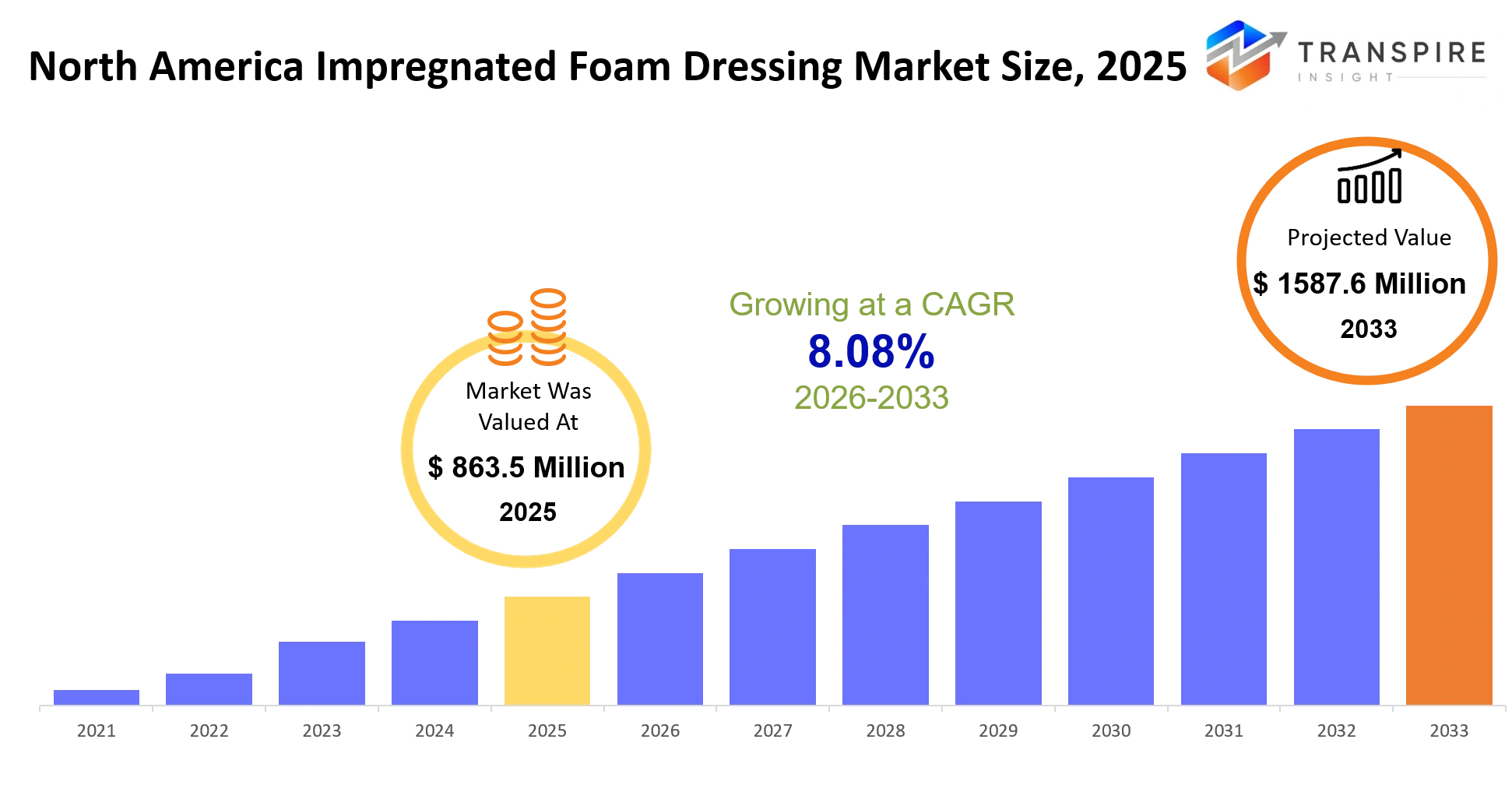
- North America Impregnated Foam Dressing Market Size 2025: USD 863.5 Million
- North America Impregnated Foam Dressing Market Size 2033: USD 1587.6 Million
- North America Impregnated Foam Dressing Market CAGR: 8.08%
- North America Impregnated Foam Dressing Market Segments: By Product Type (Silver Foam Dressings, Silicone Foam Dressings, Antimicrobial Foam Dressings, Hydrocellular Foam Dressings, Others), By Application (Chronic Wounds, Surgical Wounds, Burn Care, Pressure Ulcers, Others), By End User (Hospitals, Clinics, Home Healthcare, Others), By Material (Polyurethane Foam, Silicone Foam, Hydrogel Foam, Others).
To learn more about this report,  Download Free Sample Report
North America Impregnated Foam Dressing Market Summary:
The North America Impregnated Foam Dressing Market size is estimated at USD 863.5 Million in 2025 and is anticipated to reach USD 1587.6 Million by 2033, growing at a CAGR of 8.08% from 2026 to 2033.In North America, the impregnated foam dressing market plays a fairly big part in modern wound management, it helps clinicians keep infection under control, deal with wound fluid, and push recovery forward in difficult cases like diabetic foot ulcers, pressure injuries, thermal burns, and post surgical wounds. In practice, these foam based products also can cut down how often dressings need to be swapped out, and that tends to support improved clinical results. Because of that, healthcare teams are often able to reduce overall treatment expenses and speed up discharge or recovery timelines.
In the last three to five years, the market has been kind of moving in a more structured way toward upgraded antimicrobial formulations. Like, especially popular now are dressings that are impregnated with silver, iodine, and other bioactive agents. This shift somewhat resembles the broader healthcare focus on stopping wound problems early , before they spiral into something that needs costly and intensive treatment. One clear catalyst was the disruption of hospital routines and care pathways during the COVID-19 pandemic, where demand went up for materials that can stay in place longer and also cut down on how much face-to- face clinician time is needed per patient. At the same time, chronic conditions are staying high, and outpatient wound care volumes keep climbing. So providers are gravitating toward higher performance dressings that promise quicker healing efficiency and more reliable results. All of this is pushing revenue growth for premium wound care products, and they are now being used more often in hospital environments as well as community care settings, too.
Key Market Insights
- The United States really leads the North America Impregnated Foam Dressing Market, with more than 75% market share in 2025, it kinda stays on top for a reason.
- Strong reimbursement frameworks and pretty advanced wound care infrastructure keep the industry size big there. Canada on the other hand shows the fastest regional climb during the forecast window, this is backed by expanding outpatient wound care services, and more care being delivered outside hospitals.
- Meanwhile growing healthcare spending, plus aging demographics, are still adding extra pull to the demand side across the region.
- Within the product space, silver-impregnated foam dressings are leading, they take roughly 45% of the total revenue share in 2025, and that share holds steady.
- Antimicrobial foam dressings stay in second place because they are used widely in wounds that are more likely to get infected, basically infection-prone settings.
- Iodine-impregnated foam dressings are expected to grow the quickest through 2032.
- Product development is leaning into improved absorption and stronger antimicrobial performance, so segment growth rates are picking up.
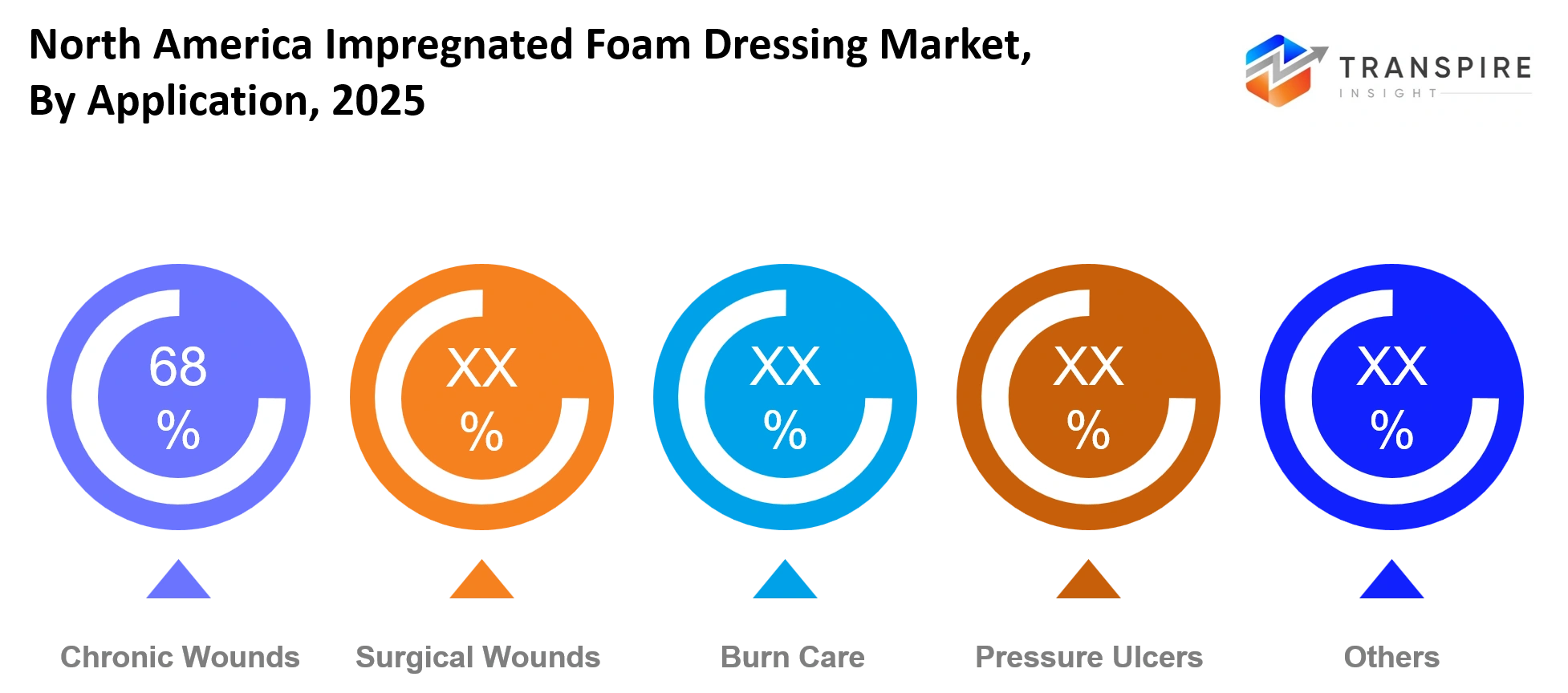
- For applications, chronic wound management dominates, it contributes close to 50% of the North America Impregnated Foam Dressing Market revenue.
- Diabetic foot ulcers plus pressure ulcers keep creating heavy demand across healthcare facilities, especially where long-term care is common.
- Surgical wound care meanwhile is the fastest-growing application segment through the forecast period, driven by more surgical work and follow-up infection prevention efforts.
- When it comes to end users, hospitals control the market, they account for about 55% of total end-user revenue in 2025.
- Acute care facilities also hold a meaningful slice because wound treatments there are high in volume and complexity.
- Ambulatory surgical centers seem to be the fastest-growing end-user category through 2032, as more procedures shift toward outpatient models.
What are the Key Drivers, Restraints, and Opportunities in the North America Impregnated Foam Dressing Market?
The strongest force driving the North America Impregnated Foam Dressing Market is basically the shift toward value based wound care where providers are judged on clinical results and overall treatment costs rather than just procedure volume . This change picked up speed when hospitals and insurers started seeing bigger bills from chronic wounds , especially diabetic foot ulcers and pressure injuries. Impregnated foam dressings, mainly antimicrobial versions , tend to help curb infection rates, reduce how often dressings need replacing, and shorten healing timeframes. At the same time , healthcare systems are trying to cut readmissions and dodge expensive complications, so the use of these more advanced dressings moved out of only specialist wound centers and into more general acute and outpatient care . That shift is one of the key reasons market revenue keeps climbing.
The biggest obstacle is the continuing reimbursement and budget gap between advanced wound care products and conventional dressings . A lot of providers , especially smaller facilities and long term care centers , work within fixed reimbursement models that don’t really reflect the longer term economic gains from higher priced dressings. This is structural, since reimbursement rules, procurement systems, and even clinical practice guidelines tend to update slowly. Because of that, buyers often choose based on the upfront price rather than the lifetime savings from better outcomes , which ends up delaying adoption and keeping market penetration smaller than it could be .
A big growth possibility sits in plugging impregnated foam dressings together with remote wound monitoring and home based care programs, sorta like one loop, not separate pieces. In North America things are moving fast with outpatient and home healthcare services , since healthcare systems keep trying to cut inpatient costs. So advanced dressings that can stay on for extended wear kinda match what is being asked for. For instance, money going into digital wound assessment platforms lets clinicians track progress from a distance while patients handle their treatment at home . With this pairing, product use can grow, continuity of care gets better, and it can open new revenue currents across community wound management.
What Has the Impact of Artificial Intelligence Been on the North America Impregnated Foam Dressing Market?
Artificial intelligence and some advanced digital technologies are slowly reshaping the North America Impregnated Foam Dressing Market, mostly by changing how wounds are assessed, how treatment plans are built, and how clinical routines move day to day. AI powered wound imaging tools, like those that run on a smartphone or tablet , can take care of wound measurement by themselves, and they can also flag tissue features while watching healing progress over time. When this part is automated , clinicians spend less time doing manual notes, and they get a more uniform way to decide what to do next across different care sites, even when teams are a bit different.
Machine learning is also showing up in the background to forecast wound recovery paths and to spot people who may be at higher risk of infection or delayed recovery. These models look at past patient notes, the wound’s own properties, and the outcomes of prior treatments. From that they help clinicians choose suitable antimicrobial or impregnated foam dressings earlier in the care timeline. With predictive analytics doing that early sorting, the system can lower unneeded dressing changes, make product use more efficient, and support better resource planning in hospitals as well as outpatient wound care centers.
In day to day operations, healthcare providers are mentioning better documentation accuracy, quicker clinical checks, and steadier treatment protocols overall. Plus, remote monitoring helps with home based wound management , so clinicians can keep an eye on progress without having to see patients in person all the time.
That said, one major snag is still data quality and interoperability. A lot of wound care information is scattered across healthcare organizations, so it’s harder to train AI models that are truly accurate. On top of that, the integration effort plus regulatory obligations can slow adoption, especially for smaller providers that don’t have strong digital infrastructure yet.
Key Market Trends
- Since 2020, hospitals have kind of shifted their procurement toward silver-impregnated dressings, as infection prevention became a higher priority throughout wound care protocols, which is sort of important I guess.
- Manufacturers are now competing more on clinical outcome data instead of just product volume, this mirrors the value-based reimbursement trends happening across North American healthcare systems.
- Home healthcare adoption picked up after 2021, so there was a clear preference for dressings that need fewer changes and reduce clinician intervention, how much less… you know?
- Between 2022 and 2025, digital wound assessment platforms gained traction, helping providers standardize treatment selection and track healing progression remotely without as much friction.
- Companies like 3M and Smith+Nephew expanded their advanced wound care portfolios through product innovation , and evidence-based positioning that actually sticks.
- Procurement teams increasingly look at total treatment costs rather than unit pricing, which reinforces adoption of premium antimicrobial foam dressing technologies even when budgets get tight.
- After 2020, outpatient wound care centers captured a larger portion of treatment volumes, as healthcare systems pushed for lower-cost care delivery models, probably to stay lean.
- Development work has moved toward bioactive and multi-functional dressings, combining moisture management antimicrobial protection and extended wear performance , in one kind of package.
- During the supply chain disruptions in 2020–2022, manufacturers were encouraged to diversify sourcing strategies, and also tighten up regional inventory management capabilities.
- AI-enabled wound monitoring tools showed up as a differentiator after 2023, supporting personalized treatment decisions and also helping allocate resources more efficiently, for sure.
North America Impregnated Foam Dressing Market Segmentation
By Product Type
In terms of product type, silver foam dressings kind of take the lead, largely because there is strong clinical acceptance for dealing with infected and high risk wounds, not just “basic” cases. Antimicrobial foam dressings also grab a noticeable portion of demand, since many healthcare providers are shifting more attention to infection prevention and fewer treatment complications at once. Meanwhile silicone foam dressings keep a steady foothold for delicate wound situations where atraumatic removal is crucial , like when patients can’t tolerate extra disturbance.
Hydrocellular foam dressings still show up often in cases needing high absorbency and careful moisture balance, while the other specialty products move into smaller niche treatment areas. The growth pattern isn’t identical across every category. Generally, silver and antimicrobial variants ride on evidence based wound care protocols, whereas silicone offerings get extra momentum from patient comfort considerations and that whole “leave it in place” feel. Going forward, development is expected to point toward multifunctional products that blend antimicrobial action, longer wear time, and more advanced exudate management. That path should open up room for manufacturers to stand out with clearer portfolio choices and also help healthcare systems improve treatment efficiency, overall.
By Application
In terms of application, chronic wounds make up the leading segment, because diabetic foot ulcers, venous leg ulcers, and those long-duration pressure injuries need constant supervision and more frequent clinical attention. Surgical wounds sit in the second place, or at least that seems to be the case, as hospitals keep adopting advanced dressings to lower infection risk and help recovery outcomes. Meanwhile burn care and pressure ulcer management keep pulling in steady demand, especially in specialized treatment centers and in long-term care settings.
Honestly each application kind of follows its own demand rhythm and it rarely lines up perfectly. Chronic wounds track demographic shifts like an aging population, plus higher diabetes rates, while surgical use is more tied to procedure volumes and the usual post-operative care rules. Looking ahead, advanced wound management protocols are likely to spread through multiple care environments, which should push broader adoption of premium dressing technologies, and that can translate into more consistent revenue across the different application segments.
To learn more about this report, Download Free Sample Report
By End-User
For end users, hospitals still look like the biggest slice, mostly because tricky wound cases, tend to need a sort of multidisciplinary approach , solid clinical know-how and also access to specialized wound care items. Clinics hold a meaningful share too, outpatient treatment models are continuing to stretch across North America, so more patients get managed outside inpatient settings. Home healthcare is basically the fastest-growing part, driven by healthcare cost pressures and the general preference to receive care beyond acute care facilities.
Other end users such as long term care centers, and rehabilitation facilities, keep showing steady demand for chronic wound management products, even if the pace is a bit different. Each category has its own growth triggers. Hospitals tend to focus on clinical performance and infection control, while home healthcare organizations look for wound dressings that cut down on dressing changes and help simplify care delivery. In the future, market growth should depend more and more on solutions made for decentralized care environments, which pushes manufacturers to build products that balance real clinical effectiveness with day to day ease of use.
By Material
So for material side of things, polyurethane foam basically runs the show, mainly because it shows high absorbency, holds up well, and can help keep the wound healing environment in a sort of optimal balance. After that, silicone foam comes next as a notable slice, mostly due to its mild adhesion behavior and its fit for fragile skin, where you do not want harsh sticking. Hydrogel foam products then take a smaller but still growing role, in situations where wounds need extra moisture retention, plus stronger tissue support.
Beyond that, the other material categories keep showing up to meet specific clinical needs, where standard formulas just aren’t doing enough in practice. Also, the choice of material is leaning more and more on treatment results, patient comfort, and overall care costs, not just the starting price of the product. Looking forward, innovation should likely concentrate on more advanced material engineering, aiming to enhance antimicrobial delivery, improve moisture control, and extend wear duration. If that happens, it should make products more distinct from each other and make it easier for more people to adopt them, in hospitals as well as home-based wound care.
What are the Key Use Cases Driving the North America Impregnated Foam Dressing Market?
The main reason impregnated foam dressings exist is for chronic wound management, especially diabetic foot ulcers, venous leg ulcers, and pressure injuries. You can see the biggest pull from hospitals, and also wound care specialty centers, because these types of injuries need long treatment cycles , strict infection control, and really good exudate handling, otherwise complications pop up and patients end up back again sooner than they should.
Adoption is quietly moving outward too, into post surgical wound care and burn treatment. More surgical departments are leaning on antimicrobial foam dressings, to lower infection risks and help the recovery process after complicated procedures. At the same time, outpatient clinics and ambulatory care centers are adding newer dressings as well, partly to speed up care and also to cut down on extra follow up visits.
What’s next, people are starting to talk about remote wound management, and home healthcare programs, often supported by digital wound monitoring tools. Long term care facilities are also checking out advanced impregnated dressings for older patients, especially where skin is fragile and wounds tend to come back. Today these uses are still sort of limited, but they seem ready to grow faster once healthcare systems keep shifting treatment away from only traditional hospital settings and more toward community based models.
|
Report Metrics |
Details |
|
Market size value in 2025 |
USD 863.5 Million |
|
Market size value in 2026 |
USD 921.8 Million |
|
Revenue forecast in 2033 |
USD 1587.6 Million |
|
Growth rate |
CAGR of 8.08% from 2026 to 2033 |
|
Base year |
2025 |
|
Historical data |
2021 - 2024 |
|
Forecast period |
2026 - 2033 |
|
Report coverage |
Revenue forecast, competitive landscape, growth factors, and trends |
|
Country scope |
North America (Canada, The United States, and Mexico) |
|
Key company profiled |
Smith & Nephew, Mölnlycke Health Care, ConvaTec, 3M, Coloplast, Medline Industries, Cardinal Health, Hartmann Group, Lohmann & Rauscher, Integra LifeSciences, Organogenesis, B. Braun, Derma Sciences, Hollister Incorporated, Advanced Medical Solutions. |
|
Customization scope |
Free report customization (country, regional & segment scope). Avail customized purchase options to meet your exact research needs. |
|
Report Segmentation |
By Product Type (Silver Foam Dressings, Silicone Foam Dressings, Antimicrobial Foam Dressings, Hydrocellular Foam Dressings, Others), By Application (Chronic Wounds, Surgical Wounds, Burn Care, Pressure Ulcers, Others), By End User (Hospitals, Clinics, Home Healthcare, Others), By Material (Polyurethane Foam, Silicone Foam, Hydrogel Foam, Others). |
Which Regions are Driving the North America Impregnated Foam Dressing Market Growth?
The United States basically leads the regional market, mostly because it has an extensive healthcare setup, a huge chronic wound patient pool, and solid reimbursement backing for advanced wound care products. In practice, hospitals wound care centers and even bigger integrated health networks routinely choose premium dressings, but only when clinical evidence kinda shows fewer complications, plus better healing results. Regulatory oversight, along with well known clinical standards, also pushes adoption of advanced antimicrobial approaches and moisture management technologies in wound therapy. And there is this mature ecosystem, with manufacturers , distributors, research institutions, and specialized care providers all working together, which keeps reinforcing the overall leadership.
Canada is the second-largest regional market, yet the growth route feels different than in the United States. Provincial healthcare systems lean hard into long-term cost efficiency, so the demand tends to stay steady for products that can shorten treatment duration and reduce the number of hospital visits. With consistent health spending, plus a growing elderly population, market expansion gets a fairly reliable base. Because of that, Canada stays a meaningful revenue contributor even if the adoption timelines are a bit more measured, and procurement is more centralized.
Mexico, meanwhile, is showing up as the fastest-growing market as healthcare modernization efforts widen access to advanced wound care across both public and private facilities. More investment in hospital infrastructure, specialty clinics, and chronic disease management programs has made higher value dressing products easier to obtain. Also, diabetes prevalence keeps rising, and that has created additional demand for practical solutions that help handle complicated wounds and prevent setbacks. For the 2026–2033 window, growth is expected to open up quite attractive opportunities.
Who are the Key Players in the North America Impregnated Foam Dressing Market and How Do They Compete?
Competition in the North America Impregnated Foam Dressing Market looks moderately consolidated, i mean not totally split up but also not one giant wall either. Most of the hospital procurement channels are influenced by a small set of multinational wound care manufacturers, while regional specialists tend to go after more specific clinical niches. These days, the real fight is about technology and clinical evidence, not simply price. Healthcare providers are increasingly looking at infection control, wear time, patient comfort, and the overall treatment cost. At the same time incumbents try to hold their position via portfolio expansion, reimbursement support programs, and investments in clinical studies. Smaller entrants, in contrast, often focus on outpatient and home healthcare segments that are still underserved, using specialized formulations.
3M stands out because it has broad healthcare integration and strong relationships with hospital purchasing networks. They mix advanced dressing technologies with training and clinical support services, so adoption is smoother for larger health systems. Smith+Nephew, on the other hand, leans hard on innovation in antimicrobial and moisture-management dressings, and it leans on its wound care know how to position products for difficult chronic wounds. They’ve also expanded through acquisitions and partnerships which help reinforce their advanced wound management offerings and improve global distribution reach.
Mölnlycke Health Care sort of focuses on premium wound care products that aim to improve healing outcomes, and also reduce how often dressings need changing , especially when you are in hospital and surgical settings. Convatec Group meanwhile really emphasizes integrated chronic wound care solutions, plus it has a broad product range that goes across acute care , outpatient programs and home care environments. Coloplast has built its differentiation more around patient-centered wound management and they’ve expanded by boosting their presence in community care and home healthcare channels where ease of use and long wear times are being valued more and more by providers and payers.
Company List
- Smith & Nephew
- Mölnlycke Health Care
- ConvaTec
- 3M
- Coloplast
- Medline Industries
- Cardinal Health
- Hartmann Group
- Lohmann & Rauscher
- Integra LifeSciences
- Organogenesis
- B. Braun
- Derma Sciences
- Hollister Incorporated
- Advanced Medical Solutions
Recent Development News
In February 2026, Solventum beat quarterly estimates on strong demand for wound care products: Medical technology company Solventum reported quarterly results that exceeded market expectations, citing strong demand for its wound care and sterilization product portfolio. The company remains a major supplier of advanced wound dressings used across North American healthcare facilities, making the announcement relevant to the impregnated foam dressing segment.
Source: https://www.reuters.com
In May 2026, Solventum Reports First Quarter 2026 Financial Results: Solventum announced its first-quarter 2026 financial results and outlined continued focus on its medical-surgical and advanced wound care businesses. The company’s wound management portfolio includes several dressing technologies widely used in North America, supporting ongoing investment in the sector.
Source: https://investors.solventum.com
What Strategic Insights Define the Future of the North America Impregnated Foam Dressing Market?
The North America Impregnated Foam Dressing Market is kinda shifting, toward outcome based wound management, where the choice of product will more and more hinge on proven clinical and economic value, instead of those usual procurement numbers. The main reason for this change is the rising financial weight of chronic wounds, and it is basically pushing healthcare systems to move toward tools that lower complications, speed up healing, and help care happen beyond hospitals. Over the next five to seven years, advanced dressings will get more and more linked with digital wound evaluation and remote patient monitoring systems.
A risk that does not get talked about enough is how concentrated the market can be, within a small set of suppliers for specialized antimicrobial materials plus advanced foam substrates. Any supply disruption or even pricing pressure on these inputs could quietly squeeze margins and reduce product availability, even while demand stays strong. On the opportunity side, an important emerging angle is digitally supported home wound care, especially for diabetic and older patient groups. Market players should really lean into collaborations with remote monitoring providers, and they should also build solid real world evidence, since upcoming purchasing decisions will likely reward measurable treatment results more than product details, alone.
North America Impregnated Foam Dressing Market Report Segmentation
By Product Type
- Silver Foam Dressings
- Silicone Foam Dressings
- Antimicrobial Foam Dressings
- Hydrocellular Foam Dressings
- Others
By Application
- Chronic Wounds
- Surgical Wounds
- Burn Care
- Pressure Ulcers
- Others
By End User
- Hospitals
- Clinics
- Home Healthcare
- Others
By Material
- Polyurethane Foam
- Silicone Foam
- Hydrogel Foam
- Others
Frequently Asked Questions
Find quick answers to common questions.
The approximate North America Impregnated Foam Dressing Market size for the market will be USD 1587.6 Million in 2033.
The key segments of the North America Impregnated Foam Dressing Market are By Product Type (Silver Foam Dressings, Silicone Foam Dressings, Antimicrobial Foam Dressings, Hydrocellular Foam Dressings, Others), By Application (Chronic Wounds, Surgical Wounds, Burn Care, Pressure Ulcers, Others), By End User (Hospitals, Clinics, Home Healthcare, Others), By Material (Polyurethane Foam, Silicone Foam, Hydrogel Foam, Others).
Major players in the North America Impregnated Foam Dressing Market are Smith & Nephew, Mölnlycke Health Care, ConvaTec, 3M, Coloplast, Medline Industries, Cardinal Health, Hartmann Group, Lohmann & Rauscher, Integra LifeSciences, Organogenesis, B. Braun, Derma Sciences, Hollister Incorporated, Advanced Medical Solutions.
The current market size of the North America Impregnated Foam Dressing Market is USD 863.5 Million in 2025.
The North America Impregnated Foam Dressing Market CAGR is 8.08%.
- Smith & Nephew
- Mölnlycke Health Care
- ConvaTec
- 3M
- Coloplast
- Medline Industries
- Cardinal Health
- Hartmann Group
- Lohmann & Rauscher
- Integra LifeSciences
- Organogenesis
- B. Braun
- Derma Sciences
- Hollister Incorporated
- Advanced Medical Solutions
About the Authors

Pankaj Ghogare Patil
I am Pankaj Ghogare Patil, a Senior Research Analyst at Transpire Insight, specializing in the Pharmaceutical, Chemicals & Materials, Healthcare IT, and Biotechnology industry. My expertise lies in conducting comprehensive market research, analyzing industry trends, evaluating competitive landscapes, and translating complex data into actionable insights. At Transpire Insight, I closely follow emerging technologies, regulatory developments, and market innovations to create accurate, well-researched, and informative content that helps businesses and professionals make informed decisions. I am committed to producing credible, evidence-based articles that reflect industry best practices while making technical topics accessible and valuable for a broad audience.

Chakradhar Khansole
Chakradhar serves as the Research Director at Transpire Insight, bringing over 8 years of experience in technology, innovation, and strategic market intelligence. He specializes in transforming complex market data into actionable business insights that enable organizations to make informed, growth-oriented decisions. Recognized for his strategic vision and analytical expertise, Chakradhar leads high-impact research initiatives, delivering comprehensive market assessments, competitive intelligence, and forward-looking industry analysis.
Recently Published Reports
-
Apr 2026
AI in Diabetic Retinopathy Market
AI in Diabetic Retinopathy Market Size, Share & Analysis Report By Type (Screening AI Systems, Diagnostic AI Systems, and Predictive AI Models), By Application Segment (Hospitals, Ophthalmology Clinics, Diagnostic Centers, and Research and Development), and Geography (North America, Europe, Asia-Pacific, Middle East and Africa, South and Central America), 2021 - 2031
-
Apr 2026
Psychometric Tests Market
Psychometric Tests Market Size, Share & Analysis Report By Type (Personality Tests, Ability/Aptitude Tests, Skill/Knowledge Tests, and Others), By Application (Talent Acquisition and Talent Management), and Geography (North America, Europe, Asia-Pacific, Middle East and Africa, South and Central America), 2021 – 2031
-
Apr 2026
Rare Biological Sample Collection Market
Rare Biological Sample Collection Market Size, Share & Analysis Report By Type (Isolation Kits & Reagent, Blood Collection Tubes, and Others), By Application (Oncology, Transcriptomics, Pharmacogenomics, and Others), and Geography (North America, Europe, Asia-Pacific, Middle East and Africa, South and Central America), 2021 – 2031
-
Jul 2026
Diabetic Retinopathy Market
Diabetic Retinopathy Market Size, Share & Analysis Report By Type (Proliferative Diabetic Retinopathy, and Diabetic Macular Edema (DME)), By Treatment Type (Anti VEGF Drug, Steroid Implants, Laser Surgeries, and Vitrectomy), and Geography (North America, Europe, Asia-Pacific, Middle East and Africa, South and Central America), 2021 – 2031
Our Clients







