

United Kingdom Antimicrobial Wound Dressing Market Size & Forecast:
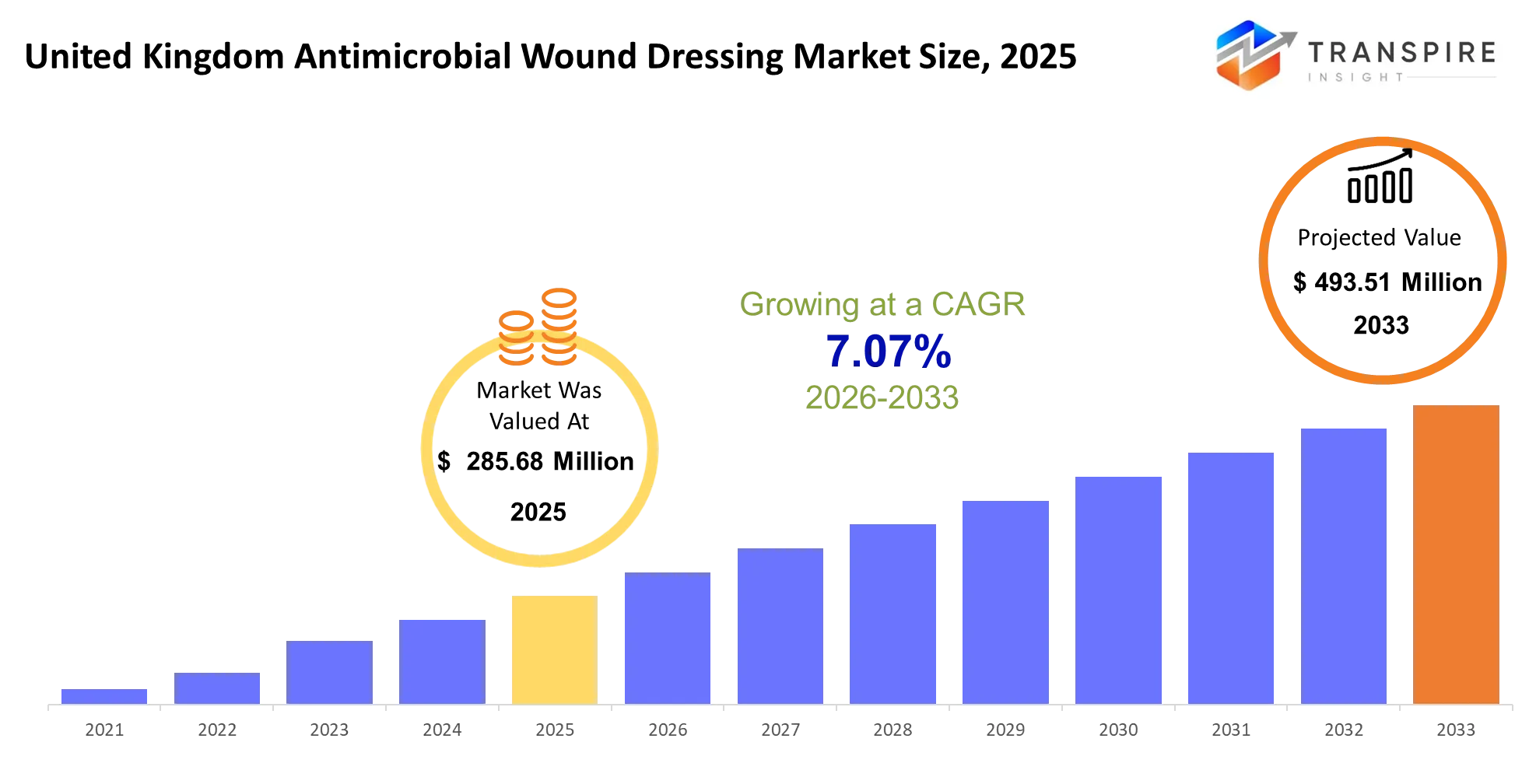
- United Kingdom Antimicrobial Wound Dressing Market Size 2025: USD 285.68 Million
- United Kingdom Antimicrobial Wound Dressing Market Size 2033: USD 493.51 Million
- United Kingdom Antimicrobial Wound Dressing Market CAGR: 7.07%
- United Kingdom Antimicrobial Wound Dressing Market Segments: By Product Type (Silver-based Dressings, Honey-based Dressings, Iodine Dressings, Foam Dressings, Hydrogel Dressings, Alginate Dressings, Collagen Dressings, Others); By Application (Surgical Wounds, Chronic Wounds, Burns, Diabetic Foot Ulcers, Pressure Ulcers, Traumatic Wounds, Others); By End User (Hospitals, Clinics, Home Healthcare, Ambulatory Surgical Centers, Others); By Distribution Channel (Hospital Pharmacies, Retail Pharmacies, Online Pharmacies, Others)
To learn more about this report,  Download Free Sample Report
United Kingdom Antimicrobial Wound Dressing Market Summary
The United Kingdom Antimicrobial Wound Dressing Market was valued at USD 285.68 Million in 2025. It is forecast to reach USD 493.51 Million by 2033. That is a CAGR of 7.07% over the period.
In the United Kingdom antimicrobial wound dressing market it’s sort of a key thing for handling both chronic and acute wounds, because healthcare providers can control infection while also helping recovery move along quicker. You can see these products being used quite a lot in hospitals, in community care, and in long-term treatment situations, including diabetic foot ulcers, pressure ulcers, surgical wounds, and burns. In these settings, infection isn’t just a nuisance it can push treatment costs up and delay recovery time.
Over the last five years, there’s been a real change in how the market is organized. More advanced dressings are showing up, and they tend to mix antimicrobial protection with moisture management, plus longer wear performance. This shift, i’d say, has been reinforced by healthcare providers who want to shorten hospital stays and also reduce the load from repeat wound procedures. One big push was the pressure the health system faced during and after the COVID-19 period , which basically sped up adoption of products that allow more efficient wound care outside of acute care wards. And now, as providers keep focusing on preventing wound problems and reducing total treatment spend, demand is drifting toward higher-value dressing solutions. That creates better revenue openings for manufacturers, especially those with clinically proven products.
Key Market Insights
- England is basically running the United Kingdom Antimicrobial Wound Dressing Market, with a share around 80% of the total in 2025 or so.
- London and Southeast England also look like the big demand hubs since there are more hospitals in the area and the wound care setup is more advanced , compared to other regions.
- Scotland meanwhile is forecast to become the quickest mover through 2030, largely because community health services are expanding there, and they are doing it steadily.
- At the same time, ongoing healthcare modernization programs are pushing these antimicrobial wound dressings deeper into underserved locations, like it’s gradually speeding up every year.
- When it comes to product types, silver based antimicrobial wound dressings lead in the United Kingdom, taking an estimated 40% plus market share in 2025.
- After that, iodine based dressings hold the next biggest slice, mainly due to strong infection control results in chronic wound treatment.
- Multi functional dressings, which basically blend antimicrobial action with moisture balance, keep gaining traction too, and that’s supporting overall growth.
- For applications, chronic wound care is the dominant area, and it brings in close to 45% of market revenue in 2025.
- Diabetic foot ulcers also matter a lot, because diabetes cases are rising, and the long term care burden stays high.
- And for the fastest growth, surgical wound care is expected to be the top segment during the forecast years, pushed by higher procedure volumes and more frequent interventions.
What are the Key Drivers, Restraints, and Opportunities in the United Kingdom Antimicrobial Wound Dressing Market?
The strongest force moving the United Kingdom antimicrobial wound dressing market forward is the healthcare system’s real, ongoing focus on bringing down both the clinical hassle and the financial weight caused by chronic wounds. Over the past several years, NHS providers have been getting squeezed by rising expectations, they’re pushed to reduce hospital admissions, cut down on how long treatment lasts and also prevent wound related complications. Because of that, you see a broader uptake of advanced antimicrobial dressings that can manage infection while helping keep the dressing change routine less frequent. And since healthcare providers are chasing numbers they can actually measure better patient results plus smarter use of resources, higher-value wound care products are taking a bigger slice of the overall treatment budget, which in turn helps feed market revenue growth quite directly.
The biggest hitch, though, is still the high upfront cost of advanced antimicrobial dressings when compared with conventional wound care products. This is sort of structural, because procurement systems in healthcare often run on fixed yearly budgets, and they typically need extensive clinical evidence before expanding reimbursement options. Even if those advanced dressings show long-term cost savings, purchase decisions often lean toward what has to be paid right now. So adoption slows in some healthcare settings and that also caps some of the revenue expansion options for manufacturers.
A major growth opportunity sits in blending antimicrobial dressings and digital wound monitoring, plus the community based care model stuff. Remote wound assessment platforms are getting more common across the United Kingdom, especially when you think about elderly patients and those who are diabetic. If you pair advanced dressings with digital tracking technology, you can make treatment adherence stronger, cut down on unnecessary clinic visits, and build a more attractive value story for healthcare providers. It kind of opens up the next phase of market development, and yeah that seems pretty important.
What Has the Impact of Artificial Intelligence Been on the United Kingdom Antimicrobial Wound Dressing Market?
Artificial intelligence, and the broader area of advanced digital technologies, are starting to reshape the United Kingdom antimicrobial wound dressing market a bit more each year, mainly because they make wound evaluation feel more systematic. Things like wound assessment, treatment selection, and patient monitoring are getting shifted with better analytics. In practice healthcare providers are increasingly leaning on AI enabled imaging platforms, to read and interpret wound size, tissue composition, infection risk, and even healing movement, from photos taken in hospitals or sometimes in community care. These platforms sort of handle parts of the usual clinical process, so clinicians write less manually and can, in turn make quicker treatment decisions , especially when time matters.
On top of that, machine learning models are now used to forecast wound healing results and to spot people who are at higher risk for complications. They work by looking through prior clinical records, comorbidities, and wound related features. Then they can suggest more fitting antimicrobial dressing approaches, and also encourage earlier intervention. The idea is that prediction helps reduce needless hospital trips, improves healing timelines, and makes it easier to use advanced wound care products in a more targeted way, not just broadly.
Digital wound monitoring platforms then add another layer by supporting remote check-ins and keeping continuous track of whether the treatment is doing what it should. Providers can spot worsening wounds earlier, improve coordination between teams, and lower the number of resource heavy in person evaluations. Still, there’s a persistent bottleneck. High quality, standardized clinical data isn’t always easy to get. If wound images are captured under different lighting, angles, or device settings and if patients vary a lot, plus documentation habits differ , then algorithm performance can drop. That mismatch can slow down adoption across healthcare environments, even when the technology looks promising.
Key Market Trends
- Since 2020, NHS providers have kind of been pushing wound management more into community settings , which (sorta) speeds up the adoption of longer-wear antimicrobial dressings that mean fewer clinic visits overall.
- Silver-based dressings really strengthened their spot in the market between 2021 and 2025, because clinicians leaned harder on broad-spectrum antimicrobial performance for the more complex wounds, you know.
- Manufacturers started moving away from “single, standalone” products, and instead they built integrated wound care portfolios , pairing infection control with moisture balance , and then also adding tissue management know-how too.
- After 2021 , digital wound assessment platforms picked up real momentum, letting clinicians track healing progress remotely, and make dressing selection decisions more carefully—without being in the room.
- Procurement teams also adjusted their approach, shifting the purchasing criteria toward total treatment costs rather than just unit pricing, so clinically proven advanced wound care solutions gained preference.
- Companies including Smith & Nephew, Convatec, and Mölnlycke increased investments in clinical evidence generation , aiming to improve reimbursement confidence and procurement results.
- From 2022 to 2025, healthcare providers expanded the use of antimicrobial dressings for diabetic foot ulcer management, specifically to help cut down admissions tied to complications.
- Product development has been trending toward extended wear times , helping providers reduce how often dressings need changing, and in turn improving workforce efficiency in practice.
- And after 2021 , strategic collaborations between manufacturers and healthcare systems became more common, supporting training programs , and generally making advanced wound care adoption a little smoother.
United Kingdom Antimicrobial Wound Dressing Market Segmentation
By Product Type :
Silver based dressings still hold a pretty strong place in wound care because antimicrobial protection helps lower the infection risk especially in those complicated wounds where healing is slow. Honey based and iodine dressings also keep showing up in practice, mainly due to their antibacterial properties ,and that makes them a good fit for a range of clinical needs. In the end, the way products are picked usually comes down to the wound condition, where the healing process is at, and how severe the infection seems to be.
Then there are foam dressings, hydrogel dressings, alginate dressings and collagen dressings—these focus on moisture balance and tissue recovery while treatment is happening. More and more healthcare facilities are choosing newer products that try to balance comfort, infection control, and healing support all together. There are also several other dressing categories that give clinicians more flexibility, so they can match wound care requirements with the right product traits without over complicating it.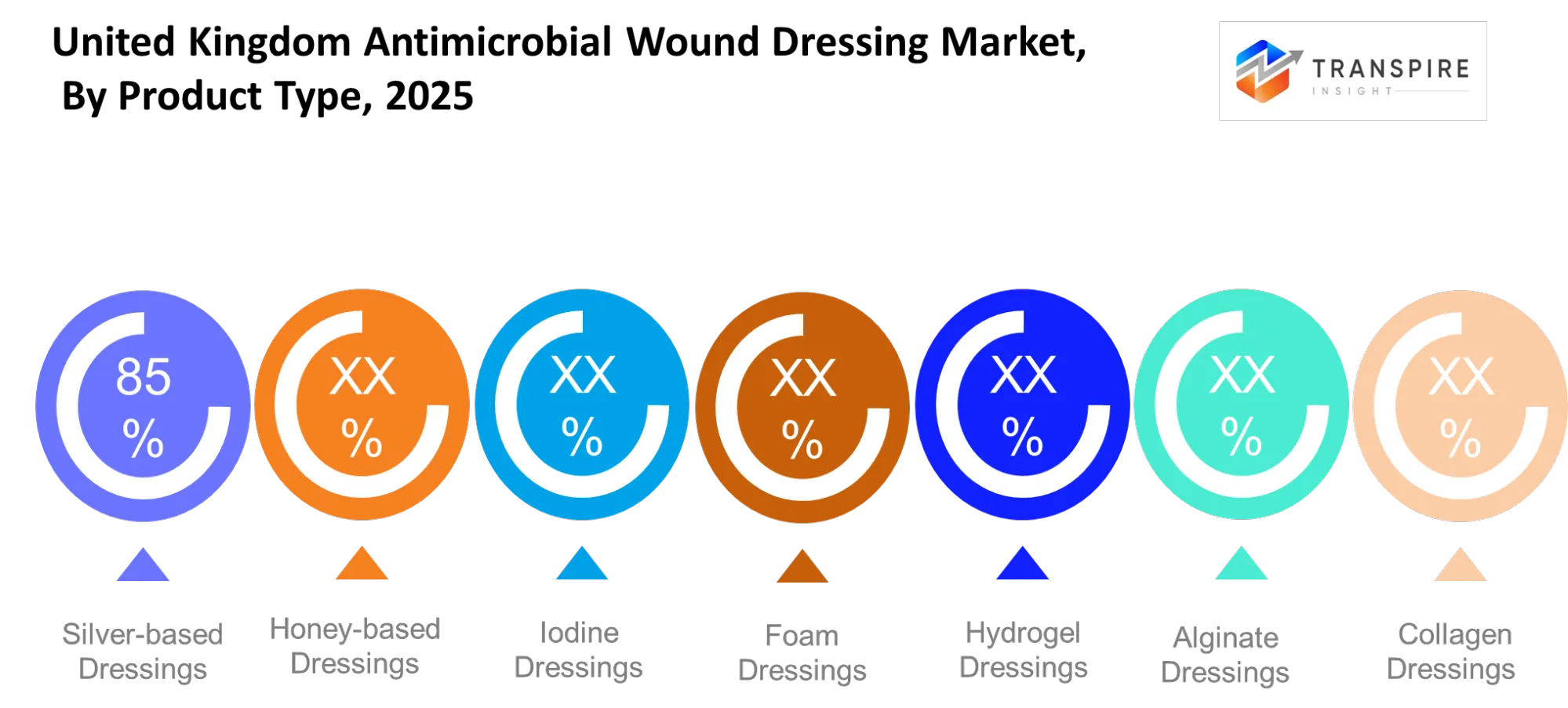
To learn more about this report, Download Free Sample Report
By Application :
Surgical wounds are a major application area, largely because preventing infection remains important after medical procedures. Chronic wounds need long term management and ongoing observation, so antimicrobial dressings tend to stay in use for longer periods. Burns are another area where specialized care matters, since infection control and skin protection are usually top treatment goals.
Diabetic foot ulcers and pressure ulcers need constant attention, because if healing is delayed it can turn into bigger complications. Traumatic wounds from accidents or injuries also help drive adoption across many healthcare settings. Beyond that, other uses keep demand steady as antimicrobial wound dressings become part of wider treatment strategies aimed at improving healing results and reducing the overall recovery burden.
By End User :
Hospitals account for a significant share, because complex wound situations, surgical interventions, and emergency treatments often need advanced wound care solutions (and honestly a lot of coordination too). Clinics also contribute strongly, mostly via routine wound evaluations, follow up attention, and the management of long-term conditions that need specialized dressings, plus infection control practices, that are consistent.
Home healthcare keeps expanding as healthcare systems push treatment outside hospital settings whenever it is practical. Ambulatory surgical centers back this demand with outpatient procedures that still depend on effective post operative wound care. Other end users also move the market forward by offering specialized caregiving services that rely on dependable antimicrobial dressing products for patient support.
By Distribution Channel :
Hospital pharmacies stay a leading distribution channel, since direct access to wound care items helps deliver timely treatment inside the facilities. Having products through hospital networks supports continuity, while also keeping access open to clinically approved antimicrobial dressing solutions, for different patient requirements and not just one type of case.
Retail pharmacies give patients a more convenient way to get what they need when wounds are managed outside hospital environments. Online pharmacies are getting more attention too, thanks to easier product comparison, ordering convenience, and wider accessibility overall. Other distribution channels join in as well by reaching healthcare providers, caregivers, and patients who want specialized wound management products across multiple care settings.
What are the Key Use Cases Driving the United Kingdom Antimicrobial Wound Dressing Market?
The main driver behind adoption of antimicrobial wound dressings in the United Kingdom is basically the way chronic wounds are handled, like diabetic foot ulcers and pressure ulcers. These problems often stretch out for a long time, and the infection risk is pretty high, so advanced antimicrobial dressings become important for better healing results and also for cutting down on expensive hospital visits or other costly interventions, you know.
Another area that keeps expanding is post surgical wound care plus burn management. More hospitals and ambulatory surgical centers are relying on modern dressings to help bring down infection risks, speed up recovery, and minimize the need for repeated follow up treatment. Because of that, there is stronger demand for products that do antimicrobial protection and moisture management together, in a more balanced way.
Newer use cases are starting to pop up too, especially in home healthcare setups and in digitally supported wound management programs. Remote monitoring efforts for older adults and diabetic patients are opening doors for longer wear antimicrobial dressings that do not need changing as often. Also, advanced dressings tailored for personalized treatment pathways and community based care models are likely to see wider clinical acceptance over the forecast period, even if adoption varies by region a bit.
|
Report Metrics |
Details |
|
Market size value in 2025 |
USD 285.68 Million |
|
Market size value in 2026 |
USD 305.89 Million |
|
Revenue forecast in 2033 |
USD 493.51 Million |
|
Growth rate |
CAGR of 7.07% from 2026 to 2033 |
|
Base year |
2025 |
|
Historical data |
2021 - 2024 |
|
Forecast period |
2026 - 2033 |
|
Report coverage |
Revenue forecast, competitive landscape, growth factors, and trends |
|
Regional scope |
Middle East and Africa (Saudi Arabia, United Arab Emirates, South Africa, Rest of Middle East and Africa) |
|
Key company profiled |
Smith & Nephew, Mölnlycke, 3M, ConvaTec, Coloplast, Medline, Hartmann, Cardinal Health, Derma Sciences, Integra LifeSciences, Organogenesis, Urgo Medical, Lohmann & Rauscher, Essity, Medtronic |
|
Customization scope |
Free report customization (country, regional & segment scope). Avail customized purchase options to meet your exact research needs. |
|
Report Segmentation |
By Product Type (Silver-based Dressings, Honey-based Dressings, Iodine Dressings, Foam Dressings, Hydrogel Dressings, Alginate Dressings, Collagen Dressings, Others); By Application (Surgical Wounds, Chronic Wounds, Burns, Diabetic Foot Ulcers, Pressure Ulcers, Traumatic Wounds, Others); By End User (Hospitals, Clinics, Home Healthcare, Ambulatory Surgical Centers, Others); By Distribution Channel (Hospital Pharmacies, Retail Pharmacies, Online Pharmacies, Others) |
Which Regions are Driving the United Kingdom Antimicrobial Wound Dressing Market Growth?
England still kind of stays the leading region across the United Kingdom antimicrobial wound dressing market, mostly because there’s a big cluster of hospitals, wound care specialist centers, and teaching institutions. On top of that, the area gets solid NHS funding rounds, plus easier access to newer wound management services. You also see steady demand tied to higher patient numbers related to diabetes , post-surgical procedures and age related problems, so antimicrobial dressings are needed pretty often. And there’s a well linked ecosystem of manufacturers, distributors, clinicians, and research groups which keeps the leadership position more or less intact.
Scotland is the second-largest regional segment, but the engine is a bit different. When you compare it to England, Scotland leans harder on coordinated community healthcare programs, and on long term chronic wound management. Healthcare investment stays relatively stable there, and treatment decisions are guided by structured, evidence based protocol adoption. This helps keep product usage from wobbling too much over time. So suppliers get a dependable revenue base while patients generally experience steady outcomes in both cities and smaller rural areas, which matters quite a lot.
Wales is now showing up as the fastest growing region, mainly because care providers are pushing more community-led treatment pathways and adding digital wound monitoring initiatives. Efforts aimed at reducing pressure on hospitals have also made it more common to use advanced wound care products outside acute care settings. At the same time, integrated care programs, especially for elderly and diabetic patients, are improving how quickly these products get accepted. Because of that momentum, expansion looks especially interesting for manufacturers and investors sometime between 2026 and 2033 , notably in more innovative wound management solutions.
Who are the Key Players in the United Kingdom Antimicrobial Wound Dressing Market and How Do They Compete?
The competitive landscape in the United Kingdom antimicrobial wound dressing market is, kind of moderately consolidated, and it looks like a set of global wound care manufacturers holds a meaningful portion of advanced product sales. In practice , the rivalry is less about price and more about clinical performance, infection-control effectiveness, faster or better healing results, and also the capability to build solid evidence that helps with healthcare procurement decisions. Bigger players keep defending share via product innovation and long-term relationships with healthcare providers, but smaller participants are often leaning into specific wound care niches, with more targeted product differentiation. Lately, the “winning” angle seems to hinge on proving, in measurable terms, fewer treatment complications and lower overall care costs.
Smith & Nephew competes by doing continuous product development alongside a broad wound management portfolio, so healthcare providers can tackle different wound types using a single supplier network. The firm separates itself with solid clinical research strengths, plus ongoing investment in advanced wound healing technologies. Convatec, on the other hand , focuses on bundling antimicrobial protection with moisture management, which lets clinicians manage complicated wounds more effectively. Their expansion activities include reinforcing healthcare partnerships and widening access to advanced wound care solutions across both community and acute care settings.
Mölnlycke Health Care keeps saying it is all about evidence based wound management and also products that aim to make patients feel more at ease, while still backing the whole healing progression. They seem to stand out mainly because they run clinician education programs that are pretty extensive, plus they bring specialized wound care knowledge to the table , which helps in practice. 3M on the other hand really leans on material science and healthcare technology know-how to create advanced dressing solutions , these are built to show better performance characteristics than before. Then there is Coloplast , which focuses more on innovation for specific wound care needs and patient centered treatment methods. They keep expanding their market reach by improving products and doing closer collaboration with healthcare providers, so that long term wound management outcomes can be stronger.
Company List
- Smith & Nephew
- Mölnlycke
- 3M
- ConvaTec
- Coloplast
- Medline
- Hartmann
- Cardinal Health
- Derma Sciences
- Integra LifeSciences
- Organogenesis
- Urgo Medical
- Lohmann & Rauscher
- Essity
- Medtronic
Recent Development News
In May 2026, Smith+Nephew announced the launch of its ALLEVYN COMPLETE CARE Dressing and RENASYS EDGE tNPWT system at EWMA 2026. The launch expands the company’s advanced wound management portfolio and strengthens innovation in chronic wound care, a key segment of the United Kingdom antimicrobial wound dressing market. \
Source https://www.businesswire.com/
In May 2026, Convatec unveiled AQUACEL ConvaFiber in its European debut ahead of broader commercialization later in the year. The product introduction, alongside the company’s nitric oxide-generating dressing technologies, reinforces competition and technological advancement within the antimicrobial wound dressing segment. Source https://www.businesswire.com/
What Strategic Insights Define the Future of the United Kingdom Antimicrobial Wound Dressing Market?
Over the next five to seven years, the United Kingdom antimicrobial wound dressing market is expected to drift toward more integrated wound management solutions rather than just standalone dressing products. And the biggest driver behind this change will be healthcare systems that are trying to show measurable clinical outcomes, reduce treatment costs, and rely more on community-based care. So, the products that blend antimicrobial performance with digital monitoring, data capture, and tailored treatment pathways will probably be pulled into a stronger spot inside procurement frameworks.
There is also a less visible risk , the sort that hides in the background. It comes from the growing concentration of advanced antimicrobial technologies among a smaller set of suppliers. If buyers become dependent on specialized raw materials and proprietary technologies, supply disruptions can happen, or pricing pressure might rise, especially if manufacturing constraints start to appear. This kind of risk might not show up in near-term growth figures, but it can still weigh on long-term market steadiness.
At the same time, one emerging opportunity is the way artificial intelligence can be used in remote wound assessment programs, particularly for diabetic and elderly patients. As digital health infrastructure keeps expanding across regional healthcare networks, demand for dressings that help enable data-driven treatment decisions is likely to increase. Market players should start investing in clinical evidence generation and digital care partnerships sooner rather than later, because procurement priorities will keep changing, and it’s easier to secure a competitive advantage while the direction is still forming.
United Kingdom Antimicrobial Wound Dressing Market Report Segmentation
By Product Type
- Silver-based Dressings
- Honey-based Dressings
- Iodine Dressings
- Foam Dressings
- Hydrogel Dressings
- Alginate Dressings
- Collagen Dressings
By Application
- Surgical Wounds
- Chronic Wounds
- Burns
- Diabetic Foot Ulcers
- Pressure Ulcers
- Traumatic Wounds
By End User
- Hospitals
- Clinics
- Home Healthcare
- Ambulatory Surgical Centers
By Distribution Channel
- Hospital Pharmacies
- Retail Pharmacies
- Online Pharmacies
Frequently Asked Questions
Find quick answers to common questions.
The United Kingdom Antimicrobial Wound Dressing Market size is USD 493.51 Million in 2033.
Key segments for the United Kingdom Antimicrobial Wound Dressing Market are By Product Type (Silver-based Dressings, Honey-based Dressings, Iodine Dressings, Foam Dressings, Hydrogel Dressings, Alginate Dressings, Collagen Dressings, Others); By Application (Surgical Wounds, Chronic Wounds, Burns, Diabetic Foot Ulcers, Pressure Ulcers, Traumatic Wounds, Others); By End User (Hospitals, Clinics, Home Healthcare, Ambulatory Surgical Centers, Others); By Distribution Channel (Hospital Pharmacies, Retail Pharmacies, Online Pharmacies, Others).
Major United Kingdom Antimicrobial Wound Dressing Market Players are Smith & Nephew, Mölnlycke, 3M, ConvaTec, Coloplast, Medline, Hartmann, Cardinal Health, Derma Sciences, Integra LifeSciences, Organogenesis, Urgo Medical, Lohmann & Rauscher, Essity, Medtronic.
The United Kingdom Antimicrobial Wound Dressing Market size is USD 285.68 Million in 2025.
The United Kingdom Antimicrobial Wound Dressing Market CAGR is 7.07% from 2026 to 2033.
- Smith & Nephew
- Mölnlycke
- 3M
- ConvaTec
- Coloplast
- Medline
- Hartmann
- Cardinal Health
- Derma Sciences
- Integra LifeSciences
- Organogenesis
- Urgo Medical
- Lohmann & Rauscher
- Essity
- Medtronic
About the Authors

Pankaj Ghogare Patil
I am Pankaj Ghogare Patil, a Senior Research Analyst at Transpire Insight, specializing in the Pharmaceutical, Chemicals & Materials, Healthcare IT, and Biotechnology industry. My expertise lies in conducting comprehensive market research, analyzing industry trends, evaluating competitive landscapes, and translating complex data into actionable insights. At Transpire Insight, I closely follow emerging technologies, regulatory developments, and market innovations to create accurate, well-researched, and informative content that helps businesses and professionals make informed decisions. I am committed to producing credible, evidence-based articles that reflect industry best practices while making technical topics accessible and valuable for a broad audience.

Chakradhar Khansole
Chakradhar serves as the Research Director at Transpire Insight, bringing over 8 years of experience in technology, innovation, and strategic market intelligence. He specializes in transforming complex market data into actionable business insights that enable organizations to make informed, growth-oriented decisions. Recognized for his strategic vision and analytical expertise, Chakradhar leads high-impact research initiatives, delivering comprehensive market assessments, competitive intelligence, and forward-looking industry analysis.
Recently Published Reports
-
Jul 2026
Alopecia Treatment Market
Alopecia Treatment Market Size, Share & Analysis Report By Disease Type (Alopecia Areata, Cicatricial Alopecia, Traction Alopecia, Alopecia Totalis, Androgenetic Alopecia, Alopecia Universalis, and Other Disease Types), By Treatment Type (Topical Treatments, Oral Medications, Injectable Therapies, and Hair Transplantation), By Gender (Male, and Female), By Distribution Channel (Hospitals and Clinics, Retail Pharmacies, and Online Retailers), and Geography (North America, Europe, Asia-Pacific, Middle East and Africa, South and Central America), 2021 - 2031
-
Jul 2026
Medical Ultrasound Probe Market
Medical Ultrasound Probe Market Size, Share & Analysis Report By Type (Linear Type, Convex Type, Endocavitary Probe, Phased Array/Cardiac Probe, Transesophageal (TEE) Probe, and Others), By Application (Ophthalmology, Cardiology, Musculoskeletal, Oncology, Obstetrics & Gynecology, General Imaging, and Others), By End User (Hospitals & Clinics, Diagnostic Centers, Ambulatory Surgical Centers, and Others), and Geography (North America, Europe, Asia-Pacific, Middle East and Africa, South and Central America), 2021 – 2031
-
May 2026
Biosimilars Market
Biosimilars Market By Product Type (Monoclonal Antibodies, Recombinant Hormones, Erythropoietin, G-CSF, Others), By Indication (Oncology, Autoimmune Diseases, Blood Disorders, Diabetes, Others), By Manufacturing Type (In-House Manufacturing, Contract Manufacturing), By Distribution Channel (Hospital Pharmacies, Retail Pharmacies, Online Pharmacies), By Industry Analysis, Size, Share, Growth, Trends, and Forecasts 2021-2033
-
Apr 2026
Gastrointestinal Endoscopy Market
Gastrointestinal Endoscopy Market By Type (Rigid Gastrointestinal Endoscope, Flexible Gastrointestinal Endoscopes, Disposable Gastrointestinal Endoscope), By Procedure Type (Colonoscopy, Gastroscopy, Duodenoscopy, Enteroscopy, Flexible Sigmoidoscopy, Others), By Application (Diagnosis, Treatment), By End-Users (Hospitals, Ambulatory Surgical Centers, Specialty Clinics, Laboratories, Others), By Industry Analysis, Size, Share, Growth, Trends, and Forecasts 2021-2033