
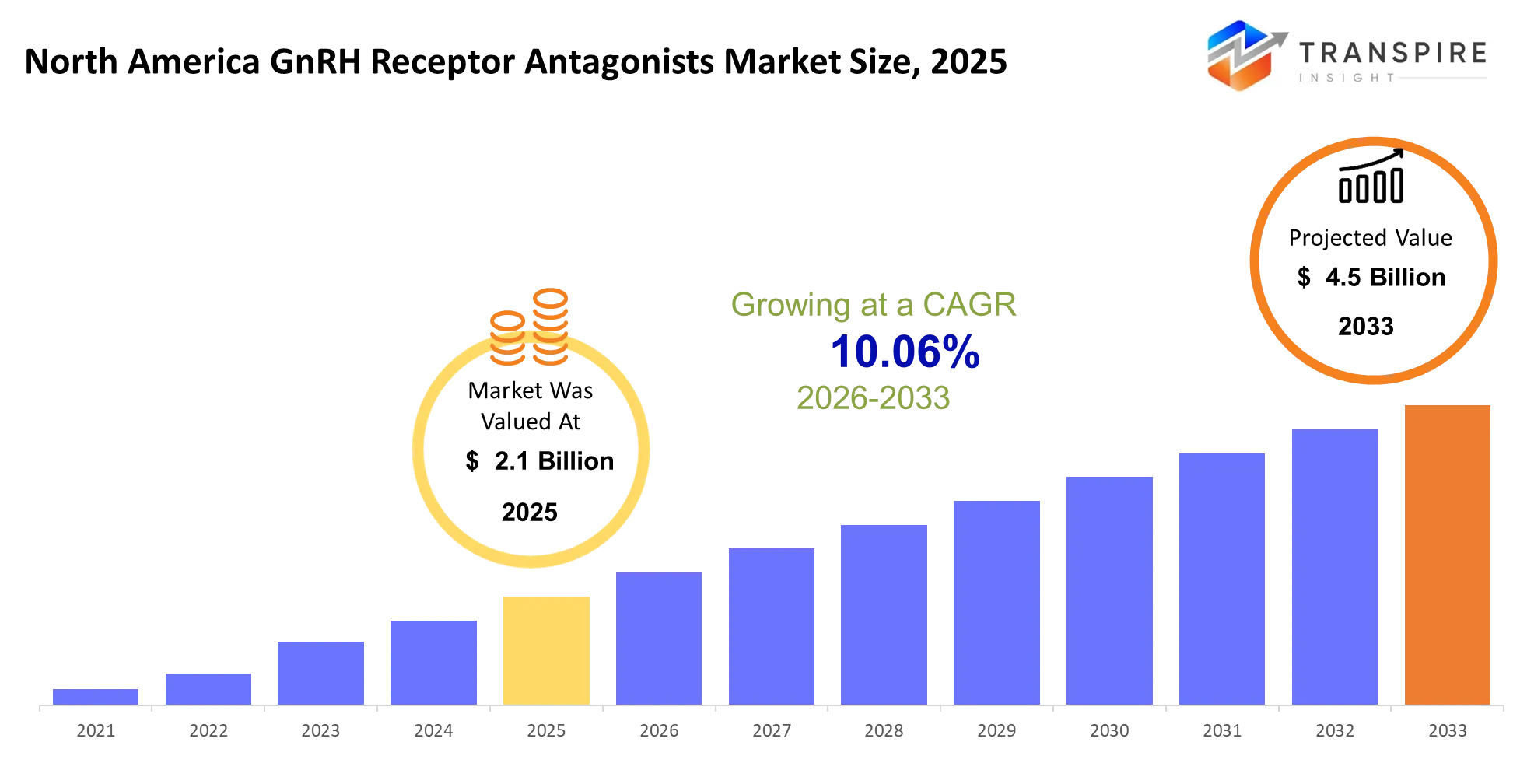
North America GnRH Receptor Antagonists Market Size & Forecast:
- North America GnRH Receptor Antagonists Market Size 2025: USD 2.1 Billion
- North America GnRH Receptor Antagonists Market Size 2033: USD 4.5 Billion
- North America GnRH Receptor Antagonists Market CAGR: 10.06%
- North America GnRH Receptor Antagonists Market Segments: By Drug Type (Oral GnRH Antagonists, Injectable GnRH Antagonists, Combination Therapies, Others); By Application (Prostate Cancer, Endometriosis, Uterine Fibroids, Assisted Reproductive Technology, Others); By Distribution Channel (Hospital Pharmacies, Retail Pharmacies, Online Pharmacies, Others); By End User (Hospitals, Fertility Clinics, Specialty Clinics, Others)
To learn more about this report,  Download Free Sample Report
North America GnRH Receptor Antagonists Market Summary
The North America GnRH Receptor Antagonists Market was valued at USD 2.1 Billion in 2025. It is forecast to reach USD 4.5 Billion by 2033. That is a CAGR of 10.06% over the period.
In North America, GnRH receptor antagonists are used to quickly quash sex hormone signaling in conditions like advanced prostate cancer, endometriosis, uterine fibroids, and assisted reproductive care, so clinicians can sidestep the initial hormone flare that comes with the older suppression regimens. Over the last five years, the market has basically shifted from long-acting injectable approaches to oral antagonist therapies , and this looks increasingly like more outpatient-managed treatment pathways. FDA approvals of oral options, such as relugolix and elagolix , helped lock in that move since they allow at home dosing and more sustained treatment continuity. Meanwhile, the COVID-19 pandemic disrupted routine oncology and gynecology visits, which in turn pushed both patients and providers toward therapies that cut down on time spent in the clinic. Put together, that regulatory backing plus the care delivery change strengthened adoption, because faster relief and better day to day convenience have shown up as stronger prescription uptake, and even a larger slice of specialty pharmaceutical revenue.
Key Market Insights
- The United States kinda dominates the North American GnRH Receptor Antagonists Market, with nearly 78% share in 2025, mostly because of how quickly advanced biologics are being adopted.
- Meanwhile Canada keeps a steady uptake, backed by public reimbursement systems plus specialty drug access programs.
- Mexico is actually the fastest-growing sub-region from 2025 to 2032, this is led by better oncology infrastructure and improved drug availability which is becoming more routine.
- Oral GnRH receptor antagonists are leading, with more than 55% share, largely due to a notable shift toward non-invasive long-term therapies.
- Injectable formulations remain the second-largest segment and are still widely used in clinical oncology protocols.
- The oral drug class is also the fastest-growing segment through 2032 in the North America GnRH Receptor Antagonists Market, mostly due to the preference for home-based treatment pathways.
- Prostate cancer drives most of the application demand , at around 48% share, supported by rising incidence rates.
- Endometriosis treatment is the fastest-growing application, and that’s tied to increased diagnosis activity, along with new oral therapies that are showing up in practice.
- Fertility treatment applications keep expanding steadily across specialty clinics and IVF centers, even when patient flow changes a bit.
- Hospitals hold the largest share at about 52%, mainly because they handle a large volume of oncology and surgical treatments.
What are the Key Drivers, Restraints, and Opportunities in the North America GnRH Receptor Antagonists Market?
The main driver is this gradual move toward oral, patient-managed therapies that kind of removes the whole need for initial hormonal flare control that older GnRH agonists used to bring along. Regulatory approvals from the U.S. Food and Drug Administration for options like relugolix and elagolix, have let clinicians more easily shift patients to at home dosing. That typically cuts down the hospital reliance and it helps adherence, which is kinda big. And this framework change has pushed prescription volumes higher, especially in prostate cancer and endometriosis care pathways where long term suppression therapy is basically required, and convenience is often the deciding factor for whether patients stay on treatment.
The main restraint is the heavy cost burden of branded antagonist therapies. These are still notably more expensive than legacy injectable alternatives. Since they are protected by strong intellectual property frameworks and they also demand specialized manufacturing, the room for pricing flexibility stays narrow. So you end up with a structural access gap, particularly among underinsured patients and in smaller healthcare systems. As a result, therapy starts later than it should, and volume growth feels capped, even with solid clinical demand.
A major opportunity is in widening combination therapy research and generating real world evidence across oncology centers throughout the United States. For instance, ongoing clinical integration of GnRH antagonists with next generation androgen receptor inhibitors is improving outcomes in advanced prostate cancer. This pattern is pulling in attention from specialty pharmaceutical companies. If things keep going that way, it could broaden treatment protocols quite a bit, and in turn unlock new revenue streams across the North America GnRH Receptor Antagonists Market.
What Has the Impact of Artificial Intelligence Been on the North America GnRH Receptor Antagonists Market?
Artificial intelligence and advanced digital technologies are kinda reshaping the North America GnRH receptor antagonists market, in this sense by boosting drug development efficiency, helping tailor treatment more precisely and also streamlining the commercial operations within specialty pharmaceuticals.
In clinical and commercial environments, AI-enabled analytics platforms are showing up more often for automated demand forecasting, so manufacturers can line up production of oral antagonists like relugolix and elagolix alongside oncology and endometriosis prescription behaviors. Machine learning models also bolster pharmacovigilance by scanning real-world patient information to surface adverse event signals sooner , which helps cut reporting lags and improves regulatory compliance accuracy. In hospital networks and specialty clinics, AI-driven clinical decision tools assist physicians in spotting who actually fits GnRH antagonist therapy, supporting higher treatment initiation rates and better therapy sequencing in hormone-sensitive cancers.
On the operations side, digital supply chain systems improve inventory awareness across distributors and specialty pharmacies, which reduces stockouts and keeps medication availability steadier. Some early deployments are reporting more or less directional gains in inventory efficiency and reduced wastage of high-cost assets, partly because forecasting accuracy has improved slightly.
Still, the adoption story is not fully smooth, since real-world clinical data is fragmented and interoperability between healthcare IT systems is uneven. That situation can weaken model training reliability and slow down large-scale rollout across the North America GnRH receptor antagonists market, especially for smaller oncology practices and fertility care centers that do not have an inte
Key Market Trends
- Oral GnRH antagonists kinda got the upper hand after the 2021 FDA approvals, and it really shifted the whole care pattern away from those long acting injectable hormone suppression regimens, overall.
- In prostate cancer management, prescribing behavior moved more toward faster testosterone suppression therapies, which helped boost initiation rates in oncology clinics around 2022.
- Meanwhile specialty pharmacies kept expanding their distribution networks from 2020 thru 2025, so the older hospital only dispensing setup sorta got replaced, at least for the pricier antagonist medications.
- After 2021, digital prescription monitoring tools also showed up and improved adherence tracking. That matters because it reduced missed doses in people doing long term hormone therapy, more than before.
- On the women’s health side, endometriosis diagnosis rates went up after 2022 screening updates, and that seems to have driven a bigger uptake of elagolix based treatment paths across many clinics.
- In oncology centers, they started integrating GnRH antagonists earlier in the treatment order, which reduced how much clinicians relied on the older LHRH agonist flare management protocols.
- Also, patient preference swung hard toward at home oral dosing models after COVID-19, and it kinda permanently changed outpatient oncology care habits.
- Between 2023 and 2025, AbbVie and Pfizer both increased pipeline investments, focusing on next-generation receptor-selective antagonists with a better safety profile.
- Then there were real world evidence programs that expanded after 2021 too, helping regulators fine tune safety labeling and making post market surveillance decisions happen faster.
- Finally, hospital procurement strategies evolved into more value based contracting models, emphasizing therapy outcomes rather than just unit pricing since 2023.
North America GnRH Receptor Antagonists Market Segmentation
By Drug Type
Oral GnRH receptor antagonists are basically taking the lead in the overall drug type mix , mainly because clinicians want rapid hormone suppression right away, not that initial flare thing. Adoption stays high across oncology and gynecology settings, and that momentum only got stronger after approvals for oral options such as relugolix and elagolix. Injectable antagonists keep a fairly steady presence, but their share is slowly slipping , since they depend on hospital based administration and longer care cycles. Combination therapies are still being tested , so commercial traction is limited so far.
The pull behind oral growth is tied to a more structural shift toward outpatient care, and also a move to patient managed treatment models. Providers seem to favor oral formats for chronic conditions where long-term hormonal regulation matters a lot, especially in prostate cancer and endometriosis. Injectable options face operational limits, primarily related to infusion infrastructure and hospital scheduling. Combination regimens are emerging from oncology research, with the goal of achieving more potent outcomes in later or advanced disease stages.
During the forecast period, oral therapies should solidify their dominance as pipeline innovation centers on next generation selective receptor antagonists. Injectable products may end up being repositioned within more niche hospital protocols. Combination therapies could attract more investor attention, particularly from those focusing on multi-target endocrine modulation strategies.
By Application
Prostate cancer is still the leading application segment, mostly because the incidence is high and there’s this widespread reliance on androgen deprivation therapy, even when the disease is already in advanced stages. Then endometriosis comes in pretty close as a fast-expanding segment, helped by improved diagnostic rates and by more patients preferring non-surgical, hormonal management over other approaches. Uterine fibroids hang around with steady utilization in most gynecology practices, while assisted reproductive technology keeps growing inside fertility-focused clinical networks. Everything else stays relatively narrow, and it’s mostly investigational, not really mainstream yet.
In terms of what’s pushing growth, prostate cancer treatment is benefiting from earlier use of GnRH antagonists within first line therapy protocols, which shortens the time to actually start treatment. Endometriosis management has shifted toward oral therapies, which helps because compliance tends to be better and reliance on surgery can be reduced. Assisted reproductive technology also gains an edge from accurate hormone suppression control, which supports IVF cycle success rates. For uterine fibroid treatment, progress is somewhat more limited, largely due to variability in clinical practice guidelines across healthcare systems.
Looking ahead, future growth is likely to focus on earlier intervention, especially in oncology, as well as wider adoption across women’s health indications. Pharmaceutical developers will tend to prioritize indications where treatment is chronic , and where the demand supports repeat prescriptions. Investors will likely lean toward multi-indication drug platforms, since those can improve lifecycle value over time.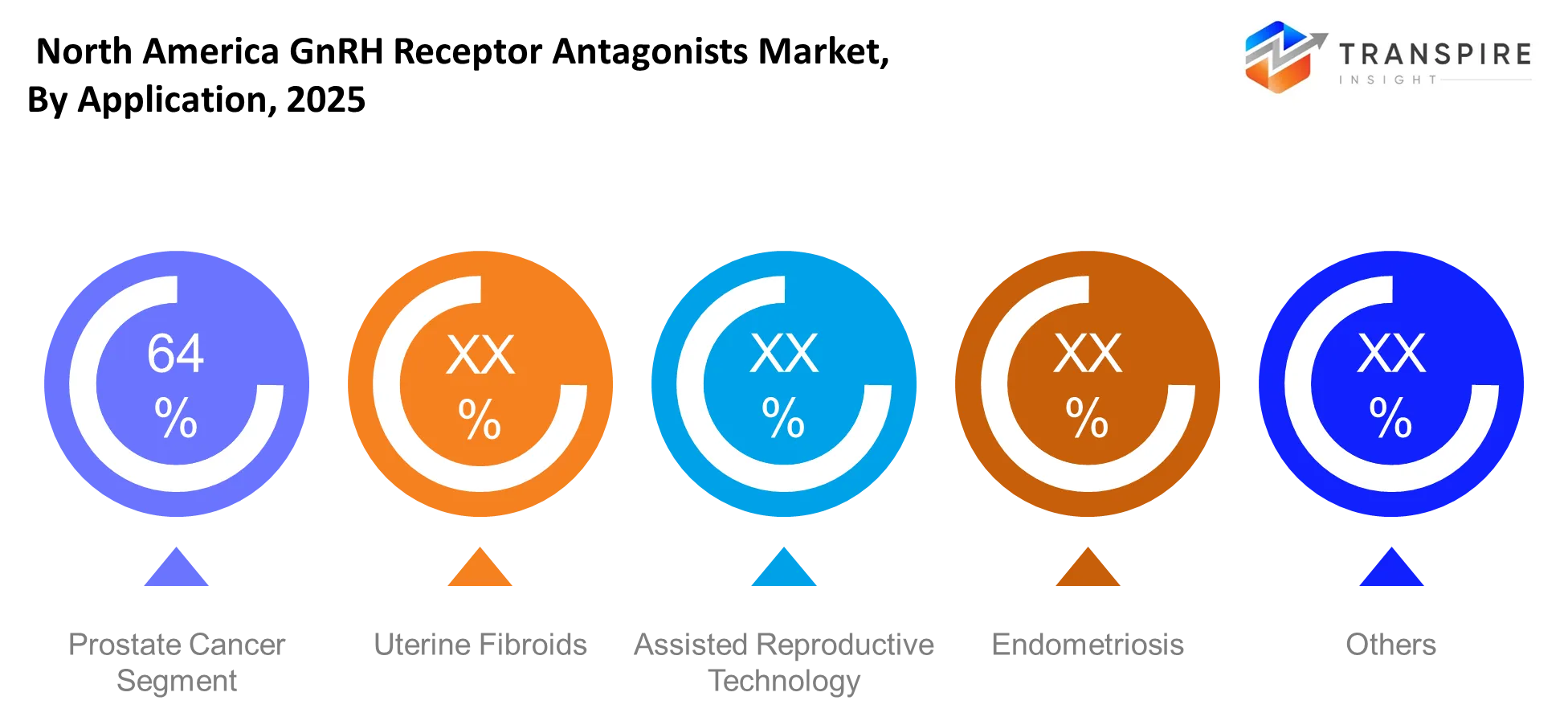
To learn more about this report, Download Free Sample Report
By Distribution Channel
Hospital pharmacies take the lead in distribution, mostly because they are integrated pretty directly with oncology departments and gynecology units where therapy is started under specialist oversight. Retail pharmacies still grab a noticeable secondary share by helping patients continue therapy for oral GnRH antagonists after they leave the hospital. Online pharmacies are smaller right now, but they’re expanding quickly, driven by digital prescription uptake plus repeat refills for chronic medication. The other channels basically stay narrow, they usually rely on institutional procurement systems , without much consumer-facing reach.
The rise of hospital pharmacies is propped up by standardized initiation protocols for hormone-sensitive cancers. Retail growth mirrors the movement to oral outpatient regimens that need long-term medication access outside the clinical space. Online pharmacy growth accelerated after 2020, partly because telemedicine became more common and the digital healthcare framework continued to improve. Even so, the handling requirements for specialty drugs still make full digital penetration hard.
Over time, distribution should shift toward hybrid setups, pairing hospital initiation with retail and online continuation models. Pharmaceutical companies will likely put more effort into specialty pharmacy partnerships in order to strengthen adherence monitoring. Digital channels will continue to expand as e-prescribing systems become more tightly integrated across healthcare networks.
By End User
Hospitals take the biggest share, kinda by default, because end user demand is high, mainly from oncology sessions and surgical gynecology procedures that need supervised initiation of hormone therapy. Fertility clinics, on the other hand, are the fast moving segment, driven by a rise in assisted reproductive procedures and carefully controlled ovarian stimulation protocols. Specialty clinics are growing steadily too, often because outpatient care keeps migrating into the community, plus chronic disease management type models. Other end users stay kind of scattered , across smaller healthcare providers and research institutions, so they don’t really show up as one clean block.
Hospital growth is linked to more structured clinical pathways, especially around prostate cancer and uterine fibroids, where immediate hormonal suppression matters. Fertility clinics benefit from the increasing demand for precise hormone regulation during assisted reproduction. Specialty clinics expand by using cost-efficient outpatient treatment models that lower reliance on hospitals. Altogether, this seems to reflect wider healthcare decentralization trends across North America , not just one narrow case.
Looking ahead, adoption will likely lean more toward fertility clinics and specialty clinics as outpatient care continues to widen. Hospitals will still be important for the first round of therapy delivery, but their relative share may thin out in long-term management. Investors and developers will probably focus on decentralized care networks that enable ongoing oral therapy adherence, because that’s where the sustained commitment happens.
What are the Key Use Cases Driving the North America GnRH Receptor Antagonists Market?
Prostate cancer management is kind of the main use case that keeps driving the North America GnRH receptor antagonist market, because advanced stage patients need really fast testosterone suppression, so that tumor progression slows down and survival outcomes look better. A lot of clinicians lean toward antagonist-based regimens because they don’t have the early hormonal flare you get with older-style therapies, so they end up being central in oncology treatment protocols across different hospitals.
Then there are endometriosis and uterine fibroid care options which are also growing, especially in gynaecology speciality clinics and those hospital outpatient departments. For these issues, oral hormone suppression treatments are helpful; they reduce the need for surgical procedures, and they help with long term symptom control, which makes adoption feel easier inside women’s health care pathways. On top of that, assisted reproductive technology is adding more pull too, because fertility clinics want tight hormonal regulation, to improve IVF cycle success rates.
Looking ahead, there are emerging use cases such as earlier stage prostate cancer intervention, and also longer term preventive hormone modulation in people considered high risk. There’s also research on combining endocrine therapies in oncology centers, and that suggests the market could expand beyond the usual treatment boundaries during the forecast period.
|
Report Metrics |
Details |
|
Market size value in 2025 |
USD 2.1 Billion |
|
Market size value in 2026 |
USD 2.3 Billion |
|
Revenue forecast in 2033 |
USD 4.5 Billion |
|
Growth rate |
CAGR of 10.06% from 2026 to 2033 |
|
Base year |
2025 |
|
Historical data |
2021 - 2024 |
|
Forecast period |
2026 - 2033 |
|
Report coverage |
Revenue forecast, competitive landscape, growth factors, and trends |
|
Regional scope |
North America (Canada, The United States, and Mexico) |
|
Key company profiled |
AbbVie, Pfizer, Takeda Pharmaceutical, Myovant Sciences, Astellas Pharma, Bayer, Ferring Pharmaceuticals, Ipsen, Sanofi, Novartis, AstraZeneca, Eli Lilly, Merck & Co., Teva Pharmaceuticals, Roche |
|
Customization scope |
Free report customization (country, regional & segment scope). Avail customized purchase options to meet your exact research needs. |
|
Report Segmentation |
By Drug Type (Oral GnRH Antagonists, Injectable GnRH Antagonists, Combination Therapies, Others); By Application (Prostate Cancer, Endometriosis, Uterine Fibroids, Assisted Reproductive Technology, Others); By Distribution Channel (Hospital Pharmacies, Retail Pharmacies, Online Pharmacies, Others); By End User (Hospitals, Fertility Clinics, Specialty Clinics, Others) |
Which Regions are Driving the North America GnRH Receptor Antagonists Market Growth?
The United States leads the North America GnRH receptor antagonists market, mostly because it has this advanced oncology infrastructure, strong regulatory approvals, and it basically manages to integrate newer hormone therapies into day to day clinical practice faster than others. The high prostate cancer prevalence and the widespread use of specialty oncology networks keep the demand steady across hospital systems, year after year. Also, there are established pharmaceutical companies, plus solid reimbursement pathways , which together make it easier for early adoption of oral antagonist therapies. There is also a mature clinical trial ecosystem so physicians get familiar sooner, and that kind of familiarity, kind of reinforces the country’s dominant position.
Canada sits as the second major contributor, and it is supported by a publicly funded healthcare system that helps ensure stable access to essential oncology and gynecology treatments. Unlike the United States, Canada’s growth feels more shaped by structured, province level reimbursement decisions, instead of super rapid innovation cycles. Those decisions end up making drug uptake more predictable, which matters a lot for organizations planning long term. Centralized hospital networks also drive consistent procurement, so demand for GnRH therapies stays steady , especially for prostate cancer and fertility care. So overall, Canada becomes a reliable market contributor, even if it evolves a bit slower.
Mexico is emerging as the fastest growing region due to expanding oncology infrastructure and increased investment in specialized hospital facilities. Healthcare modernization initiatives lately, and better access to specialty pharmaceuticals, have accelerated adoption of hormone based cancer therapies. Beyond that, rising awareness of endometriosis treatment options, plus a gradual expansion of fertility clinics, also keeps pushing demand growth. For market entrants and investors, Mexico is like a high opportunity expansion corridor from 2026 to 2033 , where early distribution partnerships and localized supply chains could deliver strong competitive advantage.
Who are the Key Players in the North America GnRH Receptor Antagonists Market and How Do They Compete?
The North America GnRH receptor antagonists market looks fairly moderately consolidated, like only a small cluster of specialty pharmaceutical players hold most of the branded prescriptions while they sort of compete by clinical differentiation not really by price. You can see the competition being driven mostly by oral drug performance, how fast hormonal suppression kicks in, and those lifecycle management plays that stretch therapy duration particularly in oncology and women’s health. Getting in is still pretty tough because regulation is complex, intellectual property is well protected, and physicians already trust early-mover oral therapies. So, in practice, rivalry bunches up around delivery format innovation and label expansion, rather than people going head to head on generic pricing.
AbbVie pushes its position by leaning into endocrine therapy know-how, and it leans on elagolix-based options that cover endometriosis and uterine fibroids, with differentiated oral dosing convenience. Pfizer keeps the spotlight on oncology by driving relugolix uptake through the Orgovyx brand, using hospital relationships and oncology network reach to grow early stage prostate cancer usage. Sumitomo Pharma tries to pull ahead by managing the relugolix portfolio across lifecycles and partnering to broaden market access across North American specialty pharmacies. Bayer, meanwhile, impacts things more indirectly via nearby women’s health portfolios and by participating in hormonal therapy ecosystems, which helps gynecology care get integrated more smoothly. They all tend to expand influence through physician education programs, real-world evidence investigations, and very pointed payer discussions, all of which strengthen reimbursement positioning in different ways.
Company List
- AbbVie
- Pfizer
- Takeda Pharmaceutical
- Myovant Sciences
- Astellas Pharma
- Bayer
- Ferring Pharmaceuticals
- Ipsen
- Sanofi
- Novartis
- AstraZeneca
- Eli Lilly
- Merck & Co.
- Teva Pharmaceuticals
- Roche
Recent Development News
“In September 2025, Eli Lilly and Company announced FDA approval of imlunestrant (Inluriyo) for ER-positive, HER2-negative, ESR1-mutated advanced or metastatic breast cancer. The estrogen receptor antagonist expands North America’s endocrine resistance treatment landscape, increasing competitive relevance for GnRH receptor antagonist therapies used in hormone-dependent cancers.https://www.fda.gov
“In December 2025, Pfizer completed expanded commercialization integration activities for ORGOVYX (relugolix) across its U.S. oncology portfolio.” This strengthened Pfizer’s control over the only oral GnRH receptor antagonist for advanced prostate cancer in North America, improving market penetration and physician adoption across androgen deprivation therapy (ADT) channels.https://www.pfizer.com
What Strategic Insights Define the Future of the North America GnRH Receptor Antagonists Market?
In North America, the GnRH receptor antagonists market is starting to move, kind of away from the usual clinic dependent pathway and toward a more outpatient, precision led treatment model. In practice oral therapies are increasingly stepping in where hormone suppression used to be the default, at least for many settings. That direction seems to come from a mix of long-running demand for convenience in oncology and women’s health, plus payer pressure aimed at lowering hospital utilization spend. Over the next 5 to 7 years, much of the market value should be concentrated in treatments that show rapid-onset efficacy while keeping long-term dosing simpler. That, in turn, further reinforces the current edge of oral small-molecule antagonists.
There is also a less obvious catch, therapeutic substitution from newer non-hormonal oncology options, and the continued expansion of targeted cancer immunotherapies. For some patient groups this could end up reducing how much the care plans rely on hormone suppression routes. On top of that, payers are also looking more closely at high-cost branded oral therapies. In cost-sensitive healthcare systems, this can lead to stricter reimbursement thresholds, which is not exactly a minor issue.
Still, an emerging chance is showing up in early intervention prostate cancer protocols across outpatient oncology centers, where GnRH antagonists are being placed earlier in the overall treatment sequence. Companies should focus on real world evidence generation, not only trial outcomes , and they should line up pricing models with payer expectations. The goal is to lock formulary placement and help defend long term prescription volume, even as alternatives keep appearing.
North America GnRH Receptor Antagonists Market Report Segmentation
By Drug Type
- Oral GnRH Antagonists
- Injectable GnRH Antagonists
- Combination Therapies
- Others
By Application
- Prostate Cancer
- Endometriosis
- Uterine Fibroids
- Assisted Reproductive Technology
- Others
By Distribution Channel
- Hospital Pharmacies
- Retail Pharmacies
- Online Pharmacies
- Others
By End User
- Hospitals
- Fertility Clinics
- Specialty Clinics
- Others
Frequently Asked Questions
Find quick answers to common questions.
The North America GnRH Receptor Antagonists Market size is USD 4.5 Billion in 2033.
Key Segments for the North America GnRH Receptor Antagonists Market are By Drug Type (Oral GnRH Antagonists, Injectable GnRH Antagonists, Combination Therapies, Others); By Application (Prostate Cancer, Endometriosis, Uterine Fibroids, Assisted Reproductive Technology, Others); By Distribution Channel (Hospital Pharmacies, Retail Pharmacies, Online Pharmacies, Others); By End User (Hospitals, Fertility Clinics, Specialty Clinics, Others).
Major North America GnRH Receptor Antagonists Market Players are AbbVie, Pfizer, Takeda Pharmaceutical, Myovant Sciences, Astellas Pharma, Bayer, Ferring Pharmaceuticals, Ipsen, Sanofi, Novartis, AstraZeneca, Eli Lilly, Merck & Co., Teva Pharmaceuticals, Roche.
The Current North America GnRH Receptor Antagonists Market size is USD 2.1 billion in 2025.
The North America GnRH Receptor Antagonists Market CAGR is 10.06% from 2026 to 2033.
- AbbVie
- Pfizer
- Takeda Pharmaceutical
- Myovant Sciences
- Astellas Pharma
- Bayer
- Ferring Pharmaceuticals
- Ipsen
- Sanofi
- Novartis
- AstraZeneca
- Eli Lilly
- Merck & Co.
- Teva Pharmaceuticals
- Roche
Recently Published Reports
-
May 2026
Biosimilars Market
Biosimilars Market By Product Type (Monoclonal Antibodies, Recombinant Hormones, Erythropoietin, G-CSF, Others), By Indication (Oncology, Autoimmune Diseases, Blood Disorders, Diabetes, Others), By Manufacturing Type (In-House Manufacturing, Contract Manufacturing), By Distribution Channel (Hospital Pharmacies, Retail Pharmacies, Online Pharmacies), By Industry Analysis, Size, Share, Growth, Trends, and Forecasts 2021-2033
-
Apr 2026
Gastrointestinal Endoscopy Market
Gastrointestinal Endoscopy Market By Type (Rigid Gastrointestinal Endoscope, Flexible Gastrointestinal Endoscopes, Disposable Gastrointestinal Endoscope), By Procedure Type (Colonoscopy, Gastroscopy, Duodenoscopy, Enteroscopy, Flexible Sigmoidoscopy, Others), By Application (Diagnosis, Treatment), By End-Users (Hospitals, Ambulatory Surgical Centers, Specialty Clinics, Laboratories, Others), By Industry Analysis, Size, Share, Growth, Trends, and Forecasts 2021-2033
-
Apr 2026
Rare Inherited Metabolic Disorder Drug Market
Rare Inherited Metabolic Disorder Drug Market By Drug Class (Enzyme Replacement Drugs, Gene Therapy Drugs, Substrate Reduction Drugs, Small Module Drugs, Protein Drugs), By Route of Administration(Parenteral, Oral, Intrathecal), By Clinical Development (Marketed Drugs, Late Stage Clinical Phase III, Early Stage Clinical Phase I-II, Preclinical Candidates), By Indication (Lysosomal Storage Disorders, Urea Cycle Disorders, Amino Acid Metabolic Disorders, organic Acidemias, Peroximal Disorders), By Industry Analysis, Size, Share, Growth, Trends, and Forecasts 2021-2033
-
Jan 2026
Pharmaceutical Cleanroom Technology Market
Pharmaceutical Cleanroom Technology Market By Product (Equipment, Consumables, Services); By Cleanroom Type (Standard Cleanrooms, Modular Cleanrooms); By End Use (Pharmaceutical Companies, Biotechnology Companies), By Industry Analysis, Size, Share, Growth, Trends, and Forecasts 2021-2033