

North America Gasoline Direct Injection System Market Size & Forecast:
- North America Gasoline Direct Injection System Market Size 2025: USD 3.8 Billion
- North America Gasoline Direct Injection System Market Size 2033: USD 6.8 Billion
- North America Gasoline Direct Injection System Market CAGR: 7.50%
- North America Gasoline Direct Injection System Market Segments: By Component (Fuel Injectors, Electronic Control Units, Fuel Pumps, Sensors, Others); By Vehicle Type (Passenger Cars, Commercial Vehicles, Hybrid Vehicles, Others); By Application (Fuel Efficiency Enhancement, Emission Reduction, Performance Optimization, Others); By End User (OEMs, Aftermarket Suppliers, Others)

To learn more about this report,  Download Free Sample Report
North America Gasoline Direct Injection System Market Summary
The North America Gasoline Direct Injection System Market was valued at USD 3.8 Billion in 2025. It is forecast to reach USD 6.8 Billion by 2033. That is a CAGR of 7.50% over the period.
In practice, North America Gasoline Direct Injection, like it helps manage how fuel is pushed at high pressure right into the engine cylinders, so automakers can wring out more power and efficiency from smaller engines while still hitting those strict emissions limits. Over the last five years the market has kinda shifted, more structurally, away from port fuel injection and toward turbocharged downsized engines where GDI is basically the default fueling setup, and it is also getting more and more folded into hybrid powertrains. This shift got pushed faster by tighter EPA Tier 3 and California LEV III requirements, which more or less demanded that OEMs tighten up combustion precision and cut CO2 output. At the same time pandemic-era supply chain disruptions made manufacturers localize injector sourcing and also high-pressure pump sourcing, which in turn changed procurement approaches, not just logistics. So overall, these dynamics have upped component complexity and replacement frequency a lot, and the regulatory pressure, kind of feeds through, into steady demand for high-pressure injection hardware across both OEM production and aftermarket sales.
Key Market Insights
- United States kind of takes over the North America Gasoline Direct Injection System Market with about 72% share in 2025 , mostly because the OEM production base is strong and there is a lot of emissions compliance pressure pushing changes.
- Canada looks pretty steady, you can say, with adoption holding firm thanks to fuel efficiency mandates and the modernization of light-duty vehicle fleets.
- Mexico, on the other hand, seems like the fastest mover through 2025–2030, it’s mainly tied to export oriented automotive manufacturing expansion, you know, the kind that keeps scaling up components demand.
- High-pressure fuel injectors are leading, at roughly 38% share, driven by the need for precise fuel atomization.
- Fuel pumps come in second, and turbocharged engine penetration is basically supporting that position.
- Advanced multi-hole injectors grow the quickest up to 2030 , because they improve combustion efficiency in a more efficient way.
- Passenger vehicles dominate with nearly 81% share , and that’s mostly because downsized turbo engine adoption keeps showing up across major OEMs.
- Hybrid powertrains are the fastest-growing application too, they’re integrating GDI systems to raise fuel economy , which is the whole point.
- OEM automotive manufacturers lead the North America Gasoline Direct Injection System Market, holding over 85% share, mainly because the systems are directly integrated into new engine platforms.
- Aftermarket replacement demand is also climbing steadily, due to injector wear and carbon buildup issues that build over time.
What are the Key Drivers, Restraints, and Opportunities in the North America Gasoline Direct Injection System Market?
The primary driver is mostly tightening emissions regulation along with fuel efficiency mandates under EPA Tier 3 and California LEV III frameworks. These standards kind of push automakers to adopt high-pressure direct injection systems that let them achieve finer fuel atomization, and more controlled combustion. And as OEMs re-engineer engine platforms around turbocharged, downsized architectures, GDI systems are becoming a baseline requirement, not exactly an optional upgrade. That, in turn, directly increases component volumes across the newer vehicle production cycles.
The main restraint is the persistent headache of carbon buildup on intake valves. It’s a structural limitation tied to gasoline direct injection, so it requires additional engineering solutions, such as dual-injection systems or periodic maintenance interventions. This can raise the total cost of ownership and complicate long-term durability expectations, especially for fleet operators. As a result, some manufacturers delay a full-scale shift away from port fuel injection in certain engine classes, which suppresses faster revenue growth in the North America Gasoline Direct Injection System Market.
The most promising opportunity seems to be in integration with hybrid electric powertrains, where GDI systems optimize efficiency during internal combustion intervals. U.S. and Canadian OEM investment in hybrid platforms, especially plug-in SUVs and light trucks, is generating new layers of demand that go beyond typical ICE use cases.
What Has the Impact of Artificial Intelligence Been on the North America Gasoline Direct Injection System Market?
Artificial intelligence and advanced digital technologies are increasingly integrated across the North America Gasoline Direct Injection System Market, especially in how modern engines manage fuel delivery precision and emissions outcomes. Nowadays automakers often lean on AI-enabled engine control units, they keep fine tuning injection timing, pressure, and even spray pattern decisions based on real-time driving conditions, which steadies combustion and cuts down fuel waste. In the manufacturing side, automated calibration systems kind of “assist” with injector performance testing, so less manual involvement is needed, and production ends up more consistent, kind of less chaotic.
On top of that, machine learning models are also showing up for predictive maintenance of injectors and high-pressure fuel pumps. They chew through vibration information, pressure swings, and thermal patterns to sort of foresee failure before it actually happens. These predictive setups support OEMs and fleet teams with better vehicle uptime while also trimming down those annoying unscheduled maintenance costs. At the same time they help with compliance as emissions rules get stricter and stricter. In certain cases, AI-driven optimization has produced real, measurable improvements in fuel economy and lowered tailpipe emissions, particularly on turbocharged engine platforms which dominate a lot of the North America Gasoline Direct Injection System Market.
Still, the overall rollout isn’t entirely smooth because integration costs are high and data ecosystems are fragmented across OEM architectures. Sensor calibration standards vary widely, and that variation degrades model accuracy, especially when systems must operate across mixed vehicle fleets and older engine platforms. So even if the performance benefits are clear, full-scale deployment often gets slowed, delayed, and kind of stuck in the middle.
Key Market Trends
- Since around 2020, a kind of regulatory tightening under EPA Tier 3 and California LEV III (not 100% steady everywhere) kinda pushed the industry to move faster, from port fuel injection to GDI architectures, across most OEM platforms.
- Automakers increasingly shifted from naturally aspirated engines to turbocharged, downsized engines between 2020 and 2025, and in practice, GDI became the default fuel delivery standard, adopted by many new models.
- Hybrid vehicle adoption took off after 2021, and manufacturers started integrating GDI systems into plug-in hybrid SUVs, so combustion efficiency during ICE cycles would be better, even when the driver expectation was “mostly electric.”
- During the COVID-era supply chain disruptions across 2020–2022, many OEMs had to localize injector and pump sourcing across North America, which reshaped procurement strategies pretty noticeably.
- Multi-hole injector technology gained momentum after 2022, supporting finer atomization precision and helping reduce emissions variability in high-pressure gasoline direct injection setups.
- Dual injection systems that combine port injection with direct injection expanded from 2023 onward, aiming to manage carbon buildup issues and also improve long term durability.
- The competitive landscape also shifted toward OEM-tier partnerships, with Bosch and Denso increasing embedded platform supply contract commitments across North American automakers since 2021, sort of tightening the usual vendor loops.
- Aftermarket demand for injector replacement rose steadily after 2022, because carbon deposits and high-pressure wear kept climbing, which raised the maintenance requirements on aging fleets, not just for new drivers but for service centers too.
North America Gasoline Direct Injection System Market Segmentation
By Component
Fuel injectors take the lead, not because they are the biggest piece on paper, but because they sit right in the middle of high-pressure fuel atomization and direct combustion control, so yeah they’re always doing the heavy lifting. Their edge grew fast once port fuel injection got sidelined on turbocharged engines, and that shift really picked up after emissions enforcement got tighter starting in 2020. Then, electronic control units and fuel pumps follow not far behind, supported by the integration push across newer engine platforms, which basically means tighter pressure regulation and ongoing, real-time changes to injection timing. Sensors and the other supporting parts also climb steadily here, since OEMs keep leaning more on closed-loop combustion monitoring to keep compliance accuracy solid.
The growth logic for injectors feels more like a performance-first story, so less about squeezing costs, more about meeting requirements that can’t really wait. Meanwhile secondary components tend to expand when the system itself gets upgraded, kind of a “we needed it anyway” effect. Fuel pumps are getting extra attention due to the higher injection pressures in current engines, and ECU advancements mirror the broader move toward software-defined engine calibration. Going forward, expansion will likely favor multi-hole injectors and smarter pump systems, the kind that incorporate diagnostics as standard. Component suppliers who emphasize durability plus thermal efficiency should see better margins, especially as hybrid ICE cycles intensify across more vehicle platforms.
By Vehicle Type
Passenger cars kinda dominate, mainly because of huge production volumes and the broad adoption of turbocharged gasoline engines across mainstream OEMs. This segment grew even stronger after 2020, when automakers began downsizing engines to meet emissions requirements while still trying not to sacrifice performance. Commercial vehicles show moderate penetration, they are limited by diesel preference for heavy duty work, yet they’re gradually folding in gasoline direct injection for light commercial fleets. Hybrid vehicles are the fast rising group, since electrified powertrains often keep the internal combustion unit, as a kind of efficiency tradeoff, not as a replacement.
Passenger car dominance ties back to consumer preference for fuel efficient performance rides, especially under tougher regulatory climates. The growth in hybrid vehicles is more structurally different, it’s not only about combustion efficiency, rather it comes from dual powertrain optimization and how the system cooperates. Looking ahead, growth is expected to focus on hybrid SUVs and crossover platforms, where GDI systems run intermittently but still matter a lot. Commercial uptake should expand slowly, mostly within urban logistics fleets that are moving toward cleaner gasoline-based options.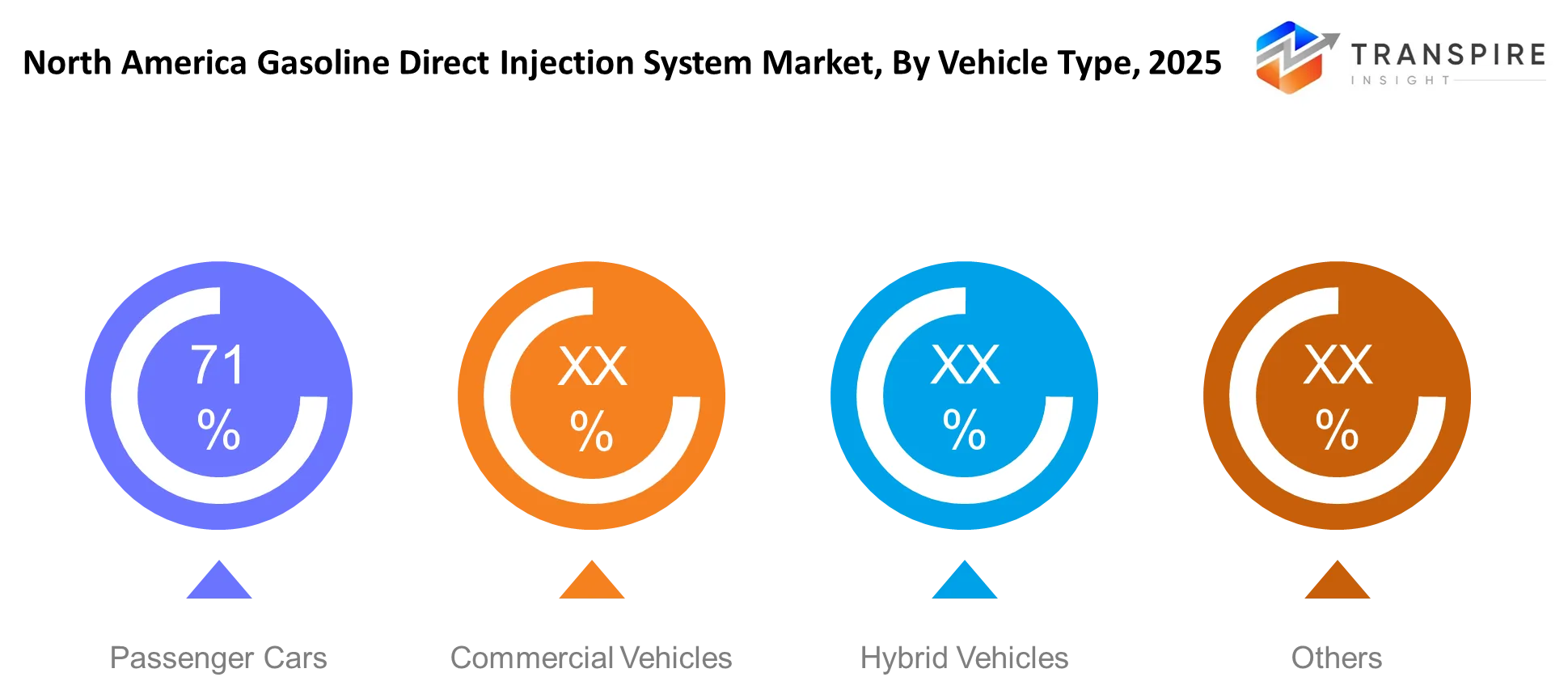
To learn more about this report, Download Free Sample Report
By Application
Fuel efficiency enhancement is still the leading one because automakers keep pushing combustion precision to meet tighter fuel economy standards, yeah. Emission reduction follows close behind, reinforced by regulatory pressure that forces lower particulate matter and NOx emissions from gasoline engines. Performance optimization keeps growing too, especially in turbocharged engines where fuel-air mixing has to stay accurate under shifting load conditions. The remaining applications are more niche, but you still see cold-start improvement and drivability enhancement systems showing up.
Efficiency and emissions use cases really picked up after 2020, as regulatory compliance shifted away from fleet averages and toward real-world driving conditions. Performance optimization is a bit different; it leans toward consumer experience rather than compliance figures, especially in premium vehicle segments. What comes next likely involves integrated combustion control systems that combine all three functions into adaptive engine management platforms. In that future, software driven calibration tools will be central, mainly for getting efficiency and performance improvements at the same time, not just separately.
By End User
OEMs basically dominate the end user segment , mostly because they integrate gasoline direct injection systems straight into new engine platforms while vehicles are being built. This kind of lead got stronger after 2020, when engine downsizing and turbocharging turned into common, almost default, design choices. The aftermarket side is smaller , yet it stays fairly steady too, and it keeps moving due to injector wear, carbon buildup, and the whole replacement cadence that shows up in these high pressure systems. Other users still show up , like fleet operators who run more specialized maintenance programs so performance stays consistent , basically on purpose.
The OEM dominance here comes from structural integration of GDI systems at the design stage, not from casual aftermarket retrofits. Meanwhile aftermarket growth is pushed by durability issues that are baked into high-pressure injection setups, which then creates repeating service demand over time. Going forward, expansion will stay OEM led, but aftermarket relevance should creep up as the vehicle parc ages , and as maintenance requirements start stacking higher. Suppliers who line up early with OEM platforms will tend to grab stronger lifecycle revenue streams and more stable long term contract arrangements.
What are the Key Use Cases Driving the North America Gasoline Direct Injection System Market?
Passenger vehicle efficiency improvements drive the core adoption of gasoline direct injection systems, as OEMs use higher-pressure fuel delivery to meet tightening EPA and California emission standards. Turbocharged compact SUVs and sedans rely on this use case, since precise combustion management improves fuel economy without reducing engine output, so it remains the dominant demand driver.
Also, expanding applications show up in hybrid SUVs and light commercial fleets, where internal combustion engines run in short bursts but still need dialed in combustion when the vehicle is actually doing work. Fleet operators and OEMs integrate GDI to reduce fuel consumption in city delivery vehicles while keeping performance consistency during stop–start routines and changing loads, kinda like day-to-day variability that has to be handled quietly.
More emerging use cases involve performance oriented software calibrated engines in premium vehicles, plus advanced hybrid platforms that use dual injection tactics. Electrified powertrains currently under development by major OEMs increasingly pair direct injection with predictive engine management, aiming to boost real-world efficiency especially as emission compliance rules keep evolving across North America.
|
Report Metrics |
Details |
|
Market size value in 2025 |
USD 3.8 Billion |
|
Market size value in 2026 |
USD 4.1 Billion |
|
Revenue forecast in 2033 |
USD 6.8 Billion |
|
Growth rate |
CAGR of 7.50% from 2026 to 2033 |
|
Base year |
2025 |
|
Historical data |
2021 - 2024 |
|
Forecast period |
2026 - 2033 |
|
Report coverage |
Revenue forecast, competitive landscape, growth factors, and trends |
|
Regional scope |
North America (Canada, The United States, and Mexico) |
|
Key company profiled |
Bosch, Denso, Continental AG, Delphi Technologies, Hitachi Astemo, Magneti Marelli, Valeo, Hyundai Mobis, Aptiv, Infineon Technologies, Renesas Electronics, BorgWarner, STMicroelectronics, Sensata Technologies, Cummins |
|
Customization scope |
Free report customization (country, regional & segment scope). Avail customized purchase options to meet your exact research needs. |
|
Report Segmentation |
By Component (Fuel Injectors, Electronic Control Units, Fuel Pumps, Sensors, Others); By Vehicle Type (Passenger Cars, Commercial Vehicles, Hybrid Vehicles, Others); By Application (Fuel Efficiency Enhancement, Emission Reduction, Performance Optimization, Others); By End User (OEMs, Aftermarket Suppliers, Others) |
Which Regions are Driving the North America Gasoline Direct Injection System Market Growth?
The United States kind of dominates the North America Gasoline Direct Injection System Market, because it has this huge light vehicle production base, plus it’s pushing hard on emissions controls with EPA Tier 3 and California LEV III. Big OEM clusters around Michigan , Ohio and Texas keep the direct injection engines moving at high volumes across passenger cars and light trucks . There’s also a mature supplier network , led mostly by Tier 1 manufacturers, and backed by advanced testing facilities, so high pressure fuel system innovation keeps getting refreshed. And automakers are putting strong R&D money into it, which helps turbocharged, fuel-efficient architectures show up fast in new model cycles .
Canada is more stable but also has a smaller impact, mostly because its regulations largely track the U.S. emissions frameworks and because people still want fuel-efficient vehicles in those urban corridors. In Canada, it’s less about pure scale and more about lifecycle modernization of existing fleets, under slow, steady federal efficiency programs. Automotive imports, plus cross border supply chains tied to U.S. OEMs, keep component flow steady and make tech adoption easier . So in the end, Canada becomes a predictable revenue floor, not exactly a high-growth playground.
Mexico shows the fastest growth momentum, and that’s tied to the expansion of automotive manufacturing hubs in Nuevo León and Guanajuato. Export focused investments from global OEMs, along with Tier 1 suppliers , have pushed advanced fuel systems into more of the production lines . The manufacturing stays cost efficient, and the proximity to U.S. assembly operations boosts how smoothly it integrates into regional supply efforts. For 2026–2033, this path really positions Mexico as a critical expansion node, especially for suppliers chasing scaled output and cost optimized deployment strategies.
Who are the Key Players in the North America Gasoline Direct Injection System Market and How Do They Compete?
In the competitive landscape of the North America Gasoline Direct Injection System Market things are sort of moderately consolidated , not completely, because a smaller set of Tier 1 suppliers basically governs most OEM integration contracts. Where the real fight happens is less about cost and more about high-pressure injection accuracy, the ability to meet emissions rules, and ECU-driven combustion calibration, which sounds obvious but it’s still the core. The incumbents tend to hold their ground through long-term relationships with automakers and pre-validated platform approvals, and that’s where the entry barriers get tough for newcomers, because certification timelines and tooling needs require time and money. Also , technology depth and the “fit together” system integration now matter more than simply shipping a standalone part, especially as engines are increasingly software-calibrated .
Bosch , for instance , pushes forward with high-pressure injector innovation plus multi-hole spray arrangements aimed at turbocharged engines, which helps lock in deep integration with North American OEM platforms. Denso leans into hybrid-compatible fuel delivery systems and leverages long-standing ties with Japanese OEMs to expand its production footprint across U.S. assembly ecosystems. Continental AG differentiates by focusing on ECU and software-centric engine control , improving injection timing and emissions outcomes in real time. Delphi Technologies builds its edge in high-pressure fuel systems and also in aftermarket supply continuity, and it benefits from steady replacement demand coming from older injector fleets. Hitachi Astemo expands through integrated powertrain platforms that bundle fuel , control, and hybrid components, which helps strengthen its position in next-generation engine architectures across various North American OEM programs.
Company List
- Bosch
- Denso
- Continental AG
- Delphi Technologies
- Hitachi Astemo
- Magneti Marelli
- Valeo
- Hyundai Mobis
- Aptiv
- Infineon Technologies
- Renesas Electronics
- BorgWarner
- STMicroelectronics
- Sensata Technologies
- Cummins
Recent Development News
“In April 2025, Astemo launched an expanded portfolio of aftermarket fuel-system technologies at Autopromotec 2025, including advanced fuel-system components and ignition technologies. The launch strengthened Astemo’s combustion-engine and gasoline injection ecosystem capabilities, supporting continued innovation in GDI-related vehicle systems globally, including North America. https://www.astemo.com/en/news/20250403-01/(Astemo).”
“In May 2026, BorgWarner secured multiple turbocharger business awards with a major European OEM for passenger car and van combustion-engine platforms. The awards strengthen BorgWarner’s position in gasoline and hybrid propulsion technologies by expanding deployment of fuel-efficiency and emissions-reduction turbocharger systems across several vehicle programs. https://www.borgwarner.com/newsroom/press-releases/2026/05/06/borgwarner-secures-multiple-turbocharger-awards-with-major-european-oem (BorgWarner).”
What Strategic Insights Define the Future of the North America Gasoline Direct Injection System Market?
The North America Gasoline Direct Injection System Market is kinda shifting, toward more tightly integrated software- calibrated fuel delivery ecosystems, as combustion engines start acting more like secondary contributors inside hybrid architectures. Over the next 5–7 years, demand is likely to be shaped less by pure ICE expansion and more by efficiency tweaking inside electrified powertrains. In that setting, GDI shows up intermittently but it needs higher precision requirements, and that changes how things get designed.
This transition is being pushed by regulatory tightening plus OEM platform consolidation, which tends to trim engine variants while also making the system complexity per platform go up, you could say. A less obvious risk is technology substitution, from faster electrification of light-duty vehicles. That could shrink long term GDI volumes sooner than many forecasts are assuming, especially for urban passenger segments where adoption cycles can be aggressive. Another constraint comes from broader platform standardization, where a small number of global Tier 1 suppliers end up with most of the supply influence. That, in practice, increases dependency risk for OEM procurement strategies, and it can be a bit hard to unwind later.
Still, there’s an emerging opportunity too, especially with AI assisted combustion calibration systems. These can dynamically improve injection timing across hybrid driving cycles, and the effect seems stronger in plug-in SUVs and light trucks. Early traction is already showing up in U.S. OEM pilot programs, focused on real world efficiency gains. Market participants might want to lean into integrated fuel system-software offerings rather than treating it like standalone hardware only. If they position early within hybrid platform contracts, they can also try to lock in long lifecycle revenue streams.
North America Gasoline Direct Injection System Market Report Segmentation
By Component
- Fuel Injectors
- Electronic Control Units
- Fuel Pumps
- Sensors
- Others
By Vehicle Type
- Passenger Cars
- Commercial Vehicles
- Hybrid Vehicles
- Others
By Application
- Fuel Efficiency Enhancement
- Emission Reduction
- Performance Optimization
- Others
By End User
- OEMs
- Aftermarket Suppliers
- Others
Frequently Asked Questions
Find quick answers to common questions.
The Expected North America Gasoline Direct Injection System Market size is USD 6.8 Billion in 2033.
Key Segments for the North America Gasoline Direct Injection System Market are By Component (Fuel Injectors, Electronic Control Units, Fuel Pumps, Sensors, Others); By Vehicle Type (Passenger Cars, Commercial Vehicles, Hybrid Vehicles, Others); By Application (Fuel Efficiency Enhancement, Emission Reduction, Performance Optimization, Others); By End User (OEMs, Aftermarket Suppliers, Others).
Major North America Gasoline Direct Injection System Market players are Bosch, Denso, Continental AG, Delphi Technologies, Hitachi Astemo, Magneti Marelli, Valeo, Hyundai Mobis, Aptiv, Infineon Technologies, Renesas Electronics, BorgWarner, STMicroelectronics, Sensata Technologies, Cummins.
The North America Gasoline Direct Injection System Market size is USD 3.8 Billion in 2025.
The North America Gasoline Direct Injection System Market CAGR is 7.50% from 2026 to 2033.
- Bosch
- Denso
- Continental AG
- Delphi Technologies
- Hitachi Astemo
- Magneti Marelli
- Valeo
- Hyundai Mobis
- Aptiv
- Infineon Technologies
- Renesas Electronics
- BorgWarner
- STMicroelectronics
- Sensata Technologies
- Cummins
About the Authors

Mayur Shinde
I am Mayur Shinde, a Senior Research Analyst at Transpire Insight, specializing in the Automotive & Transportation and Information & Communication Technology (ICT) Industry. My work focuses on analyzing emerging market trends, technological advancements, competitive landscapes, and industry developments to deliver accurate, data-driven insights. I am passionate about transforming complex market information into clear, actionable content that helps businesses, professionals, and decision-makers stay informed and make confident strategic decisions.

Chakradhar Khansole
Chakradhar serves as the Research Director at Transpire Insight, bringing over 8 years of experience in technology, innovation, and strategic market intelligence. He specializes in transforming complex market data into actionable business insights that enable organizations to make informed, growth-oriented decisions. Recognized for his strategic vision and analytical expertise, Chakradhar leads high-impact research initiatives, delivering comprehensive market assessments, competitive intelligence, and forward-looking industry analysis.
Recently Published Reports
-
Apr 2026
ATV & UTV Market
ATV & UTV Market Size, Share & Analysis Report By Type (ATV, and UTV), By Variants (Less Than 400 CC, 400 CC To 800 CC, and More Than 800 CC), and Geography (North America, Europe, Asia-Pacific, Middle East and Africa, South and Central America), 2021 - 2031
-
Apr 2026
Automotive Central Gateway Module Market
Automotive Central Gateway Module Market Size, Share & Analysis Report By Type (Ethernet Central Gateway Module, CAN Central Gateway Module, LIN Central Gateway Module, and FlexRay), By Application (Powertrain Control, Body Control, Infotainment System, Advanced Driver Assistance Systems (ADAS), and Others), By End User (Passenger Vehicles, and Commercial Vehicles), and Geography (North America, Europe, Asia-Pacific, Middle East and Africa, South and Central America), 2021 - 2031
-
Apr 2026
Automotive Engine Oil Filter Market
Automotive Engine Oil Filter Market Size, Share & Analysis Report By Filter Type (Fuel Filter, Engine Oil Filter, Hydraulic Oil Filter, and Others), By Filter Media (Cellulose, Synthetic, and Micro), By Sales Channel (OEMs, and Aftermarket), By Vehicle Type (Passenger Cars, Light Commercial Vehicles, Heavy Duty Trucks, Buses and Coaches, and Off-road Vehicles), and Geography (North America, Europe, Asia-Pacific, Middle East and Africa, South and Central America), 2021 - 2031
-
Apr 2026
Automotive Parts Aluminium Die Casting Market
Automotive Parts Aluminium Die Casting Market Size, Share & Analysis Report By Production Process (Pressure Die Casting, Vacuum Die Casting, Squeeze Die Casting, Gravity Die Casting), By Application (Body Parts, Engine Parts, Transmission Parts, Battery And Related Components, Other Application Types), and Geography (North America, Europe, Asia-Pacific, Middle East and Africa, South and Central America), 2021 - 2031
Our Clients



